Film Room: Why Michael Misa is the most complete player in the 2025 NHL Draft



What Michael Misa achieved in his NHL draft season was nothing short of exceptional.
Now, hindsight is 20/20, but it’s hard to believe that ten months ago, Misa wasn’t a consensus top-five pick for the 2025 NHL Draft.
On Bob McKenzie’s preseason survey of 10 NHL scouts back in September, Misa was ranked seventh, with just two scouts ranking him in the top five.
(For what it’s worth, this OHL scout thought that was crazy.)
Maybe it was because he spent most of his sophomore season on the third line of a deep Saginaw Spirit team that ended up winning a Memorial Cup, that he didn’t play at the Hlinka-Gretzky Cup in August, or that he had yet to have a true breakout season typical of most players granted exceptional status.
But for whatever reason, Misa needed to prove that he was every bit the first overall challenger that he had been projected to be three years ago.
It’s safe to say he more than delivered.
By the time his season wrapped in April, Misa had put the finishing touches on one of the best NHL draft-eligible seasons in OHL history. He finished as both the OHL and CHL’s scoring leader, with 134 points in 65 games – the most points not only in the entire draft class, but across all major hockey leagues worldwide.
He became the first OHL player to finish his draft season over two points-per-game since Marco Rossi five years ago. He set new Spirit franchise records for most goals and points in a single campaign, and became the Spirit’s all-time points leader.
He tied John Tavares for the most points by an under-18 skater in the last 25 years, and his 62 goals were the third-most by an NHL draft-eligible skater in OHL history, matching Patrick Kane’s total in 2006-07.
The list of achievements and accolades could go on.
There are no obvious weaknesses in Misa’s game – he’s the most complete player to come out of the OHL in years. He plays with a poise beyond his years, a maturity that is rare to see from most junior players, and is armed with an expansive skillset and above-average tools.
What became the difference was how he linked his skills together to drive play on every shift, and as a result, Misa emerged as not only the best forward in the class, but a legitimate first-overall talent.
Exceptional Details
While it’s a ridiculously powerful motor that drives Misa’s game, his elite details lay the foundation for his two-way play. Whether it’s his habits and awareness, ability to read and process plays quickly, decision-making under pressure, or off-puck positioning, Misa understands how to create advantages in a variety of ways.
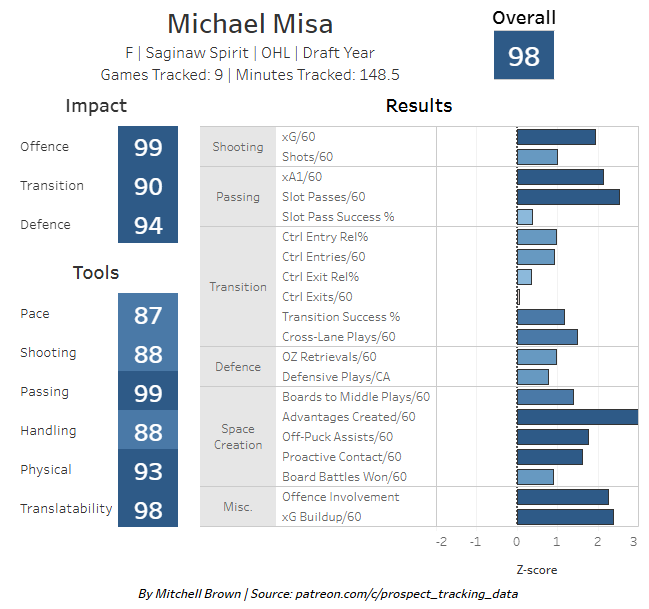
A true tactician, Misa is always a factor on his shifts. He draws pressure, attacks at angles, and adapts quickly to changes in coverage, constantly circling to relocate or engage another defender to open up lanes for his linemates. He times his movements into space and scans before every pass reception.
His defensive work rate is amongst the very best forwards in the class and impressively consistent. Whether it was timing his backchecks to neutralize breakouts, sealing off backpressure, eliminating off-puck threats, or battling for pucks along the walls, Misa was uber-involved in his own end.
He would lay out to block shots, cover out-of-position defenders, recover pucks, and set picks, and once he had helped his team regain possession, he would immediately transition play up the ice. Also an impressive shorthanded player, Misa identifies and anticipates puck carriers before engaging to force turnovers, before taking off down the ice to generate a scoring chance.
Misa thrived offensively in Saginaw’s free-flowing, creative system, but his details and habits will allow him to succeed in any system that he’s asked to play in the NHL.
Monster Motor in Transition
Once Misa gets the puck in transition, he’s a force. With one of the best motors in the class, he explodes out of his first two strides to separate from backpressure, beat defenders into the zone, and create gaps in coverage. He works complex rush patterns all the way up the ice, engaging defenders, changing pace and direction to catch them off guard.
Remarkably inside-driven off the rush, Misa’s dual-threat creation shines in full flight. Disguising his true intentions as the puck carrier, he creates openings with east-west movements, delaying for as long as possible while maintaining his speed, before threading the needle through the tightest of gaps.
If there isn’t a pass option for him, he tries to manipulate defenders 1-on-1, stickhandling around to get inside alone, succeeding on multiple instances in the video compilation above.
Most of Misa’s best transition plays were the result of him carrying the puck, but he’s equally as dangerous as the F2 or F3 in transition. He moves into space, can drag the puck around defenders in motion or shoot off the pass. Many nights this season, defenders struggled to contain him, and he overwhelmed on rush after rush, creating a scoring chance on almost every attempt.
Physical Skills & Cycle Creation
But Misa isn’t just reliant on creating through rush chances. This season, his physical skills took a significant jump, and fueled his development into an equally dominant cycle player.
In his first two OHL seasons, Misa’s physical game really only appeared in flashes. However, concerns about his lack of consistent hard skill quickly faded with each viewing, as physicality became a staple of his game this year.
Extremely difficult to force off pucks, Misa created a significant amount of space for himself and his linemates. He made plays under pressure, won board battles, took pucks off the wall to the middle of the ice, and won positioning on defenders in front of the net to get open in the crease.
And if outworking defenders on the forecheck or stripping them from behind on breakouts wasn’t enough, Misa was also more than capable of levelling unsuspecting players with crushing open-ice and reverse hits.
Perhaps Misa’s physicality doesn’t get enough recognition for how well it powers his game. Combining his contact skills with his pace and playmaking made it almost impossible for defenders to shut him down.
Look no further than the first clip in the above video compilation, where Misa passed off, engaged a defender and threw him out of his way to create a lane, before getting open down low and finishing off a pass at the backdoor.
That particular sequence was on the rush, but in the video compilation below, you’ll see just how effectively Misa’s physical skills power his cycle game, through quick in-zone give-and-gos, spinning off pressure along the walls before feeding teammates in front of the net, or cycling high before hitting the backdoor option.
Misa’s body positioning, along with his ability to absorb and escape contact, made him one of the league’s better players along the wall and down low this season. And if he didn’t have possession, he would hunt space, engage defenders, and get open to execute quick one-timers.
How Misa leveraged his consistent physicality and contact skills to create advantages is what ended up setting him apart from other prospects who had been in top-three conversation all season long.
Future No. 1 NHL Centre
While there were some industry doubts about whether Misa would be a winger or centre in the NHL, there was none of that amongst the Elite Prospects team. His seamless transition back to centre was a significant game-changer for his development and reinforced the belief that he will be able to hold his own as a top-six centre in the NHL.
It’s no accident that Misa’s breakout OHL season coincided with his return to centre. The move came with more two-way responsibility and more frequency using the middle of the ice. It became the best opportunity to leverage his hockey sense and details to take over games, which he took and ran with. It allowed Misa to get back to his dynamic, play-driving ways and blossom into a legitimate dual-threat creator.

Every facet of Misa’s game blends together in flawless harmony. At times this season, watching his shifts felt like watching a machine at work, from his relentless drive to retrieve pucks, to his ability to extend offensive zone time before creating a high-end scoring chance seemingly out of nothing.
While he’s not the flashiest playmaker like some others in this class and he doesn’t have one standout offensive tool, it won’t matter at the next level. He’s a uniquely elite and efficient jack-of-all-trades player who boasts one of the most translatable skillsets and styles of all his peers.
Misa’s high level of engagement, combination of pace and power, support habits, dual-threat ability, contact skills, and inside-driven style are all qualities seen in the NHL’s best centres.
Just like Macklin Celebrini did a season ago, Misa proved that he has the vision, details, habits and physical skills to thrive in the NHL. Though there were whispers back in the fall that he might head to the NCAA next year, it doesn’t feel like that should be the plan anymore.
Misa’s body of work this season speaks for itself. The most well-rounded prospect in the entire draft should be NHL-bound in the fall. He is ready for whatever challenge awaits him there, on whatever team selects him.
And would be pretty fitting for him and Celebrini to end up teammates in San Jose.


