Film Room: How Carson Carels could become a top-pairing defenceman in the NHL



In a draft class loaded with highly-regarded defensive WHL prospects, Carson Carels stands at the peak, not only among his Western League contemporaries, but possibly the top-end of the 2026 NHL Entry Draft.
Rolling out of the 2024-25 season, Carels already looked like a highly translatable NHL prospect. In short spurts, he was dynamic, and his mobility was a clear advantage creator.
Nevertheless, Carels was obviously young, lacked strength, especially on the outside of the ice, and on a Prince George Cougars roster primed for turnover, he obviously didn’t have the proverbial keys to the castle. In turn, Carels played a safer brand of hockey, focusing more on defensive details, defending at pace, and learning to survive and build a foundation as a 16-year-old playing against older competition.
Coming into the 2025-26 season, Carels was well-liked. In our post-Hlinka Gretzky Cup ranking, he landed 11th on our board, with an expectation that his tools and overall upside should lead to a top-four projection. That said, the biggest unknown was just how impactful he would be in a number-one role with the Cougars — would we see more skill flashes? What changed in the offseason?
What we didn’t expect was the degree of evolution Carels underwent. He was clearly bigger and much stronger, flexing even more explosiveness. The developed details and foundation from his draft-minus-one campaign served as a base he relied on and layered upon. His involvement in a given game was absurd, albeit a bit inconsistent from game to game.
Carels rose to the occasion at every turn, though, especially when the magnifying glass was so pointed it could burn a hole in his jersey.
He was one of the best players on the ice at the CHL USA Prospects Challenge and WHL Top Prospects Game, and even beat out NHL-drafted players to secure a roster spot on Team Canada’s 2026 World Junior Championship team — a rarity for a 17-year-old, let alone a defender.
Carels would finish the season first in points-per-game for first-time draft-eligible WHL defenders at 1.26, scoring 20 goals, and racking up eight shot attempts and over three-and-a-half minutes on each special team per game, according to InStat Hockey.
He even put up gaudy results on Head of Scouting Mitchell Brown’s tracking data, flexing a 99th percentile result for expected primary assists and overall offensive involvement compared to his peers. He was also a top entry prevention defender and a standout entry man when he had control.
.png)
Counter-punching monster
Carels’ game is built from the ground up through his skating. His knees are engaged as he drives hard off his edges on the push-off, fully extending into a powerful toe flick before snapping back under his upper body on the recover. He’s fluid, launching off his inside edge, transitioning into the crossover, even opening up his hips into the heel-to-heel to catch pass receptions or twisting his body to open up new lanes to zip pucks through.

His overall involvement off the rush separated him as an offensive defender this season. At his best, he’s an excellent pass supporter who jumps into weakside positions. Carels takes inside routes, accelerates through the reception to create space, and drives the net to push defenders back into their own net. That’s not even mentioning his drop-back game as a trailing shooter.
Off the entry, the eye test matches the data. Again, he sprints through the neutral zone picking up speed, blending large-area handles, shovelling pucks in front of his body to skate onto. He’s daring, splitting resistance while creating speed mismatches, often powering into shoulder-down drives, cutting through the hands of the turned defender, capturing the inside lane. While his handling isn’t great in tight, the lead-up is not only dynamic, but rare to see from any defender, at any level.
He carries over many of these patterns working off the blueline, where his playmaking really pops. Downhill activations into layered east-to-west passing, backdoor set-ups from the top of the point, and eye-line deception are part of his mix. He’ll default into volume shooting, with little lane manipulation, threading pucks low, creating pass-off-pad and redirection chances, but occasionally, Carels utilizes a deadly snap-shot, typically off the reception, hunting stacked screens and tricky placements.
His release is already ridiculous, especially with how violently he folds over his wrist.
Using physicality to disrupt attackers
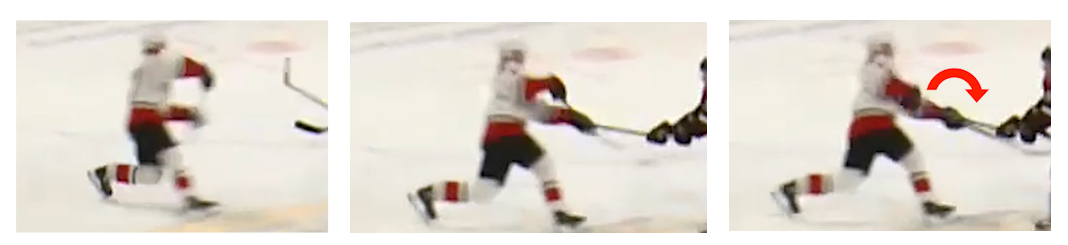
There’s being aggressive, and then there’s having bloodlust. Carels may fall in the latter category. He’s like a heat-seeking missile, locking onto neutral zone breakout targets, lining them up, and blowing them up with thunderous checking. He hits through his targets, stopping them in their tracks, catching unsuspecting puck retrievers like Niklas Kronwall in his prime. There are moments when it backfires, but he has more nuance in his game, pushing stingy, well-timed pokechecks and stick lifts.
He’s not flying at every transitional threat, though; guiding details are a large part of his game. Because of his defensive skating and tendency to keep his feet stable, his gap is strong, preventing most inside-route attacks. At his worst, he’s a bit too passive on outside threats, allowing inside passes off the flanks. Still, he’s so mobile in four directions that even when his gap is disrupted, he’s able to push off, close space, and use his range to disrupt, ramp, or check shot releases. He covers so much ground, and it will be a massive advantage at any level.
You would think that Carels, with his level of physicality, would be a standout space creator, but he’s not much of a sealer or staller, and he doesn't leverage pins as much as he should. What he does apply is aggressive, timed pressure to push play outside. He’s actually more of a proactive processor, taking out secondary threats at the net, swinging into one-touch shooting lanes off the flanks, and taking care of cross-crease bids.
Game management, consistency, and scouting flashes
Scouting players who play heavy minutes in all situations across all competitions is always somewhat complex. Carels, in particular, was hard to get a read on, even after tens of viewings.
The fact of the matter is that he was playing marathon minutes, averaging 27:45 per game, with some significant outlier games in which he reached 30 minutes and logged upwards of 150 puck touches. He had to manage his minutes, what he expends energy on, and really pick spots to create advantages.
While it’s hard to quantify the full effect of heavy time-on-ice play — there are smarter people than me who will figure that out — there has to be some level of diminishing returns for players in Carels’ situation.
In an article like this, his higher-end flashes are thrown at you consecutively — it’s impossible to deny his potential upside. Still, it wasn’t out of the question to leave a Carels viewing with limited notes. It’s something everyone on our NHL scouting team who covered Carels encountered, including myself, who is based in Prince George, and saw him a lot.
It’s to the point where consistency is our biggest question mark about his game. How often will he put everything together in a single performance? How does his projection change if he sits back on his “B” game?
At the end of the day, we won’t know the full effect of game management, fewer minutes, and their effect on a player's patterns. This raises the question of whether consistency is one of the biggest differentiators between very good hockey players and stars.
When you look at Carels’ games, especially his retrieval work, you can see the inconsistency in his game. He’s up and down when it comes to details and overall habits. At some points, he’s reverse-hitting, stealing the inside lane, even controlling his opponents' upper bodies by locking their arms high on the end boards. In other cases, seemingly the same scenarios, he opts to tank physical pressure, refuses to use his edges to escape forechecking threats, and his breakouts and overall exit game suffer.
It’s complex and requires more thought, and it may even just be a bias, but game management is something to keep in mind with Carels, who very well may be in the same overleveraged situations in the NHL.
The future
Carels has everything to anchor a top pair in the NHL — vision, mobility, defensive details, work rate, and a deft transition game with control. He's a legitimate building block for a team hoping to contend deep into the playoffs, providing a bit of everything to the mix, from staunch defending to daring puck rushing. He’s an average size for a defender — the league average coming in at around 6-foot-2 — so there is a possibility that some of his physical game isn’t as much of an advantage creator at higher levels. Still, he has the runway to become stronger to counteract that while further developing his tools, and a commitment to the University of North Dakota is the first step toward achieving that.