Film Room: Why Caleb Malhotra is the 2026 NHL Draft's best, most complete centre



While the novelty of a player with hockey bloodlines has existed throughout the NHL's history, Caleb Malhotra is far from just a former NHL player’s son.
A prospect who has skyrocketed in terms of upside and overall value, his path to this point has been as sheer as Banff’s iconic Rocky Mountain range.
We aren’t being hyperbolic, either. Malhotra, who was unranked in Elite Prospects' initial September 2026 ranking, has steadily risen over the season, ultimately landing 5th on the final board.
But how did he get here?
Setting off to the Chilliwack Chiefs in the 2024-2025 season, Malhotra, a top-10 OHL Priority selection, decided against playing in the CHL, joined the newly independent BCHL, and embarked on a typical NCAA-eligibility path.
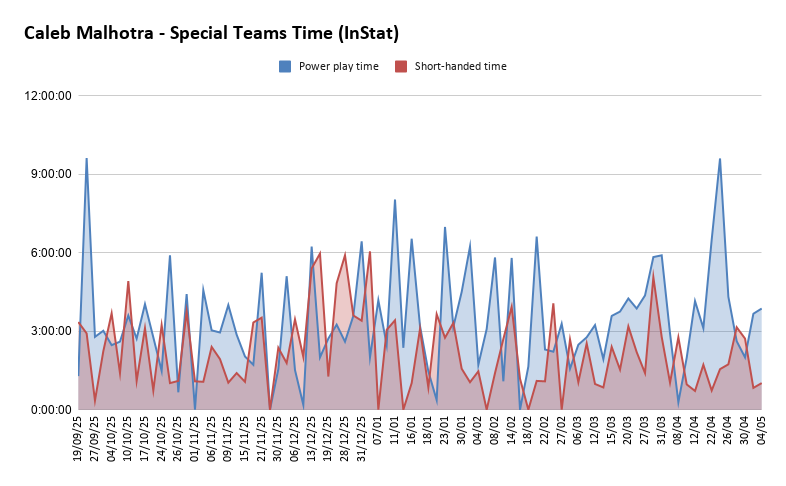
His season in the BCHL wasn’t very fruitful, however. He only averaged 13:58 of time-on-ice, saw very limited usage on the power play, and was rarely an option on the penalty kill, producing just over a half-point per game in that time.
Benefitting from NCAA and CHL eligibility rule changes, Malhotra left the BCHL, joining the Brantford Bulldogs for his draft-eligible season. Expectations weren’t enormous; he was a rookie who lacked the production that screamed high-end contributor.
.png)
Things changed for Malhotra at the turn of December. Jake O’Brien, a scoring centre and Seattle Kraken 8th-overall pick, left Brantford to join Team Canada's World Junior selection camp. Malhotra took the opportunity and ran with it.
His time on ice exploded, his importance to Brantford increased rapidly, and a post-camp injury to O’Brien only gave the 17-year-old more time to take over as an offensive producer.
Flash forward to the end of the season, and Malhotra reset the hockey world’s expectations. He finished the year on fire, scoring 13 goals and 13 assists in 15 playoff games, capping off an 84-point, 55-assist regular season. He saw ample opportunity as a power play threat and play-stopping penalty killer, completely flipping his BCHL season on its head.
Malhotra turned into an offensive driver, finishing second in overall points among draft-eligible forwards and 11th in overall scoring in the OHL and a relied-upon playstopper by season's end.
Separating playmaking
Flashing gifted offensive awareness, an arsenal of playmaking skills, patience, foresight, and confidence, Malhotra punished defensive structures this season through deceptive dishes and dangerous set-ups.
Already a deft area passer, Malhotra’s feel for the developing play is a major reason he is so successful. He predicts teammates' movements and sends well-timed, soft-touch passes through layers, hitting his targets in stride and creating instant advantages for the receiver.
From perfectly weighted saucers, cross-slot backhand connections, and zippy slip passes through defender triangles, he has a planetary effect, drawing in opponents to his gravity field, in turn, creating space for his linemates. Often, the nexus of pretty connections off the cycle, Malhotra shows restraint, finding creative looks on a near-constant basis.
The translation of this ability is clear. While the NHL pace is a whole other animal, when playmakers play at such a high level of intuition in junior, creating advantages at the rate he does, success tends to follow in tougher environments.
Adaptable goal scoring and slot usage
The beauty of Malhotra’s game is that he also carries dual-threat scoring upside. Already a projectable shooter who leverages details like inside-foot releases, Malhotra was adaptable across his minutes. From half-wall powerplay one-timers to off-puck backdoor redirections and solo individual efforts blending his handling skill, he could beat you in multiple ways. Add in a layer of deception, full of eye-line manipulation and body feints, and he was a tough player to predict with possession
Part of this goal-scoring success stems from his penchant for focusing on play on the inside. A regular route-adjuster, working outside and in, Malhotra is already a daring attacker.
Nevertheless, he’s overly ambitious in his attempts to gain advantages through his handling skill. Lacking dynamic edges, pull-away explosiveness, and overall mechanical refinement, he has many moments throughout his tape where he lacks the speed, agility, and blend of handling to execute his ideas. He overcomes this weakness through all of the aforementioned skills, which dissipates some concern, but improving his mobility will be necessary to fully translate his adaptable scoring profile.
Projectable protection and power game
Part of overcoming his skating comes down to his protection and overall power game, an area of real upside for Malhotra. Throughout the season, he fended off pressure with a deflecting arm, drove off the wall with power, dropping his shoulder and widening his stance to add balance, and he already incorporates highly detailed proactive contact habits, mostly through reverse hitting and inside-position hunting.
Not only does it expand his creative possibilities by working into the middle of the ice, but he also projects well as a forechecker and puck retriever, despite some mobility hurdles.
At 6-foot-2, 183 pounds, he has considerable runway to become stronger, which in turn should lead to even more success when he leverages these habits — only a good sign for his translatability.
Counter punching and defensive upside
What really expands Malhotra's profile is his defensive upside. The same processing that aids in creating offensive chances also serves a dual purpose in his own zone. He’s an outstanding anticipator, timing entries into pass lanes, intercepting and sweep-checking pucks, all while translating the possession change into real counter-punching opportunities.
From aerial knockdowns to higher-pressure rip-aways, Malhotra’s stick work stands out as a real asset. He has reach, flexes small details, lifts and checks sticks, and applies tactical pressure to overwhelm on-puck opponents.
This extends to the backcheck, where he provides constant, high-energy support. Malhotra aids as the outside guide, stretches to intercept cross-slot passing, and his work rate is undeniable, especially on the outside. He’s uber-engaged, pushes a higher pace than others around him, surprising carriers with recoiled pokechecks.
That said, Malhotra’s defending is fairly stick-dominant, with most of his physicality coming after the disruption attempt, primarily through his protection habits. Becoming a more imposing threat that overpowers puck carriers is the next layer he must add to translate his defensive upside to the NHL.
Ceiling and long-term projection
The NHL is a “have” and “have-not” league. Some organizations are blessed with scoring, skill-based advantage creator archetypes manning their centre position. Edmonton Oilers’ Connor McDavid represents the high end of that type of player.
Other successful teams, both in the present and the past, have used different, high-scoring, but more adaptable two-way options in the top-centre position. Florida Panthers’ Aleksander Barkov and Boston Bruins’ Patrice Bergeron are elite examples.
There’s a real argument that both archetypes have brought similar success to their teams, which raises the question: What is a top-line centre to you?
Will he be an outlier two-way driver like the aforementioned players? It would be foolish to expect that type of upside. But Nick Suzuki-like (our “shades of” comparison from the Elite Prospects 2026 NHL Draft Guide)?
Totally in the realm of possibilities.
Nevertheless, Malhotra’s inclusion at the top of the 2026 NHL Draft is often qualified within the framework of an individual's view of the number-one centre role.
Some evaluators don’t see it; some do. At the end of the day, it’s hard to really qualify what a number-one centre actually is because definitions will inherently differ. Hockey is the most dynamic sport in the world, and it’s almost inconceivable to break down every point of impact and detail from a given player.
Still, whether you believe it or not, it’s clear Malhotra brings a complete profile to the table. A player who will be leveraged in every scenario, taking crucial faceoffs, possessing projectable scoring tools in the form of his playmaking and handling, with shooting skill to be a dual-threat option. That’s not even mentioning his two-way and physical upside.
He may not be the quickest out of the upper echelon of this draft to become an impact player in the NHL, but with room to grow more explosive, the upside is immense.
Likely to hear his name in the top five of this upcoming draft, Malhotra will also be given every developmental opportunity and the resources needed to reach his upside and make the selection count — an important factor for his future.
Regardless, when push comes to shove, organizations should want players like Malhotra to occupy the highest-leverage minutes, the minutes earmarked for the top-line centre.