

Every draft has a handful of high-risk, high-reward bets. Prospects who bring a truly special skillset, with an asterisk or two to their profiles, which could hold them back from NHL success.
Enter Yegor Shilov.
The 18th-ranked prospect on our midseason board is a near-unanimous tail-end first-rounder at this stage in the draft cycle. Silky mitts, meticulous playmaking, and a pro release — all elevated by an elite processor — have made Shilov the Victoriaville Tigres’ most impactful forward. The centre’s 82 points in 63 regular-season games were good for seventh in the league, and he ended the season as the Tigres’ top scorer.
Beyond the production, Shilov brought much-needed excitement to Victoriaville’s offence. Highlight-reel play after highlight-reel play made the Tigres a must-watch team this year, despite inconsistent regular-season performances for the squad overall.
We’ll delve into Shilov’s offensive tools, his processing on both sides of the puck, the hurdles in his way, and how he can overcome them to cash in on his top-six potential.
The puck skills
At the core of Shilov’s first-round value is a tremendous set of offensive skills. As a triple-threat forward, he can manipulate defences with his hands, open up passing seams, and drag sticks out of shooting lanes to leverage his release.
Stickhandling
We’ll start with Shilov’s stickhandling, as it sets the table for the rest of his offensive game.
A highly manipulative and dextrous handler, Shilov is constantly setting up attacks through gap and reach exploitation. He can deke off reception to send defenders scrambling the wrong way, but can also play a meticulous puck-carrying game. His specialty is triangle exploitation — attacking the gap between a defender’s stick blade and their skates. With gliding carries and the puck cradled in front of his feet, he baits defencemen into poke checks, before quickly adjusting his hands to slip the puck under the shaft of their stick and accessing the space around them. From there, he uses his hips and feet to counter defenders’ scramble attempts, protecting the puck from stick checks while setting up his next move.
Shilov’s mechanics themselves are refined. An incredibly stable upper body due to a smooth stride cycle allows him to comfortably deke in stride. He cradles the puck on the heel of his blade, and he can pop the puck in and out of his hip pocket comfortably by detaching his top hand from his body. This both offers him a wider range of motion to work with and keeps him deceptive. The last clip of the above montage is a great example, as he baits an aggressive close from his immediate check with a momentary hip pocket setup, hinting at a shot before moving the puck across the opponent’s heels, easily solving him for a higher-percentage chance.
Using subtle cues and adjustments with his feet, Shilov slices and dices through tight neutral-zone blocks time and time again, gaining the zone with perplexing efficiency from a glide. He lulls defencemen into passive postures and stick reaching, before pushing the puck into the gaps he creates. Once defencemen figure out what they’ve done by backing off, it’s too late — the controlled zone entry is completed, and the offensive-zone cycle begins.
Passing
Once his hands allow him to gain exploitable ice, Shilov’s high-end passing game rears its head.
An incredibly patient playmaker, even when faced with closing passing lanes, Shilov outwaits structures, fakes them out, misdirects defenders’ sticks out of seams, and uses those fakes to gain additional information and make the right pass.
The first clip is a great example: we see him win the puck back along the wall in his own zone, step off, and spot his teammate streaking ahead of him. He fakes the instant bomb pass, which prompts both blue-liners to reach for the middle lane. This allows him to gauge the defender on the right’s reach, and gives his teammate a step on both of them as they momentarily adjust for the pass. With a quick handling adjustment, the lane is created, and he executes a perfect dish onto his teammate’s stick for a breakaway goal.
While he can be patient, Shilov can also execute off reception and accelerate his passes when needed. The second clip shows this, as he spins off a check down low and spots the net-front defender going down to close the slot lane, quickly slipping the puck under his stick before it drops to the ice and hitting an open teammate for the goal.
We’ve established that Shilov’s handling is boosted by his patience and his ability to misdirect his opponents; those skills are just as prevalent when it comes to his playmaking. Constant look-offs from the half wall on the power play allow him to catch defenders by surprise and thread perfect cross-seam passes. He doesn’t just use look-offs for the half wall to half wall pass — he can step inside to the edge of the dot and thread it down to the goal line, or hit the back-door threat. Once again, the hip pocket position aids in his deception, as he can believably threaten a shot with the puck at his hip before rolling his wrists to hit those seams.
Great scanning reads and a wide arsenal of passes increase Shilov’s effectiveness on tougher attempts, too. He can find teammates in his blind spots off the wall, and can beat sticks by curling pucks around them or adjusting his release point by shortening his reach for slip passes. He uses area and hook passes to get around defenders’ coverage in transition, and has a delay game that lends itself well to finding trailers off the rush. The greatest addition to his passing versatility over the next few years will be increasing the frequency and effectiveness of his backhand passes. They currently serve as a last resort for Shilov; incorporating more backhand comfort into his current arsenal will effectively double his range of available plays.
Shooting
On top of being a clever playmaker, Shilov’s powerful and accurate release forces defenders to respect him as a direct scoring threat.
The mechanics in Shilov’s release are high-end for this draft class. He loads his inside leg instantly, pulls pucks into his feet on his load-up, and applies strong downforce to elevate the puck with little follow-through. He can also shoot with the puck outside of his feet, a tool he uses most effectively when shooting off the carry, after cutting inside and popping the puck across a defenceman’s body. His follow-through adapts, too, as he can extend it when shooting outside of his wheelhouse to maximize lift and power.
The pre-shot habits, however, take Shilov’s scoring threat to another level. He always looks to create better lanes, opening his hips to freeze defenders’ feet before curling his release around them, side-stepping on set netminders down low, and shooting inside weight shifts and inside cuts off the rush. The constant pre-shot puck movement makes his release incredibly difficult to anticipate for netminders, who often get caught with their feet planted or going down too early at this level.
Beating NHL netminders will require more than misdirection on carries; growing his arsenal of available releases will make Shilov even more effective as a scorer as he climbs the ranks. Shooting off the pass remains the key to NHL goal scoring, and while Shilov has a threatening one-timer from the half wall, he could develop into a better catch-and-release shooter with time. Luckily, there are signs in this game that this progression will come.
A cerebral centre
Every skill in Shilov’s arsenal is steeped in hockey sense. His passes are often premeditated, his shot selection is supported by accurate reads on netminders’ expectations, and his handling always serves a purpose further down the decision-making chain. He is always scanning, processing information, reading space, anticipating teammates’ routes and opponents’ defensive coverage, and executing on those reads.
Shilov’s processing serves him just away from the puck, as he times his rotations with the flow of cycles, gets lost in coverage behind the net, pops up unmarked in high-danger areas, reloads high on zone defence before attacking downhill, and constantly keeps himself available in the offensive zone. He can read and exploit defensive breakdowns better than most prospects in this draft class.
Another key element in Shilov’s decision-making process is his ability to execute on the space he creates off the carry. Multiple times a game, he drags defences to his side of the ice with East-West entries, and either finds a winger across the offensive zone, or delays to allow his defencemen to join in the rush and finds them in flight.
Shilov doesn’t settle for immediately available plays, either; always thinking ahead, he sets up give-and-go plays off the rush, sets up his passes in advance with misdirection, and then quickly executes once the lane is pried open.
Shilov is likely to adapt a more efficient game off the catch and become less reliant on lengthy puck possession plays as he climbs the ranks. Time and space won’t be as readily available, and he already shows all the signs of a prospect with the processing and anticipation to hit his targets quickly and accurately. All the foundational habits — timed scanning, positional sense, system adherence, and pattern recognition — are there to support growth in execution speed.
The ability to scan, process, anticipate, and adapt also shows up in Shilov’s positioning in his own end.
For all his skill, Shilov remains a cerebral two-way centre. Constantly reading intentions, scanning for threats, and adjusting accordingly, he anticipates where the puck will be pushed and positions himself with the flow of opposing cycles. Always supporting his defencemen low, he supports wall break-ups below his goal line, stays below the puck off the cycle, and offers much-needed relief when his teammates recover possession under pressure.
Shilov’s threat identification drives much of his defensive impact. His frequent scans and pattern recognition allow him to spot open opponents away from the puck and pick off cross-seam passes or tie up fly-by screens. When it comes to reading opposing structures, he gets noticeably better at anticipating threats as the game rolls on, showing the in-zone adaptability to read and adjust to opposing teams’ tactics.
On the backcheck, Shilov often puts himself in positions that allow him to rely on sense over effort. He’ll join the defensive line in a three-man block, and then either angle inside to cover the slot, or glide to the wall to pick off the cycle-initiating rim pass attempt. Given how much time he spends in the top half of the offensive zone, he is often well-positioned for these backcheck habits, with a step on opposing rushers and time to get in position.
This brings us to the asterisks in Shilov’s game — setbacks that, if left unchecked, could affect his ability to influence the game in all three zones.
What needs to improve?
Pace
Shilov’s game is one of meticulous skill; he dominates when slowing down the pace of the game and controlling it on his terms. Angling inside from a glide, dragging opponents out of position, misdirecting them with his hands and body language, and exploiting the space that movement creates is a repeatable pattern in the CHL, but in pro hockey, beating opponents to the inside for higher-danger chances requires pace modulation.
So far, Shilov hasn’t shown that ability in the QMJHL.
The vast majority of Shilov’s attack patterns occur at the same pace throughout the sequence. He rarely manipulates his speed, accelerates and decelerates, or picks up the pace on entries to catch defenders flat-footed. He relies on defensive lines backing up, on teammates driving them back for him, and on picking structures apart with his hands.
The NHL’s best playmakers manipulate their speed in transition, anticipate and evade back pressure, and then force their way inside contact through crossovers. This creates havoc — defensive breakdowns — that they then exploit. Shilov’s patient approach to rush offence and cycle creation means he is, for the most part, beating opponents with his hands rather than his feet. This limits the space he can exploit, the amount of havoc he can create, and the numbers of lanes that open up.
This also shows up in his defensive game, as he mostly relies on anticipation and reads for his break-ups, rather than hustling to spots and being disruptive through effort. On the forecheck, he retrieves dump-ins at a lower rate than the vast majority of QMJHL forwards, mostly preferring to glide in as the F3 and offer support to his teammates as they win their battles and climb the wall.
Fewer repetitions on the forecheck also means fewer opportunities to address his other main concern:
Contact management
As currently constructed, Shilov will need to add more contact management skills to fend off pressure along the wall.
Shilov has some of the elements required to handle contact at the next level — particularly, cutting through opponents’ hands with the puck, and the ability to roll off of checks along the wall. He uses his edges to leverage defencemen’s cross checks as a speed boost, exploding out of contact and into space. However, a key element is missing: proactive contact.
When heading into 50/50 challenges, Shilov very rarely pushes against his opponent proactively. He aims to get inside positioning and hopes that he’ll be able to escape the pressure on his back once he establishes possession. He easily gets sealed off the puck early as a result, especially against better battlers in the league. We saw this often in the series against Blainville-Boisbriand, where he struggled to get inside positioning and effectively backed out of battles altogether.
The other issue with Shilov’s contact game is his reliance on stick checks and lifts. He excels at timing stick lifts when going shoulder to shoulder with a like-minded opponent, but this leaves him vulnerable to losing inside positioning and getting sealed off again.
Thankfully, in Shilov’s case, both of his current setbacks are related and will likely be solved in conjunction.
How will Shilov improve?
The solution to the areas of improvement giving teams pause on Shilov’s profile is relatively straightforward: he will have to inject a fair amount of pace into his game. Moving his feet more consistently and attacking at higher speeds will allow for growth in three key areas: on-puck effectiveness, forechecking, and ultimately, contact skills.
We already see glimpses of pace injection when Shilov exits his zone with control; he can accelerate out of exit passes into space for give-and-gos, and can do the same on entries to access space behind defencemen. Using that same acceleration off the carry will allow him to overwhelm defences and allow his linemates to exploit the gaps defencemen leave as they try to keep up with him.
Keeping his feet moving through off-puck zone entries will also allow him to hit the goal line with speed on dump-ins and get him involved more often in offensive-zone retrievals. Speed is momentum, and momentum is a puck-acquisition tool. Once he creates those speed differentials heading into battles, Shilov will have more leverage in battles, and from there, it’s only a matter of adding the proactive contact skills required to leverage that momentum into seal-offs, contact interception, and counterweight.
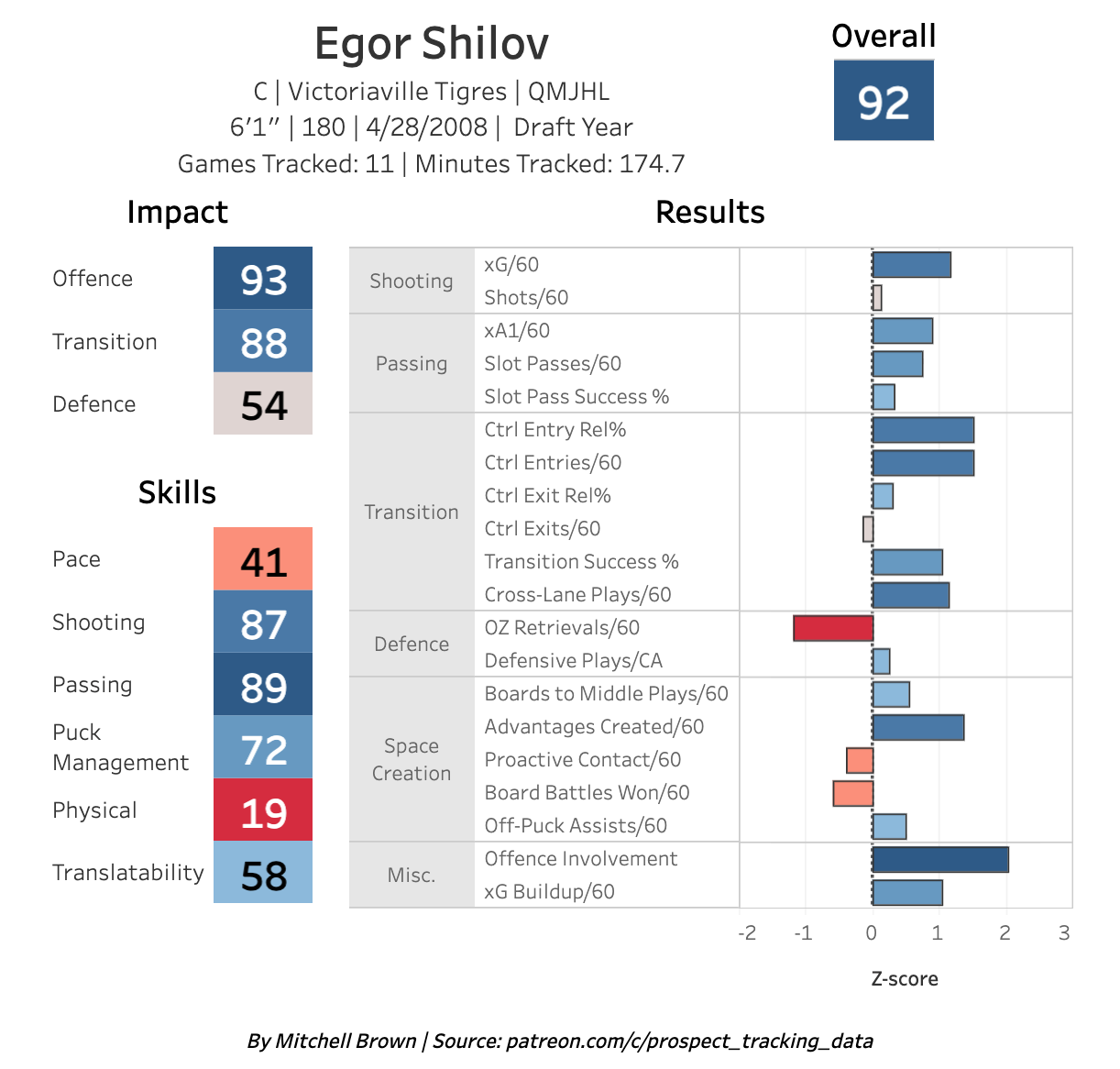
In this draft, few prospects can match Shilov’s sheer skill and offensive creativity. He can dangle circles around defensive structures, feather seam passes with precision, and if teams give him an inch of space, he can pick corners on them with his deceptive release. The natural talent and feel for the game that Shilov possesses are unique in this group, and the right team could provide him with the right development tools to become an elite all-around centre with skill. Shilov will have a lot to learn over the next few years and will likely need loads of off-season work to hit the levels of fitness that more pace will demand of him.
However, in the right hands, he could get there. If he does, he might end up being the highest-scoring centre in his draft class, and a steal of a pick in the late first round.