What's going on with Gavin McKenna at Penn State?


What’s going on with Gavin McKenna?
It’s the question that just about everyone in the hockey world is asking themselves these days.
The long-running favourite for the No. 1 overall pick, and considered by some to be a generational prospect, has just 14 points in 12 games to begin his college career.
That’s after breaking scoring records in WHL, whether that’s his official CHL-best 54-game point streak or the absurd 2.3 points-per-game clip last season.
Truthfully, McKenna looks largely as advertised, though there have been a few quiet outings and some memorable gaffes between playmaking dominance.
So, let’s take a look at what’s translated, how luck plays a major role in the narrative, and how McKenna can change it.
What has translated
Without question, McKenna’s playmaking has translated. It was visible from his first game and remains a consistent theme, even in the tougher outings.
Just about every habit and element we highlighted back in our preseason scouting report has translated. Along the wall, McKenna remains deadly, controlling play regularly with ultra-sharp turns, dynamic edge work, incredibly precise handling, and, of course, deception.
McKenna never gives away his intentions, always looking away from his eventual target and then layers a fake shot or pass. He shifts NCAA defenders around with ease, constantly leaving them chasing passes they’ll never be able to reach. He adjusts to passing lanes, pulling pucks into his feet to pass underneath sticks or reaching around to hook them around, too.
Though McKenna is generating less offence as the primary carrier off the rush versus the WHL, he remains an elite rush playmaker. When he gets a puck inside a bit of space, he draws in every possible defender and quickly finds an option with those same deceptive and adaptable passing skills. Plus, the delay game continues to be a weapon.
Combined, these skills have made McKenna a special playmaker in the NCAA already, even at 5-on-5.
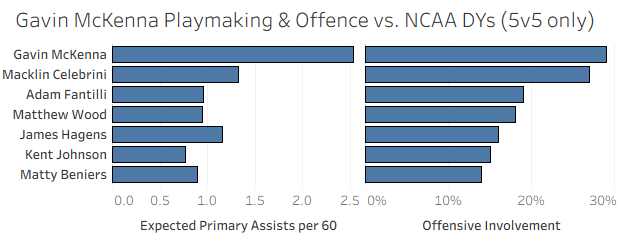
In a hand-tracked six-game sample (that excludes games against Independent programs), McKenna is setting up scoring chances at a historic rate. His expected primary assists at 5-on-5, a metric that measures the likelihood of a player’s shot assists becoming a goal based on location, type, quality, etc., is 2.5 per 60, the same rate as his last season in the WHL.
That’s not just a higher rate than Macklin Celebrini and Adam Fantilli’s only NCAA seasons – it’s higher than both combined. In fact, it’s higher than every NCAA season I’ve ever tracked, Trevor Zegras, Gabe Perreault, Ryan Leonard, Will Smith, Jackson Blake’s 60-point season, and Frank Nazar’s deceptively incredible draft-plus-two year, and hundreds more. And he's shot or set up a higher percentage of his team's 5-on-5 offence than any other NCAA draft-year player by a gap that would be larger had it been compared to their results at the same stage of the season versus the end.
Despite all that work, he had just one primary assist at even-strength all season, which leads to the next point…
Luck, or a lack of it
Now, the luck – or lack of. McKenna has only been on the ice for six even-strength goals. He has points on five of them. Meanwhile, his even-strength Fenwick on-ice shooting percentage – the percentage of shots attempts, excluding blocks – that find the twine when he’s on the ice is under four percent, or three percentage below the NCAA average and a couple hundred spots outside of the top one thousand (via InStat Hockey). That’s a tough go.
If McKenna had even an NCAA-average on-ice shooting percentage, he’d have nine points at even-strength and 18 overall, the latter of which would be tied for third in the NCAA. And, given the barrage of high-quality looks he’s creating for his teammates, it’s safe to assume he should have an elevated on-ice shooting percentage.
For fun, if McKenna’s linemates were converting at the same clip as Penn State’s top line – Charlie Cerrato, Matthew DiMarsico, and J.J. Wiebusch – he’d have 22 points and lead the entire NCAA in scoring.
In either of these scenarios, the narrative around McKenna would sure look a lot different, wouldn’t it?
But the NCAA season is shorter than most other leagues. Teams play around 40 games – if they’re great. Players can ride heaters all season long – and icy cold streaks, too. It’s why the NCAA has tons of one-season wonders, and why the scoring race doesn’t reflect NHL outcomes as much as other leagues.
Given that, the percentages may not normalize, let alone swing in McKenna’s favour. Therefore, he can’t just keep doing what he’s been doing and hope to break through. He has to make some changes.
What has to change
Defence to offence
Offence comes from defence, especially for the rush attackers of the sport. McKenna isn’t doing much defending, despite spending plenty of time in the defensive zone. It’s never been a strength, but last weekend was basically rock-bottom in his off-puck game.
There’s no nice way to put it: McKenna’s urgency is too low. He’s cheating for offence, gliding on backchecks, taking looping defensive routes that put him out of the play, and disengaging when the play isn’t directly in front of him. It’s the same story on the forecheck, as he regularly coasts to the puck carrier in a half-hearted attempt to angle, without ever touching the opponent.
These have a direct impact on McKenna’s offensive impact. He's not creating much offence as the driver in transition, largely because he's relying on flying the zone, 1-on-1s, and solo rushes to transport the puck. That's really antithetical to his game, as he's best in transition when getting his first rush touch deeper in the defensive zone, building speed, and working intricate passing plays. He's lethal when working the walls, but he's getting fewer opportunities to do that because his solo rush game means more one-and-dones while his lack of physical details means he's not turning the forecheck into offence.
Some of this seems like the product of McKenna lacking confidence inside contact. While he was never overpowering opponents in the WHL, he was successfully drawing pressure and making plays through it, rolling with checks along the walls, and spinning off contact to get to the middle. Now, he’s often throwing away pucks as a response to pressure, passing up opportunities to get inside, and getting easily outmuscled in prime positions, like behind the net.
Turning puck acquisition and puck protection into true strengths will require some work physically. McKenna measured at 5-foot-11, 170 pounds, 10 pounds below the NCAA average and 18.5 pounds lighter than the average NCAA defenceman. In the meantime, upping the urgency, getting deeper into the defensive zone, making proactive contact, and trusting his body positioning to gain the middle of the rink are all attainable adjustments he can make. He has them in him; he's even shown them at times this year.
Scanning and support
One intriguing element about CHLers moving to the NCAA would be how they would handle the skill gap, with many going from playing with high-end skill CHLers to former Jr. A and USHL players elevated into top roles because of their energy, attention to detail, and heaviness. Similarly, the increased structure and, particularly, the heavier net-front and slot protection of the NCAA.
Though Penn State plays a very active and skilled game for the NCAA, it’s still not Medicine Hat. His linemates don't turn every pass – however bad – into precise catch-and-release wrister or tip down every perimeter shot like they did in the WHL. When McKenna seems to expect the defenceman to activate off the point, a forward to flare out to the weak side, or a shooter to pop free in the slot, they often aren’t there, or they’re slow to get there.
The solution for McKenna is scanning and identifying where his teammates actually are, instead of blindly throwing the puck into the slot. That’s a small thing, but it would alleviate a lot of the play completion issues that he’s had some nights, especially if combined with some more comfort with fending off back pressure.
Has the projection changed?
Not really. At least, not yet.
If McKenna had some luck backing him, the lack of urgency and physicality would be a tertiary part of any discussion. After all, he’s here to score, and with normal percentages, he’d be lighting up the scoresheet.
But the lack of progression since last season is a bit alarming, and the off-puck questions are now legitimate projection concerns. Sure, it’s stepping up from the CHL to the NCAA, but many players step up from the USHL and show new elements of their game in the NCAA at this age.
To keep the No. 1 spot, McKenna will have to widen the gap again. Towering power forward Ethan Belchetz is closing in, but he’ll have to stop alternating elite and just pretty good performances. Keaton Verhoeff could make a push if he starts cracking 20 minutes regularly. Chase Reid has played himself into top-five discussions with his tools, offensive skill, and improving defence. There’s also the all-around dynamo Ivar Stenberg, and the dynamic centre Tynan Lawrence looming.
McKenna still leads the draft class, but his start has been more complex than dynamite, though it has been better than points-watching may suggest. With some tweaking and a bit of luck, he’ll get back on track and alleviate doubts.
