Your guide to following – and understanding – the NHL Draft



The big week is finally here – the week of the 2026 NHL Draft. When it's all said and done, more than 200 players will hear their names called, see their dreams become a reality, and officially join the NHL.
If you're a fan of a rebuilding team, this is the most important weekend on the NHL calendar. This is where your team's luck starts to turn. When your team gets that star player at the start of what is hopefully a long and productive career, all or most of it spent wearing your favourite jersey. Then everything changes.
The stakes for contending teams aren't as immediately apparent, but mining talent from the NHL Draft is critical for either extending a competitive window or slamming it back open with a fresh wave of up-and-coming talent. The longer that window stays open, the better a team's chances of breaking through. Just look at the Stanley Cup champion Carolina Hurricanes.
Simply put: The draft is a pretty big deal. It's also kind of complicated. The scale and scope of NHL Draft coverage have proliferated over the years. So too has the average fan's understanding of the annual talent fare. But one key fact remains – it's a lot. And it can be pretty hard to follow if you're not as draft-obsessed as the average Elite Prospects subscriber.
So, I'm going to help you navigate this landscape in my guide to following and understanding the NHL Draft.
Do your homework
If you're going to watch the NHL Draft and want to keep pace as the picks fly fast and furious, there's one resource you absolutely cannot do without: The Elite Prospects 2026 NHL Draft Guide.
With scouting reports on more than 400 players, more than 5500 individual game reports, quotes from industry sources, and manually tracked data by my colleagues Mitchell Brown and Lassi Alanen, it's got everything you need to be the most informed fan or analyst as the picks roll in fast and furious from Buffalo, New York.
If you want to get an even more comprehensive grasp of these players, then the series of Film Room articles we've written about these prospects offers even greater insights, with video clips and still images to show how these players operate. We deliver the same experience on the Elite Prospects YouTube channel.
You can find them on the “2026 NHL Draft” page by following this link. You'll also be treated to a series of human interest stories and features that allow you to get to know the players off the ice, too.
What's in a draft pick?
What's a draft pick worth? To borrow from a great moment in a good film, “nothing… everything.”
There are 224 picks in each draft, and on average, you're looking at somewhere in the neighbourhood of 40, maybe even 50 replacement-level-or-better players in each class. You do the math on that, and you're looking at about a 25 percent success rate.
That number drops precipitously when you zero in on how many of those players move the needle for the team that drafts them – think maybe 30 or so in any given draft.
So most of the time, your draft pick is worth, well, almost nothing. Certainly not from the perspective of use value. Unless you hit, at which point it can be everything for your franchise.
Just look at what the Hurricanes did in 2021. They made 13 selections when it was all said and done, five of them in the second and third rounds. We're four years out, and only one of those players has developed into an impact player, but that player just led the Hurricanes in playoff scoring en route to the Stanley Cup – Jackson Blake, taken with their sixth pick, 109th overall in the fourth round. Nothing, everything, and so on.
Pick value by numbers
Okay, so I know I just said that a pick is worth nothing and everything, but that doesn't mean there aren't shades between the two. There's a lot of great work in the public sphere on assigning a numerical value to a draft pick. The starting point for many people has been Michael Schucker's research paper on the subject, which he submitted to St. Lawrence University back in 2011. The paper examines a sample that includes every draft from 1988 to 1997.
You can read it for yourself by following the link in the above passage, but I'll try to summarize some of its most important findings here.
Let's start with success rates, as defined by a player crossing the 200 games played threshold. Your overall probability for success is 25 percent when drafting forwards, 21 percent when drafting defenders, and 19 percent for goaltenders. This is a chart from that same research paper that places a numerical value on each pick.
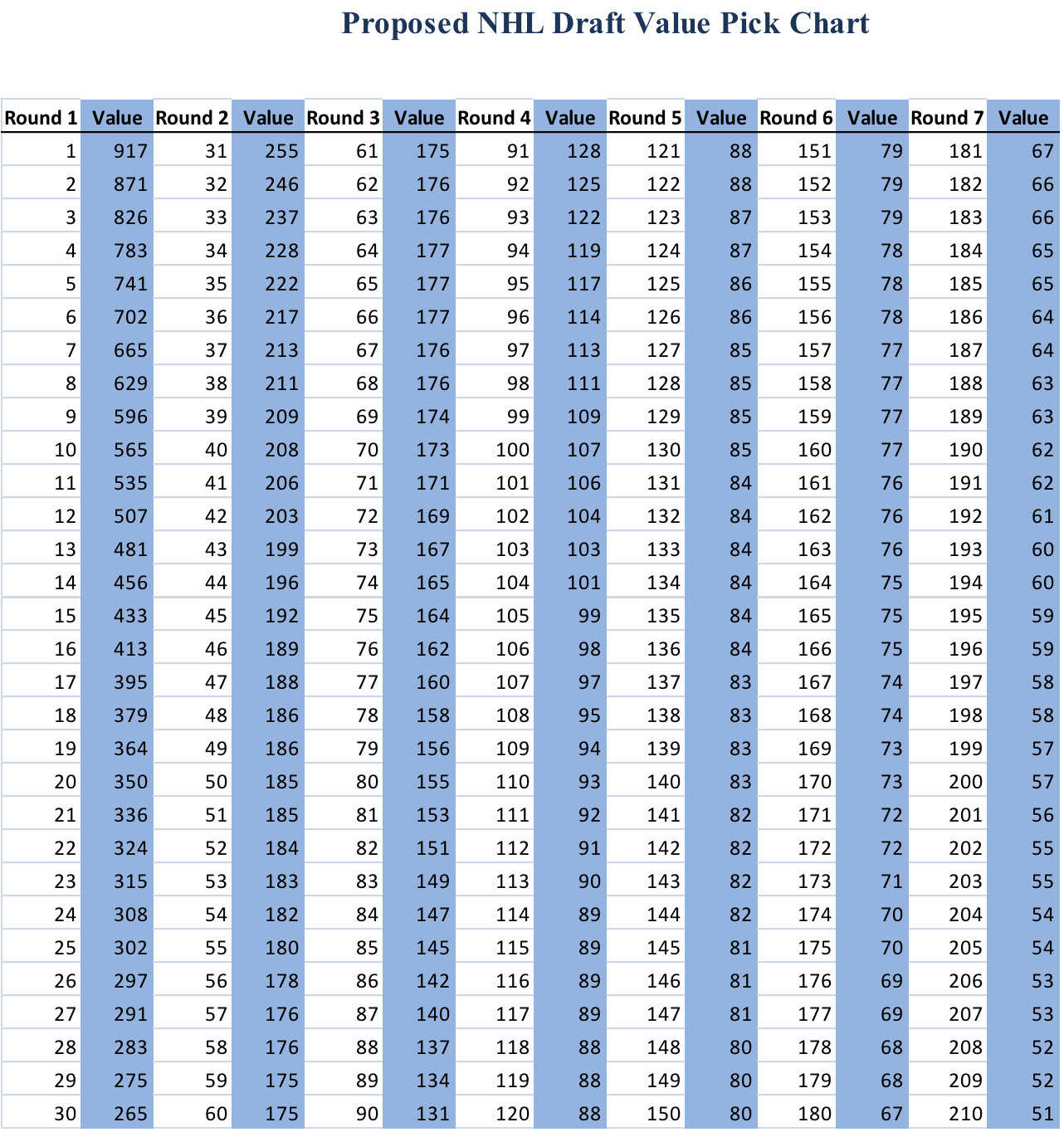
A lot has changed in the time since Schuckers published this paper in 2011 and now, but we can't have this discussion without giving him his due – his work is foundational to understanding the draft through a statistical lens. It's also worth noting that Schuckers updated his work in 2016, using the drafts between 2003 and 2008.
The Athletic's Dom Luszczyszyn took an even more contemporary look at the draft, using his GSVA (Game Score Versus Average) as a proxy for how many wins a draft pick can add to their lineup. I won't share any specifics or charts in this article because it's behind a paywall, but the findings are broadly similar. The one area where they are most divergent is in their valuation of late-round picks, with Luszczyszyn's work valuing them significantly less than Schuckers'. This makes sense because the draft has become an increasingly efficient marketplace with time; scouts are getting better at identifying talent early and picking them accordingly.
Moving up and down
Every year, there's talk of teams moving up or down depending on how the board shakes out or their specific needs. Then, when the dust settles, there's maybe a handful of pick swaps in the middle and late rounds of the draft. At that point, the fans barely know who the players are, and they may as well not have happened as far as most people are concerned.
So, why don't they happen as often as they do in other leagues, like the NFL, for example? There's a whole host of reasons.
For starters, you're not drafting Day 1 contributors unless you're in the top five. Even then, it's hardly a given. So that positional need that an NFL team may move heaven and earth to address at the draft doesn't have an NHL analogue; you may have a positional need and a willingness to address it, but you're not going to see the payoff for two or three years or so. Who knows what any given team will need by then?
The other thing is that a lot of the public research done during the analytics revolution is a strong link sport, meaning star players drive results. Because of that, teams are less willing to part with the draft capital necessary to acquire those players. You may be more likely to find an NHL player with those two picks in the twenties, but you're far more likely to find a star player with one top-ten pick.
That's not to say they don't happen at all. Last year was unusually active on that front, with lots of manoeuvring in the first round, starting at 12th overall and ending with the 29th pick. So maybe the landscape is changing; maybe that was an outlier. But traditionally, there isn't a ton of movement. Especially in the first ten picks.
If you want to entertain the idea anyway, there are some great resources out there to test the waters with. Our partners at PuckPedia just published a tool that allows you to make hypothetical pick swaps based on their valuations. Just because most NHL teams are reticent to do pick swaps in the first round doesn't mean you can't have a little fun with the idea anyway.
What does a good draft pick look like?
I've got a golden rule for determining whether to celebrate or lament a team's draft pick: Was it reasonable? If yes, you've got a pick that you can feel good about, at a minimum.
Seriously, that's about all you can ask for. We scout these players for a living and don't have access to nearly as much information about these prospects as they do on the team side. Just because someone looks like a can't-miss prospect or an obvious bust candidate to you doesn't necessarily mean that you would reach the same conclusion if you had access to the same information as the team that drafted them.
Take the example of the Ottawa Senators in the 2020 draft. Nearly every public outlet had Jamie Drysdale as the top defenceman in that class, Elite Prospects among them; the Senators clearly felt differently and went with Jake Sanderson at fifth overall. You do a tale of the tape with their draft-year scoring, and it's easy enough to understand why the public sphere leaned in favour of the former: Drysdale was a point-a-game scorer with an impressive draft-minus-one season in the bank, while Sanderson wasn't even quite at 0.75 points per game.
Some fans and analysts thought that Sanderson was a reach ahead of Drysdale. In reality, that was never really the case. Sure hasn't played out that way with time.
Your favourite team isn't always going to take the player you want them to. Sometimes, they're going to take a player who seems flat-out worse than the one you'd like them to. But try to give these scouts and executives the benefit of the doubt when the player they do land on is a more or less reasonable bet – it's about all you can ask for.
What does a bad draft pick look like?
It would be reductive to call any pick that's deemed a reach a “bad pick,” but that's not exactly an unreasonable position to take either.
Because, ultimately, the draft is an exercise in efficiency. The goal isn't just to leave with the best players; it's to leave with the best players as late as you possibly can.
What does that look like in practical terms? Well, I usually lean on the Jamie Benn example. The Dallas Stars drafted Benn 129th overall in the fifth round of the 2007 draft. As of this writing, his 992 career points are the second-most of anyone in that draft, behind only Patrick Kane.
So, would he have been a good pick at second overall? No, not really. You could've taken James van Riemsdyk or Jakub Voráček or Kyle Turris or any number of other players that wouldn't be available later in the draft and circle back to Benn. It's about leaving with as much talent as you possibly can. Game theory rules apply.
Trying to draft by game theory comes with its fair share of risk, though. Seattle Kraken analyst Namita Nandakumar did a presentation on this at the Vancouver Hockey Analytics Conference that outlines the risk, using the example of the Boston Bruins losing out on Johnny Gaudreau in her study. You can read that work by following this link.
So, as with everything in the draft, this is pretty complicated. You don't want to reach on a player if you can avoid it, but you'd much rather do that than lose out on someone you rate well because you're trying to be clever. It's a delicate balancing act.
What does a good draft look like?
The usual rule of thumb for determining whether a draft was successful or not has been the two-for-seven rule. If you can extract two NHL players out of the seven picks that your team has been allotted in the draft, that's a win. That's how most people have determined draft success to date, anyway.
That seems reasonable enough on its face. Two for seven puts you at about a 29 percent success rate. It's maybe a bit on the optimistic side, given the success rate at the draft generally is closer to 25 percent, but I suppose that's why this would be a “good” draft rather than a passable one.
I got some pushback on that from one industry source, though. Their idea of a good draft was much broader in scope. They argued that the goal of your scouting department shouldn't be to find two players for every seven picks; it should be to find one impact player in every two or three drafts.
And you know what? That seems reasonable enough to me, too. You don't make hay in the NHL because your team is better than others at unearthing bottom-six forwards or third-pair defenders. No, your success is determined by your star players. So if that's your focus, then that seems reasonable enough to me.
There's more than one way to judge a draft pick, and you don't always have to wait
If someone tells you that you can't judge a draft pick or a draft class for five or more years, just go ahead and dismiss that out of hand. You won't know the outcomes on these players' careers for five-plus years, sure, but that's a narrow way of thinking about the draft and prospects generally.
The thing you have to remember is that all of these players have value as assets for years before they ever play a single shift – assuming they get there, which isn't exactly a sure thing – for your favourite hockey team. And the value of these assets is determined by the market, of which any single franchise is only a small part.
Sometimes, a team is going to need to use these prospects as trade capital. Other times, they're going to want to move on from these prospects because the evaluation has changed. In either event, they're going to have a much easier time manoeuvring if they make efficient bets.
Here's an instructive example. Remember David Rundblad? The St. Louis Blues took him 17th overall in the 2009 draft, which is right around where a player with his statistical and physical profile would usually go – put another way, that was a reasonable bet. They had him in their organization for about a year, identified critical flaws that made his likelihood of NHL success unlikely, and were able to move him for the 16th overall pick in the 2010 draft, which they used on Vladimir Tarasenko.
We didn't know at the time that Rundblad would only go on to play 113 NHL games and score 25 points. Neither did anyone else, though. And this is the point I'm trying to make. These players aren't something or nothing based on how many games they've played or how many goals they've scored when it's all said and done. They have value on the day they're drafted, and they have value for as long as they're in an organization.
Rundblad had value that was at least commensurate with where the Blues took him, so you would have been right to call him a good pick on draft day; you would be incorrect if you said that he was a lock to be a franchise player. These are two different things, though. Sometimes good bets don't work out, but if you're proactive and move decisively to get in front of that, you can still turn a profit and leave someone else holding the bag. You see it every trade deadline.
The lesson here? It's never too early to judge draft day decisions. It's not like the NHL is passing on the opportunity.
My last lesson for following the NHL Draft? Just enjoy yourselves. It's fun to get excited about prospects. That's where everyone in this space started their scouting journey.
If you're a skeptic who wants to scrutinize your favourite team's decisions, for better or worse, knock yourself out. In many cases, that skepticism is well-earned. Likewise, if you bleed your team's colours and just want to believe in their decision-makers. That's often warranted, too.
It's one of the most exciting parts of every season. And there really isn't any wrong way to get in on the fun. There are better and worse ways, though, and I hope today's guide has helped you get a grip on things.