Meet Kade O’Rourke, and the remarkable journey behind his bid for exceptional status



Where do you start the Kade O’Rourke story?
There’s the recent public buzz, fresh off a standout performance in the OHL Cup for the Toronto Jr. Canadiens, about O’Rourke’s application to be the tenth player to receive exceptional status to play early in the CHL.
You could start there, go a bit deeper about his hockey IQ and game sense, and how while he hasn’t been given any indication one way or the other yet whether the status will be granted, there’s already been some questions from the Western Hockey League about whether he should be WHL property since he was born in Texas, even though he’s lived in Toronto on a student visa since he was 11-years-old.
You could start with the 11-year-old version of O’Rourke, who moved to Toronto with his father, Dave, to pursue a dream to play in the OHL, and how, in the first apartment they moved into, Kade wrote “Exceptional Status 2026” on a sign above his door for motivation.
You could also start with the Texas connection, and how, despite coming from a non-hockey-playing family, O’Rourke began skating as a 3-year-old because he had a great time at a Texas Stars game. How he cried the first time he was on the ice in Austin, but went back, and a dozen years later has a chance to be the next poster child for hockey’s growth and inspiration in sunbelt markets.
You could even pull in the diabetes angle, and how, at 15, O’Rourke has started and wants to grow his own non-profit to help other kids and families that have Type I diabetes after his own experiences, including a close scare soon after he was diagnosed.
Those are all great entry points to this story, but as someone who’s known the O’Rourke family for close to a decade, and partially watched Kade grow up from a 3-year-old on the glass at Texas Stars games with a sign needling Julius Honka to a 15-year-old having to handle his own needles for medical reasons, I want to start with a number that largely defines who Kade O’Rourke is and what it represents.
So we need to start our story with the No. 24.
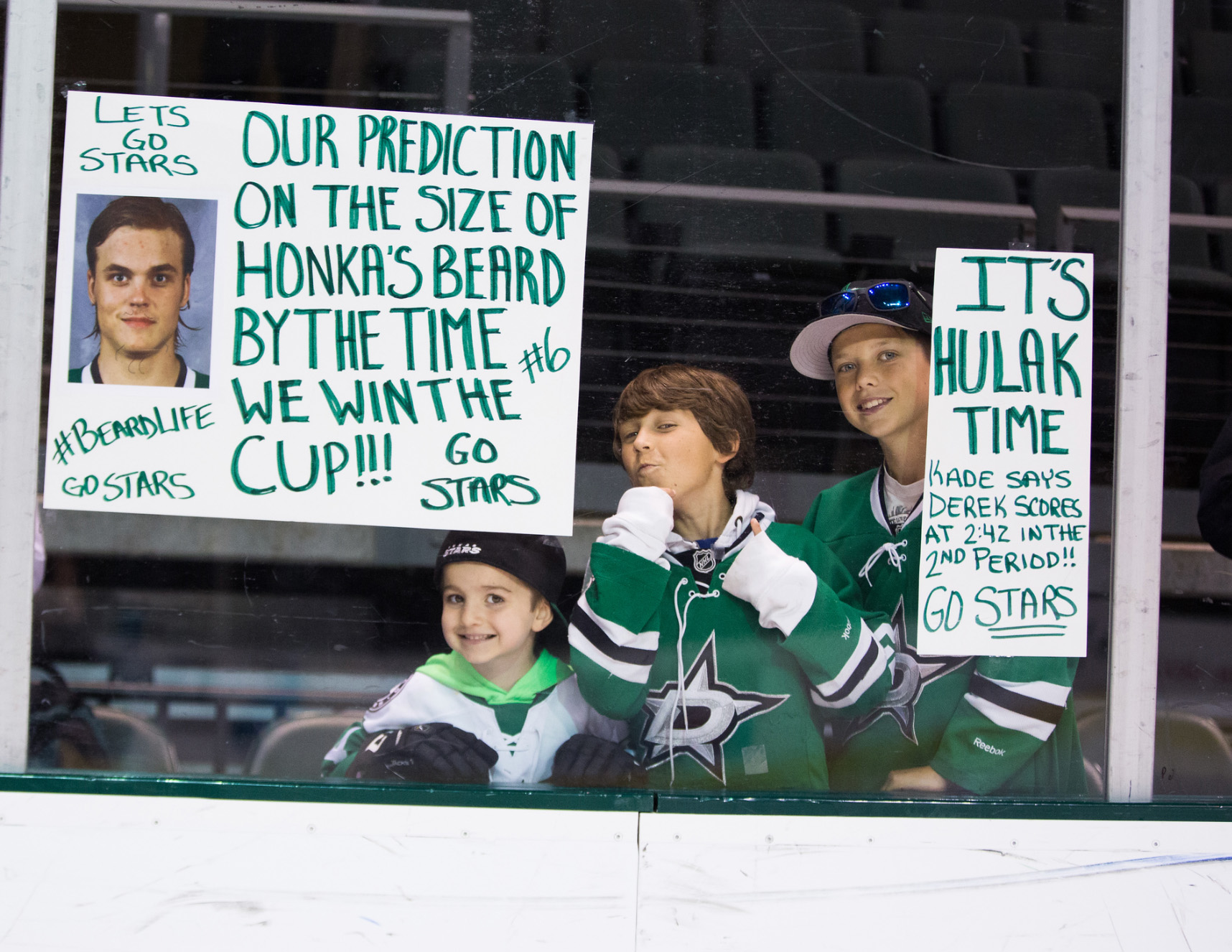
Kade O'Rourke (left) with his older brothers, Liam (middle) and Nevan (right), at a Texas Stars game (Courtesy of Christina Shapiro)
Kade O’Rourke never got to meet Cody Smuk.
O’Rourke was only 4-years-old when Smuk passed away in 2015 after a battle with testicular cancer that quickly moved to his lungs, taking his life at 26-years-old, less than 18 months after he finished his collegiate career at the University of Saskatchewan.
Smuk was a battler and beloved in the Saskatoon hockey community. The community rallied around him, the University of Saskatchewan Huskies wore stickers with his name on them, and helped raise funds for him to seek treatment in Germany.
More than a decade after Smuk’s passing, his former teammates gather each year to remember his life and what he meant to both the hockey program and community.
“Cody was the best of us. He lit up a room, loved people, and was such a great example for everyone of the right way to treat people,” said Derek Hulak, Smuk’s former teammate and current assistant coach at the University of Saskatchewan. “I finished my college career with the Huskies, went and played pro hockey, and around the exact same time I was doing that, he was diagnosed with cancer and had to battle for his life.”
Hulak signed an AHL deal with the Texas Stars in the spring of 2014 and wore No. 39. The next year, his first full season of pro hockey, he switched to No. 24 to honour Smuk. He wrote Smuk’s initials on his stick and received permission from the AHL to wear a sticker on the back of his helmet to raise awareness for Smuk’s battle.
Hulak happened to be 4-year-old Kade O’Rourke’s favourite player. He would make signs for Texas Stars home games that said, “It’s Hulak time”, and would often exchange fist bumps with Hulak through the glass during the 2014-15 season.
Kade and his three older siblings, Nevan, Liam, and Karis, told their parents they wanted part of the money that would normally go to Christmas presents to be donated to help Hulak raise money for Smuk’s treatment.
“They never knew Cody. They’ve gotten to know his parents since, but they never knew him, and they opened up their hearts for him and his family in a way that really, as kids, was so unexpected,” Hulak said. “I’m not even sure how they learned the story in the first place, but they helped bring Cody’s story [to light], and to this day, keep his memory alive.”
So O’Rourke, like Hulak, picked No. 24 as his number. He’s worn it ever since, and before each game, O’Rourke still writes Smuk’s initials on his stick.
“I will never change my number,” Kade said. “It means that much to me.”
“Cody’s story and memory gets to live on because of Kade in a way that I don’t think anyone would have imagined,” Hulak said. “I wore No. 24 for him, and it was a way to remember him, but hockey careers are short. To see that Cody’s story gets to live on now and when someone asks Kade about his number or something like that, and it looks like Kade is going to do some special things, I don’t really have great words for what that means, but it means everything to know he’s sharing Cody’s story.”
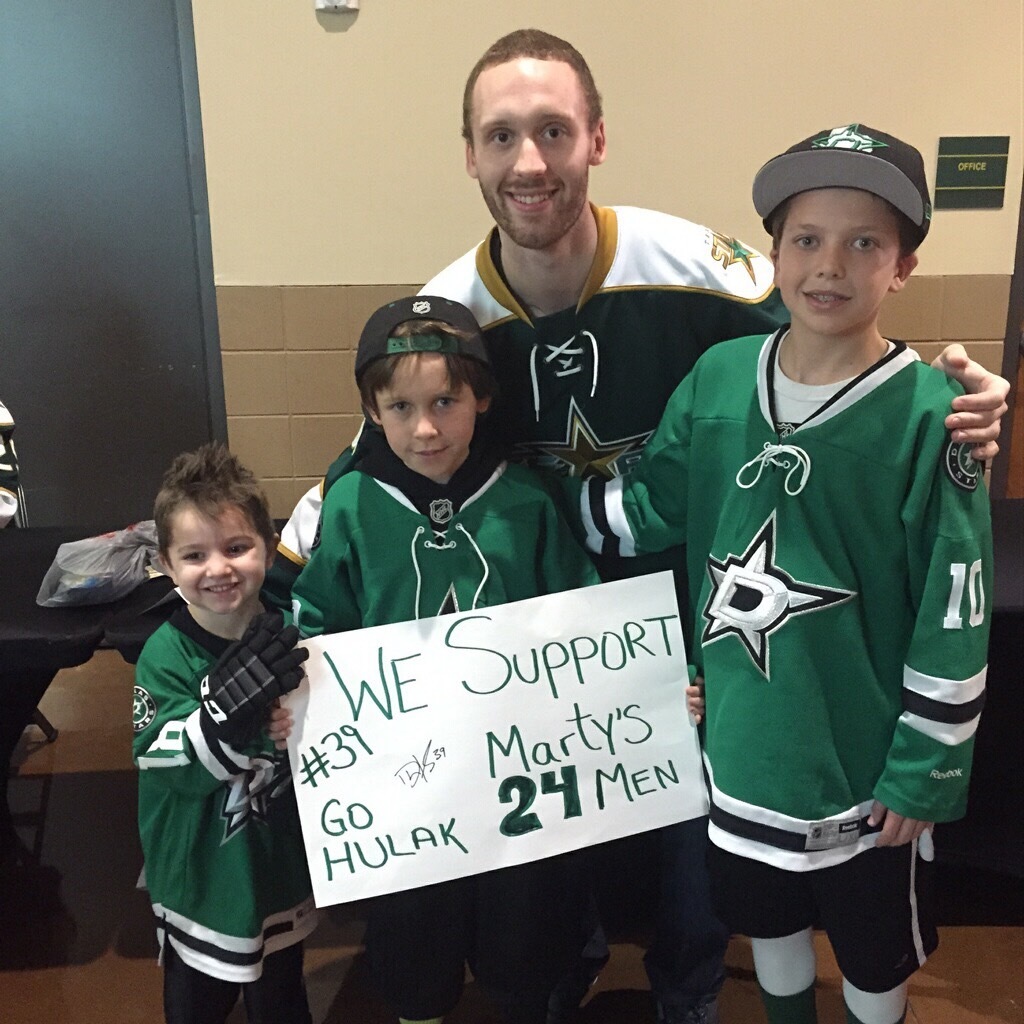
4-year-old Kade O'Rourke (far left), with his older brothers and Texas Stars player Derek Hulak (Courtesy of Christina Shapiro)
If things go according to O’Rourke’s plan, Cody’s story is probably going to spread quite a bit more in Kingston when the Oshawa Generals have the No. 1 pick in the 2026 OHL Draft.
It sounds bold, but exceptional status, and particularly OHL exceptional status, has been O’Rourke’s goal for a long time. After starting to play hockey in Austin, playing up against 10U competition as an 8-year-old, he started playing for the Dallas Stars Elite, making the seven-hour, round-trip drive four days a week from Central Texas to Dallas.
When O'Rourke turned 11, he and his dad moved to Toronto. Kade got a student visa, Dave retired from work to make the move, and the rest of the O’Rourke family committed to supporting Kade’s hockey career remotely back in Texas. Right after that move, Kade wrote the words “Exceptional Status 2026” on a sign above his bedroom door as a daily motivator.
“We’ve been full-time in Ontario since then,” Dave O’Rourke said. “And as a family, we made some pretty big sacrifices. Kade and I missed his brothers and sister going through high school. Kristy was a single mom, basically, to the rest of the kids back in Texas. We wanted to put Kade in a position to succeed. We built him the bus and gassed it up for him, but he was the one who had to drive it."
And Kade has done a pretty good job of driving it, including the attention-grabbing performance at the OHL Cup last month, leading to a headlines segment on Hockey Night in Canada.
The funny part about all of this, if you could call it that, is how remarkably unfazed O’Rourke is by all of the attention and hoopla that’s been generated.
“I mean, that’s been really sick to see,” Kade admitted. “But that’s kind of what I wanted and expected with this path.”
Like his approach on the ice, it's a mix of swagger and ego, but still respectful at the same time. He looks you in the eye when he’s talking, which isn’t too common with hockey players or teenagers who often look over or around reporters. And he’s pretty honest about his game and its the shortcomings and realities, that, for example, his physicality is going to need to improve at the next level.
There’s also some perspective to all of this. While so much of O’Rourke’s life has been dedicated to hockey, there are the everyday challenges he faces as a Type 1 diabetic, including some scarier moments.
“When we first found out he had diabetes, we were at the doctor, and he asked how soon he could play hockey, and the doctor wasn’t going to let him until he could show he knew how to use the needle, how to take care of himself,” Dave said. “So he did that, and he goes to a tournament the next weekend, scores in overtime, and that night I made my first mistake with it and overdosed him with the wrong type of insulin.”
There are two types of insulin, both fast-acting and slow-release. Slow-release is meant to act and take effect in spans of 12 to 24 hours, while fast-acting usually takes effect instantly.
“It was supposed to be 18 units of long-lasting, and he gave me 18 units of fast-acting,” Kade said. “And I started crashing. Had to eat like 500 grams of sugar right away to help counteract it.”
“I’m panicked,” Dave said. “You think in the moment you went and killed your kid.”
Dave and Kade can laugh about it now. In fact, the ribbing Kade gives his dad about it is a pretty good view of their relationship – they don’t pull verbal punches with each other – but it was also one of the core diabetic memories that pushed O’Rourke to start a nonprofit, The Path for 24, which supports and connects kids and families that are dealing with the challenges of Type 1 diabetes.
Kade has already spoken at schools in the Toronto area about the non-profit, and the family has also connected with others in the hockey community who have dealt with similar challenges.
“It’s really only getting started, but I want to be able to help others here,” O’Rourke said. “That’s something for me, that’s really important about who I am and helping others.”
That maturity and approach certainly haven’t hurt during the application process for exceptional status to the OHL. While exceptional status is based on on-ice merit, there’s a key off-ice element as well, where Hockey Canada digs into the player and the family away from the ice. They investigate a player's maturity and do a full personal audit on the person to determine whether the player can handle everything else that comes with exceptional status away from the ice.
And as of this past weekend, the O’Rourkes are still waiting on an answer from Hockey Canada, even if there are signs that exceptional status will likely be granted. The WHL, for example, has inquired whether O’Rourke should be their draft property, because he’s from Texas – a WHL territory – even though he’s been living in Toronto since he was 11.
For Kade himself, playing in the OHL has been the goal for five years.
“I really believe it’s the best league in the world to get you to the next level,” O’Rourke said. “It trains you and makes you better every day. When I moved up from Austin and then to Dallas, I wanted to be on a path to be the best I can, and for me, that’s what the OHL represents.”
Maybe O’Rourke will get exceptional status. Maybe he won’t.
Either way, there are so many ways to write the Kade O’Rourke story. The hype, the move from Texas to Ontario, and the reality that his story is only going to keep evolving.
But no matter where O'Rourke's story goes, he’s going to do it with No. 24 on his back.
And he’ll be bringing Cody Smuk’s story with him.

