How Buium, Rossi, and Öhgren impact Canucks' future after Quinn Hughes trade



The Vancouver Canucks traded away Quinn Hughes, the best player in their franchise history. There’s no winning that trade. His departure will create a massive hole in their lineup that may take years to really fill.
That being said, Zeev Buium may help ease the pain of the post-Hughes transition for the now rebuilding Canucks. The similarities between their games will inevitably lead to some direct comparisons between them over the next few weeks. You’ll probably hear commentators mention how they traded away Hughes, only to get a version of him back.
Just like Hughes, Buium loves to challenge defenders one-on-one, holding on to the puck as they approach, unbalancing them with a feint, before attacking open space. Capable of veiling his intentions and orchestrating the play, he’s opening up the offence and creating passing and shooting lanes.
As I wrote in an article ranking the performances of top NHL rookies a few weeks ago, “Receiving power play one opportunity next to some of the league’s top playmakers in Matt Boldy and Kirill Kaprizov, Buium has racked up points by distributing passes. He’s choosing the right plays at the right times, shifting the defence with lateral movements, opening space, deceiving, shooting for deflections, and generally finding plays through the defensive box.He’s also pulling off some Lane Hutson-esque moves, letting defenders close on him and evading them with timely skating moves and skating forward at opponents in the neutral zone. This tight neutral-zone gapping and some precise defensive-zone rotations have helped him limit the opposition’s chances in his shifts.”
The biggest difference between Buium and Hughes lies in their skating ability. Of course, no one matches Hughes’ agility even in the NHL, but the gap is even more significant with Buium, who’s more of an average mover.
Some would disagree with that assessment, seeing him swivel his hips and spin off defenders, but his lack of lower body flexion, especially at the ankles, and more rigid, high-stance posture also limits some of his plays. There’s not as much explosiveness out of turns and his pivot lacks some smoothness, forcing him to use multiple steps to catch up and get ahead of the play.
While Buium managed to consistently pull off his feints at the NCAA level, escaping to attack the slot or isolate a second defender, the success rate of his moves dropped in the NHL this season. Again, just like Hughes before him, Buium will have to relearn the timing of some of his moves and better balance the risk and reward of them. He won’t be able to pull off most dangles in his repertoire as consistently, but will be able to fall back on his advanced vision, passing skills, and talent for activating into the play.
With his ability to anticipate gaps in coverage and attack them and playmaking skills, he has the making of a career powerplay one quarterback.
His NHL game has been tilted toward the offence, but we anticipate that he will become a much more well-rounded player as he matures, just like he was in college. In fact, it was mostly his play in the neutral and defensive zone that made us value him so highly in his draft-year:
“He gaps up early in the neutral zone, expertly guides puck carriers away from the centre lane with his stick, and steals possession with a well-timed stick lift or by driving through his opponents’ hands to separate them from the puck entirely. During sustained pressures, Buium scans, disrupts plays as they develop, and exacts a physical toll on anyone who would deign to set up shop in soft ice.” – Elite Prospects 2024 NHL Draft Guide
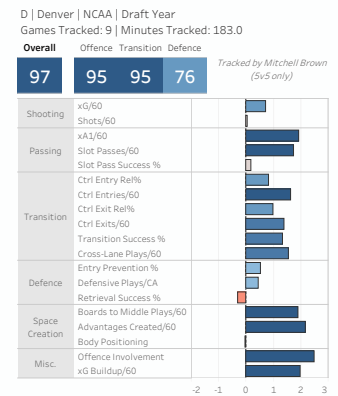
Neither too aggressive or passive, he let the game come to him, disrupted plays, won back pucks, and then created expert breakouts, drawing in forecheckers to the walls and passing through them to teammates skating in the middle of the ice. Buium accumulated a ton of controlled zone exits and entries, plays off the boards, and slot passes on Mitch Brown’s tracking data, illustrated above.
His elite puck-moving game was the main focus of this pre-draft video. And we’ve continued to see flashes of it with the Wild this season.
In the defensive zone, one can’t fault his effort. A high-energy player, he’s trying his best to perfect his rotations sticking to opponents, and separating them from the puck. But as an average-skating, smaller defenceman, Buium will have to continue to adapt his play, as he can’t impose himself physically and guide opponents into traps as much as he did in the NCAA. His opponents are more clever and a lot faster and bigger. They can better shake him with cutbacks, beat him wide off the rush, and sneak behind his back to one-time pucks.
We see some of his limitations in the video below, as he’s trying to catch up and shutdown speedy rushes, match quick changes of directions, and misses an opponent popping behind him.
It’s normal for a rookie defenceman to struggle with some aspects of the defensive game. Most do. Simply playing more games will help Buium perfect his rotations and anticipate better some of the opposition’s plays, getting ahead of them.
As he lacks the tools of a higher-end shutdown player, he may benefit from a partner who can insulate him, who can cover ice and bring opponents to a stop in the defensive zone, and Buium to position optimally and orchestrate the breakout.
In his prime, Buium should cement his role on the first powerplay, while posting league-average defensive metrics. He could become a top play-driver for the Canucks, as a top-four and maybe even top-line element. The more his finer agility improves and the more the Canucks will involve defencemen in their attack, the more his upside will grow.
We ranked Buium 20th in our Under-23 skaters ranking back in March, and as the seventh-ranked NHL-affiliated prospect heading into the 2025-26 season.
Buium was not the only Wild player moved in this trade, however. A favourite of our team in his draft year, Liam Öhgren is rejoining his long-time teammate with Djurgårdens IF, Jonathan Lekkerimäki. We ranked Öhgren ahead in his draft-year, seeing an easier NHL path for the winger considering his stockier build, physical and passing skills, and ability to support plays.
Always in the right spot, Öhgren creates space for others, giving them immediate outlets, pushing back defenders off the rush, and driving the net. He closes on opponents with heavy, but powerful steps, making them rush their plays and he fights for every loose puck, while putting in a full effort defensively.
While he displayed more playmaking ability against his own age group in Sweden, his game has mostly been streamlined in the AHL. We don’t see him deceive opponents, turn back on the rush to connect with teammates coming in behind, and hold on to the puck in the offensive zone.
Leaving the Iowa Wild and playing more minutes at the NHL level may give Öhgren some of his creativity back. The AHL club struggled to orchestrate attacks and have scored the 2nd-fewest goals in the entire league. So far this season, Öhgren has only received an average of ten minutes of ice-time at the NHL level. That’s partly because he’s still a developing prospect, but also because of the Wild’s depth on the wing and tendency to rely on veterans over youngsters.
To bring his playmaking skills back into his game however, Öhgren will have to improve his puck management. He’s not one of those players who can get away with forcing plays, projecting more as a supportive element in a lineup.
While he doesn’t have the offensive upside of Lekkerimäki, lacking a similar high-end release or advanced playmaking skills, Öhgren could play a middle-six role in his prime, providing timely options, a physical presence, and quick-passing skills.
The final player piece of the trade, Marco Rossi’s value to a line only becomes clear when you watch him in isolation.
Playing an even more advanced version of Öhgren’s game, Rossi makes plays evident for teammates, following the team’s system, seeing plays ahead of them and making the right cuts to complement teammates. A compact power forward, he’s constantly driving inside, finding openings around the net, and winning battles on the wall by leveraging his deep skating posture and lower centre of gravity.
There’s not a lot of flash in his game, but his vision stands out. His passes fly by multiple defenders and hit teammates in space and he rarely holds possession unnecessarily, instead drawing rapid give-and-goes to get the puck from the defensive end to the offensive one.
.png)
His stature comes with some obvious limitations and his game lacks high-end creativity, but his style of play is tailor-made for the center position. It shines even more next to creative line-mates, who can bounce the puck off of him, find open at the door-step, and count on him to go full-throttle on the forecheck and backcheck.
Rossi has played like a true top-six center over the past couple of seasons. We ranked him 21st in our last Under-23 skaters ranking. The only centers ahead of him were Logan Cooley, Leo Carlsson, Adam Fantilli, Tim Stützle, Macklin Celebrini, and Connor Bedard.
On top of all three players, the Canucks also received a 2026 first-round pick from the Wild. If the draft were this week, the acquired first rounder would fall somewhere in the 20s.
While the 2026 draft was once considered a strong class, it’s looking more like an average one in the first half of the season. That means the Canucks can hope to get a valuable prospect in the Wild’s range, but may end up with a player with middle-of-the-lineup projection.
Every year, higher-upside prospects with some question marks fall to the range.
Here’s a few names to keep in mind that could end up realistic targets: Jaxon Cover, Alexander Command, Nikita Shcherbakov, Ryan Roobroeck, Giorgos Pantelas, Nikita Klepov, Oscar Hemming, Mathis Preston, Ilia Morozov, and J.P. Hurlbert.
In a way, this trade may be the starting point of a more exciting journey for the Canucks, filled with more hope than dread. A long-term second-line centre, a top-four, power play quarterback, a middle-of-the-lineup forward, and a first-round pick won’t replace Hughes' contributions — no one could — but they could form the building blocks of an organizational reset.
The departure of the all-star defenceman could also enable the Canucks to do what they should have likely done years ago, which is drop to the bottom of the standings to grab a real, franchise-altering prospect.