How Does the NHL Playoffs Work? NHL Postseason Explained

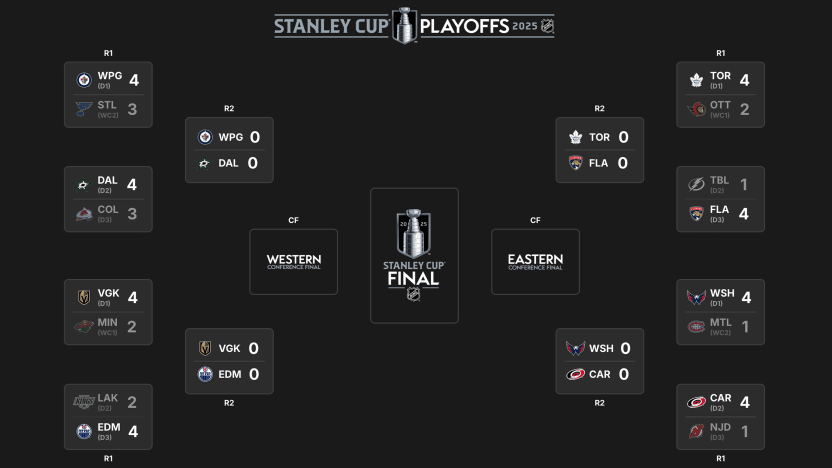
How does the NHL playoffs work? Sixteen teams qualify for the postseason, eight from each conference, and matchups follow a division-based bracket rather than a conference-wide ladder. The top three teams in each division earn automatic berths, while two wild cards per conference fill the remaining spots based on points. The bracket is fixed, so there is no reseeding between rounds and every series is a best-of-seven.
Teams qualify by their divisional standings: the top three teams in each of the four divisions advance and the next two highest point totals in the conference earn wild-card spots. The postseason then plays out across four rounds: the first round, the second round (the divisional final), the conference final and the Stanley Cup Final. Seeding is set by regular-season points, with the NHL's tiebreakers applied when teams finish level.
What you need to know
Sixteen teams make the playoffs, eight per conference, and they move through a division-based fixed bracket across four best-of-seven rounds to win the Stanley Cup. That structure keeps the first two rounds within divisions, then crowns conference champions who meet in the Stanley Cup Final. The format places a premium on divisional seeding and head-to-head results.
How does the NHL playoffs work: the quick primer
Quick primer: 16 teams qualify, split evenly between the two conferences, and they play a fixed, division-based bracket until one team wins the Stanley Cup. Each conference sends six automatic qualifiers (the top three in each division) plus two wild cards determined by points, producing eight teams per conference.
Image: nhl.com
Who gets in: divisions, wild cards and seeding
Automatic qualifiers are the top three teams in each division, so the simplest way to see who is headed to the playoffs is to check division standings. When teams finish level on points, the NHL tiebreakers determine exact seeds and order of finish. Division placement dictates the first two rounds and who gets early home-ice advantage.
Wild cards occupy the seventh and eighth seeds in each conference and come from the teams with the highest conference point totals outside the top three in each division. The lower wild card plays the conference's top division winner, and the higher wild card faces the other division winner. Because wild cards can come from either division, one division may send five teams while the other sends three, which affects travel and matchup balance in opening rounds.
Example: Western Conference
Central Division
Pacific Division
Western Conference Wild Card Standings
If the season ended with the standings shown in the example above, the playoff field in the Western Conference would be determined directly from those division positions and the two wild card spots.
From the Central Division, the automatic qualifiers would be the Colorado Avalanche, Dallas Stars, and Minnesota Wild. From the Pacific Division, the top three teams would be the Anaheim Ducks, Vegas Golden Knights, and Edmonton Oilers.
The wild card teams would then be the two remaining clubs with the highest point totals in the conference. In this example, those spots would go to the Utah Mammoth and Seattle Kraken.
That would produce the following first-round matchups.
Colorado Avalanche vs Seattle Kraken
Dallas Stars vs Minnesota Wild
Vegas Golden Knights vs Edmonton Oilers
As outlined above, the lower wild card faces the conference’s top division winner, while the higher wild card plays the other division winner, and the second and third place teams in each division meet in the opening round.
Reading the bracket and how teams progress
Think of the bracket as four fixed tracks that do not reshuffle. Each division effectively contains a mini-bracket with the 2 vs 3 series and the division winner versus a wild card. Following seed numbers rather than team names makes it easier to project paths, since team labels change after upsets but seeds stay in place.
Winners from the two divisional matchups meet in the second round to decide the divisional champion. Those divisional champions then play in the conference final, and conference champions meet in the Stanley Cup Final. Because the bracket is fixed, you can map potential opponents several rounds ahead by tracing seed paths instead of reacting to team names after every result.
Series format, home-ice and the details that matter
Each playoff series is best-of-seven, played in a 2-2-1-1-1 format. The higher seed hosts Games 1, 2, 5 and 7, while the lower seed hosts Games 3, 4 and 6. That schedule reduces travel early in a series and puts the potential Game 7 in the higher seed's building.
Travel and scheduled rest days affect practice time, goalie recovery and line rotations. Teams usually play Games 1 and 2, travel for Games 3 and 4, then return for Game 5 with further travel only if Games 6 or 7 are required. Short series can let a hot goaltender swing momentum quickly, while long series force coaches to manage minutes and rely on depth.
Home-ice in rounds one and two follows divisional seeding, while the conference finals and Stanley Cup Final use overall regular-season points to decide which club gets the extra home game. The "last change" rule gives the home coach the final matchup after stoppages, which is a tactical advantage for sheltering a key player or creating favorable line matchups.
Tie-breakers, timeline, betting edges and using Elite Prospects
The NHL applies tie-breakers in a set order when teams finish level on points. They are applied in sequence to determine seeding and are commonly shown in standings screens as RW, ROW, W and H2H metrics. The main tiebreaker categories include points percentage, RW, ROW, W and head-to-head points.
- Points percentage (points ÷ games played), used when teams have played an unequal number of games.
- Regulation wins (RW).
- Regulation plus overtime wins (ROW).
- Total wins (W).
- Points in head-to-head games, with the odd-game adjustment when applicable.
- Goal differential (shown as DIFF or +/-).
- Goals for (GF).
Standings screens often show P% or PCT for points percentage and RW, ROW and W columns for the win-based tiebreakers. Head-to-head appears as H2H under tiebreaker details, while goal differential and goals for appear as DIFF or +/- and GF. Knowing those abbreviations makes it easier to interpret late-season tables when seeds are tight.
The postseason calendar is compact, with first games typically starting in mid-April and the Stanley Cup decided in June, roughly eight to ten weeks later. Each round lasts a few weeks depending on how many games are needed, so injuries and roster moves can reshape series odds quickly. That compressed timeline makes late-season form and health especially valuable.
For betting and scouting, focus on repeatable edges such as goaltender form, recent starts, days of rest, travel and matchup leverage from last change. Elite Prospects provides interactive bracket tracking, transaction feeds and verified player videos to help evaluate prospects and roster changes. Before placing a wager confirm the starter, days of rest and any late scratches, then adjust your bracket or prop bets accordingly.