Wayne Gretzky Trade: The Line Item That Broke a Nation
Image: Bildbyrån
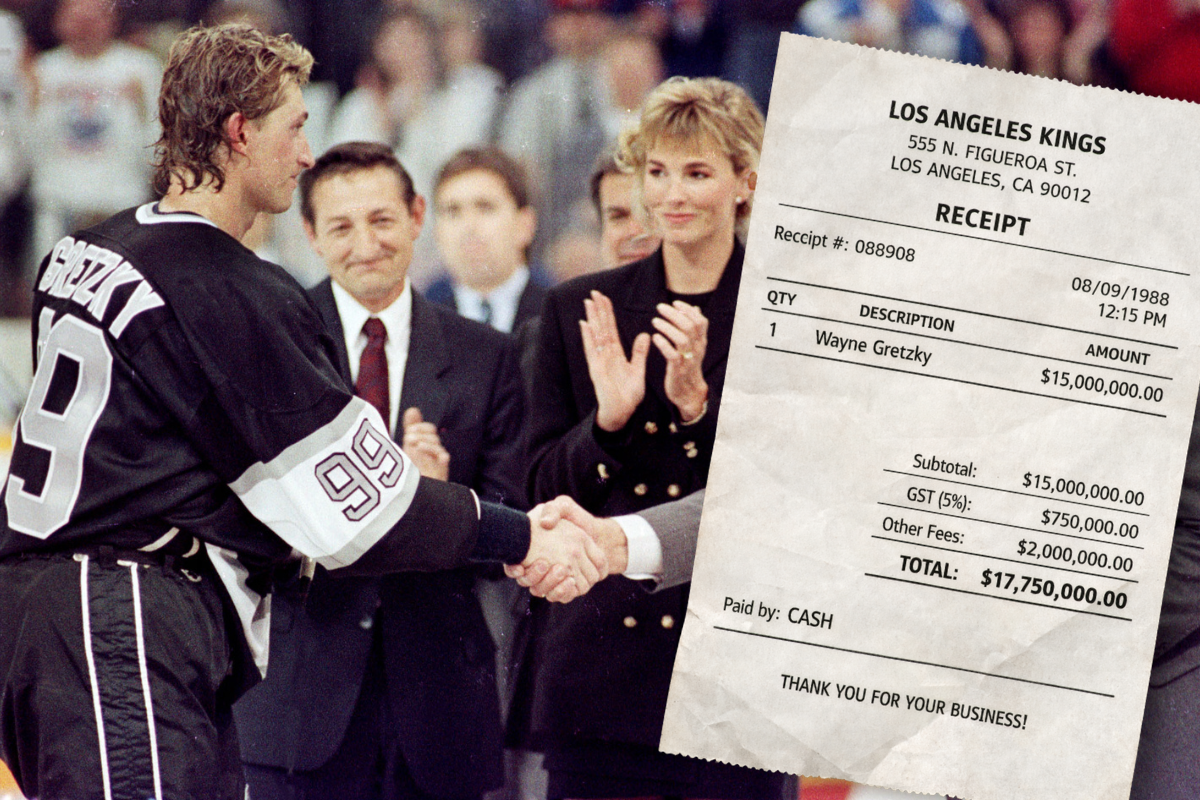
By the summer of 1988, Wayne Gretzky was more than the best hockey player in the world. In Canada, he had become something close to a national institution, the face of a dynasty in Edmonton and the center of the sport’s universe.
Then came a phone call.
Two hours after the Edmonton Oilers lifted the Stanley Cup for the fourth time, Gretzky’s father called with news that sounded impossible. The Oilers were planning to trade him.
On August 9, 1988, it became official.
Los Angeles Kings Trade Breakdown
Los Angeles Kings Received: Wayne Gretzky, Marty McSorley, Mike Krushelnyski
Edmonton Oilers Received: Jimmy Carson, Martin Gelinas, 1989 first-round pick, 1991 first-round pick, 1993 first-round pick, $15 million USD
That's the transaction. The aftermath was something else entirely.
In Edmonton, Pocklington was burned in effigy by angry fans who believed the owner had sold off the franchise's greatest asset. The Oilers' 21 phone lines melted with callers threatening to cancel season tickets. Gretzky's wife, the actor Janet Jones, was also blamed for the trade, three weeks after she was the sweetheart of Edmonton during the couple's storybook wedding. A member of Parliament proposed the federal government block the deal outright. None of it worked.
The reasons were less romantic than the public wanted to believe. According to Walter Gretzky, Wayne was being shopped to Los Angeles, Detroit, and Vancouver. Pocklington needed money as his other business ventures were not doing well. The best player in the history of hockey had become a line item on a balance sheet. After the details of the trade were finalized by the two owners, one final condition had to be met: Gretzky had to call Pocklington and formally request the trade himself.
Eight Seasons in Los Angeles
What followed in Los Angeles was remarkable by any measure. In his first season with the Los Angeles Kings, Gretzky scored 54 goals and put up 114 assists for 168 points, good enough to secure him the Hart Memorial Trophy. The Kings made the postseason in each of his first five seasons.
The Kings reached the Stanley Cup Final in 1993, but lost to the Montreal Canadiens in five games. It remains Gretzky's deepest postseason run as a King.
The decline that followed was not his doing. The franchise had grown unstable around him. Gretzky made clear he wanted assurance that the club's new ownership shared his commitment to winning, and when that assurance didn't come, he began to look elsewhere. By February 1996, he requested a trade.
Gretzky Gets Traded Again: The Move to St. Louis
On February 27, 1996, Gretzky was traded to the St. Louis Blues.
St. Louis Blues Received: Wayne Gretzky
Los Angeles Kings Received: Craig Johnson, Patrice Tardif, Roman Vopat, 1996 fifth-round pick (Peter Hogan), 1997 first-round pick (Matt Zultek)
The fit looked compelling on paper. The Blues had seven eventual Hockey Hall of Fame members on their roster that season: Gretzky, Brett Hull, Al MacInnis, Glenn Anderson, Grant Fuhr, Dale Hawerchuk, and Chris Pronger. The pairing of Gretzky alongside Hull, one of the most natural goal scorers the game had seen, felt like a blueprint for a championship run.
Gretzky was immediately named team captain and scored 21 points in 18 regular season games. The Blues qualified for the playoffs and he added 16 points in 13 postseason contests before St. Louis fell in double overtime of Game 7 of the conference semifinals, eliminated by the Detroit Red Wings.
The Keenan problem ended it all. Gretzky wanted to stay in St. Louis and potentially end his career there, but the strained relationship with head coach Mike Keenan made it a non-starter. Keenan's coaching style was intense and publicly critical, and it was ultimately his presence that drove Gretzky out of town.
The Blues went 6-10 with five ties after acquiring Gretzky, were eliminated in the second round, and watched him sign elsewhere. None of the players acquired by the Kings in the deal made a meaningful impact in the NHL.
The Wayne Gretzky Trade Tree: Where Every Asset Ended Up
With both deals on the table, here is where the pieces actually landed.
The 1988 Trade: Edmonton's Return
The headlining piece, Jimmy Carson, produced immediately. In his first season with the Oilers, Carson scored 49 goals and 51 assists over 80 games. But he asked for a trade in November of 1989, citing the pressure of being associated with the Gretzky departure. The Oilers dealt him to the Detroit Red Wings, and coming back were Adam Graves, Petr Klima, Joe Murphy, and Jeff Sharples. Murphy was later moved to the Chicago Blackhawks in a thread that eventually brought Dan Cleary, Ethan Moreau, and Chad Kilger to Edmonton. Moreau went on to play 653 games over parts of 11 seasons with the Oilers and captained the team for three seasons, making him the last remaining link on the Edmonton side of the trade tree.
Martin Gelinas played a key role on Edmonton's 1990 Stanley Cup squad before being dealt to the Quebec Nordiques in 1993 for Scott Pearson, who was later flipped to the Buffalo Sabres for Ken Sutton. The branch faded quickly from there.
The three first-round picks told a story of missed opportunity. The 1989 pick was traded to the New Jersey Devils, who used it to select Jason Miller. The 1991 pick became Martin Rucinsky, and the 1993 pick became Nick Stajduhar. Rucinsky played just two games for the Oilers before being moved to Quebec for Ron Tugnutt and Brad Zavisha. Tugnutt played 29 games and was claimed by the Mighty Ducks of Anaheim in the expansion draft. Zavisha was later traded to the Philadelphia Flyers for Brad McGill, who played eight games before retiring. Rucinsky, meanwhile, went on to score 612 points in 961 NHL games. Edmonton flipped a 961-game NHL career for a backup goalie and a player who never stuck.
The Kings' side of the 1988 tree stretched even longer. Nelson Nogier was the final remaining link on the Los Angeles side of the trade. He signed with a KHL team in Russia in September 2022, officially closing out the Gretzky trade tree after 34 years and nearly 64 total transactions.
The 1996 Trade: Los Angeles' Return
None of the players acquired by the Kings made an impact in the NHL. Johnson was the most productive of the group, spending the bulk of his career in Los Angeles across eight seasons, but he never became a difference maker. Tardif played 15 games as a King. Vopat managed 45 games across four NHL seasons. The 1997 first-rounder, Matt Zultek, never played a game in the league. Peter Hogan, the fifth-round pick, never made it either.
The Kings traded Gretzky, the greatest player in history, for three players who combined for fewer NHL games than a single average NHL career.
Gretzky Takes His Number to New York
Gretzky declined a three-year deal worth $15 million from the Blues and signed with the New York Rangers on a two-year, $8 million contract, reuniting with longtime teammate Mark Messier.
The first season produced results. The Rangers advanced to the Eastern Conference Finals before falling to the Philadelphia Flyers, with Gretzky posting strong numbers throughout the playoff run. It was his last deep run as a player.
After Messier departed for the Vancouver Canucks following the 1996-97 season, the reunion that had drawn Gretzky to New York lasted just one year. The Rangers missed the playoffs in each of his final two seasons. The curtain was coming down.
Gretzky played his final game on April 18, 1999 at Madison Square Garden. The NHL retired his number 99 league-wide, ensuring no player would ever wear it again.
The trade that left Edmonton weeping in 1988 set off a career arc that crossed four franchises and 11 years. Los Angeles got eight seasons of the greatest player alive. St. Louis got a glimpse and a heartbreak. New York got the farewell. Each city holds a piece of the same story, and all of it started on a summer afternoon when the unthinkable became real.