Film Room: How Tommy Bleyl skated his way from prep hockey to first-round consideration


The NCAA’s November 2024 decision to grant eligibility to CHL players has altered the junior hockey landscape forever, perhaps nowhere as dramatically as the QMJHL. Two years ago, there were two American players in its ranks; this past season, there were 46. Many of these newcomers are already writing their names in the league's history books.
Enter Tommy Bleyl, a 5-foot-11 right-shot defenceman from Schenectady, New York, who signed in August 2025 as a free agent with the defending Gilles-Courteau Trophy champion Moncton Wildcats. Bleyl entered the QMJHL directly from Massachusetts’ 18U AAA and high school prep circuits, though he did play three games in the USHL in December 2024.
The defender was one of many Moncton recruits made in their bid to stay atop the QMJHL in the face of high turnover (the 2025-26 Wildcats featured only eight players from their 2025 Memorial Cup appearance roster). As the Wildcats repeated history, reprising their regular-season title and making a second consecutive run to the QMJHL finals, their brand-new No. 1 defenceman was rewriting it.
With 81 points (13 goals, 68 assists) in 63 games, Bleyl put together the most productive season for a draft-eligible defenceman in 45 years and the most productive of any defensive rookie in the league’s 57-year history. This distinction was rewarded handsomely with three QMJHL trophies — the Raymond Lagacé Trophy (defensive rookie of the year), Émile Bouchard Trophy (defenceman of the year), and Sidney Crosby Trophy (rookie of the year), in addition to the CHL Rookie of the Year Award. A first-round selection will be next on his list of accolades — our ranking of Bleyl at 32nd overall seems to be more conservative than most NHL teams’ lists.
Bleyl sped his way up the QMJHL record books and NHL draft boards in much the same way he speeds up the ice. On the second weekend of the season, his new coaches were already on the record likening him to Secretariat. Our NHL Draft Guide team minted the ‘Race Car’ badge for his exclusive use. Teammate Caleb Desnoyers described him as “slimy” in a French-language interview, referring to his inexplicable slipperiness in transition.
The Michigan State commit, who has pushed back his freshman year to 2027-28 to remain in one of junior hockey’s emerging development hubs, has captured the attention and imagination of the scouting world in record time. A prospect who entered the season in near-total obscurity, Bleyl’s story is one of the most impressive draft-year ascents in recent memory.
Breakout star
The quality of Bleyl’s skating base and straight-line speed was immediately evident in his first QMJHL games, and it consistently made strong first impressions as people tuned in through the season. It takes no more than three Bleyl shifts in any Wildcats game to see why he came out on top in our Scouts’ Poll for best straight-line skater, as well as earning a fifth-place shout for best four-way mobility.
The catch-me-if-you-can evasiveness has made opposing defenders look downright silly all season, blending his elite speed with mobility to route efficiently through the zone, confidently extending and contracting his reach to dodge and confuse. Desnoyers, in the “slimy” interview, also described Bleyl as “unhittable”; he seems to slip through pins to the wall at least once a game, making his typical attack-from-the-wing game work where it seems it shouldn’t.
Bleyl dominates through more than his speed, and it’s a cyclical relationship — his acceleration benefits from his technical base, and the marginal speed advantages compound when he’s able to deftly work his feet around the mild inconveniences that are defending players. Add in the puck skills to maintain possession, and he’s one of the best puck-carrying defencemen in the class.
.png)
Bleyl’s puck-carrying frequency and efficiency place him in the same neighbourhood as top-10 candidates Carson Carels, Daxon Rudolph, and Keaton Verhoeff. When it comes to puck-moving defencemen, Bleyl is international same-day delivery — and he’s not outsourcing last-mile transport. According to our partners at InStat, the only QMJHL defenceman of any age who carried more pucks into the offensive zone on a per-game basis was Xavier Villeneuve.
Edgework
There’s much more to Bleyl’s skating and overall upside than just elite footspeed. His first games in the QMJHL were littered with the tendency to frequently transition into deep heel-to-heels through the neutral zone or to pull off quick direction changes.
As the season progressed, this tool became more utilitarian as he deployed it in his more frequent passing and puck-protecting reps. Heel-to-heels became one of his key strategies in surfing with contact and neutralizing the oft-cited size concerns, and they also offered an advantage to his entries in opening his stance to make offensive-zone passes.
Bleyl’s mobile directionality, whether it’s through a broader heel-to-heel stride or his ability to cut back on a dime, is how he dominates in transition and exploits feints at a ridiculous rate.
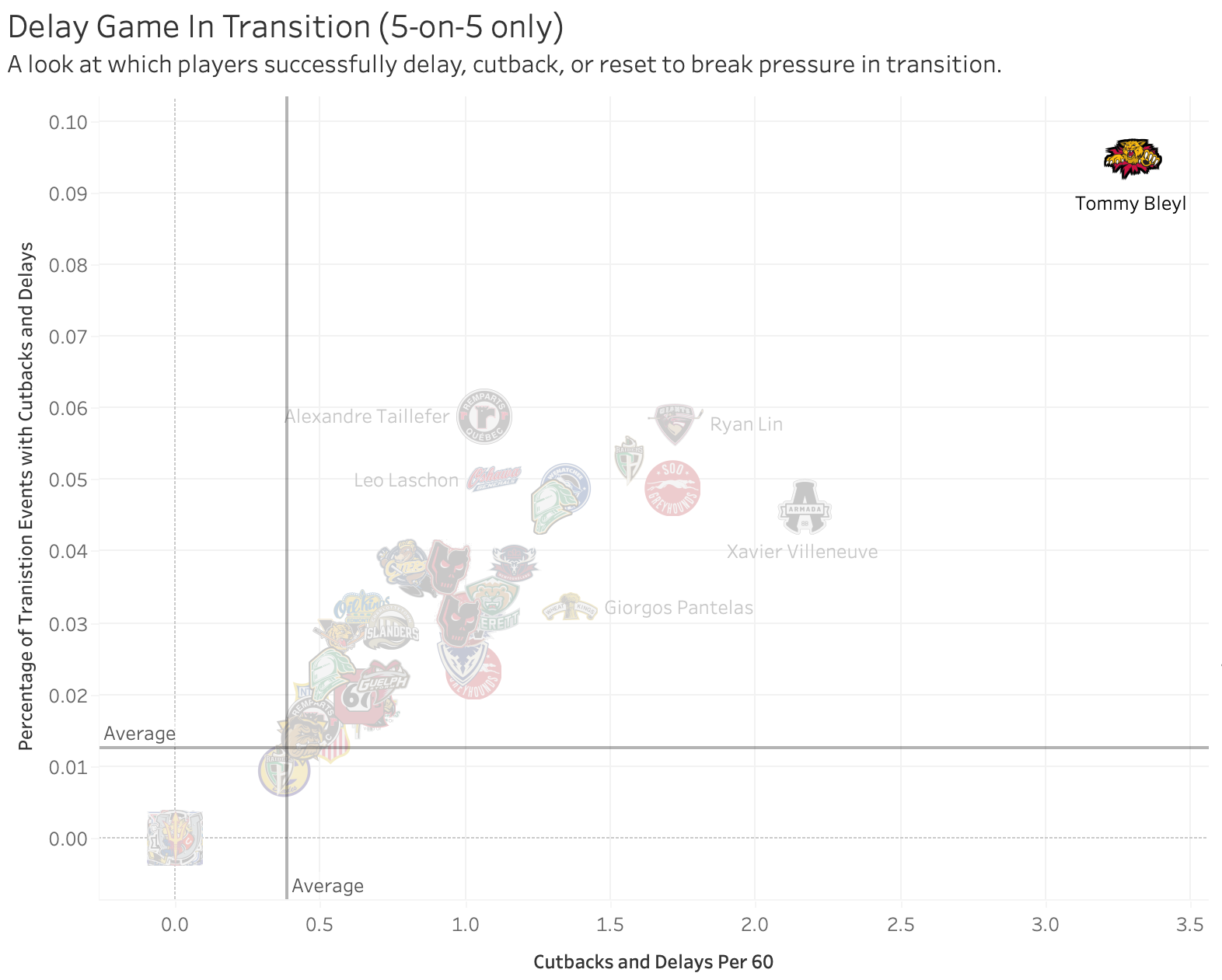
Though he’d been pulling off his signature end-to-ends since the pre-season, Bleyl did not touch down in the QMJHL as a finished product, and unlocking the complete potential within being an elite skater was a major growth opportunity. The heel-to-heels through an empty neutral zone became heel-to-heels to protect the puck, to beat checkers 1-on-1, to reel his teammates into his run-and-gun entries.
The manoeuvres themselves were never challenges for Bleyl, but they weren’t truly notable to his profile until he began harnessing them to create material advantages. The moments where he speeds past hits are fun to watch, but it’s the moments where he heel-to-heels in transition to turn his back on a hungry forechecker that’ll more greatly impact his NHL survival and feasibility.
Passing and playmaking progress
Entering a brand-new league in his draft year, the learning curve for Bleyl was understandably steep. Though the breakouts stood out immediately upon arrival and became his signature, the passage of his season in Moncton’s system encouraged development on Bleyl’s secondary skills, nowhere else more than in his passing game.
The improvement was as simple as increasing the volume, as he came into the league as an immediate power play distributor. Through the second half of the season and the playoffs, he became more receptive to making passing plays on his entries, exploiting his shiftiness and puck control to make his game even more breakneck, east-west (playmaking pace) as much as north-south (footspeed).
The one-man nature of Bleyl’s early-season game was a problem area we flagged, but his second-half tape showed sufficient initiative to pass and build up offensive plays. These changes didn’t require an overhaul of his game nor the abandonment of his highest-end qualities — his most potent late-season assists came off the same speedy end-to-end rushes that put him on the radar, but consider them 150-foot instead of 200-foot in nature. Zipping into the zone and allowing Moncton’s choice of scoring threats to finish the job became a recipe for success, proven time and time again.
Bleyl doesn’t have the high-end vision of a Chase Reid or a Xavier Villeneuve, but his simple buildup game, with his speed on the play and his puckhandling prowess, worked exceptionally well in Moncton’s system. Though his high-danger passes to the slot are less reliable with a completion rate of 29 percent, compared to the 44 percent average among draft-eligible defencemen, he was an effective passer on the outside and his current environment is the place to explore these types of plays — not just playing junior hockey, but playing on one of its most dominant teams. The parts of his passing game that will stick will likely be his odd-man-rush efficiency and efficient transportation through the cycle.
Defensive-zone play
As is the enduring knee-jerk concern with any high-scoring, sub-6-foot defenceman who comes under the NHL Draft microscope, Bleyl’s defensive game was bound to be called into question. Weighing in at 170 pounds at the Combine, the greatest damage he does lined up at the blue line is what he can do when he turns the play around.
At the start of the season, the defensive bright spots were off-puck stick lifts on off-side retrievals, taking away the cross-ice passing options he grew familiar with on the other side of the ice. His puck control also offered benefit on uncontrolled entries where he was in the right place, though he had yet to do much with causing the chaos himself.
As the season progressed, Bleyl’s rush defence became more consistent, more often positioning himself with his fluid backward skating to corner players into the wall and forcing dump-ins without needing to lay a hit. The pokechecks worked here too at their best; his mobility allowed Bleyl to remain oriented toward the neutral zone, and his puck skills lent themselves to repossession and quick counterattacks.
Similar to how he surfs through offensive zone contact, Bleyl’s defence also goes with the flow out of sheer necessity. His gaps on the rush and the cycle alike tended to stagnate or even grow as attackers closed in, but his playoff tape showed more frequent physicality at the blue line and on retrievals. Keeping tight gaps with his manoeuvrability and dislodging pucks in the zone with his stick-forward defensive game seem to be Bleyl’s way forward, assuming the frame stays as it is.
The projection
Defencemen of Bleyl’s description in the past have often been fiercely scrutinized or “underrated” by teams, slipping out of the first round despite the skill and points indicating seemingly unlimited offensive potential. This is not the case at all with the Wildcats defenceman — industry chatter and fan excitement are much more aligned than they have been with recent offensive defenders in the draft, such as Lane and Cole Hutson. Our final consensus ranking, averaged from ten NHL lists, placed Bleyl at 20th overall.
The name of the game, as with all undersized NHL defencemen, is opportunity and organizational fit. Bleyl succeeded in Moncton because he played high-leverage offensive situations from the start of the season, bursting onto the scene with his rush game and playing with virtually no leash, save for some tinkering in defensive zone coverage. The team that could unlock him has the blueprint in the details that progressed under Wildcats head coach Gardiner MacDougall, leveraging the omnipresence of skating as Bleyl’s greatest strength to round out his game.
Bleyl was originally committed to play at Michigan State next season, and his decision to instead remain in the QMJHL has raised some eyebrows. The second season in Moncton was Bleyl’s choice, considering he would likely lose the high-offence reps at MSU to projected top-five pick Chase Reid. His second season with the Wildcats will all but guarantee his all-situations deployment, as MacDougall has been vocal about playing Bleyl in challenging defensive scenarios and pushing the limits of his game.
When putting together the Elite Prospects 2026 NHL Draft Guide, we struggled to come up with a ‘shades of’ comparison for a player as unique as Bleyl. Every sub-6-foot defenceman in this just-beginning era is anointed on arrival as yet another Hutson brother, but we attribute Bleyl’s success to tools much more than hockey sense. He can be Hutson-like in his feints, but the offensive-zone play when not rushing the puck exposes those processing gaps — even more so when our chosen ‘shades of Lane Hutson’ comparable, Villeneuve, played with and against Bleyl in the same QMJHL (including a seven-game playoff showdown).
There are a select few 5-foot-something skating-driven defenders in the NHL to compare to Bleyl, and those that we chose to publish in the Draft Guide are Jamie Drysdale and Samuel Girard. Drysdale parlayed his remarkable OHL production into a sixth-overall selection in 2020, and Girard previously held the QMJHL’s most productive draft-eligible season for a defenseman in the 21st century (74 points in 67 games). Both players stood out for their acceleration and top speed as prospects, and they both show that those advantages can flash in valuable moments in the NHL.
To make it with this profile, true puck-moving from the neutral zone becomes a necessity with the lack of time and space provided. Both Drysdale and Girard, with puck control and mobility similar to Bleyl’s, can wheel into the depths of the offensive zone or execute the coveted fake-out, but the efficacy of these moves takes a hit. This is why this Film Room took the time to emphasize the development in Bleyl’s passing game, where he began to stop up and connect passes after entering the zone, because that’s an adaptation that both of these NHL comparables made. It’s hard enough to get to the middle of NHL ice, even more so when you’re a 5-foot-11 defenceman simultaneously covering your own zone.
Among the many CHL debutants in this first full season post-NCAA ruling, Bleyl rose to the top as a key cog on one of the league’s most successful teams. With a second season in the same system, Bleyl will have ample opportunity and ice time to improve upon his peripheral skills to prime him for his future NHL tryout, learning how to leverage his high-end skating in all areas as a diminutive defenceman. To the flash, there’s utility, and Bleyl is a solid bet with tons of runway to become a pro puck-moving defenceman.