Film Room: Why Marcus Nordmark is one of the 2026 NHL Draft's more polarizing prospects

(1).png)

When it comes to raw offensive talent, only a handful of skaters in this draft class are able to rise to the level of Marcus Nordmark.
The production track record against it is immaculate. Nordmark was already a point-per-game player in the Swedish U20 league as a 16-year-old, also leading the Swedish U17 team by a wide margin internationally. This season, his 1.52 points-per-game pace with Djurgården's U20 team places him third amongst all draft-eligible talent in the league over the past ten years. He's also remained incredibly productive internationally, having amassed 33 points in 19 games going into the U18s.
At the same time, Nordmark also stands as one of the more polarizing players amongst the public, with some seeing him as a borderline top-10 talent, while others don't have time for him as a first-rounder. Amongst NHL teams, opinions seem to vary just as much.
Let's dive deeper into what makes Nordmark such an enigmatic force.
Playmaking skill and vision
Playmaking vision and the skill to take advantage of the openings he sees and creates drive a large portion of Nordmark's offensive value.
At his best, he can masterfully manipulate and shift defenders to his desire, baiting them to reach before passing around them or using the threat of his shot to deceive them and manufacture the ideal passing lane. He processes changing situations quickly, making him very good at creating for his teammates out of forechecking steals and completing short-range give-and-gos.
Off the rush, his bread and butter is the delay play where he patiently waits for the F2 to sprint up to the backdoor or the net-front for a deflection or finds the trailer striking down the middle. Off the cycle, he likes to both circle to the point and get his defencemen involved, or move downhill and attract additional pressure before passing through it.
Nordmark also brings plenty of finesse as a playmaker. He comfortably makes plays through sticks and skates and threads pucks through pressure from his backhand, also being able to rapid-fire his cross-slot passes when fast action is required.
As such, Nordmark is a player who thrives with other skilled operators who can link up with him for give-and-gos and find open pockets in the slot, trusting his ability to deliver the puck just at the right time. In my 15-game sample of manually tracked data, he averaged 21 slot pass attempts and 9.9 completed slot passes per 60 minutes at 5-on-5, both being one of the highest marks I've tracked across all major European junior ranks over the past few seasons.
Shooting and scoring abilities
While Nordmark's playmaking has arguably been the main star of the show so far, there's an argument to be made that it's his finishing ability that is going to drive an increasing share of his success as he graduates to the professional levels.
Nordmark's calm and calculated approach really works in his favour when it comes to goal-scoring. His shot placements are consistently excellent from mid-range, and he doesn't panic in the net-front, either, being very crafty at finding the optimal move or angle instead of rushing and slamming the puck directly to the pads.
From a mechanical standpoint, Nordmark's wrister is about as good as they come. His chest stays upright, and his hands are pushed in front of his body, allowing for optimal power generation and a lightning-fast release. He's versatile, being able to shoot almost equally well from either leg, often surprising goalies with his ability to mask his intentions by shooting mid-stride. His ability to shoot directly off the pass is also among the very top of the class, as he can turn difficult pass catches into accurate releases at a very high rate.
Whether it's popping to the slot just at the right time, crashing the backdoor for a tap-in, or reacting quicker than the opposing defenceman to a turnover in the neutral zone, Nordmark's ability to anticipate the play offensively is also highly impressive and just as important to his scoring prowess as his shot. It's also a necessity for him, given some of the deficiencies we'll touch on later.
For Nordmark, the next step in becoming an even more complete finisher would be adding a one-timer, a shot type he currently doesn't really use, instead currently relying on his catch-and-release abilities. A rather perplexing statistic fact is that he scored just a single power play goal during the U20 league regular season; this is where a more commanding one-timer could've really made a difference.
Areas of development
While Nordmark's strengths are highly formidable, there are also a few key obstacles he needs to overcome and improve upon to continue having success at higher levels.
A low motor is arguably the biggest one, and on many nights this season, it has led to Nordmark fading into the background, especially when things are going his way offensively. Especially for a 6-foot-2 winger, he loses a way too large a percentage of his puck battles, lacking contact skills and — even more notably — a desire to engage. He's become a bit more active at finishing hits, but it's more performative than functional physicality; in contested battles, he rarely comes out on top and often looks to skip them altogether.
Nordmark can intercept passes through his instincts, but his lack of effort greatly limits his ability to create turnovers on the forecheck. He can create some value in transition, but relies on others getting him the puck in motion — a lack of play-driving was something our staff noted consistently in our reports across the season. It's not a skating issue per se, either, as when he really turns on the jets, he can surprise you with his speed and ability to challenge defenders off the rush, making you wonder why he isn't doing it more often. Cheating for offence is another regular habit that does work for him in the junior ranks, but could really frustrate coaches as he moves up the ranks.
Once in a while, Nordmark does give you a glimmer of hope by fighting through a check while moving down the wall, engaging defenders properly on the forecheck by cutting them at their hands and leveraging his frame properly, or hustling back and taking the extra strides required to force the opponent's hand on the backcheck.
Still, these moments came all too infrequently, and it's hard to say that he made much progress in this regard during the season.
When everything is combined, in the end, it's very easy to see why there's no real consensus with Nordmark.
You could argue his hockey sense, playmaking, and shooting all project to the NHL as at least above-average, if not high-end qualities. Oftentimes, when these kinds of players are not consensus top-of-the-class players, it comes down to skating or size being a crippling weakness, but that's not really the case with Nordmark, who brings decent size and is a decent mover mechanically, sometimes even output-wise.
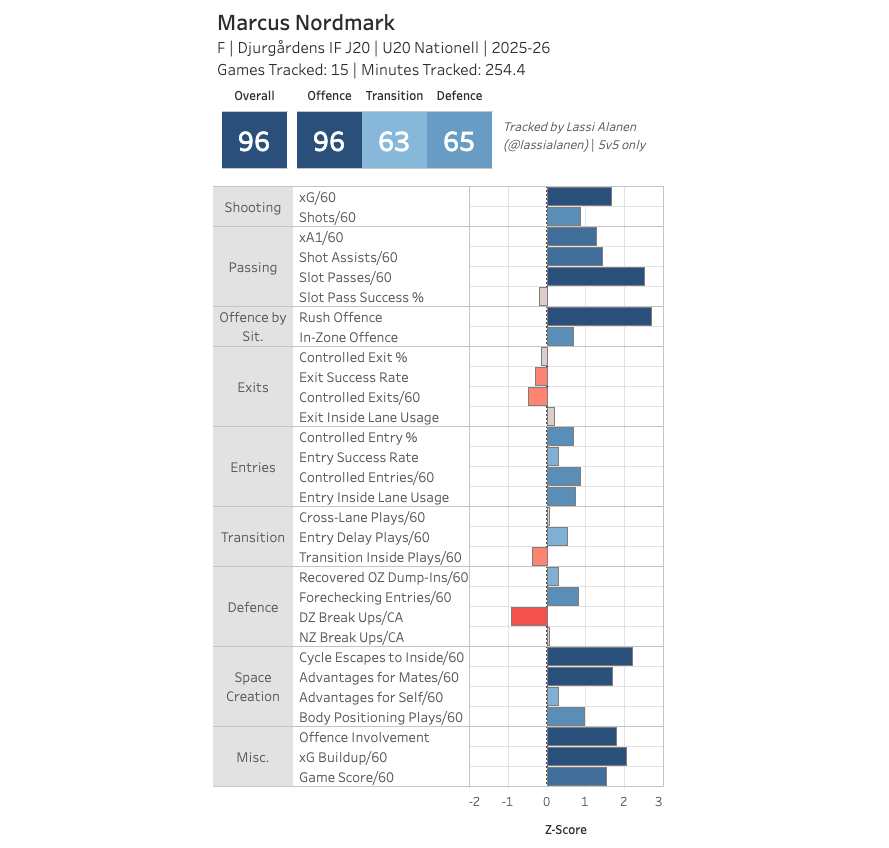
On the other hand, the weak motor, lacking physical play, and limited play-driving could also end up being crippling flaws and prevent Nordmark from utilizing his offensive strengths. There were already times this season when he had trouble adjusting and creating when the space and time became more limited, notably during December's World Junior A Challenge, which will also be the only tape we have of him playing on the smaller North American surface.
One could look for a stylistic comparison from Arthur Kaliyev, who scored at an elite rate in his draft year and possessed a high-end release and off-puck instincts to match, but whose skating, work rate, and one-dimensionality were always noted as significant concerns. He's played over 200 NHL games over the past six seasons, but has fallen out of favour with multiple teams and mainly been a top-end AHL scorer this season.
Of course, you shouldn't make too many judgments from this. Two prospects are never fully alike, and you should always be very cautious about drawing conclusions about a singular outcome. While Kaliyev's scoring ability was always greater than Nordmark's, the latter arguably brings more as a playmaker and has slightly fewer direct skating concerns.
While he doesn't have to and he's also never going to be the most hard-working player on the ice, though, I think it's reasonable to note that Nordmark won't have a fruitful NHL career if he doesn't make at least some improvements to his physical play and motor, preferably also getting more involved in building up plays from his own end of the ice. His offensive instincts are near-impossible to teach, but it's also true that players with his deficiencies usually don't evolve out of them, either.
If Nordmark can break out of that mould, though, the payoff for a team willing to take the risk could be enormous: a legitimate top-six winger with 30-goal, 70-point upside.