Film Room: Why Wyatt Cullen has entered top-ten pick conversations



In 2024, Wyatt Cullen was playing bantam hockey with his age group in Moorhead, Minnesota, in preparation for the National Team Development Program evaluation camp. He stood 5-foot-4 and was a long shot to be considered for the upcoming season’s U17 team. Cullen was an omission from the 2008-born Americans' Youth Olympics team that won a gold medal and had yet to dominate anywhere outside of bantam hockey.
Fast forward two years.
It’s now 2026, and Wyatt Cullen is a 6-foot-1 superstar who just finished 3rd in scoring at U18 Worlds, earned a selection to the tournament all-star team, and is now publicly considered a potential top-10 pick at the NHL draft in Buffalo. He became a beacon of hope for an NTDP team that’s been thin on talent for a few seasons now.
How did we get here?
Meteoric rise
There are natural movers in every draft cycle: the dominant draft-minus-one players that fade off, the standouts at early international tournaments, and the late risers who appear higher on lists every time you look. Names like Juraj Slafkovský, Mason McTavish, and Beckett Sennecke stand out most as risers in recent memory, players who played their way up draft boards before getting selected in the top three.
As other players in this draft failed to develop high-end skills and put together packages of upside for teams to bet on, Cullen continued to improve, sprinting up lists.
In particular, there are stark comparables in Cullen's profile to Sennecke's: late growth spurts, high-end handling, and a still-awkward feel for edges and body control. The two players have been compared all season by our scouts, and while there are mismatched elements in each of their profiles, the macro-scale similarities are evident. Cullen going third overall feels a bit ambitious, but a top-10 pick may be in the realm of possibilities.
With these players, the ones who climb lists late in the draft cycle, there’s typically an isolated moment that works to shift the public consensus. For Cullen, it was a slow burn, but his initial burst onto the scene came at the CHL USA Prospects Challenge this fall in Alberta. The U.S. team shocked many by winning the event, and it was spearheaded by Cullen’s first real moment in the spotlight. He had only played one regular-season USHL game before the event, a hurried return from injury, but Cullen made it count with three points in the two full games.
Dominant puck possession
If you’ve watched any of the NTDP this year, it probably hasn’t taken long to realize one player has the puck for far longer than everyone else. Cullen’s dominant control of possession begins before he even gets the puck. His head is constantly scanning, mentally mapping the most optimal routes to generate touches for himself. There’s situational skating, too; sprinting into space, using skulling to fine-tune his touches, and appearing in space at the right time. He still doesn’t boast the explosive straight-line speed to blow the doors off opponents to get pucks, so he relies on what he has. Once he’s on the puck, it’s clear he knows he’s the player best suited to control play.
Many high-end players will give pucks away at the end of offensive sprints, as if there’s a timer limiting their length of possession. Not Cullen. In the offensive zone, he’ll start with a high-slot east-west roll, one with a handful of potential outcomes. If he doesn’t find a read to exploit, instead of burying the puck, he faces up to pressure and looks for a half-wall sequence, simply shifting his ice geography instead of quitting on a sequence. These are complex ways to attack the game, ones that he can typically pull off with his handling skill. More on this later.
Dynamic attack patterns
Even with his adaptability to analyze defensive posture and counter coverages in real time, Cullen still has his favourite rush patterns to default to. Upon entry on the right wing, his off-hand, Cullen will drive hard, pull into the high slot while placing the puck in a deep hip pocket, and rip it back against the grain through the defender’s triangle. It’s a deceptive scoring pattern that’s hard for goalies to pick up; he crosses the royal road, disguises from a triple threat position, and gets a natural flash screen from the defender.
Cullen pairs inside handles with a high crossover rate when transporting pucks into the middle of the ice. His mechanical base, while still a bit awkward, is going to continue to do him favours in pro hockey; the freedom of movement in his top hand, combined with his heads-up scanning, allows Cullen to react to coverages in real time and instinctually dart in any direction necessary. We feel strongly that his ability to access the middle of the ice and react to defensive posture will make him a dangerous transition threat in the NHL.
Carrying pucks off the wall
In the offensive structure of the modern NHL, and particularly in the playoffs, the team that can repurpose the most pucks from the perimeter into the middle has all the power. Hockey has quickly become a game of spacing and real estate, the best players accessing the highest priority ice consistently through carries and passes. In our Head of Scouting Mitchell Brown’s tracked data sample, Cullen was one of the most dominant players at accessing the middle lane both in transition and off the cycle.
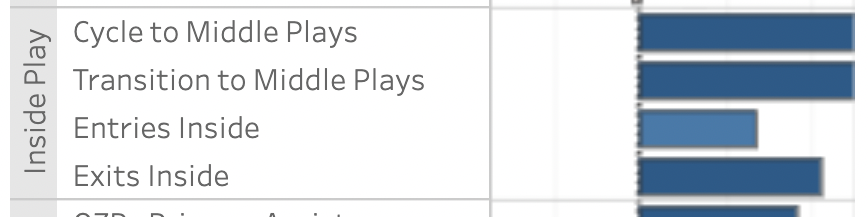
His dynamic heads-up posture allows him to compute a mental map of the ice in real time. With his feet moving, Cullen can counter sticks and feet with his handling, manipulating checks out of lanes to either skate or pass through. This will get exponentially harder in professional hockey, and there’ll be times he has to play a more streamlined transition game.
Developing a physical game
Among our scouting team, and likely through NHL scouting rooms as well, the unanimous agreement is that Cullen is missing a consistent contact game. The moments of proactive contact, calculated pressure absorption, and finished hits are few and far between. It limits Cullen's touches in the area from the hashmarks to below the net. As the pace comes down, Cullen can be quickly neutralized by heavier defencemen.
Still, our team has optimism that his offensive game will round out. Towards the end of the year, and especially at the U18s, we began to see him try more manoeuvres on the wall to create advantageous space.
It’s a work in progress, but it's evident he’s beginning to learn situational contact and how to deploy his body. Cullen’s frame is extremely slender at just 172 pounds, and he battled injuries all year, so he earns a bit of a pass as he still feels out physical play.
Streamlining his offensive game
The NTDP has developed for the hockey world some exciting archetypes of players in the past decade, but perhaps none more frequent than the “try everything imaginable” forward. Cullen is the latest in a healthy line of American forwards that will pair one handling move after another, putting together wild sequences with varied results.
There’s no question that his game will have to simplify to play up lineups in professional hockey, better picking his spots. It isn’t rare to watch Cullen handle into insurmountable traffic, biting off far more than he can chew. Still, our team believes in betting on the special qualities, expecting the rest to iron out.
What could the path look like for him?
Wyatt will spend at least one season at the University of Minnesota under new Head Coach Brett Larson (and his father, Matt, as an assistant). The Gophers have found success ironing out issues with other prolific forward prospects like Jimmy Snuggerud, Matthew Knies, and another fellow NTDP kid that loves to try every move in the book, Logan Cooley.
Cullen’s physical development should be priority No. 1 for the program and player, consciously focusing on adding strength. College Hockey has developed the moniker as the go-to league for adding the strength, speed, and stability to handle the rigours of the pro game. His skating could use an extra level of pop with a little less awkward flailing of the limbs, too, but the reality is that it will improve quickly. It’s a strong case study moment with Cullen.
There isn’t much preventing Cullen from becoming an impactful NHL offensive player at this rate. He’s done all he can, proving himself as a positive-trajectory prospect all year long. Now it’s up to the National Hockey League to take a chance on him.