Elite Prospects final 2026 OHL Draft top 100 ranking



With the 2026 OHL Priority Selection mere days away, tension is mounting over who the Oshawa Generals will select with the first overall pick.
A wide-open draft class with little if any consensus became even more wide open after news broke that Kade O’Rourke was not granted exceptional status to enter the OHL as a 15-year-old for next season.
There’s no shortage of talent in the province, but there's also the absence of a clear-cut front-runner at the top. There was almost no consensus at midseason, and little has changed since.
With O’Rourke out of the race, a pair of centres emerged as first-overall contenders in the two months since the OHL Cup ended: Kane Cloutier, the draft’s fastest riser, and Tanner Adams, the high-octane, punishing model of consistency.
Adding a layer of complexity is how high OHL teams will draft U.S. players this year. Several elite Americans with OHL eligibility were picked late in the USHL Futures Draft, typically a good indication that they intend to report to junior teams north of the border.
And in the final weeks leading up to the draft, a third, even more intriguing name emerged as an option at first overall: Defenceman Drew Daley.
Daley, who was ranked second overall on our 2010-born American ranking released back in April, has already committed to the U.S. National Team Development Program for next season. It’s exceedingly rare for a player to commit to the program for their U17 season and then depart for the OHL before playing a single game (Antonio Stranges is the most notable example of this in recent memory).
As fascinating a story as Daley going first overall could end up being, it wasn’t something our team could consider for our final board. To avoid overlap with players in the already-released USA 2010-born ranking, our team opted to rank Ontario-based players and only Canadian-born players playing in the United States, a major change from our midseason ranking that included all OHL-eligible Americans who had played major tournaments in Ontario at that point in the season.
The result is a board that looks vastly different from six months ago, but one that we hope better reflects the talent and upside in this class, with a full season’s worth of viewings, insight, and opinions under our belt.
As a reminder, this is not a mock draft but a ranking that emphasizes long-term upside and considers role, certainty, and opportunity as we attempt to project these players to the OHL.
With all that out of the way, here is our final top 100 ranking for the 2026 OHL Priority Selection, which will be held June 12-13 in Kingston. You can access a downloadable copy of our list by clicking here.
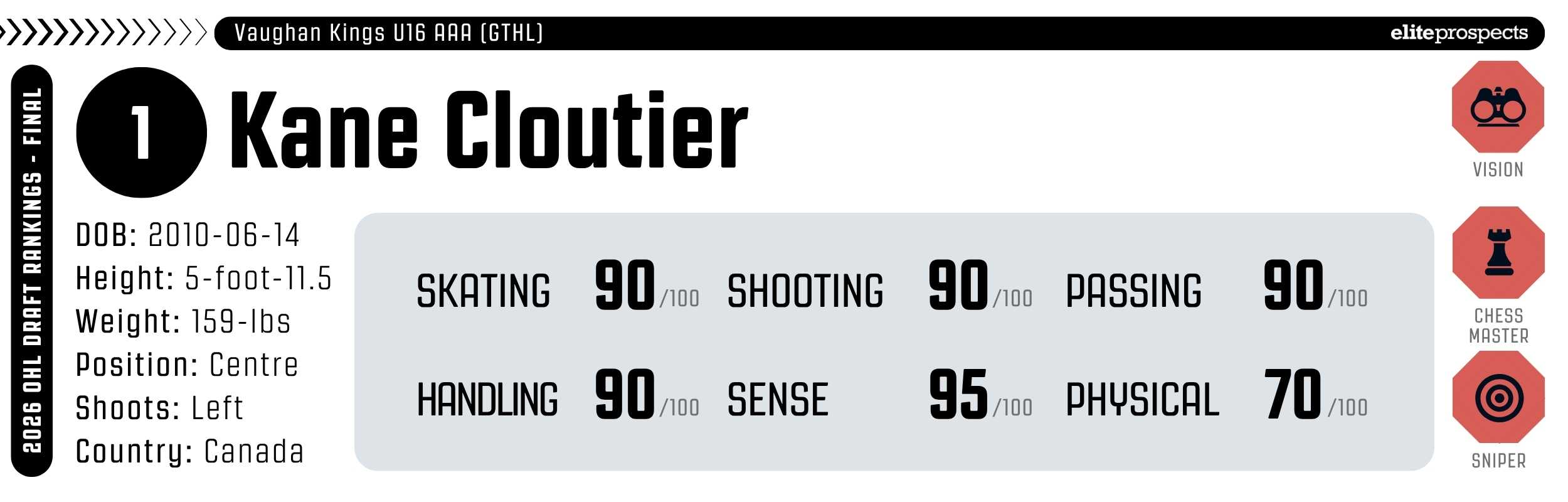
How does a prospect who was ranked 18th at the midseason skyrocket to first overall less than six months later?
We always believed in Kane Cloutier’s elite vision and toolkit; we were just waiting to see him put it all together. And it was worth the wait. He was far and away the best U16 player in Ontario in the second half of the season. The wide-open draft class played to his favour: While other prospects maintained their levels of play or regressed in the final months of the season, Cloutier took his game to new, exciting heights.
Combining his dynamic playmaking vision with improved effort on every shift made Cloutier’s dual-threat abilities unstoppable. He leveraged manipulation and deception on every attack, sought the highest-value plays, and executed with lethal precision, controlling the game with ease. Elite crossover use and pace changes allowed him to attack inside lanes regularly, fool defenders as he dragged pucks through traffic to space, and create high-end plays as frequently off the rush as on the cycle.
Cloutier helped lead his Vaughan Kings squad to a GTHL championship to cap off a phenomenal spring. With the highest upside and most well-rounded, elite skillset in the class, he’ll drive play in the OHL in a top-line centre role. All he has to do is maintain this level of pace and effort, and he could ascend to superstardom.
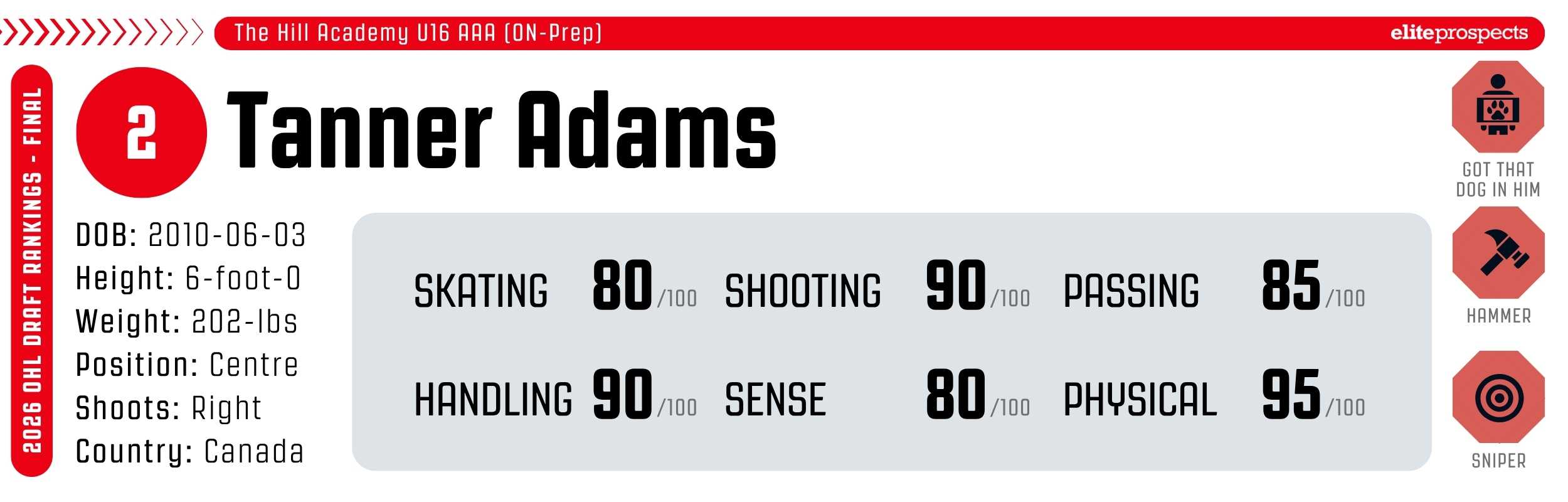
With unmatched pace and competitive drive, Tanner Adams nearly beat out Cloutier for first overall on this ranking – one vote separated the two. Cloutier’s elite offensive upside ultimately won out, but make no mistake – Adams is a true first-overall calibre talent in this class.
An elite goal-scorer, Adams picked goaltenders apart in the second half of the season. He bulldozed his way past defenders on the rush, initiating early contact, before driving into space to unleash his powerful wrist shot or crash the net for rebounds. Without the puck, he was a wrecking ball on the forecheck, charging after puck carriers, hammering them into the walls, outworking them in battles, and winning possession back.
If there’s one question mark to Adams’ game, it’s how high-end his playmaking is. However, he already flashes deception on his carries and the ability to manipulate gaps. It’s just a matter of consistency, something we believe that he’ll find in the OHL alongside better linemates.
Adams is built for the big moments and the playoffs. Amongst our staff, there were no doubts about his translatability, and that alone makes him the highest floor prospect in the entire class. It won’t take Adams long to become a play-driving No. 1 centre in the league. When you factor in his scoring skill, overwhelming pace, bruising physicality, and his potential to add a better playmaking dimension, he could very well end up being the best OHL player in this class.
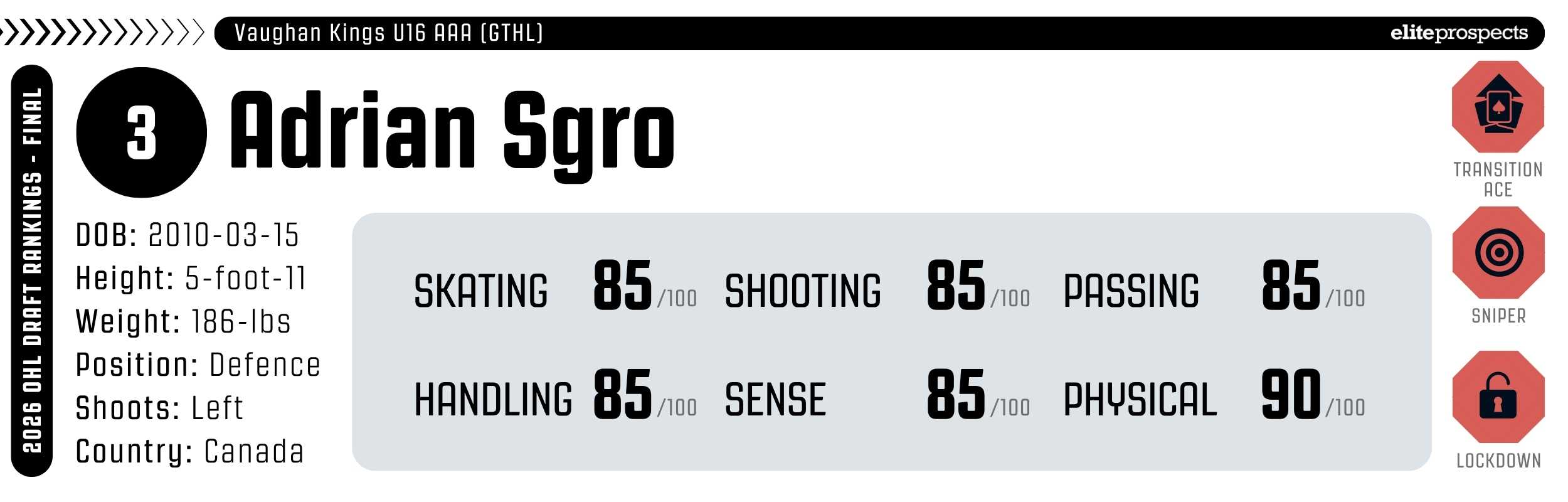
Wire-to-wire, Adrian Sgro was the highest-ranked defenceman on our board, and for good reason. The dynamic skater can create ample separation in transition, beat layers of pressure with his breakout passing, and is one of the most competitive players in this entire class.
An all-around workhorse and minute muncher for Vaughan this season, Sgro showed so many different, intriguing tools. His hands on retrievals are slick, which allows him to turn up ice with room to gather speed early in the breakout. His ability to leverage physical tools and his strong lower-half allowed him to nix cycle plays, and his ability to read the offensive third led to many dangerous chances from up top, and timely activations to keep pressure on opponents at full throttle.
The only question concerning Sgro is how much room there is to continue filling out his frame. If he is closer to being tapped out physically, that may impact him down the road when his NHL Draft year comes around. For now, our staff has zero concerns about projecting his game to the OHL.
When the lights got brighter, so did Sgro’s play. On the Vaughan Kings' march to the GTHL Championship and into the OHL Cup, his game reached new heights, and his consistency only improved. He should be an immediate difference-maker stepping into a top-four role next season, with longer-term potential as an all-situations, No. 1 defenceman.
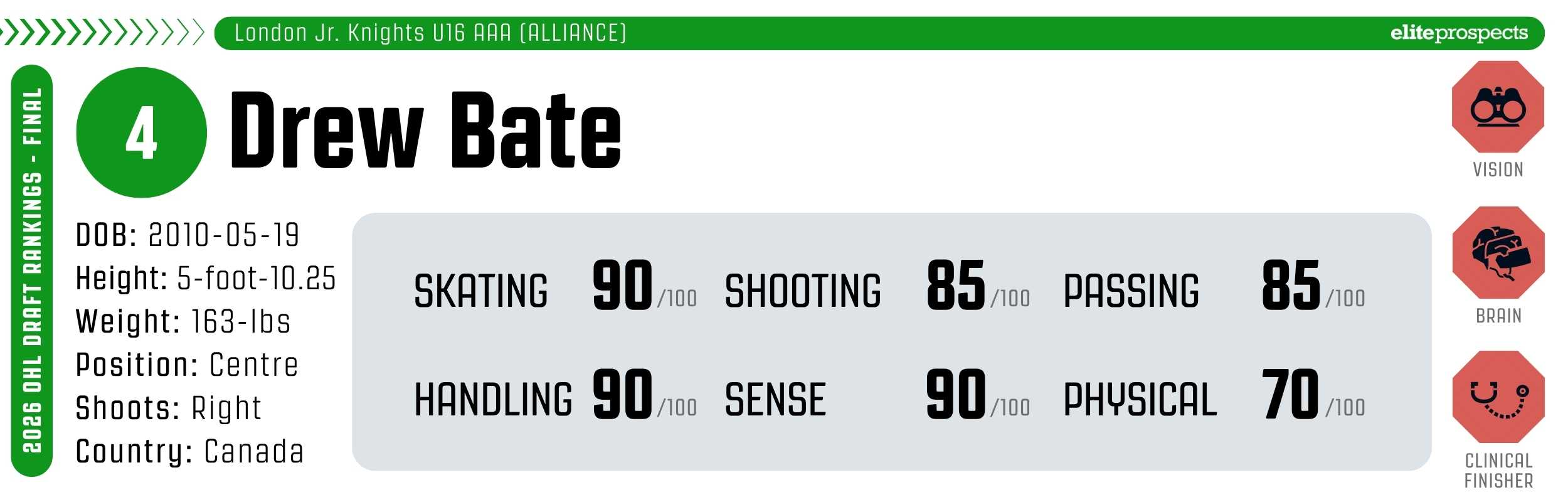
Virtually unstoppable in both league play and at major tournaments this season, Drew Bate led the London Jr. Knights to an ALLIANCE U16 championship and a semifinal berth at the OHL Cup, racking up points wherever he went. His dynamic, dual-threat scoring abilities and versatility as a rush and cycle creator proved too powerful and overwhelming for many defenders to contain. As a result, he held onto his fourth overall midseason ranking.
Calm, cool, and collected under pressure, Bate controls the game like few others in this class. A masterful and tactical playmaker who layers pace changes in transition and cutbacks on entries to adapt to coverage changes, he can thread the needle through the tightest of seams. Undersized but undeterred, he’s far from a perimeter player, frequently working the inside lanes and the dirty areas around the net, where he can leverage his clinical finishing abilities.
As an undersized centre whose physical game is still developing, Bate may slide further on draft day compared to where we have him ranked. However, it would be a mistake to overlook and discount a player who possesses such dynamic pace, vision, and game-breaking ability – he’s a future play-driving top-line centre. Whichever OHL team chooses to bet on his skillset should be reaping the rewards of his talent in just a couple of seasons.
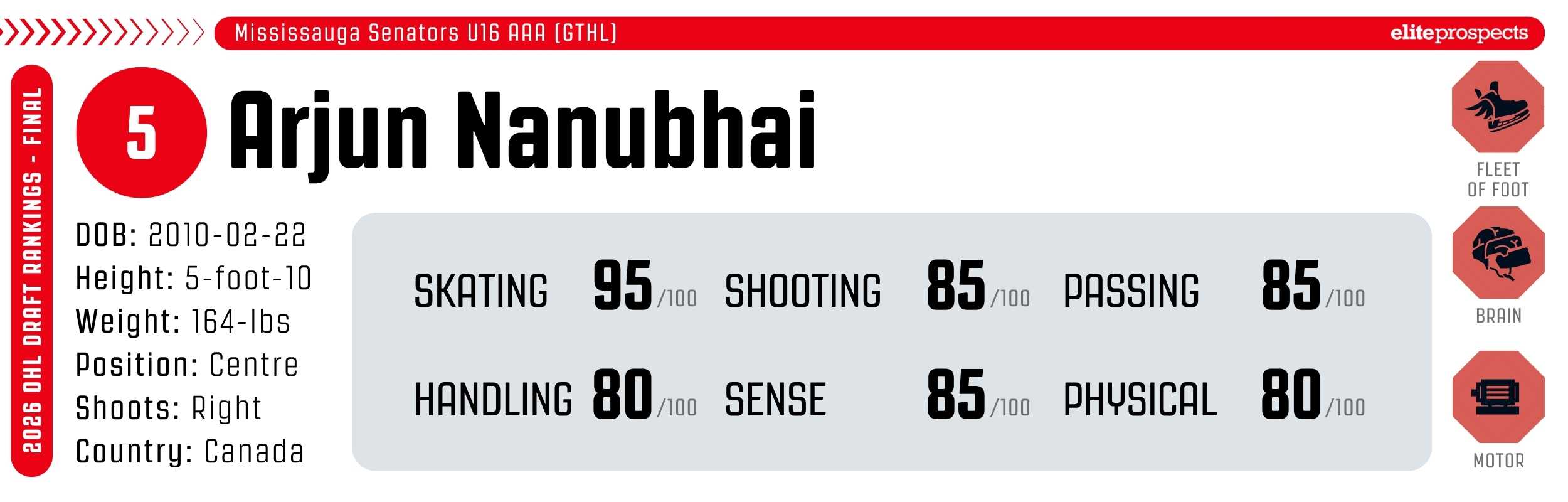
Arjun Nanubhai’s fall from first to fifth says more about other players raising their stocks than any shortcomings on his part – he’s still a worthy top-five talent in this draft class.
With a game built on explosive skating and acceleration, Nanubhai creates most of his offence off the rush, where the threat of his speed forces defenders to back up. As the season progressed, he incorporated more pace changes into his rush attacks, rather than always playing fast, stopping up at the top of the circles to deliver cross-seam passes or find the trailer.
What differentiates Nanubhai from many skilled forwards is his willingness to give up possession just to win it back on the forecheck. He places pucks in areas where only he can get the first touch, and absorbs contact well to maintain inside position on defenders.
Nanubhai consistently elevated his game against the toughest opponents at every major tournament. With an elite combination of hard skills and finesse, he’ll be an impact top-line forward in the OHL, whether he stays at centre or shifts to the wing.
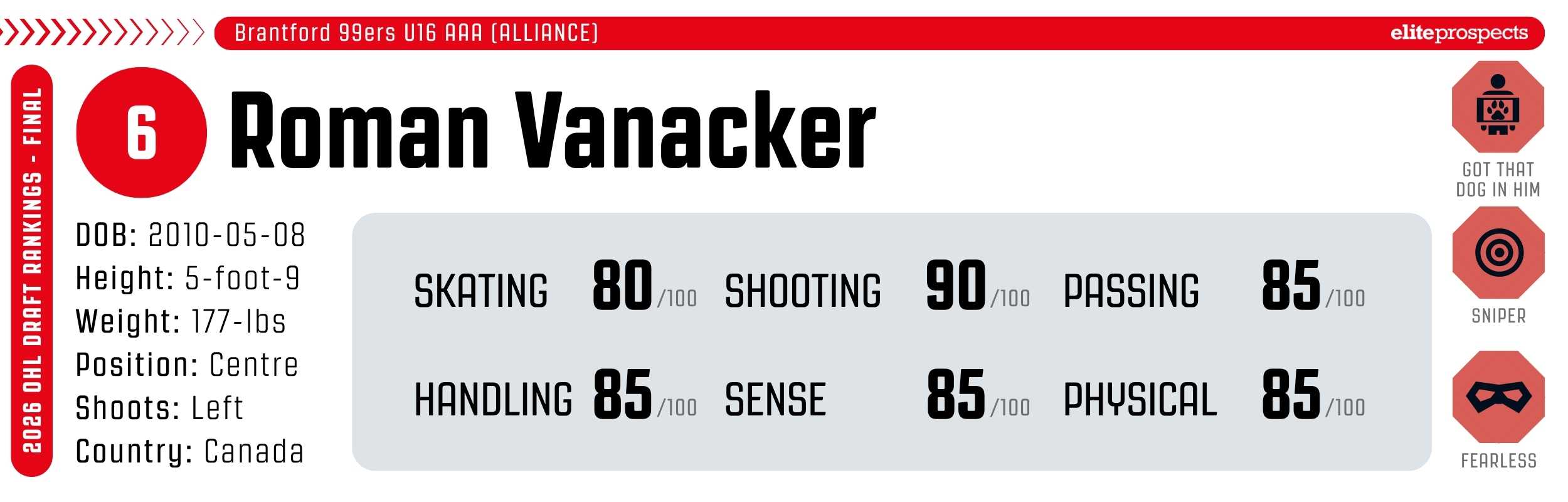
A power- and pace-driven offensive force, Roman Vanacker jumped into our top-10 after finishing just outside of it at midseason. He blends high-end skating with an unrelenting, attack-first mentality, making him one of the most formidable transition players in his class.
Vanacker explodes through the neutral zone with low, sturdy strides, consistently pushing defenders back before deceptively cutting through them. Unlike many players who expend energy off the rush only to play the perimeter, he weaponizes his pace, attacking inside lanes, driving the middle, and forcing breakdowns through contact, deception, and subtle manipulation of defensive gaps. Without the puck, his pace doesn’t stop – he’s quick to establish the forecheck, using his lower-body strength to win battles along the wall.
An elite finisher, Vanacker generates tremendous power on his release. The puck explodes off of his stick, and with a bevy of releases in his arsenal, he can beat goaltenders from distance or in tight. If shooting lanes aren’t available, he has the strength and edgework to shift inside and drive the net.
An underrated playmaker with impressive, high-end flashes, Vanacker could unlock dual-threat scoring ability in the OHL. Combined with his motor and physicality, he projects as a high-tempo offensive driver with top-six scoring potential.
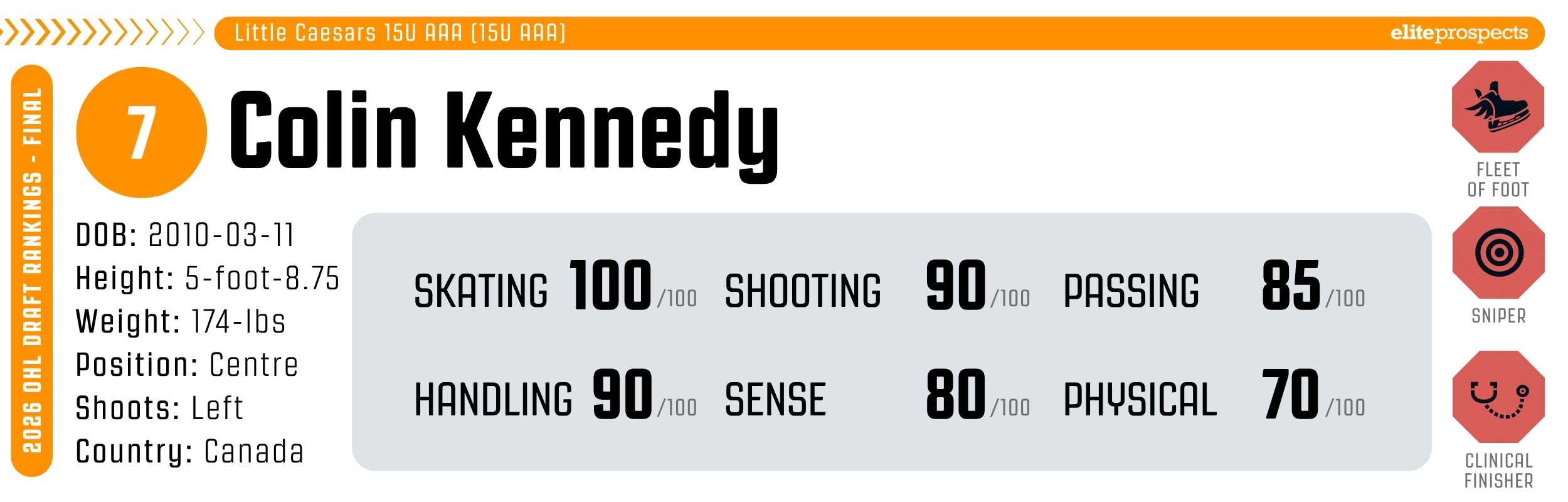
Colin Kennedy soared into our top-10 with a strong finish to the season, jumping eight spots from January, and could go inside the top-three on draft day.
Attacking defences at lightning speed, Kennedy is the fastest player in this draft class, bar none. The only player on our ranking to earn a 100 grade in any tool, he dominates the transition game, thanks to his explosive feet and hands that more than keep up. He catches passes in full flight, hits passing targets in motion, cuts through the hands of defenders, and barrels into open lanes.
Lack of size and elite-level hockey sense were the only two things holding Kennedy back from pushing for a top-five spot on this ranking. As special as his skating ability is, the shortest player in our top 10 at a shade under 5-foot-9 doesn’t quite possess the level of vision and playmaking that Bate and Vanacker have.
However, Kennedy’s elite skating should allow him to overcome any physical deficits next season, and his arsenal of high-end shot releases should help him to score immediately in a top-six role. To become one of the best scorers in the league, he must continue to round out his physical game, leverage his checking instincts and battle efforts more frequently, and add more dynamism to his playmaking.
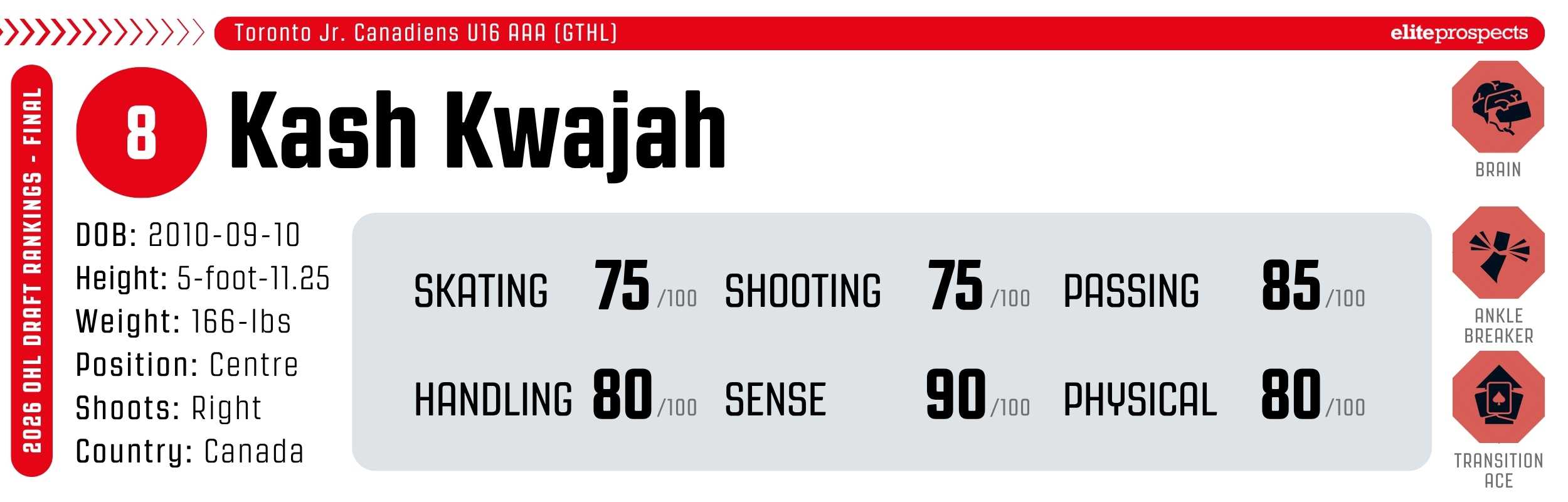
The GTHL Player of the Year, Kash Kwajah, can pull fans out of their seats with his dynamic puck skills and evasive manoeuvres.
A strong scanner who frequently surveys the ice before touching the puck, Kwajah plays fast, reading developing plays quickly and manipulating defenders regularly. He accelerates into his first touch to push the defence back before hitting the trailer or shifting east-west to draw defenders before slipping a pass to the weak side.
An unorthodox, bent-over skating stance sees Kwajah rely heavily on his edgework and head fakes to deceive defenders by baiting one way before shifting weight to attack the other. Hip-pocket handling allows him to carve through defensive structures with ease as he frees himself from pressure to shoot or pass.
High-end offensive vision and the ability to make plays at pace make Kwajah one of the highest upside bets at the draft. Adding more lower-body power could help him turn his skating into a legitimate strength as he makes the OHL jump, where he has all the tools to drive play as a top-line scoring centre.
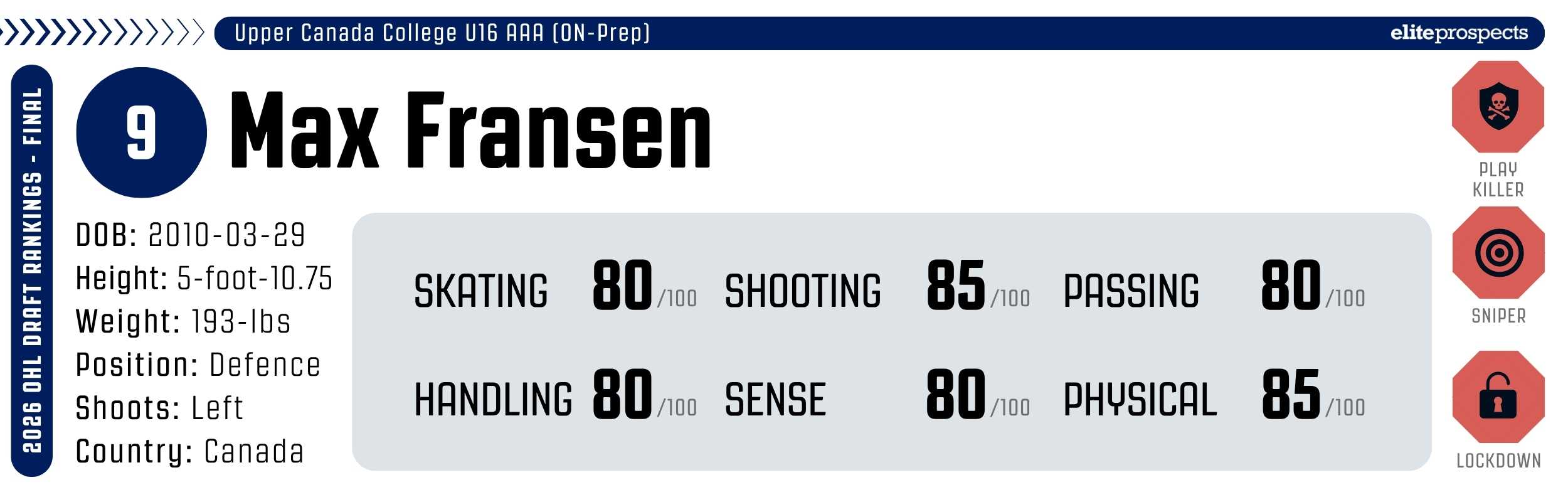
There was no bigger riser from the midterm than Max Fransen, who jumped a whopping 29 spots from 38 to nine.
Fransen lands inside our top 10 thanks to his ability to transition the puck with ease and contribute immensely in the offensive third, while taking care of his own end every bit as well. Earlier in the season, he struggled to pull pucks off the dasher and read forechecking pressure. Some ill-advised first passes and a focus on being too perfect gave us some pause at the midseason mark. Thankfully, those issues were gone by the second half, as he became a beast on retrievals and breakouts.
Offensively, Fransen has a plethora of elite traits. His 29-goal, 89-point campaign saw him regularly beat goaltenders with a heavy point shot, and he timed his activations off the line perfectly. He kept a ton of plays alive along the half-wall and paired it with the ability to then distribute the puck to middle ice or to dangerous lanes down low.
Fransen projects as an all-situations, top-pairing defender at the next level who will command a lot of attention in the middle of the first round. Should he continue to physically grow, he could take his game to even greater heights.
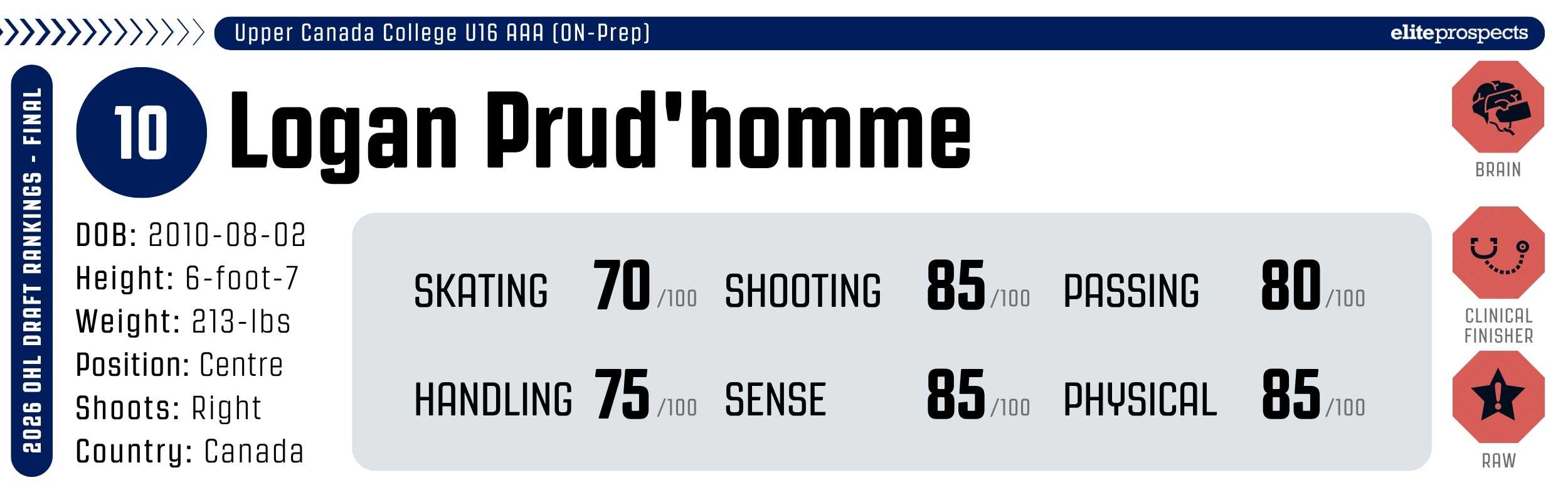
Though our second-ranked prospect at the midseason slipped eight spots, Logan Prud'homme’s unique talents cannot be ignored. A true unicorn with his imposing 6-foot-7, 213-pound frame, his smooth skating and impressive puck skills, in conjunction with his size and reach, make him a legitimate top prospect.
Prud'homme is a skilled playmaker, extremely comfortable with the puck on his stick. He consistently makes difficult passes on his forehand or backhand, adjusting the touch and elevation of his passes depending on the situation. Capable of gaining momentum on the forecheck, once he gets his feet moving, he is almost impossible for defenders to contain.
Within the offensive zone, he finds soft areas of coverage and utilizes his lethal release to score from anywhere on the ice. He still has some fine-tuning to do in his game, and it may take him longer than others to develop into a play-driver, but he projects as an impactful, versatile, top-line OHL forward.
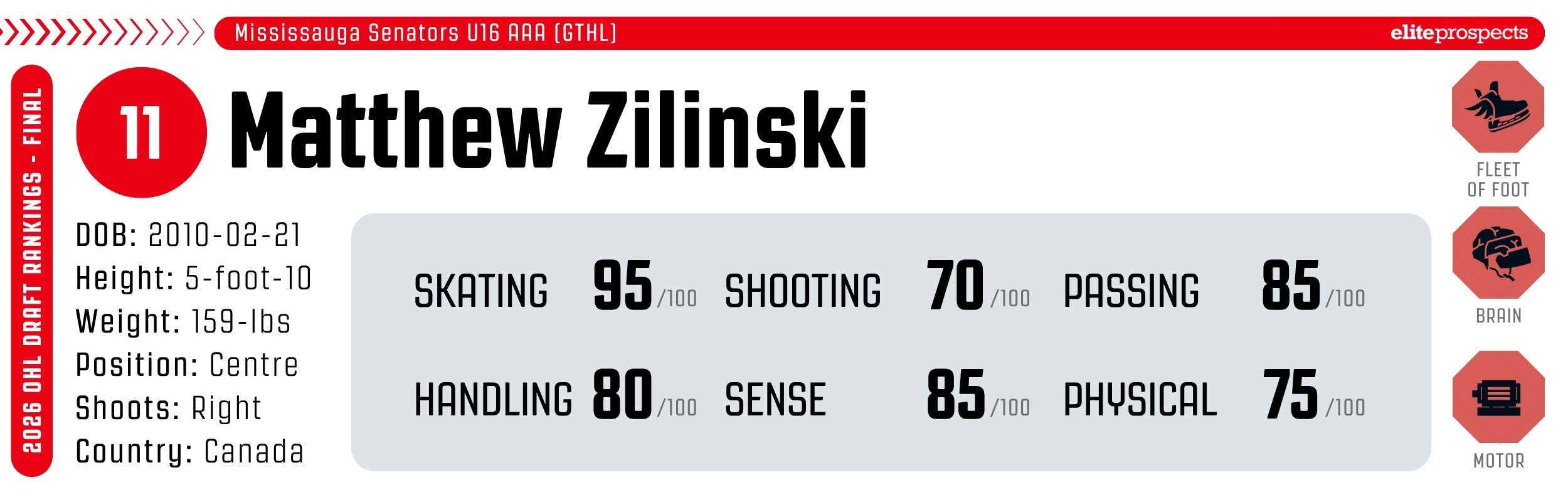
It was a tale of two halves for Matthew Zilinski after suffering a shoulder injury, going from a top-five challenger for the draft to a shadow of himself in limited second-half action. A dynamic, inside-driven attacker, Zilinski draws pressure and passes against momentum to create openings. Below the goal line, his physical skills shine, as he shields pucks with his back, spins off contact, and delivers hook, slip, and sauce passes into the inner slot, playing much larger than his 5-foot-9 frame with a motor that never stops. The injury makes his projection difficult, but a fully healthy Zilinski who can handle the physical toll of being a full-time OHLer is a formidable prospect, a top-line centre who can be relied upon in all three zones and destroy defensive structure with high-end manipulation.

One of the most projectable centres in the entire class, Lauchlan Whelan competes hard in all three zones. With his off-puck routes among the best in this class, he consistently puts himself in a position to receive a pass or provide an outlet. His reads with the puck are so fast that they often catch his linemates off guard with his passes because they cannot keep up. As he moves up levels, we expect his playmaking to improve with faster, smarter linemates. Once he fills out his frame, he should develop into a reliable top-six centre who drives play in all three zones.
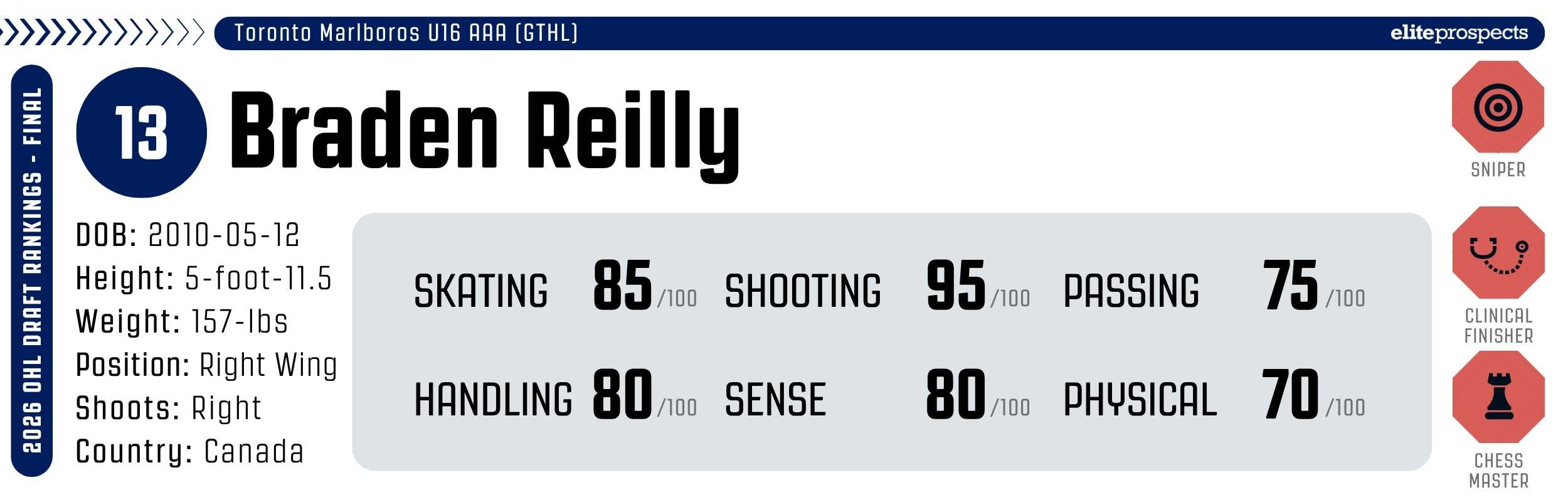
Braden Reilly is one of the most naturally gifted goal-scorers in this entire class. His footwork and balance in his shooting mechanics allow him to rotate his core and transfer his weight into his shot. He maintains good shooting posture even when defenders try to push him off the puck or pokecheck him. An above-average skater who can create separation in transition, he has a knack for producing in the biggest moments. He’ll grow as an offensive force if he diversifies his playmaking, and he projects as an impact top-six goal-scorer at the next level.
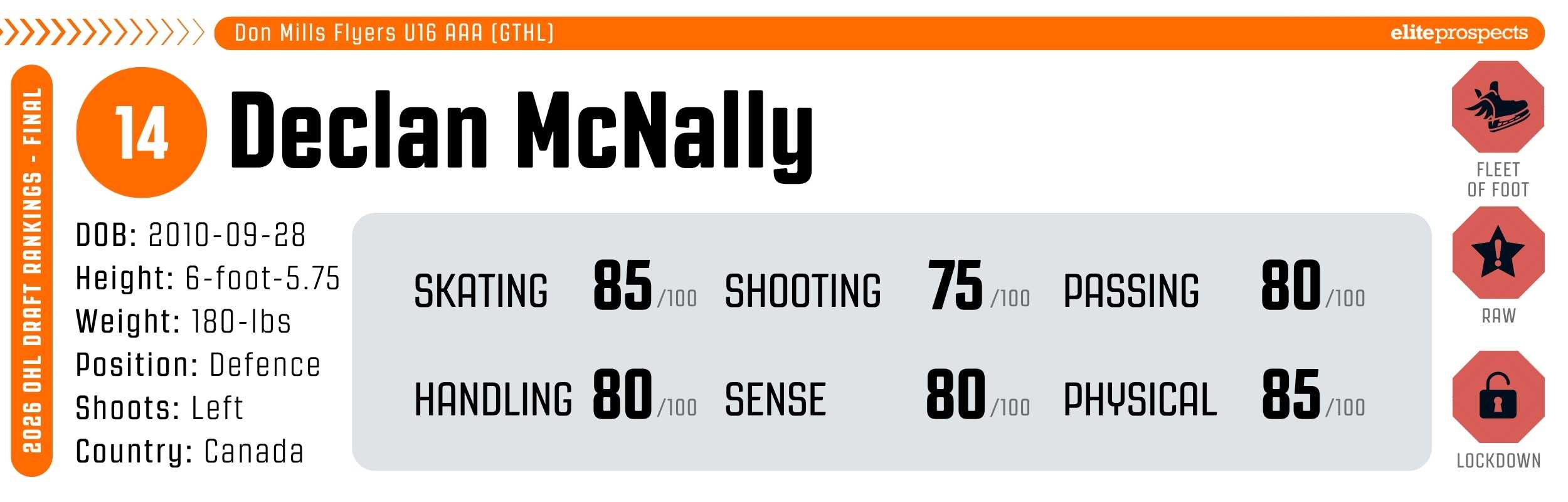
From a strict tools standpoint, there may be no defender in this class as intriguing as Declan McNally. While still raw in many regards, his agile and rangy skating style is very attractive when paired with his near-6-foot-6 frame. Leading rushes routinely, he skated pucks away from pressure and into high-danger areas before contributing to offensive chances low in the zone and in front of the net. While he doesn’t project as an offensive defenceman, he brings enough offensive creativity and ability to project as a top-pairing defender at the OHL level.
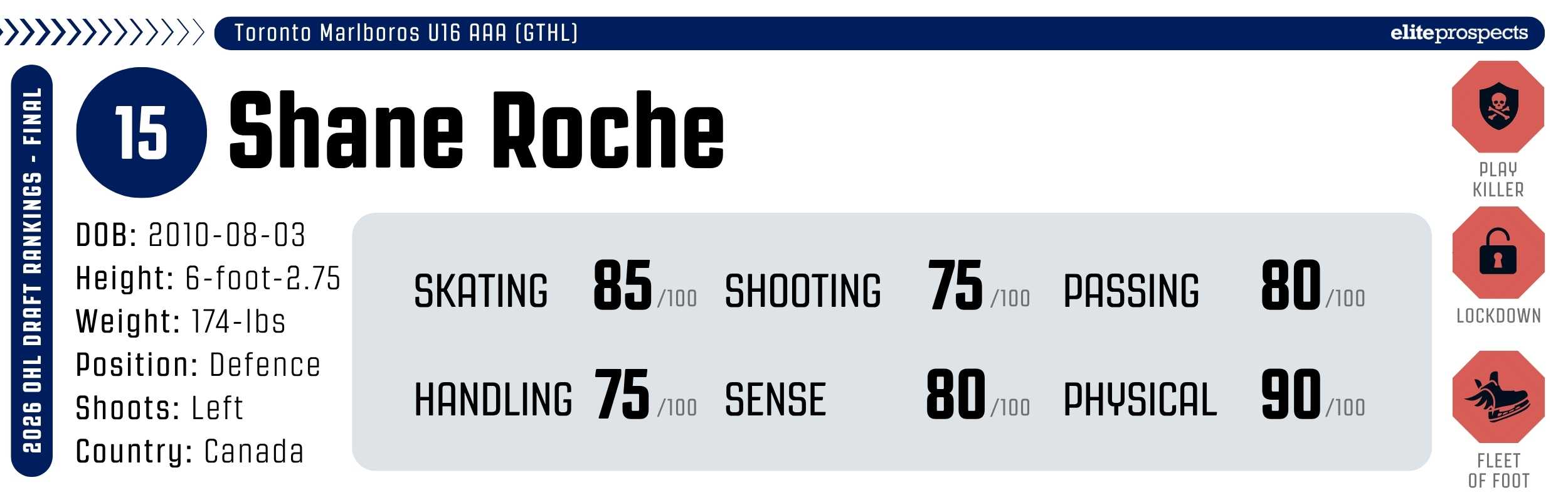
A tall, rangy, puck-moving defenceman is a must on any championship-level hockey team, and Shane Roche checks the box in all of those categories. Simply put: He's a defenceman that a team will simply love to have. Starting the campaign as more of a rush-killing, defensive defenceman, his transition and offensive skills began to blossom with time. He became more confident carrying pucks past initial layers of pressure before making an outlet pass and activating more frequently into open ice, flashing high-end vision and playmaking. If these facets of his game become more consistent, he could have more offensive upside in the OHL, too. Even if that doesn’t manifest, he projects as a top-four defender who will eat a ton of minutes, control the game, and shut down the opposition.
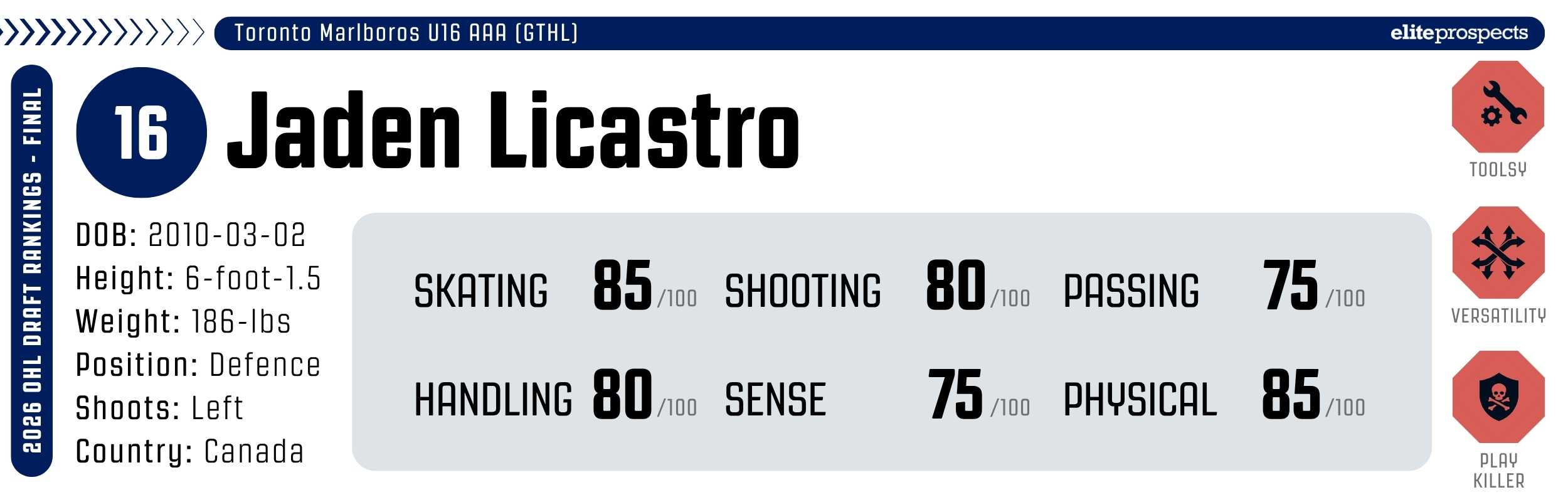
Jaden Licastro was a rock for the Toronto Marlboros, playing heavy minutes in all situations and consistently shutting down his side of the ice. His skating is smooth and efficient, allowing him to maintain perfect gaps and angle attackers into the boards. Licastro doesn't chase hits; he uses an active stick and smart body positioning to separate players from the puck cleanly. The biggest question is his decision-making. When he has a lane to skate the puck out, he looks poised and confident, but things can break down when he is under pressure and has to move the puck rather than carry it. Offensively, he picks his spots to join the rush and has the shot and handling to contribute when he does. He has top-pairing upside, with a middle-pair floor because of his shutdown ability.
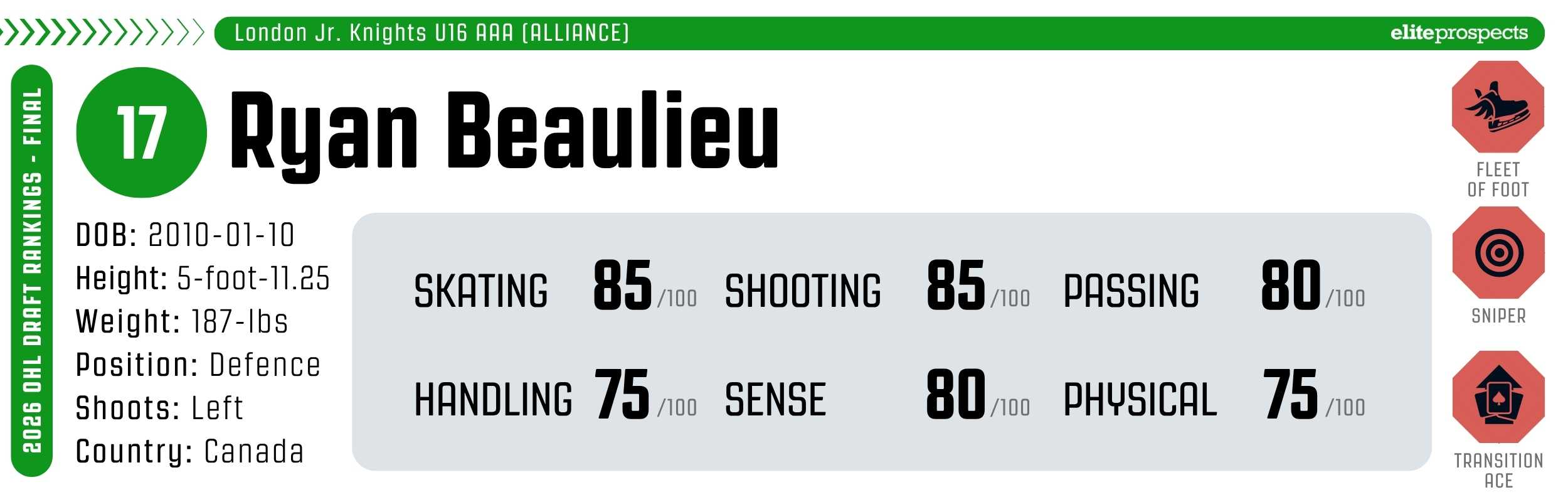
Ryan Beaulieu is a poised, offensively-driven defenceman whose game is built around activating on the puck to create offensive chances. A frequent rush joiner, he excels at getting lost and settling into soft ice as a fourth forward, and also uses subtle weight shifts, head pumps, and smooth edges to evade pressure at the top of the zone and manoeuvre the puck into dangerous scoring areas. His shot is quick, hard, and accurate, making him a dangerous scoring threat at all times. He brings impressively projectable and refined defensive habits as well. It’s easy to see Beaulieu settling into a top-four role with an OHL team down the line with power play quarterback upside.

It's not the size of the dog in the fight, but the size of the fight in the dog. Cole Guizzetti perfectly embodies that sentiment. Listed at 5-foot-5.25 and 151 pounds, Guizzetti combines his low centre of gravity, impressive strength, and high-end work ethic to make for a truly intriguing prospect. Entering board battles, he consistently initiates contact, often executing a strong reverse hit to knock larger defenders off balance and gain inside body position. Creative and skilled with possession, he possesses a wicked slingshot release that he rapidly fires during offensive zone cycles, catching goaltenders off guard with minimal wind-up. While a unique case, Guizzetti projects as a high-energy, middle-six scoring forward at the next level.
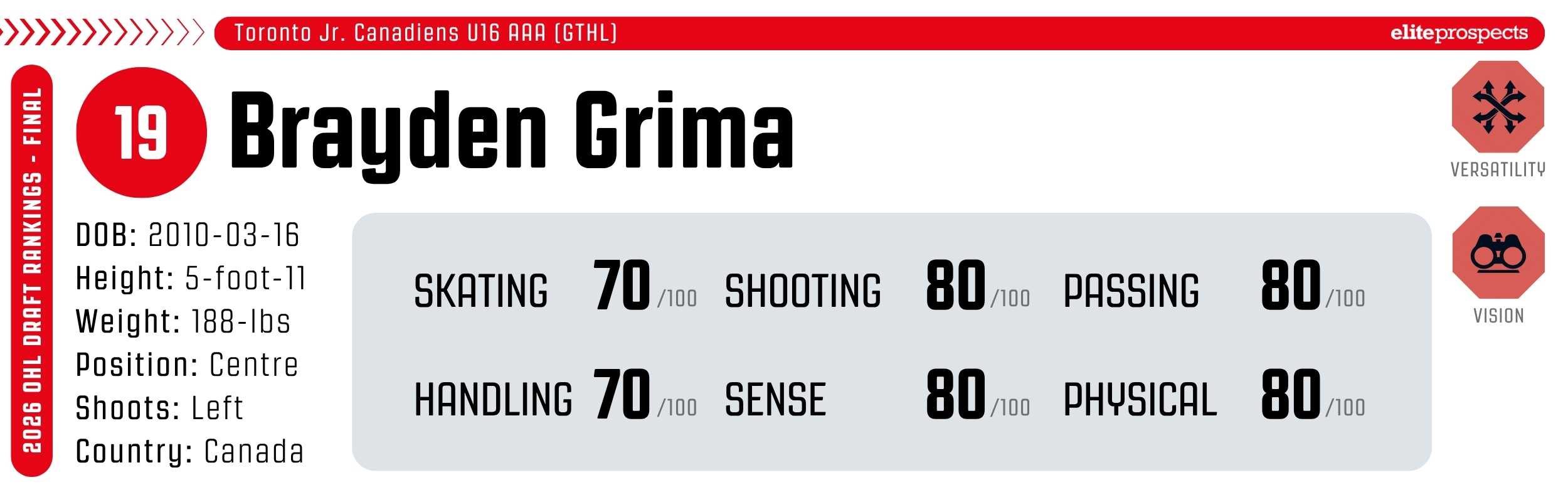
A versatile forward for the Jr. Canadiens, Brayden Grima comfortably projects as a reliable middle-six OHL forward capable of playing up and down the lineup. While not the quickest straight-line skater, Grima excels at utilizing his sturdy frame to absorb contact along the wall before attacking the middle of the ice, executing quick give-and-go plays while driving towards the low slot. He plays a dependable two-way game at centre while seamlessly transitioning to wing when needed. Poised and confident with possession, Grima is equally dangerous with his release as well as a playmaker, allowing him to diversify his attack and adapt to the developing play. His versatile game will lend itself well to a top-nine role in the OHL.
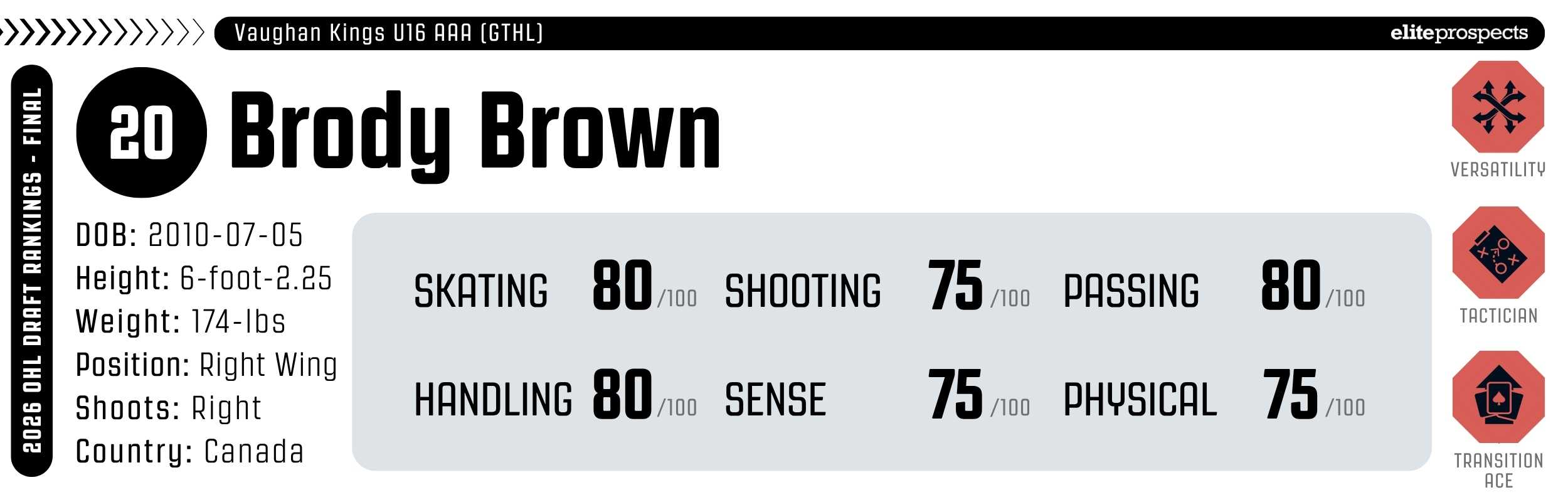
A tall, lanky centre, Brody Brown’s blend of size, quickness, and smarts impressed us all year long. A pass-first, playmaking forward who loves creating offence for his linemates, he was one of the best give-and-go passers in the GTHL this season. His consistent habit of moving after the pass and attacking defenders' backs to free up passing lanes blended seamlessly with his speed and handling in 1-on-1 situations. His game peaked in the postseason, as he was one of Vaughan’s best forwards on their run to the GTHL championship. He projects as a middle-six play-driver, capable of pairing sound defensive work alongside offensive production.

With size and athleticism, Landon Roulston is one of the draft’s most explosive straight-line skaters once he reaches top speed. When his feet are moving, Roulston gets in on the forecheck, disrupts retrievals, and separates defenders from the puck with his size and strength. He has soft hands and good vision, which allow him to set up or finish plays himself. Most of his offence comes in transition, where he can attack the defence with a head of steam. Consistency will be key moving forward for him to realize his top-six scoring upside, but his size, skating, and competitiveness should allow him to fill a middle-six role with little issue.
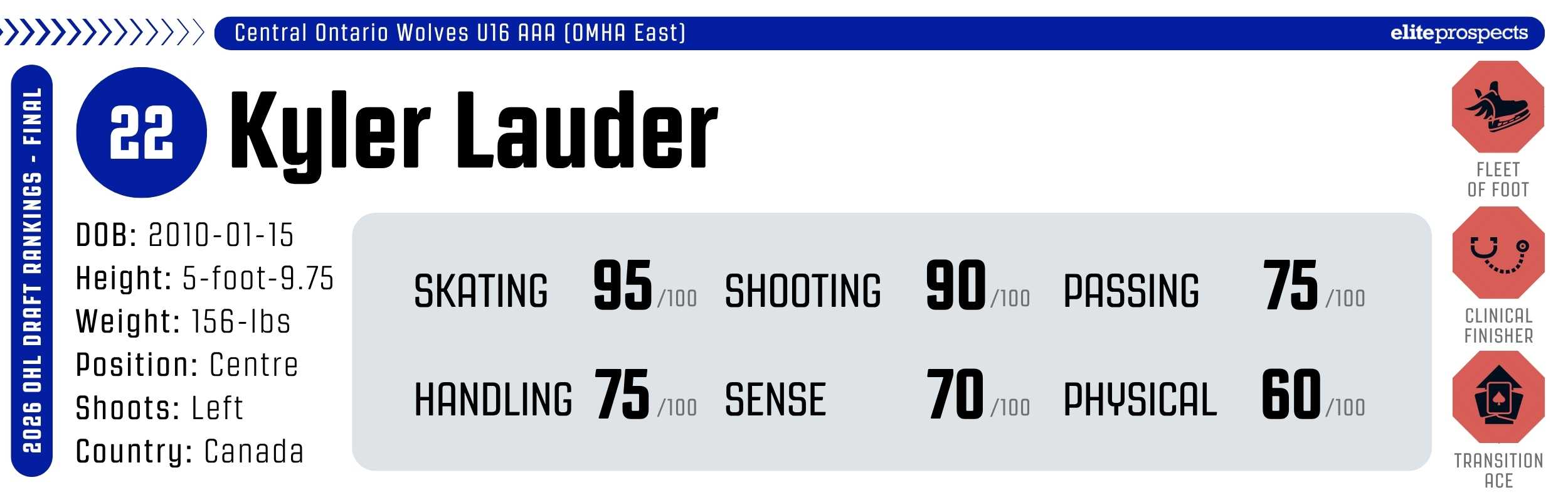
Perhaps one of the most offensively gifted players in the draft with the puck on his stick, Kyler Lauder showed his skill this season as he paced the Wolves in points and shone in big tournaments throughout the year. His explosive acceleration and elite edge work jump out immediately; he constantly looks to get a jump on defenders and gain a step on them off the rush. Mix in his lethal release and rapid puck skills, and you’ve got a highly dynamic offensive weapon overall. Developing more playmaking and relying less on 1-on-1 plays could diversify his offensive range in the OHL, and if he can, he projects as a skilled top-six swinger who can rack up serious point totals.
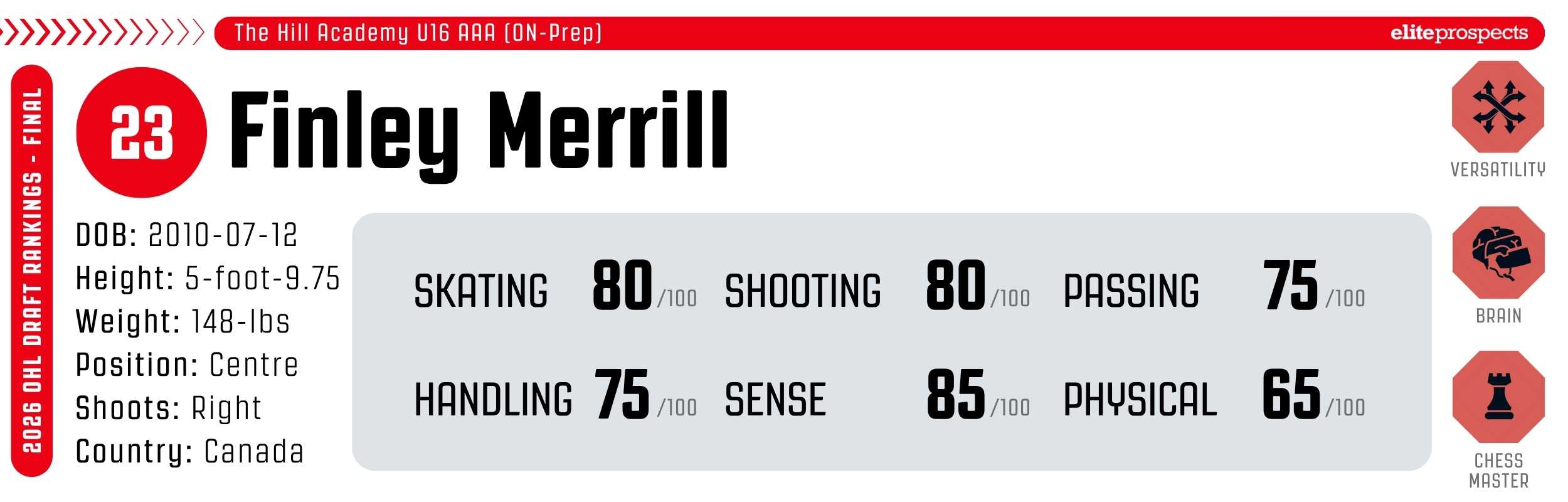
Finley Merrill, who really is a true centre, spent the majority of his U16 season playing the wing with the aforementioned Tanner Adams on Hill Academy’s top line. Merrill’s calling card is his offensive game. He plays way bigger than his size, routinely taking pucks to the net and winning battles at every turn. Though one of the best finishers from the hash marks and down, he still has some room to grow with defensive awareness and his play off the puck. That will come with time. He’ll need to add more strength and pace overall, but his dynamic offensive skills should see him score in a top-six role, either down the middle or on the wing.
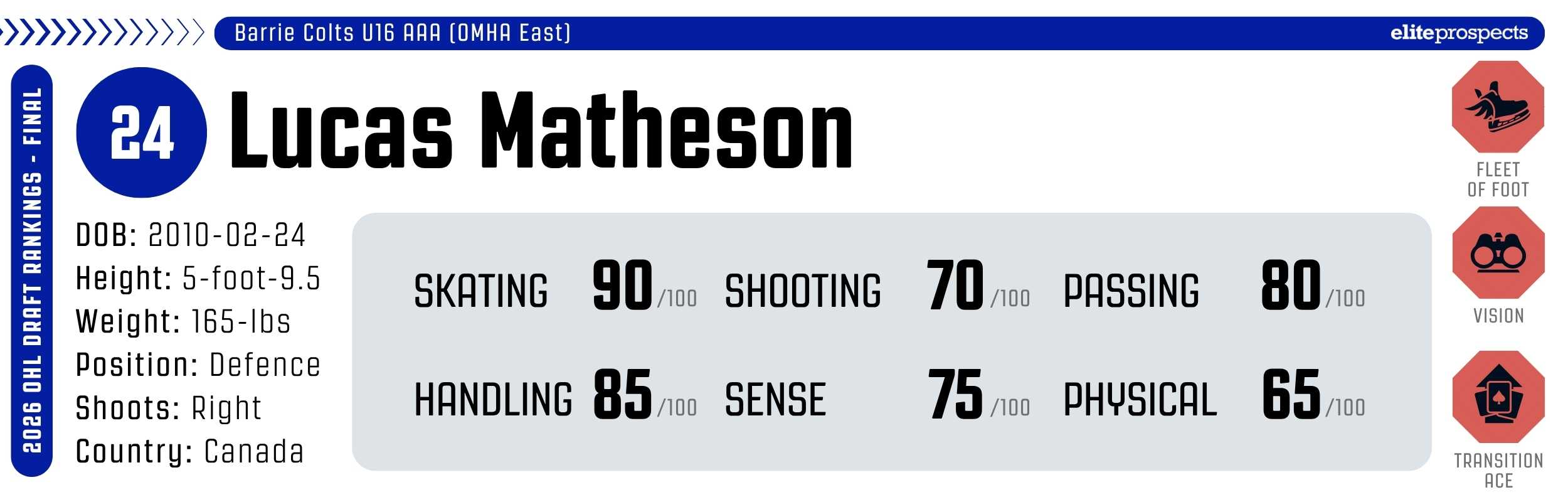
A leg injury in the OMHA Championships prematurely ended Lucas Matheson’s season, and his 13-spot slide down our ranking makes him one of our more noteworthy second-half fallers. With skating remaining his strongest attribute, given his sublime edgework, evasive manoeuvres, and superior technical foundation, he projects as a top-end puck mover who could add even more deception and manipulation to his arsenal to become a true play-driving defenceman and top OHL scorer. His upside hinges on size and strength development – he may have to land in an organization ready to offer him a top power play role right off the bat to leverage his offensive gifts, as he rounds out the defensive and physical sides of his game.
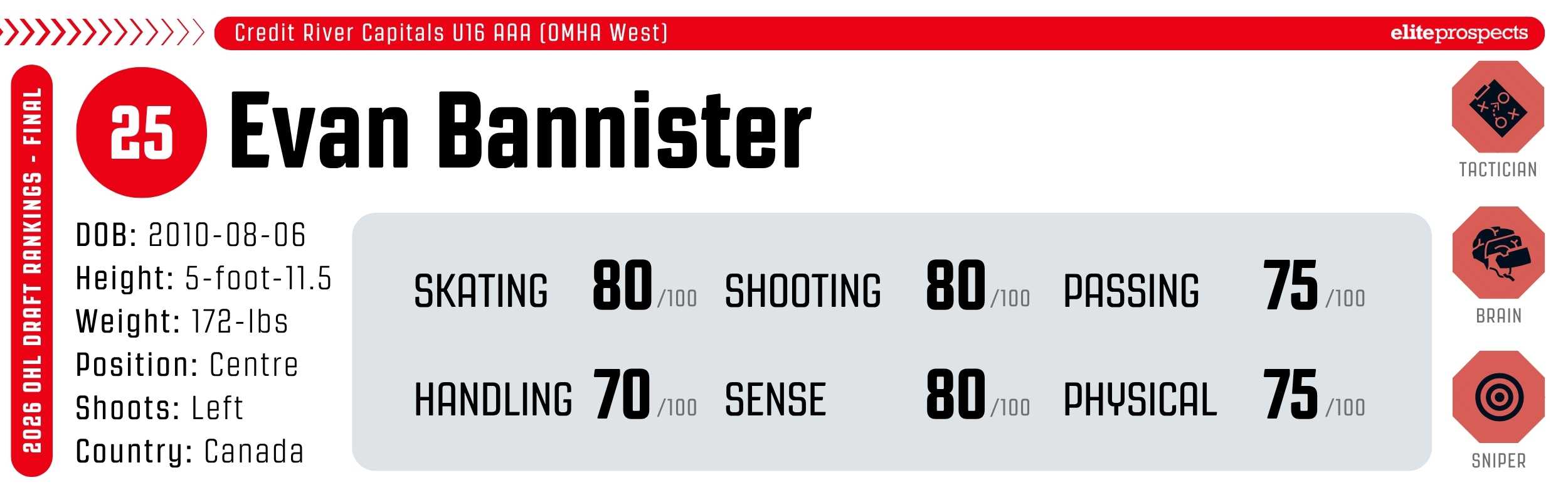
The OMHA Player of the Year, Evan Bannister plays a powerful two-way game highlighted by a natural knack for finding the back of the net, as evidenced by his league-leading 38 goals. Bannister already displays many professional-level habits; he drives the net with his stick on the ice, consistently finishes his checks along the boards, and possesses a lethal release he can get off under pressure. A sturdy centre, Bannister projects as a strong middle-six option who can elevate his performance when the stakes rise, capable of scoring big goals in big moments.

Versatile centre Evan Fitzgerald was the unsung hero on a deep Vaughan team that ended up winning the GTHL championship this season. Fitzgerald was used heavily in a matchup role and for big defensive zone draws, where he was incredibly successful. That sort of profile doesn’t scream top-30 player, but Fitzgerald’s offensive skill and hockey sense do. He is aggressive yet tactical when applying forecheck pressure, and similarly dominant as a playmaker who works a translatable give-and-go style, while also being a competent down-low and net-front creator. He has top-six upside, and his high motor, high-intensity style should see him achieve a top-nine, two-way forward role.
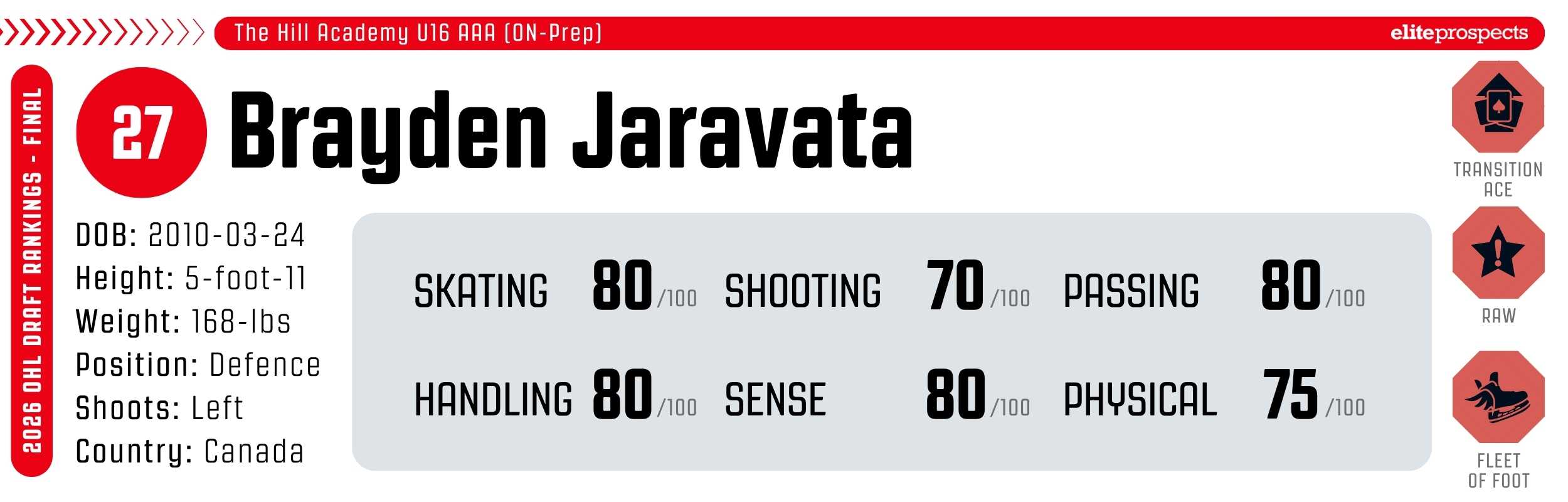
A 13-spot jump carried Brayden Jaravata into our top-30, and for good reason. As the competition grew stiffer and the lights brighter, he elevated his play. His pace, competitiveness, and smarts impact every area of his game. Frequent scanning and the contact skills to shield off forecheckers and buy himself as much time as possible below the goal line see him thrive on retrievals and breakouts. With an aggressively physical style, he consistently keeps threats to the perimeters, and he’s also engaged offensively, finding the available lanes to the net or threading seams to open options down low. Projecting as a two-way defender in the OHL, he should be able to find a middle-pairing role.
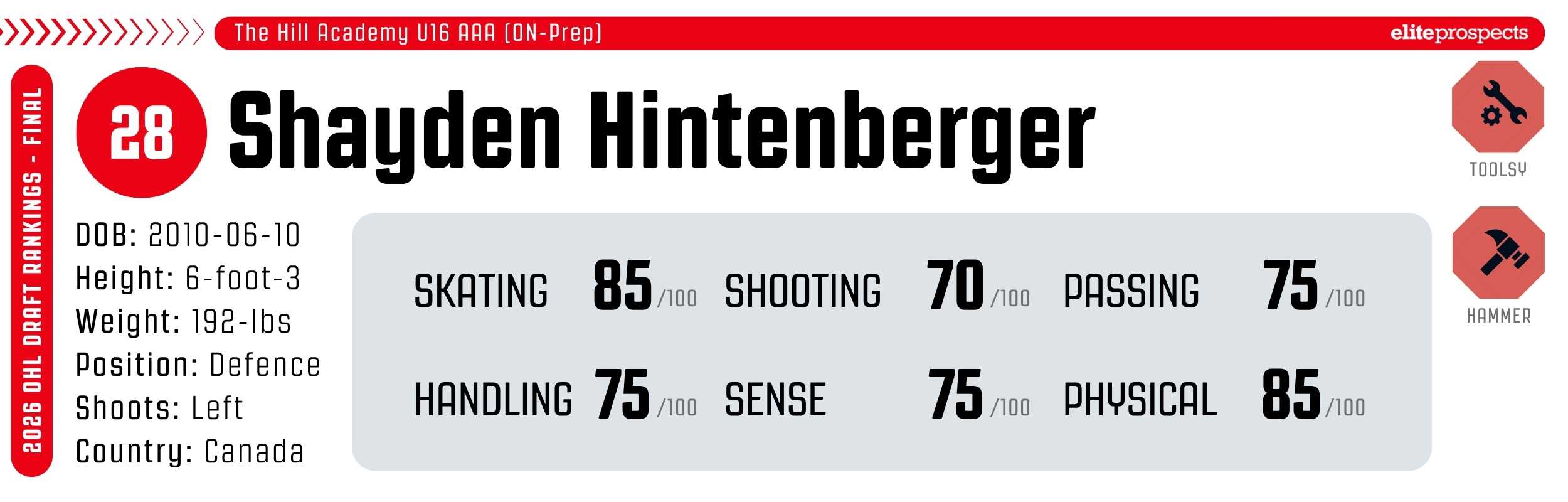
All-around defenceman Shayden Hintenberger was a rock on Hill Academy’s blue line this season. Bringing immense two-way value and great athleticism at 6-foot-3, he’s already an impressive transition player. Equally as effective at moving pucks through middle lanes up ice as he is at locking down the rush and killing plays, his range, intense physicality, and mature style bolster his long-term potential. A likely two-way pivot in the OHL whose defensive skills could see him develop into one of the league’s premier shutdown defenders, while also impacting the scoresheet through transition plays.
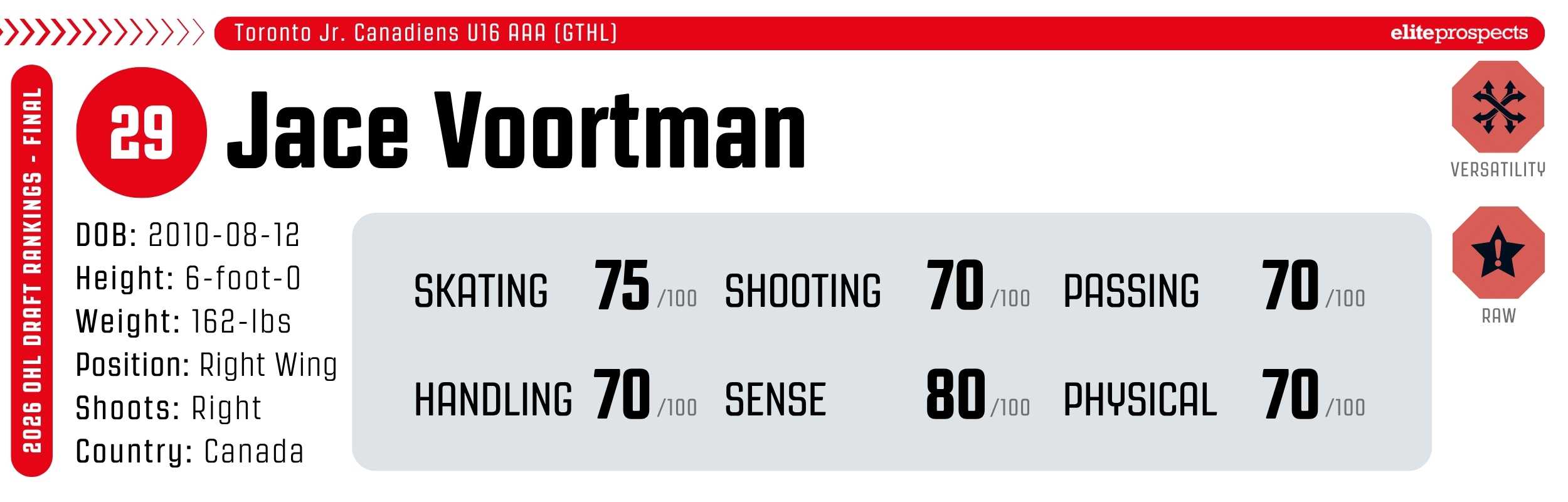
There’s a distinct pro-style element to Jace Voortman’s game that will make him a highly projectable, middle-six OHL forward. Voortman’s well-rounded skillset makes him capable of slotting into a variety of roles, providing the best value on a team’s shutdown line and penalty kill unit. He utilizes a sturdy frame and an intense compete level to proactively win inside positioning along the boards. After a hard forecheck, Voortman drives the middle with his stick down, using strong net-front habits to establish screens, retrieve pucks, and act as a dangerous, high-IQ scoring threat in and around the low slot – capable of contributing to the scoresheet in a variety of ways.

A steady, physical presence on the Blues’ back end, Jay Nimchonok possesses the necessary tools to contribute as an effective bottom-four shutdown defender. A sturdy, right-shot defenceman, Nimchonok excels defensively both off the rush and within the zone, utilizing impressive lateral agility to maintain positioning and force plays to the boards before delivering massive hits to eliminate attackers. Positionally sound, he balances an aggressive, disciplined edge with an effective ability to clear the crease and box out opponents in the low slot. Streamlining his breakouts and handling could improve his upside, but he’s about as safe a projection as it gets.
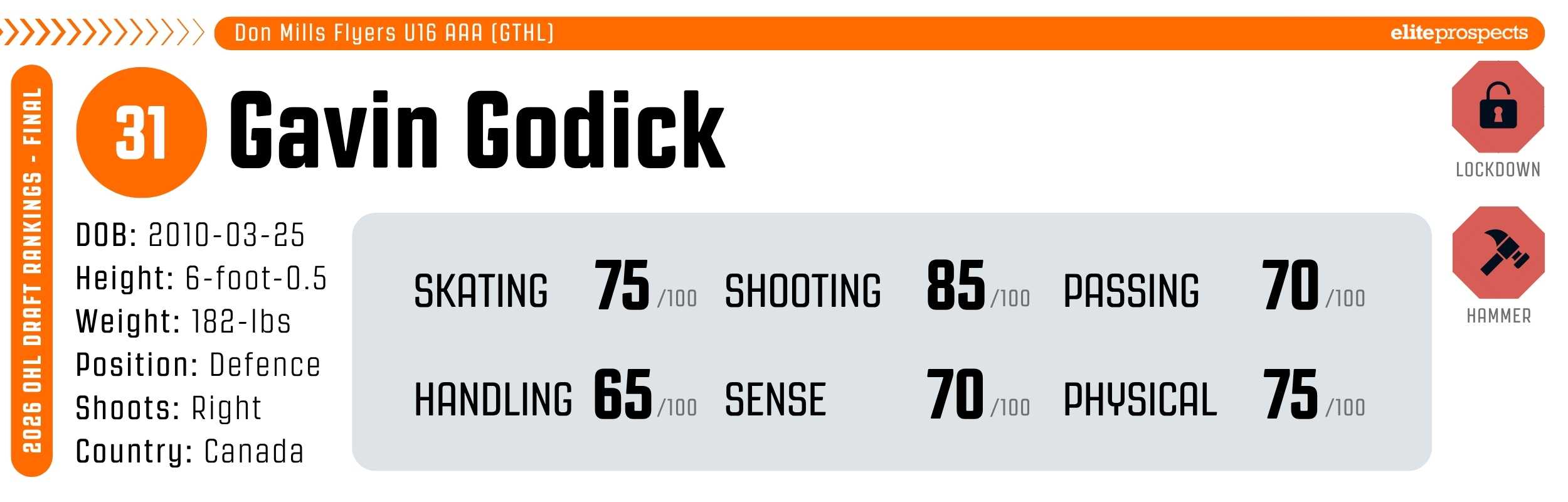
A dependable two-way defender who reads off his teammates and times his activations into the play, Gavin Godick frequently walks the line and carries pucks deeper into the zone. With his lateral agility and pinpoint accuracy, his point shot is lethal, making him a constant scoring threat. But it’s his defensive range that will carry him to future OHL success – deception and poise on retrievals, length and mobility to cover ground quickly, and looking to initiate contact wherever possible. A likely top-four pivot who could develop more play-driving ability, his heavy shot could see him quarterback a team’s top power play unit.
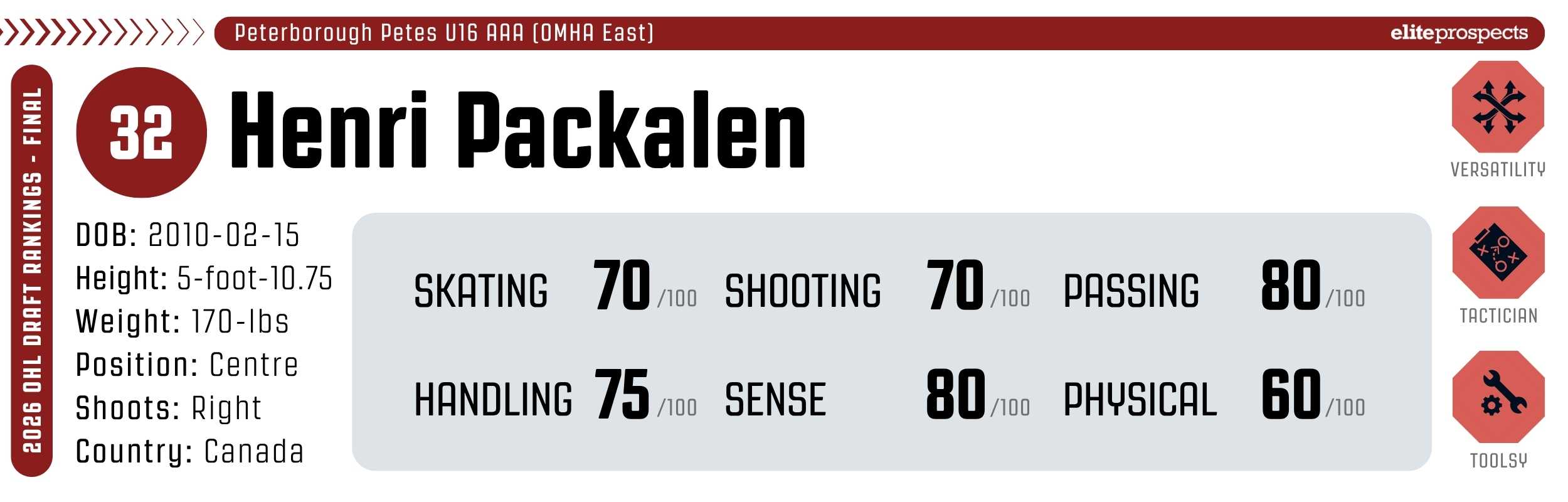
In a tough year for the Petes, this season was an opportunity for Henri Packalen to shine as one of, if not the lone, bright spots. He pairs a high playmaking ability with strong hockey sense, finding seams and gaps that often his teammates cannot recognize in time. As he moves up levels, he’ll have to improve his footspeed and display more of a willingness to play in the dirty areas, but he’s a likely middle-six forward who will connect plays and could be a crafty half-wall distributor on the power play.
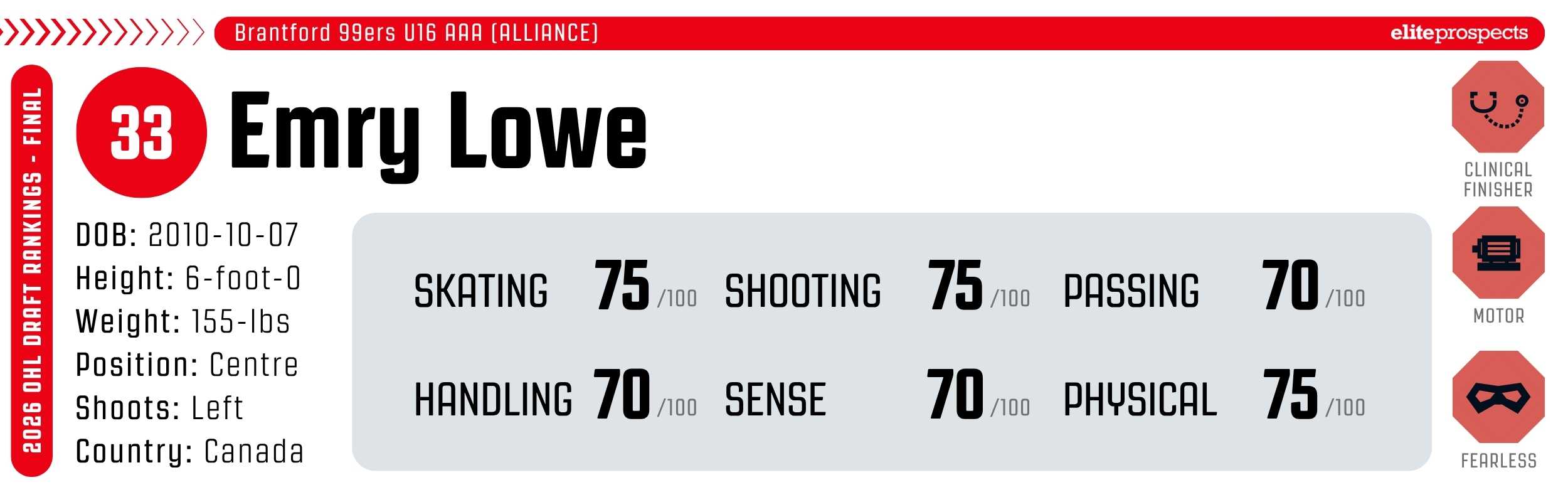
One of the younger players in this draft class, Emry Lowe developed impressively over the course of the season. A two-way power forward with a shoot-first mentality, he uses powerful strides to accelerate onto pucks with speed. He plays with a high motor, getting in on the forecheck and using strong body position to win battles. His speed is noticeable off the rush, as he works to high-danger areas and unleashes blistering shots that explode off his stick. He projects as a middle-six OHL forward with scoring potential and power forward upside.
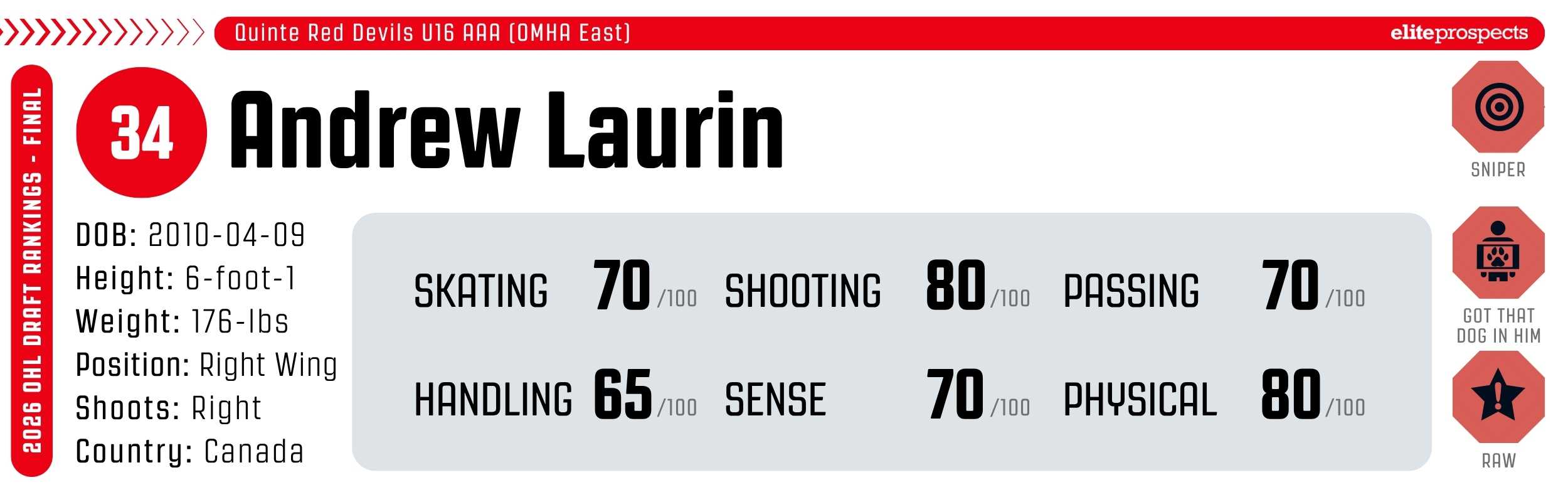
Andrew Laurin was a massive piece of the Quinte offence, locked on Whelan’s wing as the duo complemented each other well. A north-south power forward with an impressive compete level, he isn’t afraid of dirty areas, is consistently engaged physically on the forecheck, and utilizes his large frame to shield the puck. While flashes playmaking vision, his lethal release is his primary strength; with a little space in tight, he makes no mistake with his powerful, precise wrister. His skating will impact his projection, but his toolset projects nicely as a powerful bottom-six winger with scoring potential.
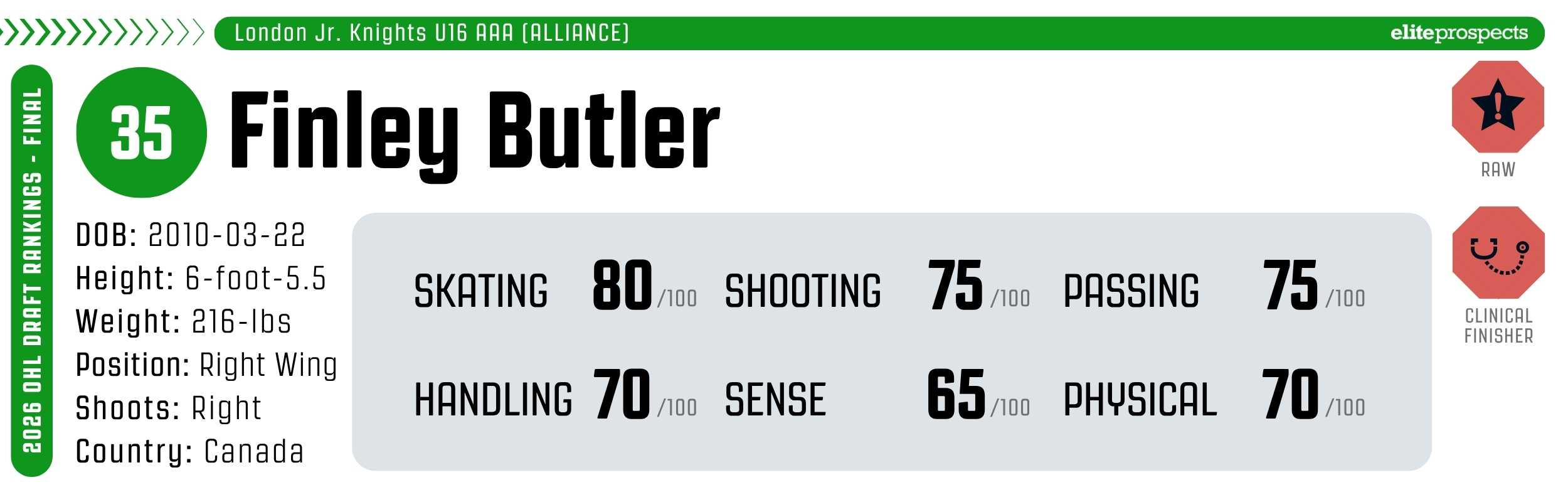
Despite falling nearly 20 spots from midseason, Finley Butler still oozes potential. A towering force with high-end skill and a finishing touch, Butler had a very strong year with London and was a key contributor. For his size, he has strong skating mechanics, accessing his edges easily and using them to dance inside and out of coverage. With a powerful, quick release and natural finishing abilities, it's not hard to see why Butler was so productive this season. To become the top-six contributor that his skillset suggests, his next step is turning those flashes of elite skill into consistent, repeatable impact.
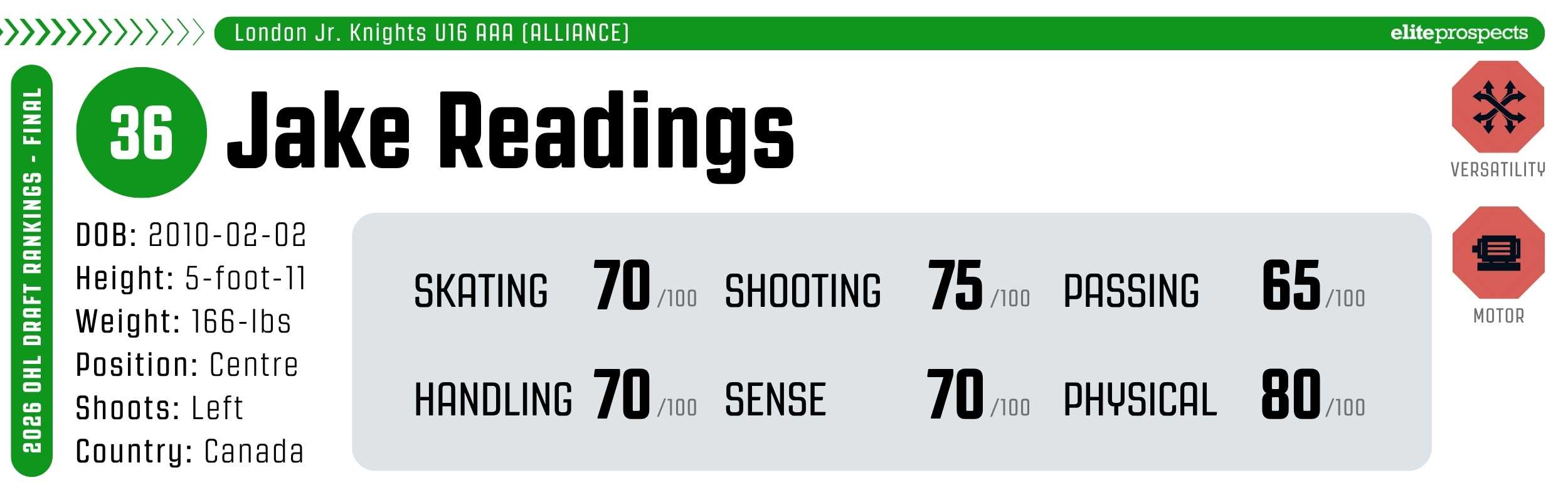
A projectable centre, Jake Readings plays an all-around game with very few holes. His physical edge and sturdy, low centre of gravity make him difficult to handle, as he consistently battles hard in the corners with strong positioning and effective board play. Off the rush, he creates space for teammates and finds soft areas of the ice once the puck has been distributed, while also showing commitment on the defensive side by tracking back, getting above the puck, and covering for lapses. He should play two-way, middle-six minutes down the line.
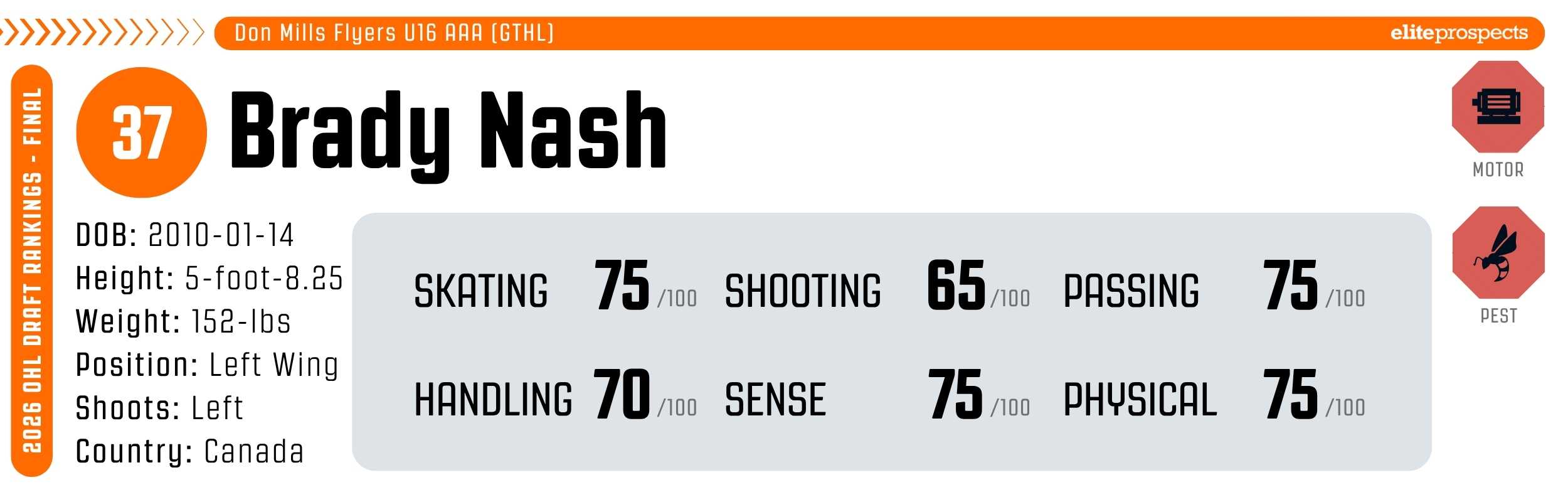
Brady Nash is the type of player opponents hate playing against and coaches love having on their bench. Uber competitive, he’ll get under opponents’ skin, but also brings projectable offensive skills. His offence comes primarily on the forecheck, where his anticipation and strong stick allow him to strip pucks and create quick-strike opportunities. His fearless nature sees him attack the interior and compete for second-chance opportunities. Though he doesn’t pass up shooting attempts, he is a better passer than shooter at this stage – it should improve with power and strength training. Lack of separating speed and size limits his ceiling, but skill, competitiveness, and IQ will carry him to a middle-six role.

Playing down in Florida, Spencer Greenhalgh hasn’t gotten enough attention on the OHL draft circuit this season. We believe that’s a mistake. The Ottawa native has blown us away every time we checked in, with his deceptive playmaking, high-end puck skills, and superior control of the game. Now listed at 5-foot-10, he must continue to add strength and more physical skills over the coming years to become a dominant junior player. It remains to be seen whether or not he’ll return to play north of the border, but should an OHL team take a chance on his talents, he’s a likely top-six play driver with dynamic elements across the board.
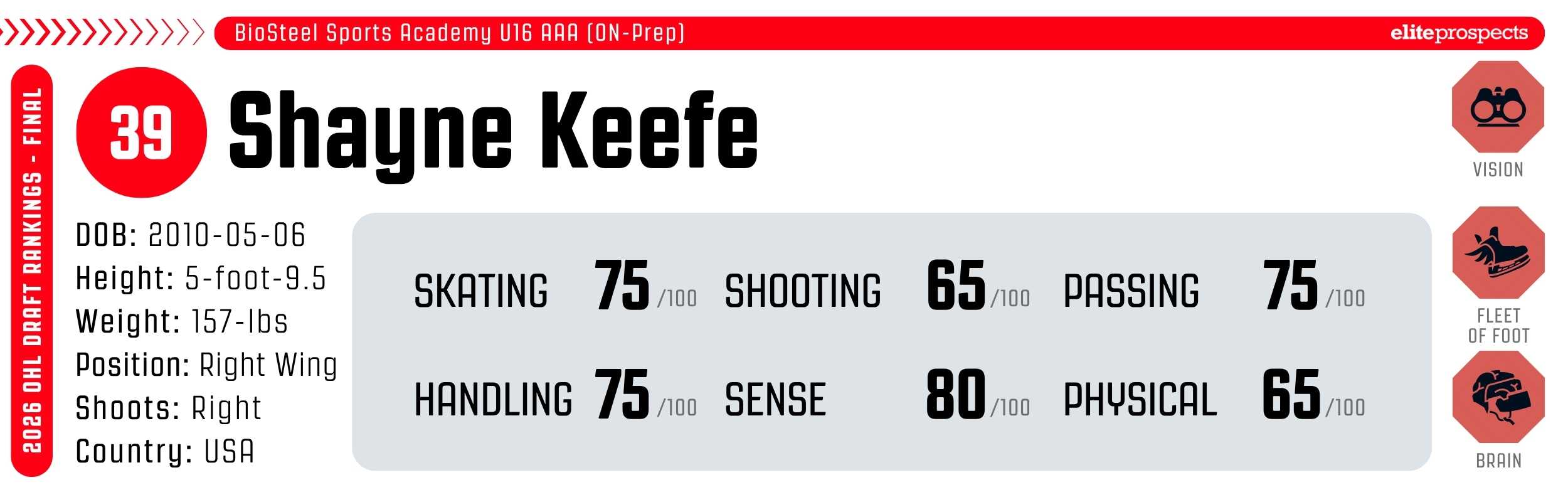
In hindsight, Shayne Keefe should have been on our midseason ranking. BioSteel’s captain dominated games with consistent dynamism, overwhelming transition creation, and manipulative playmaking. He’s also one of the most refined defensive forwards in this class, with impressively detailed off-puck reads, identifying and engaging with threats, and never sacrificing defence for offence – even when his team is down on the scoresheet. Filling out his frame and adding more strength will be key, but he’s a likely top-six junior scorer who will drive offence in a variety of ways. Should he opt to go the OHL route instead of the USHL (the Illinois native was a fifth-round pick by the Chicago Steel), he could also develop into one of the league’s better two-way forwards.
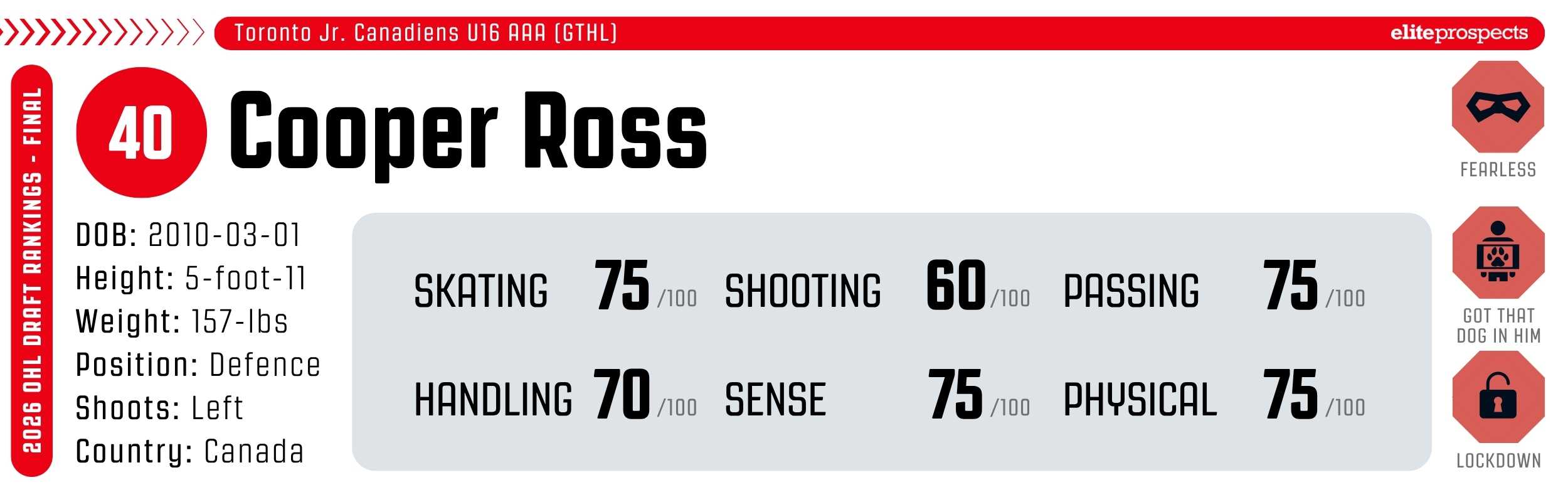
Jr. Canadiens captain Cooper Ross was a vital part of the team’s GTHL and OHL Cup finals appearances. A reliable, puck-moving defenceman, he’s capable of playing in a variety of situations with high poise. Paired with underaged Kade O’Rourke as JRC’s defensive anchor, Ross uses lateral mobility to win races to loose pucks before calmly exiting the zone with possession via a quick pass to forwards or activating up the ice. He won’t wow often with flashy skill, but his versatility will carry him to a bottom-four OHL role, where he’ll provide shutdown value and puck-moving ability.
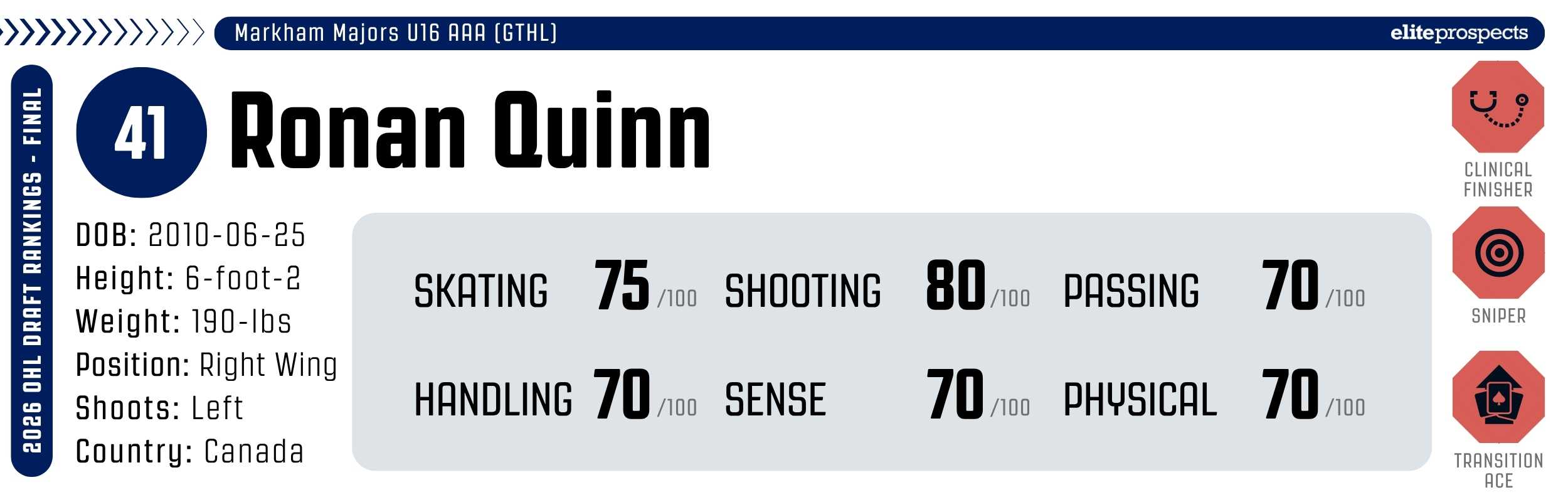
Ronan Quinn blends power forward size with above-average skating and a devastating shot off the rush. At his best, he wins board battles, hounds defenders on the forecheck, and uses his powerful frame to keep defenders to the outside. Game-to-game consistency lacked this season – he did battle injuries at multiple points – but when he’s on, few can match his physical gifts. Off the rush, he is clinical, using his speed to back defenders off, then beating goalies with a quick release or slipping a pass to a teammate if the defence challenges him. Though his range of outcomes may vary depending on his consistency, he has top-six scoring wing upside.
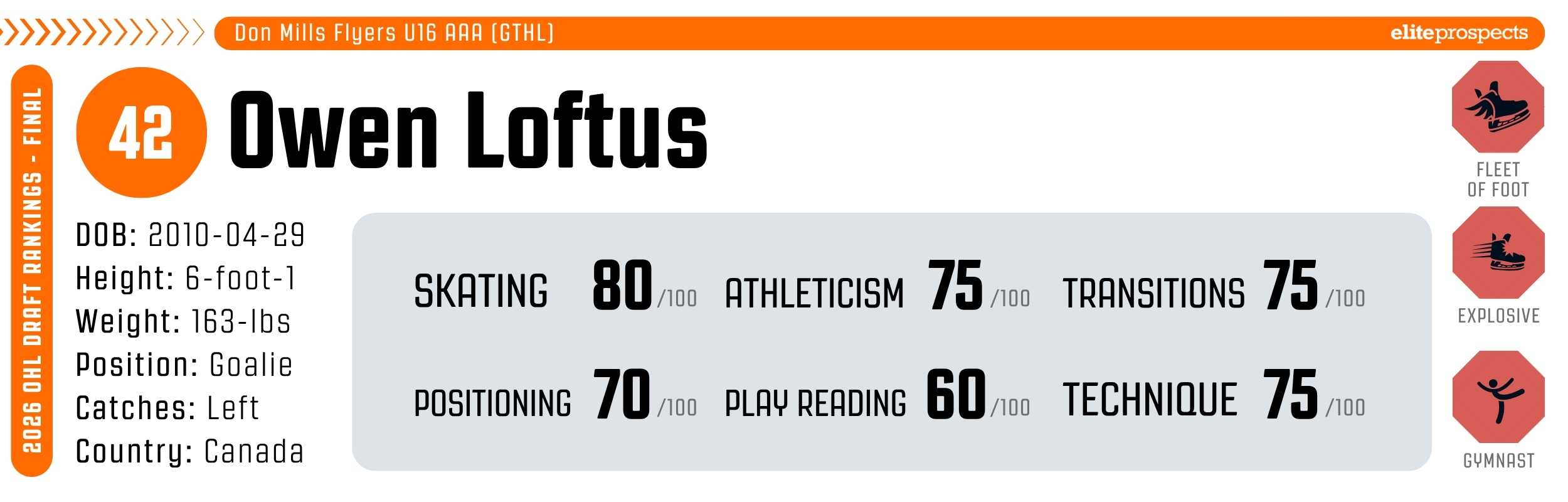
Owen Loftus is one of the draft class’s most impressive movers in the crease, orienting himself with pace, precision, and quickness, both upright and in the butterfly. He is also deeply impressive in his posts, entering the RVH quickly and sealing well, while using his stick to take away passing lanes and disrupt advances to the net front. On top of his skating, Loftus is a mesmerizing athlete, with deep splits and the ability to retract from extensions with ease. He’s easily a future OHL starting goaltender, and improvements to situational tracking and, beyond that, further improvements to play reading should see him develop NHL upside.
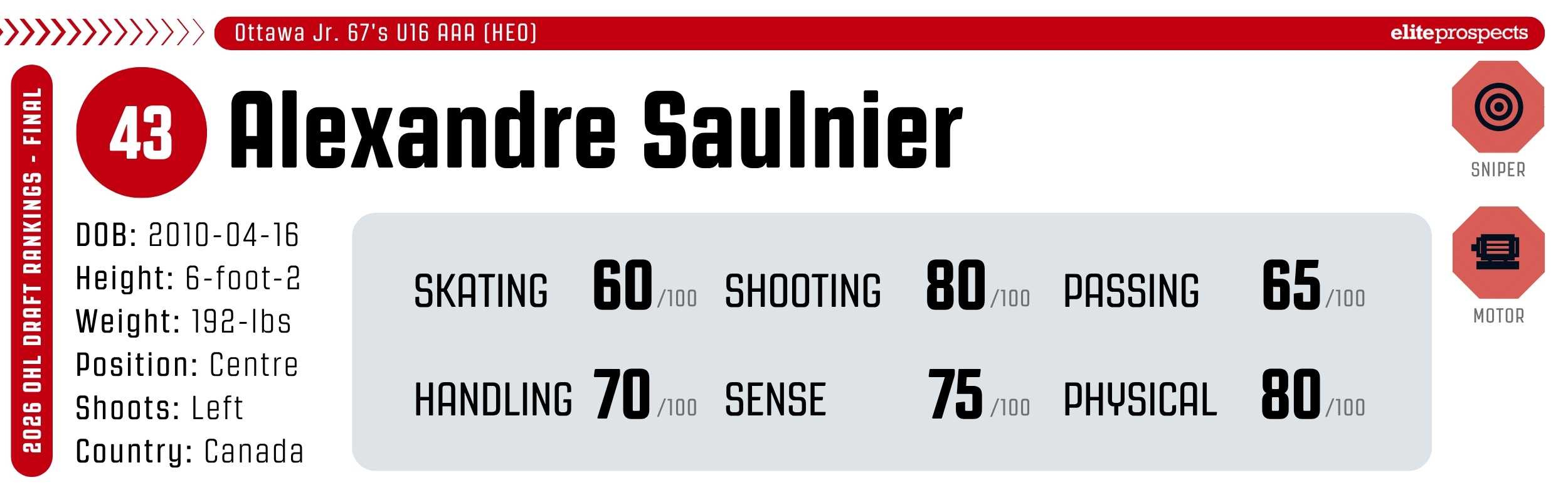
One of the most intriguing prospects out of the HEO this season, Alexandre Saulnier possesses a lethal release, strong work ethic, and subtle close-quarter puck skills within a 6-foot-2 power forward frame. A natural centre, Saulnier comfortably navigates the middle of the ice on both ends, providing support on breakouts and finding soft areas of the offensive zone. His footspeed and lateral agility will continue to improve as he develops, but Saulnier’s strength is his ability to manoeuvre around sticks in the slot before unleashing a dangerously accurate release. A unique projection, he projects as a bottom-six centre with goal-scoring upside at even strength and the power play.
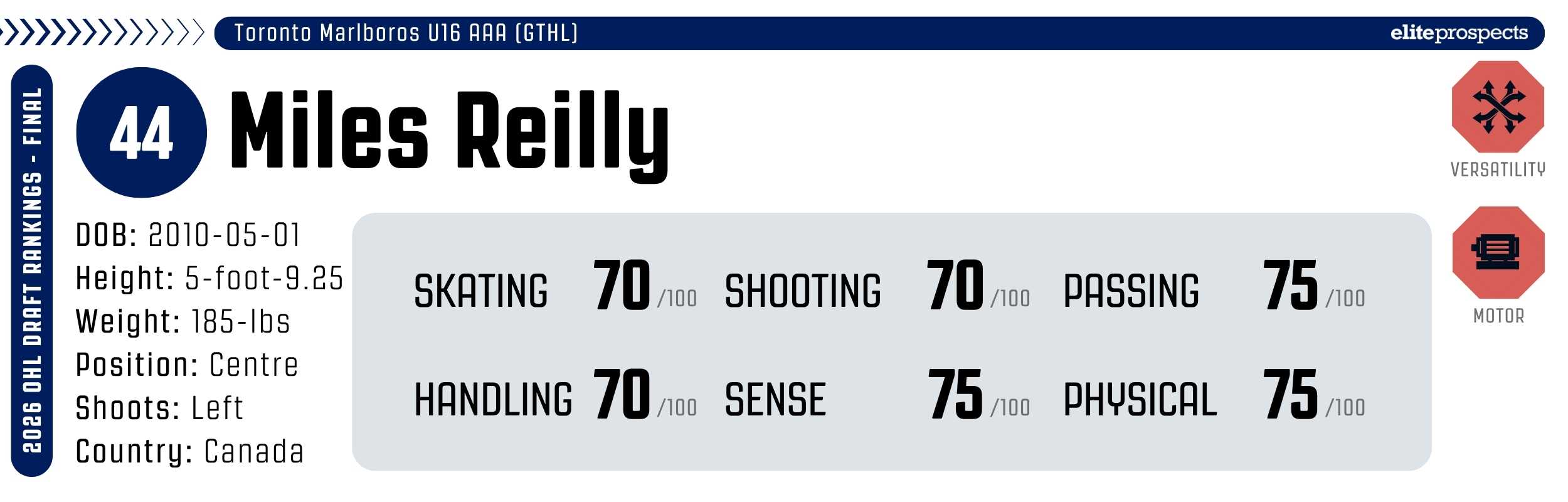
Miles Reilly is one of the more well-rounded centres in this draft class. Blending his hockey sense and competitiveness, he boasts a competitive advantage that is hard to ignore. With a game built on getting underneath defenders on the forecheck, he outworks every player on the ice, winning 50/50 pucks on the walls and on the forecheck. He’s a threatening playmaker with possession, and his upside could improve if it becomes a more prominent part of his game. With impressive straight-line speed, a gritty checking game, and great open-ice scoring feel, Reilly could be an impact middle-six checker who provides secondary scoring.

It’s easy to see what kind of role Nixon McCaig will play in the OHL. The near-6-foot-2 defender has size, above-average skating, retrieval skill, meanness, immensely bruising physicality, and defensive range – everything an OHL team wants out of a future shutdown, play-killing defender. But don’t make the mistake that McCaig lacks an offensive dimension. At times this season, he flashed rush activation skill, deception and manipulation as a carrier, and playmaking vision, surprising and intriguing us with his offensive reads. Building more on those elements could see him improve his upside and earn a top-four role, particularly as he develops more lower-body strength and fills out his frame.
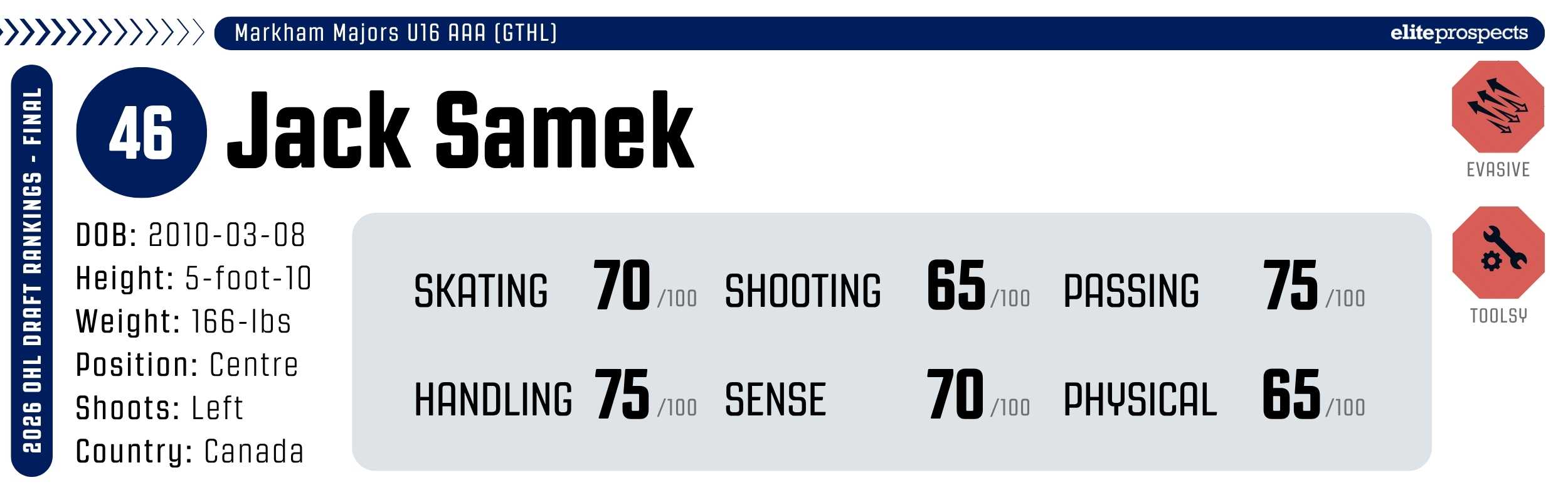
A smooth-skater, Jack Samek is your prototypical playmaking centre, possessing impressive puck skills, high-end vision, and solid passing abilities. While not overly explosive, he generates ample acceleration via quick crossovers to attack open space on entries or close gaps on the forecheck. He utilizes his stick exceptionally well on the attack, along with a strong work ethic, to get under defenders, lift sticks, and strip pucks to sustain offensive zone pressure. Overall, he projects as a middle-six option; his tools are built for a second line playmaking role, but he is more likely to settle as a third line checking piece with playmaking upside.
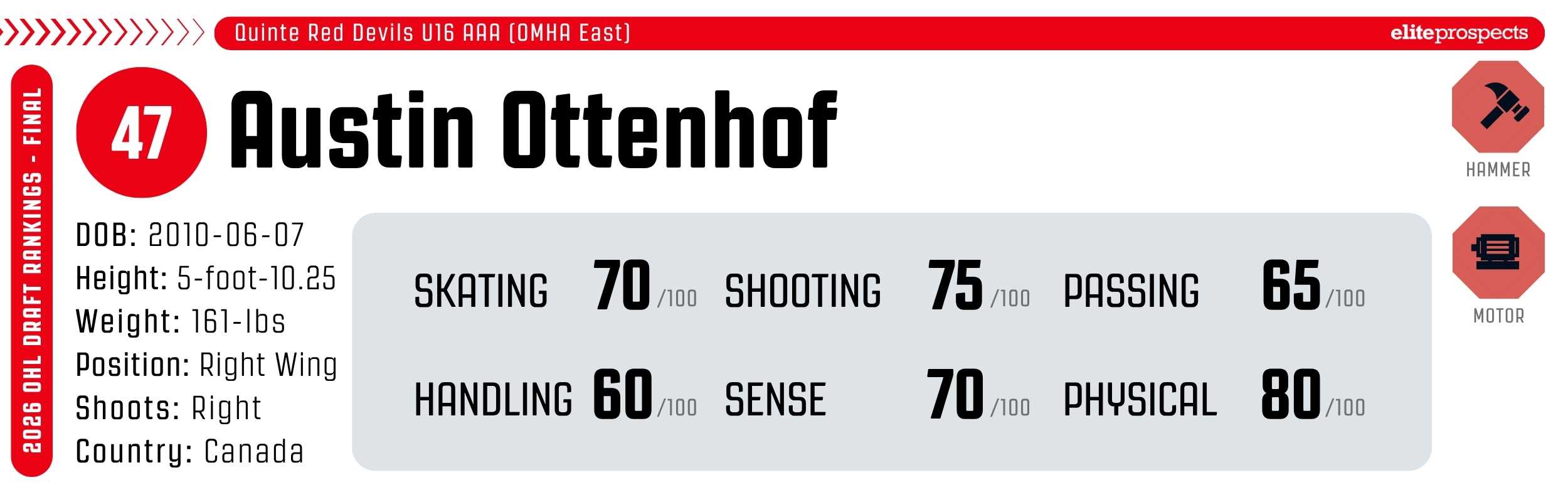
When we think of Austin Ottenhof, we think of versatility. The natural centre lined up predominantly on the wing for Quinte this year, where he displayed multiple exciting traits. With a desire to cut through seams, attack holes, and play through contact, he won’t be deterred on his way to the net. Not only does he play a physical brand of hockey, but he pairs it with pace and skill. Not solely reliant on taking pucks wide off entries, he cuts in to find shooting and passing lanes to create high-danger chances. With a strong, physical off-puck game and inside-driven style, Ottenhof projects as a complementary scorer in the OHL.
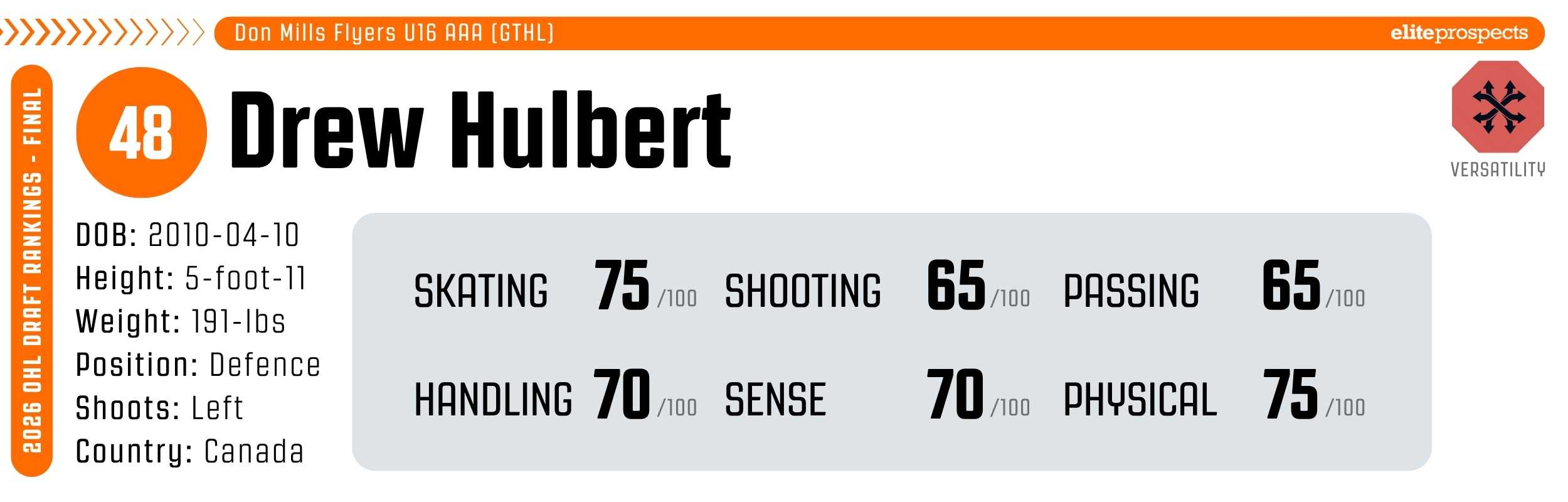
After missing a large portion of the season with injury, Drew Hulbert used the back end of the year to prove to scouts why he is deserving of being a top-50 pick. The stocky, 5-foot-11 defender showed the ability to impact the game at a high level in all three zones. A retrieval and breakout machine, he brings a level of physicality and compete to every shift he takes. He may not have the highest offensive ceiling, but he can work the puck high to low and find shooting lanes to the net without issue. Hulbert projects as more of a shutdown defender who possesses some transition and puck-moving upside.

Marko Mesich is one of the most technical goaltenders in the class, with great hands, framing them with zero double-coverage, and boasting good range and control. His butterfly is superb, with great width and a quick seal. He’s also strong in the RVH, with quick transitions as well. Positioning remains his biggest work in progress, as he sometimes misses his target on pushes, either over- or under-pushing, and can retreat too far into his net when facing scrambles. However, incorporating more scans should help him anticipate and catch up to plays faster and improve his odds of becoming a future OHL starter.

With a quick and accurate wrist shot that routinely beats goalies from mid-distance, Jakub Kuklinski is one of the better pure goalscorers in the GTHL. Beyond the shot, he protects the puck extremely well and waits out defenders, using that patience to draw pressure and then hit the open man while mixing in slip passes, hooks, and the occasional no-look feed. While his defensive positioning could stand to improve and his skating stride will need mechanical refinements to translate his offence to the OHL, he has shown enough positive flashes to believe that top-six scoring upside is possible, the most ideal role for a player with his skillset.
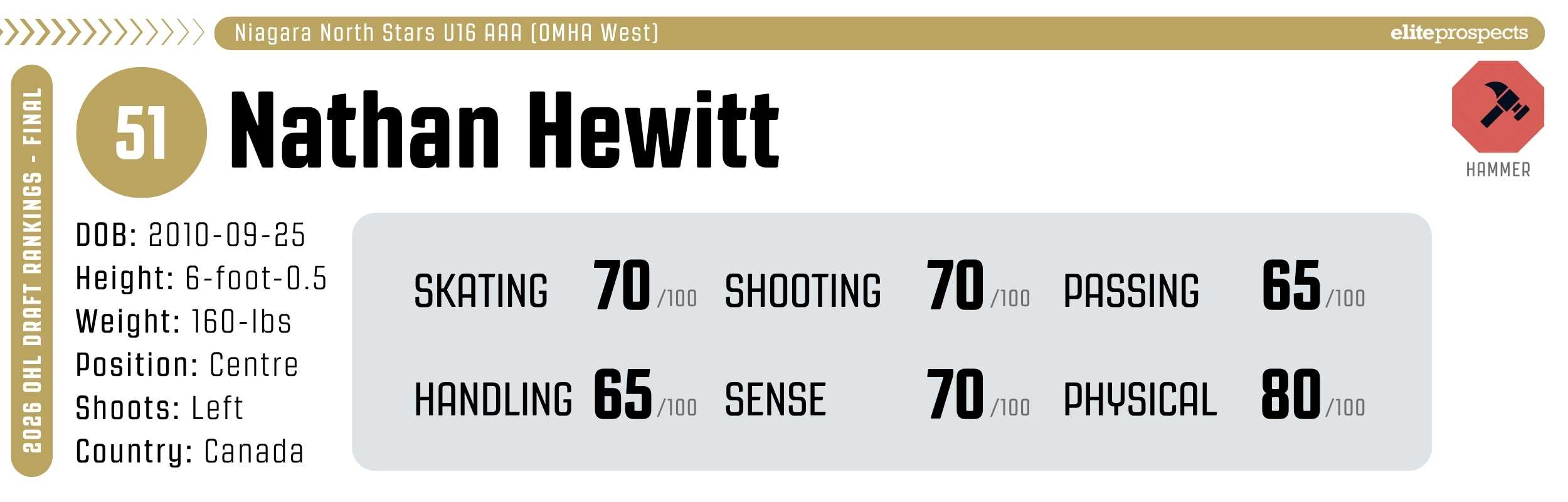
There’s a lot to like about Nathan Hewitt, a prototypical power forward centre whose rugged identity should translate comfortably into a bottom-six role. He plays a powerful north-south game; relentless on the forecheck to hound loose pucks, delivering bone-crushing hits, and consistently attacking the dirty areas on both ends of the ice. Understanding that the front of the net is prime real estate, a large part of his offence is generated by winning inside body position net-front, outbattling defenders to cash in on rebounds and hard-earned goals. His edgework and raw puck skills will have to improve to climb higher in the lineup, but he projects as an impactful, modern-day bottom-six power forward.
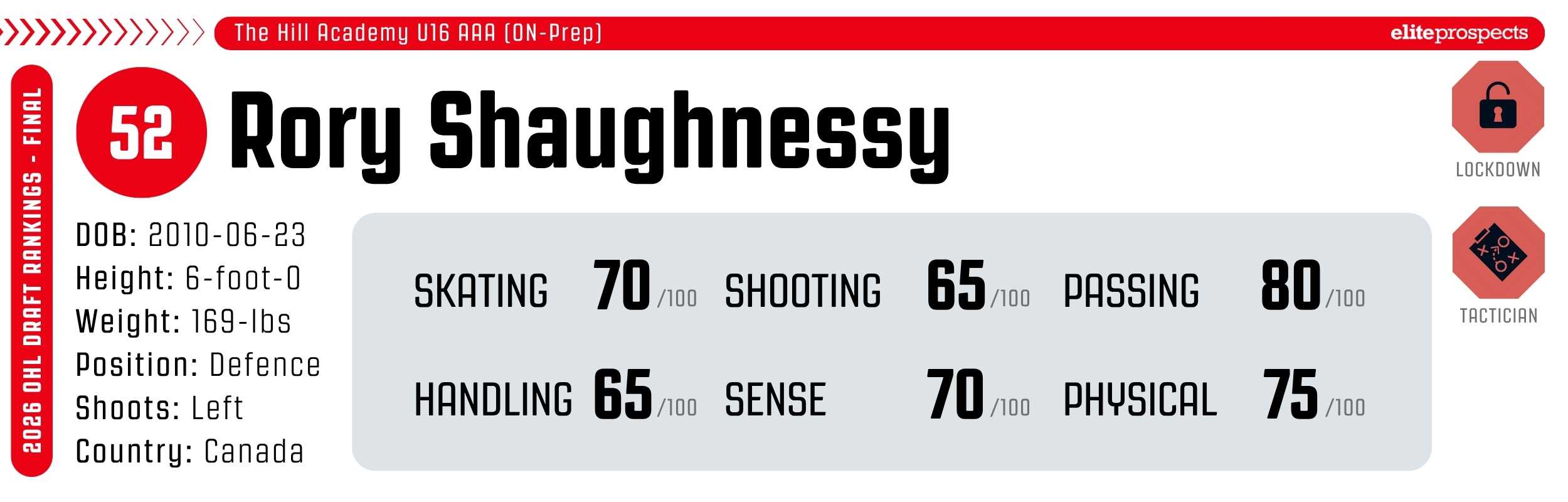
Hill Academy assembled a formidable defence corps this season, and Rory Shaughnessy brought a little bit of everything to the table. Mobility, poise, and physicality make up the foundation of his game. A strong rush defender who gets stops by mirroring footwork, closing the gap, and skating through the hands, he’s similarly effective defending the cycle, hammering, wrapping, and pinning along the walls to win pucks. An easy middle-pairing projection given his shutdown and play-killing potential, and his evolution into a playmaker and more frequent activations in the second half further boost his upside, too.
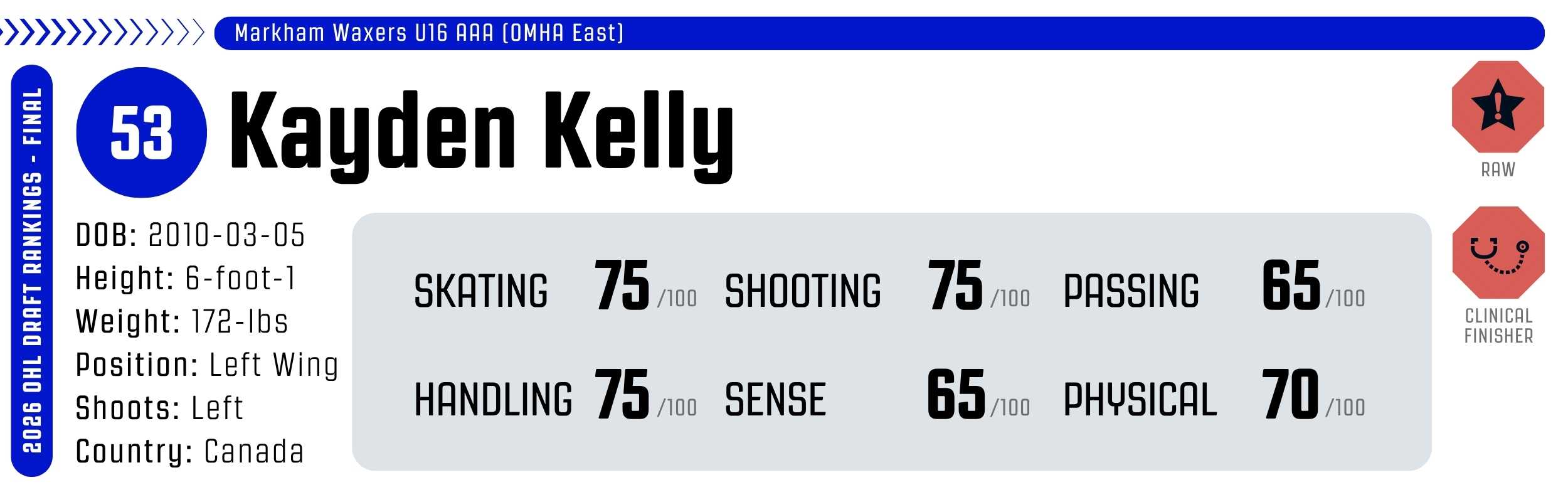
Kayden Kelly impacts the game with his speed, dynamic puck skills, and the ability to make plays at pace. His size is an immediate advantage at this level, but unlike most bigger players, his natural agility, frequent crossover use, and separating speed make him almost unstoppable in transition. He’s more of a linear, north-south creator who barrels past defenders off the rush as he takes pucks to the middle, but his playmaking continued to improve in the second half. Tapping into that side of his game more often will improve his upside, as will filling out his lower body to add more power and explosiveness. He projects as a top-six, complementary scoring forward, provided that he continues to up the pace and consistency of his motor in the OHL.
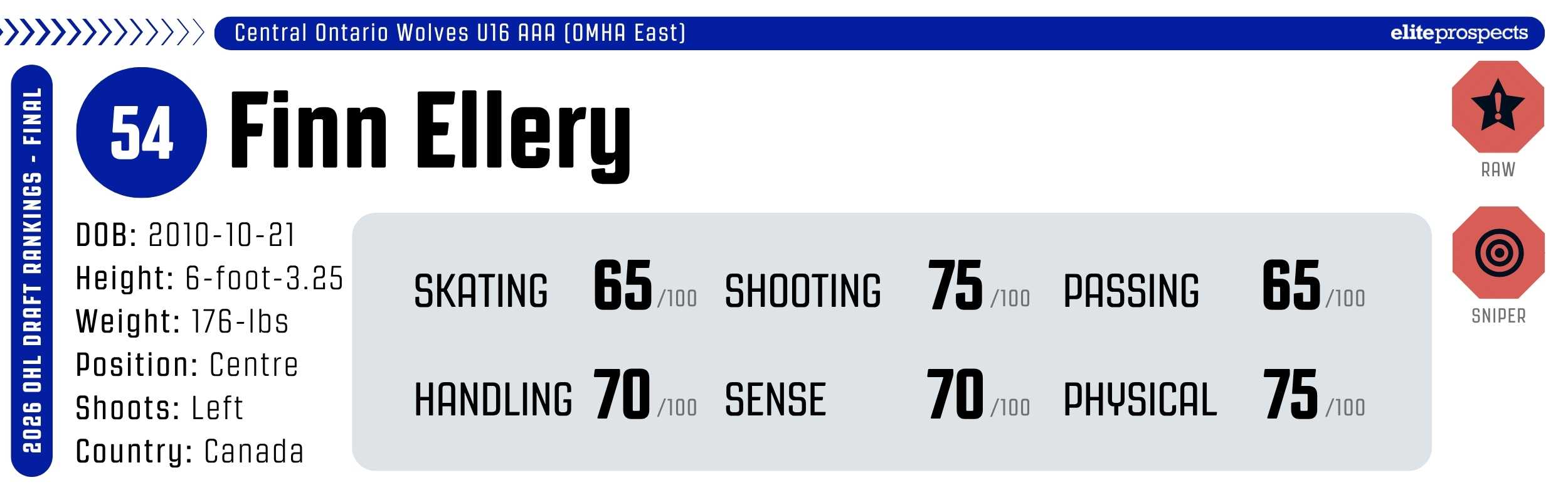
Limber 6-foot-3 centres don’t grow on trees, and Finn Ellery combines smarts, above-average tools, and physicality into an intriguing package. His reads, play-building, dual-threat flashes, inside-lane attacks, and ability to handle under pressure and in small areas all indicate top-six scoring potential. Bringing all of those elements consistently is the next step, and he has a strong enough B-game to play a third-line checking role without any issue. The margin between Kelly and Ellery was thin, and what ultimately gave Kelly the edge in this ranking was his skating. Ellery will have to improve his turns – he still loses too much speed – and first-step acceleration to achieve the upside we all believe he possesses.
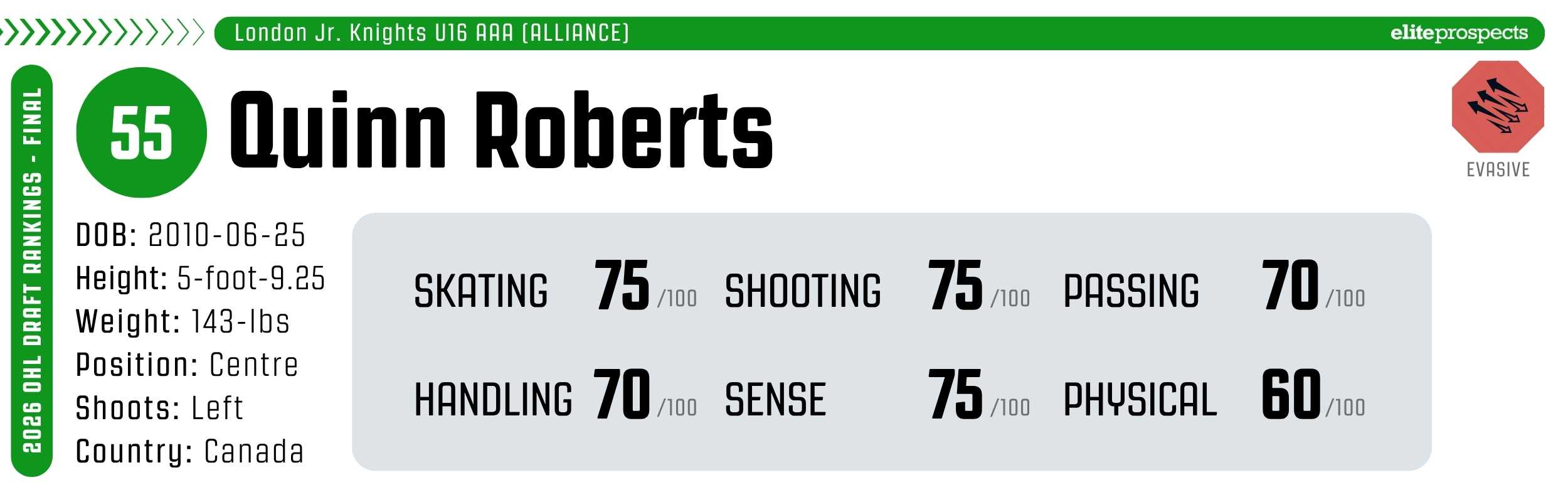
A very high-skill player, Quinn Roberts consistently impresses with his decision-making, pace, and competitive edge. He utilizes elite inside edges to create space for himself while still drawing in opponents, before threatening pinpoint passes through seams. He sees the ice exceptionally well and can create offence at any given moment. He also plays with some snarl to his game, creating a fun blend of scoring and pestiness. Roberts possesses a top-six skillset, but will need to continue filling out and further developing his physical game and contact skills before making the jump to the OHL and realizing his upside.
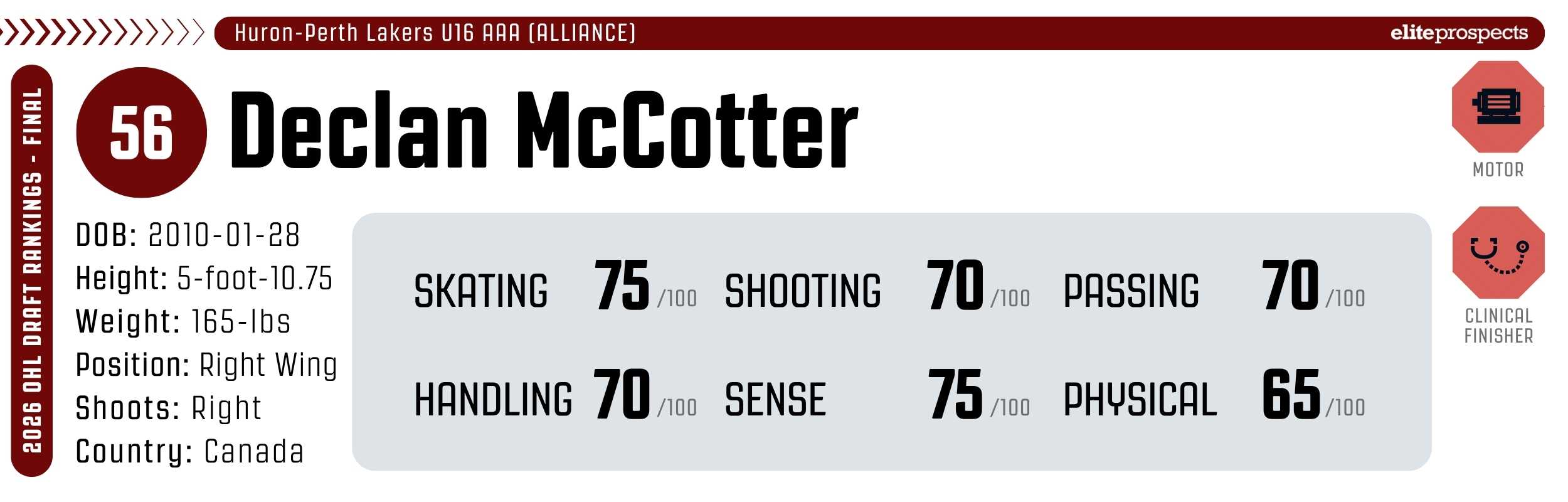
Despite being one of the biggest fallers from our midterm rankings, Declan McCotter is still a very exciting prospect. With good speed, hockey sense, and finishing touch, he is at his best when working off the forecheck to hound pucks and uses his intelligence to make smart, simple plays, rather than forcing them. He changes speeds at an extremely high level, allowing him to work off the wall to the middle and create lanes for his teammates. If he can return to playing a pace-driven game rather than forcing plays that aren’t there, he could play middle-six minutes for an OHL team down the line.
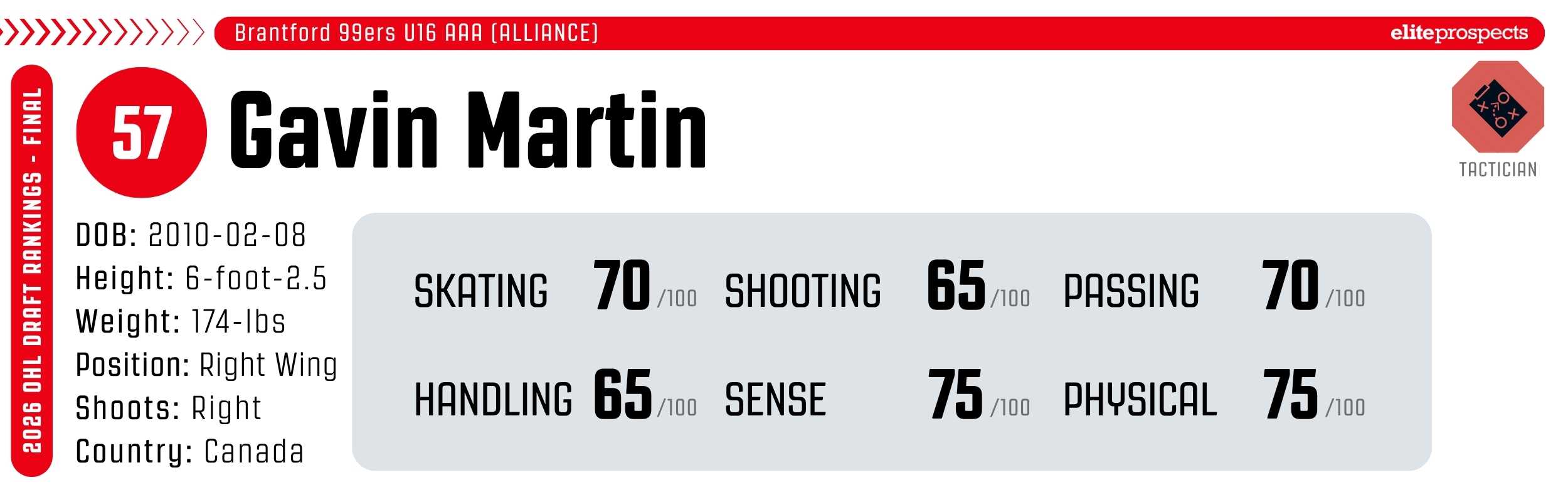
Another very projectable player, Gavin Martin's game revolves around his size, intensity, and offensive flashes. He plays with a solid, balanced base and uses his reach, body positioning, and demanding stature to win battles, extend cycles, and drive opponents off pucks. He’s defensively reliable and plays to the structure, activating good stick details to limit opposing chances. His floor is likely a bottom-six forward at the OHL level, but the combination of size and flashes of high-end skill suggest his ceiling could be much higher.
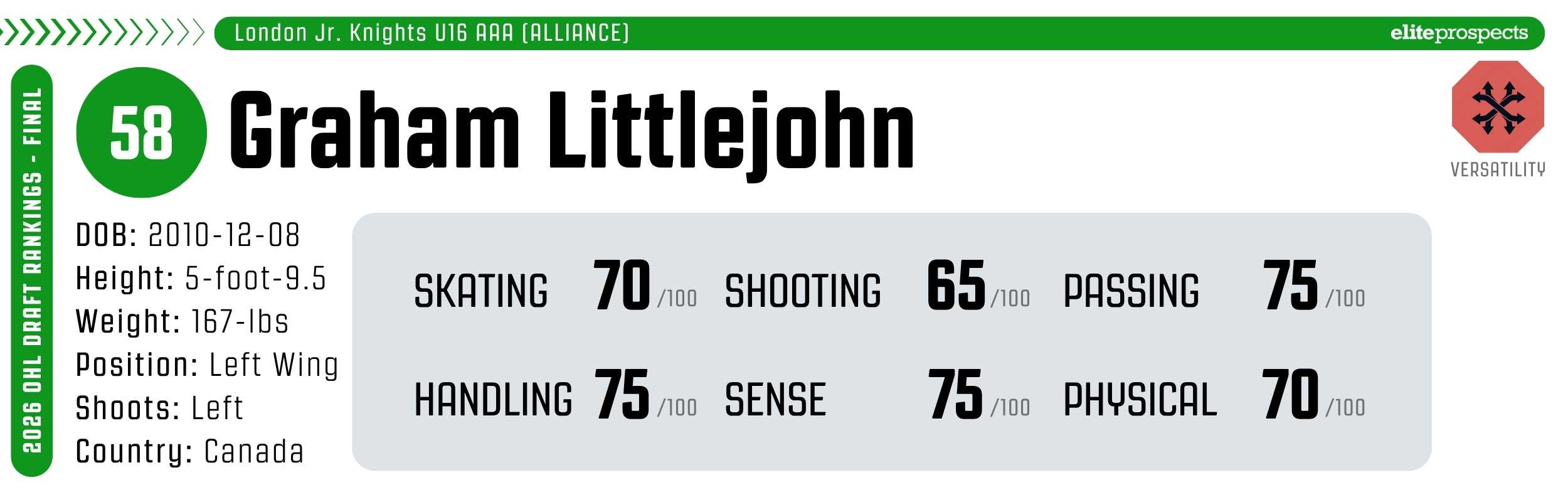
A versatile offensive player, Graham Littlejohn excels off the rush, combining strong pacing, hip mobility, and silky hands to manoeuvre through the defensive line. With a strong cycle game, he has no issues working off the wall to the middle for chances – further development of his physical skills could allow him to do this regularly in the OHL, too. Whether the game is of a high-skill nature or more of a physical match, Littlejohn will adapt his style of play to accommodate – he should have little issue translating his skills to a middle-six playmaking role down the line.
.jpg)
A smooth and explosive skater, Levi Inch has no problem getting around his crease. He uses scans in the corners to inform reads, helping cut down his angle on passing plays and meet pucks faster. Inch is also very effective along the ice due to a low, wide stance and is comfortable on his posts, boasting a strong grasp of the RVH and overlap positions. He will need to improve his rebound control from chest and pads and better time his retreats when facing breakaways, but he’s a good bet to be a future OHL starter.
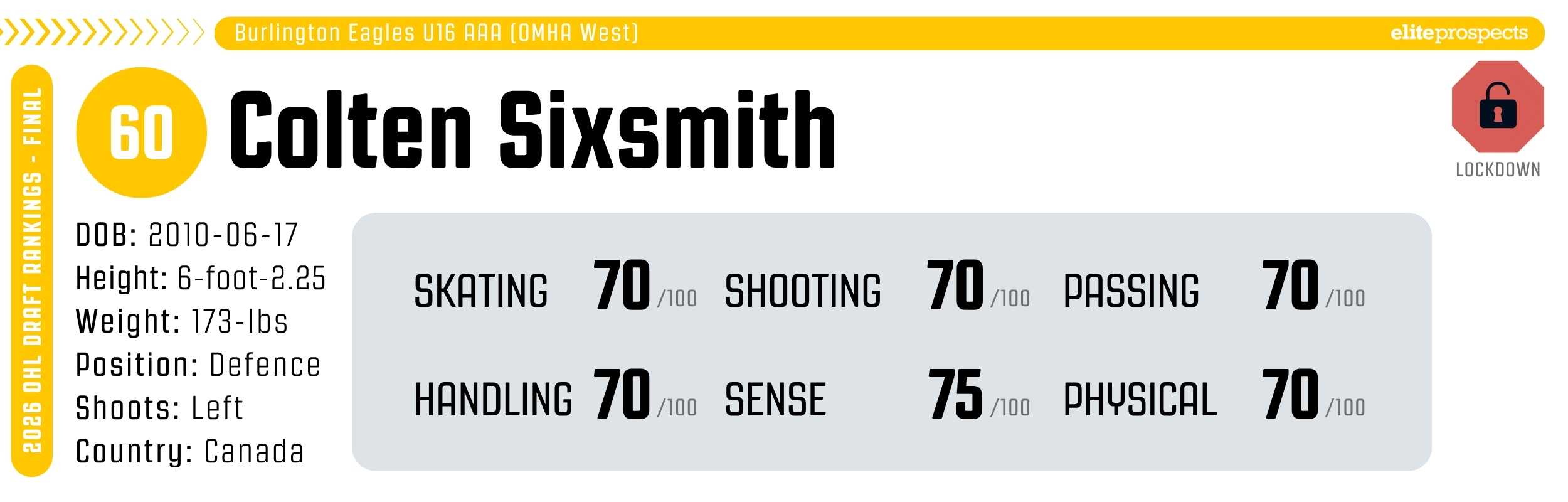
It wasn’t the deepest year for the OMHA West, but Colten Sixsmith consistently elevated his game with the Burlington Eagles. Intelligent and mobile, he aggressively neutralizes the rush, stepping up to take away puck-carriers’ space, angling and driving them to the boards, or using an active stick. He also flashed transition skill at times, including carries under pressure, rarely turning the puck over. Though his offensive game is a bit limited, his range and tools should allow him to find a middle-pairing role. Adding strength and more proactive physicality will help him develop into a rush stopper and play killer.
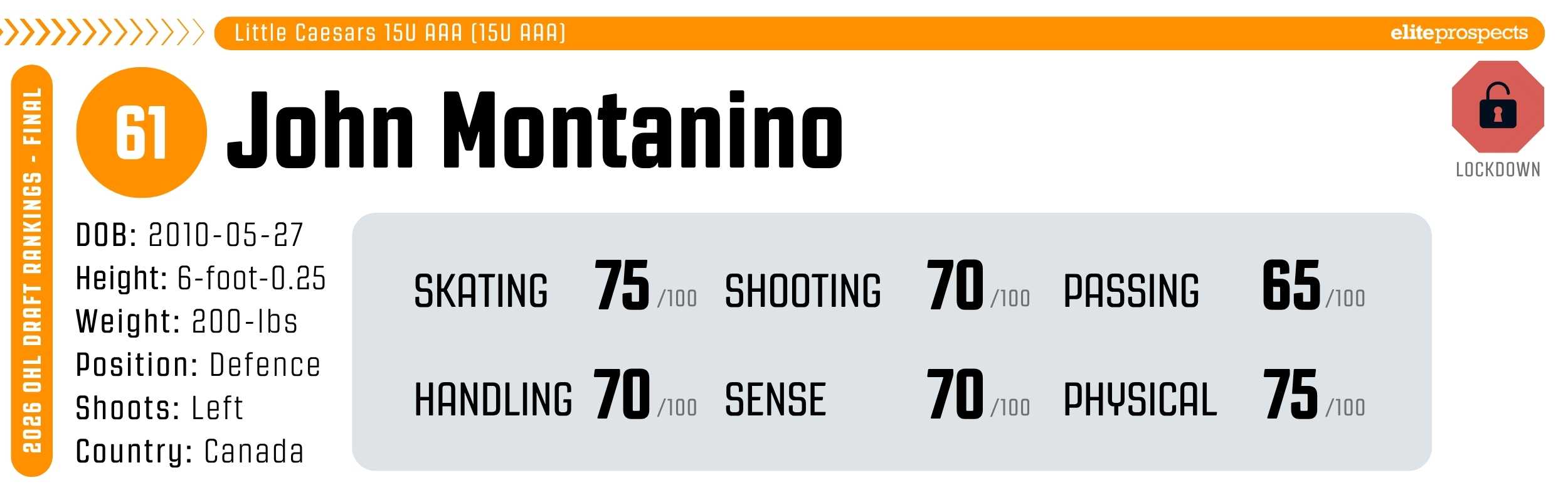
A team looking for a steady, reliable defender at the draft should look no further than John Montanino. With impressive tools, mobility, and range, he racks up rush stops at regular rates and also brings a straightforward approach to his in-zone defence. Methodical and calculated, he’s rarely overextended as he shadows puck carriers down low, wrapping and pinning in the corners to win back possession. An excellent risk-mitigator, he never overhandles as he carries or breaks pucks up ice, activating only when afforded time and space to. One of the safest projections in this range, he’ll likely log heavy minutes as a game-manager in a top-four or top-pairing role.
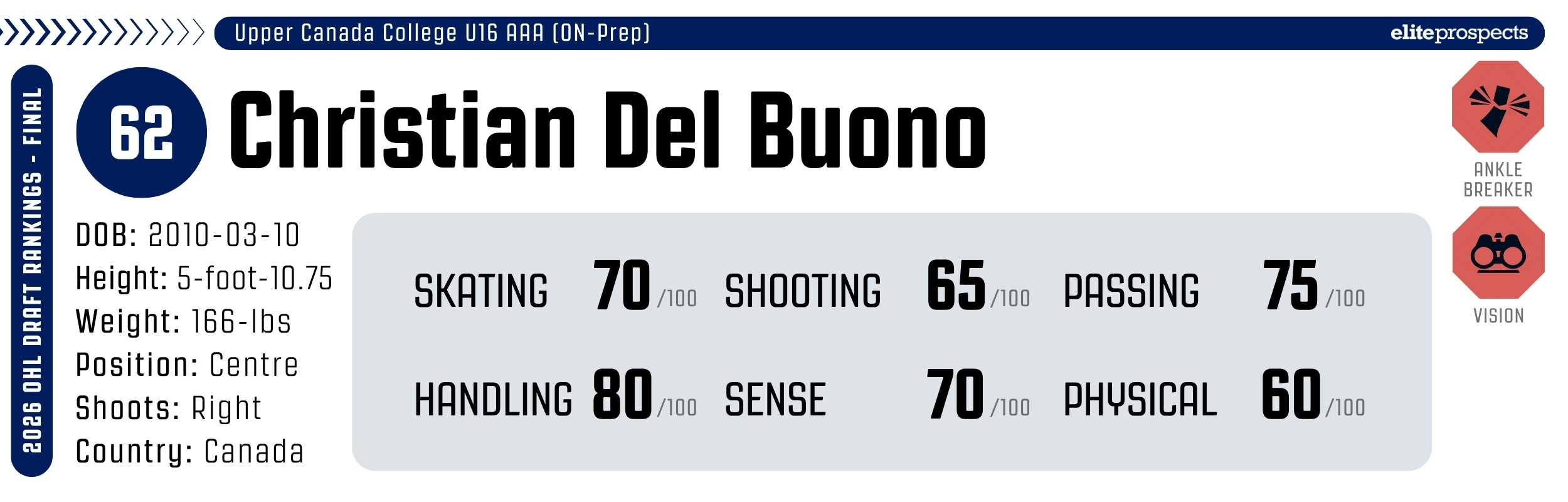
An underrated part of the Blues this season, Christian Del Buono flashed high-end skill while consistently executing the small details of the game that often go unnoticed. An above-average puck handler, he’s specifically adept at corralling difficult pucks on his backhand to gain possession along the wall. Relentless on the forecheck, he utilizes advanced anticipation and angling to force turnovers and instantly create scoring chances. He’s also an effective penalty killer who reads neutral zone transitions well, often stepping up and disrupting plays at the defensive blue line. His proficient two-way play and strong puck skills should allow him to contribute on a team’s checking line at the next level.

On what was a loaded Toronto Marlboros squad, Mason Quinn flew under the radar. The almost-6-foot winger brings an exciting blend of strength and speed. A menace for opposing defenders to handle as he flies through the neutral zone with a head of steam, he’s a shoot-first forward with a heavy wrister. However, he flashed some playmaking instincts at times this year, with the ability to connect seam plays and work the puck low-to-high. With pace, intelligence, and physical skills, he’s a likely middle-six winger who can kill penalties and provide some secondary scoring.
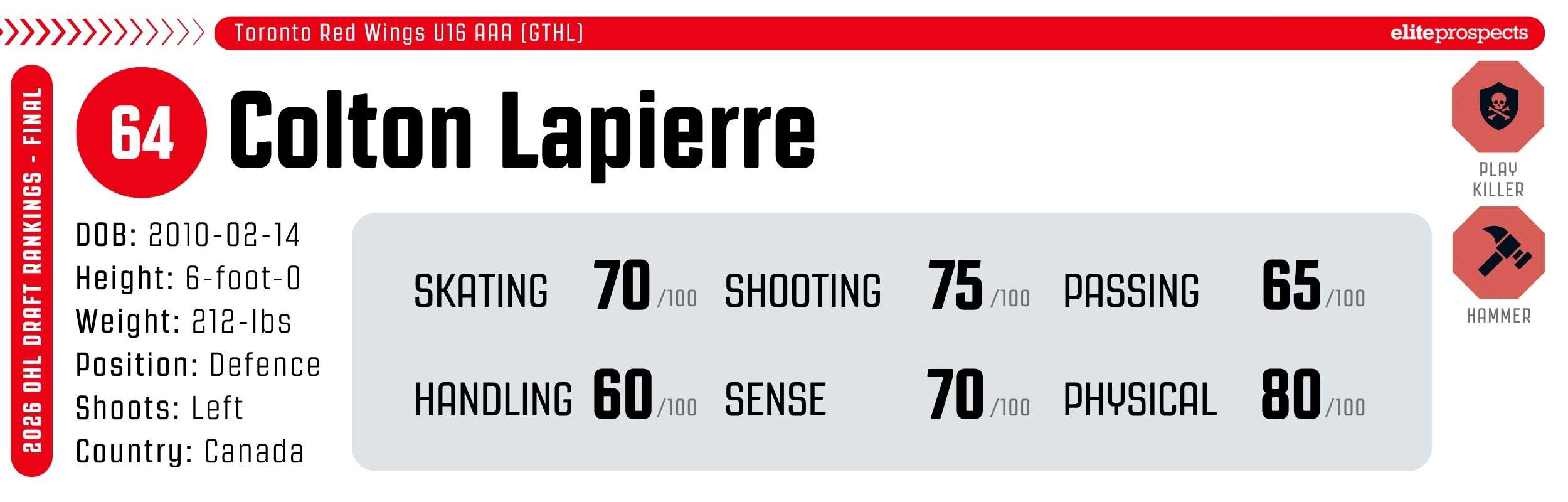
Just 6-foot but a whopping 212 pounds, Colton Lapierre plays a heavy, disruptive game. A long reach and agility allow him to suffocate opponents in transition and play tough minutes in all situations. He’s not just a brute force, though – with the puck, he’s poised and creative, stickhandling past pressure and activating from the weak side of the blue line to short the zone. Better scanning habits would allow him to pick up threats sooner, as he was prone to minor positional lapses where his focus narrowed too much on the puck, but his blend of size, skating, physicality, and two-way instincts gives him middle-pair upside.
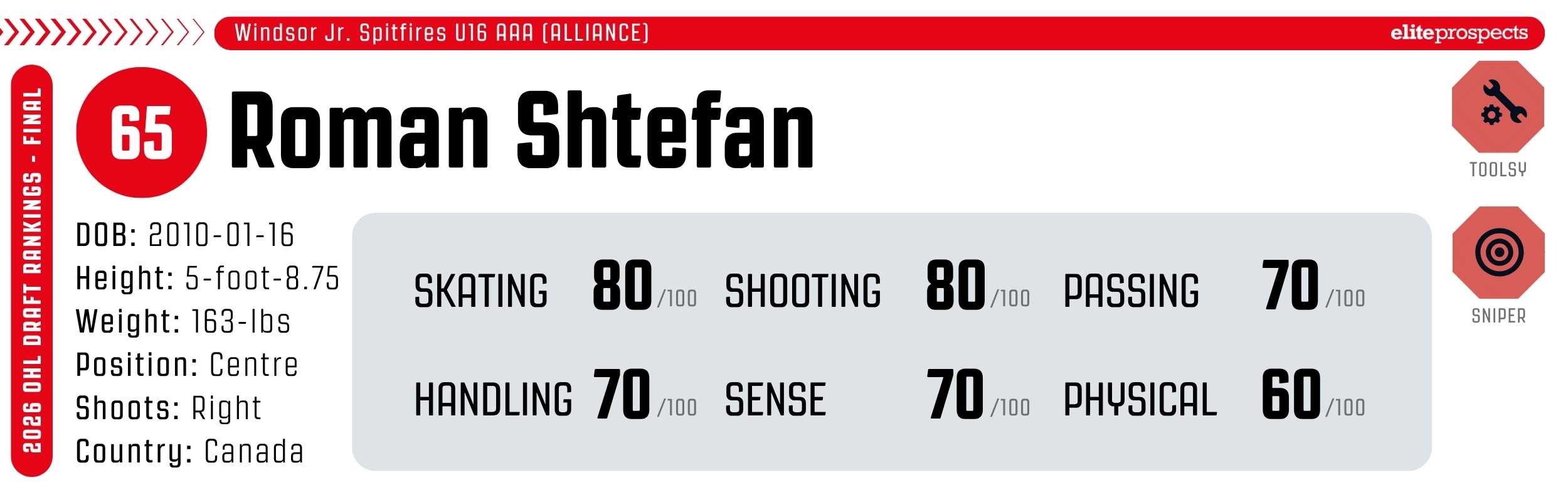
A high-skill forward, Roman Shtefan, radiates immense potential. An exceptional skater whose edges allow him to turn on a dime and evade pressure with ease, Shtefan made scoring look easy this year in Windsor. His shot is already OHL-ready, as it explodes off his stick with strength and accuracy. We could have ranked him higher, too, but the biggest translatability factor is size. As he’s smaller than other talented scorers in this class, he’ll need to add more strength and physical skills to his game if he hopes to make the jump. If he can, his puck skills and skating should allow him to realize his top-six scoring upside.
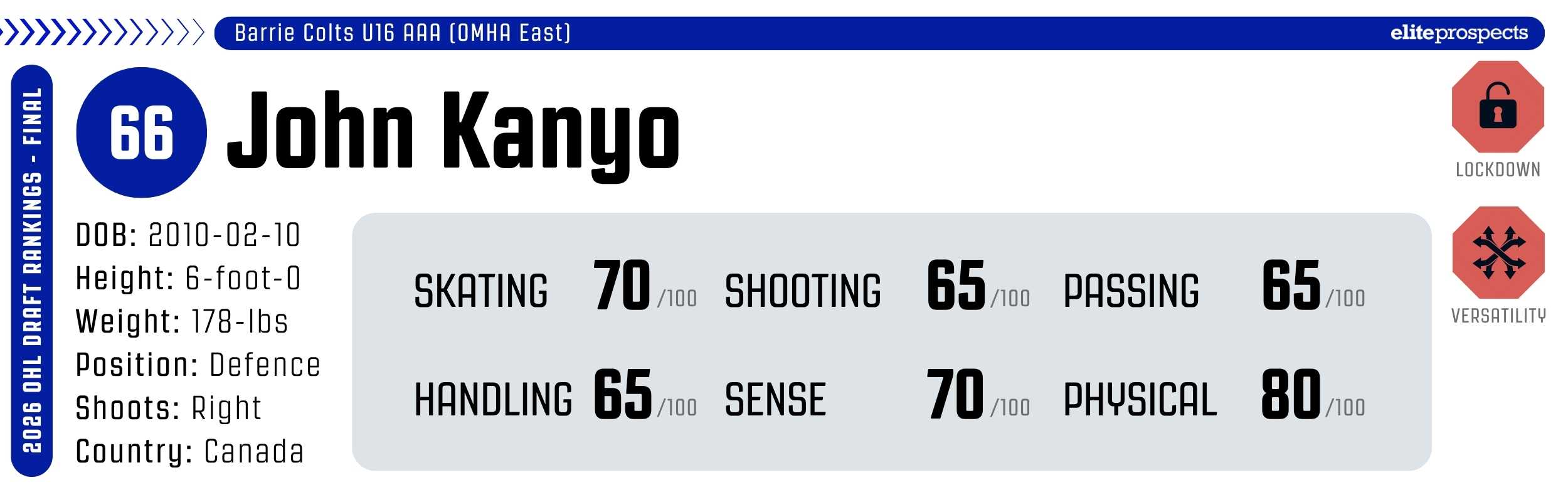
A rugged, stay-at-home defender, John Kanyo embodies what it means to put the team first and be a pain to play against. He nips entries in the bud with ease, finding ways to erase attackers from the play while stripping them of the puck, and also brings similar effectiveness as a puck-mover, hanging onto pucks to evade forecheckers and open up lanes to get the puck safely in the hands of his forwards. Continued physical growth and leveraging his puck skills more frequently could see him realize his middle-pair upside, but he has a floor as a steady, shutdown third-pairing OHL defender.
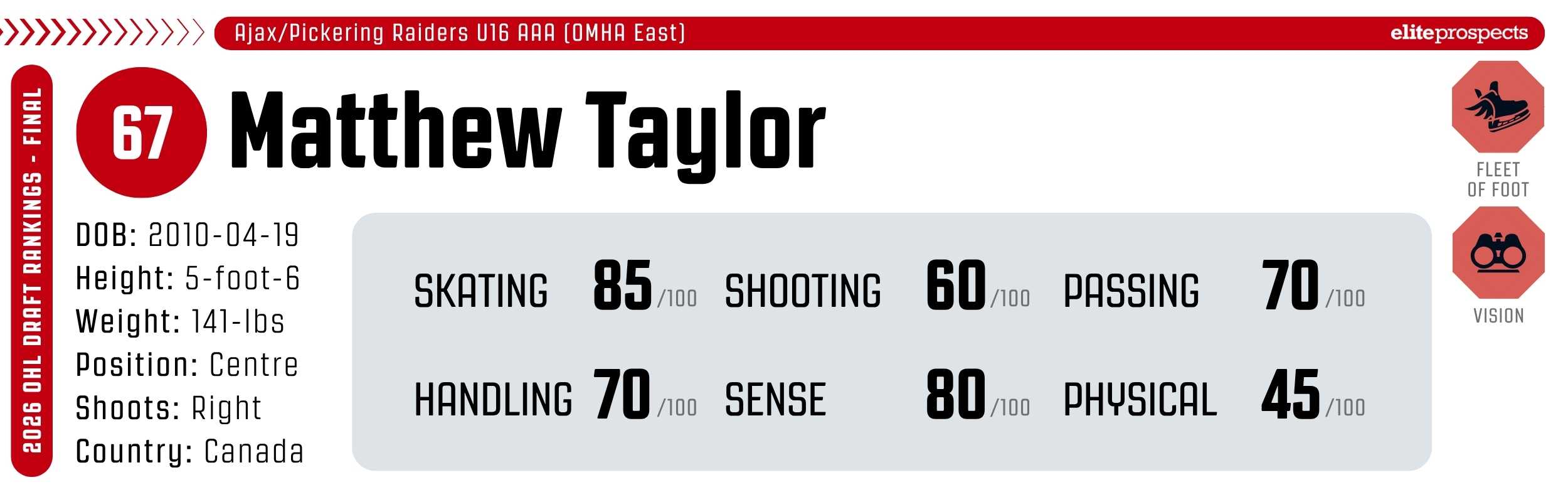
Underestimate Matthew Taylor at your own peril. Breakneck speed and elite skating technique allow him to dominate the transition game, overwhelming and outworking opponents much taller. He also brings a high work rate away from the puck. Like most undersized players, he’ll have to become more inside-driven to have success as an OHL scorer and find a top-nine role, but his skating could be a separating and defining skill, laying the foundation for his vision and playmaking. At his height, he’ll likely slip way further on draft day than his skillset deserves, but the right team will give him the opportunity to prove everyone else wrong.
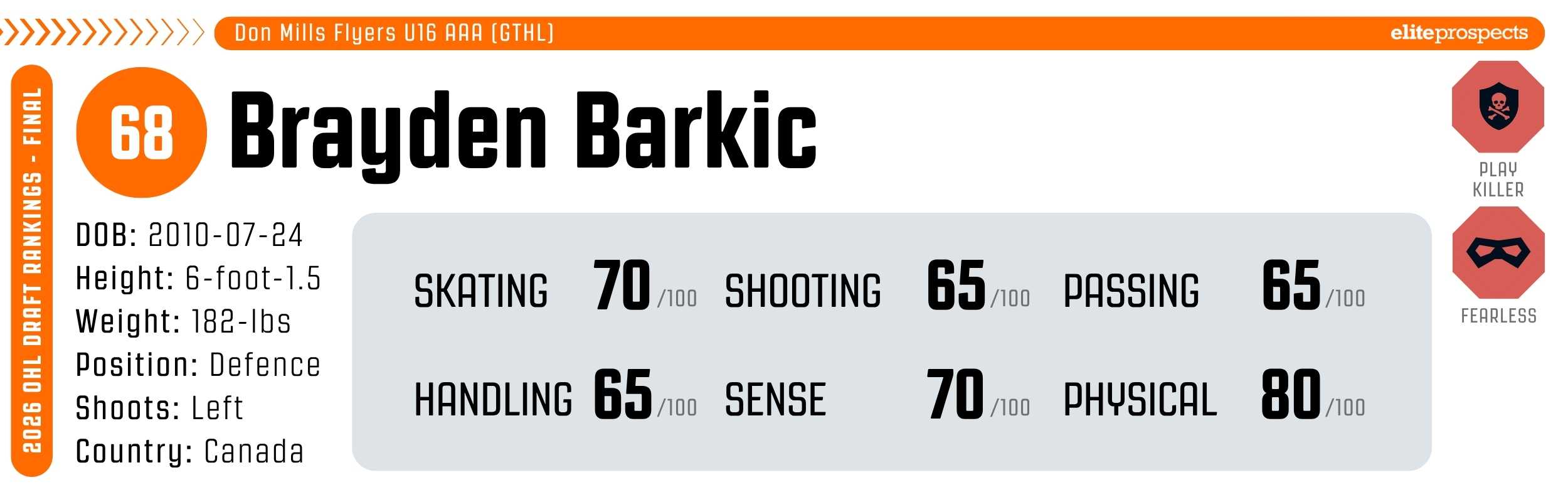
Brayden Barkic’s game is built around making life difficult for opposing forwards from the moment they enter the defensive zone. He positions himself well and has good enough mobility to push opponents toward the boards, where he can leverage his size and strength to play the body and separate his man from the puck. A glue guy who will stand up for teammates or sacrifice his body to block a shot or take a hit to make a play, he projects as a dependable bottom-pair defenceman whom coaches and teammates will love because of his reliability and team-first approach.
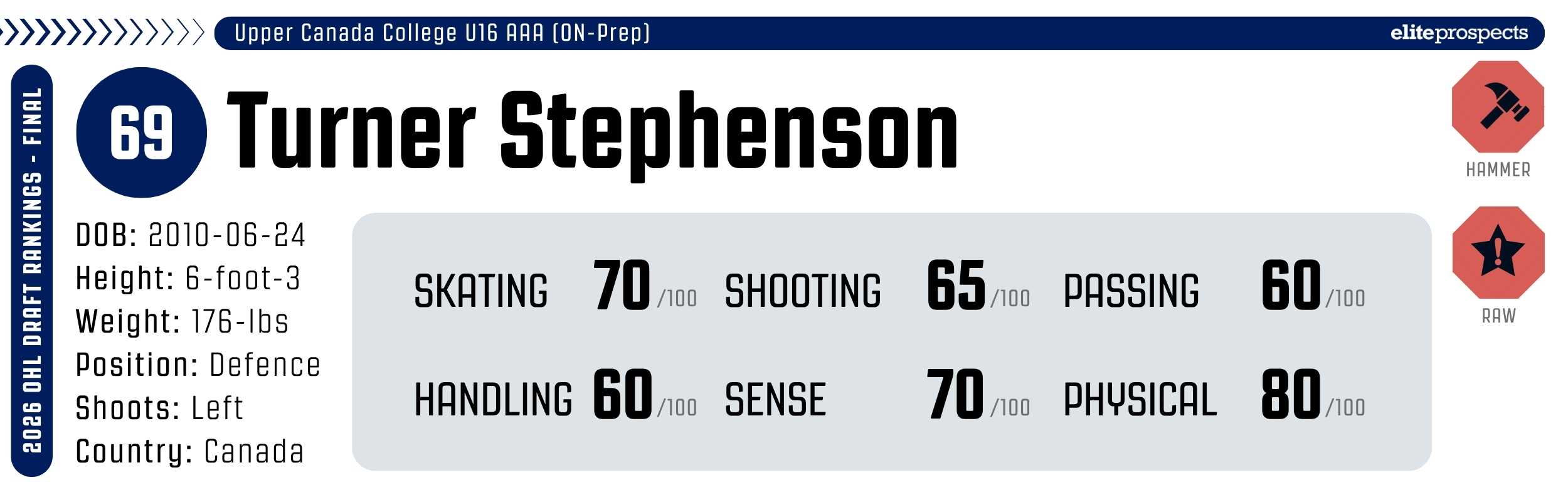
A behemoth on UCC’s blue line, Turner Stephenson has what it takes to become a regular OHL defender. Though a rawer player who lacks some coordination at times, his defensive range is great, and he has enough mobility to get stops at this level. He’s a staunch defensive presence, blocking shots, breaking up the cycle, hammering opponents into the walls, and closing quickly to negate rushes. He also flashed puck-moving ability at times this season, but it’s more likely that he’s a pure bottom-four shutdown projection in the OHL.
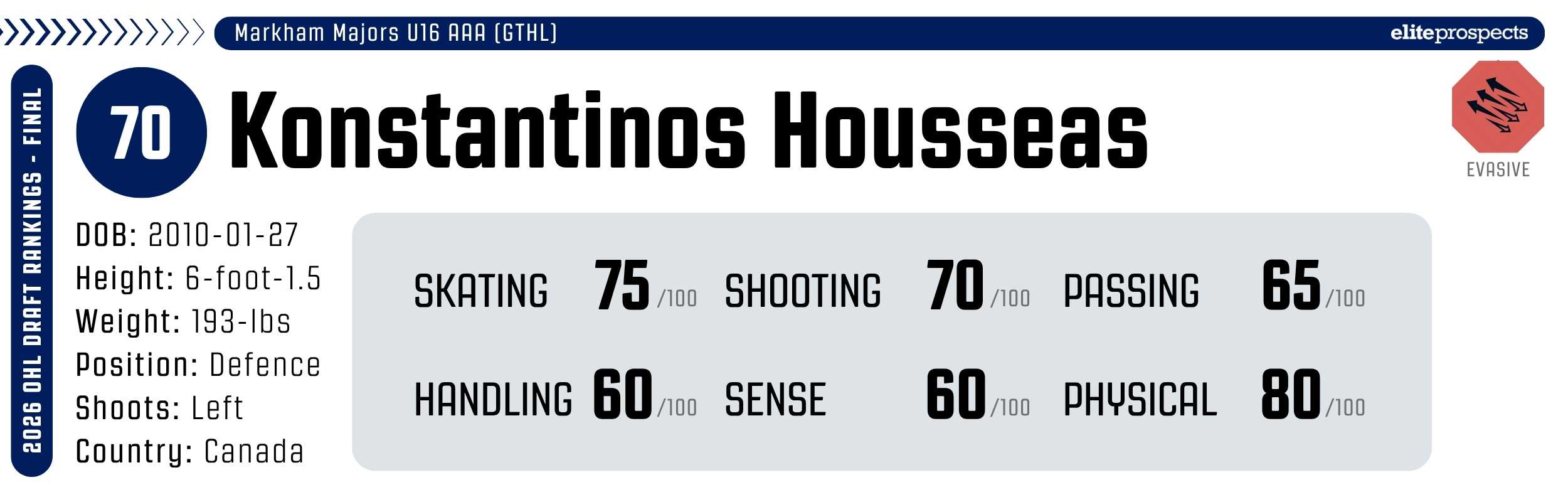
After making our midseason top-50 ranking, Konstantinos Housseas now sits in the back half of our top-100, one of the biggest fallers. Still, his game should project well to the OHL. A solid rush stopper, he also possesses both retrieval and breakout skills. His poise impressed our team at multiple points this season, but we hoped to see more assertiveness, consistent creation, and more deception on his puck touches in the second half. That didn’t quite materialize, which impacted his projection, but given his tools, technical foundation, and size, he should still find a bottom-four role.
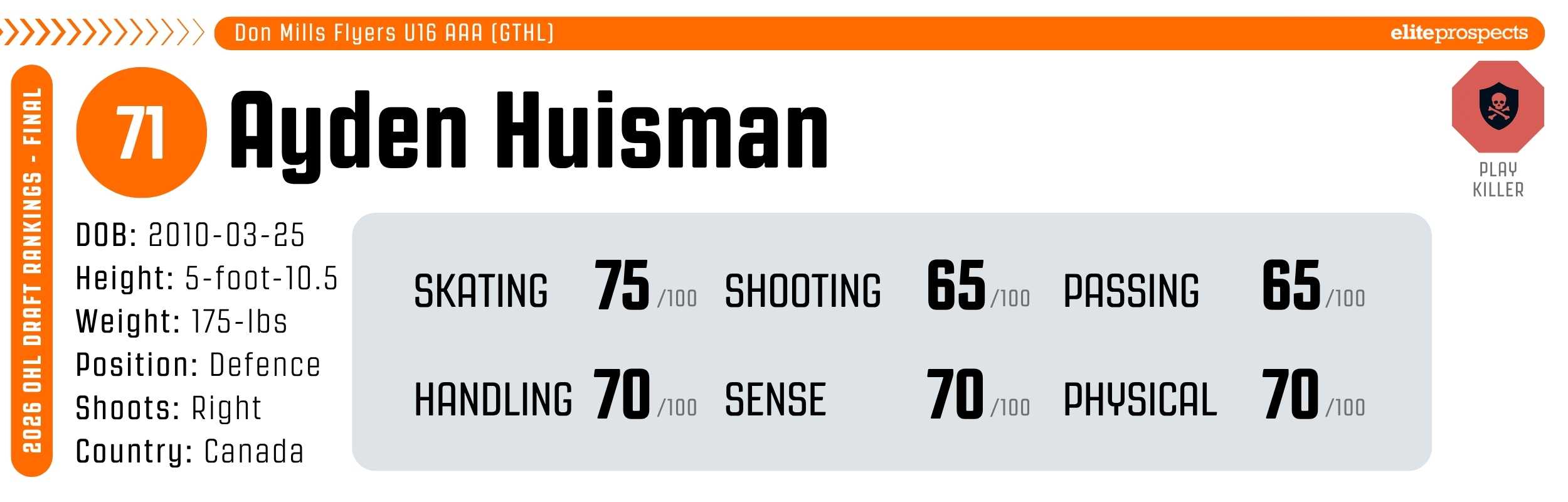
A toolsy all-around defender, Ayden Huisman has all the requisite skills to succeed in a middle-pairing role. Above-average mobility and backwards edges allow him to excel against the rush, mirroring footwork, tightening his gap, and slingshotting across to engage a puck carrier with his body, often getting stops early along the walls. Bringing that physical engagement to cycle defence will be the next step to achieving true shutdown and play-killing status, but his activation flashes and puck-rushing ability could give him more offensive upside.
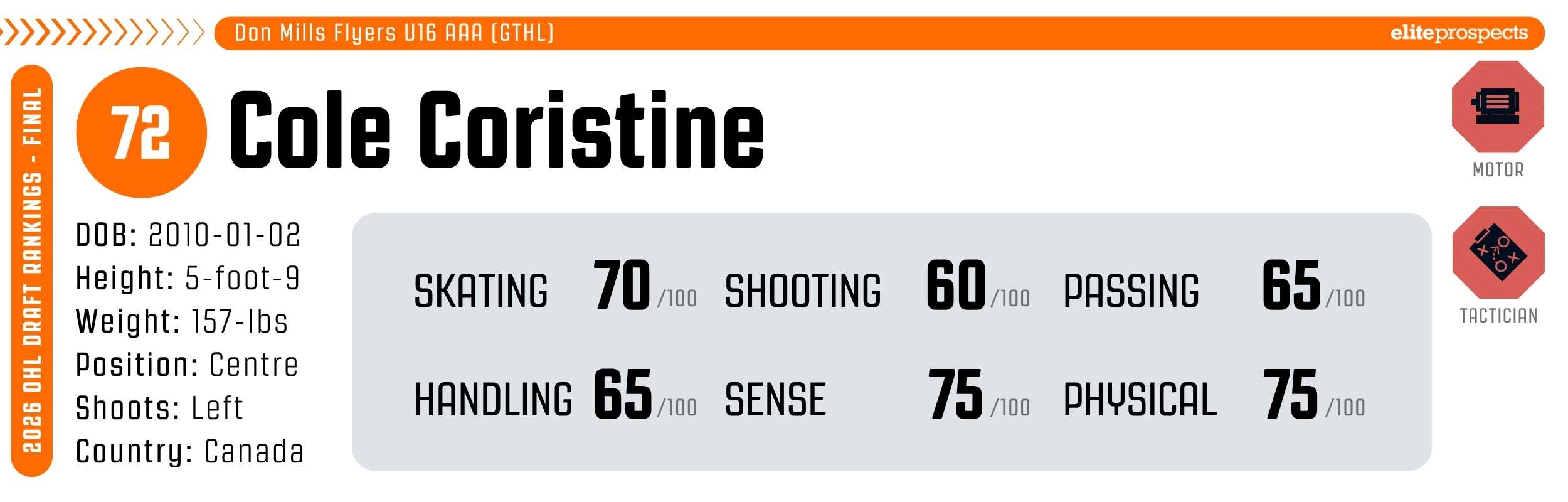
A responsible 200-foot centre, Cole Coristine brings a tenacious package blending defensive effort, scoring touch and competitiveness. With a relentless motor, he leaves no loose puck unattended. He strips defenders of pucks on the forecheck, works the puck back up high, and goes to the net to find a loose puck. Like a true responsible centreman, he always supports defenders down low and never flies the zone above the dots without clear-cut possession. His height may play a factor in his long-term role, but he’s a safe bet to anchor a team’s bottom six and chip in with some goal scoring.
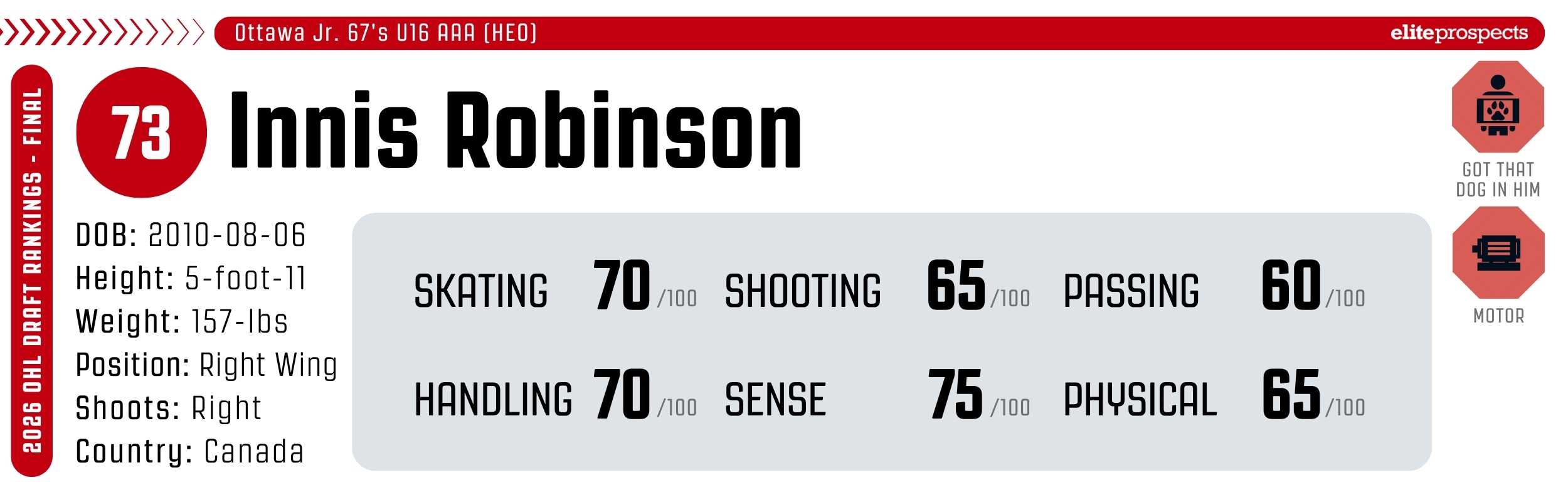
It’s never a bad idea to bet on skill in this range, and Innis Robinson led the 67’s comfortably in scoring this past season thanks to his sharp edgework, rapid footspeed and snappy release. He excels in transition, working one-touch give-and-gos with his teammates as he finds lanes behind defenders and in soft areas of the ice. He carries a strong work ethic at both ends of the ice, proving to be a reliable winger who can consistently lead transition for his line. He will have to add weight to his frame to round out his physical game, but he projects as a high-energy middle-six winger who can chip in offensively.
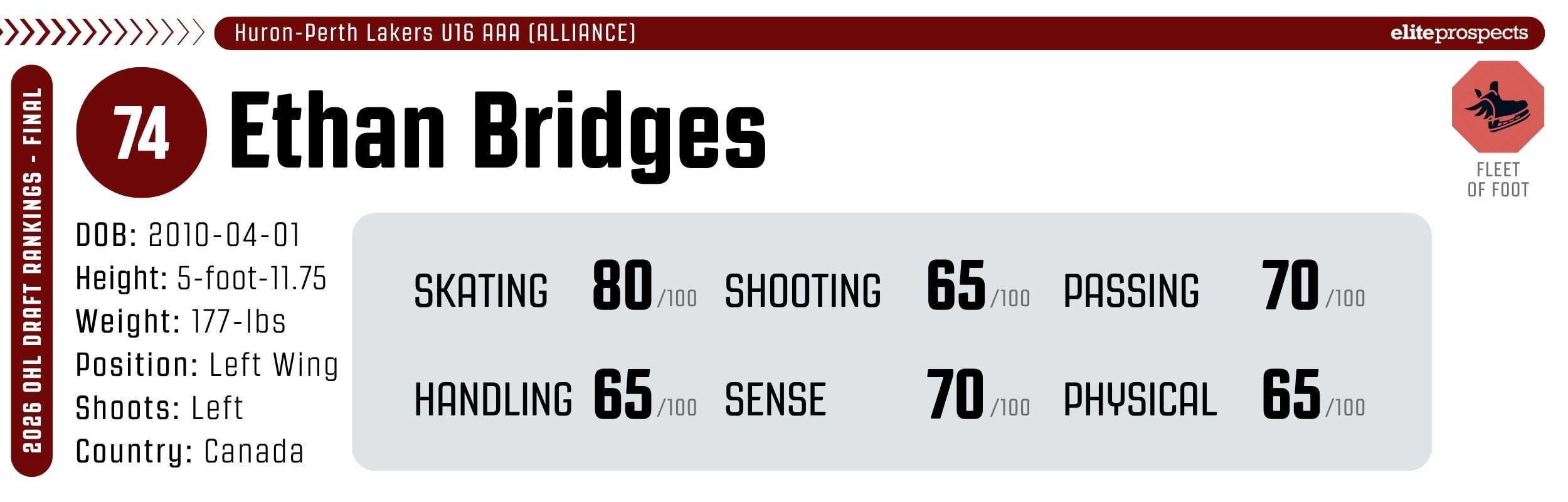
Ethan Bridges’ consistency was one of the most impressive sights this season, as he rarely went more than a game without finding the scoresheet. A powerful forward with separation speed and a knack for finding open ice, his strong manipulation abilities fuel his offensive skills. Off the rush, he times cutbacks perfectly to the commitment of the defenders and can hit the open lanes with precision. Without the puck, he has a strong understanding of where the puck will end up, allowing him to position himself accordingly. With improvements to his decision-making and the consistency of his pace of play, Bridges should be able to produce in a middle-six role down the line.
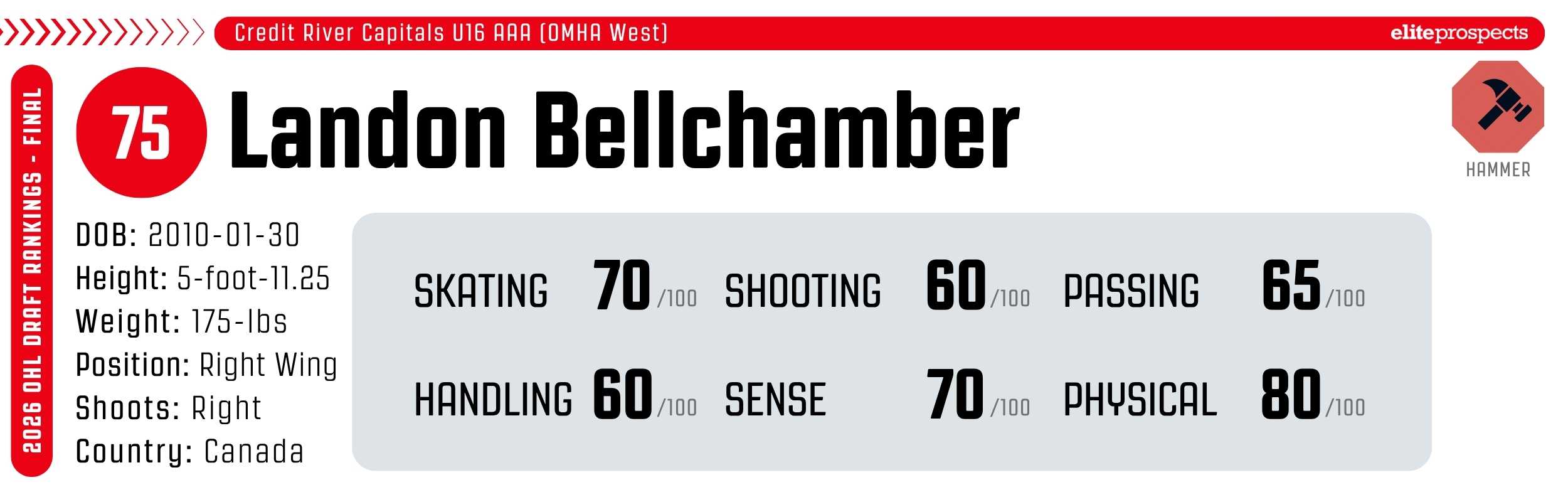
A modern-day power forward, Landon Bellchamber motors through all three zones, looking to take a bite out of opponents, wreak havoc on the forecheck, and get open off drives. Deft finishing touch at the net front sees him bury rebounds with precision, outworking defenders to get his stick free. Pace and physicality define his game, and his effort level is never in question. Though he may lack the top-end skill to find a role higher up in a lineup, he’s an easy projection to a third-line or bottom-six checking role, where his physical and net-front games could become defining skills.
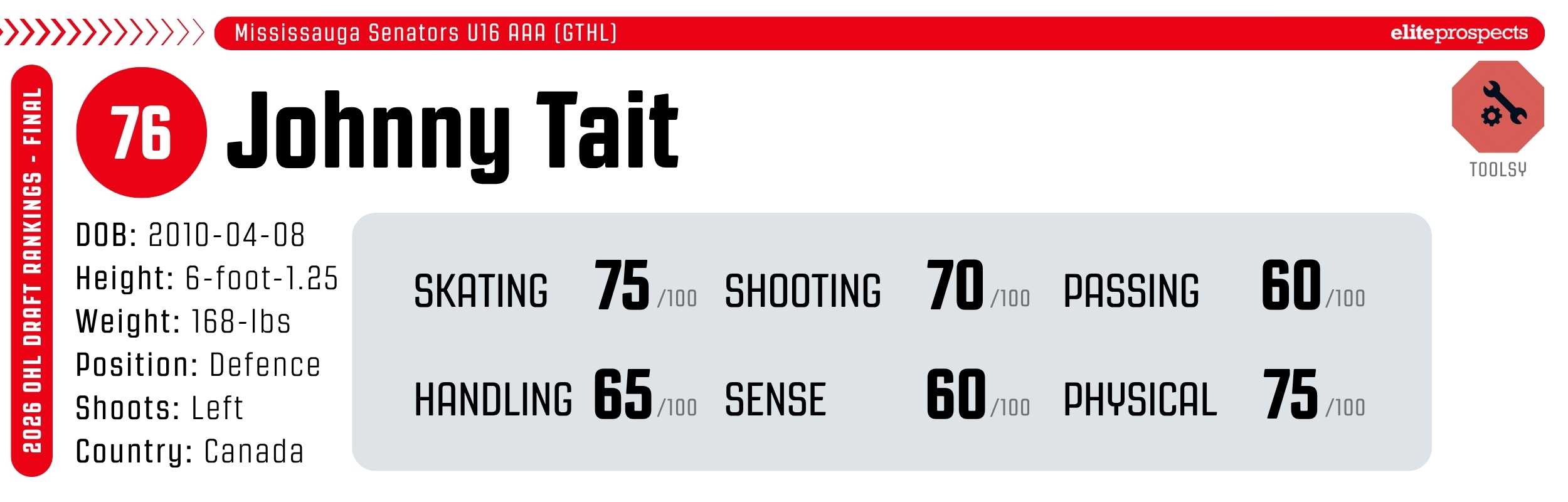
Johnny Tait’s combination of size and skating gives him a projectable foundation as a defender. With good four-way mobility for a bigger body, he uses his feet to angle attackers wide or below the goal line before sealing them on the wall, where his strength makes him hard to shake. Though effective at killing rushes on his side and winning battles, his on-puck reads and planning must improve, as he’s a bit turnover-prone. Better reads may come with time, experience, and reps – at this point, he's likely more to become a No. 4 or 5 defenceman who is prized less for his puck-moving prowess and more for his shutdown abilities.
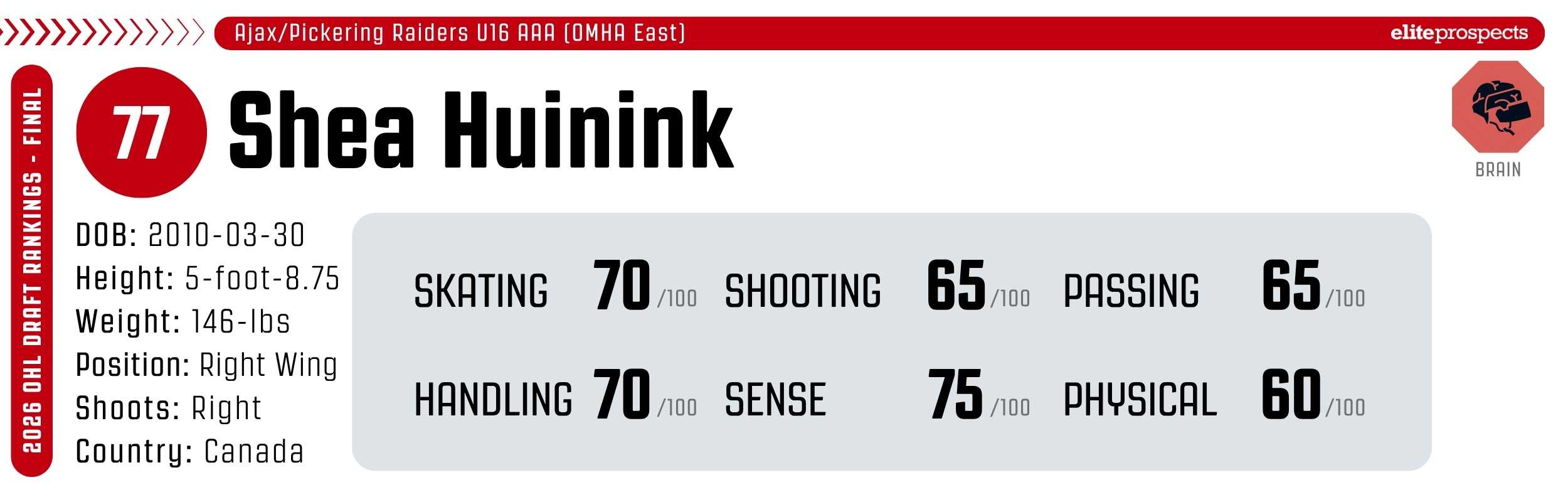
Hockey sense sets the foundation for Shea Huinink’s game. He loves to work with the puck in transition, where he uses his edges to dart in and out of lanes with the goal of pulling pucks through defenders. Defensively, he’s a responsible winger with strong positioning who never cheats his own zone. Crafty breakouts when along the half-wall sees him he finds centre-lane drivers with outlets before joining the rush himself. At just a shade under 5-foot-9, he will have to bulk up his frame significantly to play a middle-six scoring role, but his strong defensive habits and feel for the game will carry him to long-term success.
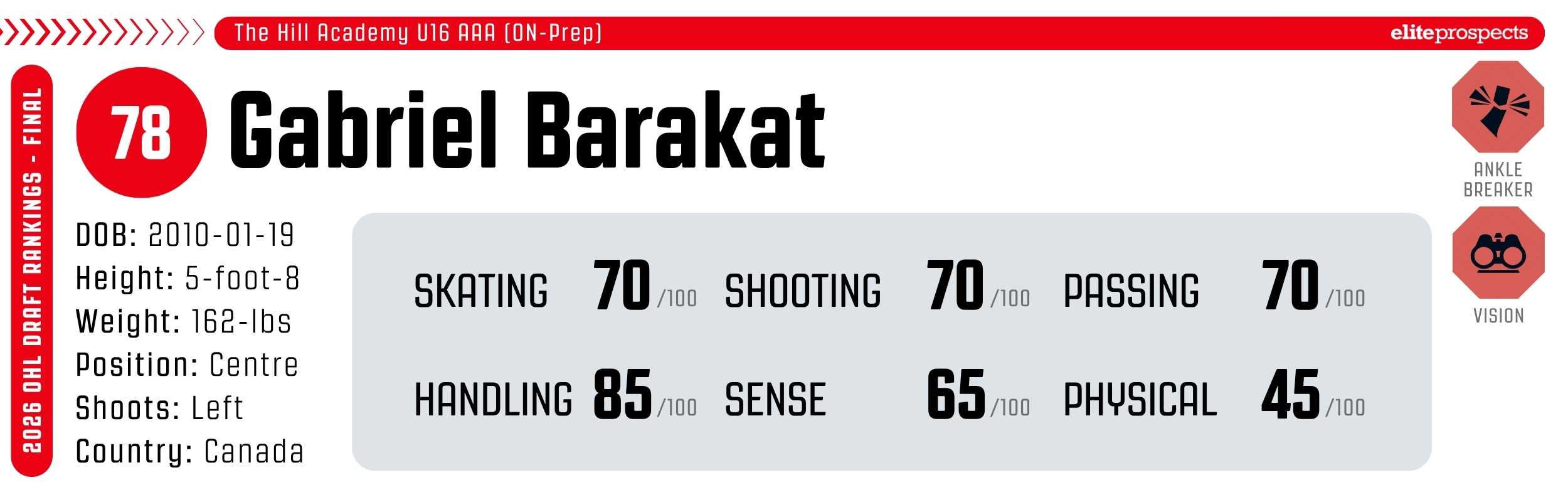
Gabriel Barakat’s dynamic handles, flashes of manipulation, and high-pace game made him one of our team’s favourite prospects. Small-area manoeuvrability, the confidence to bait defenders 1-on-1, fake to draw pressure, and a determination to work the inside lanes allowed him to generate chances at impressive rates. Without the puck, he’s equally as impactful, relentlessly hounding on backchecks to force turnovers and create steals. Further strength development and more translatable playmaking – less reliance on his handling and solo efforts, better use of his linemates – will likely be required to translate his offence to the OHL, but he could be a middle-six complementary forward who provides secondary scoring and off-puck impact.
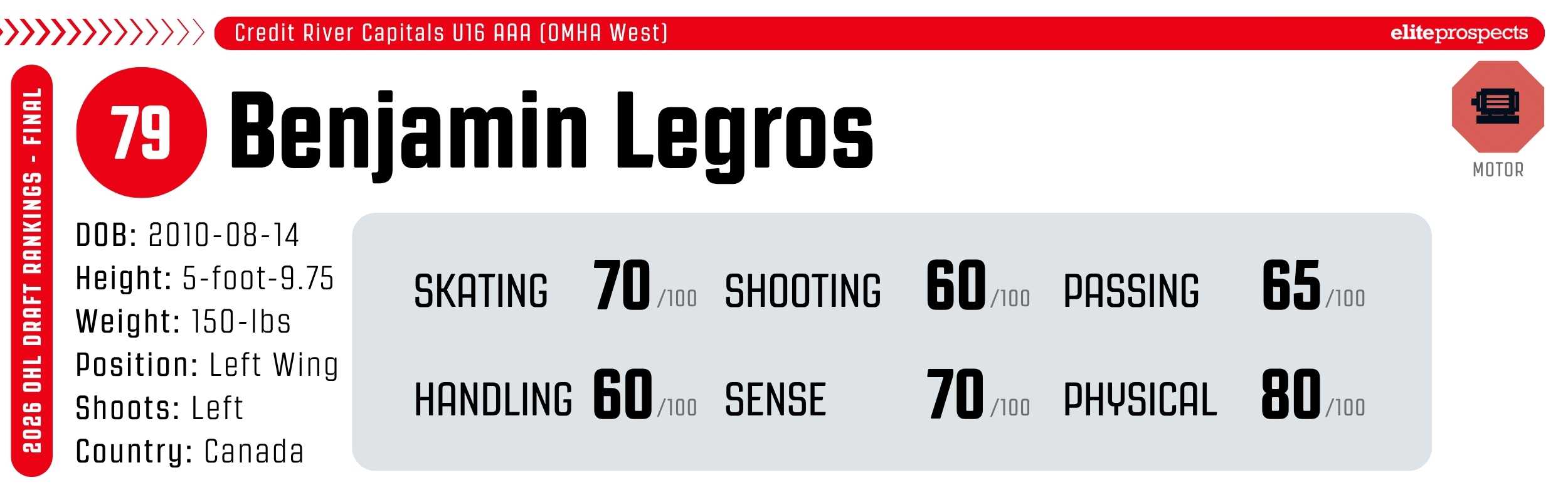
One of the second half’s brighter lights, Benjamin Legros brings a blend of speed and physicality paired with an elite motor and compete level. His first couple of steps are explosive, and he’s equipped with breakaway speed. After winning puck races, he is happy to initiate contact and play through physicality with some level of success in order to open lanes to the net. He’s at his most effective in the offensive zone when driving wide and taking pucks hard to the net or interior. He projects as an energetic bottom-six forward at the next level who carries some goal-scoring upside – diversifying his rush attacks could unlock more playmaking.
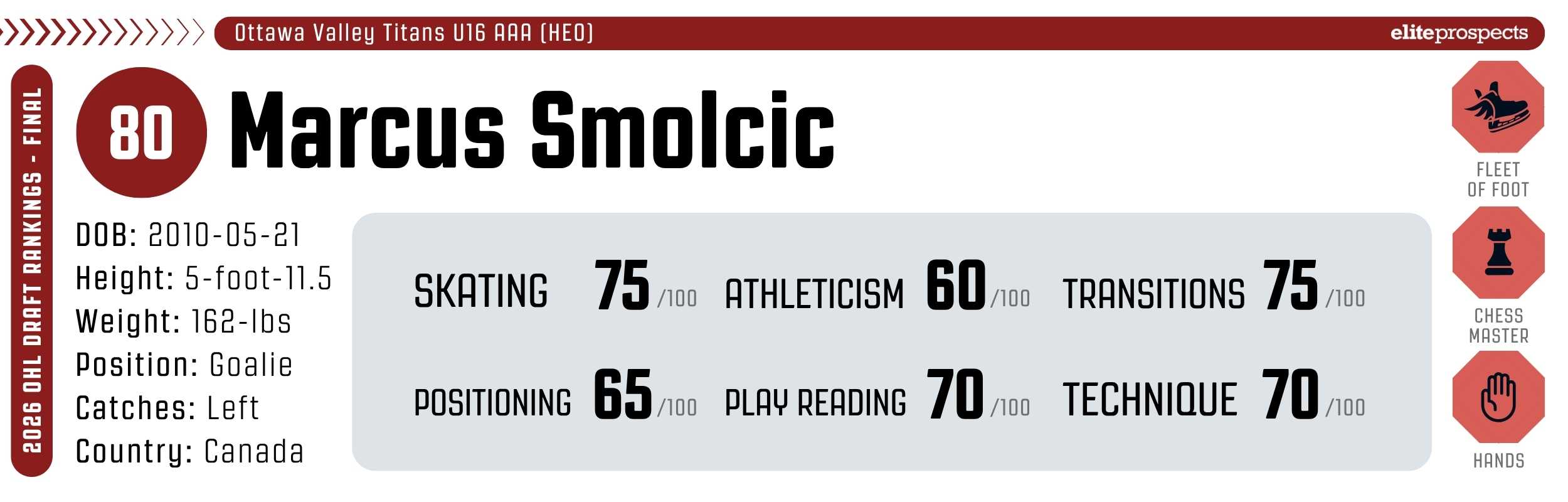
There’s a lot to like from Marcus Smolcic’s game. He’s a great puck-tracker, with strong hands and good rebound control. Smolcic is also an effective mover, with hard stops and quick feet. On his posts, he layers reads to slow down the game and meet backdoor plays efficiently. Though Smolcic can lose his composure and positioning in moments and overcompensate with larger movements, improvements in those areas, alongside tracking through traffic, should help him reach the quality level of an OHL starter.
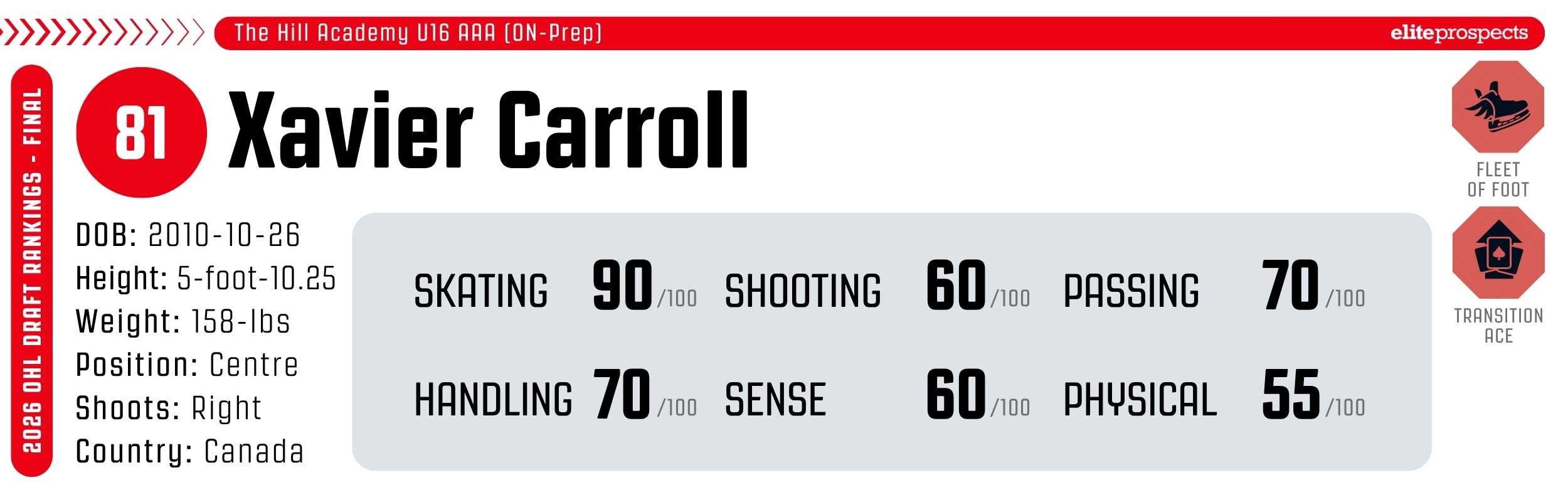
Hill Academy’s high-flying centre, Xavier Carroll showcased exciting pace combined with a tireless work ethic to impact the game in a variety of ways. His primary asset is his explosive acceleration. He utilizes his speed exceptionally well both in transition, providing a reliable outlet in the middle of the ice, and on the forecheck, where he aggressively closes the gap on defenders, hounding them to force turnovers. It’s more likely that he fills an energy bottom-six centre capable of driving transition play; though he showed flashes of slick stickwork as he attacked the inner slot, his puck skills will need to take a step to earn a scoring role in the OHL.
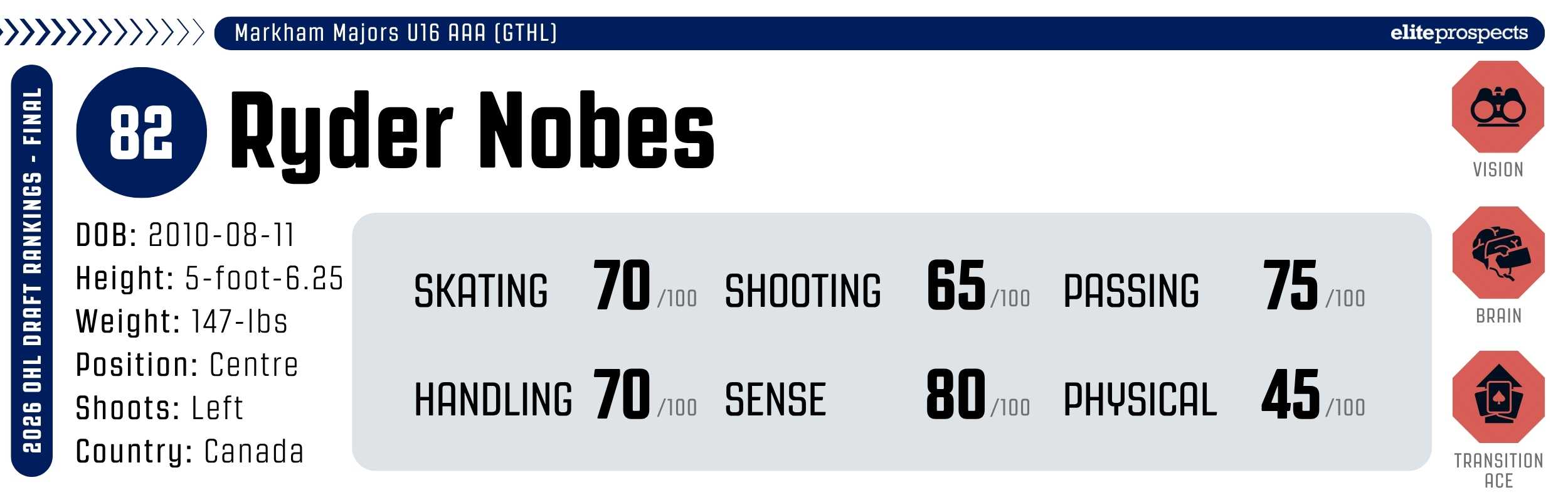
Ryder Nobes was one of the most consistent offensive producers in the GTHL this season. He has a quick, accurate release, smart route timing, and a natural feel for arriving in soft spots at the right time. Nobes is more than just a finisher, using his skill to beat defenders off the rush and slip pucks to teammates when lanes open. Off the puck, he competes hard, supports low and slow, and has a good stick to win loose puck battles. The biggest challenge? Nobes is one of the smallest players on our ranking. We’ve been believers all season long, but for Nobes to reach his middle-six upside and stick at centre, he will have to develop significant physical skills to hold down an OHL scoring role. There’s significant risk here, but he’s a great mid-round bet on skill and upside.
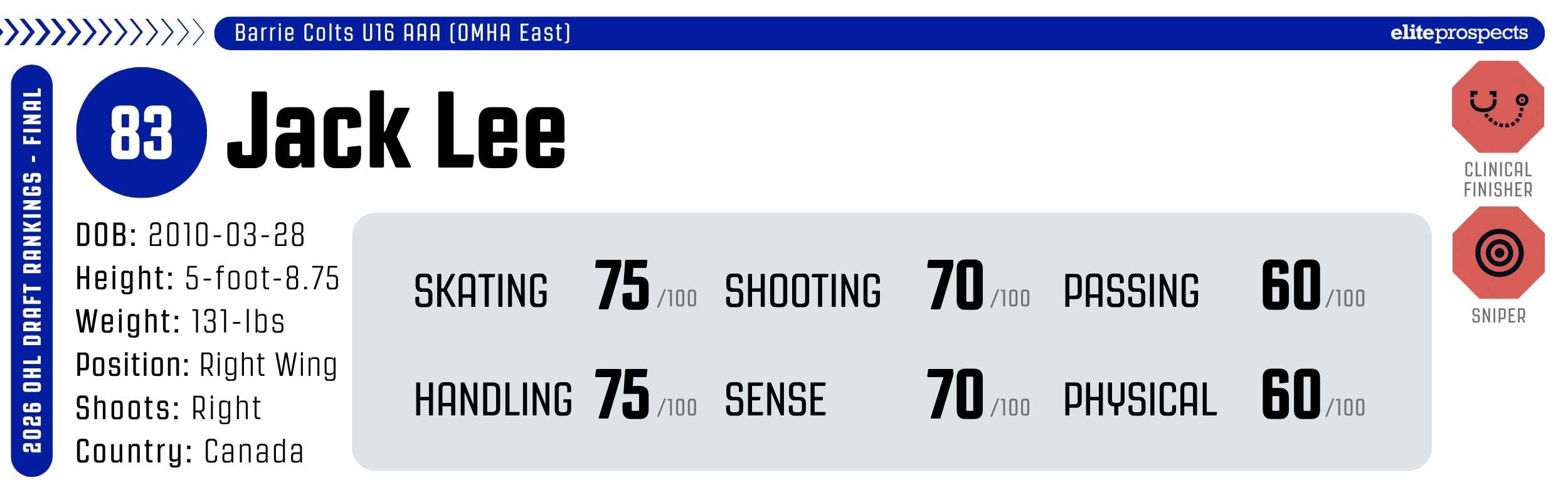
Jack Lee, at his best, is a chance creation machine firing on all cylinders. An enticing combination of skill and competitive drive, he’s a dynamic rush threat, able to make plays at pace and beat defenders down the walls. He’s unafraid to throw his weight around on the forecheck and in battles, and he’s a calculated off-puck mover, too, hunting space to get shots off quickly. Adding more strength, patience in mapping out his attacks, and a better playmaking dimension will help his creation translate to the OHL. With top-six upside, he’s a prospect worth betting on in the middle rounds of the draft.
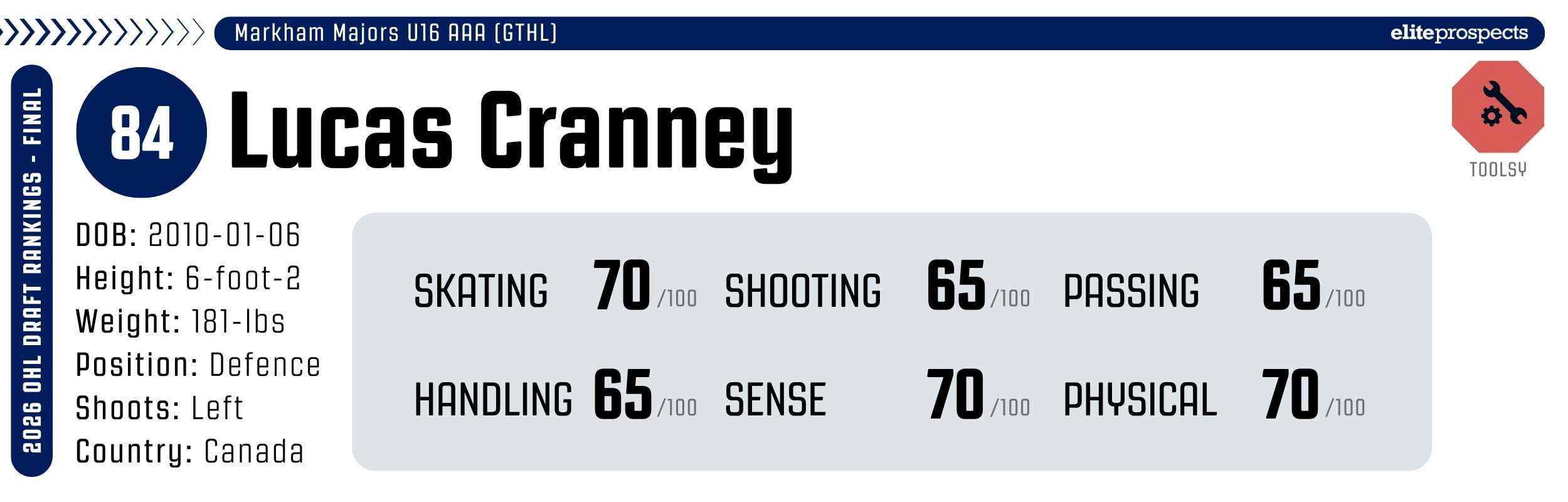
As far as Majors defenders go, Lucas Cranney may be the biggest riser and their best player in the second half. A rush killer, he uses exceptional angling to steer traffic to the walls. In transition, he can make a clean first pass and absorb contact on retrievals – all important elements of an OHL projection. Going forward, he’ll have to add more physical skills to his game, like throwing hits to finish his rush-defending sequences, but even with the improvement, he’s a likely No. 4 to 6 defender at the OHL level.
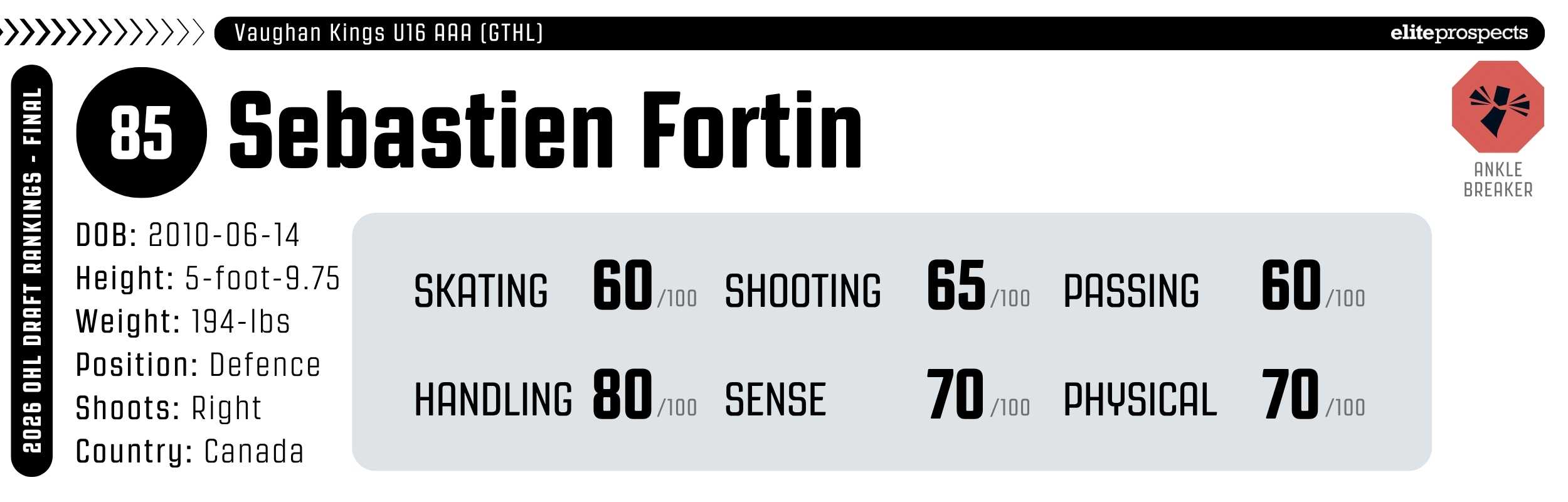
A smooth-skating, sturdy, right-shot defenceman, Sebastien Fortin was an invaluable piece of the GTHL champions this season. A dependable presence on the back end, he excelled at using his strength to box attackers out of the crease, carried an active stick to disrupt passes, and executed crisp breakout passes under pressure. He confidently carried the puck up the ice with his legs when appropriate, showing advanced underhandling techniques along with his smooth stride for some highlight-reel goals. His overall footspeed will have to improve, but he projects as a sturdy bottom-four defender at the next level with some production upside.
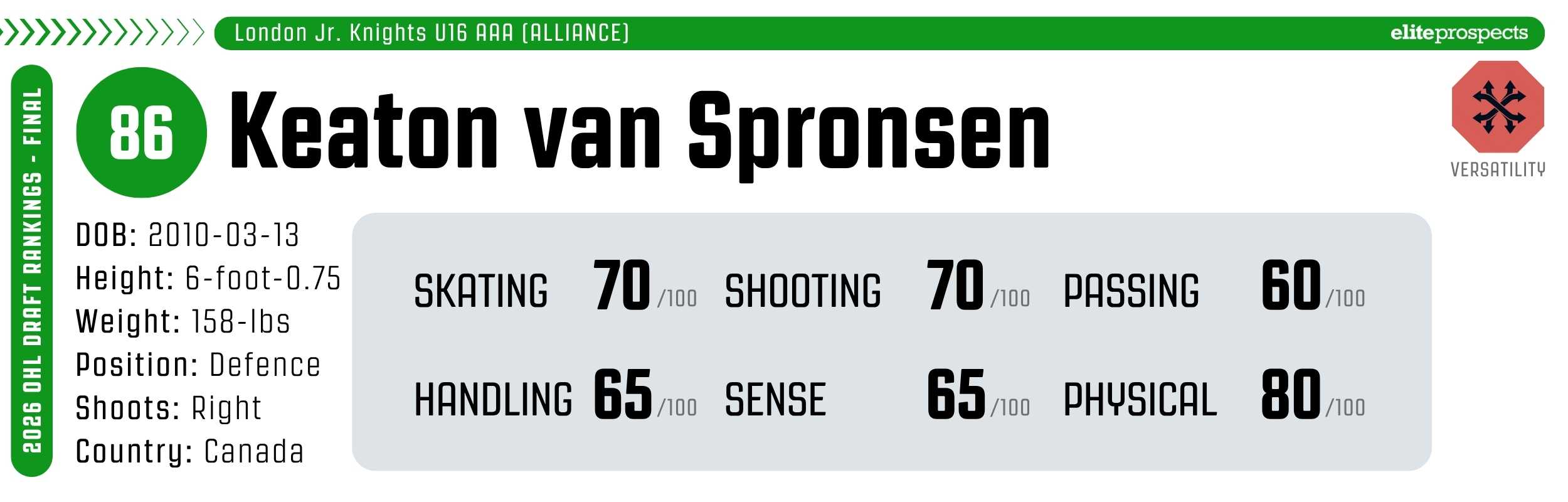
All-around, hard-nosed defender Keaton van Spronsen combines physicality and play-killing potential. A smart defender with solid positioning, he scans consistently to pick up threats, shadows puck carriers on the cycle, uses his stick to disrupt carries, and maintains his gap enough on the rush to knock them off stride with a well-timed engagement. With a simpler puck-moving game, he finds the right targets on breakouts, and his heavy shot creates rebounds and chances in front for teammates. Not likely to be much of a producer in the OHL, he’ll be valued for his defensive range and shutdown style, likely in a bottom-pairing role, once he fills out his frame.
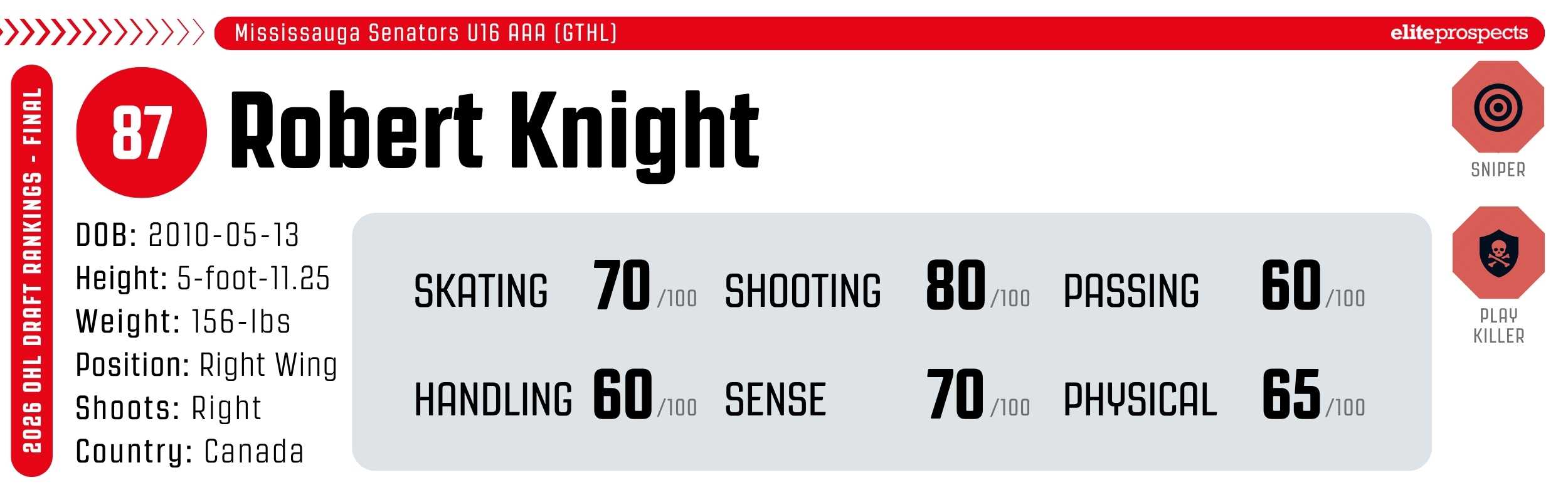
From a mechanical standpoint, Robert Knight has one of the best shots in this year's OHL class. A heavy, accurate wrist shot threatens goalies from distance, and his willingness to attack the inner slot elevates his scoring upside. A defensively mature winger, he stays above his check, supports deep in his own end, and constantly communicates to direct coverage, switching off assignments when plays break down and tracking back to dispossess opponents. While he didn’t take enough of a step forward in the second half to earn a higher ranking, he’ll be a versatile middle-six contributor due to his two-way play, finishing ability, and defensive acumen.
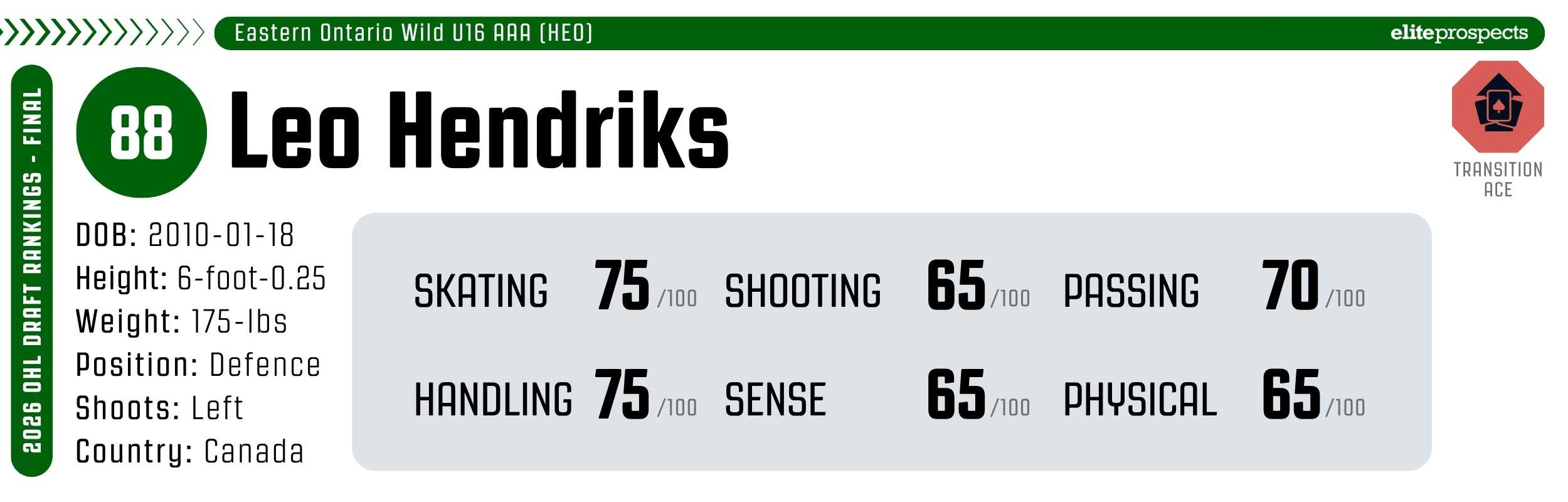
A model of consistency, Leo Hendriks brought stability, control, and adaptability to the table this season. He’s a versatile defender who is just as capable of making plays as he is of shutting them down. With high-end mobility, he excels on retrievals and breakouts, carrying pucks through zones and activating into space, sometimes pinching deeper into the zone to keep pucks in. His playmaking vision really took a step in the second half, boosting his upside and projection even further. Also a physical defenceman who looks well on his way to becoming a competent rush killer, he looks poised for a top-four OHL role as a likely two-way defender.
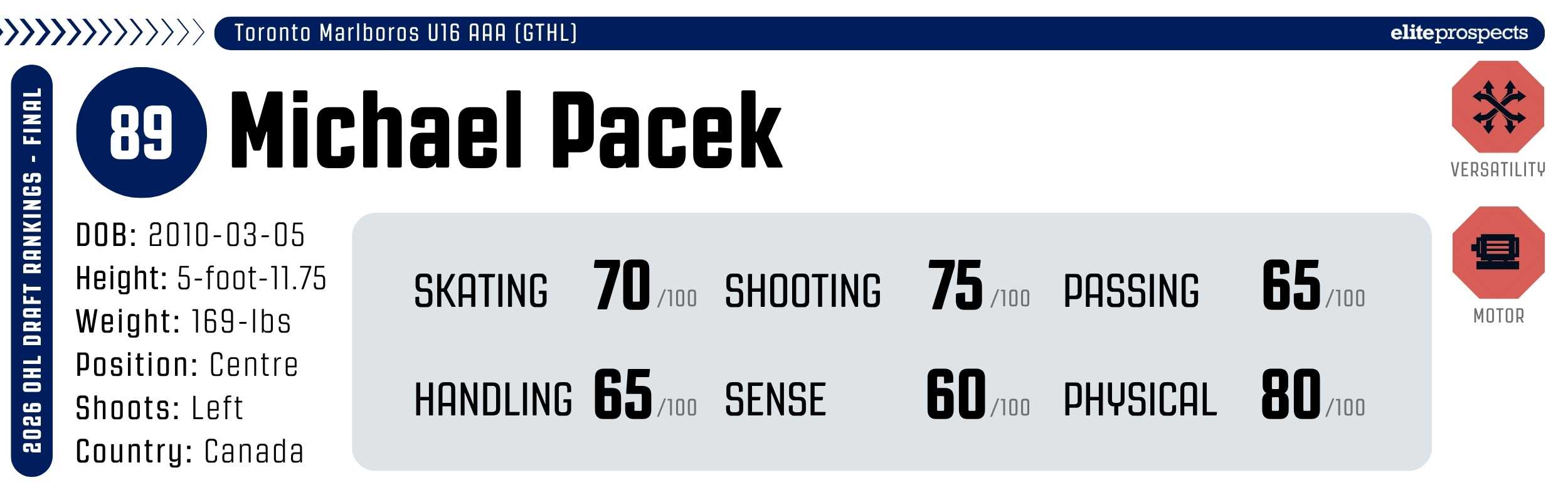
It was a tale of two seasons for Michael Pacek, the result of an upper-body injury which kept him out for three months, but his second half proved he can be an impact OHL player. One of the fiercest competitors in our entire ranking, he’s at his best when physically engaged, pushing pace, and motoring all over the ice in pursuit of pucks. When options aren’t available to him as he carries the puck in transition, he chips pucks behind the defence and announces his arrival heavily on the forecheck. With some power forward elements, he’s a potential bottom-six energy player, and further development of his puck tools could help him chip in offensively at the OHL level.
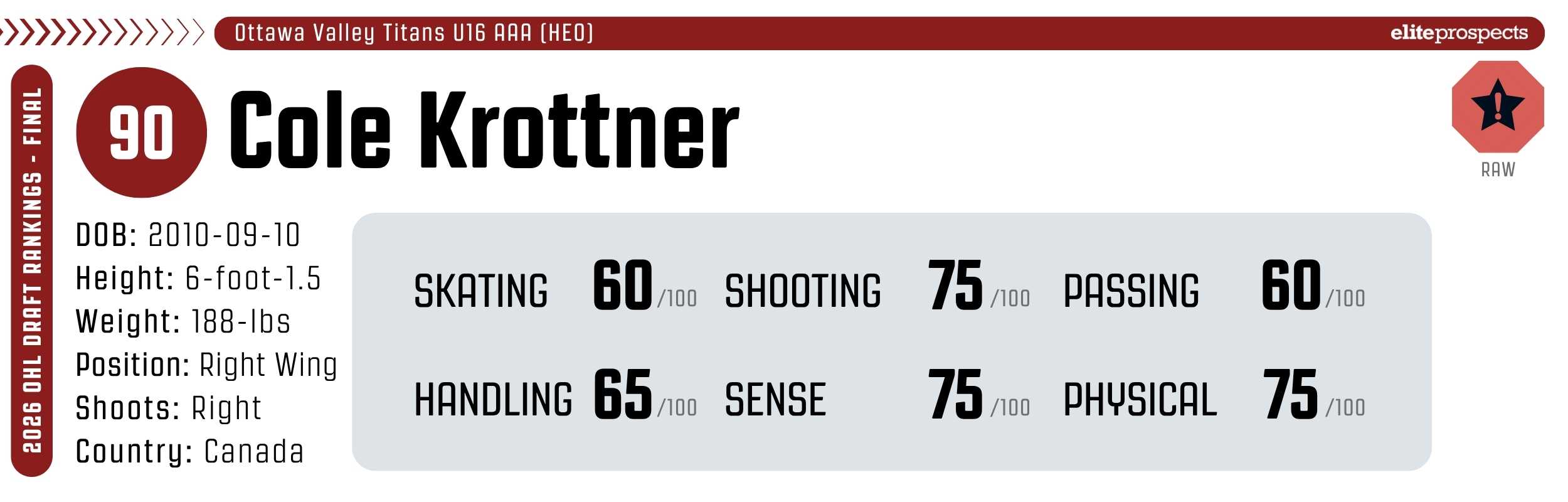
Strength and intelligence defined Cole Krottner’s game at the U16 level, and those characteristics will likely carry him to success in the OHL, too. A positionally sound, tactical mover, the winger frequently scanned as he moved from check to check, engaging threats and battling intensely to regain possession, before kick-starting rushes up ice, often using give-and-gos to gain the zone. A powerful shooter who can get shots off with little wind-up, he also boasts an impressive net-front game. Better first-step explosiveness and faster acceleration could see him add more pace to his game, but he has the right style and habits to play a third-line role.
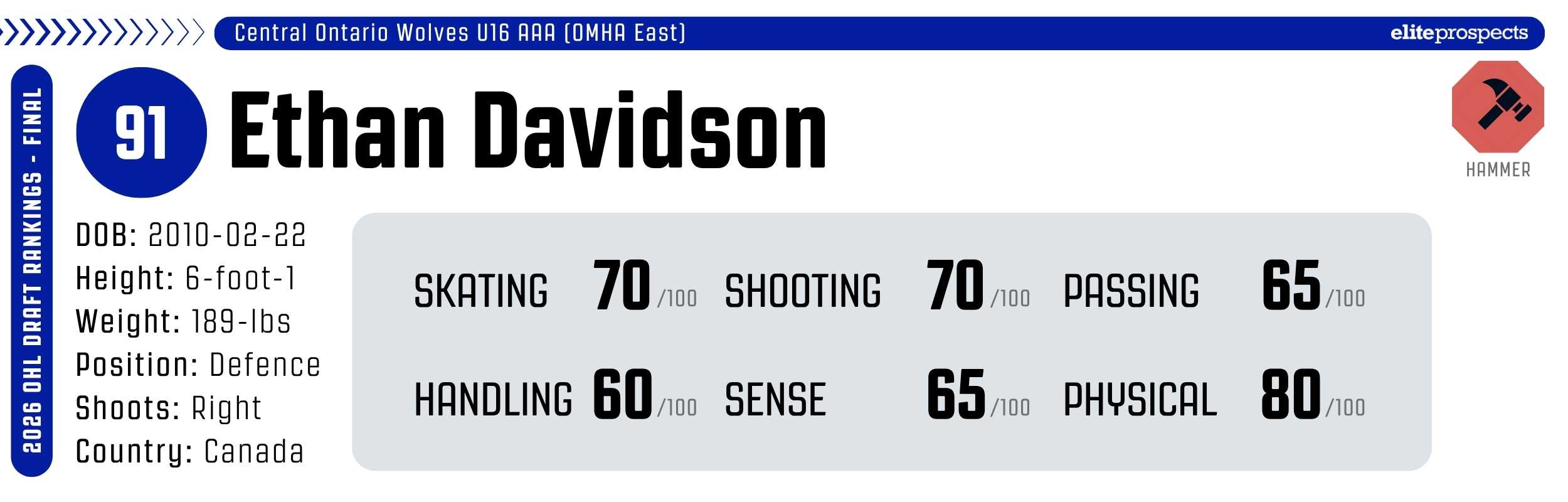
The anchor on the blueline for the Wolves this season, Ethan Davidson’s combination of size and physicality consistently impressed. He carries strong defensive awareness to identify lanes and get in the way of pucks, never afraid to put his body on the line to make a play, angling players to the boards with high success, and delivering painful hits along the wall often. His puck skills are still quite raw, but he can make strong breakout passes with some space, and his shot frequently finds its way through traffic in the offensive zone. He’ll find a role as a bottom-pair OHL defender, bringing high value as a penalty killer and shutdown force.
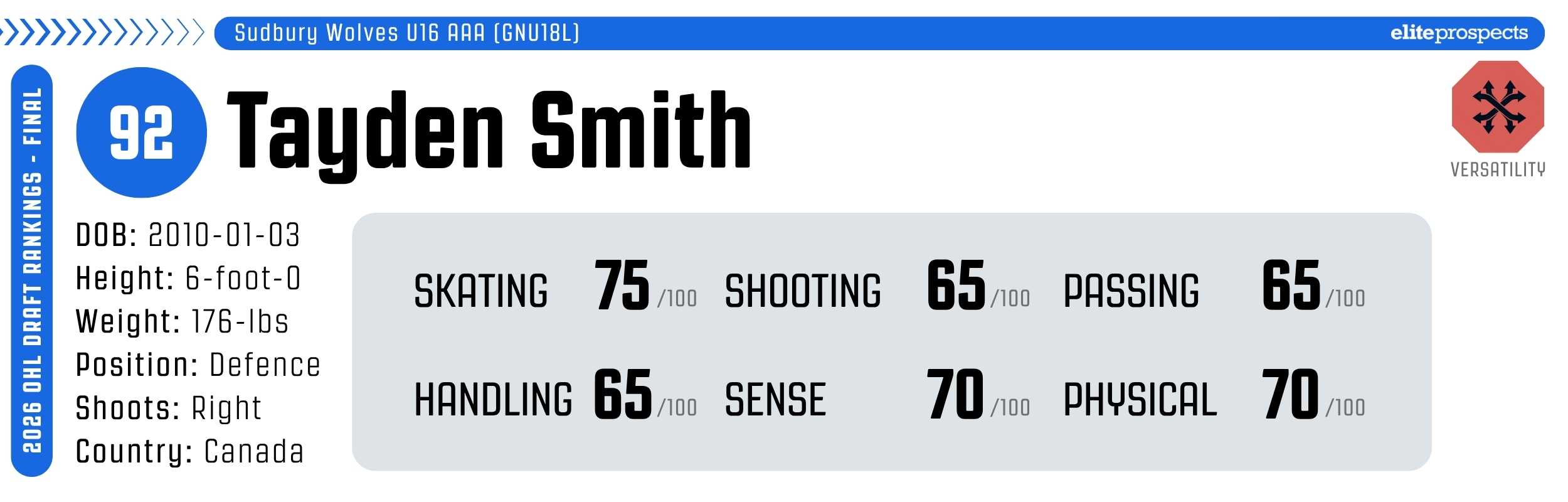
There’s no shortage of players from Northern Ontario on this ranking, but Tayden Smith is the GNU18L’s lone representative on our list. Skating forms the foundation of the defenceman’s game, as he surfs regularly to keep attackers to the outside, skates through the hands of attackers, and engages physically to neutralize threats. Though not a flashy puck-carrier, he moves pucks up ice effectively, opens up lanes as he walks the top of the zone, and can thread his shot through traffic to create havoc at the net front. He’ll have to unlock another layer of offence to improve his upside, but with his tools and habits, he has all the makings of a bottom-four defender.
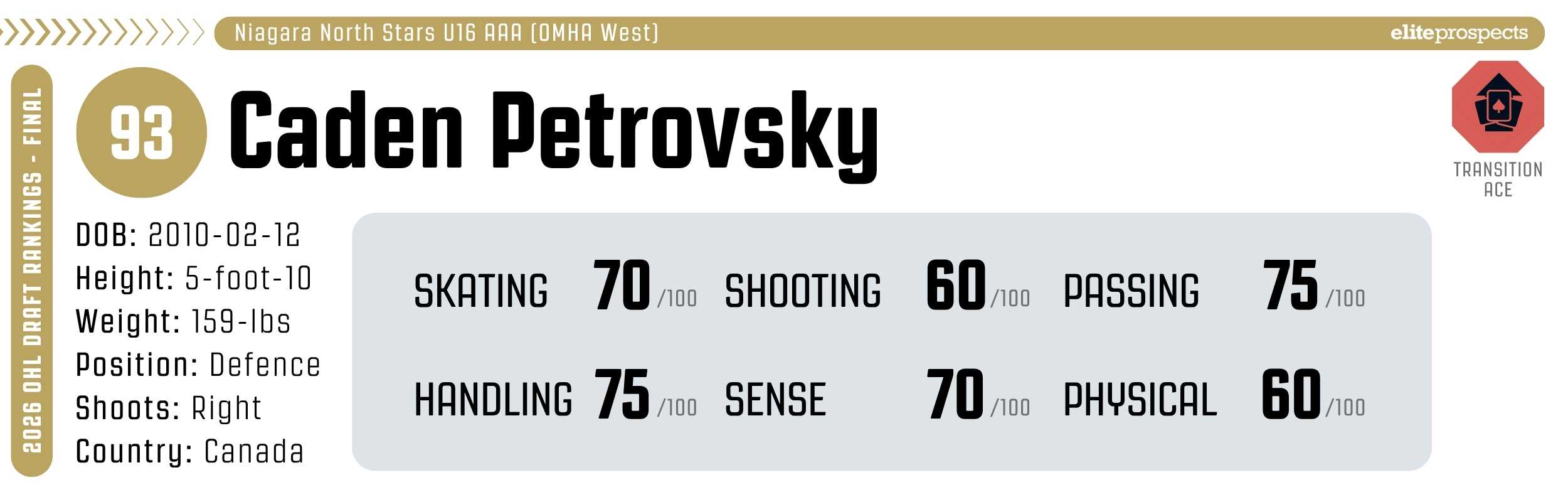
After logging heavy minutes on the backend in all situations for Niagara this season, Caden Petrovsky possesses a very strong two-way foundation for the OHL level. A sturdy right-shot defender, he consistently makes crisp passes up the ice in transition and has a strong sense of when to activate offensively to keep the play alive. He understands the importance of games and shows great poise in his activations. A point-per-game season in the OMHA is no fluke; he carries legitimate top-four puck-moving upside, but will have to continue to improve his footspeed and overall physicality to achieve it.
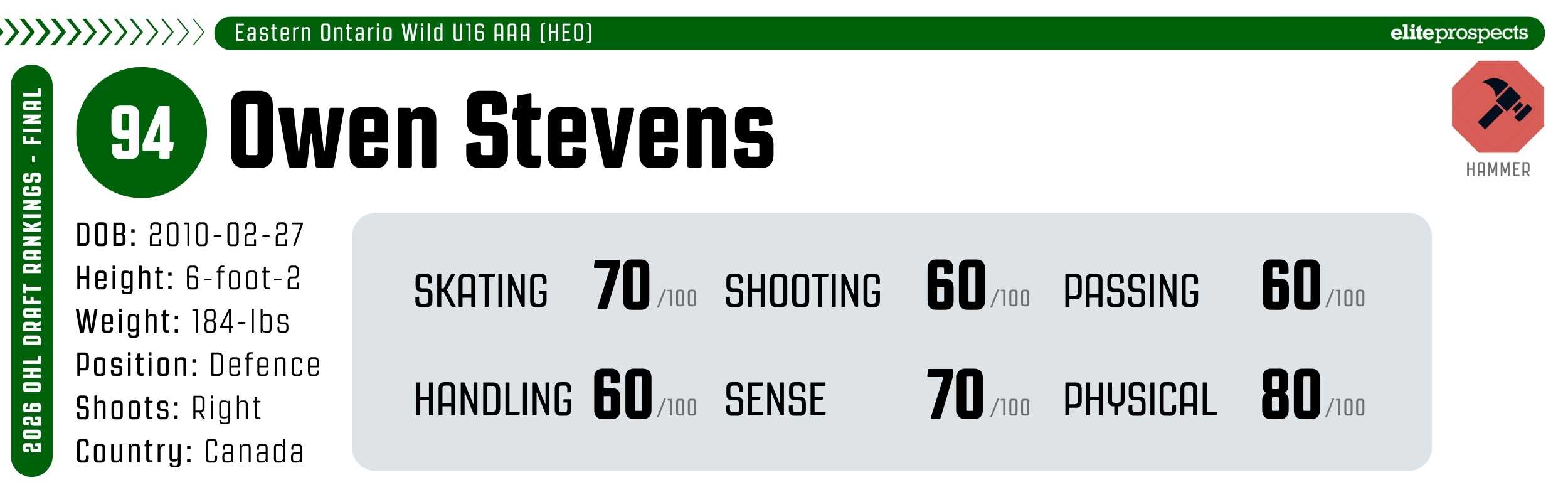
As far as complete defenders in this range go, there may not be a better option out there than Owen Stevens, who has shown the ability to handle forecheck pressure with poise, hit outlets in stride, and, most importantly for his projection, use the wall without hesitation when in trouble. Offensively, he can find lanes to the net from the point as a shooter and has proven to be a threat from there, but the majority of his value is held in his defensive stability. That will be his calling card at future levels, as he finds a bottom-pairing role as a detail-oriented defender.
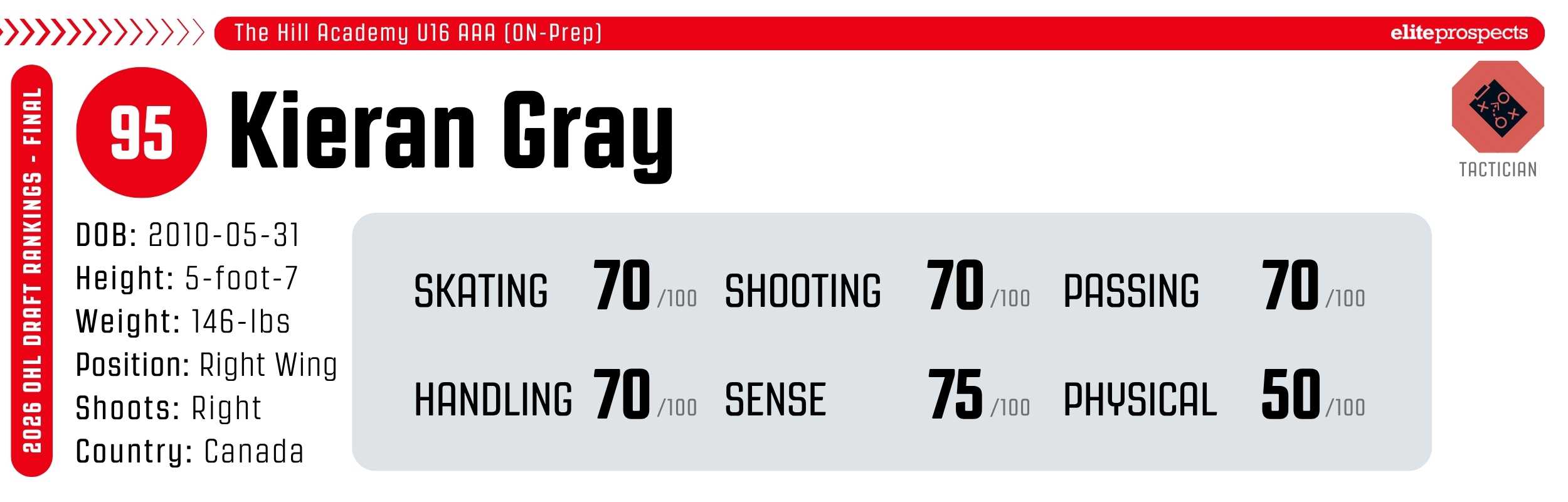
A workhorse winger, Kieran Gray is the type of forward that coaches and fans alike love to go see play. He combines a high-paced game with an elite compete level to hound loose pucks, attack the crease, and make his line difficult to play against without cheating on his defensive play. He excels at turning quick tracking plays and steals into immediate transition opportunities, utilizing his high motor to disrupt opponents before they can break out cleanly. He doesn’t have an overly dynamic element to his game, and his current size poses translatability concerns, but he could find a role as an impact, bottom-six energy player who can move up and down the lineup when needed.
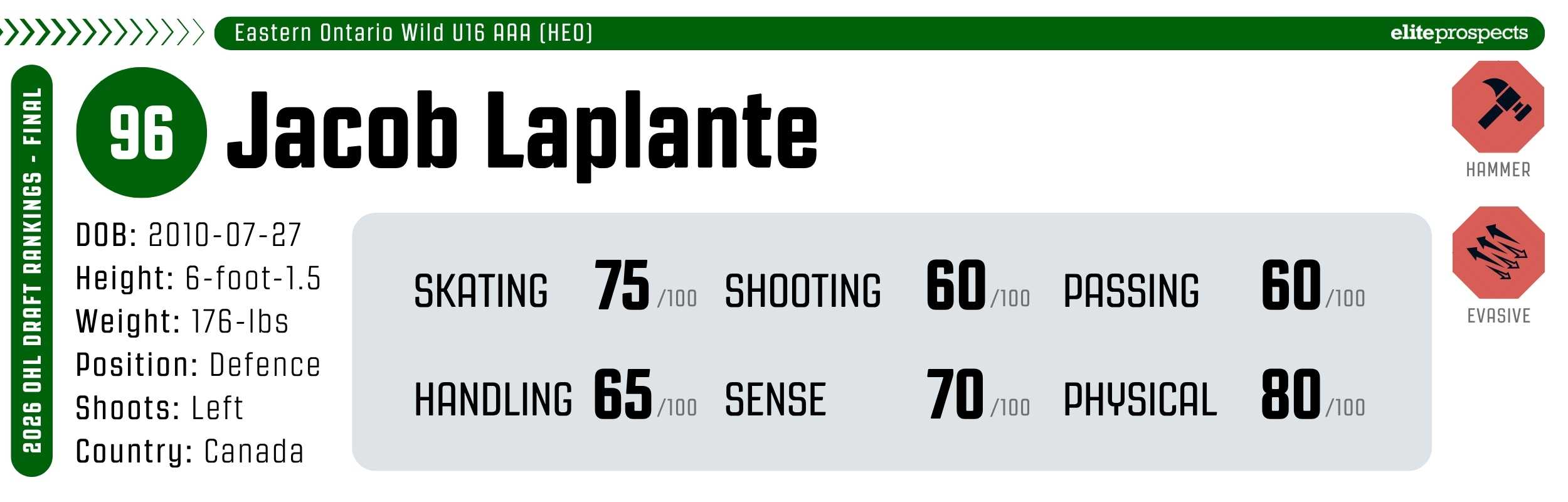
A modern-day shutdown defenceman, Jacob Laplante has the agility of a puck-mover and the size, aggressive physicality, and meanness of a play killer. He stays tight to puck carriers, mirroring footwork, closing gaps fast, and hitting on entries. Evasive on his edges, he can shake forechecking pressure with cutbacks on retrievals – skating could become even more of a defining element in his game with added lower-body strength, developing more explosiveness and power. Though his offensive game is unlikely to be a needle-mover in the OHL, he projects as a bottom-four insulator who can lock down his own zone, impose his physical will, and get stops.
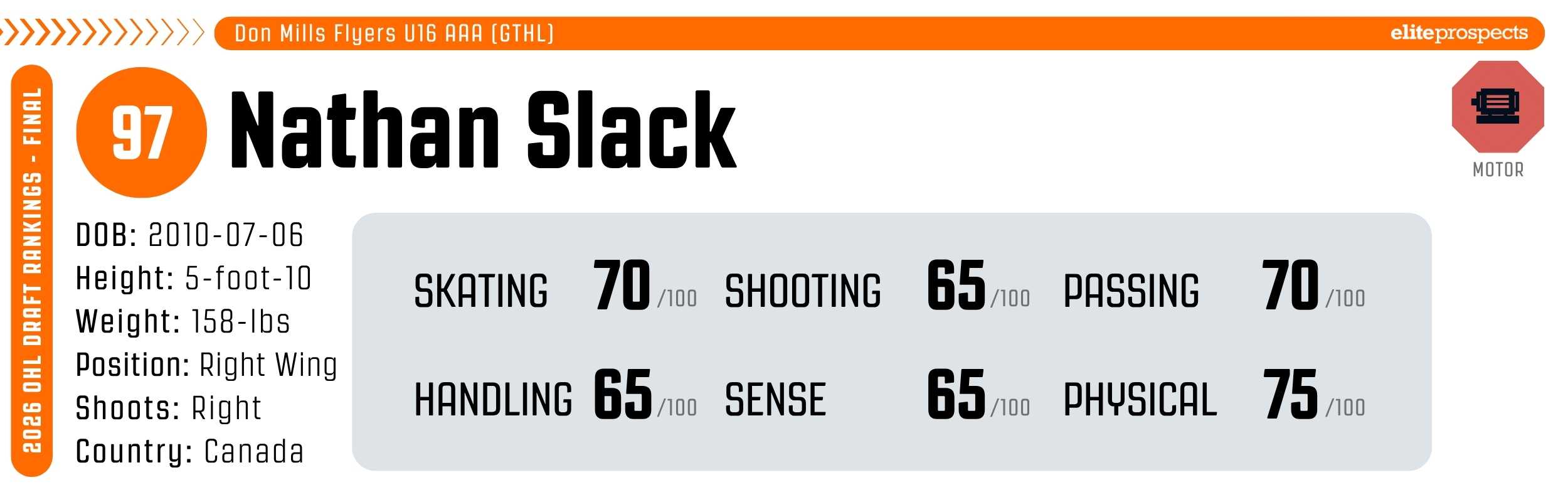
Though undersized, Nathan Slack will never be outworked. He pushes pace, forechecks like a fiend, and fearlessly attacks the inside. A puck retrieval machine, he brings so much energy and isn’t afraid to throw a huge hit on an unsuspecting defender, either. A versatile forward who can create off the cycle and with speed in transition, he can work one-touch passes, give-and-gos, and get open in the slot to shoot off the pass or jump on loose pucks in the crease. He’s an easy projection to be a third-line checker, and he has the skill flashes to improve his upside and find a top-six role, too.

Cameron Hogg plays a direct north-south game, finishes his checks, and competes for loose pucks along the walls. There is some sneaky playmaking skill here, but his best tool is his wrist shot, which is a real threat when he has time and space. Hogg will need to add quickness, as his stride is comfortably below average, and continue to show he can make plays with the puck. The combination of competitiveness, physical edge, and just enough skill gives him a chance to carve out a role. He projects as a bottom-six forward who can contribute physically and chip in offensively from time to time.
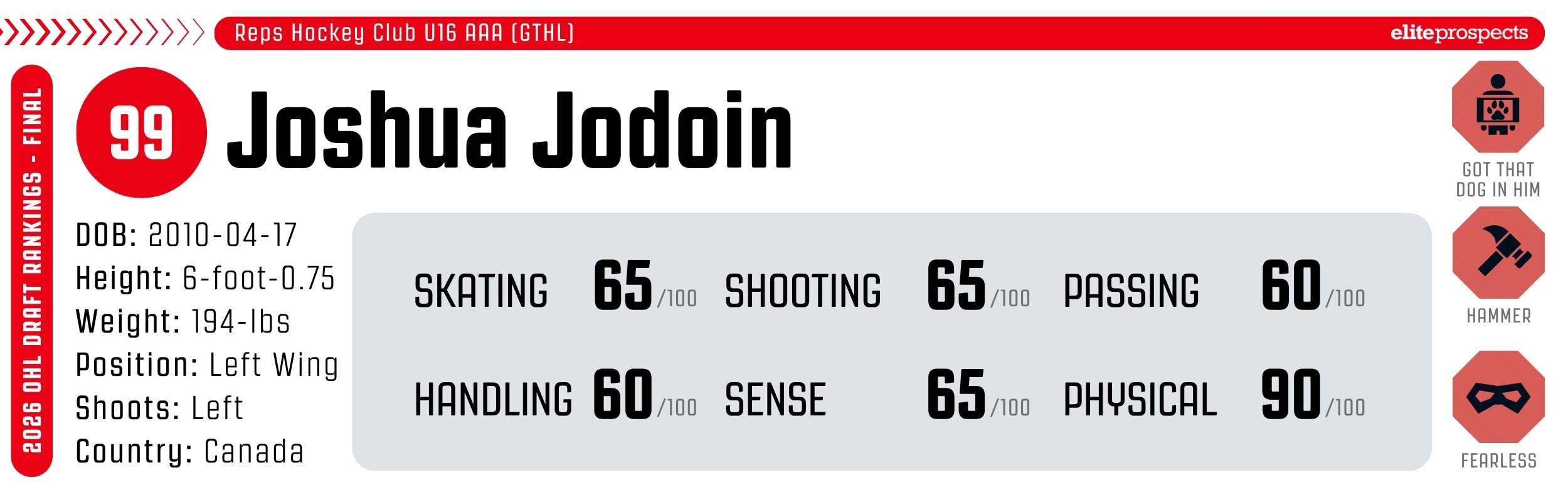
Joshua Jodoin is a rugged north-south forward who plays much bigger than his 6-foot-0.75 frame. He is heavy on the forecheck and does not turn down any opportunity to play the body. With an unrelenting work rate, he competes in all of the hard areas of the ice and uses his size and strength to shield the puck. Defensively, he supports the play well along the half-wall and can absorb contact to make a play or eat a puck when no options are available. Jodoin projects as a depth forward, but he plays with an identity and understands his strengths and how to leverage them.
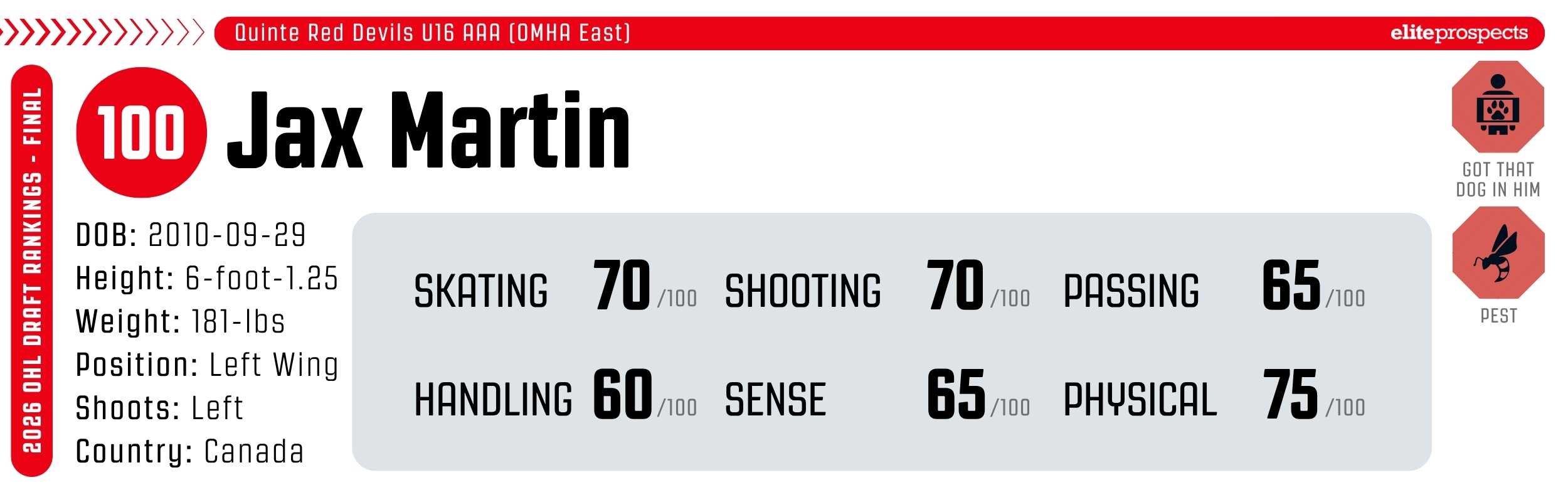
Jax Martin is a physically imposing winger who uses his speed and size to create challenges for opponents. On the forecheck, his skating allows him to get on top of defenders and seriously impact their ability to work the retrieval game. After his side gains possession off the forecheck, he takes smart routes to the net, not only getting his stick and body free, but also taking on contact in those lanes and not blinking an eye. While he projects as a physical bottom-six forward, it’s a testament to his maturity and strength that he played an OJHL game for Trenton this season.
Honourable Mentions
Anthony Peragine, D, Toronto Jr. Canadiens U16 AAA
Brechyn Aird, D, Ajax/Pickering Raiders U16 AAA
Egor Sokolov, G, Toronto Marlboros U16 AAA
Evan Miller, F, Huron-Perth Lakers U16 AAA
Everest McClellan, F, York-Simcoe Express U16 AAA
Gavin O'Connell, F, Barrie Colts U16 AAA
Hunter Vandermeer, LW, The Hill Academy U16 AAA
Jacob Greene, LW, Niagara North Stars U16 AAA
Liam Fortune, D, Mississauga Senators U16 AAA
Luke Tubbe, D, Brantford 99ers U16 AAA
Michael Warner, C, Toronto Marlboros U16 AAA
Ryan Salmoni, LW, London Jr. Knights U16 AAA
Rylan Da Costa, G, Huron-Perth Lakers U16 AAA
Taylor Van De Ven, D, Sun County Panthers U16 AAA
Theo Gravelle, D, Eastern Ontario Wild U16 AAA
Thijs van Haeren, G, Mississauga Senators U16 AAA
Our Team
Lauren Kelly, OHL Draft Lead
Ben Jordan, Ontario U16 Crossover Scout
Jagr van Brederode, Ontario U16 Crossover Scout
Kareem Ramadan, GTHL Regional Scout
Chase Windsor, ALLIANCE Regional Scout
Matthew Burns, OMHA West & USA Regional Scout
David Saad, OMHA East & HEO Regional Scout
Jacob Titus, Head Goalie Scout


