Elite Prospects 2026 QMJHL Entry Draft midseason top 50 ranking




The 2026 QMJHL Draft is rapidly approaching on the horizon, and this class is shaping up to be one of the deepest we’ve yet seen.
Heading into this season, Zaac Charbonneau had all but cleared the competition at the top of the board. 85 goals and 168 points in 58 games at the 14U AAA level will do that for any prospect, let alone a 6-foot-1 power forward. He has continued his success at the 15U level this year. Meanwhile, his linemate at Mount St. Charles Academy, Thomas Boisvert, has been hard at work this season, scoring well over two points a game and setting himself up for a top-of-the-class selection in his own right.
While Charbonneau has tendered an agreement with the Muskegon Lumberjacks to join them after this season, that didn’t have a major bearing on our ranking. Although likelihood to report mattered in our assessment, skill throned above all; therefore, if a different name shows up at first overall, it is because the prospect earned it.
Speaking of which, Jacob McKinnon has been by far and away the best QM18AAA draft-eligible prospect, shocking and impressing our scouts with not only his game-breaking skill, but his outstanding work ethic and puck-winning strategies. Meanwhile, on the East coast, Jack Cameron has never ceased to impress; the fleet-footed Nova Scotian defenceman’s injury-shortened season and average production hide sky-high upside as a puck-mover.
We’ll also be ranking Americans for the first time. New England’s best eligible prospects will feature on our board, highlighted by the dynamic and punishing Carter Felt from The Rivers School. Our New England regional scout Robert Chalmers has been hard at work in the region to provide coverage on the prospects with mutual interest in the QMJHL route.
Our scouts have been working relentlessly since the fall, logging over 400 reports to date on this age group. Our ranking reflects our gauge of each prospect’s QMJHL value, with upside and top-end role likelihood being the main focuses.
On that note, we kick off the ranking with the prospect we deem to have the highest QMJHL upside.
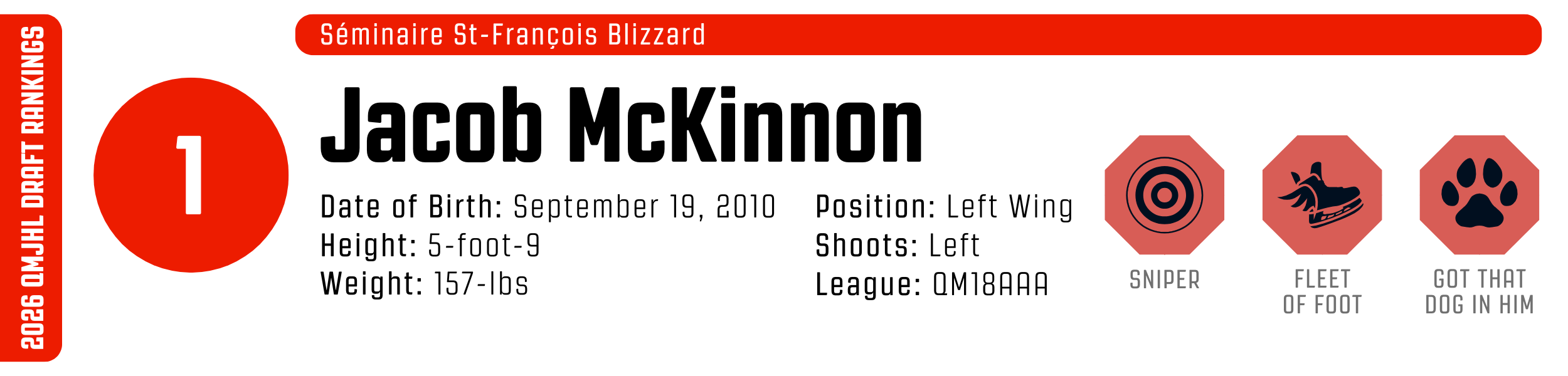
Séminaire St-François has played 42 games as of writing this ranking. They’ve won 41 of them. A key cog of that well-oiled machine has been Jacob McKinnon, who has been dominant in just about every situation for the Blizzard. The 5-foot-9 forward’s 24 goals and 51 points aren’t even the best tally among 2010s in the league, but his play in isolation has been a true separator. No one comes close at this stage.
A true top-end skater and shooter, McKinnon’s half-wall catch-and-release wrister has made victim after victim of the league’s goaltenders, as he effortlessly picks spots through perfect weight transfers, engaging his hips and dropping his weight upon release. He flies through the neutral zone effortlessly, blending stutters and cuts into his knees-over-toes crossovers to build momentum and then exploit it.
When he’s not flying at defenders off the carry, McKinnon can man a forecheck and out-muscle bigger bodies with astounding ease.
“What came as the biggest surprise were McKinnon’s contact skills”, Lead QMJHL Draft Scout Hadi Kalakeche wrote in the forward’s first game report of the season. “He’s a genuinely impressive battler, using his motor, edgework and compact frame to lower his centre of gravity and explode off his edges on contact, escaping pins through sustained momentum. He pestered defenders twice his size on the forecheck, cross-checked them off-balance when they got to pucks first, and made himself a nuisance along the wall with key stick-and-body interventions.”
With nuanced offensive patterns, McKinnon picks apart defences, ducking and weaving and adjusting to stay in pockets while showing the same tactical tendencies with the puck. That, combined with his motor and incessant pace, will be the key to his success in the QMJHL. We project that when all is said and done, McKinnon will be the best QMJHL prospect out of this age group, and will set himself up for long-term success when he inevitably turns pro.
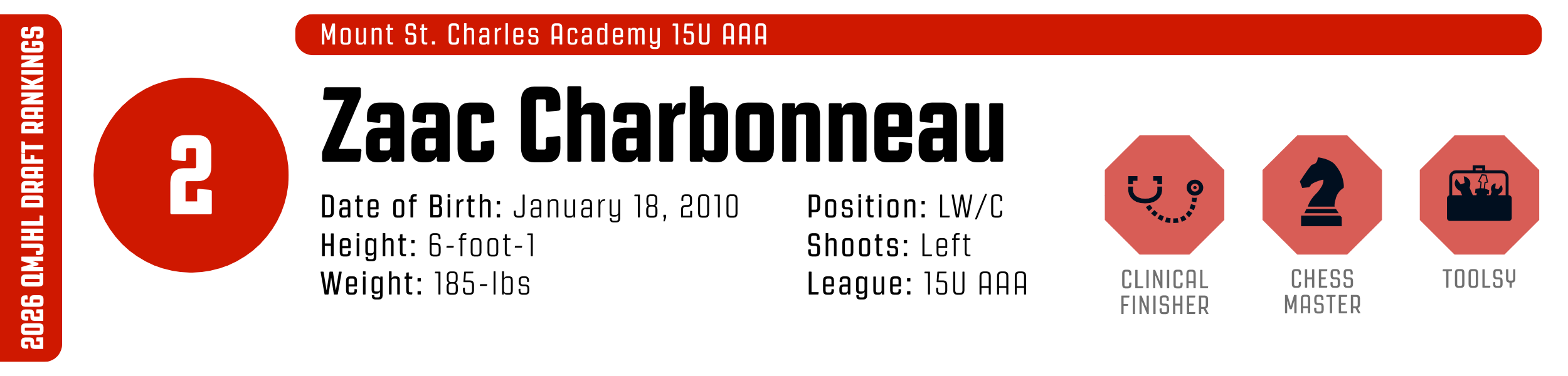
The decision to drop Zaac Charbonneau to second overall on our board took us the better part of 2025 to make, and it wasn’t for lack of tools; by our estimation, Charbonneau is the toolsiest forward in the draft class.
Tremendous backhand control, fluid skating, great power-forward physicality, slick hands, and a top-of-the-class finishing touch make Charbonneau’s on-puck game overwhelming at the 15U AAA level. The 6-foot-1 winger’s off-puck offence is just as tremendous; he effortlessly escapes wall battles before dishing off, sneaking into pockets, and firing off the pass. He engages hard at the net front and battles along the wall, tendencies that earned him a short stint at the 18U AAA level for Mount St. Charles this year — a rare feat for a 15-year-old.
While he needs a more dynamic linemate to help him execute in transition, Charbonneau is a short-ice chess master, and that should help him dominate the cycle in Major-Junior hockey. He should be considered in high regard for the 2026 QMJHL Draft, despite his commitment to Muskegon, and earn himself a top-line spot wherever he plays.
Read More: Film Room: Zaac Charbonneau, the goal-scoring power forward
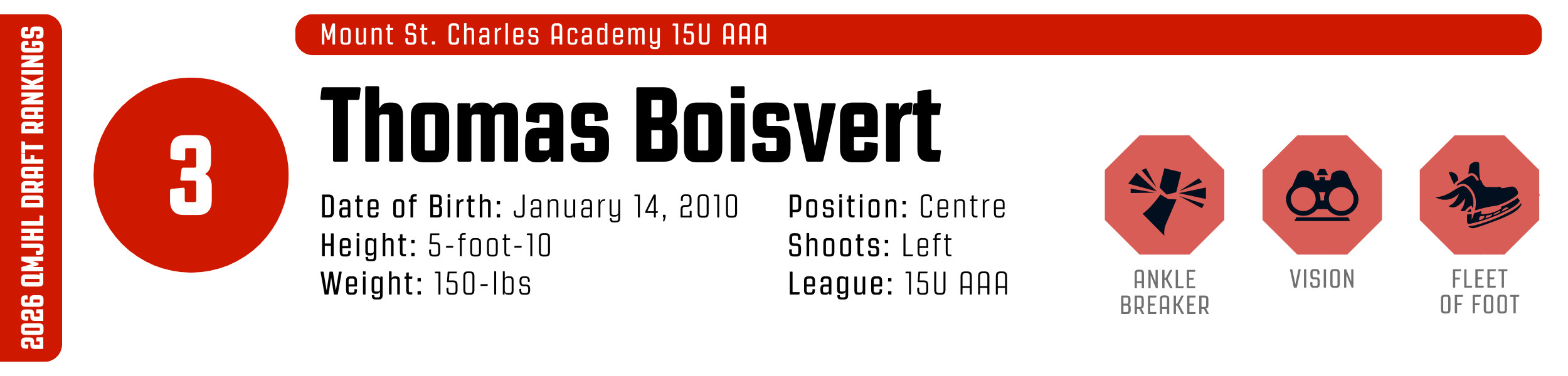
To call Thomas Boisvert a prospect hiding in Charbonneau’s shadow would be an abject lie. The 5-foot-10 centre has been just as good as his highly-touted winger — and even better on some nights.
Every chance he gets, he blazes through the neutral zone with lightning-quick crossovers before moving pucks in and out of his hip pocket, hunting lanes to the net, and taking the puck there himself. His playmaking vision helps him quickly and accurately thread passes through seams, and his one-touch reads are best-in-class, showing promise of his ability to scale his passing game up to the QMJHL.
While his physical limitations hold him back in battles, Boisvert’s motor and incessant pace allow him to bypass shoulder-to-shoulder checks through sheer momentum, and his goal-scoring game should adapt to the QMJHL as he becomes more of a mid-range threat. He’ll be an instant-impact transition dynamo with some of the best puck skills in the class, with the skill and sense to break down defences on a nightly basis.
Read More: Film Room: Thomas Boisvert, the creative engine
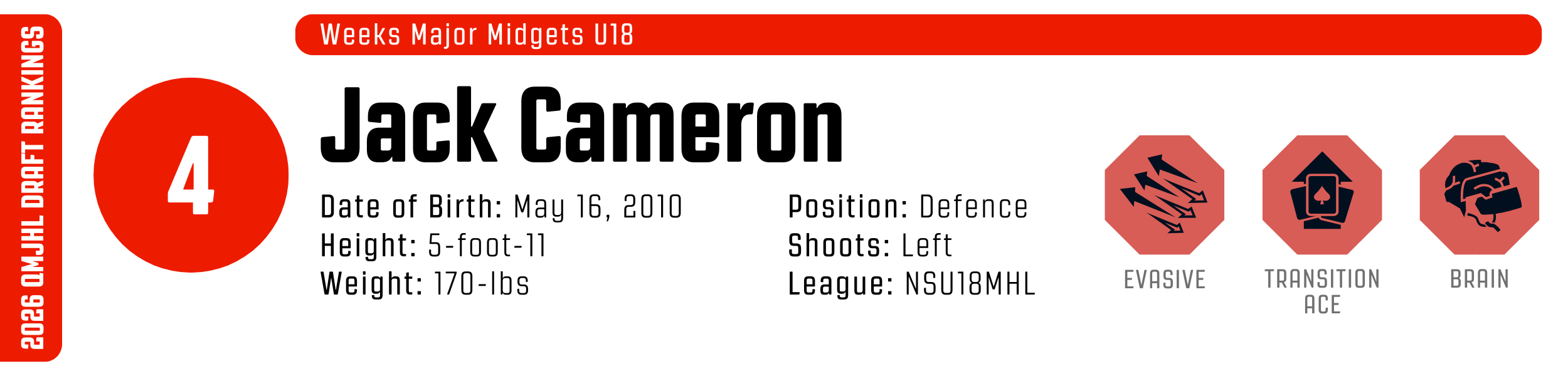
Our unanimous top Atlantic Canadian prospect, there’s no other defender who has matched Jack Cameron's level of all-situations utility. His baseline seemed to be our QMJHL Cup Atlantic viewings, where he settled into the role of a reliable rover, then his activations and offence from the point exploded at the Monctonian AAA Challenge. In various other viewings, he was getting impressive defensive stops and finessing on takeaways and offensive rushes. There’s seemingly nothing he can’t do to a high level of proficiency playing up at the U18 level as a 15-year-old, a jack of all trades on the blue line.
The ease and finesse of Cameron’s skating is something to behold, manipulating checkers with ease through his feet when he’s activating and recovering seamlessly on any salvageable play. His shot flies under the radar because the rest of his arsenal is just that good, but he’s capable of reliably finding that screen-beating lane for rebounds and a number of his own goals in big games. His confidence in handling and passing the puck make him a force in all of those situations he excels in — retrievals, cycle offence, breakouts, outlet passes; he can be counted on to keep it crisp in any clear-lane scenario.
With his poise on the puck, Cameron can be patient and bide his time, appraising numerous potential plays and their risk factors. That layer of manipulation may take a hit from the above-average opposition that gets funneled into the QMJHL, but his decision-making and willingness to make the simple play in the appropriate situations bode well for his transition; all while also possessing a special level of offensive defenceman-style skill. It’s hard to imagine Cameron not blossoming into a team’s best blue-liner a couple of years from now.
Read More: Jack Cameron leads standouts from the QMJHL Cup Atlantic
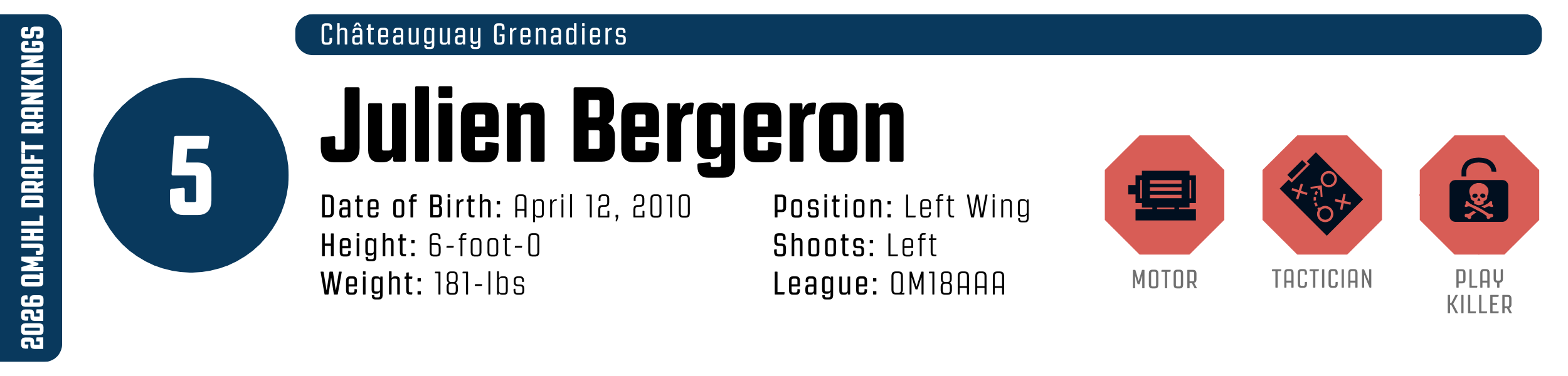
We mentioned earlier how McKinnon isn’t the QM18AAA’s top draft-eligible point-getter. That’s Julien Bergeron, whose 25 goals and 30 assists in 42 games are good for first place on his team and third in the league.
Top-of-the-class contact skills and a premium processor are the weapons Bergeron uses on a nightly basis to produce. He effortlessly shrugs off checks along the wall, using every tool at his disposal to gain inside positioning and exploit it to keep plays alive. A master of wall escapes and connective passes through layers, he chains together positive decision after positive decision, all at a high pace and with hounding relentlessness.
His polished game translates over to his puck skills, too, as he executes quickly and accurately inside pressure. He cues up defenders, baits their feet square, and subverts their expectations. Every pass, shot, and deke is improved through his decisional process and pro-level habits. As he develops, leveraging his tools into more dynamic and powerful sequences will help him not only out-think, but overpower defences in the QMJHL. He has all the makings of a long-term top-six versatile forward at the next level, with sky-high upside if the puck skills take a step.
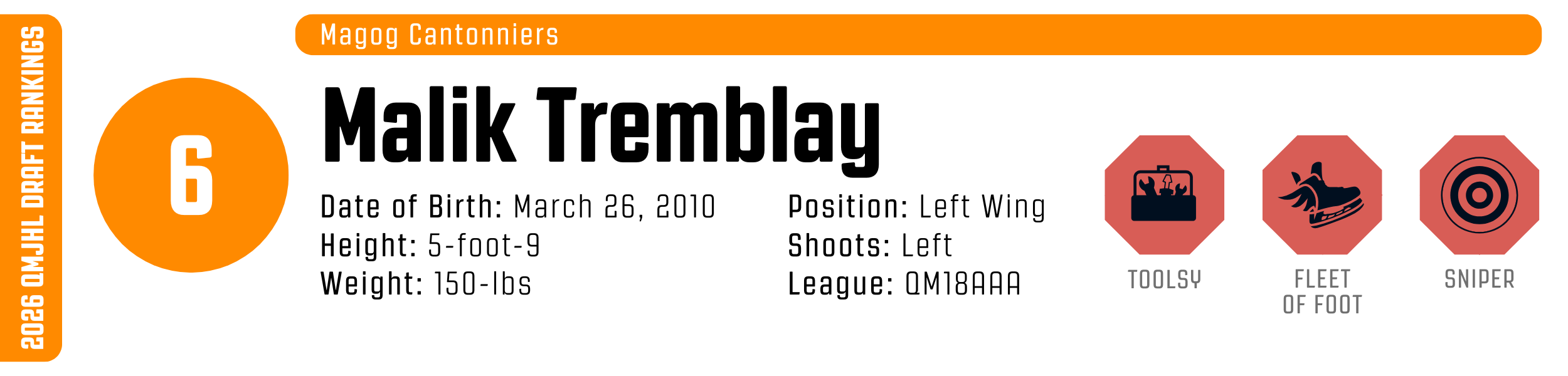
Malik Tremblay will have no issue producing in the QMJHL. The dynamic winger’s high-cycle, downhill-attack style is all the rage in the league at the moment, and he’s all but mastered that craft.
A savvy space-exploiting manipulator, Tremblay quickly identifies opportunities to access open ice, and even under hard pressure, explodes off heel-to-heels and cuts into that space to leverage his quick and accurate release. He has first-gear separation through his acceleration, but also has the blistering top speed to win races and grow gaps in transition. Despite having speed as a separator, Tremblay would be just as effective without it, using his phenomenal playmaking execution to cycle possession, give-and-gos to beat neutral-zone blocks, and quick inside cuts to drag defencemen out of position.
Don’t let his 5-foot-9 frame fool you, either — Tremblay can battle. Weight drops on retrievals and cutoffs through defenders’ hands into area passes make him a resourceful player when faced with contact, and that’ll only grow in effectiveness as he adds inches and pounds. His frame is raw, but the rest of his game is far from it, and he has the necessary skills to become a premium offence driver at the next level.
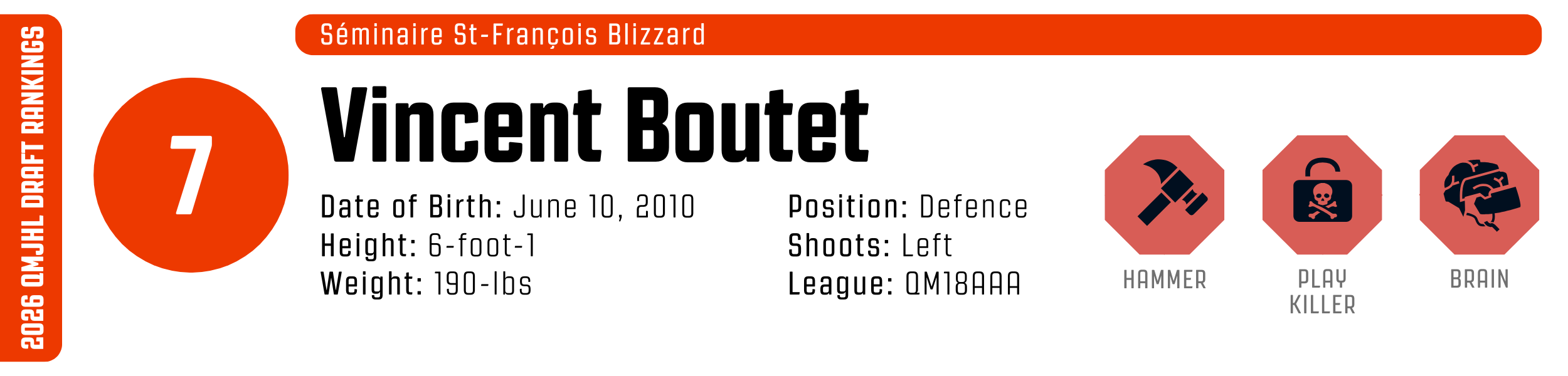
The second of two Séminaire St-François prospects in our top 10, Vincent Boutet has effectively mastered shutdown defending. The 6-foot-1, 190-pound blue-liner has all the details required for scalable success; he attaches to net-front threats aggressively, instinctively knows when to detach to attack the wall, controls gaps through his footwork and stick discipline, and always identifies tertiary threats when patrolling the slot.
Those details are backed by tools tailor-made for the job; a deep, powerful stride with fluid pivots and backwards mobility allows Boutet to keep even the league’s best puck-rushers in his range of influence, and his frame and strength make him impossible to overpower. Although he can hammer his opponents into the wall, he never ventures recklessly, opting for more physical sequences only when appropriate.
It’s rare to see a shutdown defenceman with his level of point-exploiting tools, too — he can adjust his shooting angle comfortably, attack up the weak side, out-wait screens, and outright fire bullets through them. With a bit more on-puck dare, there’s offence to unlock, but even without it, Boutet is a plug-and-play top-four insulator at the next level.
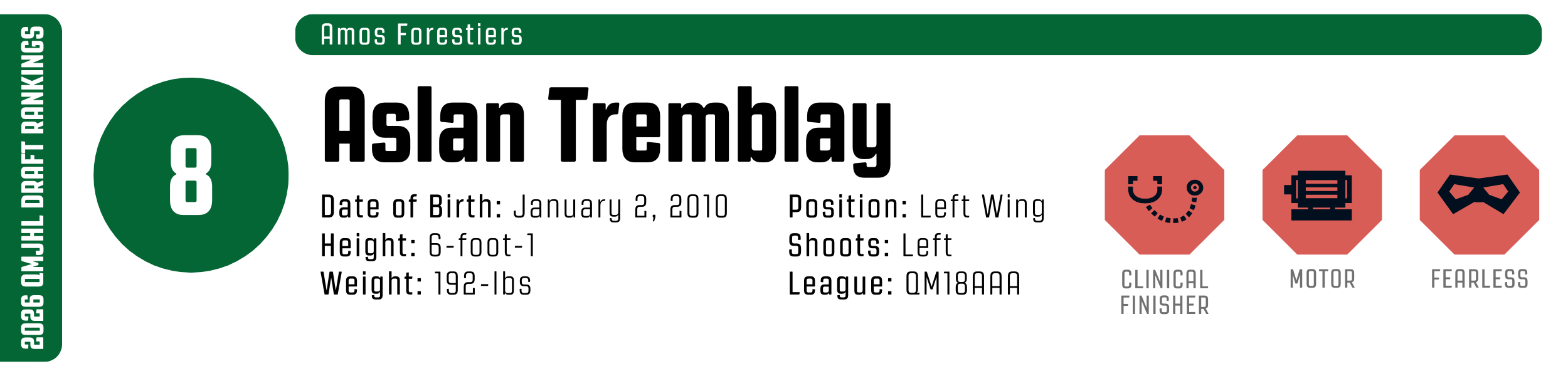
The second of two Tremblays in our top 10, Aslan Tremblay is excelling as a young prospect on an older team in Amos, emerging as their joint-leading goal-scorer with 20 in 38 games while playing a trucking physical game.
Tremblay has the prototypical power forward elements: frame, speed, and aggression. He can drop the shoulder and drive wide on defenders at this level with impressive ease, while also displaying second- and third-effort weaponization to recycle rebounds and blocked shots into lengthy possession. He staves off defenders along the wall, gets his bottom hand free to protect, then leverages his outside edges to ride their cross checks into space, before finding an outlet.
He doesn’t just bring pure power to the table, either; Tremblay can play finesse hockey, threading passes cross-crease off his wide drives and using defenders’ triangles on his off side to fire surprise snap shots across netminders’ bodies. As he develops and further increases his lower-body strength, he’ll only get more effective as a direct attacker, and gradually increase his coordination levels to be even more potent at exploiting the gaps between checks in a top-six capacity in the QMJHL.
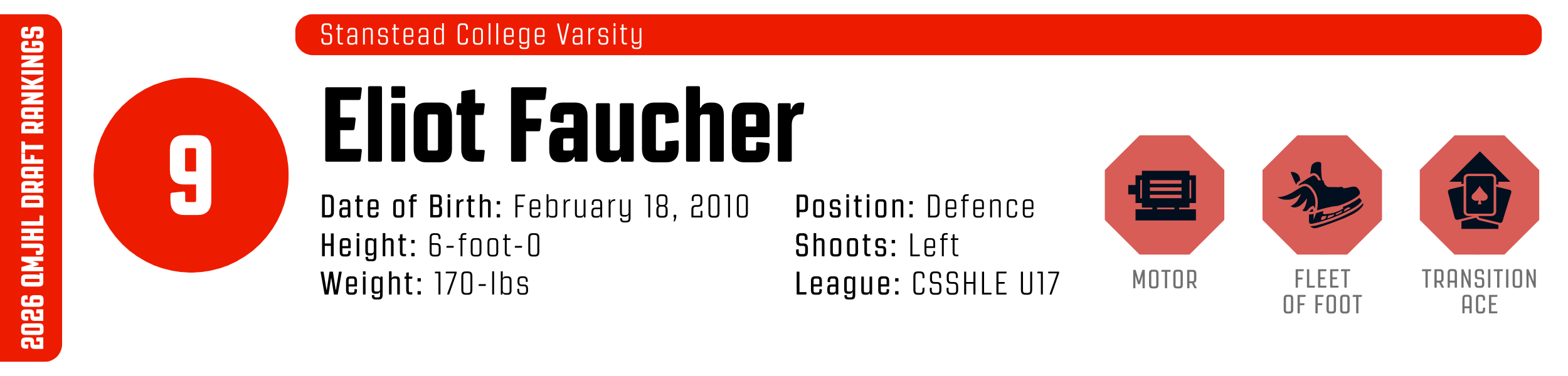
Stanstead College’s record of developing top-tier defencemen continues with Eliot Faucher. The 6-foot, 170-pound defenceman put up 24 points in 15 CSSHLE U17 games, and looked the better part of an effective two-way blue-liner at the next level in the process.
Tremendous mobility and aggression are the foundations; he attaches to threats off the rush through forward surfing, shepherding carriers to the boards before timing his lunges to perfection. Faucher has true recovery speed, allowing him to venture offensively while maintaining some safety, and his deep stride and efficient edges make him difficult to misdirect out of lanes. From there, the contact skills take over — he counterweights, leverages his feet, reverse-hits, and initiates contact ahead of his retrievals, forcing forecheckers to counter or run no chance in the battle.
Meanwhile, few are the prospects with a more active offensive mindset. He jumps into rushes aggressively, attacks down the wall on D-to-D passes, and places his first touches into space to evade hard pressure. Faucher has QMJHL-ready puck-moving and rush-suppression skills, and as he faces harder forechecks, he’ll likely improve his decision-making through repetitions. There’s top-pair upside in Faucher, although he comes attached with turnover risk.
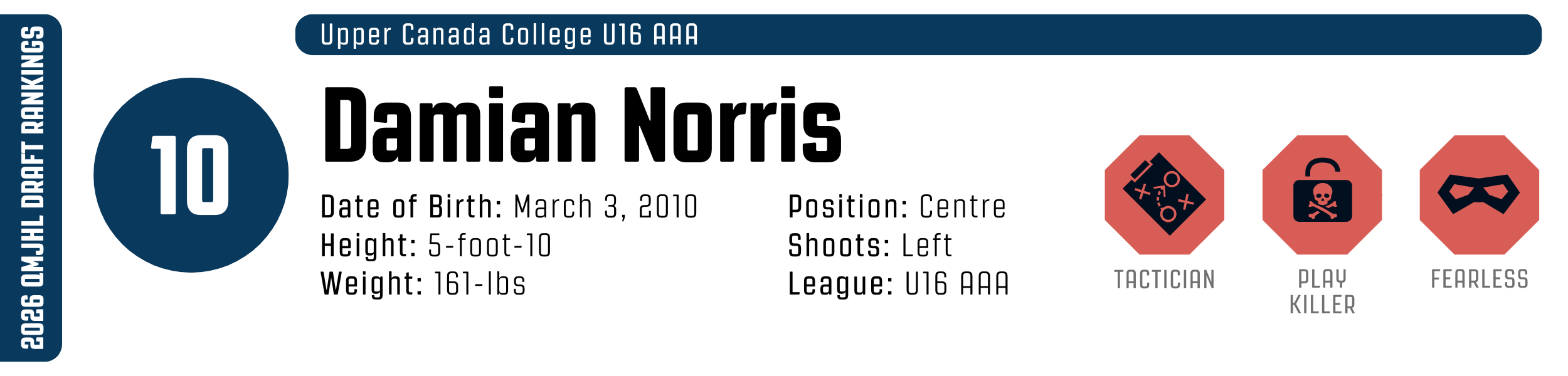
Among the numerous OHL Priority Selection standouts on Upper Canada College’s U16 squad stands Damian Norris of Newfoundland, our top-ranked Atlantic Canadian forward and an impressively efficient defensive forward. Facing off regularly against some of the most potent offences in the Canadian U16 and American 15U scenes, he has the best two-way sense of any forward in this draft class. In his own zone, we see multiple junior-level shutdown habits stacked in every shift: stick blocks, finding position to efficiently follow cycle plays, keeping close gaps and moving his stick and body to pressure puck movement. His standoff approach complements his anticipation, which results in him almost always reaching loose pucks first.
Also ranked in the high end of this class on physicality, Norris is all contact skills. It all traces back to his sense; with his head up on every play, he anticipates hitters and essentially suplexes them with reversed contact, along with a good baseline of refinement on his board battle strategies. While his takeaways and reliable play as an offensive-zone connector have led to productive success this season, he also has a well-above-average release. Though seen more sporadically than his elite defensive baseline through this season, it’s another layer that adds greatly to his projection.
Norris looks like one of the most polished prospects in this class, including in head-to-head competition against other QMJHL Entry Draft-eligible players — his two-way contributions and responsible style of play make him one of the safest bets to hit the ground running and bring immediate impact to a QMJHL team.
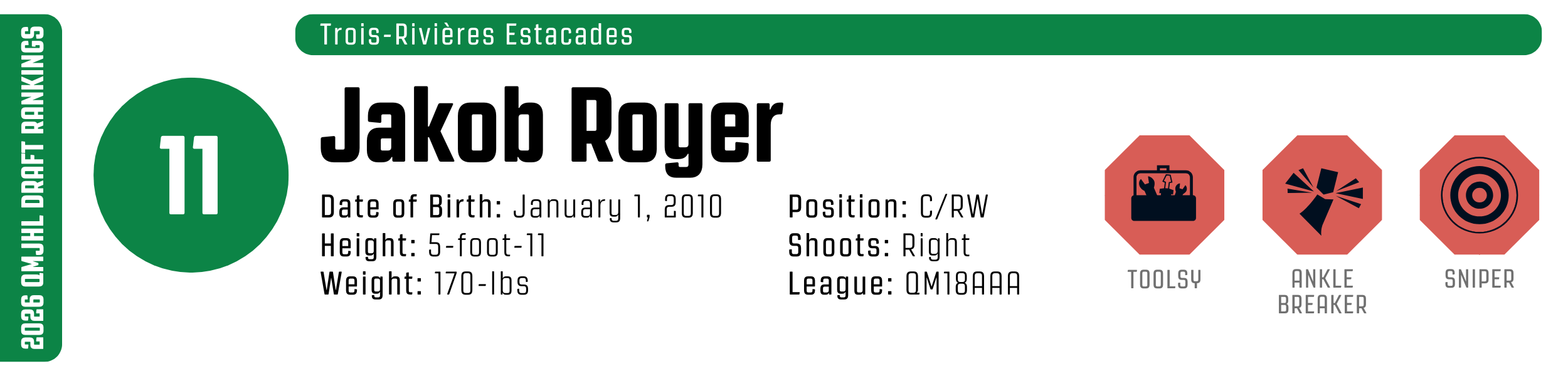
If you catch the right game, you’ll come away thinking of Jakob Royer as a top-five pick. A stable skating base sets the table for upper- and lower-body separation, allowing Royer to comfortably catch pucks outside of his wheelhouse and quickly set up his hip pocket. From there, he can dangle with his wide handling range, change the angle on his upper-echelon release, or zip pucks to teammates through misdirection. He pre-plans his attacks, working quick off-puck adjustments into pockets before taking ice downhill and stretching defences laterally. In some viewings, he even showed shutdown centre potential, supporting low, winning key defensive-zone draws, pressuring carriers with hard backchecks, and playing inspired penalty killing hockey. The key with Royer is consistency — playing at his full potential for a full QMJHL season will be difficult in his current form. Adding a more consistent pace element would make him a surefire top-line centre at the next level.
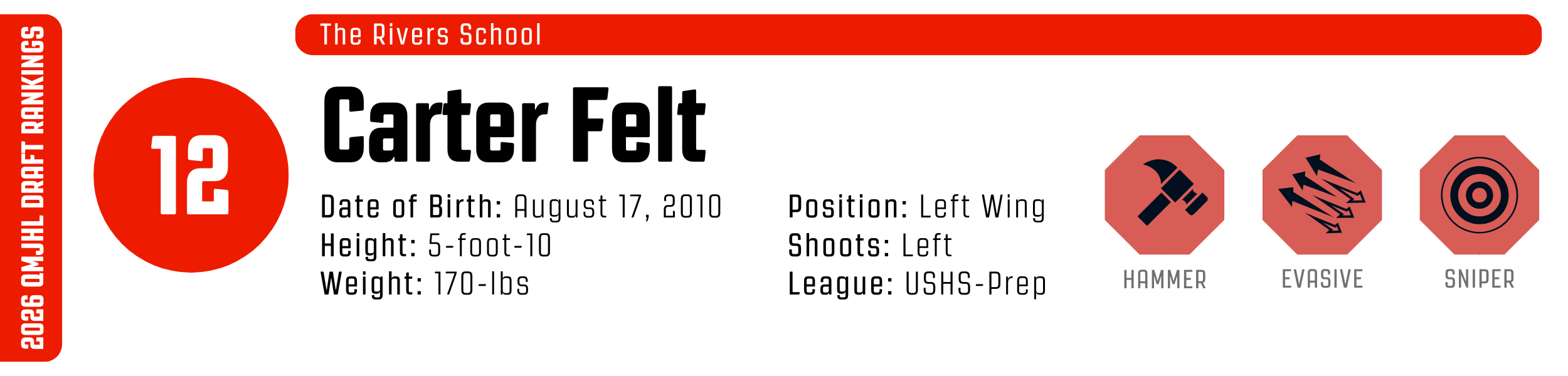
Our top-ranked American-born skater, Carter Felt has been dominant in the New England Prep School circuit after a tremendous outing with the Neponset Valley River Rats at the 15U AAA level. The 5-foot-10, 170-pound winger leads the Rivers’ prep school team in goals and points with 18 and 31 respectively, dominating through his incessant forechecking and soft-ice catch-and-shoot scoring. A wolverine on skates, Felt brings trucking physicality on every shift; he can outright hammer defencemen two years older than him, but also offers tremendous contact skills, leveraging his shoulders to turn equal-odds battles into advantages. Weight-drop catches on first-to-puck retrievals under pressure, adjusted routes across defenders’ hands, toe-pointing misdirection, light cross-checks and stick lifts when second to the puck, and hip-to-hip proactive contact also feature in the skills he uses to win battles down low. He also possesses a lethal shot, which he can execute through slashes and stick checks by shortening his release, allowing him to remain a threat off the catch as well. Add to that his crafty problem-solving passing game and quick-twitch handling, and you have a true top-six QMJHL skillset.
Read More: Carter Felt shines at River Rats Jamboree
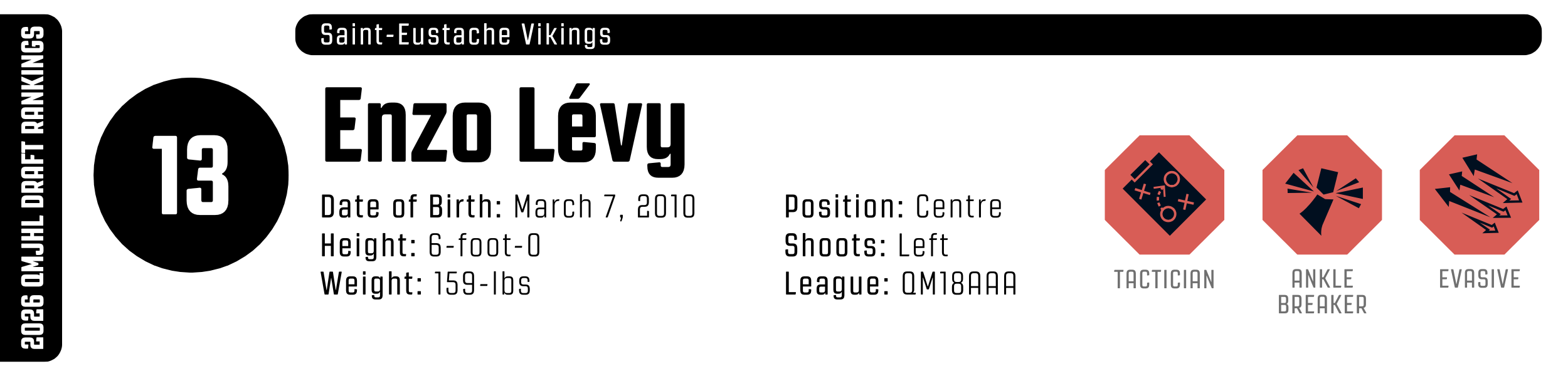
Few forwards in this draft class can hold a candle to Enzo Lévy when it comes to creativity. An uber-skillful dangler, the 6-foot, 160-pound centre can pop pucks into his hip pocket from awkward positions, dangle on receptions, manipulate and exploit defencemen’s heels, and use changes of pace to catch blue-liners overextending or flat-footed. Although his contact skills need some work, he has already shown some growth in that area this season, and makes clever use of defencemen’s expectations by baiting them into cutbacks before exploding around their opposite shoulder to fight for the puck. A deep skating posture with solid ankle and knee stacking offers him the acceleration and burst speed to beat opponents to spot, and both his rush patterns and cycle rotations are advanced, hinting at advanced hockey sense. Adding more shooting and passing layers will be the next step, but translating the deceptiveness from his handling and the processing from his carry patterns and positioning over to his shooting and playmaking habits shouldn’t be too difficult. He has top-six skill and pace, with promising signs of manifesting that potential.
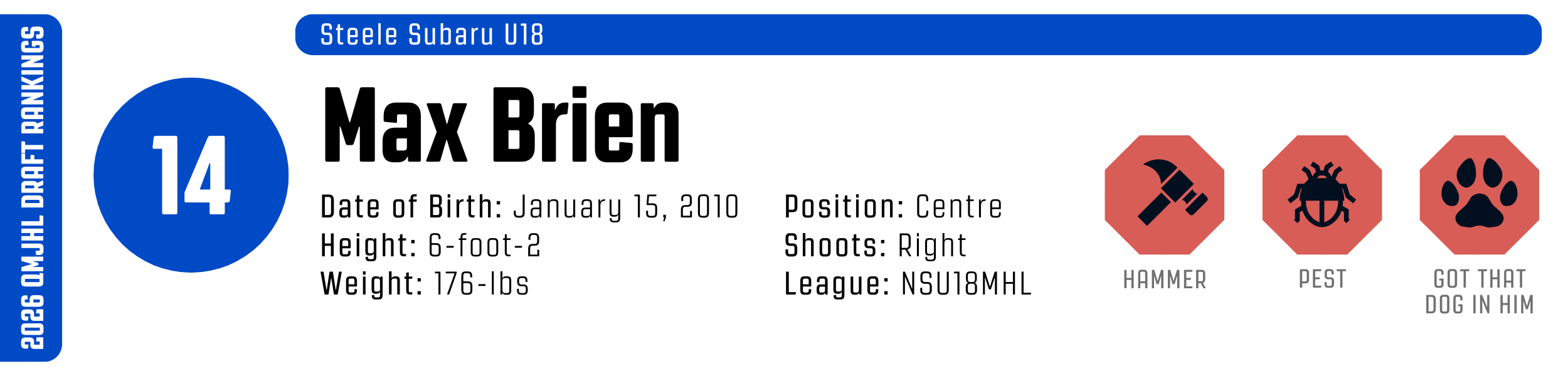
Max Brien is going to raise hell in the QMJHL. The badges tell the story — the NSU18MHL’s rookie of the year was seven points and two goals short of leading each category among rookies, but he makes up for it and then some with the compete and heart he brings every game. He powers through mechanical limitations and uses his other skills to jump right into plays where slower feet or heavier hands would be otherwise exposed. He’s a cerebral player, a proficient offensive creator, and a nightmare to contain. He’s not just mean and competitive, he’s also smart and talented. His hard and soft skills coalesce nowhere better than on the wall, incorporating reads and contact skills to gain or keep possession and make a play out of it, and his scoring threat is versatile, possessing a good shot and the ability to bury chances from the slot at a high rate. We flagged him at the start of the season as a first-round contender with his flaws, but he’s just bulldozed over any doubts that they’ll hold him back from being a big-time player. We are completely prepared for Brien to outperform our ranking with a top-ten selection and promptly punish all the teams that passed on him, on the ice and the scoresheet. He’s the type of player that many, if not most teams, will put a premium on and will be chomping at the bit on the draft floor to bring in a player with his skill and snarl.
Read More: Max Brien among standouts from the QMJHL Cup Atlantic
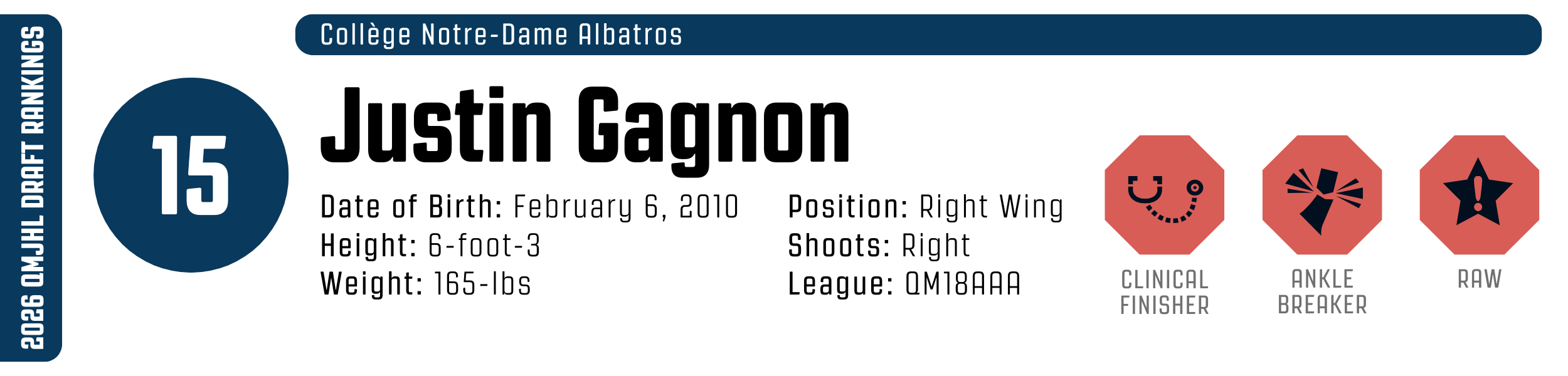
A 6-foot-3, 165-pound winger with skill, Justin Gagnon is a small-ice master. His tight-quarters handling and processing make him excel in cycle possession plays and quick receive-and-deceive zone entries, and when he needs to handle retrievals, he does so through impressively quick blade angle changes to rid himself of back pressure. At times, his hockey sense seems sky-high, as he uses underhandling to bait defencemen into covering passing lanes before exploiting the space they allow him and locating more threatening secondary passing lanes. His physical game is still raw, but there are glimpses of contact skills to work with in his ability to lower his weight in battles and his bottom-hand shielding habits. Though still unpolished, the right team and fitness regimen could turn Gagnon into a true top-six power forward, especially if the straight-line speed and lower-body power improve with the 30 extra pounds of muscle the young winger could add to his frame in the next few years.
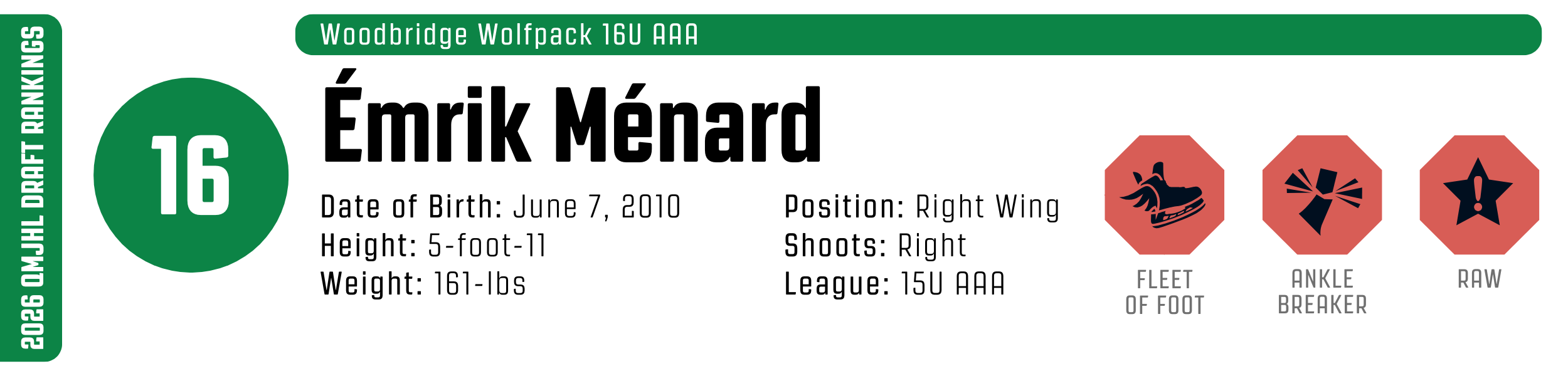
Speaking of power forward potential, Émrik Ménard has exactly that. The 5-foot-11, 160-pound winger drives the net relentlessly, leveraging his frame and power to catch defenders off guard and drive inside. The skill base overall is solid — he explodes out of retrievals with his head up, draws sticks out of lanes and exploits defenders’ triangles, and can make a quick slip pass off a pressured catch to connect with a middle-driving teammate off the rush. His reactive dangling skill makes him excel on those tight, pressured retrievals — a great sign for his ability to scale his game up to the QMJHL. His injury and team situation this year leaves his projection a little more nebulous, but with the bright flashes of skill, pace, and power, we can’t leave Ménard out of our first round. The high-end top-six potential in his game makes him way too enticing an option at this stage in our rankings.
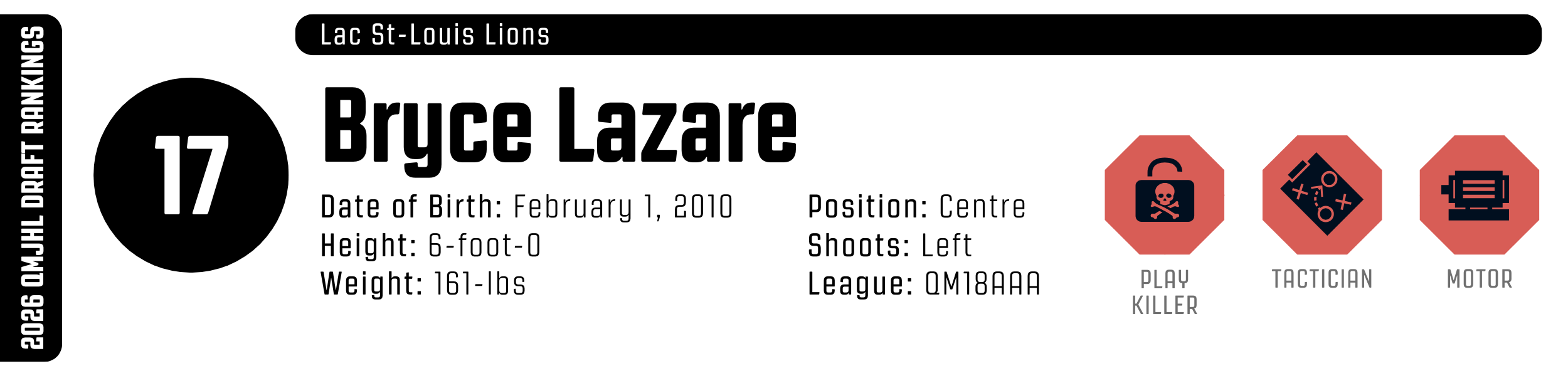
Bryce Lazare is any QMJHL coach’s dream. Responsible, impossible to knock off pucks, and incessantly engaged, he covers neutral-zone carry lanes better than most defencemen his age and quickly turns those entry breakups into offence through his deep skating stride. Once in the offensive zone, his game becomes patient and nuanced. He puts pressure on his back, shields up the ice, finds a smart outlet, and works downhill off-puck to find pockets of space. He is an exceptionally mature rush delegator, as he criss-crosses with teammates, drops passes off, and drags defencemen out of position away from the puck to create space for his wingers to exploit. On retrievals, few are the defencemen who can out-muscle him, and his contact details only add to his effectiveness in those scenarios. A highly effective two-way centre with processing at the core of his offensive game, he’d make himself a surefire top-liner with more soft-skill development, but he’s as sure a bet as any to play significant QMJHL minutes next year.
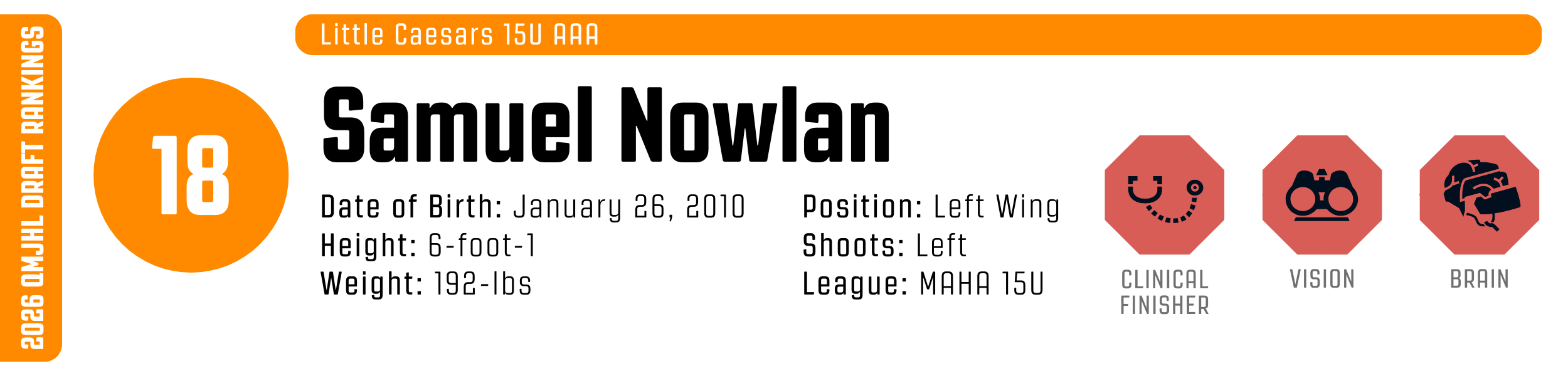
New Brunswick’s Samuel Nowlan has put together an impressive campaign as part of a dominant Little Caesars 15U team in Detroit. On a roster laden with top OHL and USNTDP prospects, he succeeds as a confident and capable playmaker with decision-making pace. His collaborative cycle play is what stands out and lends itself to high QMJHL projection, a quick and clean passer with the brain to draw up the highest-danger opportunity that feeds into his linemates’ roles and strengths. His puck manipulation adds an extra layer to his creation, protecting possession in motion and using his skill to infrequently strike on an end-to-end goal with his dangles. His goal-scoring ability is also bolstered by his sense as a net-front finisher, skilled and slippery through defensive structures. Nowlan’s skating and physical skills, although bolstered by the size gaps created by being 6-foot-1 at the 15U level, are well above average and complete the profile of an all-around strong prospect. Although none of his attributes are truly ‘special’ among this class, Nowlan is one of the most well-rounded top prospects as a smart playmaker with some situational scoring with top-line winger promise, earning the final spot in our first round.
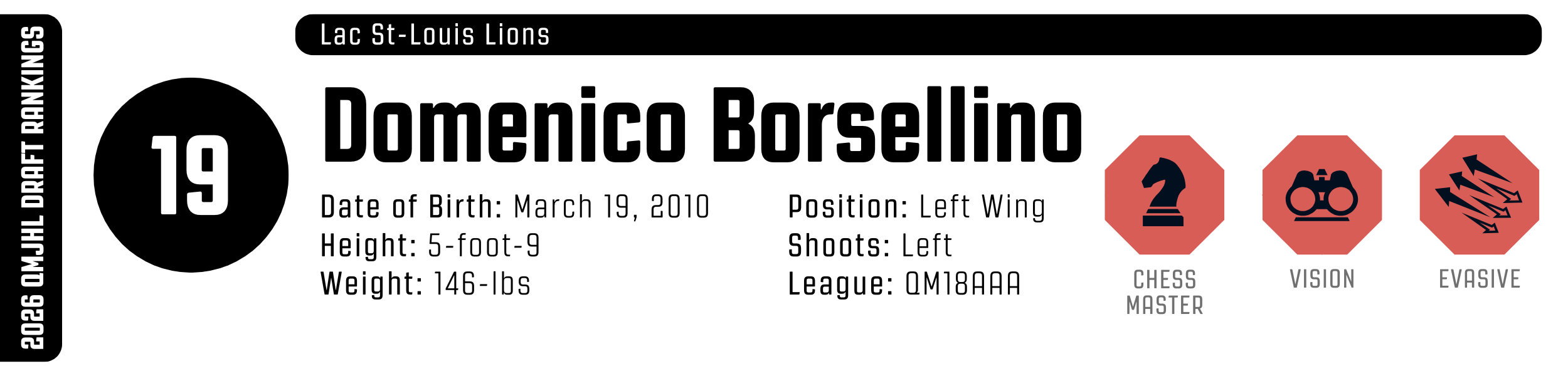
The brain of Lac St-Louis’ entire operation, Domenico Borsellino’s combination of sense and skill make him a premier chance-creator at this level. He fakes, manipulates, misdirects and anticipates his way into prime scoring areas, then makes use of a wide variety of passes and shots to produce. He can slip pucks across his heels when cycling up the wall, hook them under defenders’ sticks, and bomb a cross-ice saucer right on a teammate’s stick. His release is just as versatile, with a whippy and accurate one-timer from the half wall to go along with his in-stride angle-change wrister and front-leg stutter-step snap shot off the rush. His processing is advanced — he starts most games off reading and gauging defences, and by the third period, he takes over, using his pattern recognition to identify opposing teams’ structural tendencies and picking them apart. He won’t be a puck battle winner at the next level, but with more lower-body power to add a race-winning speed element to his game, Borsellino could be a clear top-six producer in the QMJHL.
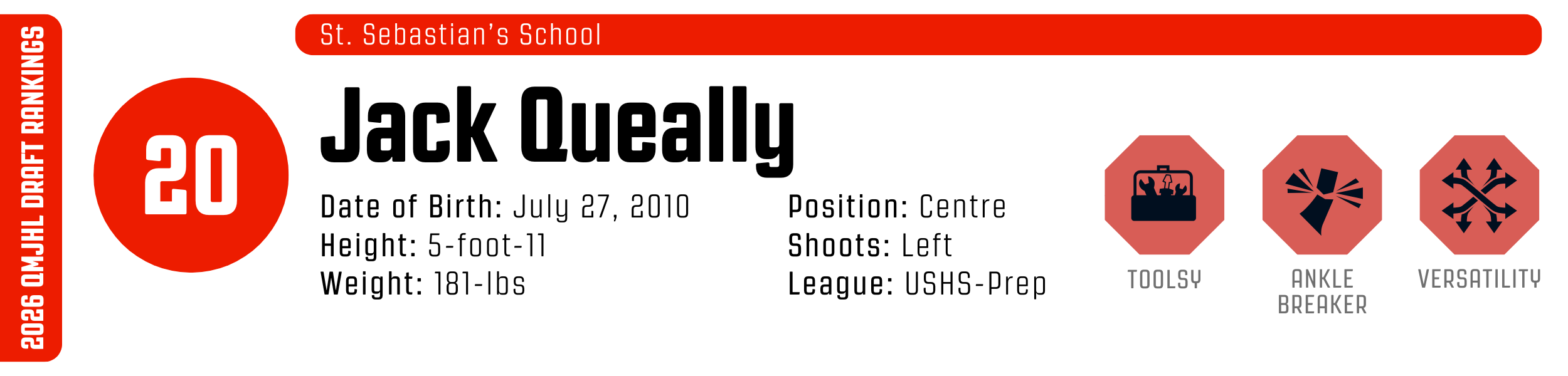
A powerful skater with great checking skills, Jack Queally makes a meal of most forechecks. His edges and deep stride get him to loose pucks first, and from there, he shakes back pressure with a tailored blend of reverse hits, posture depth, and footwork adjustments to ride cross checks out of trouble. His off-puck anticipation offers promise, as he quickly and accurately predicts rim passes and middle exit attempts and cuts them off. He’s versatile as an off-puck option, able to man the forecheck as the F1 or sit back at the high cycle in the traditional F3 centre role. Once he gets the puck, he’s a linear attacker with relentless activity, as he darts at defenders and baits them into lunges before pulling the puck into his feet and throwing a downforce-laden wrister on goal. He has playmaking flashes as well, but for the most part, Queally projects as a premium North-South checking centre with goal-scoring upside in the QMJHL. He should get there fairly quickly, too, given his physical maturity and Major-Junior-ready pace.
Read More: Jack Queally impresses at the Beantown Fall Classic
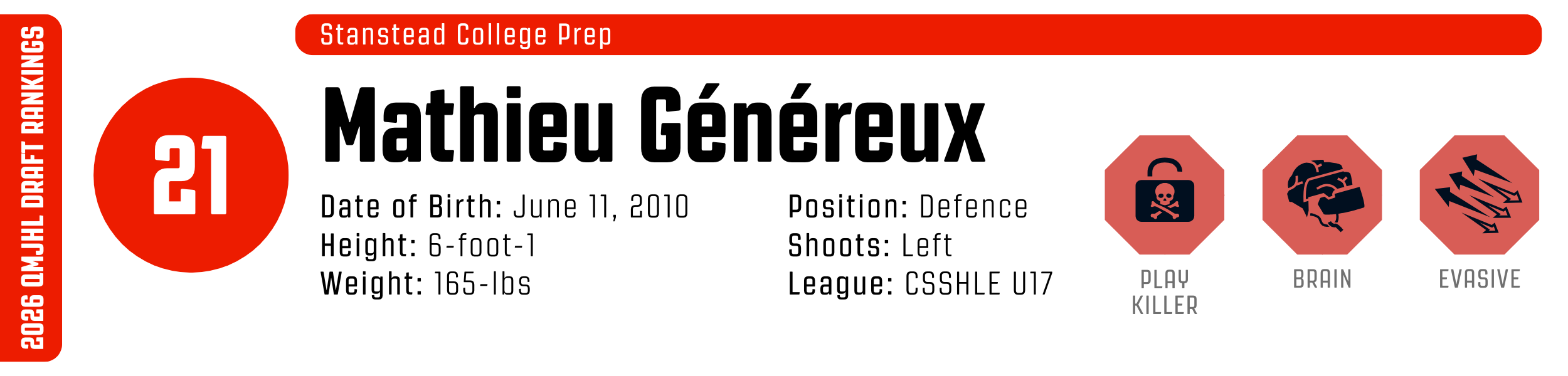
“I entered this viewing looking for a player to round up our top-50, but ended up finding possibly one of my favourite players of this entire draft class”, wrote our regional scout Simon Desjardins in his first game report on Stanstead College’s Mathieu Généreux. The defenceman’s mobility, poise, and shutdown tools stand out in every viewing — he effortlessly matches footwork with carriers off the rush, guides them away from the middle with smart stick placement, and lunges right before they can set up the dump-and-chase he forces them into. He can shut down wall plays effectively with his defensive range, and once the puck is secured, he invites pressure with his underhandling and uses every tool in his arsenal to find the best breakout option. Activating into the play comes instinctively with Généreux, and he consistently chains together solid decisions to prevent chances, neutralize threats, and get the puck flowing up the ice. While adding more stride depth would unlock even more first-on-puck retrievals and allow him to pinch even more effectively, Généreux is fairly complete already. He’ll be a great top-four defenceman in the QMJHL, and get there relatively quickly.
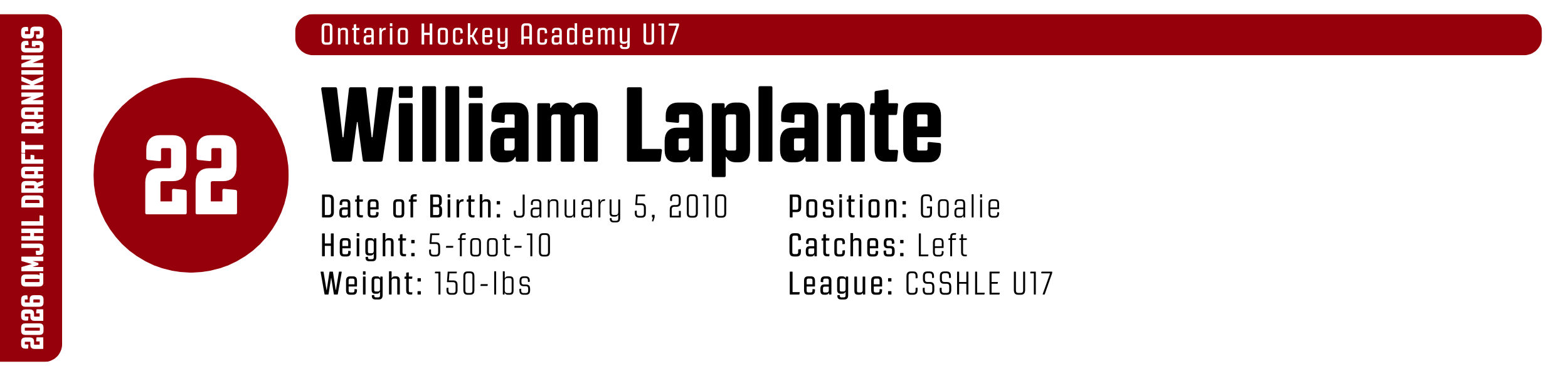
Our top-ranked netminder, William Laplante’s athleticism, footwork, and scanning drive most of his potential. An explosive post-to-post shot-stopper, Laplante keeps back-door threats in his periphery, scans frequently to identify opposing slot rotations while covering his post, and once he’s got that mental map, he quickly adjusts to hard-zipped slot passes and squares up to them with pinpoint precision. His hockey sense stands out as a positive, as he tracks pucks accurately through screens and predicts threats even before they open up. As a netminder on the smaller side at 5-foot-10, Laplante’s flexibility offers much promise, as he can contort to keep his chest upright from awkward positions, covering more net than other netminders his size. Our team firmly believes in the QMJHL starter potential Laplante’s tracking, footwork, and positioning offers, and at this stage, we see him as the highest-upside option among netminders in this age group.
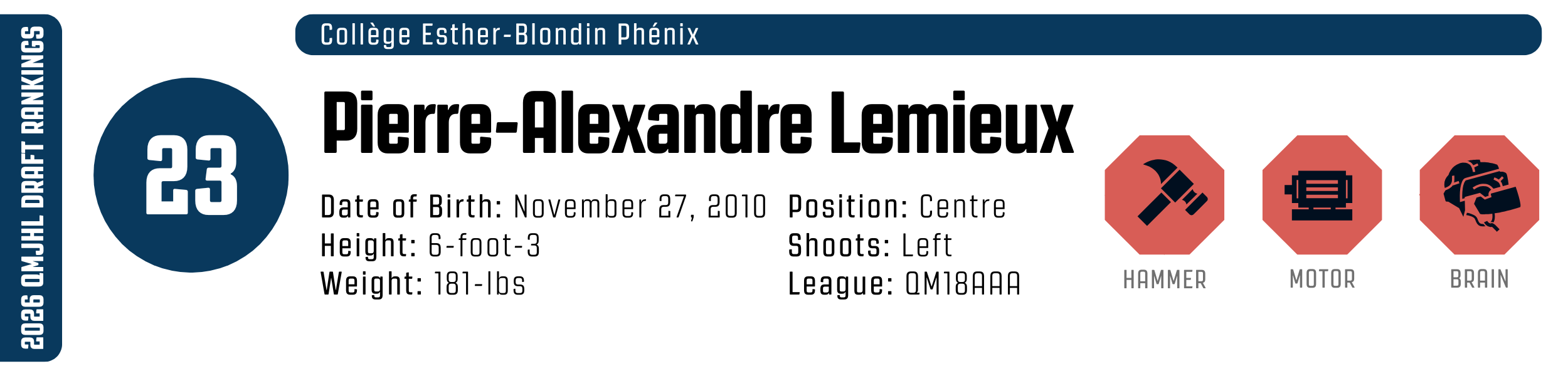
Pierre-Alexandre Lemieux took over Alexis Joseph’s former top-line centre role for Collège Esther-Blondin this season, and has been a highly reliable and effective centre for them. With his hulking 6-foot-3 frame and strong three-zone involvement, he barrels at carriers off the cycle, muscles them off the puck, then finds a quick outlet and joins the rush. A savvy off-puck patterning game makes him difficult to pick up as a wide threat, as he adjusts wide before angling to the middle, leverages off-puck assists from his teammates, and weaves into pockets right as his wingers prepare to pass. He has great puck-protection ideas, mainly aided by the fact that defencemen at this level can’t solve his on-puck strength, allowing him to focus on the next play rather than staving off the check. Overall, Lemieux’s top-six protection hinges on his ability to add pace to his on-puck game, while becoming more comfortable as a transitional play-driver. If he does, he’ll be a monster in the QMJHL.
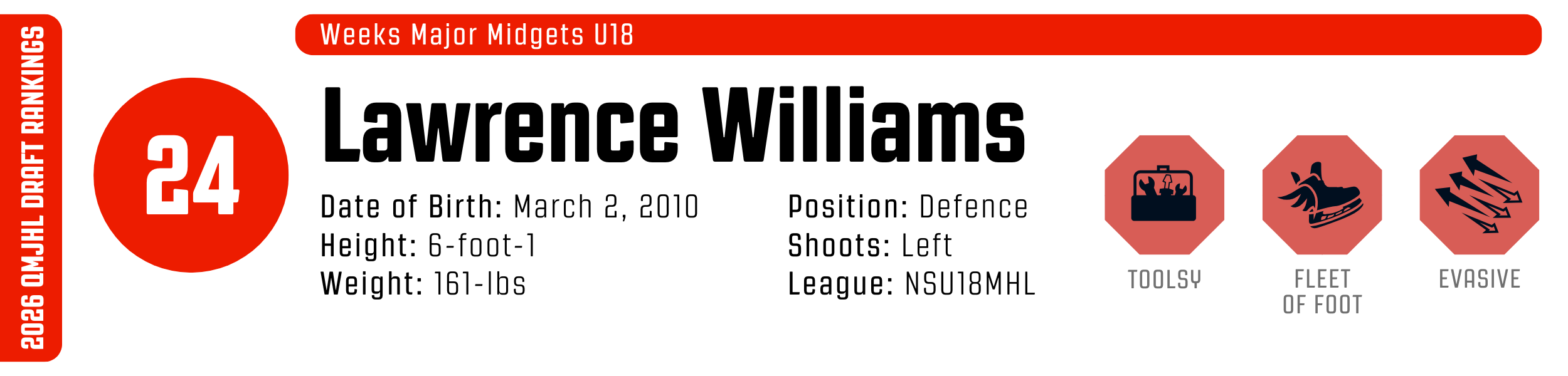
Lawrence Williams’ skating base looks downright incredible at times. Currently playing U18 hockey in an all-situations role, the defensive side of his game with his skating, reads, and stops make him one of the top shutdown options, a player who won’t need much defensive polish to step into games this preseason and look impressive. His skills as a rover are going to flourish in the high-retrieval environment of the QMJHL, garnished with his on-puck skill and the undisputed willingness to push back. The physical skills aren’t a finished product but he plays mean, adding hits to his defensive stops where he can. Developing the contact skills to protect the puck from the inside position of a retrieval or breakout is the x-factor in reaching the potential created by his skill elsewhere. The NSU18MHL’s rookie defenceman goals co-leader has quite the shot when he activates, scoring cleanly on the cycle and the breakout alike, flashing his release from every range between the blue line and the slot. His reads and speed to capitalize on these opportunities add yet another dimension to yet another touted Nova Scotian defenceman. Williams is a toolsy defender who can fill a variety of roles by carving out his own, a sniping defensive defenceman or a speedy counterattacking offensive defenceman. The range of his capabilities makes him a surefire second-rounder in our eyes, rounding out our top five defencemen in this class.
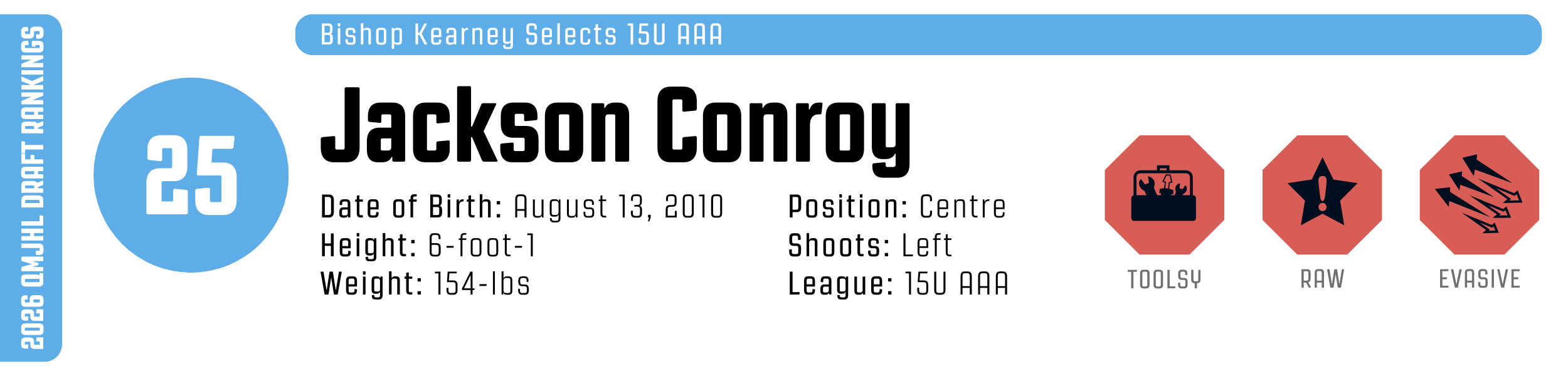
There is so much raw potential in Jackson Conroy’s game. A 6-foot-1 centre with physical runway, Conroy mainly operates as a skill player through his high-end tools. He uses adjusted crossovers to beat structures in the neutral zone, isolates defenders, and leverages his handling to solve problems at top speeds. He can slip passes inside and drive wide for give-and-gos along the wall, he can threaten from mid range with his in-stride wrister, and he can drag defenders to the net with him through his powerful wide drives. His contact game and processing have room for improvement, but you can see the gears turning — he tries to push defenders back off the rush to create off-puck space for teammates, attempts to leverage his edges on retrievals, and occasionally sees more advanced passing plays, but the timing and execution aren’t quite right yet. As he develops physically, the tools will only get better, and though he might remain a linear attacker, he has the tools and runway to become a speedy, powerful, and skillful top-six centre in the QMJHL.
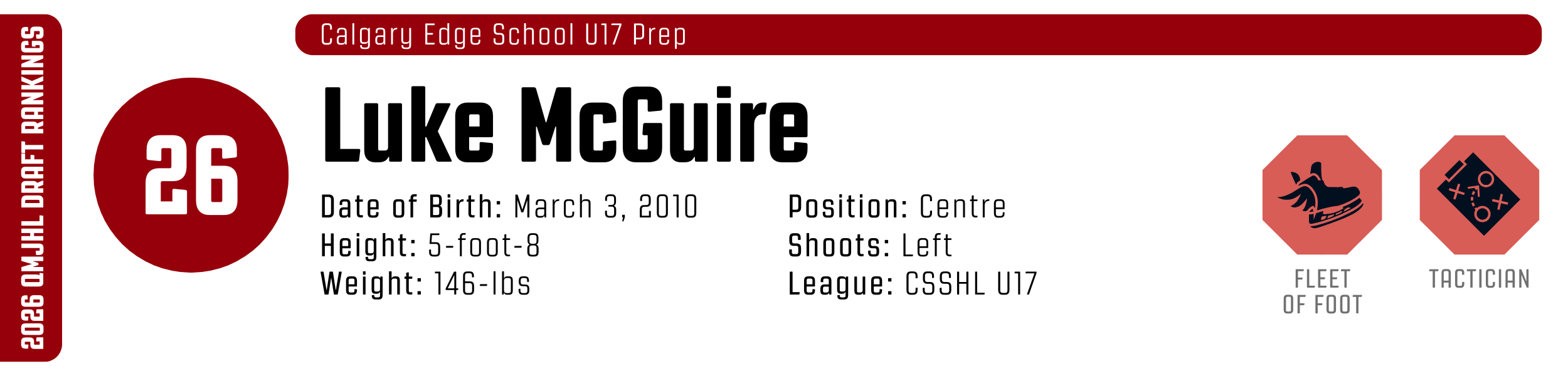
When all is said and done, Luke McGuire may be one of the best and most productive QMJHL players from this draft. The speedy, diminutive, silky-mitted forward broke U15 point records in Newfoundland before joining Calgary Edge School U17 Prep this year, where he has continued to flaunt his deception and creativity with the puck. He makes high-pace plays with ease, both one-on-one and in tandem, on both the rush and the cycle. He takes advantage of time and anticipation gaps at every level he’s played at this season, layering his playmaking in ways that bode well for figuring out creation at the next level. Currently standing at 5-foot-8, McGuire isn’t afraid to initiate contact, but his patience with the puck wanes when threatened with physical pressure. Leveraging his existing physical skills and capitalizing on his other strong skills to escape those jams will clean up his game and neutralize the target that will be on his back with his incredible skill level. McGuire in his current form absolutely looks like a future QMJHL star, and he can leverage his time in the league with that status to further develop his self-preservation skills and set his sights beyond the major junior level.
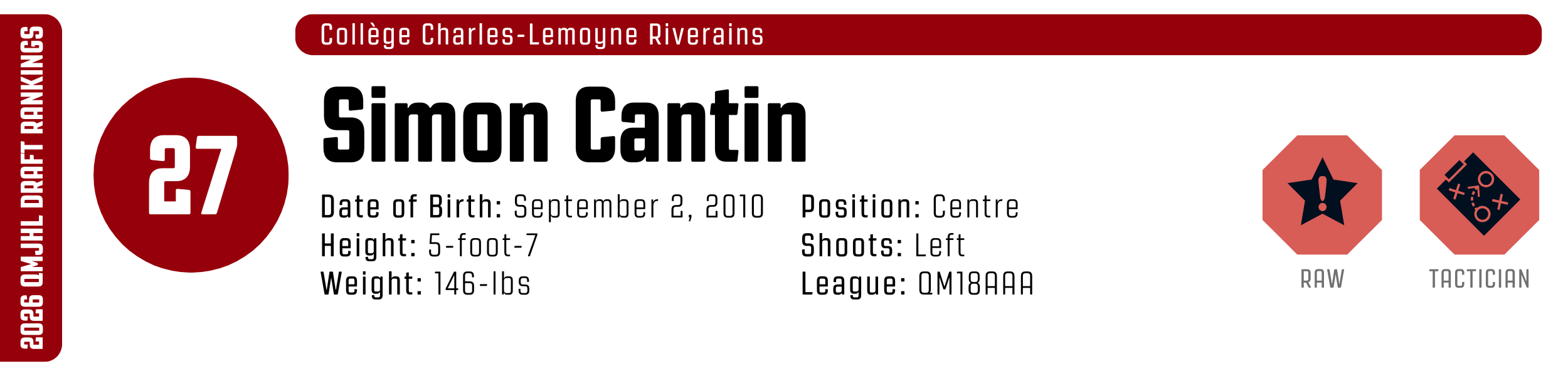
Simon Cantin’s playmaking game is fairly complete at this stage, and it’s tailor-made for QMJHL hockey. He chains together impressive playmaking decisions off the cycle, keeping his head on a swivel while scanning for options and leveraging every playmaking tool in his arsenal to convert on his reads. He misdirects defencemen into covering low-to-high passes before executing off their heels into high-danger areas, and can make clever use of his handling skill to pull pucks into his feet or to his backhand to open up even more passing options. His skating stride needs work, but he outworks most of his mechanical limitations, out-smarting defencemen along the wall with timely and economical physicality. He understands how to leverage advantages despite his size and skating disadvantages — a promising sign for what’s to come. If skating becomes a strength, there’s significant upside in Cantin as a playmaking wizard with checking skills. He could eventually become one of the league’s top point producers with the right development.
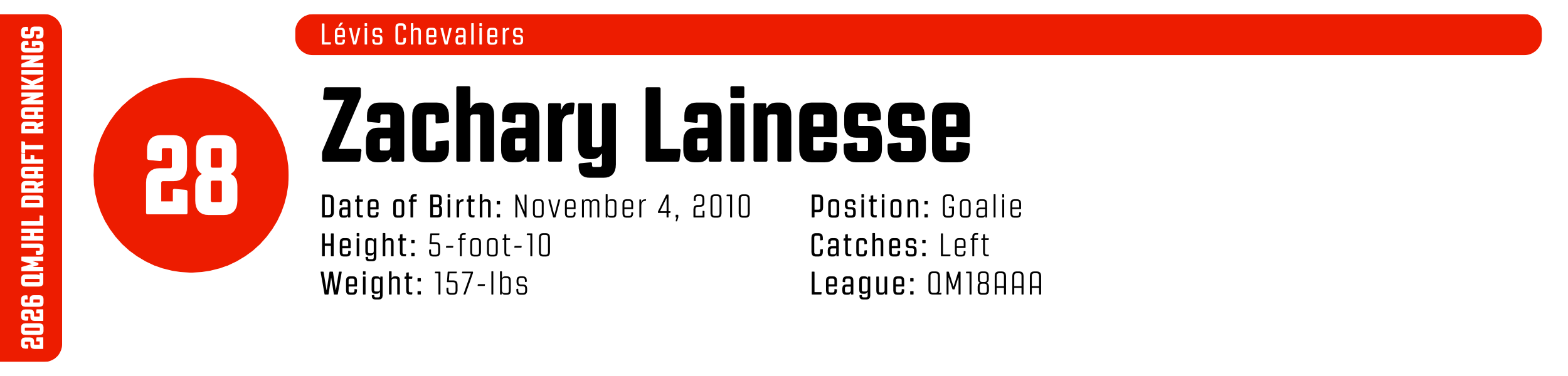
A high-floor netminder with arguably the best technical foundations in this class, Zachary Lainesse effortlessly transitions between stances, fluidly keeping up with pucks as they go from corner to point to slot. His footwork aids those transitions, as he quickly moves post to post while maintaining an upright stance to clog any top-half holes. His hands and tracking work synergistically, as he quickly spots — and even predicts — high-shot placement, adjusting his hands accordingly and making tough saves look easy. While his upside isn’t as high as Laplante’s due to having a lower athleticism and explosiveness baseline, for our money, he is the most likely 2010-born netminder to make the QMJHL first and play meaningful, valuable hockey between the pipes. He’ll be a starter in the league, and the certainty he offers make him a high-likelihood second-rounder this summer.
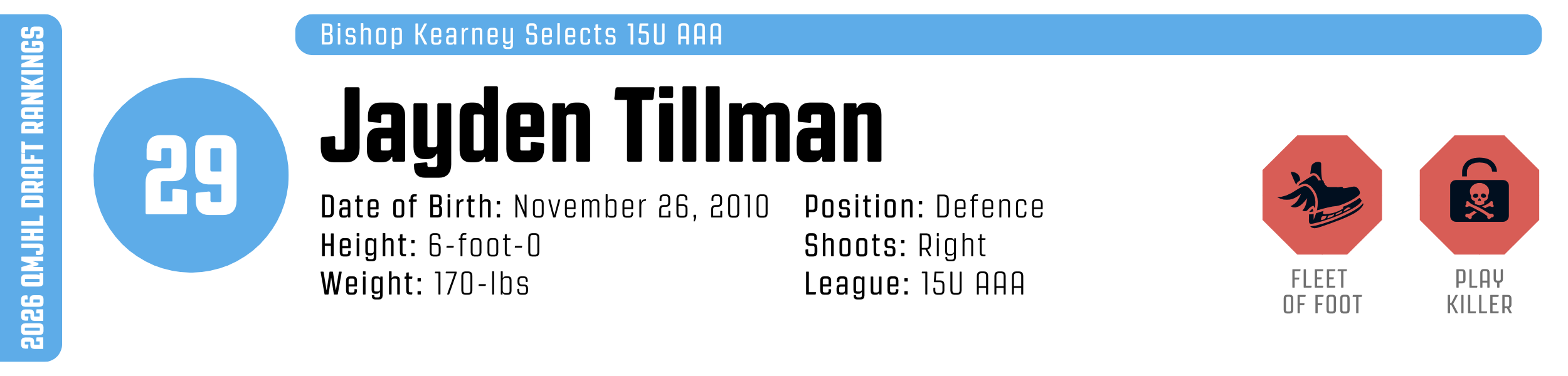
Jayden Tillman inspires the gut feeling that he’ll someday be looked upon as a steal in this draft. A bit less polished than his challengers in this defensive cohort, his one-on-one defensive plays, skating, and physicality are all excellent. He’s always seeking to be implicated in the play, getting defensive stops, looking for spots to get involved in the offensive zone, and pressuring puck-carriers in whatever way makes sense in the situation. He’s not a heavy producer but he doesn’t need to be; his defensive play is effective enough. The details of Tillman’s defence are all there—his gaps, stick, and pace are enough to extinguish most chances through some combination of the three. His skating is a large part of why his transitionary defence shines; he’s able to quickly gap up and force the carrier to either shy away from contact or feel it. He can make the necessary skilled puck play despite some gaps in his scanning, but being weaker in a more corrigible habit is a large part of why we believe in his upside. Tillman is one of the most variable prospects on this list, but the defensive maturity at this age could really blossom on a team that buys into his development.
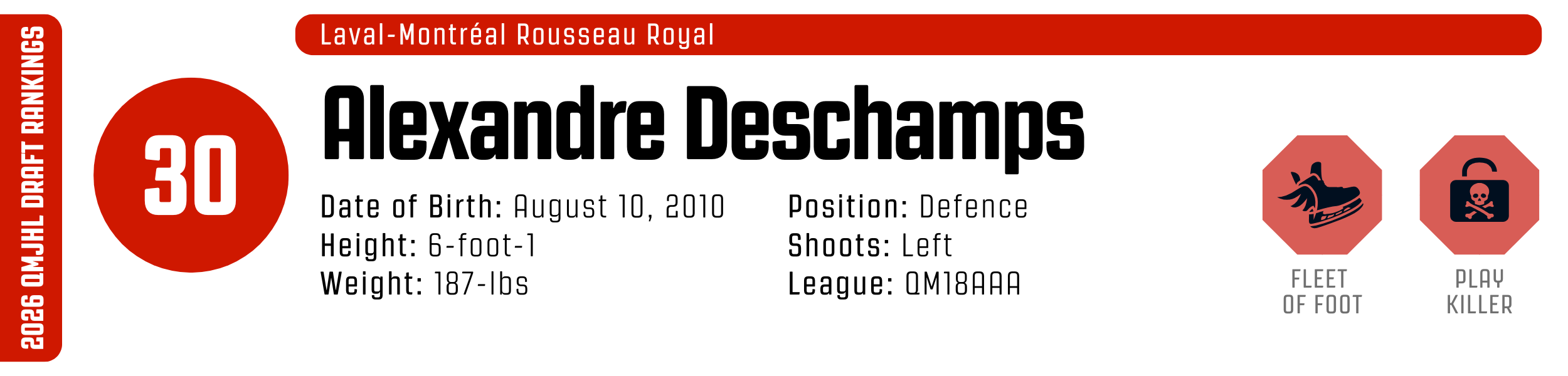
Alexandre Deschamps’ mid-season injury limited our opportunities to get a good look in on him against tougher competition, but the games we caught left us impressed. His stick-and-body layering in rush defence scenarios makes him so difficult to beat wide, and he knows it — he forces opponents wide with his angling routes knowing what he’ll inflict on them. His defensive-game scanning keeps him constantly seeking to clog lanes, and his skating foundation gets him from spot to spot comfortably. While he could improve his on-puck vision and creativity, there are glimpses of it here and there, as he spots middle lanes and exploits them on the breakout, and occasionally seeks out the East-West play from the left corner to the right dot when receiving rim passes along the blue line. The vision should expand further — Deschamps activates a lot, hangs onto pucks off retrievals, improves his point shot angles through lateral movement, and shows enough poise under pressure to put forecheckers on his back and seek out a better play. How much expansion is the question; if it’s linear based on his current projection, Deschamps will be a top-four defenceman. If he adds misdirection, manipulation, and handling confidence to his on-puck game, a full-time top-pair role isn’t out of the question.
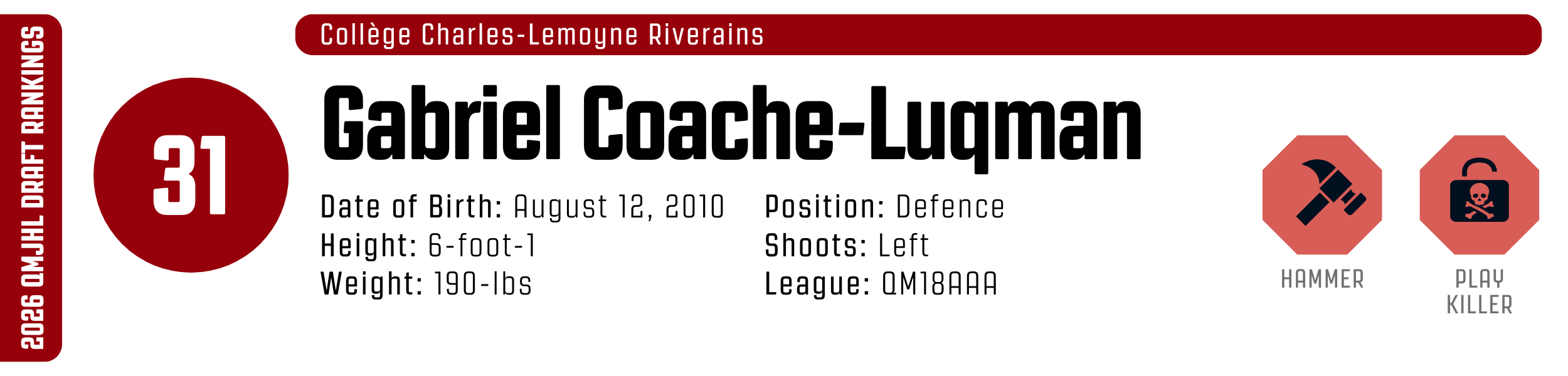
Not a single forward in the QM18AAA likes to play against Gabriel Coache-Luqman. He makes his side of the ice a nightmare to venture into, no matter the phase of play. Off the cycle, he pins forecheckers effortlessly, wrapping through their hands to nullify any attempt to leverage upper-body strength and make a play. He sticks his skates as close to his opponents’ as possible on those pins, forcing them to anchor their weight and avoiding any footwork deception altogether. When all else fails, he hammers through their chests and lets cross checks fly. Meanwhile, his rush defence game is just as punishing; he can pinch incredibly aggressively, trusting his long and deep strides to cover any space he leaves in his blind spots, but can also play a more absorbent role in rush defence, baiting space and taking it away as soon as carriers think they’re safe. While his offensive game is limited, he is starting to explore with off-the-wall carries and off-puck activations, which could lead to some soft-skill improvements. Still, the combination of fluid skating, trucking physicality, and chance-suppressing strategies Coache-Luqman brings to the table should be enough on their own for a top-four role in the QMJHL.
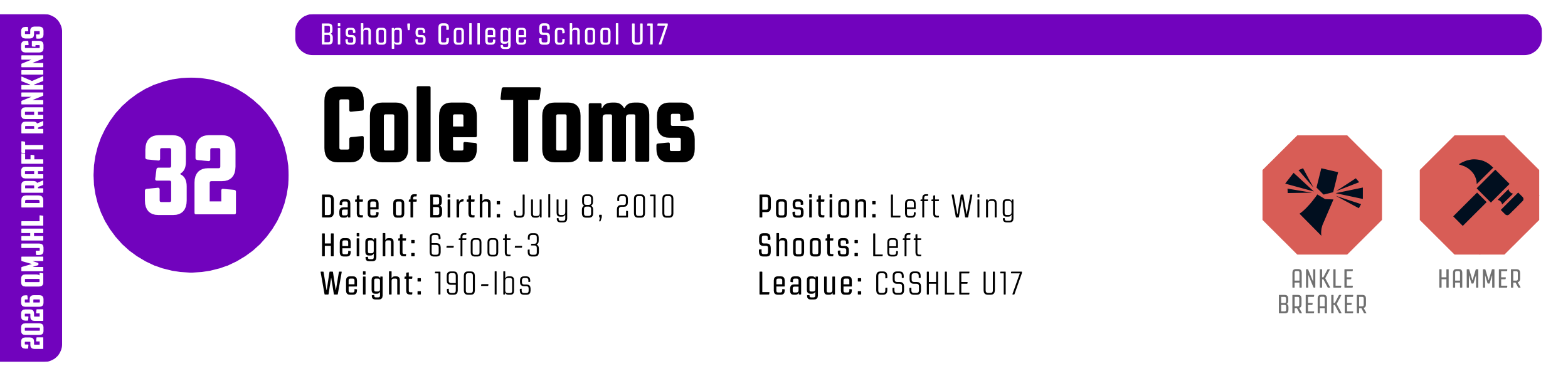
Evaluating and ranking Cole Toms is an interesting exercise: in a junior hockey league draft, where players are so young and so subject-to-change, where ‘special’ qualities are emphasized, when do you take a chance on the all-rounder? Enter Toms, a prospect of hard and soft skill, of simple and complex plays. He uses the massive advantage of his 6-foot-3 frame at the U17 level to initiate contact and protect the puck on his frequent transitions. He passes well and plays with a high level of coordination between his variable pace, his scans, and his actions. He’s a two-way forward in every sense of the term, anchored by his sense being a relative standout among everything else he does so well. His quick-reaction plays at the CSSHLE U17 level earn him a wealth of takeaways and point production to show for it, and his premier role on Team Newfoundland at the QMJHL Cup Atlantic highlighted his cerebral advances on the play in the company of our 10th-ranked prospect Damian Norris and 26th-ranked Luke McGuire. If he can take his transferable hard puckhandling skills to his passing, he’ll be all the more dangerous with his grasp on the play and the skills to execute. The door for Toms’ selection opens the moment we hit the second round at 19th overall; his style of play could really launch him up a number of teams’ list.
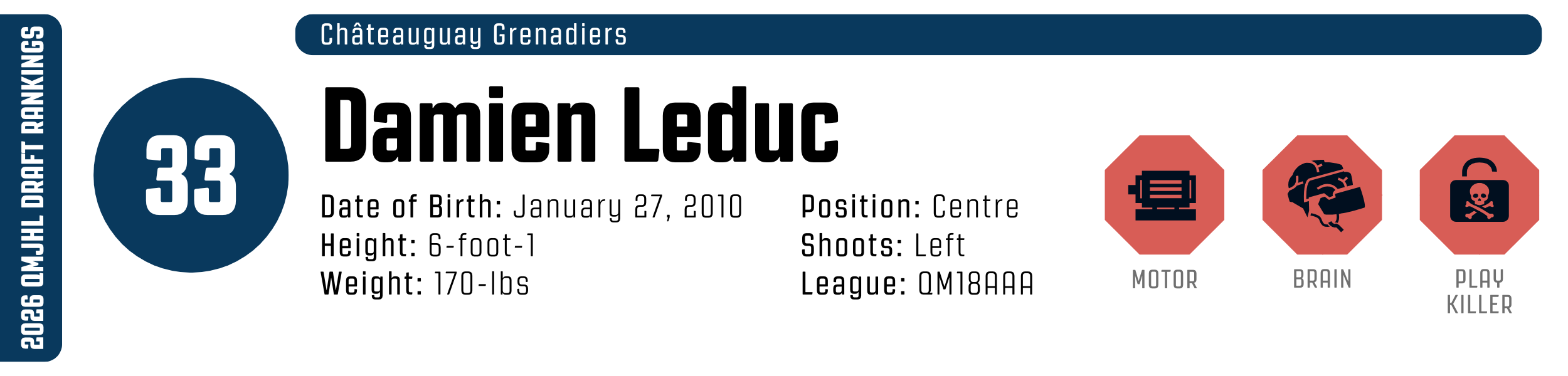
The brunt of Damien Leduc’s effectiveness comes from his contact skills and the various ways in which he can get to loose pucks first. He ties up defenders’ hands through proactive contact heading into 50/50 races, hustles hard to get his shoulder in front of a defender’s when they have the jump on him, and then once they give up on the puck and try to pin him, he wriggles out of checks with quick footwork shuffles and works up the wall with pressure on his back. His defensive support game is just as effective, as he extends wall battles and makes it near impossible to sustain any cycle offence. If he is going to add soft-skill layers to his hard-skill game, Leduc’s open-ice creativity and explosiveness needs a step, but the high-floor elements are all there; he’s a safe bet to be a long-term middle-six centre, with top six potential if he expands his open-ice skillset.
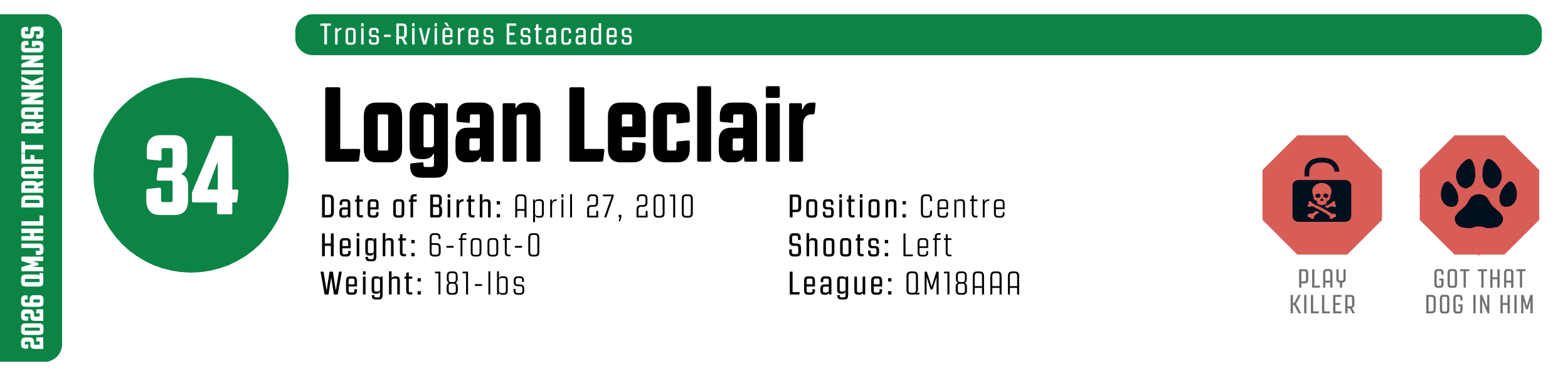
Relentless pace and trucking physicality make Logan Leclair a handful on every shift. His straight-line speed and frame make him a menace on the forecheck, as he effortlessly closes retrieval gaps and forces defenders into rushed decisions with his pressure on their backs. His defensive value is high-end, too; he hustles on the backcheck, applies smart pressure in his own zone, and never misses a chance to finish a check or battle for possession along the wall. Though Leclair’s offensive output is limited by mechanical flaws and a tendency to prefer pace over control, there are flashes of goal-scoring ability, as he can shoot off the catch and drive the net well enough to see his fair share of goals at the QMJHL level. That blend of power and speed makes Leclair an all-likelihood middle-six centre, with room to add more inventiveness, pace adjustments, and East-West exploitation to his game.
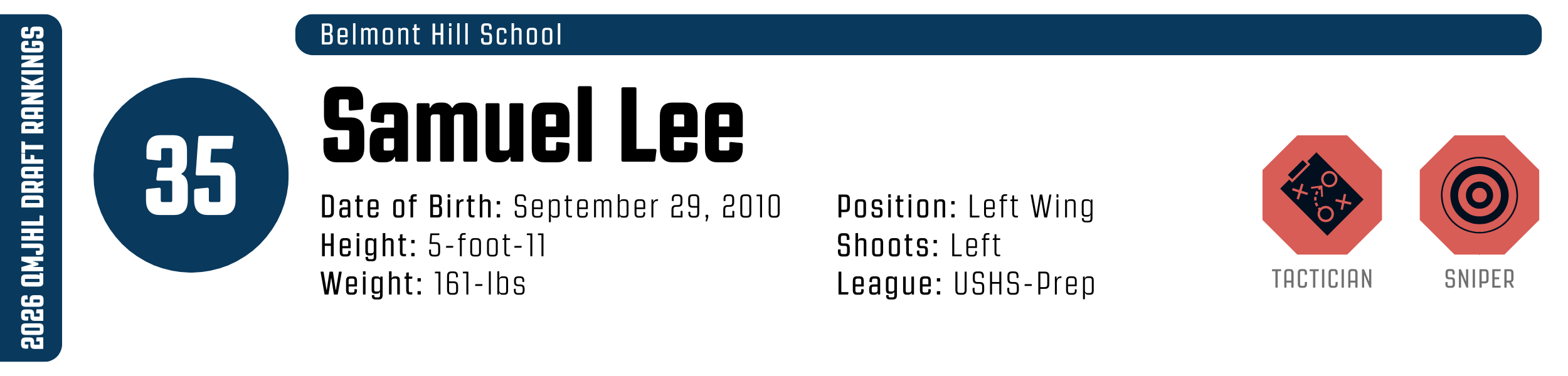
An elusive skater with one of the best releases in the region, Samuel Lee is always looking for soft ice and exploiting defenders’ blind spots. Off the cycle, he disappears and reappears in the slot, forcing defenders to either scan and commit to him, or lose him and risk a goal. His transition game is just as clever and dangerous, as he works middle-lane support into quick give-and-go plays, sprinting his routes into the offensive zone and forcing defenders onto their heels. He patterns laterally off the carry, isolates defenders, slips pucks through their coverage, and then explodes into space. He’ll need to considerably improve his contact skills and his desire to engage physically, but he has enough positional sense and stick discipline to play decent defensive hockey. The sense, skating, and shot offer a tonne of promise in a QMJHL top six if he does add some of the hard skills that will be necessary to create space in the league.

A fantastic play-reading netminder with a solid skating foundation, Colby O’Shaughnessy effortlessly anticipates shooters’ release points and shot locations, follows pucks’ trajectories through busy East-West cycle plays, and leads his movements with his head. His feet snap into place smoothly and comfortably, and he’s constantly adjusting his edges to maintain good control on his squareness. He boasts strong hands, mainly aided by upper-body control and an upright stance that increases his tracking success, and his post integration ranks among the best in this class. While his depth control, scramble composure, and ability to read shots through screens could use some work, O’Shaughnessy projects as a starting netminder in the QMJHL.
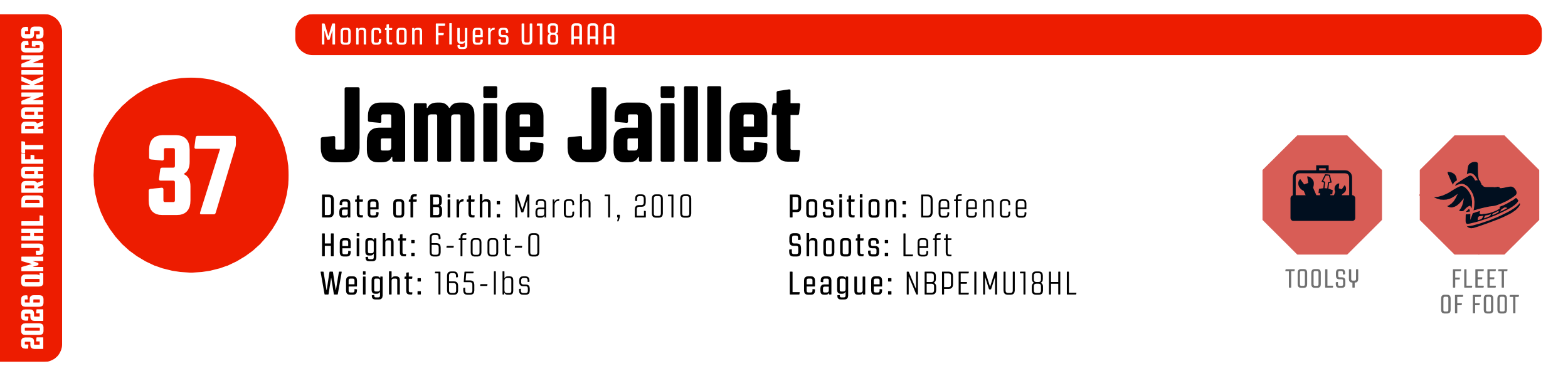
Jamie Jaillet is an all-finesse defenceman with impressive mobility and all-zones processing. His game is laden with details in his puckhandling and skating that will help his transition to the next level, possessing a high level of strategy and intentionality to his game. He also brings flair and competency to his offensive-zone play, grading out high on his tools and a bit higher on his sense. There’s still a lot of runway on his contact skills, which will undoubtedly be needed to scale up his high-involvement style of play from the blue line. His skills shine when defending the rush, forcing angles on puck-carriers and taking turnaround action once he’s positioned advantageously to move the puck. Physicality is the one question mark, but Jaillet could become a reliable minute-muncher in the right development environment.
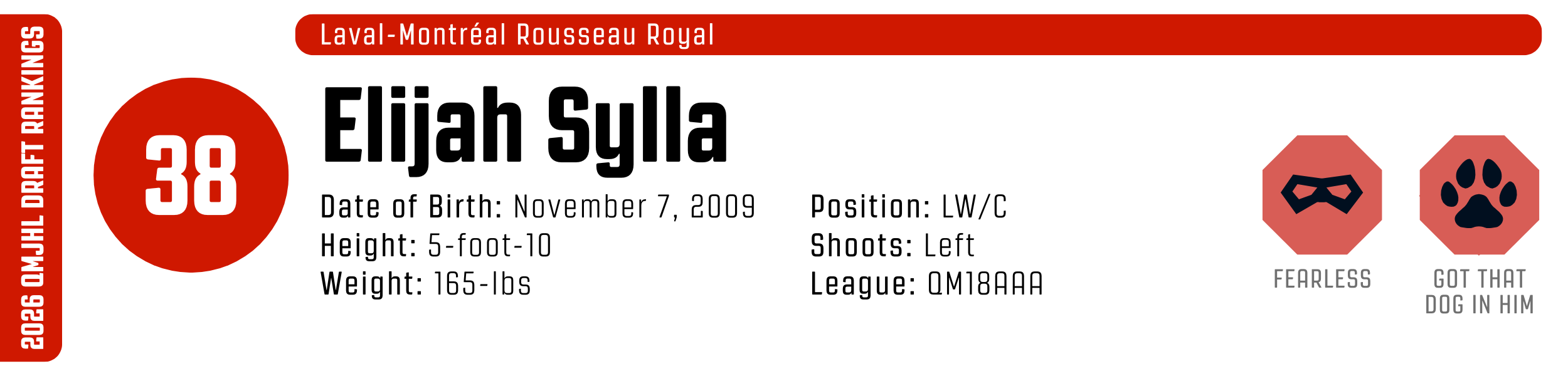
A re-entry prospect for the 2026 QMJHL Draft, Elijah Sylla came out of left field this season and established himself as one of the QM18AAA’s top players with Laval-Montréal. A highly active and engaged forechecker, Sylla hustles past defenders’ attempts to slow him down, plants himself in priority position, and then baits cross-checks before exploding out of them to start the cycle. He has a strong foundation of high-pace skills, too, able to shoot in full stride and thread seam passes when attacking downhill. While his skating mechanics hold him back from exploding from a standstill, he’s never standing still, so it rarely ever affects his game negatively. If he unlocks more nuance in transition, he’ll thrive offensively in the QMJHL, but even if he doesn’t, he’ll be a highly effective middle-six checker.
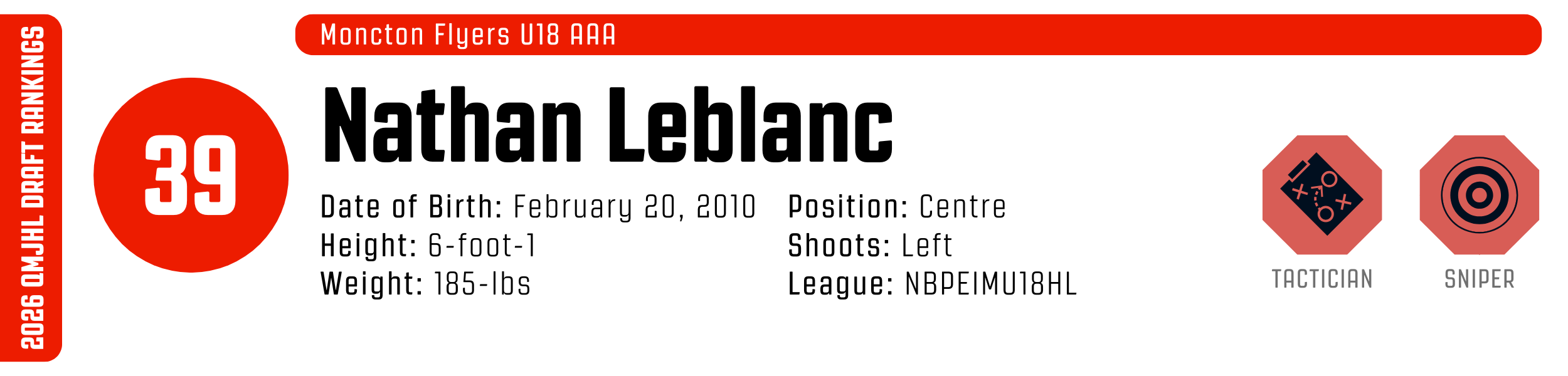
Let’s keep it simple: Nathan Leblanc is Atlantic Canada’s sharpest shooter in this draft class. Leading 2010-born scorers in the New Brunswick/PEI U18 league in variable middle-six minutes, he’s a quick-recovery, corner-picking shooter. Although he’s keen to find that prime real estate where he can rip it, he’s also capable of reading the offensive play away from the puck and making his play, whether that’s opening himself up for a connecting pass or tackling the net-front to try for an uglier goal. The hockey sense in his off-puck reads is quite high, efficiently surveying the play and adjusting in split-seconds to generate the most dangerous scoring option — a skill bolstered by his own status as a sniper. The habits seen when he’s coming in on a rush as the passenger or chasing a loose puck fall away when the puck is on his stick, but his quick-touch game can certainly find a home in the QMJHL. Leblanc’s high pace of play will make him look impressive upon arrival, and universalizing his reads post-draft would help him add layers to his scoring and special shot.
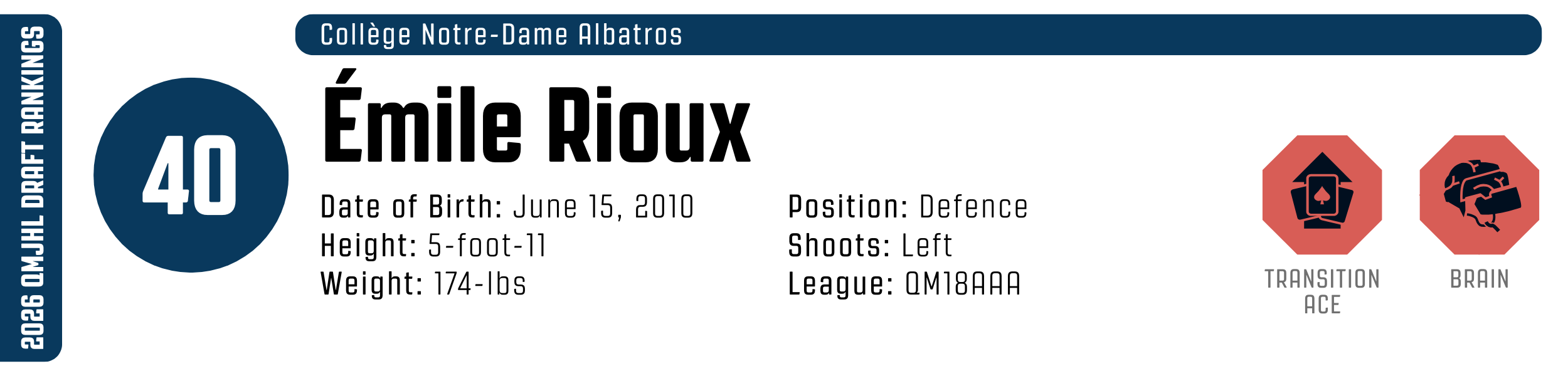
On his best nights, Émile Rioux looks like a first-round pick. He activates into plays, tracks back with his above-average mobility, controls the periphery with timely wall interventions, and cuts off cross-seam passes almost instinctively. His deep posture and hip engagement leads to smooth pivots, aiding his retrieval game and making him particularly adept at misdirecting forecheckers on retrievals and finding an exit play. More puck-mover than offensive creator, Rioux carefully selects his exit plays, plays prudently from the blue line, and only joins rushes when there are more opponents ahead of him than behind. Though his physical game can waver, especially against bigger bodies, Rioux’s net-front aggression gives him a fighting chance against QMJHL-calibre goalmouth occupants. He could develop into a top-four defenceman if his contact game improves along with his physical growth.
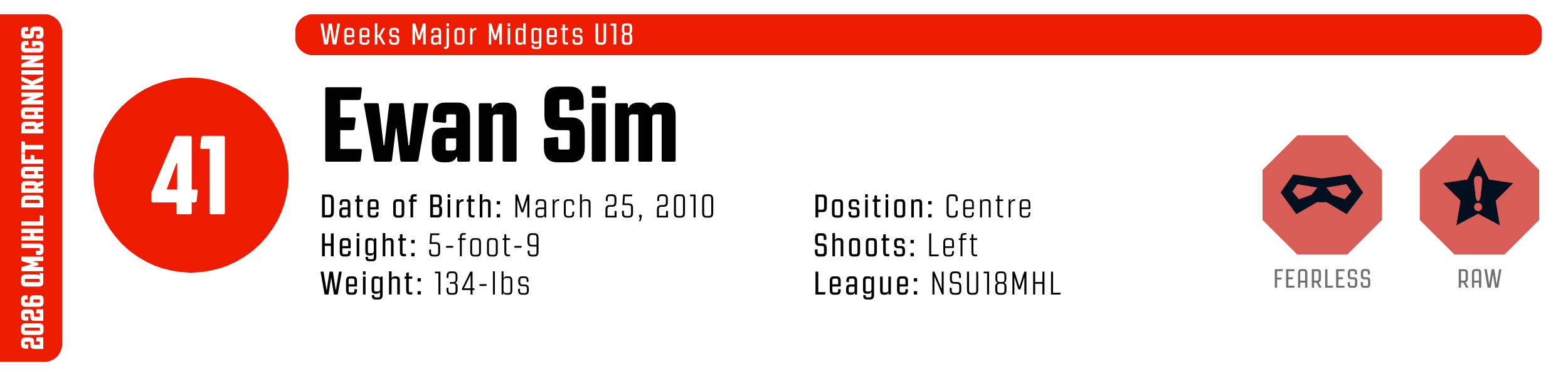
For all the QMJHL Entry Draft-eligible talent playing in the OHL’s catchment area, this pipeline offers Ewan Sim in the inverse. The Nova Scotia-born forward is OHL Priority Selection-eligible by virtue of his father’s four seasons in the OHL, and his two older brothers chose to play in Ontario. Sim is a rare case with his multiple eligibilities and, from a QMJHL lens, he sits just outside our top 40. He’s likely the pitbull of this 2026 draft class— the shortest player to receive a high-end physical grade from us at 5-foot-9, his physicality and fearlessness to join the play come with an offence-creating flavour due to an impressive high-end ability to wrangle loose pucks. Sim led the Nova Scotia U18 league in draft-eligible scoring with 49 points in 32 games, and these numbers were largely generated by his active position as a quick passer on the cycle who can reliably recover pucks and passes. It’s unlikely that Sim will ever be the best player on his future QMJHL or OHL team, but he’s in the running to become the most loved and loathed player from this draft.
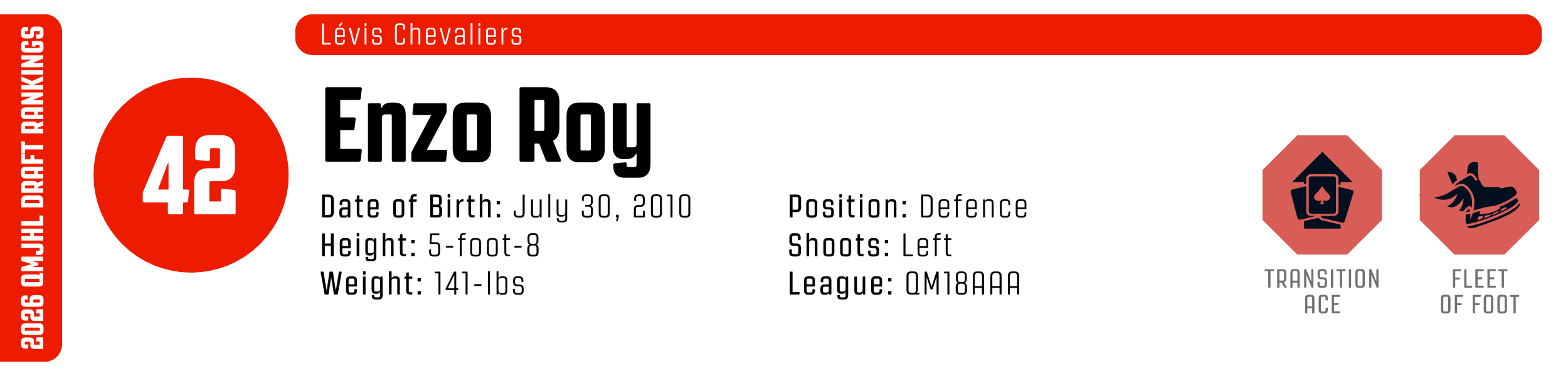
Few defencemen have done more with less than Enzo Roy has in Lévis. The undersized offensive dynamo has been playing third-pair minutes and quarterbacking the second power play, and yet, every time the Chevaliers need a goal, he’s on the ice. A tremendous puck-mover with quick edges and strong straight-line speed, Roy’s signature skill is his first touch; on pass receptions, he can baffle forecheckers by opening his hips and pushing off his back leg while tapping the puck ahead of him or into the boards for a quick escape. From there, he activates hard, joins rushes, carries pucks end-to-end, attacks defencemen’s heels with quick inside moves, and either finds a slot pass or starts the cycle. While slight and defensively limited, Roy could use the right development environment as a springboard for his career as a highly-specialized offensive blue-liner. With the right development, he has a chance to be the most productive defenceman from this class outside the first round.
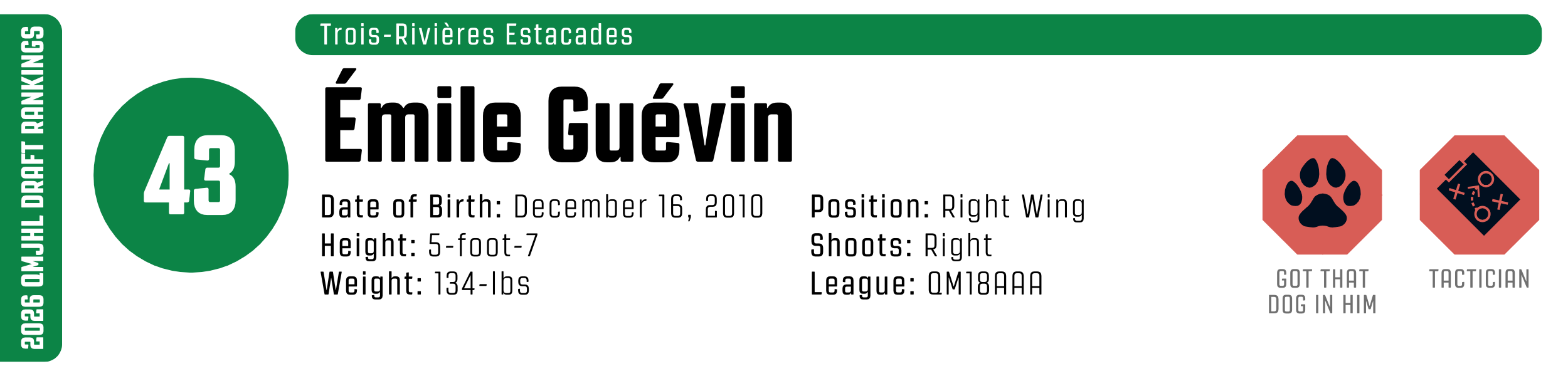
An underdeveloped yet highly promising forward, Émile Guévin’s relentless puck-hounding is his standout skill. He can outwork bigger bodies, withstand hits and cross checks on carries and retrievals, and spin off contact down low to make a play. When heading up the ice, Guévin’s base of sense takes over, as he patterns his routes laterally, isolates a defenceman, forces him on his heels, and capitalizes on the mid-range space he is offered. Guévin’s contact strategies being so advanced already at his size offers so much promise; once he adds a few inches and pounds, he could be an unstoppable checking force with the tactical awareness to cause damage off both the rush and the cycle.

A tall, athletic netminder with explosive feet, Xavier Gervais’ frame, flexibility, and skating drive much of his potential as a QMJHL shot-stopper. His cross-crease pushes are instantaneous and controlled, as he plants his edge from a butterfly position and drives through the paint while keeping his anchored knee low to the ice, sealing the low-shot threat while maintaining his lateral explosiveness. Great tracking complements his physical tools, as he keeps a close eye on the puck’s whereabouts through hard cycles and rarely gets caught a step behind the play. While his technical details are still raw, the tool foundations are there to see him succeed in a major way in the QMJHL, especially if he can clean up his post integration and transitions.
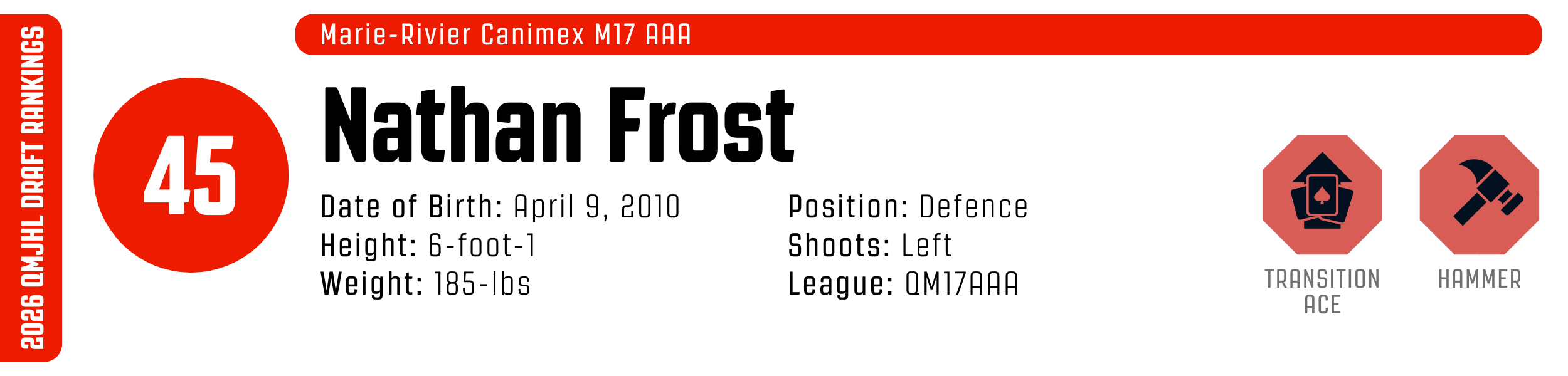
The QM17AAA’s lone representative on our board, Nathan Frost found a home in Marie-Rivier’s AAA program close to home after the Connecticut Jr. Rangers’ early collapse, and has made the most of the situation. Highly engaged, physical, and mobile, Frost lunges mercilessly at opposing carriers when defending the rush, and off the cycle, he’s just as ruthless. Timely pins, aggressive cross checks, and hard-nosed net-front battling make him a nightmare to try and circumvent down low. He has some alluring offensive ideas, such as weak-side activations and aggressive forecheck attempts when looking to buy his forwards time to change, though the offensive skills themselves could use some more polish. Continuing to explore with puck touches further up the ice while getting more comfortable on retrievals should put Frost in a position to capitalize on his offensive ideas, and solidify his potential as a top-four blue-liner in the QMJHL.
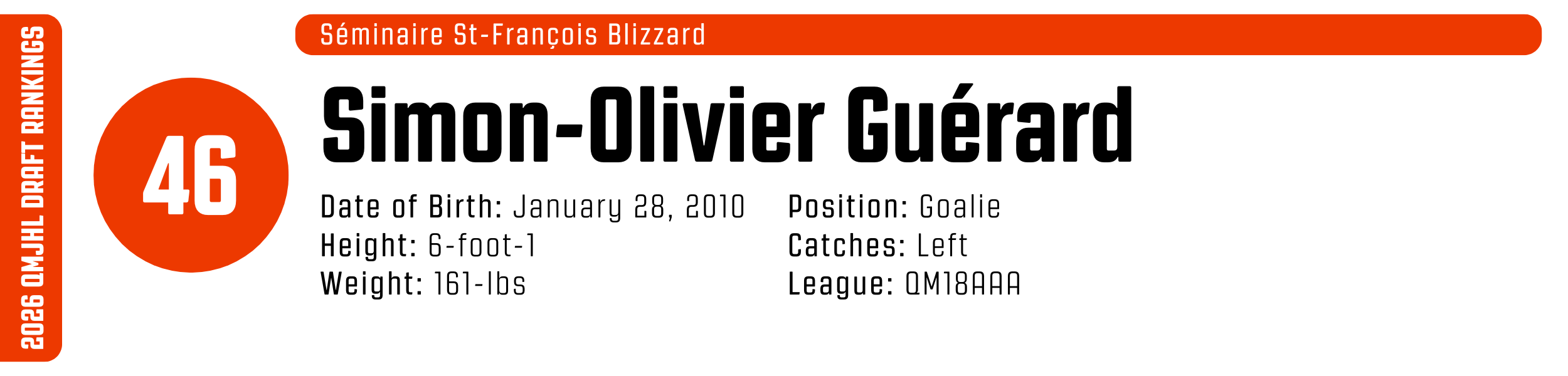
The greatest team in the league’s 1B netminder, Simon-Olivier Guérard’s numbers with Séminaire St-François may be skewed towards the positive, but his physical tools in isolation are what have our team sold on his top-50 value. A 6-foot-1 shot-stopper with great feet and natural athleticism, Guérard explodes across his crease with impressive ease on high-danger cross-slot passes, tracking the puck all the way and committing across with the right timing to cover backdoor threats. He has the compete level to make second and third saves, and with his technique being a work in progress, he sees a lot of those scenarios. Cleaning up his butterfly position to cover more net while being more consistent with his stance through his transitions will unlock tremendous potential. A raw but exciting goaltending prospect with sky-high upside in the right development environment.
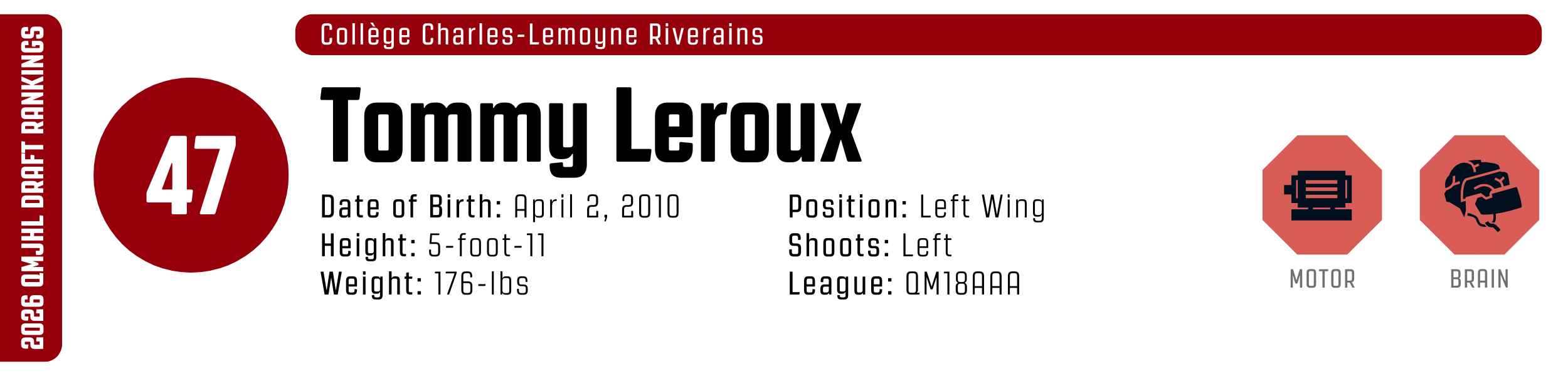
With pro-ready contact skills and a high-end motor, Tommy Leroux puts relentless pressure on opposing defenders. He shepherds them wide with intelligent forechecking arcs, forces plays up the wall, and then back-tracks to disrupt the ensuing broken play recoveries. Offensively, he brings strong positional sense and aggressive net drives to the table, constantly looking to turn battles into advantages by leveraging immediate outlets and then immediately repositioning in high-danger areas. His on-puck game in transition is straightforward: dish off early, drag a defender to the net, capitalize on the chaos. While lacking the creativity and high-cycle habits of the QMJHL’s top-liners, Leroux should become a consistent and serviceable middle-six forward in the league — possibly as soon as this fall.
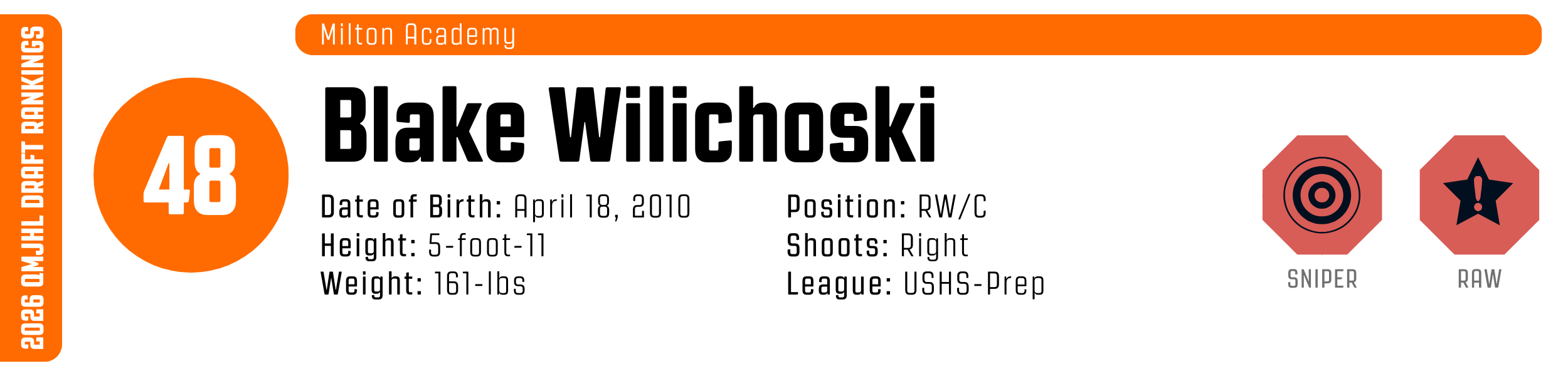
A tremendous offensive driver with skill and speed, Blake Wilichoski can fly with the best of them. He uses crossovers, cuts, and inside patterns to solve problems off the rush, and from there, he can dangle to the net or rip a wrister through a screen. The playmaking flashes have been just as bright this season, as he leverages the high cycle as a check-separation tool before working downhill and finding a savvy cross-seam threat. He’s at his best when finding separation in open ice, but has shown some flashes of contact skills on dump-in recoveries and in puck battles down low. Becoming more consistent with his defensive effort while increasing his three-zone scans are the next steps — if he leans into his checking skills while adding advantage creation to his tool belt, Wilichoski could be a tremendous QMJHLer with top-six potential.
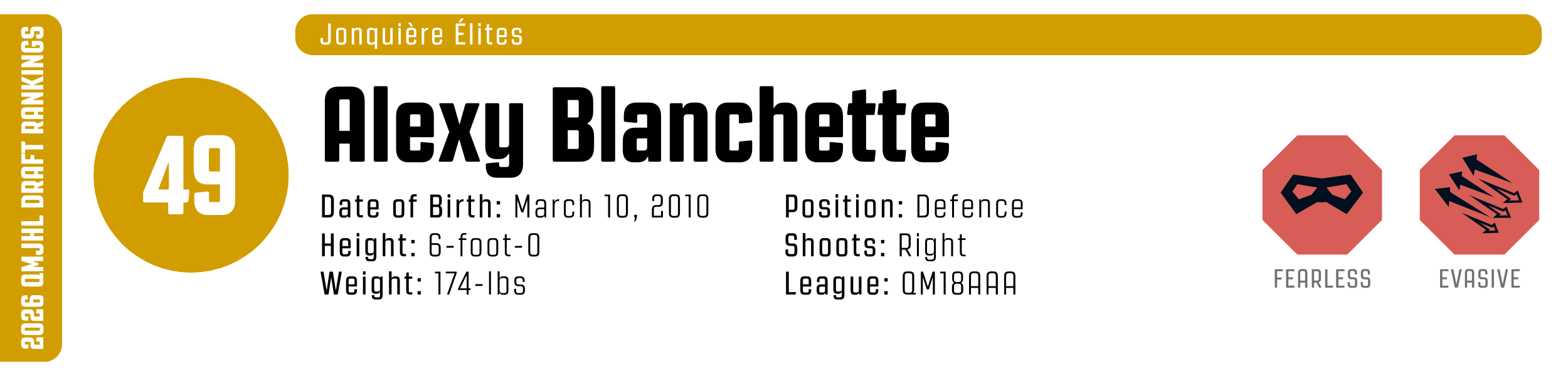
We had to slip Alexy Blanchette into our top 50; even though the projection is nebulous, the flashes of skill and shutdown ability he has shown for Jonquière in our viewings were too great to ignore. With his size and skating, he can effortlessly erase gaps off the rush, leveraging his range to bait space on entries before taking it away in the blink of an eye. Meanwhile, his handling skill really stood out — he can fake a rim pass before pivoting and cutting back, can square up to carriers with his back to the wall before rolling his wrists into a backhand deke, and has shown some impressive offensive dare at times, venturing below the hashmarks for riskier puck touches. His decision-making in those scenarios is still a work in progress, but Blanchette’s tools are too enticing to ignore, and in a better environment, he would likely stand out even more. He could be a diamond in the rough in the right hands, and develop into a top-four two-way defenceman.
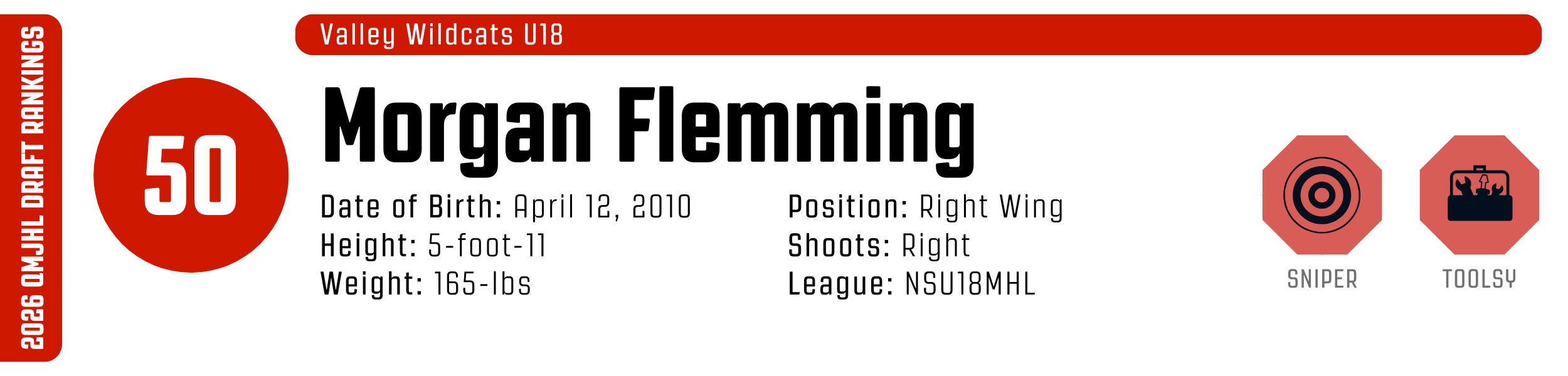
This season, Morgan Flemming was the most prolific 2010-born goal-scorer in the Nova Scotia U18 circuit, potting 19 goals in 33 games. His open-ice shooting ability makes him a lethal scoring winger, marking his name on the score sheet in nearly every live viewing our team has caught. His shooting ability off the pass is impressive, possessing a quick release and catching a deceptive amount of air that has victimized numerous young goaltenders and their water bottles across Nova Scotia. His numbers are further bolstered by the versatility to play down low, deflecting and tipping effectively. The rushes especially may be capped by his pace as his linemates and defenders get speedier in the QMJHL, but his ability to bring the same dynamism and quick release on turnovers insulates his sharp-shooting identity, plus his other puck skills. Flemming’s a player with his strengths and weaknesses, but his offensive toolkit and feasible workarounds make for a great bet to cap off our top 50.
Honourable Mentions:
Zachary Lavoie , D, Trois-Rivières Estacades (QM18AAA)
Joey Bégin, D, Collège Notre-Dame Albatros (QM18AAA)
William Vincent, LW, Saint-Eustache Vikings (QM18AAA)
Mathis Khoury, C, Laval-Montréal Rousseau Royal (QM18AAA)
Jayden Shea, C, Pittsburgh Penguins Elite 15U (15U AAA)
Chase Cleary, C, Collège Notre-Dame Albatros (QM18AAA)
Liam Duffy, D, Steele Subaru U18 (NSU18MHL)
Samuel Fishbone, D, St. Sebastian's School (USHS-Prep)
Matteo Roy, D, Moncton Flyers U18 AAA (NBPEIMU18HL)
Nolan Fraughton, G, South Shore Mustangs U18 (NSU18MHL)
Carter Heise, G, NV River Rats 15U AAA (15U AAA)
Carter Odell, F, Halifax McDonald's U18 (NSU18MHL)
Nathan Riendeau, RW, Collège Charles-Lemoyne Riverains (QM18AAA)
Our QMJHL Draft Team:
Hadi Kalakeche: QMJHL Draft Lead
Madison Delaval: Maritimes Regional Scout
Simon Desjardins: Quebec Regional Scout/Crossover Scout
Robert Chalmers: New England Regional Scout
Jacob Titus: Goalies Scout/Crossover Scout
Liam Crouse: Goalies Scout
Badges Definitions:
Sniper: A great shooter
Clinical finisher: A great net-front scorer
Vision: A great playmaker
Fleet of Foot: A great skater
Evasive: A player with a lot of small-area manoeuvrability or agility on their edges
Ankle Breaker: A player with great puck-handling skills
Chess Master: A great manipulator
Brain: A player with great hockey sense
Tactician: A player with great hockey sense away from the puck
Hammer: A player who is punishing physically
Got That Dog In Him: A player who shows up in big games
Fearless: A player who initiates contact and wants to get inside
Motor: A player with a high work rate
Versatility: A player who can fill a variety of different roles
Toolsy: A player with high-end tools
Play Killer: A player who gets defensive stops
Transition Ace: A player who moves the puck well
Raw: A player with a lot of unrealized potential



