Elite Prospects 2026 WHL Draft final top 120 ranking








The 2026 WHL Prospects Draft is just hours away, and there’s no shortage of excitement incoming.
The draft class, right up to the very top, is very much up for debate.
For some evaluators, the choice is Madden Daneault, an extremely well-rounded, ultra-competitive centre who set the AEHL U15 scoring record with 149 points in 35 games – while also having the most career points in league history.
For others, it’s Parker McMillan, a 6-foot-3 power winger with dual-threat scoring. His 3.64 point-per-game clip is second in CSSHL U15 Prep history.
Then, there’s the rising Brayden Jugnauth, the only full-time U18 player in the age group. He held down the No. 1 centre role for the BCEHL U18’s champs, and then won the Telus Cup Top Forward Award, becoming its youngest-ever winner.
This is an exciting group overall, featuring some of the most purely skilled players in the age group, dynamic defencemen, future playoff heroes, and more.
As always, our rankings are not mock drafts, but rather, focus on projecting players to the WHL level, emphasizing long-term upside while also considering role and certainty. Projecting 14-year-old players is a humbling challenge, though expect to see many of these players entering NHL Draft discussions in the coming years.
For grading, 50 represents a WHL-calibre ability, 70 is equivalent to middle-six/pair-level, and 90 is the high-end tools that you’d expect to see in top-line and top-pair players.
The 2026 WHL Draft kicks off with the first round on May 6th. With that, here’s our top 120, and you can download a list version here.
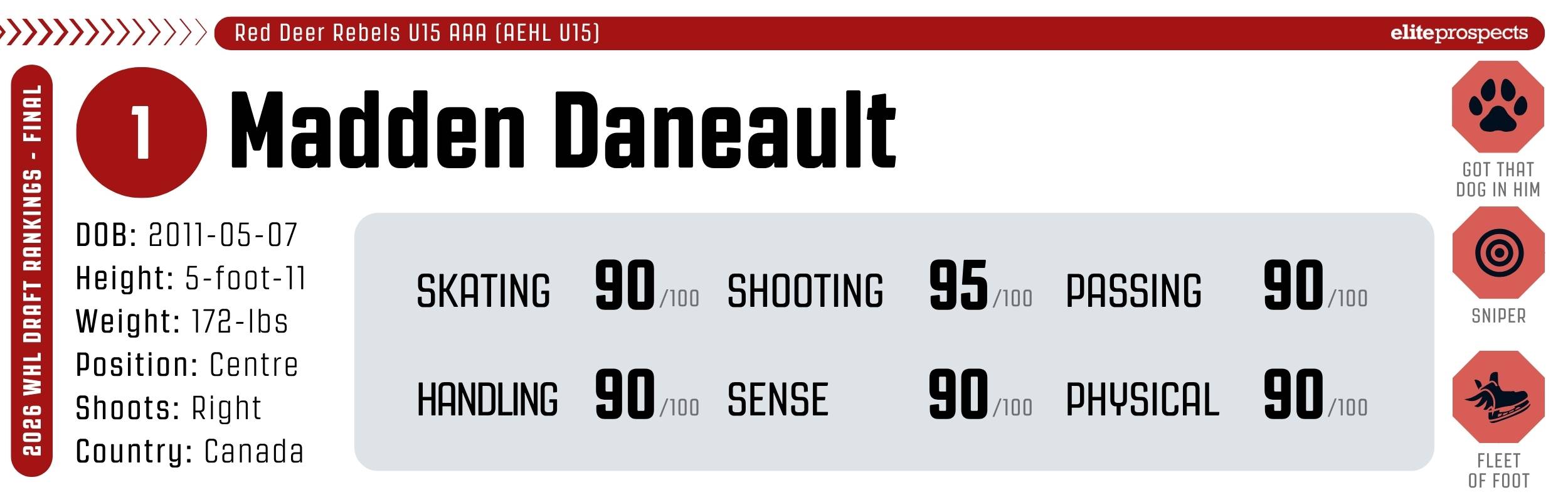
Madden Daneault set the AEHL U15 record with 149 points in 34 games, and the season told you everything you need to know about his ceiling. He is not just a scorer, though the shot is already WHL-calibre in both power and placement. He absorbs contact and rolls off it before the next play has started, wins inside position repeatedly, and blends quick-possession habits with the handling ability to make more complex plays at full speed when the situation calls for it.
Daneault’s anticipation on the defensive side of the puck turns neutral zone reads into instant transition offence, and his faceoff reliability makes him a complete pivot in every sense. The four-way mobility is explosive, and his edges generate separation that most players at this level simply cannot manufacture. He competes identically in a blowout as in a close game, a characteristic that showed up across multiple environments this season.
Adding a bit of quickness and learning when to distribute rather than shoot from the perimeter are the only notable refinements ahead. Daneault profiles as a franchise-driving No. 1 centre in the WHL.
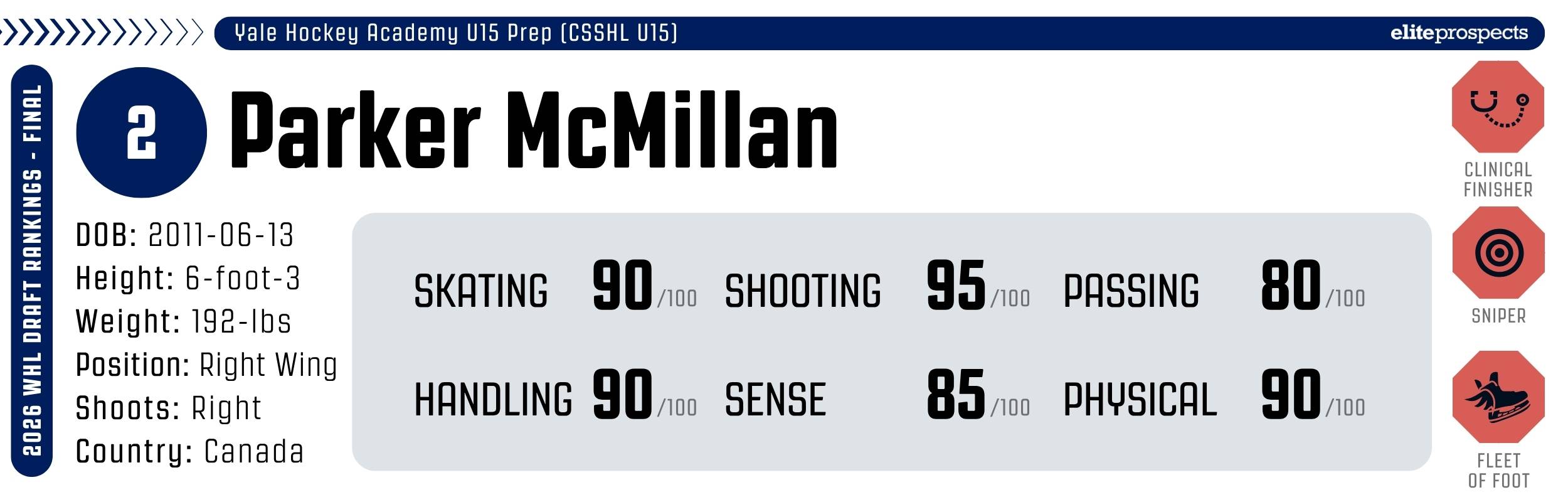
Parker McMillan is an apex predator. He’s fast, physical, mean, and in possession of a deadly offensive skill set. He spent his season making light work of the U15 circuit, excelling every time he stepped on the ice. Even on his off nights, he was a threat to come away with several points.
With explosive skating and skill, McMillan is just as much a north-south threat as he is an east-west one. He can make high-end moves in tight and through traffic, displaying his talent for escaping pressure. When he would get time to shoot this season, he was nearly automatic, with a shot that simply exploded off his stick with the precision to pick corners. His aggression is a huge asset, as he will plow through opponents with or without the puck. When he doesn’t have it, he looks like he’s on the hunt, tracking and predicting the play to put himself in the way and taking it back.
McMillan has all the tools to be a one-man offensive weapon, but he also displayed ample playmaking later on in the season. Finding his top gear every night will be an area of focus, but McMillan looks like a potential WHL star who could make an impact in his games next season.
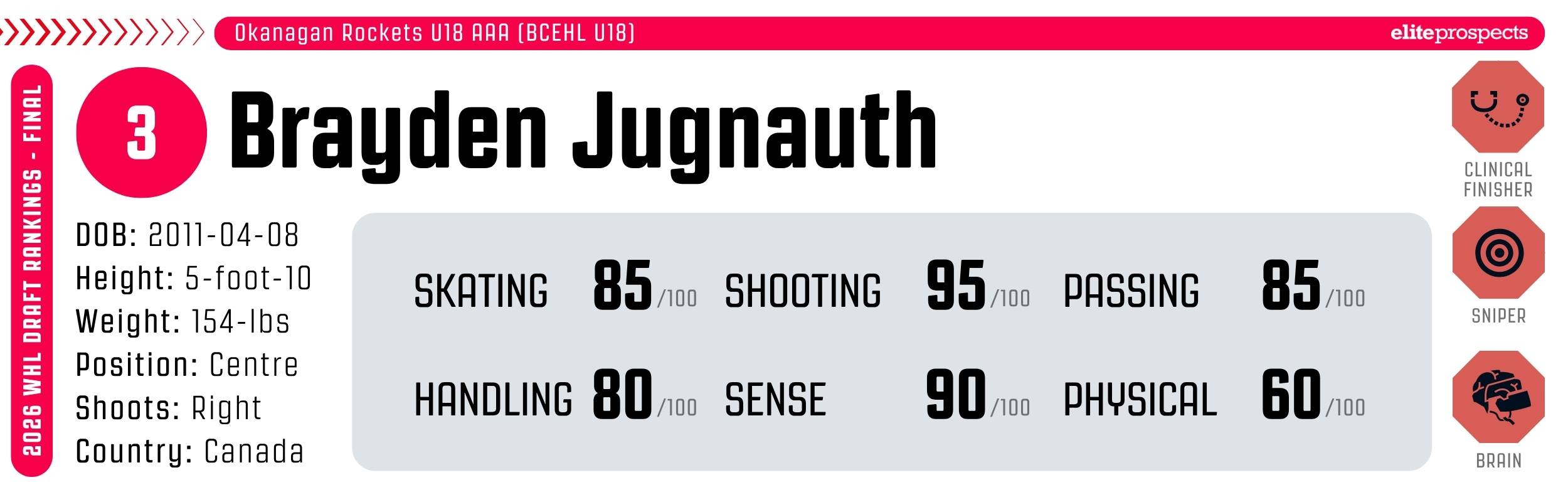
Constantly improving, Brayden Jugnauth shattered expectations this season. He made the full-time jump to the U18 level – the only top prospect to do so this season. Not only did he make an impact at that level, but he was able to dominate it, finishing second in league scoring. He followed that up with a dominant playoff run, winning the league championship.
Jugnauth is able to control games with his brain. It starts away from the puck, as he’s always open, intercepting breakouts and spacing the ice. With possession, he’s a deadly shooter, firing off the catch, off the rush, and from sharp angles. Plus, he’s a skilled playmaker who creates time and space with dishes, particularly in transition.
While Jugnauth’s not an explosive skater, his relatively thin frame suggests he has a lot more room to develop. His stock has skyrocketed this season, jumping from 14th on our first ranking to a surefire top-five pick and looking like a future first-line centre.
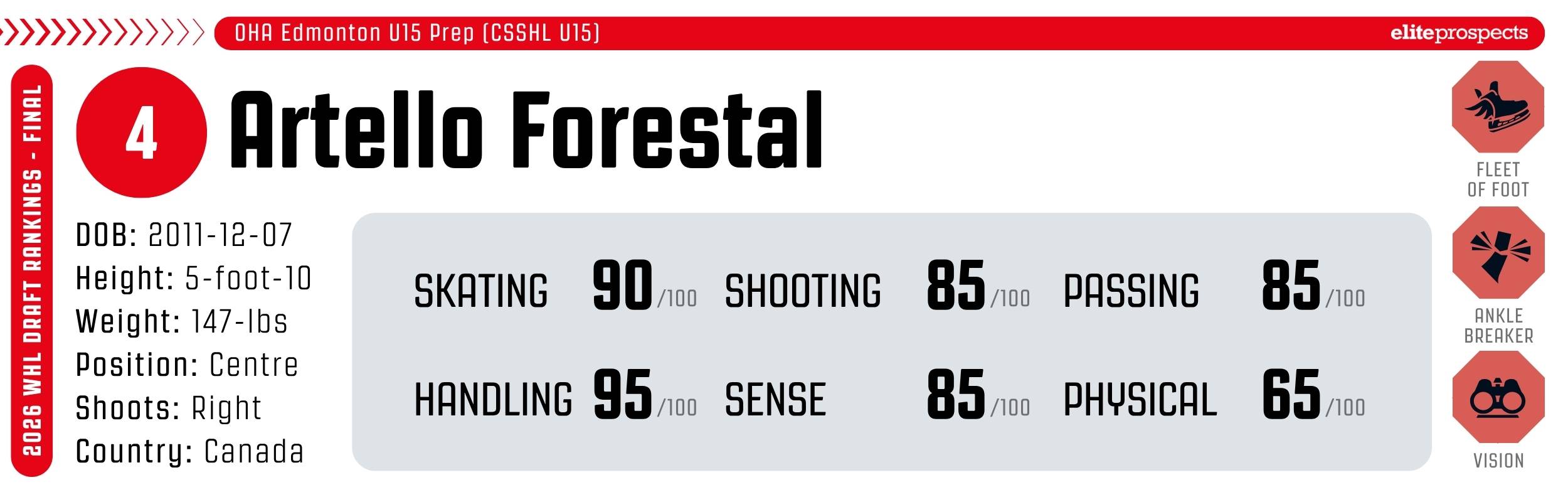
The most purely skilled player in this group is Artello Forestal. An undeniable difference-maker, the centre finished fourth in point-per-game scoring in the CSSHL U15 Prep, recording over a goal-per-game. It wasn’t a smooth sailing season, however. Forestal suffered early-season injuries, keeping him out of commission from October into the New Year. While uncertainty in his profile mounted, upon his return to action, Forestal did not look back. From his league play to outstanding performances at the John Reid Memorial and the Alberta Cup, the Edmonton-born forward only reiterated his value.
Forestal is already a dominant puck handler — his main advantage-creating weapon. He boasts a large selection of dekes, targets defenders’ weaksides, layers feints, direction changes, and edge work, all with the goal of breaking ankles and transitioning into scoring opportunities.
What makes him special is that his other tools don’t lag behind. His vision is high-end, his whippy wrist-fold release is deceptive, and everything blends together to create a prospect earmarked for a first-line role in the WHL.
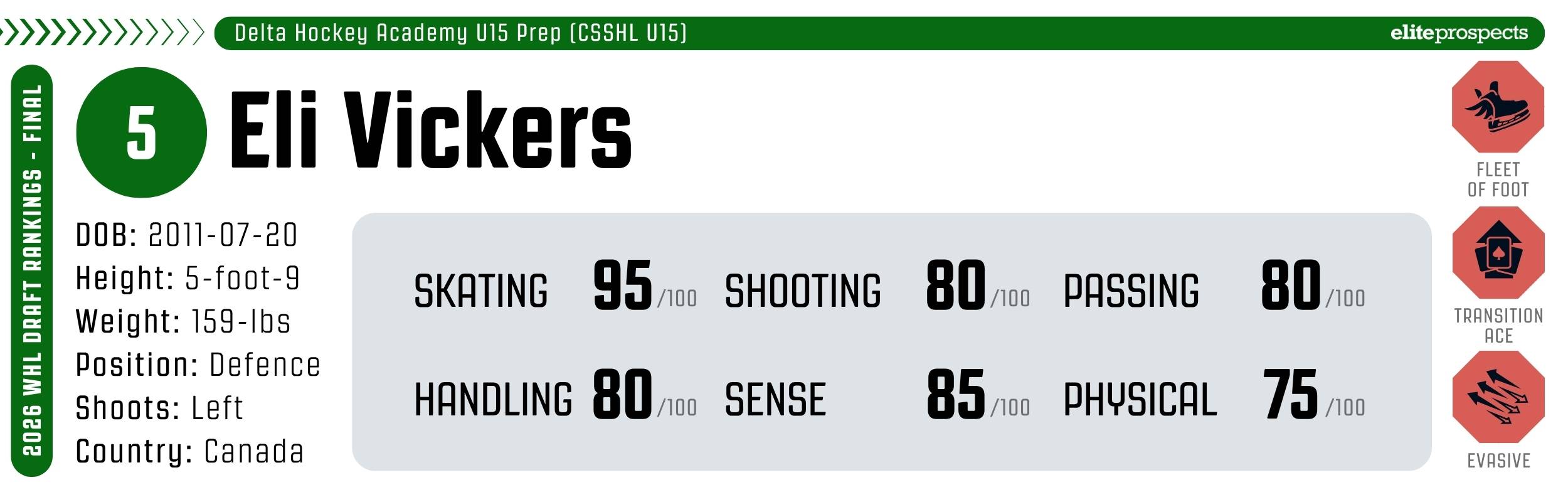
After having the third-most productive blueline season in CSSHL U15 Prep history, it’s safe to say Eli Vickers makes hockey look easy. Arguably the best skater in the draft class, he’s extremely fluid, elite off his edges, and explosive across the rink. That mobility powers his defensive game, eliminating plays with tight gaps.
Vickers is also a high-end thinker, scanning, anticipating, and reading plays. He’s a strong playmaker, finding high-value passing lanes, and a highly skilled handler. Combined with his skating, his skill and strength make him extremely challenging to get the puck from.
With such a diverse skill set and a highly competitive style, Vickers projects as a top-pair defenceman. His game is as plug-and-play as they come, too.
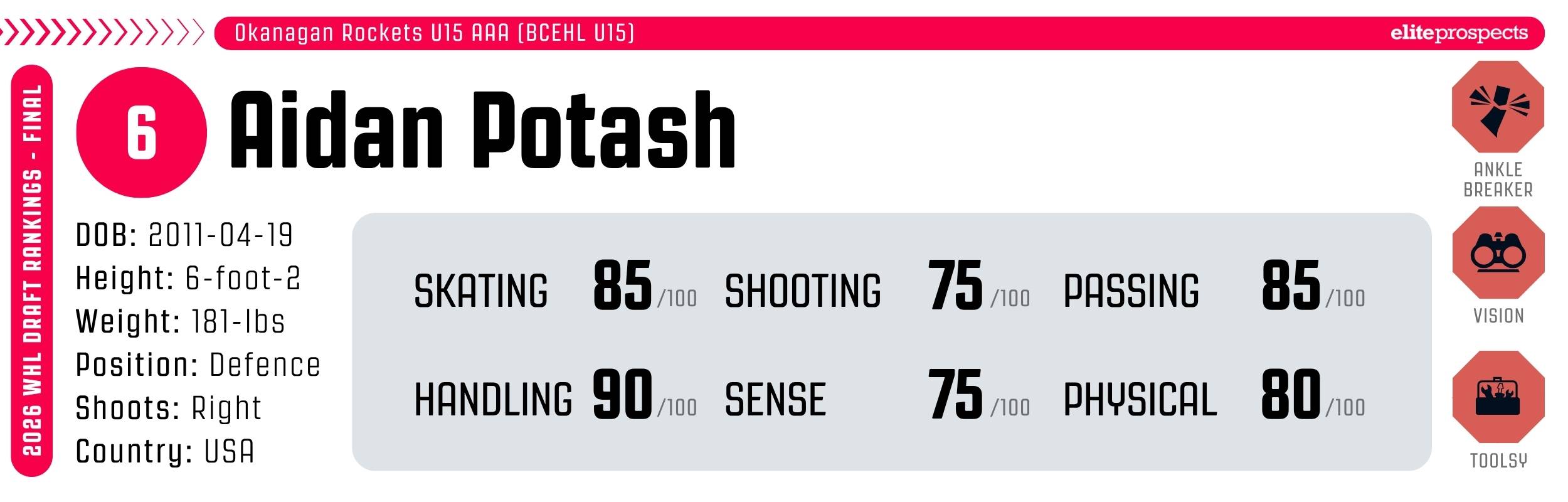
Aidan Potash stood out early and often this year, displaying high-end talent across several different tournaments and levels. He has every tool to be a possession monster at the next level, starting with his great skating. He balances well, using his edges to escape pressure, and combines that with a long stride that moves him around with speed. His puck skill and vision are high-end, allowing him to manipulate opponents and create offence at a high level.
Over the course of this season, Potash grew defensively, showing angling skills and taking away time and space with his feet and his reach. After winning a BCEHL U15 championship, he joined the U18 team, where he improved quickly and began making plays.
As a high-volume play-creating defenceman, Potash has turnovers and mistakes. His in-zone defending will have to improve, too. In our estimation, few prospects bring as much pure upside as Potash, who could become a PP1, No. 1 defenceman if his development continues at this pace.
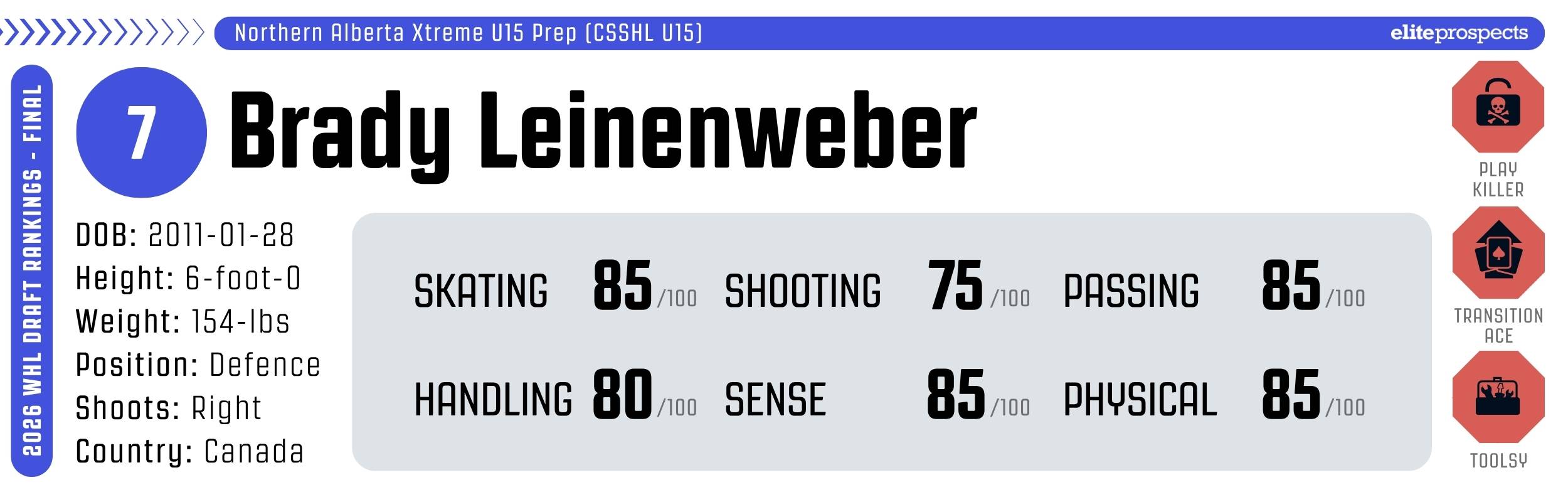
Brady Leinenweber is the most projectable defender in this class, playing a mature, two-way game with flashes of high-end skill.
Never panicked, Leinenweber uses his mobility and reach to protect the puck under pressure and finds outlets with the timing and weight that allow recipients to receive in motion. His blueline work is a legitimate offensive weapon: he opens his hips to distribute in both directions, pulls defenders out of lanes with shot fakes, and delivers backdoor passes with the kind of professional precision that is rare at this level. The shot from the right circle carries real threat, and his activation habits give his team a consistent offensive presence from the back end.
Leinenweber’s breakout reads are almost always sound, and his net-front tie-ups and poke-check timing reflect a defender who processes the game ahead of the play. Building out his physicality and using his body more assertively in wall battles will be the primary developmental step. He projects as a top-pair, two-way WHL defenceman with legitimate special teams upside on both sides of the ice.
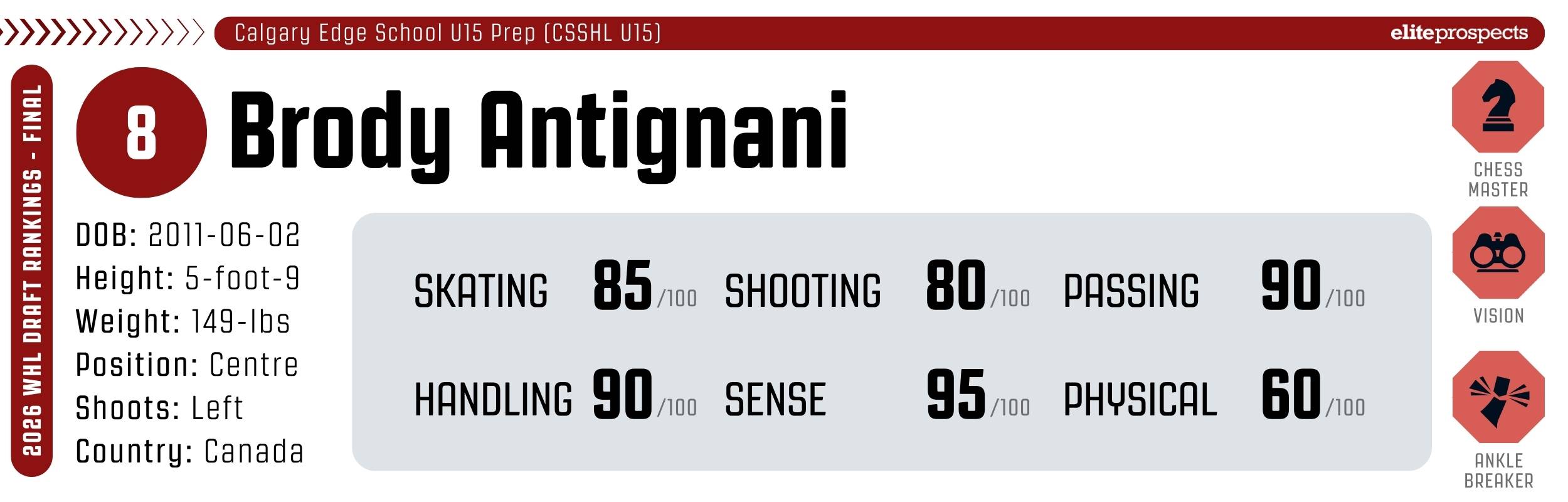
Brody Antignani is one of the most complete offensive centres in this class, and his playmaking vision is the trait that sets him apart. He finds options that most players at this level do not register as possibilities and delivers on them with a precision that makes the difficulty invisible. His backhand is a genuine weapon rather than a last resort, and opponents who cheat to take away his forehand pay for it with a top-corner goal as confident as anything he produces off his strong side.
In transition, Antignani’s handling and speed consistently put linemates in high-danger positions, and a cutback or offensive zone interception converted into offence showed up as a pattern across this season rather than in isolated moments. The game-breaking ability is present in full. He reads the ice several steps ahead, layers passing options that do not yet exist, and his dual-threat scoring gives defenders no comfortable answer regardless of positioning. Leaning into that identity more consistently at critical moments is the natural next developmental step.
Antignani has the profile of a top-six centre in the WHL, with legitimate first-line upside tied to the continued development of the playmaking and scoring instincts he already demonstrated this season.
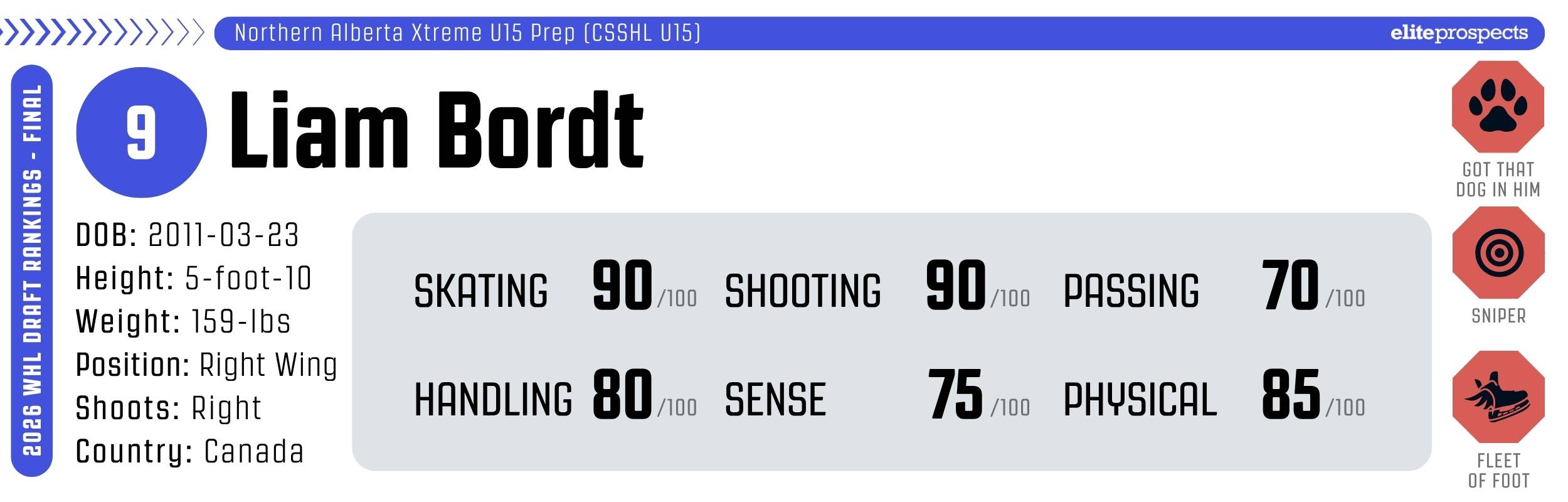
The overall game from Liam Bordt from the start of the season to the end is night and day. He’s turned into a game-breaking star, with a high-end shot that he can release from any position with power and precision. It’s a legitimate next-level weapon. His puck skill is almost as impressive as the shot, as he can instantly make electric moves in tight spots. He possesses difference-making speed, using a deep knee-bend and maximum leg extension to power around, which pairs perfectly with the aggression he found as the year went on.
Bordt is a nightmare on the forecheck, closing fast and with physicality, creating turnovers. Once he gets the puck, he has the skill to evade opponents and the vision to make smart set-up passes. While the playmaking still needs to develop further for him to become a dual-threat, the rest of his tools make him a sure-fire WHLer.
Bordt projects as a first-line play-driving winger, particularly deadly off turnovers and the counterattack. He should be able to step into the WHL as a 16-year-old.
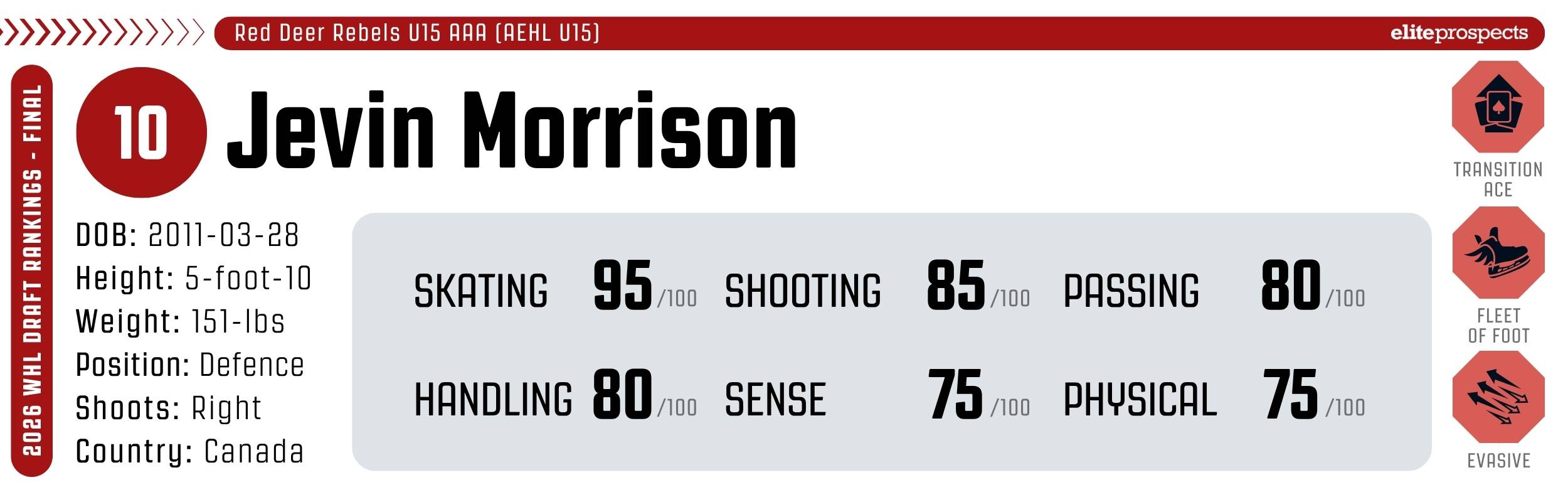
Arguably the best skater in the draft class, Jevin Morrison makes the game look effortless. Powerful, fully-extended crossovers generate top speed in a handful of strides, tight turns enable instant acceleration out of any direction, and a change-of-pace game that draws forecheckers in before he pulls the puck back and exits the other way makes him a constant transition problem for opposing forwards.
That mobility shines brightest with possession, as Morrison leverages it to evade defenders, walk the blueline, and slice right through the opposition for high-danger chances. He’s the single-season AEHL U15 point-per-game record holder for a reason.
The defensive reads in his own zone have improved steadily and showed meaningful development across this season, though consistency will remain the ongoing work as competition increases. Morrison is a natural offensive driver from a position where that combination of tools is genuinely rare. Top-pair WHL puck-mover upside.
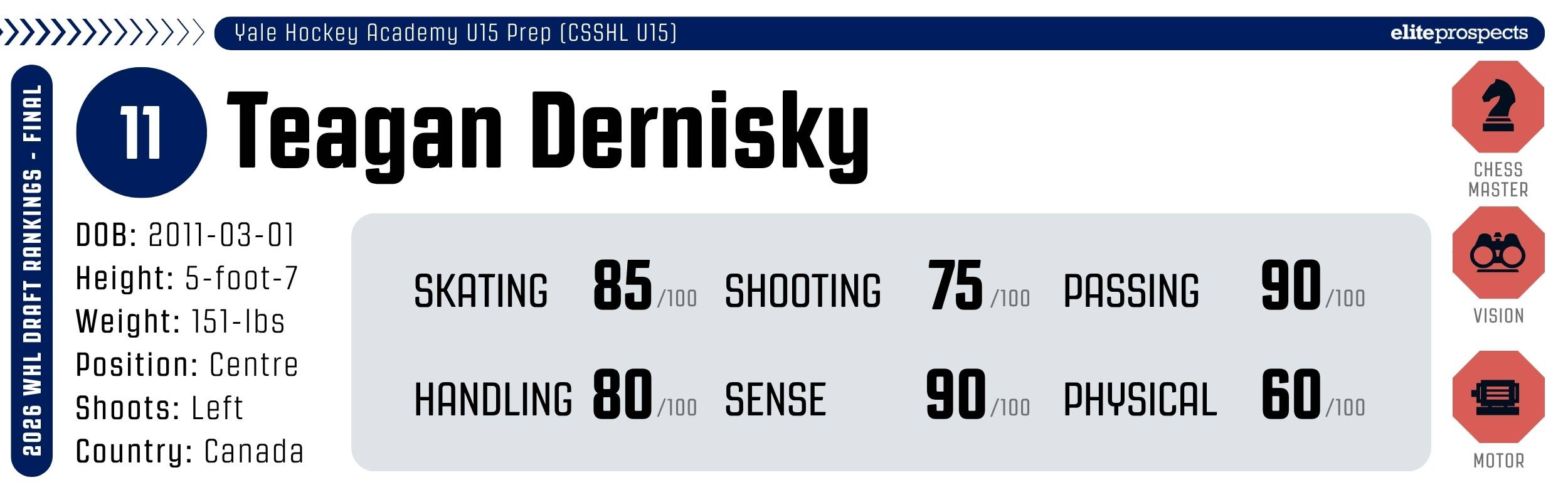
Leaving Teagan Dernisky just out of the top 10 might’ve been the toughest call to make. He’s a top prospect in just about every facet of his game, with his playmaking standing out the most. He’s mastered the tape-to-space pass, seeing through defensive structures and landing precise passes through them. Derinsky is also a dynamic skater, capable of exploding in any direction with little tell. He’s a skilled shooter, too. To round out the skill set, he does everything at an incredible pace and uses his lower centre of gravity and superior pace to protect the puck. Size is the big question mark, but he’s so dynamic that we believe he’ll make it work. He’s a potential top-six scorer in the WHL.
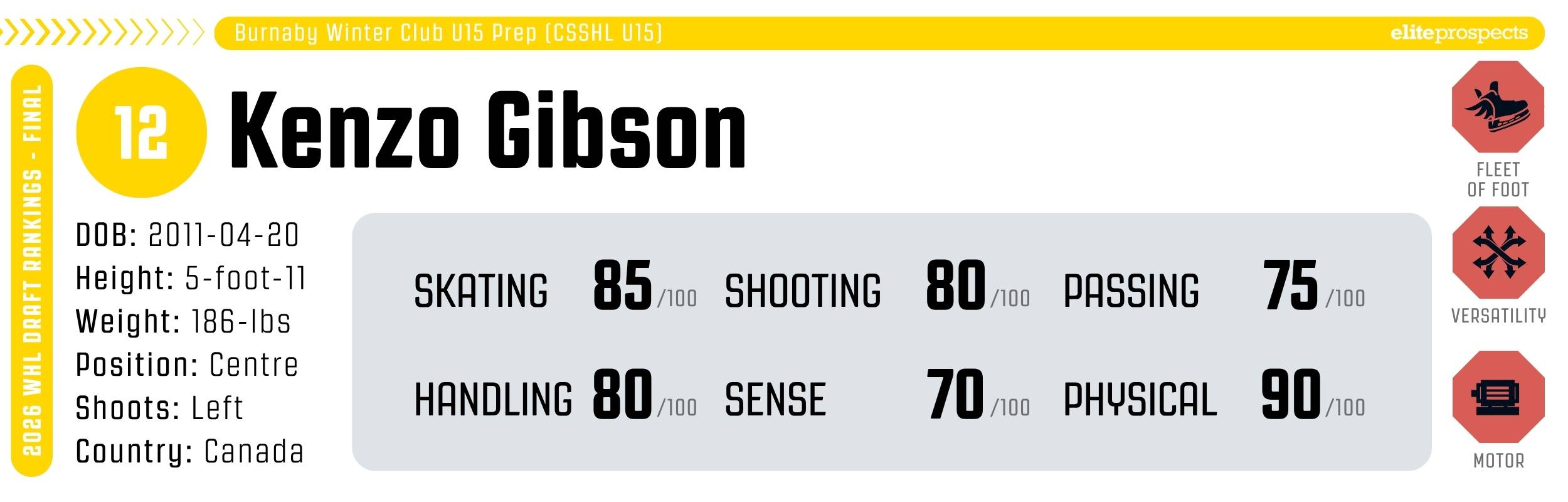
Kenzo Gibson had a lot of hype coming into this year, and he lived up to it. He’s a physical specimen. His stride is explosive, and will remain so at the WHL level. He can power right through opponents, but also possesses the finesse to make high-end plays through them. His skill is high-end, and allows him to play at breakneck pace. He can sometimes get ahead of the play and find himself attacking alone, but as the pace of his teammates increases in the WHL, more playmaking opportunities will arise. He has top-six upside and will certainly play, and should be impactful as a 16-year-old.
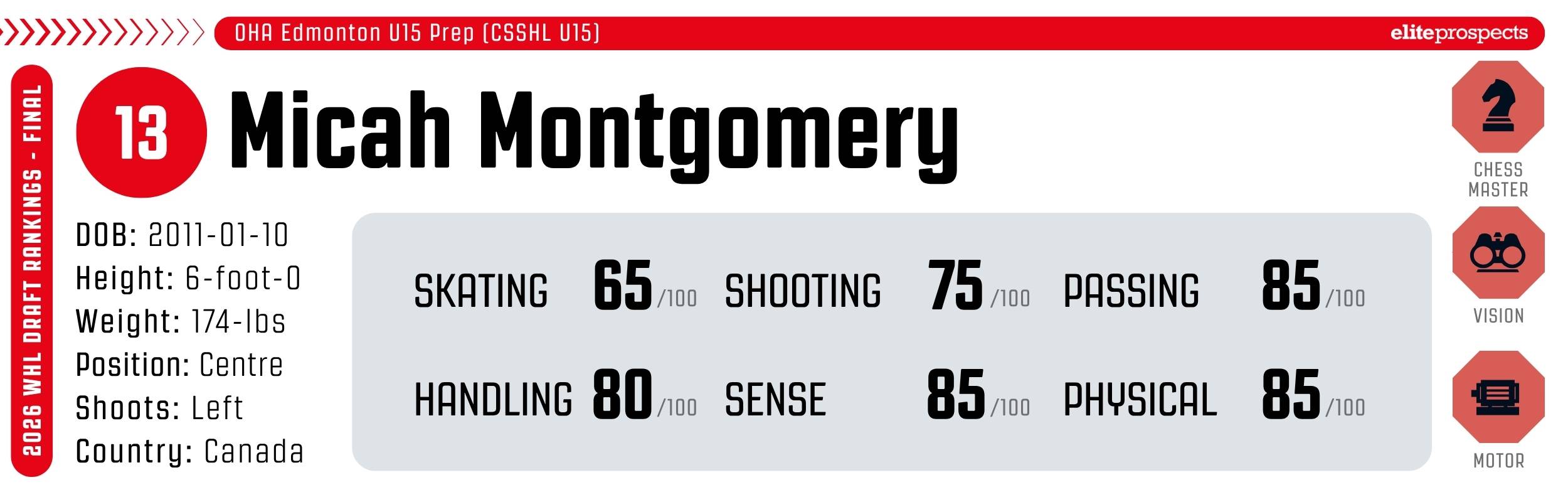
Micah Montgomery operates beyond his years. Tall, powerful, cerebral, and defensively dominant, he dictates the flow of play, relying on deception, protection, and physical skills to crush his competition. As his details stack, so does his advantage creation. Small things like winning inside position, metal mapping the ice, stick position, and the ability to outthink even the most soundly gapped defender are his superpowers. He’s a madman when it comes to pressure pushing, boasting a work rate that is hard to compare in this draft. While his skating is a key weakness across his profile, his game is built around minimizing the impact of mobility issues. He’s a top-line centre projection in the WHL.
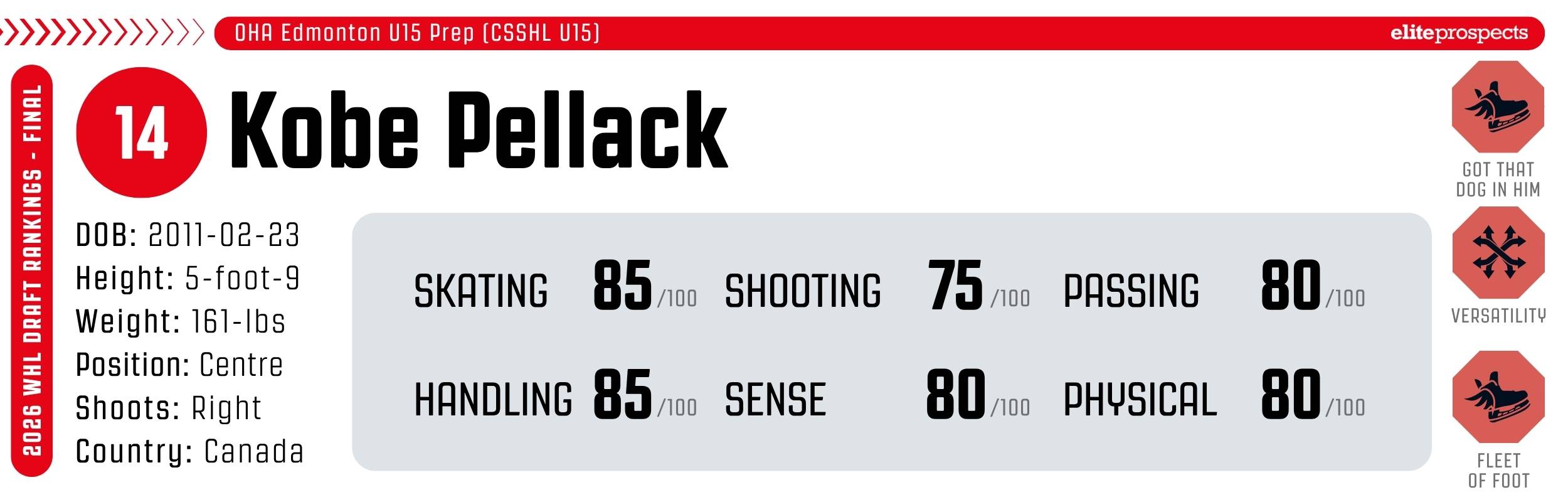
Few players in this class blend handling and vision the way Kobe Pellack does, a combination that makes him so challenging to defend. He slows the game down under pressure, windmill dekes through defenders with a composure that looks almost relaxed, and consistently finds options most players at this level do not see, whether that is a re-deflection pass through traffic, a perfectly timed slot feed, or a fake that freezes an entire defensive structure. His physicality adds a real layer to the profile. Learning to weaponize pressure rather than skating away from it will take his offensive game to another level. He has top-six WHL upside.
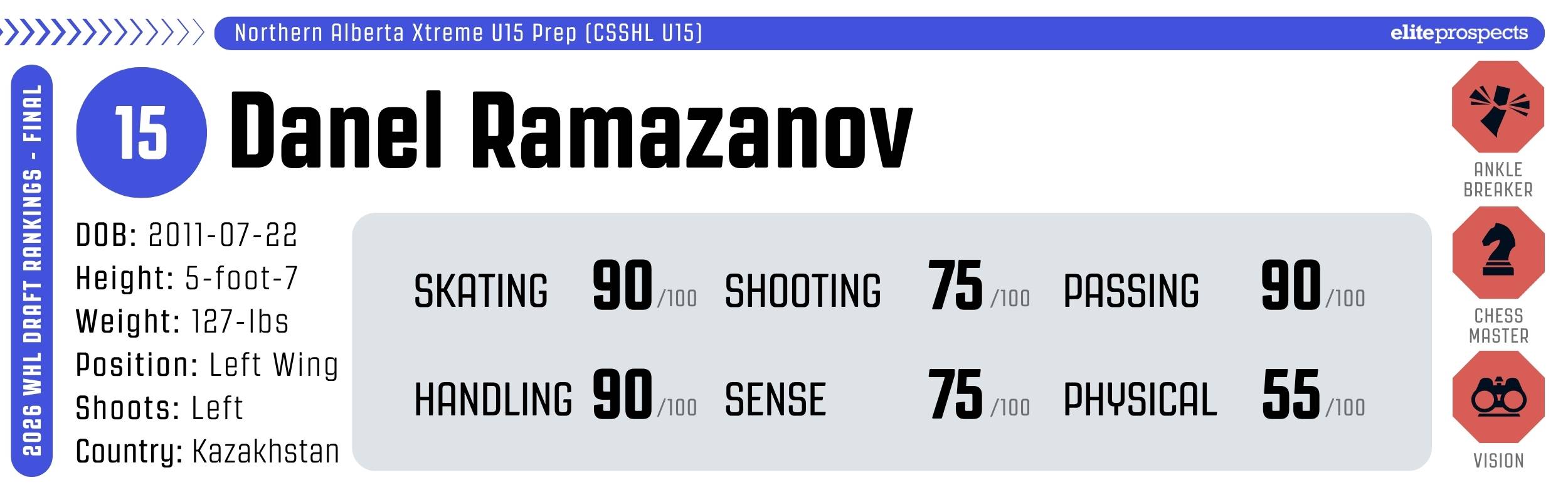
Danel Ramazanov is a game-breaking talent who reserves his best for the biggest moments. High-end handling and elite skating create a pace advantage that punishes any defensive gap or mistake instantly, and his give-and-go instincts convert those advantages into scoring chances before defences can recover. He dangles through multiple defenders while maintaining full control, plays with a feisty physical edge when fully engaged, and finds plays inside contact as consistently as any forward in this class. Developing more consistency in his off-puck spacing and route completion would unlock even more puck touches and production. Size is the question, but the ceiling is so high that he’s worth an early swing.
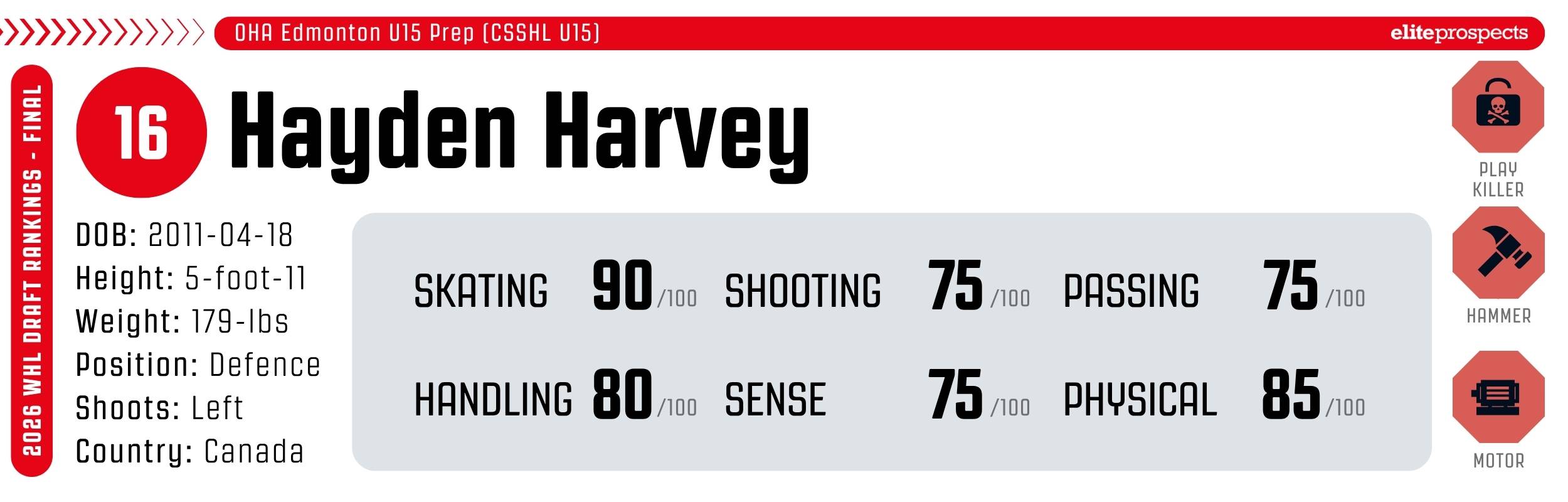
In an age of defenders becoming primary drivers of offence, Hayden Harvey is firmly riding that wave. Tall and explosively mobile, there isn’t a situation where Harvey isn’t involved. Always activating both on and off puck, he recognizes moments to jump, boasting a near-uncontainable counter-punching game. He translates this aggression into his defence, working pucks off opposing attackers in the neutral zone and angling off entry threats with his separating range. While his game will need significant calibration in terms of risk-and-reward weighing, Harvey has the framework of a top-pair defender in the WHL, an upside easily worthy of a first-round pick.
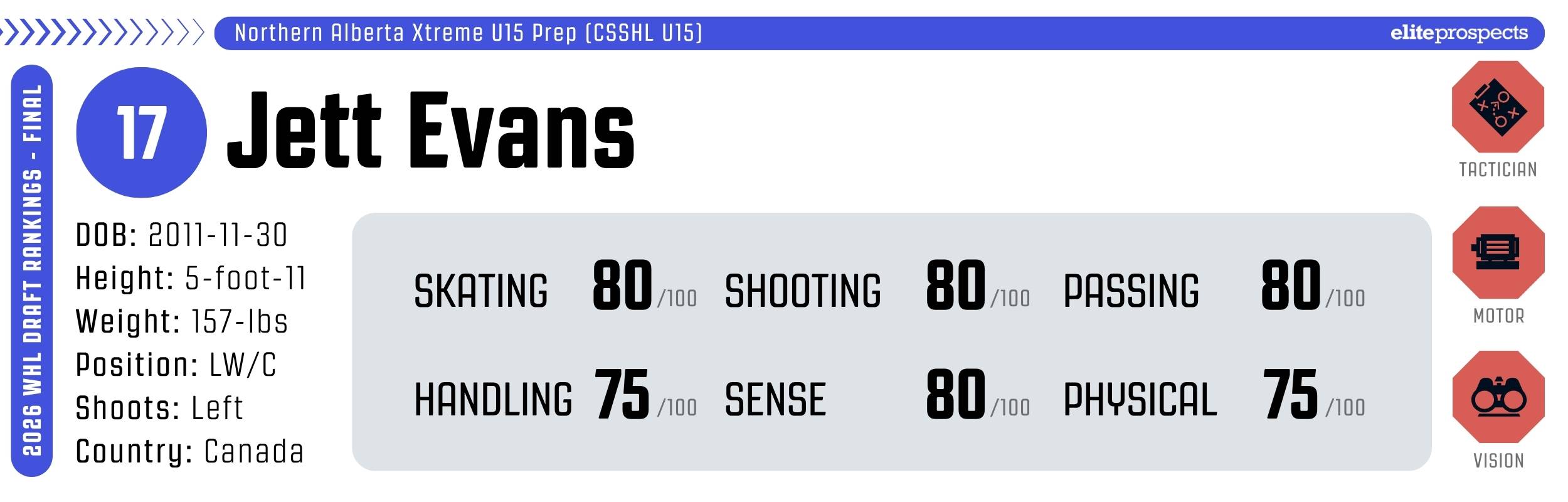
Jett Evans holds the mantle of being one of, if not the highest-paced forwards in the draft. A dual-threat attacker, possessing a league-ready catch-and-release shot, his craftiness and playmaking equally pop. Already a relentless forechecker and puck retriever, Evans boasts protection details to extend possessions from the outside of the ice. He delivers evasiveness through lateral, punch-out skating, blending handling skills to create inside-the-hash-marks advantages. With a penchant for showing up when it matters, and a plug-and-play profile off the wing, it’s easy to envision a future where Evans excels as a top-six forward in WHL.
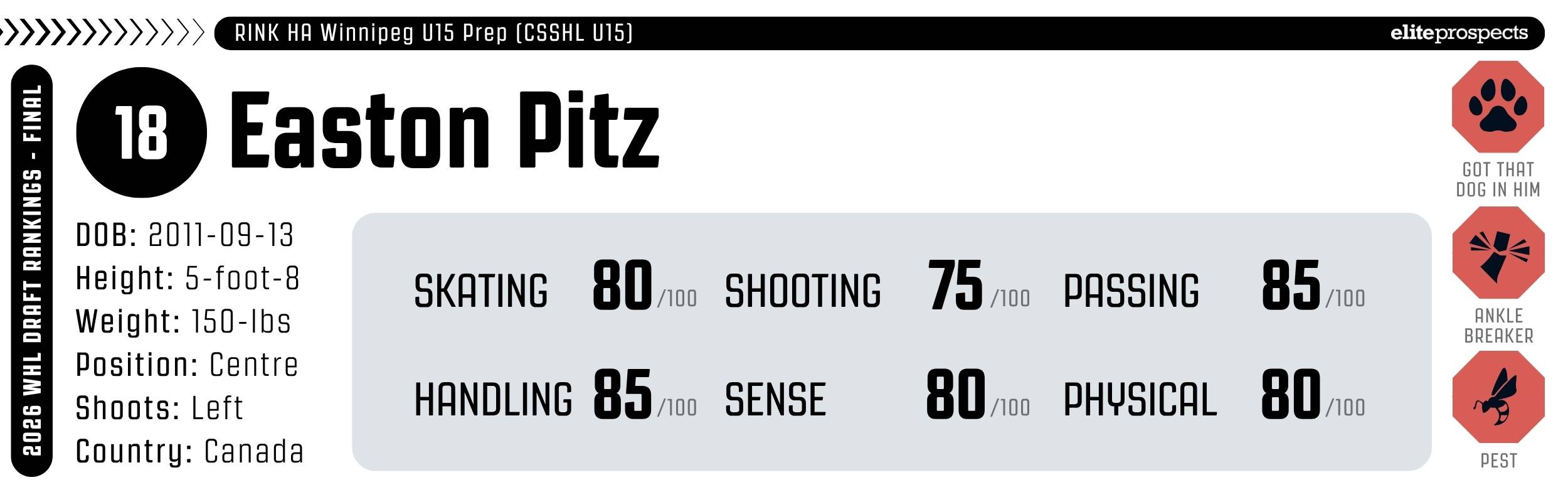
Easton Pitz is one of the most competitive players in this class. His handling is elite in motion, allowing him to string dekes with a scoring ability in a way that makes him a constant threat off the rush, and his willingness to drive through traffic, complete checks, and compete on the penalty kill gives him a dimension beyond pure skill. He can deliver a windmill deke into a backhand tuck on a breakaway and then spend the next shift winning a grinding board battle. Adding strength and inside-route consistency will sharpen the projection considerably. He profiles as a top-six, pest/scoring archetype in the WHL.
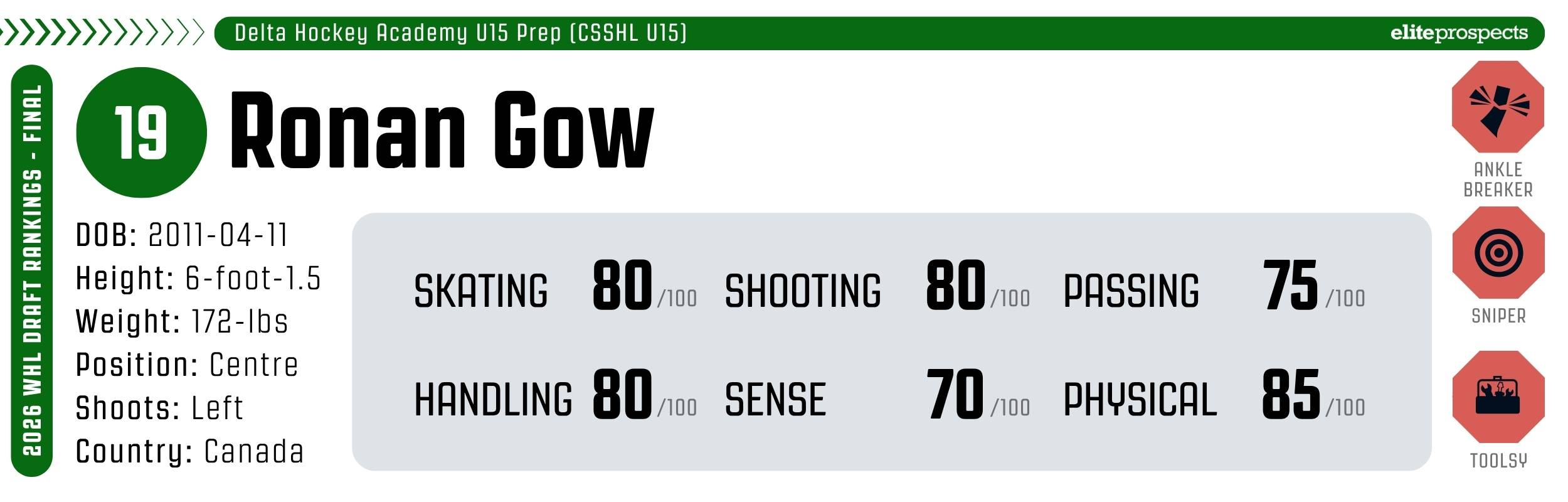
Few prospects finished this season as well as Ronan Gow, who put it all together with a dominant BC Cup showing. He combines his high-end speed and his skill to bully his opponents. He dances right through an opposing wall of defenders or burns right around them with great puck protection, before unleashing explosive wristers that beat goalies clean. When he gets engaged in the games, he's a force to be reckoned with. The physical skills that Gow possesses are high-end, using his speed and skill to dominate. Gow could be a future top-six forward, but he will need to develop his consistency in U18 next year.
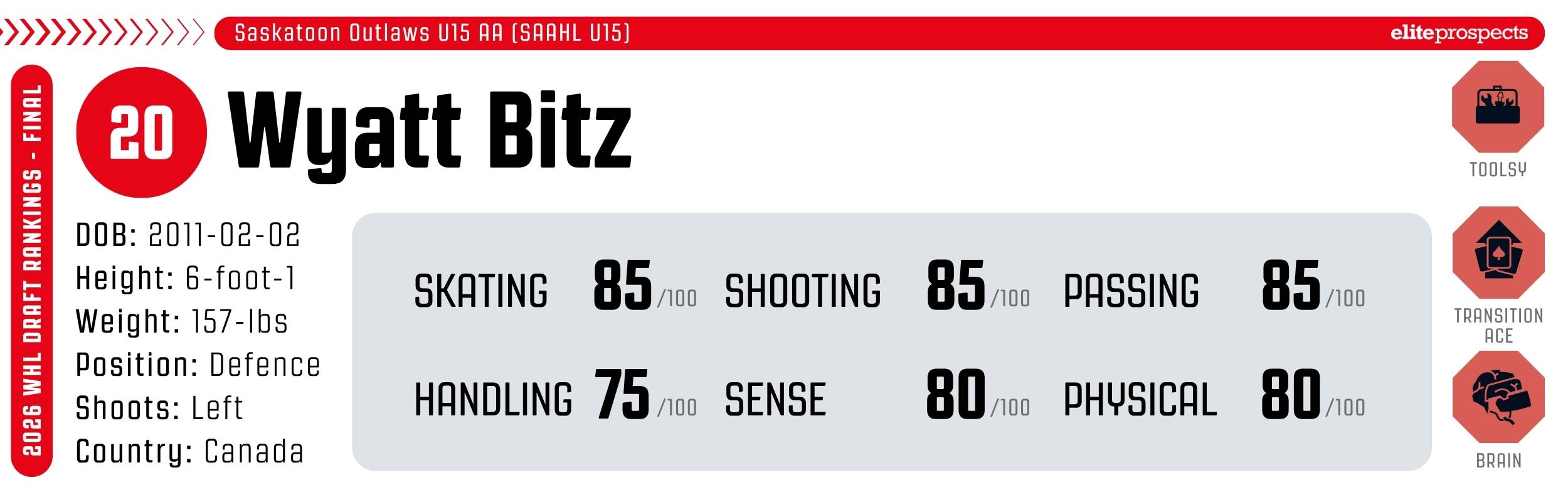
Wyatt Bitz carries one of the highest ceilings of any defender in this class. He’s a fluid, highly aware puck-mover who receives in motion, cuts back through pressure with ease, and draws defenders before advancing the puck inside. His offensive instincts at the point are genuine, combining deception, timing, and a dangerous shot into a package that already projects as a legitimate offensive driver from the back end. The defensive foundation is equally compelling; a sturdy backward skater with a tight gap and the positioning sense to take the middle away and angle attackers. Improving his urgency in coverage and his puck management on the breakout will push this projection from top-four toward top-pair upside at the WHL level.
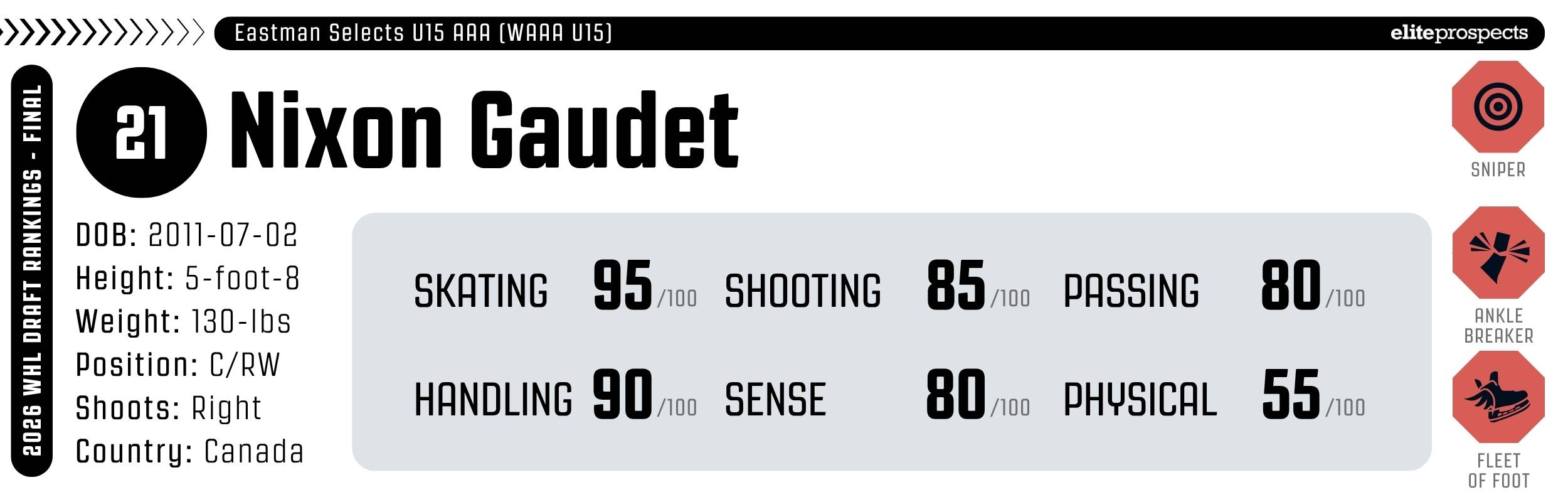
Nixon Gaudet’s first step is one of the best in the class, and once he has any hint of space, the game tilts in his favour. His acceleration and handling combine to make him a constant north-south threat, combining linear crossovers, place-and-chase, and lead passes. Though slight, he’s a highly skilled player along the walls, evading pressure with in-motion receptions and working give-and-gos. There’s risk in his profile, so adding size and physical consistency will be the priority. If he hits, he could be one of the top producers in this class, as a pace-driving, top-six winger.
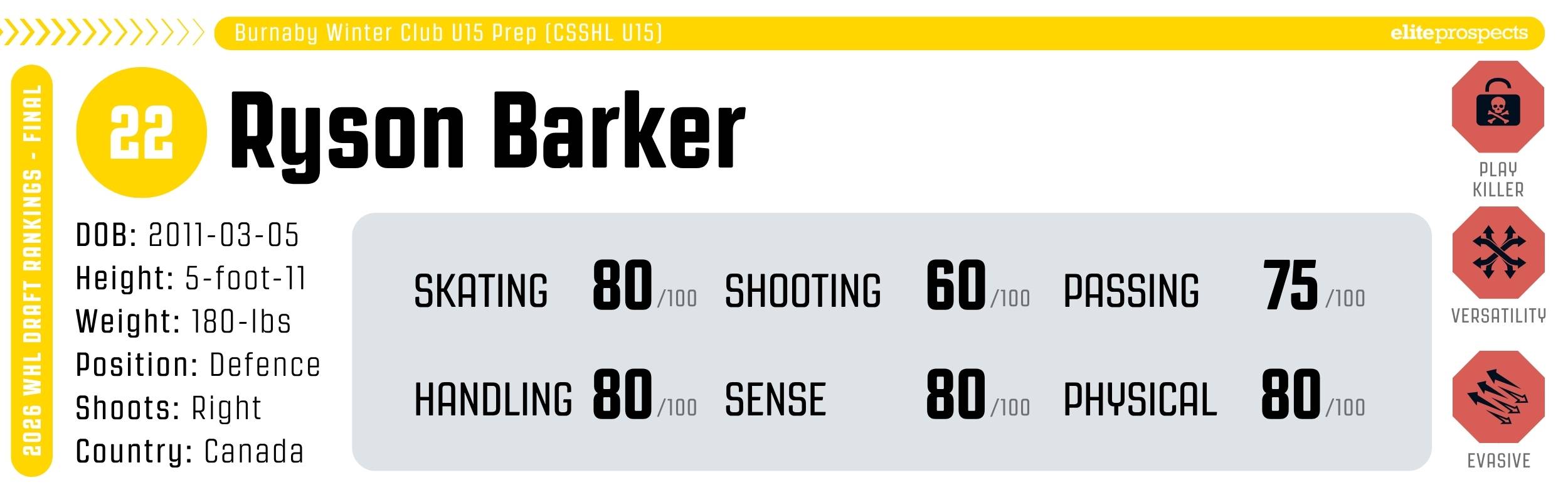
The development of Ryson Barker throughout the season propelled him up our draft board. Early in the year, he profiled like a top-end defensive defenceman. He uses strong edgework to eliminate plays in the neutral zone, positioning himself perfectly to shut down the rush and is able to consistently line up opponents for crushing neutral zone hits. His feet allowed him to position well in his own zone, and showed good instincts when defending the cycle. Once he recovers the puck, he is able to make smart breakout passes. The improvement came with the puck on his stick, adding a puck-transporting element and flashing high-end skill. We project him as a potential top-four two-way force.
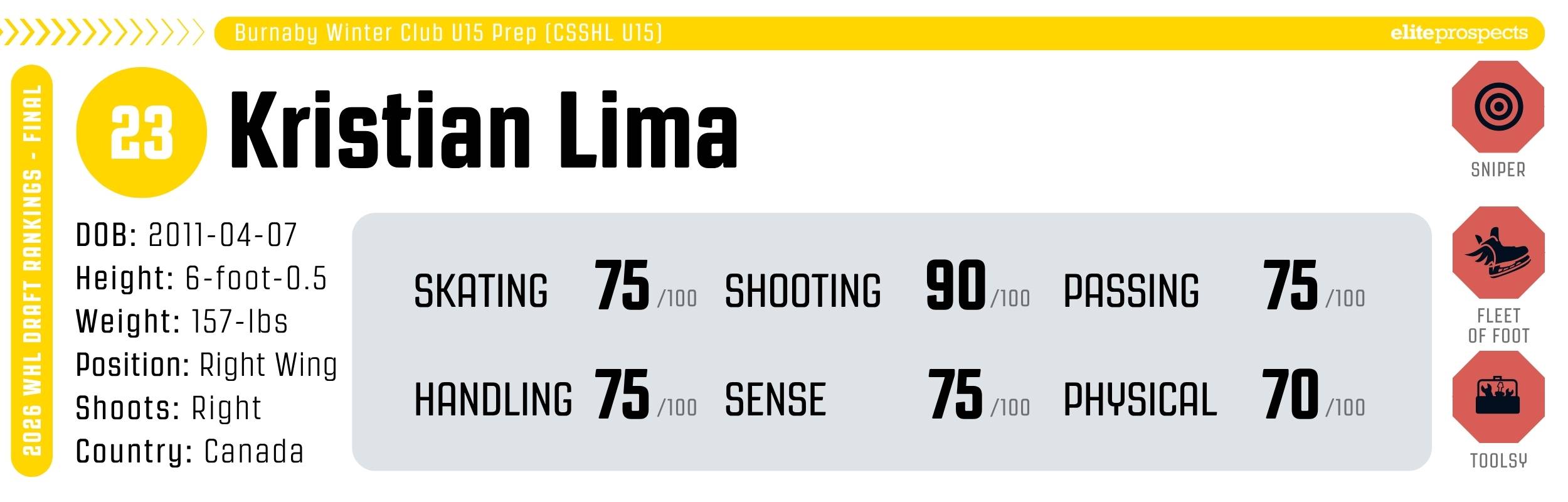
Kristian Lima’s game improved greatly throughout the season, developing a secondary playmaking game that complemented his play-driving, physicality, and elite shot to turn him into a top prospect. His shooting is a deadly weapon and is among the best in the class. He can release off of either foot, mid-stride, and still get enough velocity and accuracy to beat goalies clean from long range. Skilled hands allow him to position the puck well and make instant passes. The tools make him look like a future top-six scorer, and he could step into the WHL as a 16-year-old. Continuing to develop his playmaking and adding deception will be the difference between him playing and him becoming a star.
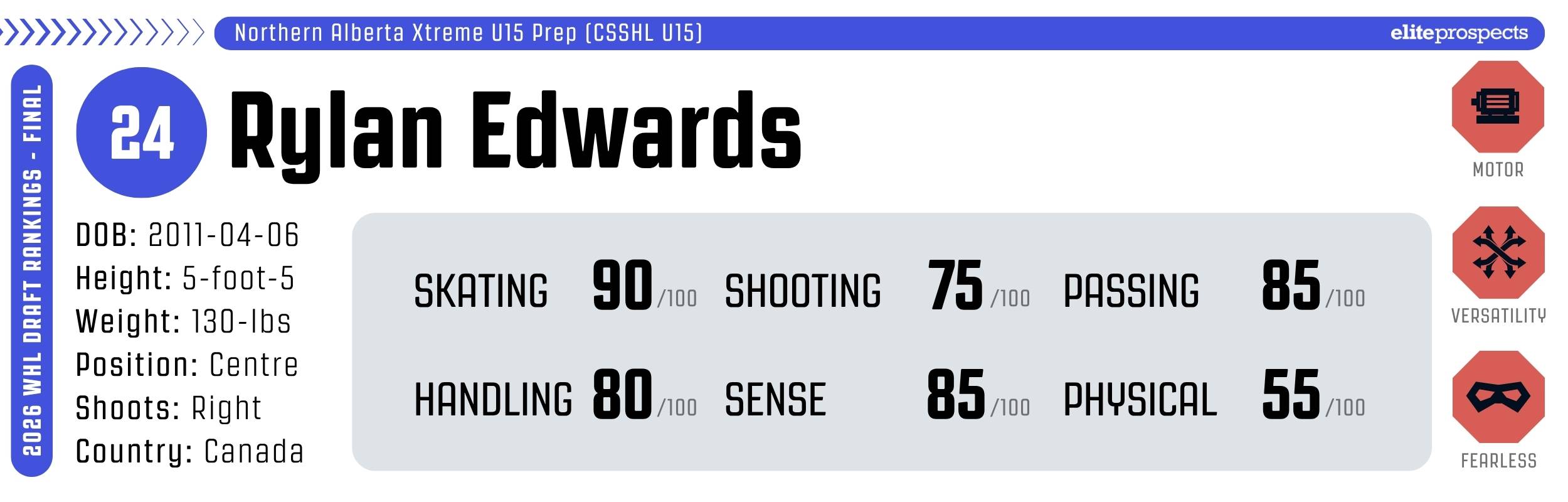
Rylan Edwards' skating veers into special territory. A nightmare to handle in transition, as he explodes through his highly active crossovers, he acts as a magnet, pulling defenders in, only to create space for others. He’s balanced, processes at lightning speeds, and layers in route feints and body fakes to break loose. With a work rate that complements his mobility advantages, he’s a scary on-puck attacker. While he boasts great playmaking ideas, he often operates too quickly, leading to execution issues. With his size also a concern, there are questions about whether he can replicate his playstyle at higher levels. Edwards is more of a high-risk, high-reward bet for this draft. That reward could be enormous, though – potentially a top-six scorer down the road.
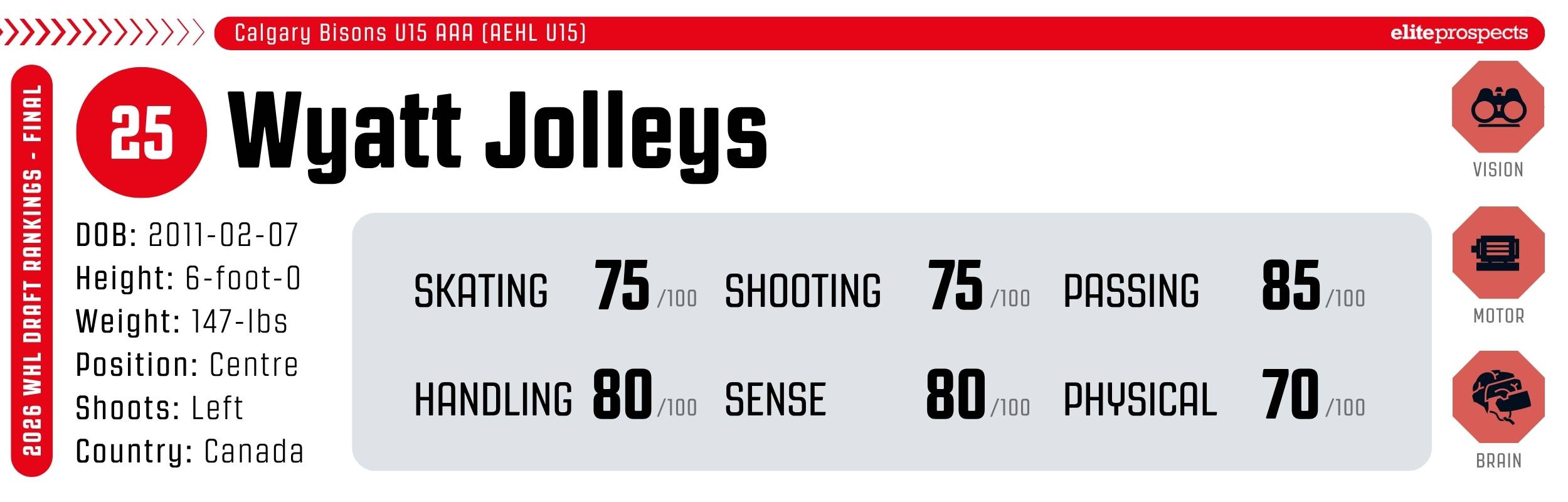
Wyatt Jolleys is one of the more skilled attackers in this class, best shown in his playmaking. He adjusts his upper body in stride to thread east-to-west passes under pressure, reads the play a step ahead of where most players his age look, and protects the puck along the wall. His dual-threat scoring gives defenders no easy answer, and his backcheck effort is impressive. Strength development will be a significant priority, but his intelligence and skill already point toward top-six WHL minutes.
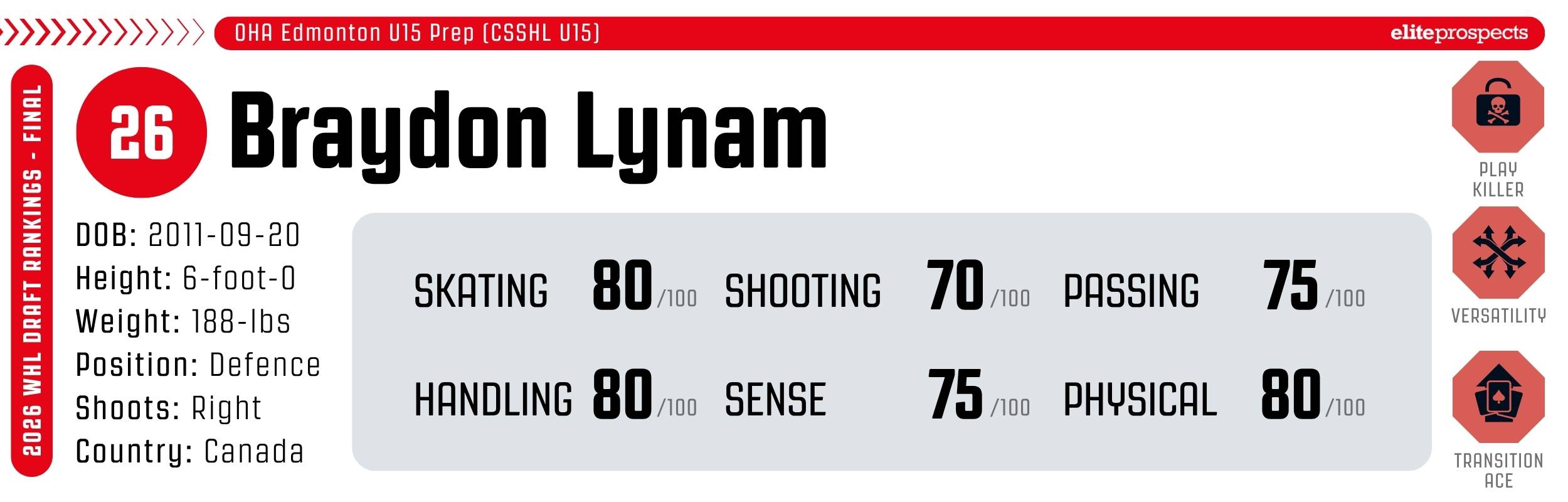
Already well-rounded, tall, and physically developed, Braydon Lynam is a ready-made right-shot defender. He plays contained, controlling his gap and protecting the inside lane with his excellent defensive skating. He surfs, angles and drives opponents outside, shocking carriers with deceptive, sweeping poke-checking. On the counterattack, Lynam is more than capable. A breakout quarterback with mobility advantages, Lynam mixes in route-adjusting zone entries, give-and-go handoffs, and instinctive pinching to extend possessions. He’s a high certainty top-four defender, one who could be leaned on as OHA Edmonton U15 Prep did all season.
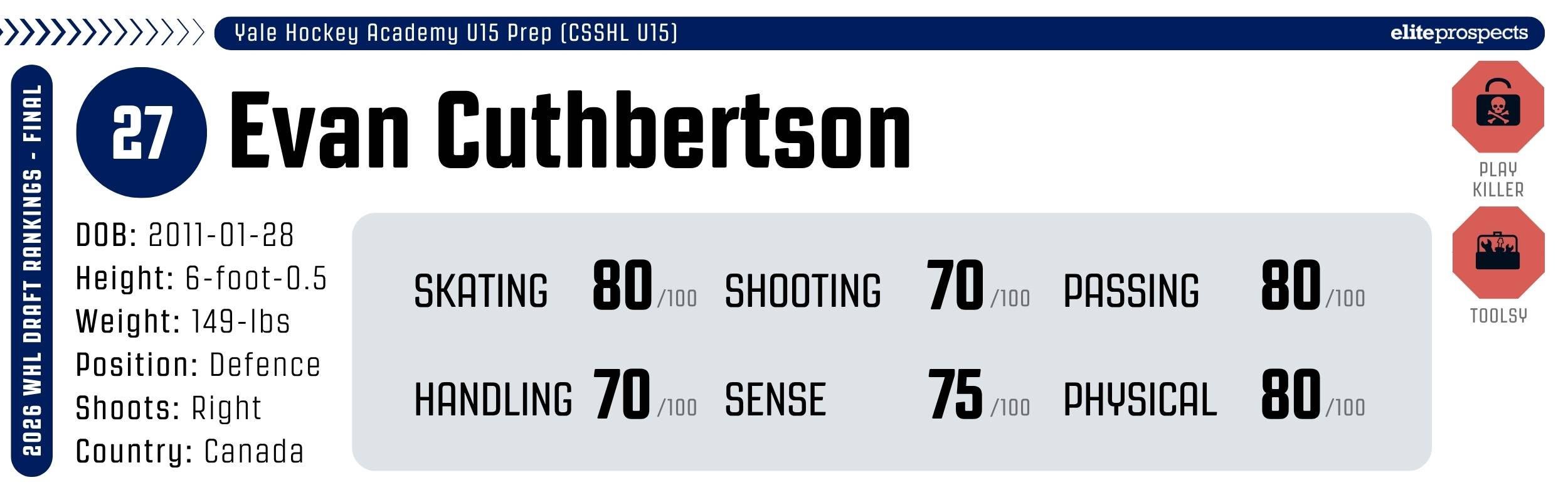
Evan Cuthbertson spent a lot of the season injured, but when he was on the ice, he displayed the talents of an A-grade prospect. He’s a horse on the ice, galloping around and closing gaps quickly, transporting the puck, and winning races. He showed good vision with the puck on his stick, making great breakout passes and springing rush chances for his teammates. He will lead the rush with the puck on his stick, but will also jump into it as a trailer. Cuthbertson will need a strong year at U18 to polish his game, but could step into the WHL at 16 and develop into a top-four defender.
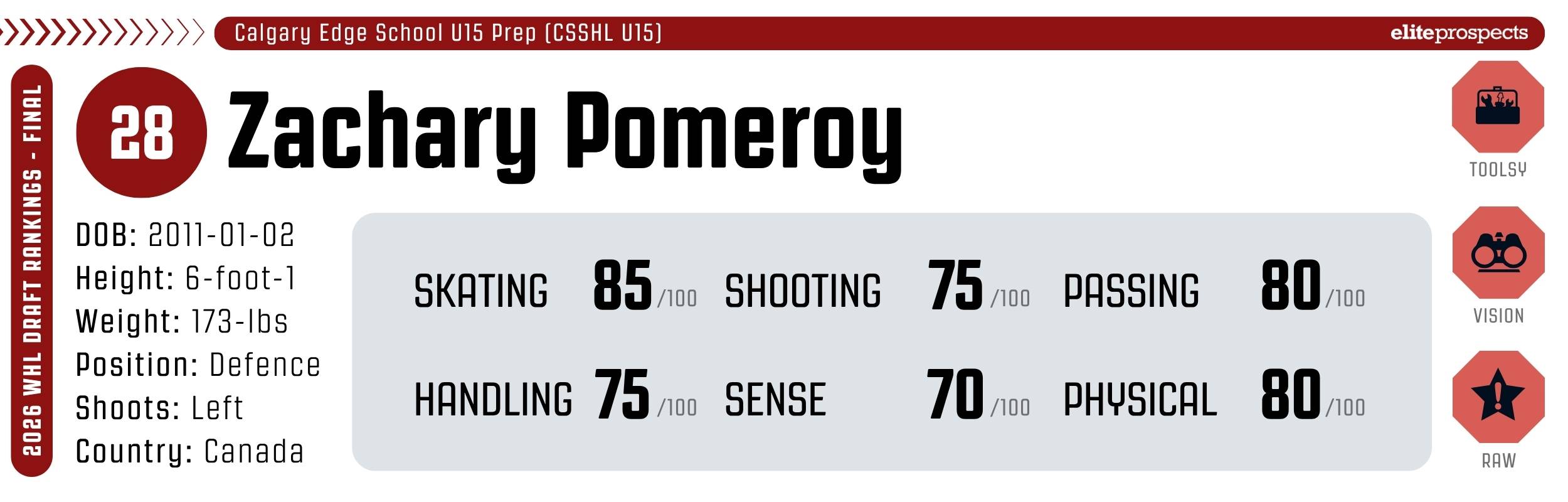
Zachary Pomeroy creates from the blueline with genuine intelligence. He beats defenders off the point with a first touch that accelerates into space, uses shot fakes to open passing lanes, and moves around the zone to find high-value positions before distributing. His physical engagement alongside the offensive game is developing, and finding the consistent balance between activation and defensive responsibility will be the primary challenge as competition increases. The production and tools both point toward a WHL defender with real special teams upside on both ends of the ice.
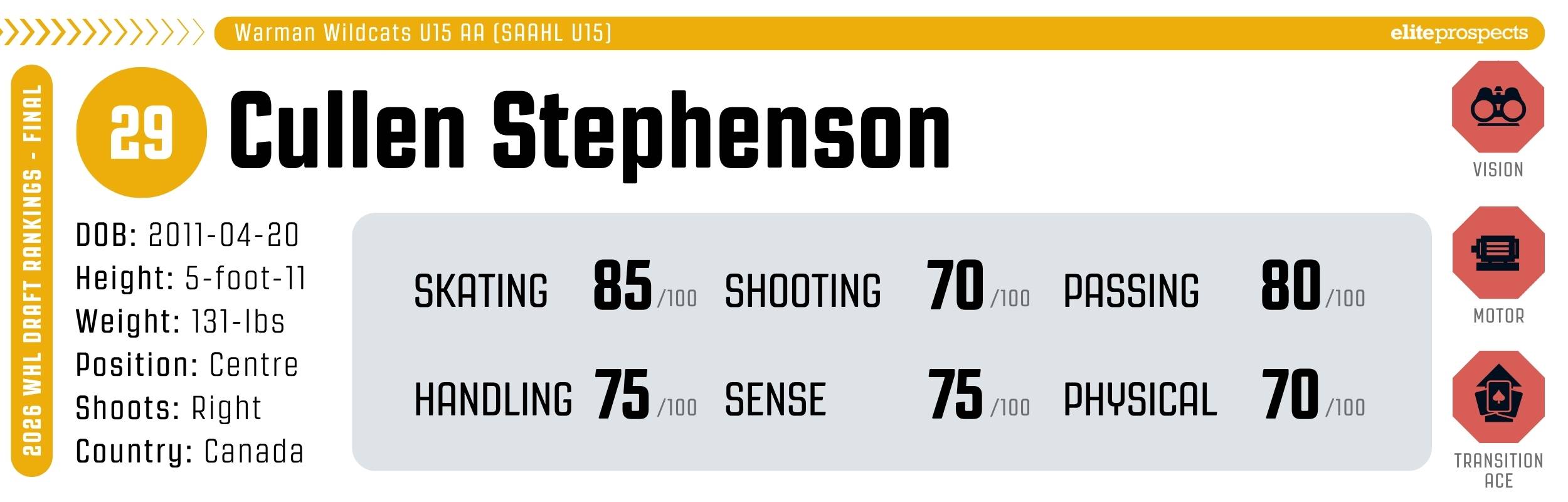
One of the draft’s most dynamic skaters, Cullen Stephenson plays with powerful crossovers, clean acceleration, and the deception to manipulate defenders. He pulls pucks into space, uses the heel-to-heel to create lanes, and shows the poise to play meaningful power play minutes against U18 competition as a 14-year-old without looking overwhelmed – a well-placed goal at that level confirmed the tools are ready for bigger stages. As his assertiveness grows alongside his physical maturity, there is legitimate top-six upside here.
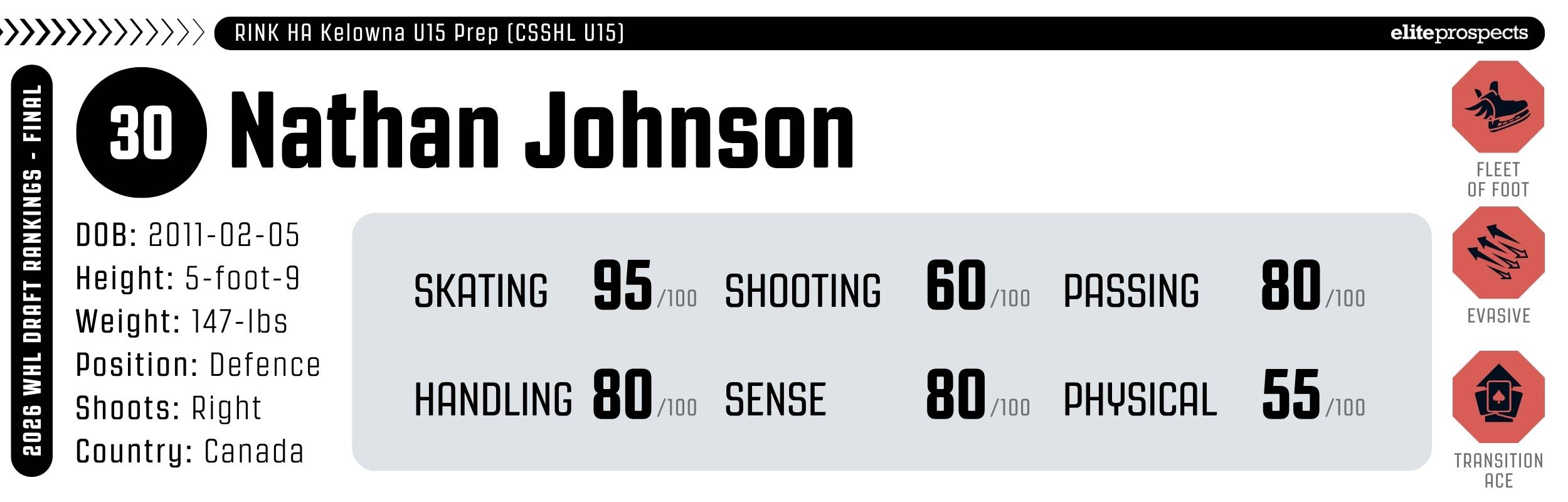
Nathan Johnson might be the smoothest skater in the class. His footwork is phenomenal, always perfectly balanced and mechanically beautiful. He’s perfect on his edges, transitioning effortlessly and seemingly never losing speed. His skating allows him to defend the rush with ease, perfectly angling and eliminating opponents. With the puck, he showed great vision and playmaking, both off the rush and while working the offensive zone blueline. He always seemed to know where everyone was on the ice, and didn’t just make good plays, but the best ones. Even when moved up to the U17 level, he was able to be the best defenceman there, too. Increasing his pace will be critical for him to reach his potential as a top-four defender.
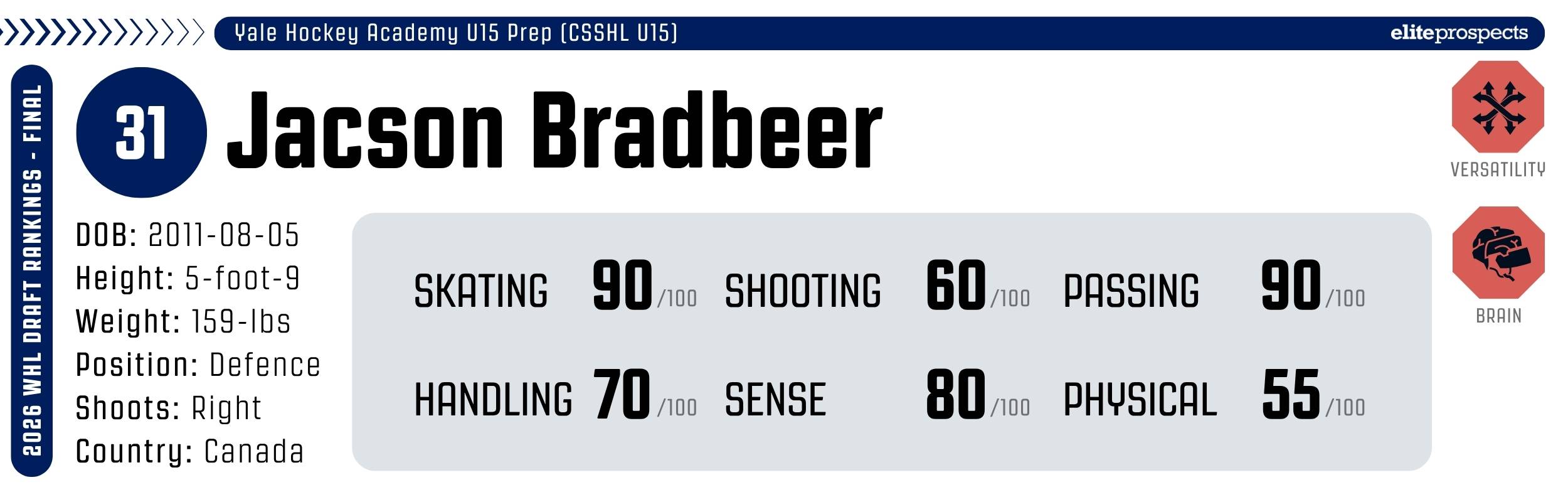
Jacson Bradbeer took over the top power play spot for his club, propelling him to lead all CSSHL U15 Prep defencemen in points. His ability to read the ice and make smart passes is high-end, as he adds a layer of deception to them that constantly tricks opponents. He’s clean and precise on the breakout, overwhelming opponents with his mobility and creating advantages for himself and his teammates. The skating also makes him a strong rush defender, closing gaps and eliminating plays with ease. Size will be the biggest factor in him making the WHL or not, but he could become a middle-pairing power play quarterback at the next level.
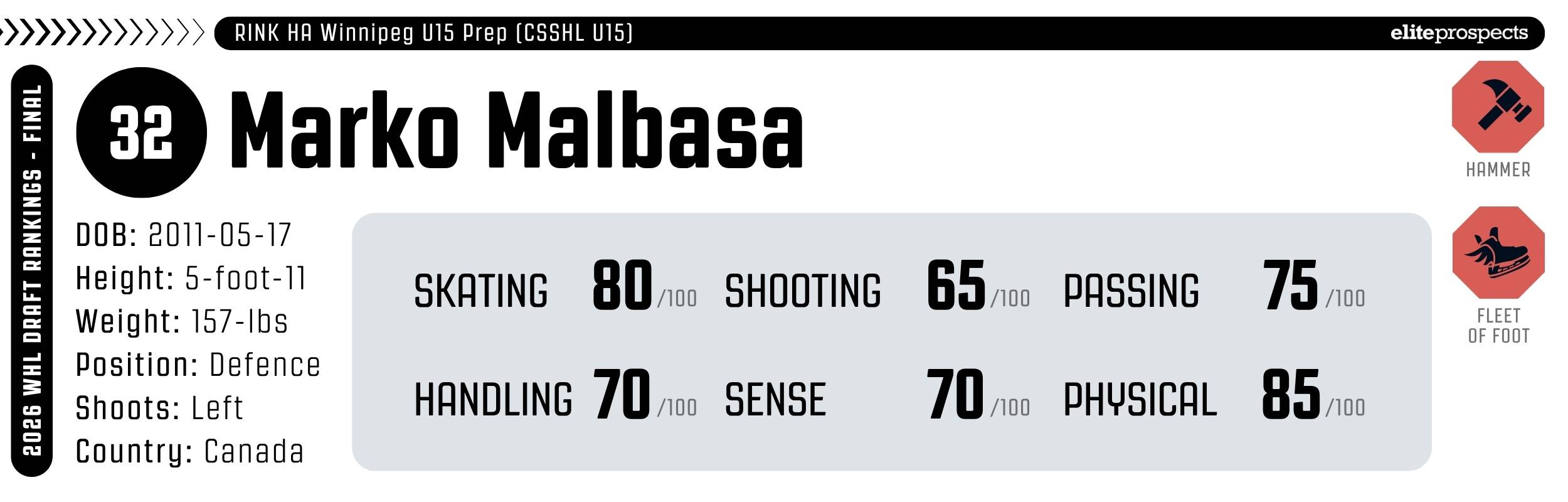
Marko Malbasa is a physically imposing defender with the skating and puck-moving ability to project as a top-four presence in the WHL. He skates with balance and power, closes space instantly, and completes hits in the neutral zone with real authority. His breakout passing is deceptive and accurate, and he has shown the ability to carry pucks end-to-end with confidence. Gap control can waver. Trusting his feet instead of reaching would produce a cleaner result. The frame, skating, and physical intelligence are already projectable tools for a shutdown or two-way role in the WHL.
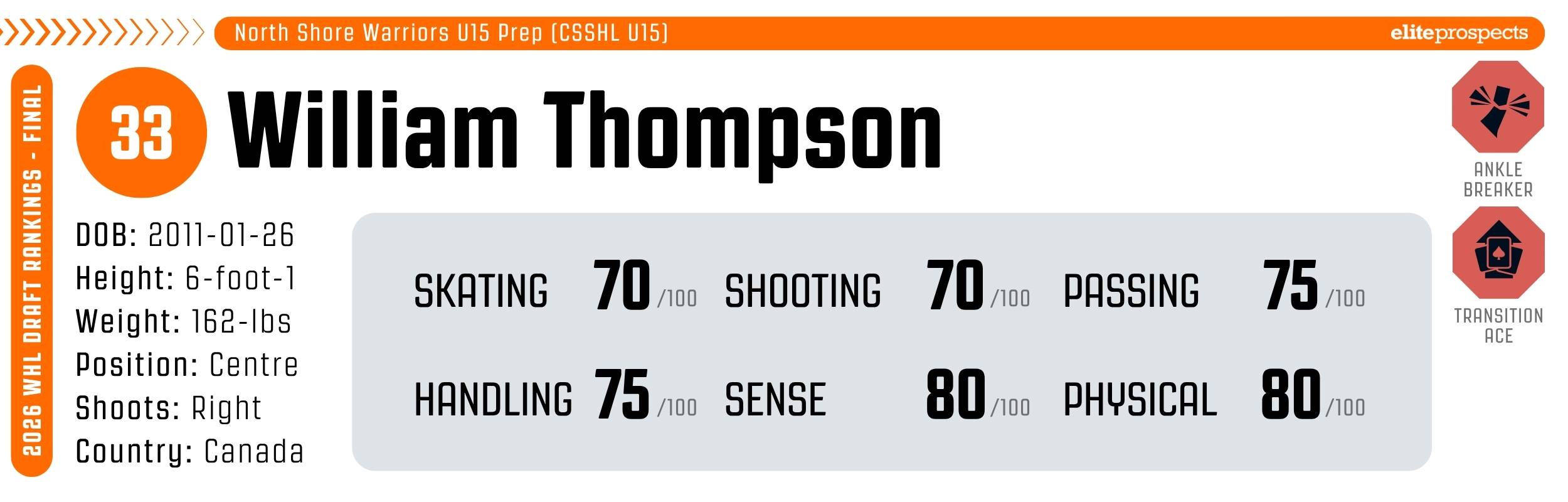
William Thompson is a very well-rounded prospect. His shooting is strong, with good velocity and a quick release. He has good puck skills, quickly handling the puck in motion and faking opponents. Those skills, combined with his edge work, power his playmaking ability, as he regularly finds teammates through traffic with seeing-eye passes. He showed good pre-contact skills, engaging players physically before a puck battle started in order to have the advantage and ultimately win. His pace will have to increase for him to hit his potential as a top-six forward.
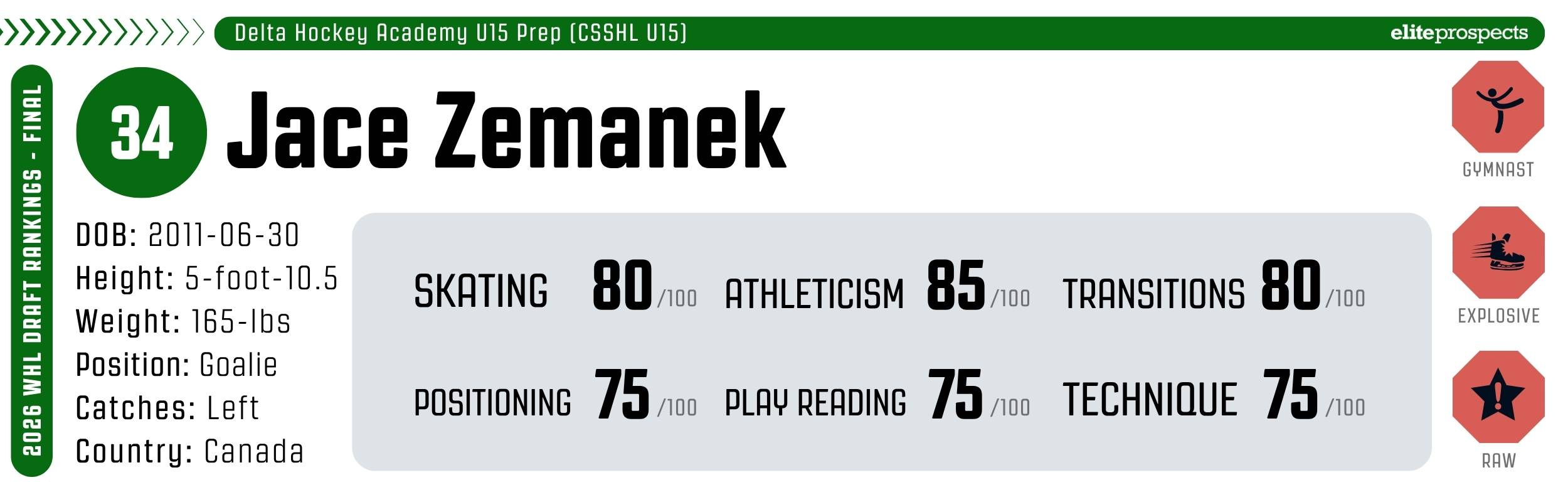
A bet on sky-high potential makes Jace Zemanek the top goalie in this draft class. Zemanek has great skating technique and power, but his edges elevate his game. He exerts a high level of control over his body using nifty edgework. He makes rapid adjustments to remain square or maintain his positioning on the fly. He hinges effortlessly on his posts and makes rapid recoveries, compounded by great flexibility and mobility. Zemanek has a hyper-wide butterfly, which makes accessing his edges and sealing the ice much easier. He can also flash out his legs in deep kicks or push across in full extension. The athleticism is eye-popping at times, and he’s got the explosive power as well. He will need to work on better managing his depth and improving his hands before making it to the next level. The talent in Zemanek’s lower body gives him high-end WHL starter potential and makes him worthy of being the first goalie off the board.
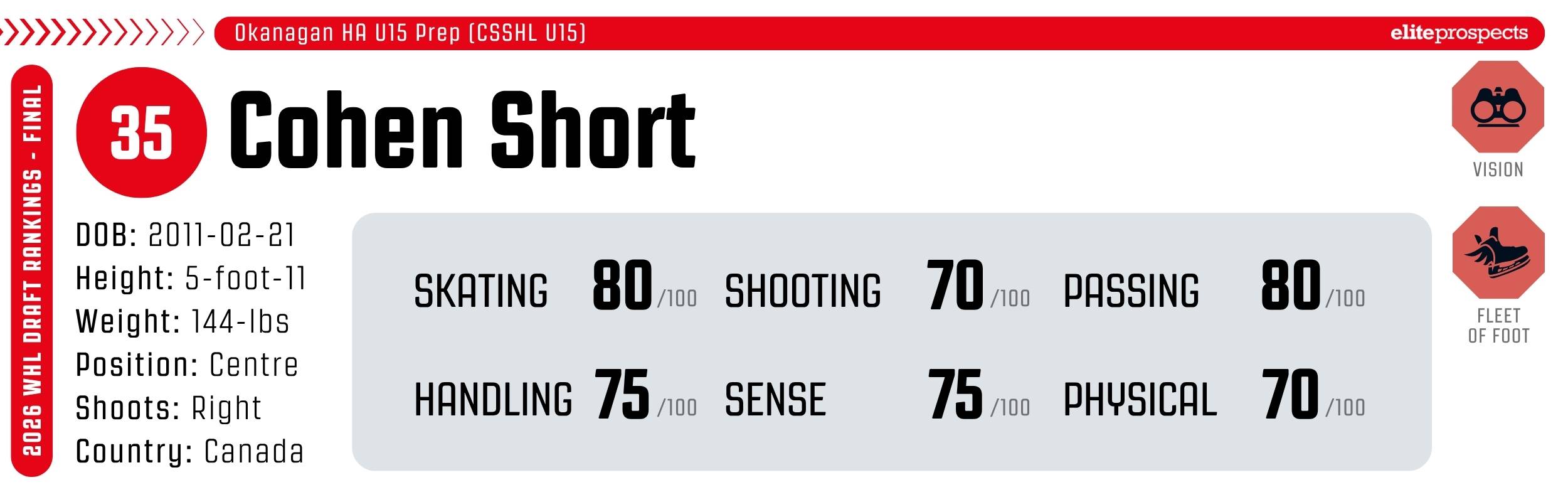
When Cohen Short gets drafted, it’ll be because of his aggressive speed and playmaking. When he’s fully engaged, he’s a menace, attacking the inside lanes off the rush, overwhelming defenders, and making good passes to flip the ice and set up his teammates in good spots. The puck skill is strong, but it really shows when he increases the pace of the game. His game needs refinement, specifically to his stride mechanics and consistency, but the underlying ideas of how he wants to attack, how he shows deception, and the plays he wants to make suggest he could develop into a top-six forward.
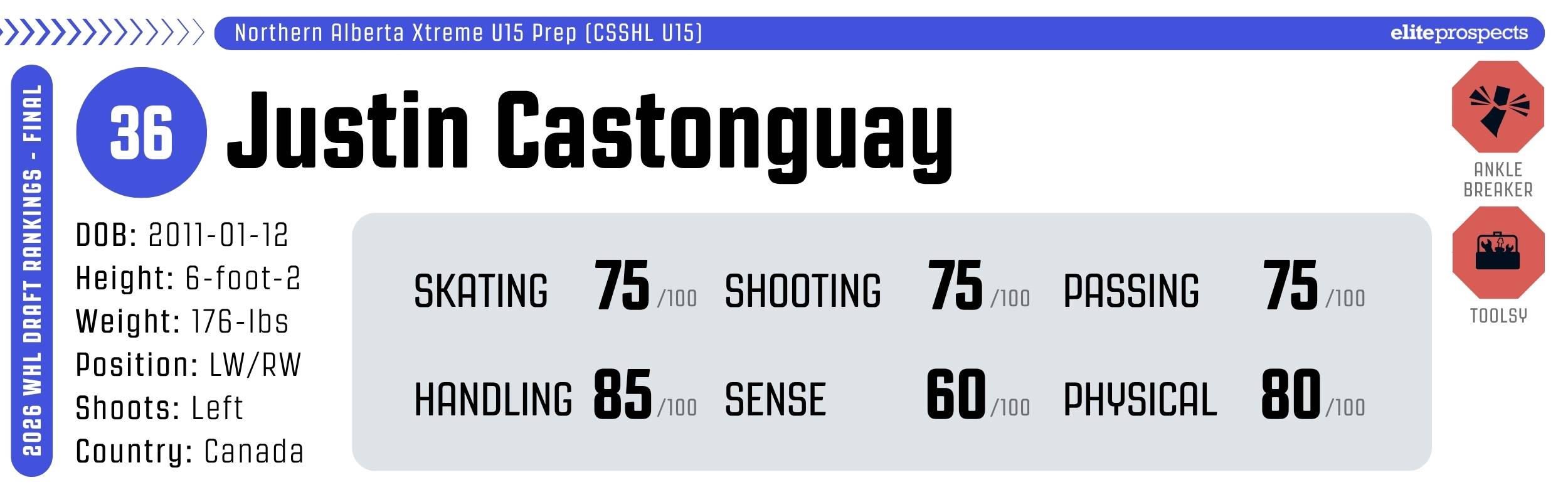
Justin Castongauy’s secondary scoring was a boon for Northern Alberta Xtreme U15 Prep this past season. Tall, with considerable physical runway, Castonguay is one of the most dynamic quantities in this class. He’s a daring, slippery handler who slices in-and-out of defensive triangles, utilising his reach and tactical pace increases to create advantages. He blends feints, protects the puck at his hip, and even incorporates hooks and slip feeds out of the deke. Castonguay has all the upside to be a successful, scoring top-six wing in the WHL, but improvements to his motor will be a deciding factor to hit that upside.
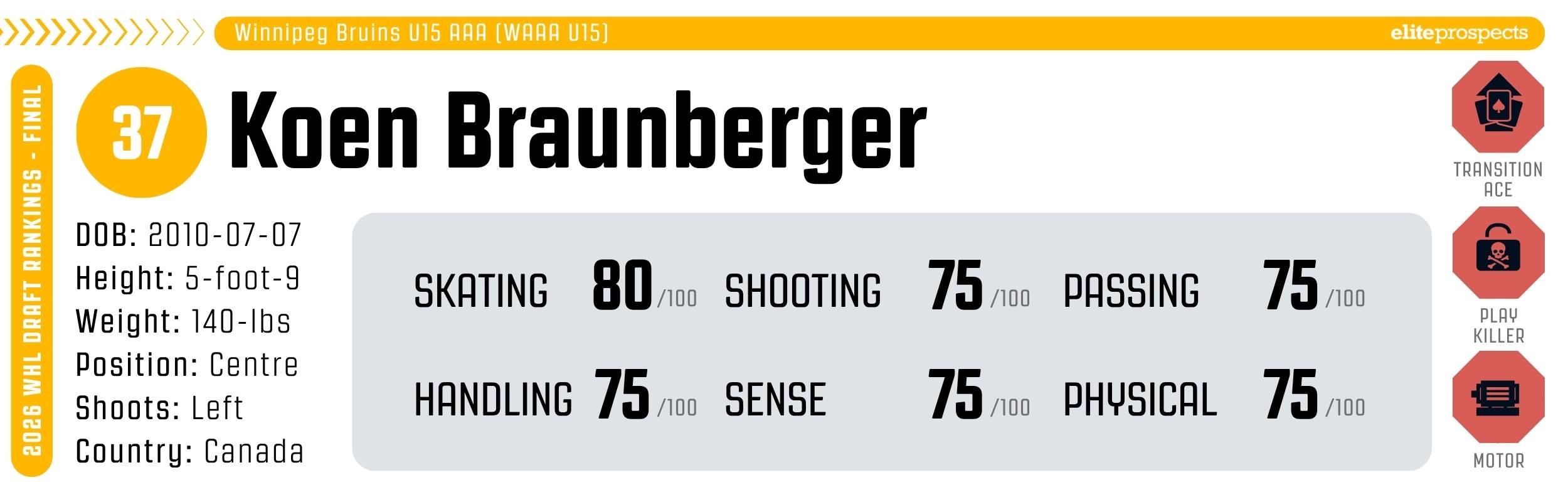
Koen Braunberger is a workhorse centre who does a bit of everything well. He wins draws, kills penalties with urgency and stick detail, drives transition with pace, and adds playmaking touch that surfaces most clearly when he is trusted with more responsibility. A cut around a defender into an instant cross-ice pass for a goal captured the timing and spatial awareness in his game. Improving his physical assertiveness and tapping into the late-game offensive confidence more consistently could make him a reliable middle-six forward.
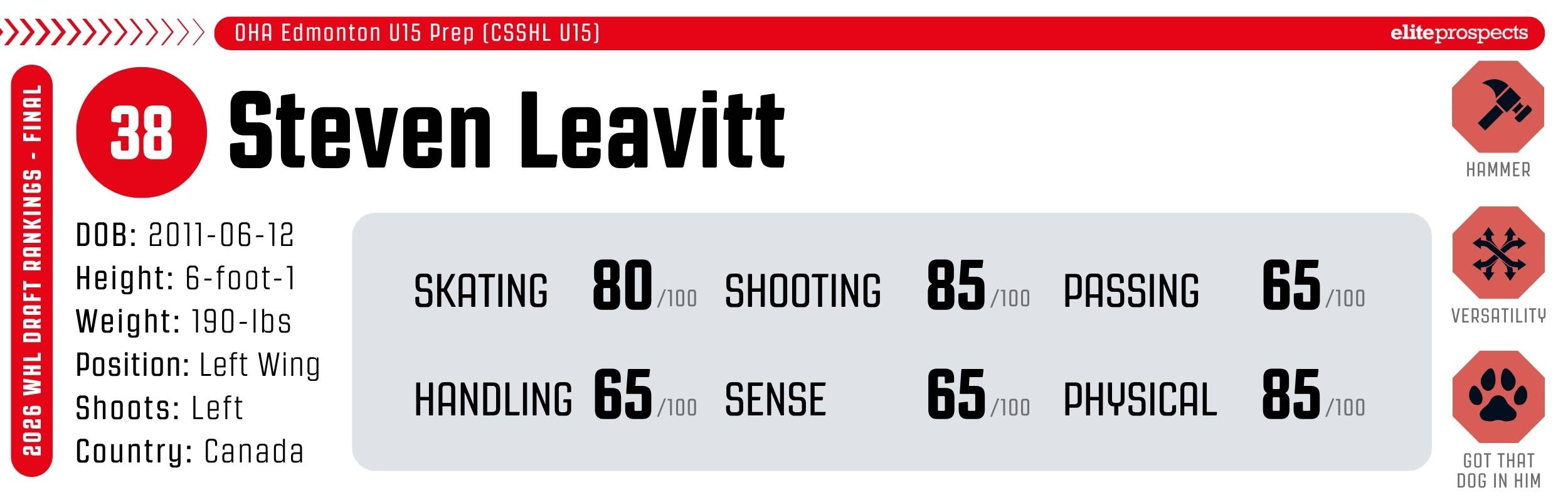
A future fan favourite in the WHL, Steven Leavitt will do whatever it takes to win. He’s fast, aggressive, and endlessly physical. Leaving nothing to chance, he puts in the extra effort for the puck every single time. He’s a skilled shooter, too, and has some advanced ideas offensively, showing some ability to manipulate defenders and create passing lanes. He’s likely to become a long-term complementary player, and, by adding another layer of control and skill to his game, he could outperform this ranking.
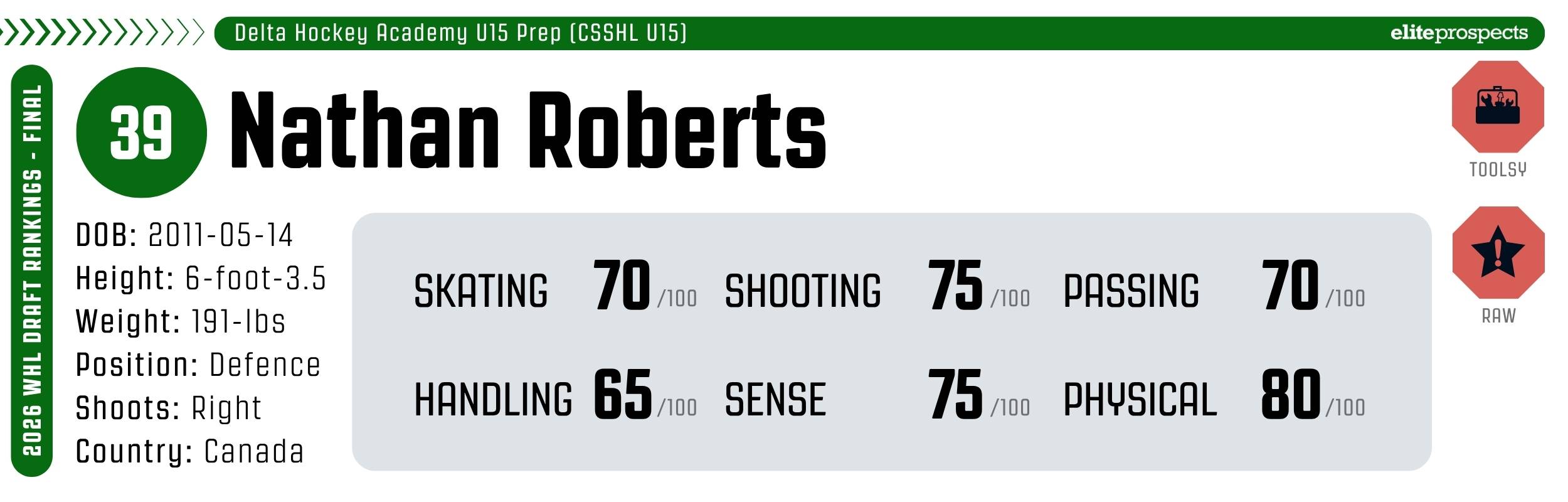
No one boosted their stock late in the season as much as Nathan Roberts did. He was already profiling like a future WHL defender, but arrived at the BC Cup with a brand-new offensive game that turned him into a play-driver on the back end. His skating mechanics aren’t perfect, but they get him up the ice quickly. He showed good instincts in the offensive zone, knowing when to activate down low. His production skyrocketed at that event, turning him from a reliable minute-muncher into a player with an intriguing ceiling of a top-pair defenceman, while still maintaining the floor of a bottom-pairing player.
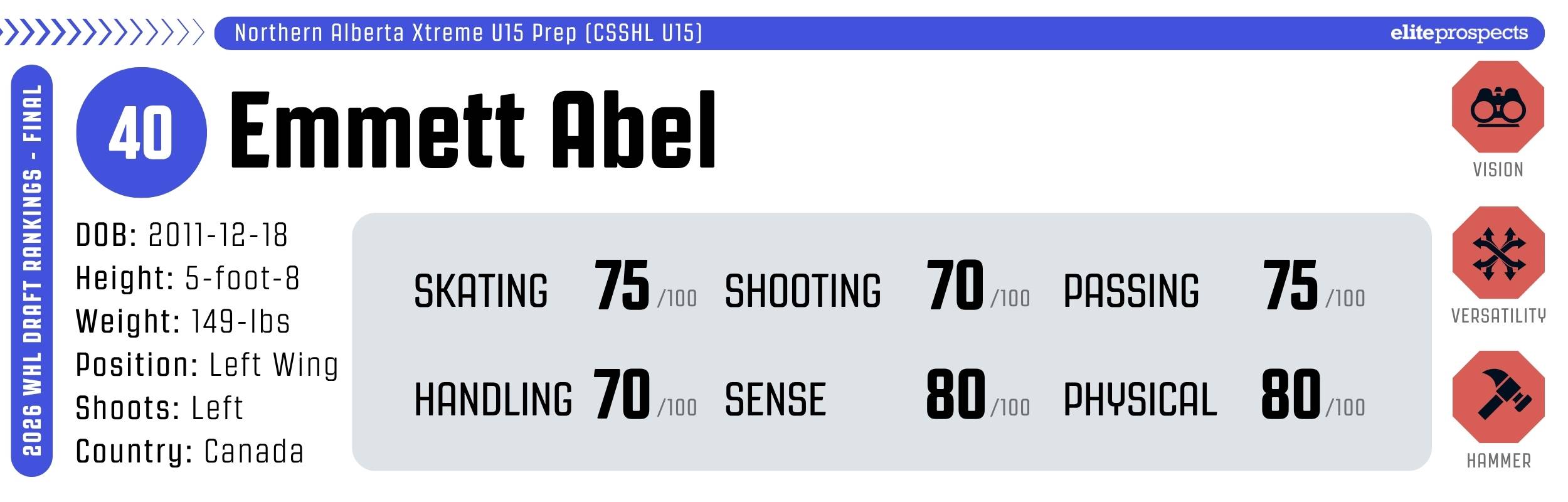
Don’t be fooled by Emmett Abel’s size; he’s a tenacious forward with skill and a surprising amount of physicality. He protects pucks with reverse hits and generates turnovers with relentless wall pressure, converting those possessions into immediate attacks, and scores with the confidence and touch of a genuine offensive threat. His cutback work behind the net and vision in open ice give him playmaking upside, and his scoring instinct in tight spaces is already reliable. He projects as a complementary WHL forward who generates offence efficiently without needing many puck touches to leave a consistent mark.
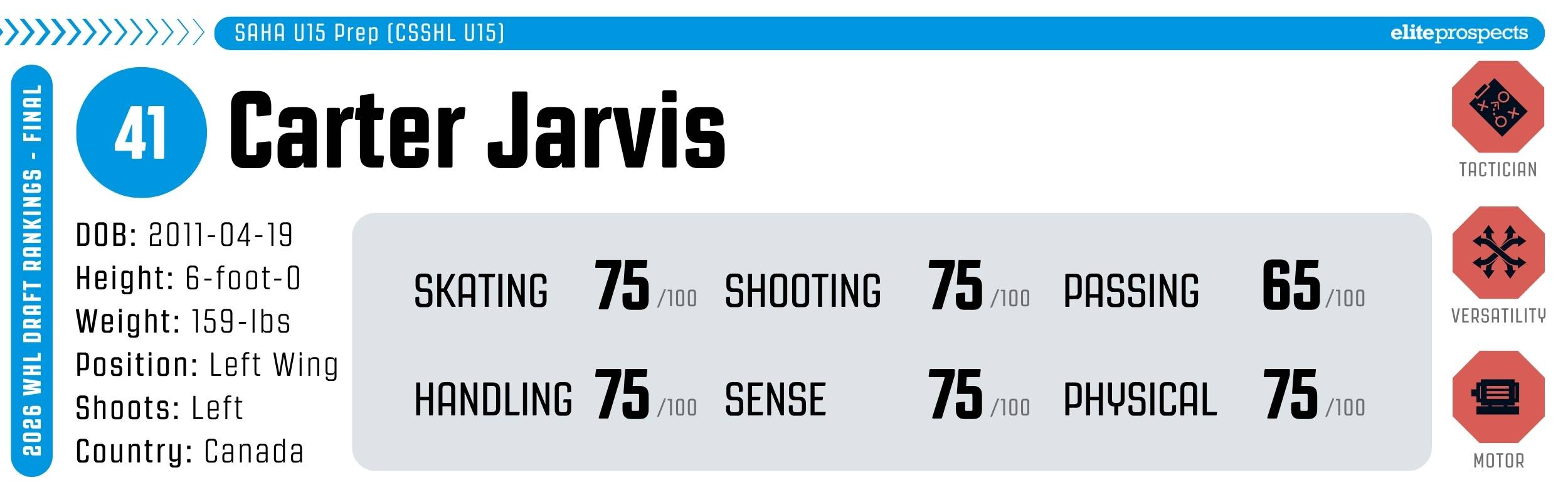
Carter Jarvis processes the game at a speed that makes difficult plays look routine, and that composure under pressure is the foundation on which everything else is built. He handles well in motion, uses cutbacks off the rush to reset plays, brings a genuine shot threat from the high slot, and backs it all up with a reliable defensive stick and real forecheck effort. His contact skills allow him to absorb pressure and continue making plays without losing control of the situation. Hockey sense ties the entire package together into a player who is effective in virtually any situation he is put in. He’s not going to be a dynamic player in the WHL, but he will bolster a middle-six.
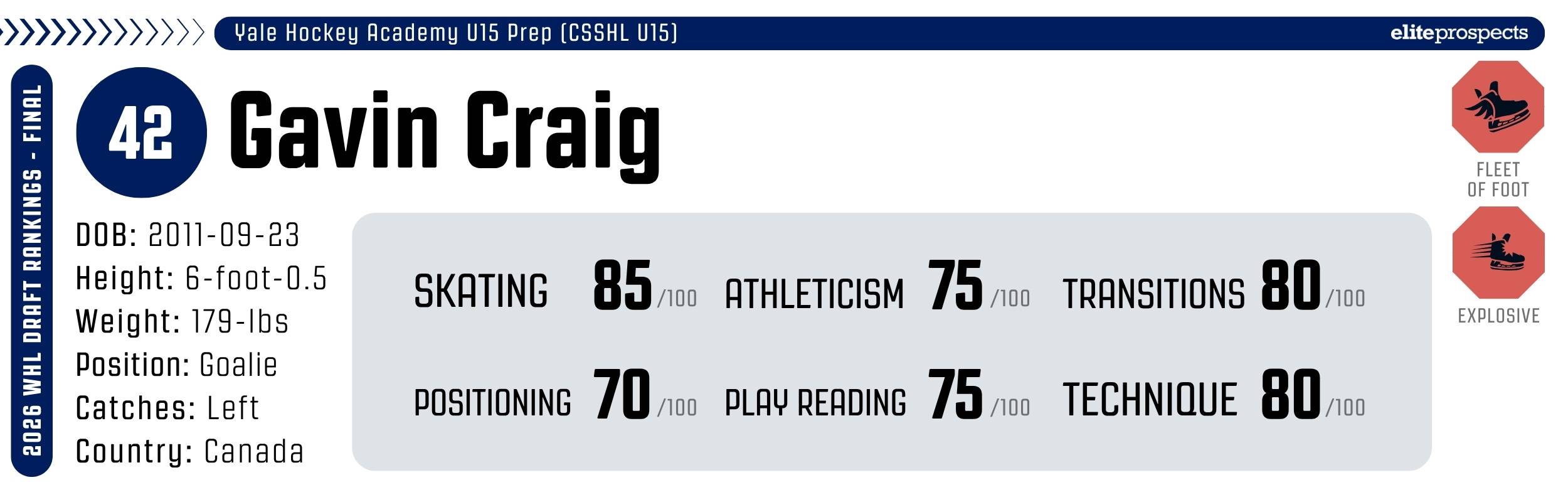
Gavin Craig has had an illustrious CSSHL career. The Langley native split the net in the U15 Prep league last season at just 13-years-old. This year, he has only grown as he backstopped a dominant Yale squad, went 15-2, led the league in save percentage, and, to cap it all off, was named to the league’s First All-Star Team. By leaps and bounds, Craig is the best upright skating goaltender available. His all-around technique, but particularly on his t-pushes and shuffles, is mature beyond his years. He’s great at keeping himself square as he moves, and he stops on a dime. The quickness and footspeed are also exceptional. He has a lot of burst off his edges and seamless transitions up and down. Mentally, Craig is calm and shows awareness of the ice with diligent scanning habits. The lack of high-calibre athletic talent keeps him from being the number one goalie on our list, but Craig may very well be closest to WHL-ready with his skating, technique, and mental game. The younger, September birthday also plays to his favour. Craig has starting potential in the WHL.
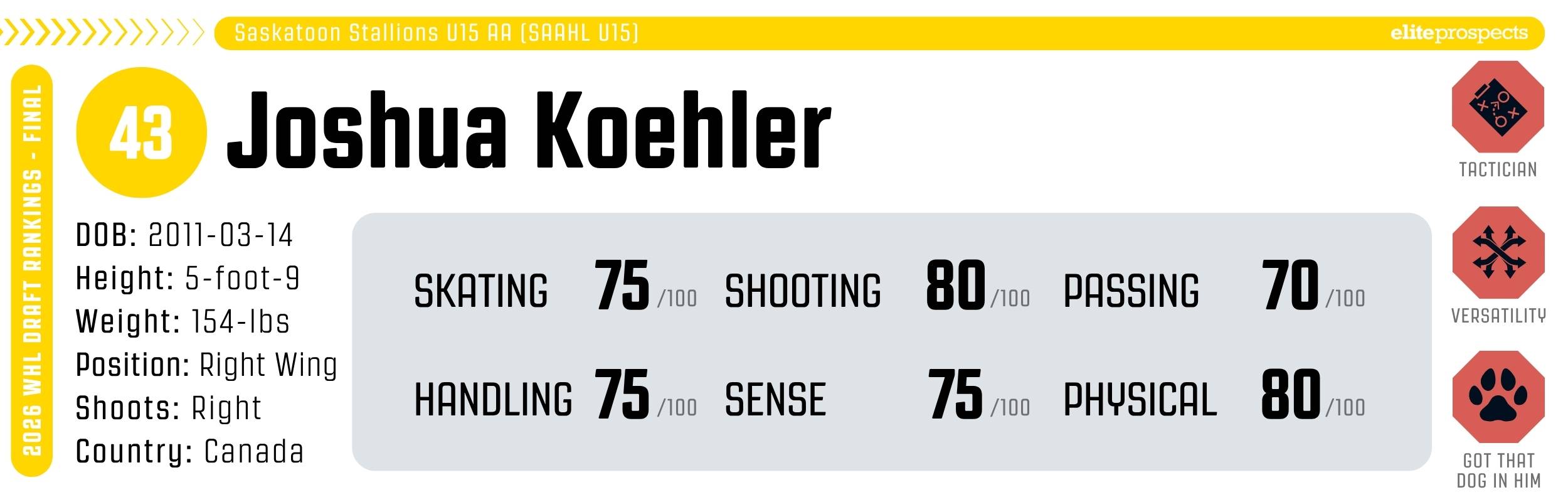
Joshua Koehler is strong on his legs, and the puck protection and battle game that come with it are already projectable. He makes smart wall plays and chooses the right option under pressure, whether that means holding, dumping, or delaying to open a lane. His high level of situational awareness allows him to find soft ice and contribute offensively without needing to rely on flash. The playmaking is equally impressive, with a knack for slot feeds, cross-ice connections, and clean power play distribution. Strong backchecks and reliable rush reads round out a complete picture. There are multiple clear ways his profile translates upward as the skill and physicality continue to develop.
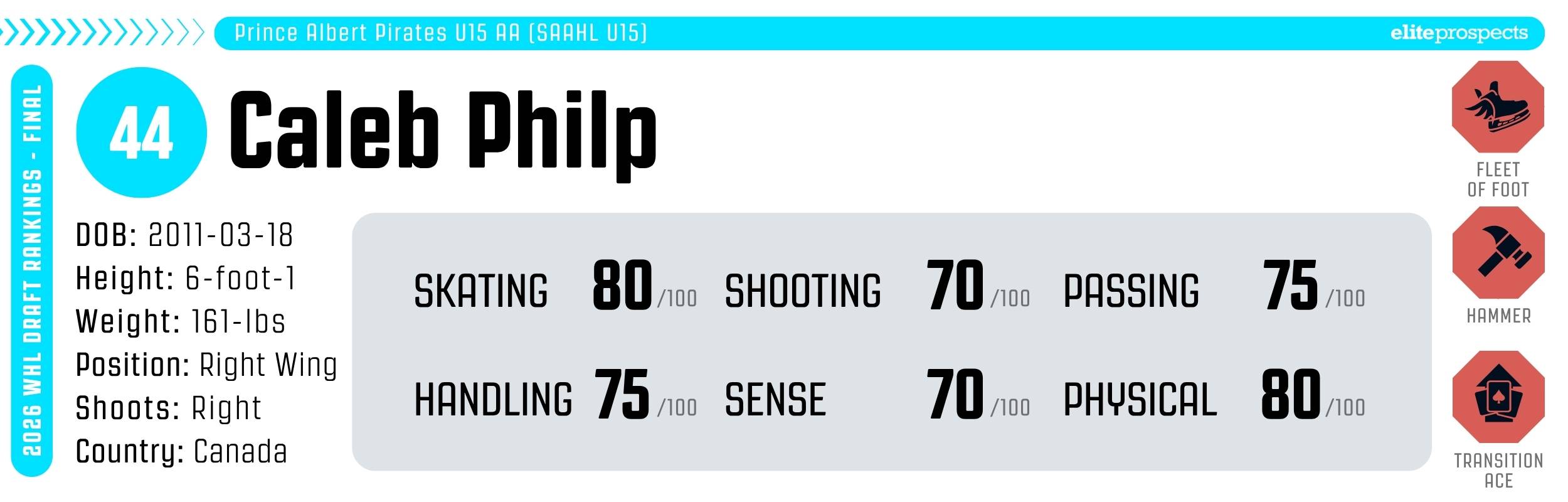
Caleb Philp is a physical, well-rounded winger with the compete level and tools to project as a reliable WHL middle-six forward. He is first to contact on the forecheck, completes checks, and generates puck battles that his opponents rarely win cleanly. His handling under pressure shows advanced spin-off and puck protection habits, underpinned by a high level of confidence in his individual skill and a trust in his tools when the game tightens up. Learning when to move the puck earlier and when to attack through layers directly is the primary refinement ahead. The frame, physical mindset, and skill floor are all pointing clearly in the right direction for a middle-six projection.
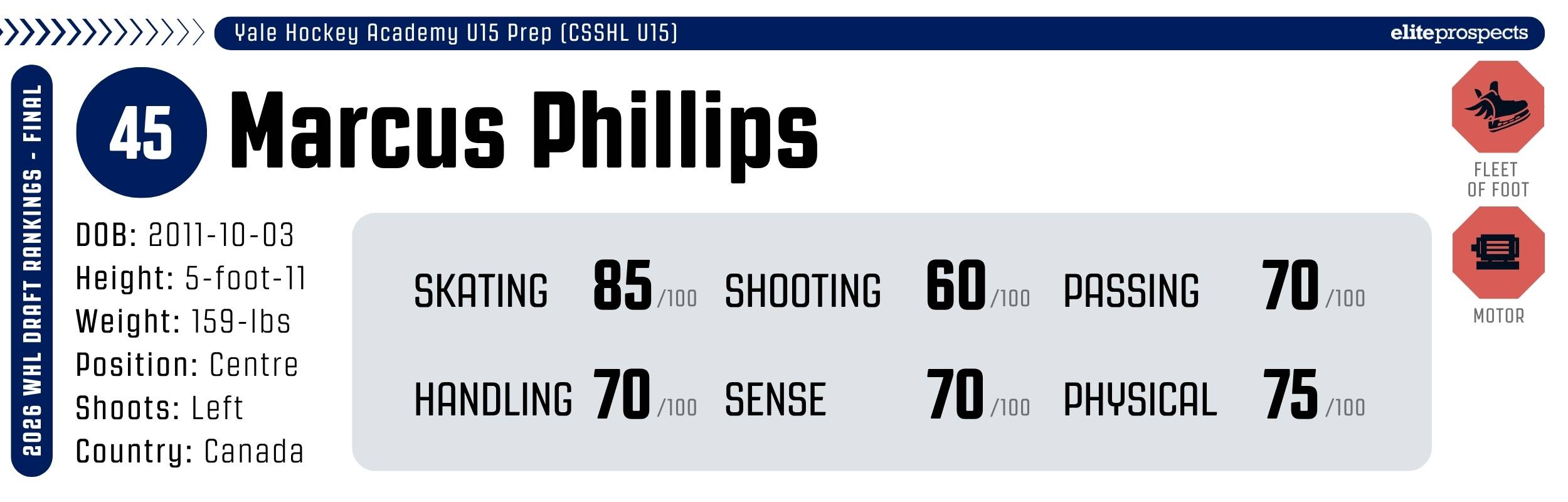
Marcus Phillips is a great skater, with strong posture and full extension that allows him to take flight up the ice. He uses his speed to put pressure on defenders and angles well to make himself an elite forechecker. His speed and defensive instincts play well in the defensive zone, especially when killing penalties. He is a top penalty-killer, which is rare at this age. He has good puck skills and can work himself off the wall and into the middle of the ice. With his skating and skill, Phillips can be a good counter-attacker and has the chance to become a solid two-way, middle-six forward at the next level.
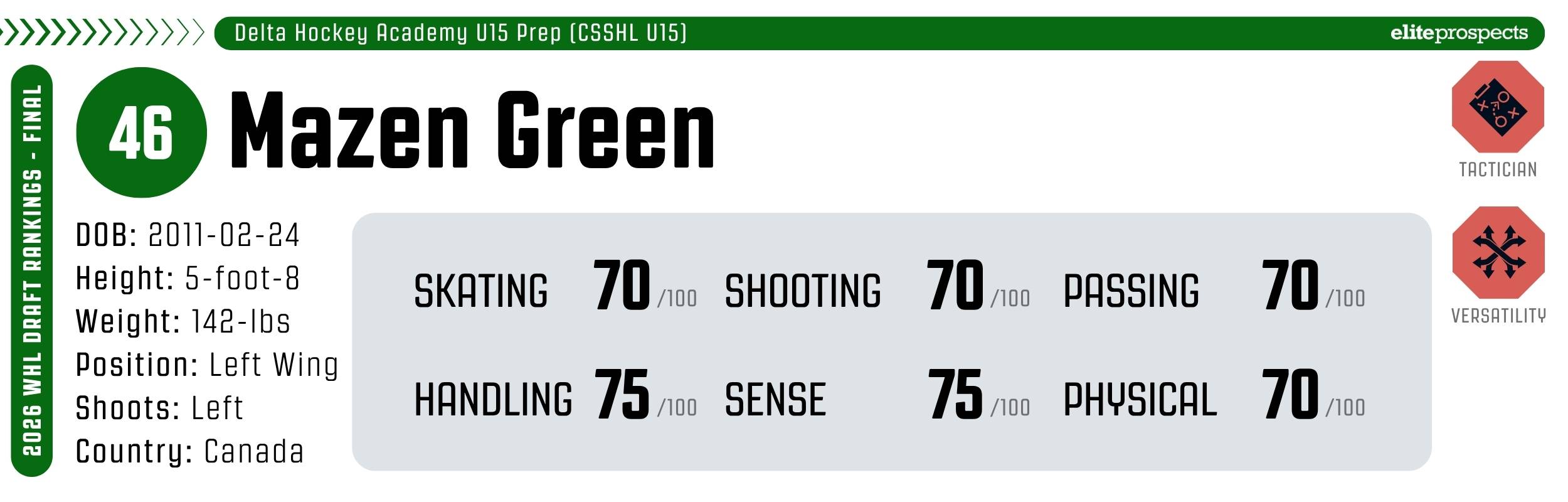
Skill and creativity are the name of the game for Mazen Green. His talent allows him to escape pressure along the wall, spinning and sliding the puck through opponents to take the puck from the wall into the middle of the ice. He sees the ice well, making good passes that can sometimes catch his teammates off guard. Green is a strong playmaker, with good offensive vision, paired with great puck skill and strong edges to make him a terrific complementary winger, capable of supporting elite talent and creating something out of nothing. His contact skills and aggressiveness could be improved, but if he can manage that, he could be a top-six supporting winger.
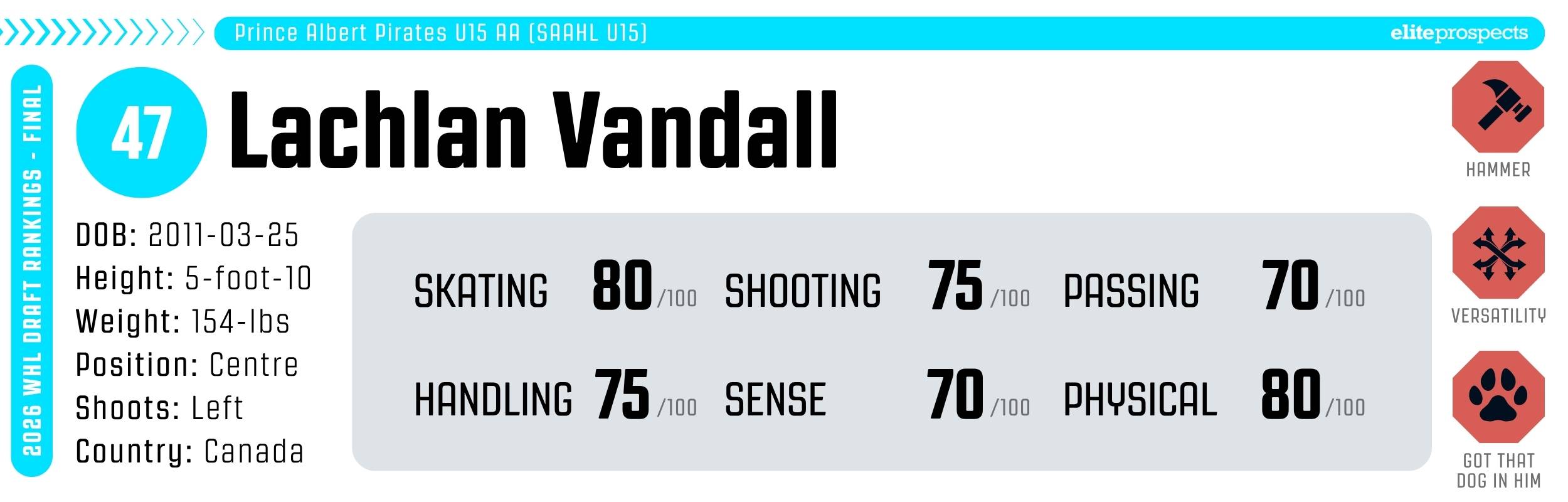
Lachlan Vandall is a physically imposing forward whose handling and vision consistently catch defenders off guard. He combines size, top-end speed, and soft hands in a way that makes him a genuine threat in transition, and his willingness to compete in the hard areas is as consistent as any forward in this class. He is relentless on the forecheck, strong along the wall, and plays with a physical edge that never turns off. The skill layer, particularly the backhand touch and playmaking in traffic, pushes his ceiling beyond a pure checking role. He projects as a complementary middle-six forward with the compete and tools to grow into that role quickly.
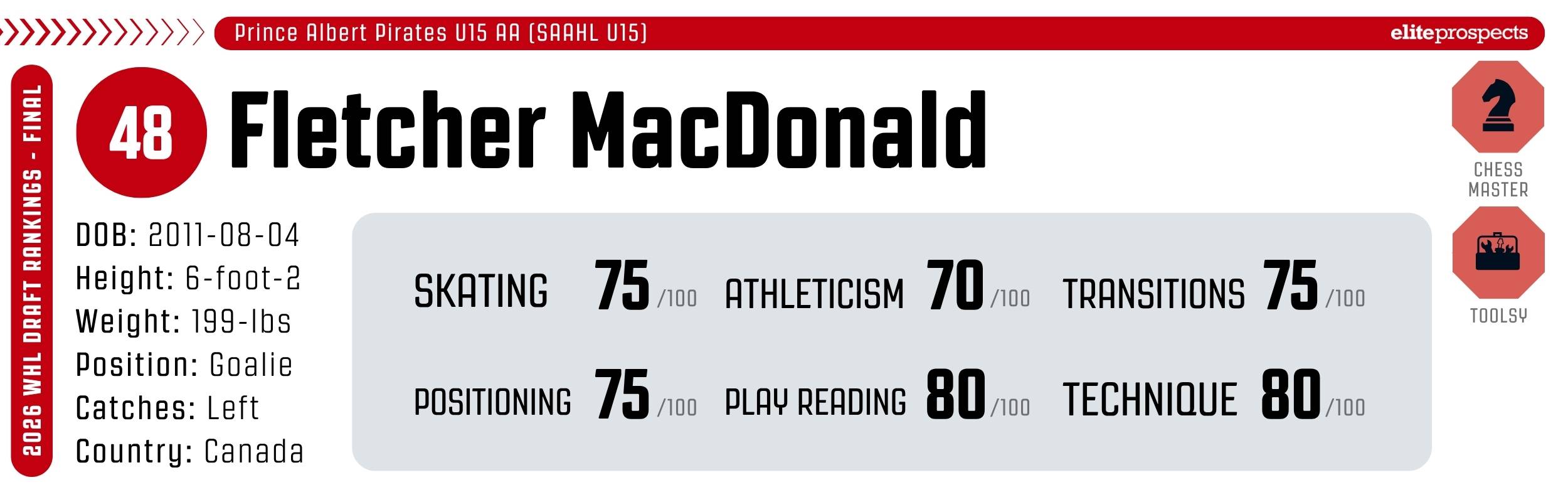
Fletcher MacDonald was lights out this season. Despite a 9-16 record, he posted a .925 save percentage and got nine of the CAC Canadians’ 12 wins. He kept up his strong form at the Alberta Cup, where he won two of three and posted a tournament-leading .942 save percentage. MacDonald might be the most projectable goaltender of the class. He’s got WHL size at 6-foot-2, and plays a mature positional game. He sits deeper in the net with a priority on setting his feet before a shot. He’s a solid skater with a lot of power in his lower body. The post-play stands out among goaltenders his age as well. As the shot speed ramps up at the junior level, he’ll need to learn to be a bit more aggressive, but his skating is strong enough to facilitate that adjustment.
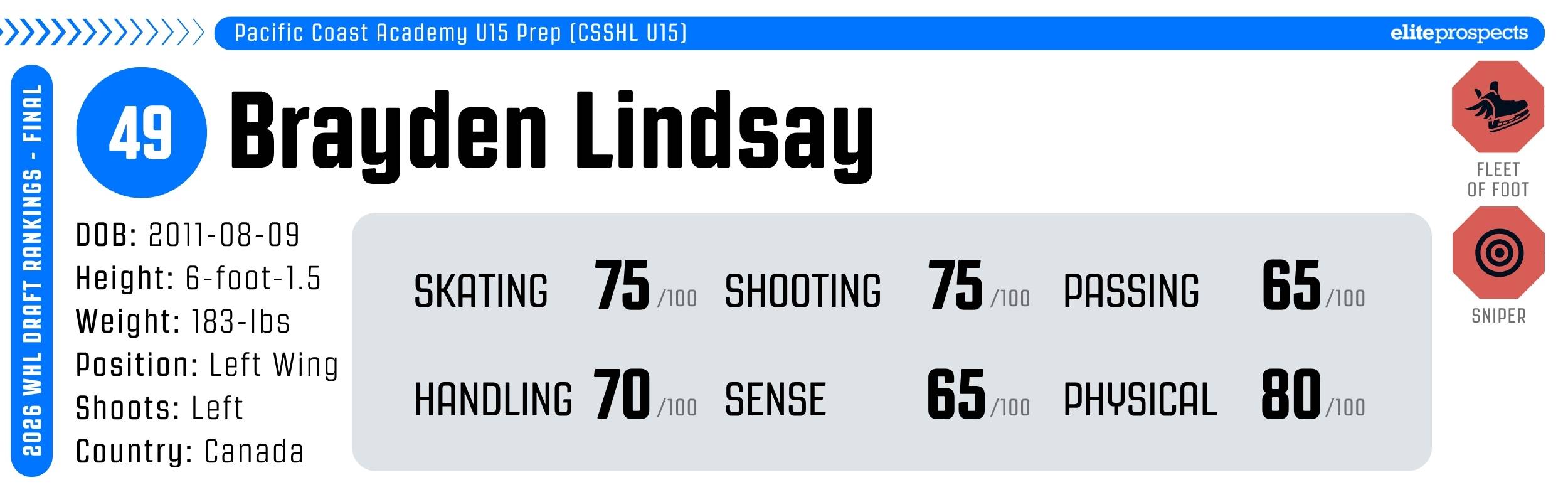
Brayden Lindsay is a tank. He’s a great skater, getting full extension out of each step and propelling himself up the ice rapidly. His speed combines with good puck skill to make him a threat off the rush, overwhelming defenders. Physically, he’s a beast. He will run right over opposing defencemen on his way to the net, preferring to chip the puck into the corners and power his way to it. His length allows him to pick off plays in the neutral zone, rapidly turning them around to push the puck back up ice. He needs to use his skill and size to attack the middle more, as well as holding on to possession and reading the play, but there’s top-nine upside here.
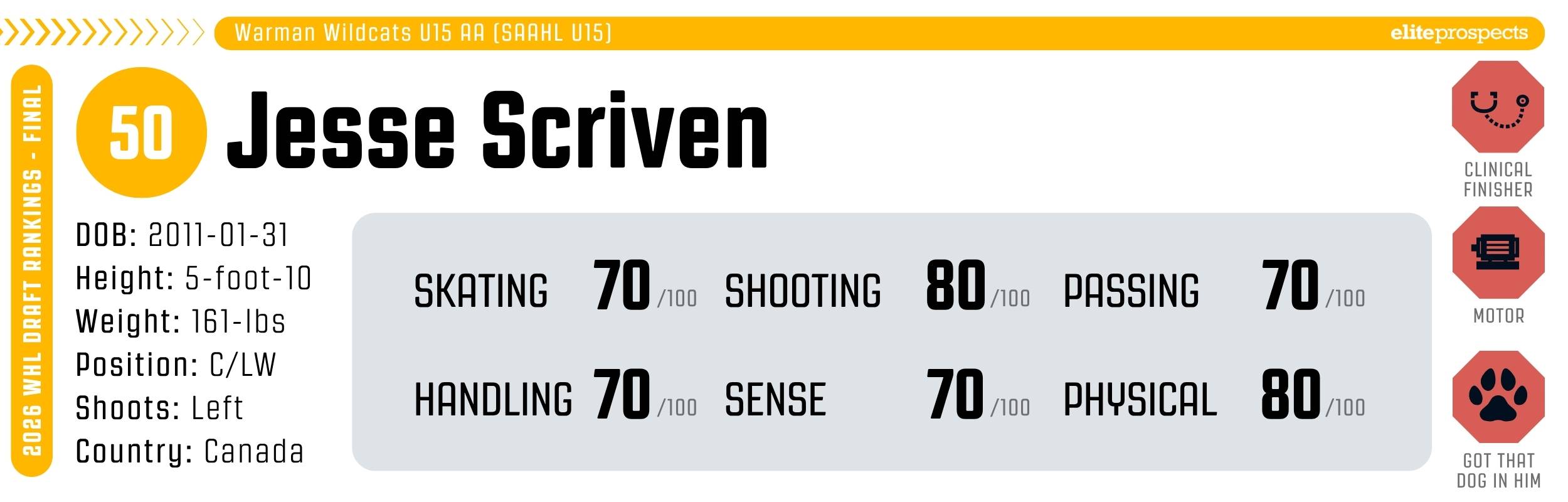
A power forward with a layered offensive game, Jesse Scriven is a projectable WHL forward. He wins races, fights through contact in the slot, and arrives on the forecheck with purpose. While his game is built on a heavy grind in the offensive zone, he shows playmaking utility through backhand feeds and drop passes in transition. He does not profile as a primary transition driver, but he enters the zone with intent and supports the attack with purpose. He has middle-six potential.
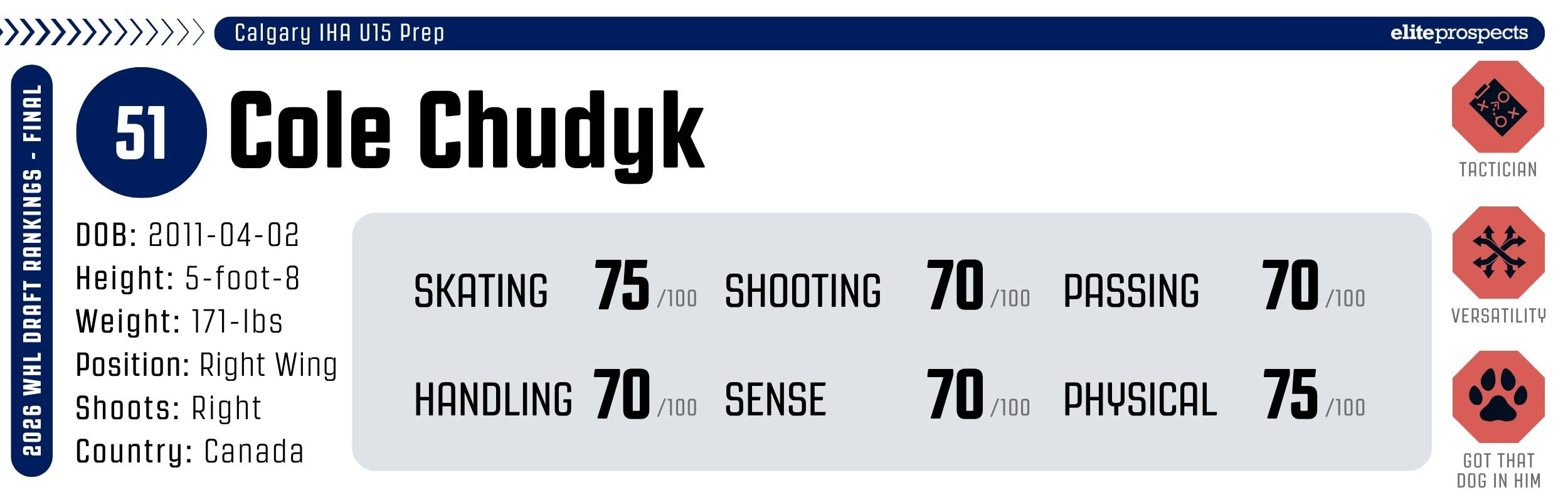
Cole Chudyk is one of the highest-motor players in this class. He races on the forecheck, steals pucks from tight spaces, and transitions immediately into attack without pausing to reset. A heavy shot and quick handling under pressure complement a physical edge he deploys without hesitation, and a dogged backcheck across the full length of the ice to strip possession shows up in his game as a genuine tendency rather than a moment. He projects as a support winger who makes play-driving players considerably harder to contain.
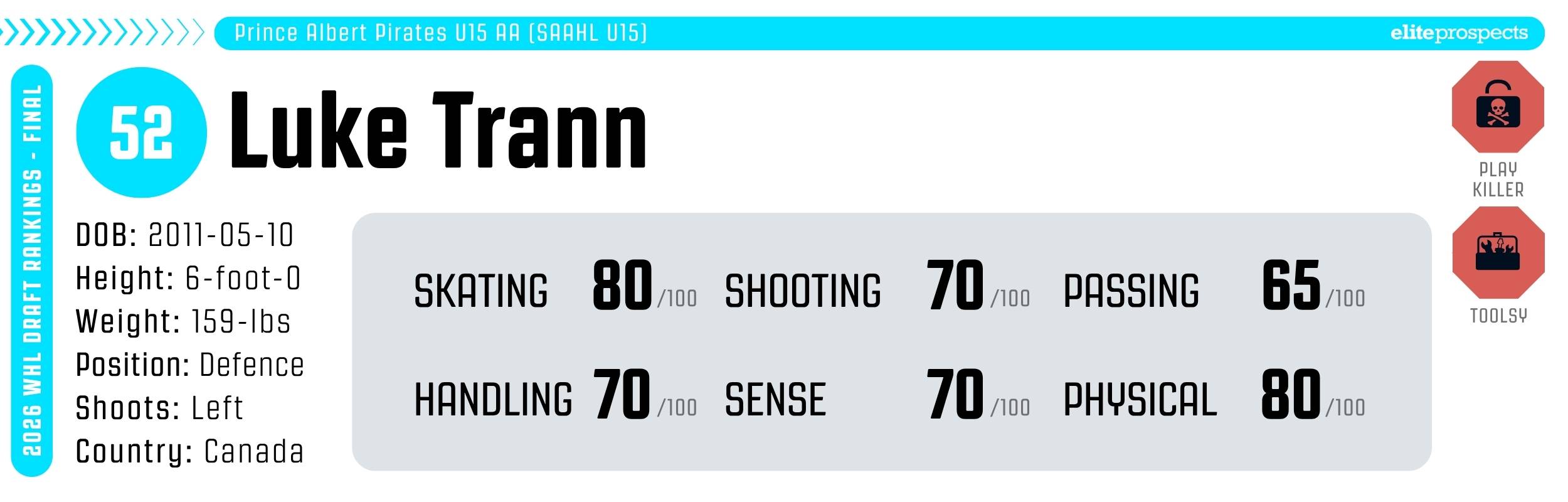
Luke Trann plays a modern, detail-driven defensive game built on sound mobility, well-timed cutbacks, and consistent gap control. He defends the rush with composure and brings genuine physical presence along the boards and around the slot that makes life difficult for opposing forwards in every situation. His activation habits and puck movement on the power play show an offensive dimension that keeps defenders honest, and his edgework and first step are both projectable tools for the 6-foot defender. Refining his timing on the pinch and trusting his skill on the breakout more consistently will sharpen the projection considerably. He profiles as a dependable WHL defender with two-way upside.
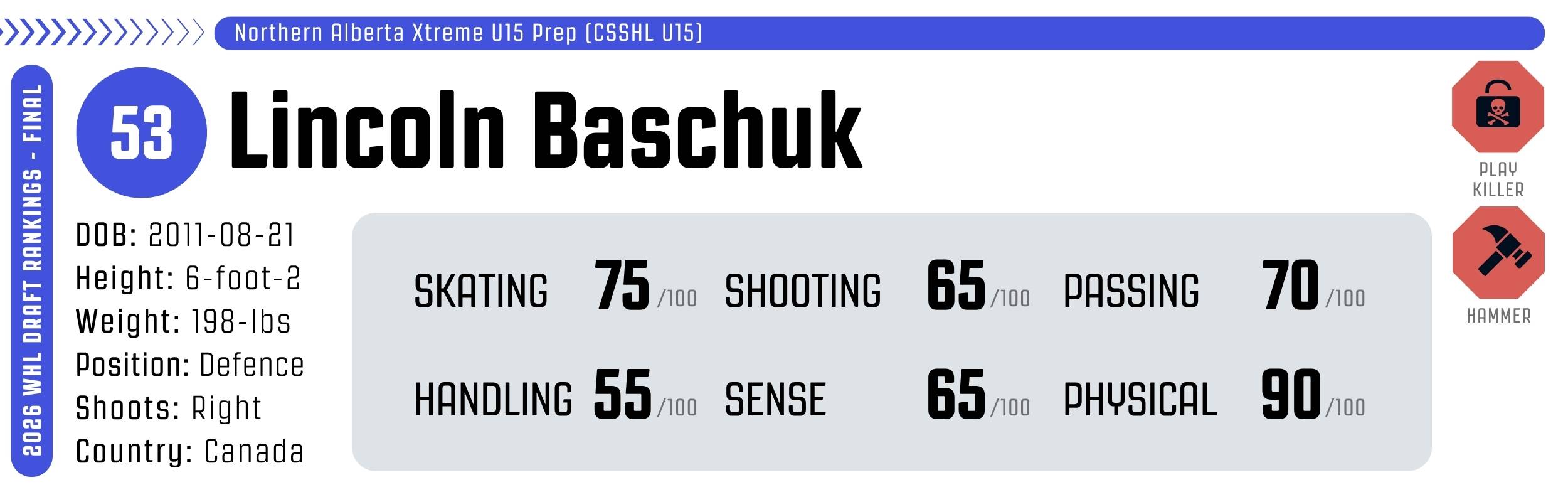
With a WHL frame and physicality that projects as high-end, Lincoln Baschuk is an easy prospect to appreciate. For this level, he’s uniquely mean, mauling opponents in battles and lining up open-ice hits. But there’s also an element of timing and craft to his defensive game – it’s clear he takes pride in it. With possession, he has vision and a heavy shot, but his handling will have to improve to keep puck-moving value at the next level. He’s an easy prospect to envision filling a third-pair role in the WHL, and as his skill develops, he could move up the lineup.
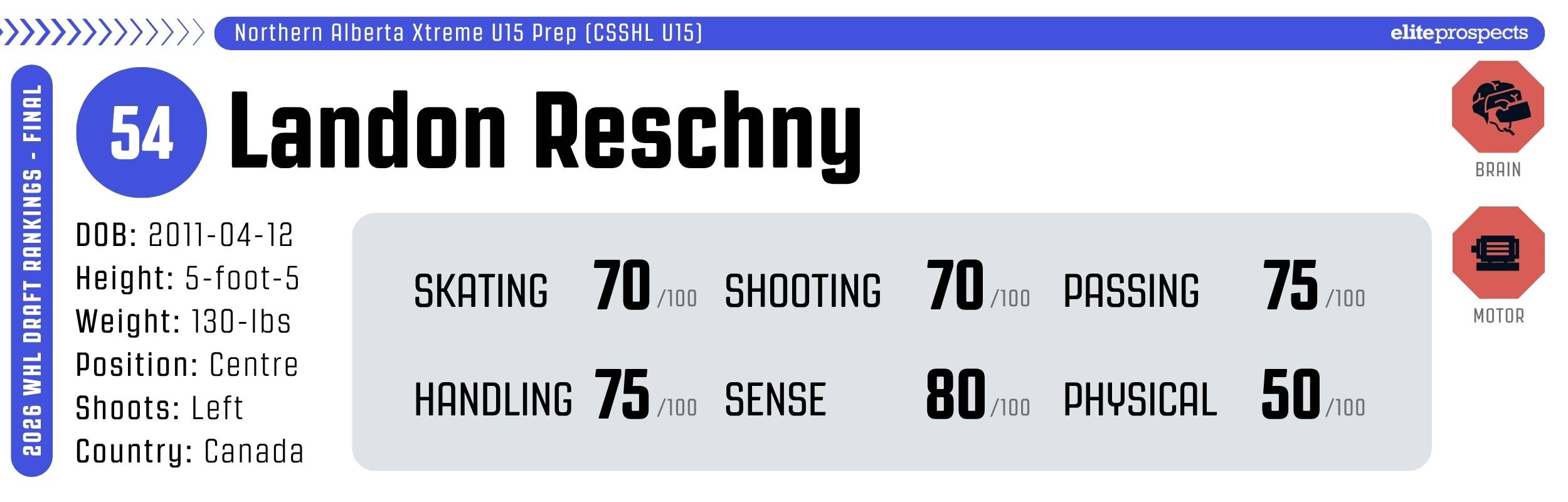
Every time Landon Reschny steps on the ice, there’s a good chance he’s the smartest player out there. He makes smart decisions constantly and in all three zones. His playmaking stands out, making passes and finding lanes before anyone else on the ice sees what's happening. His edgework is a strength, with a balanced stride that gives him four-way mobility. He’s a skilled pivot who coaches want on the ice in critical moments. Reschny’s deception is a clear strength, constantly using his feet, hands, shoulders, and eyes to trick defenders. He needs to gain strength and further develop his shot to become an everyday WHL player, but there’s a potential top-nine centre in here.
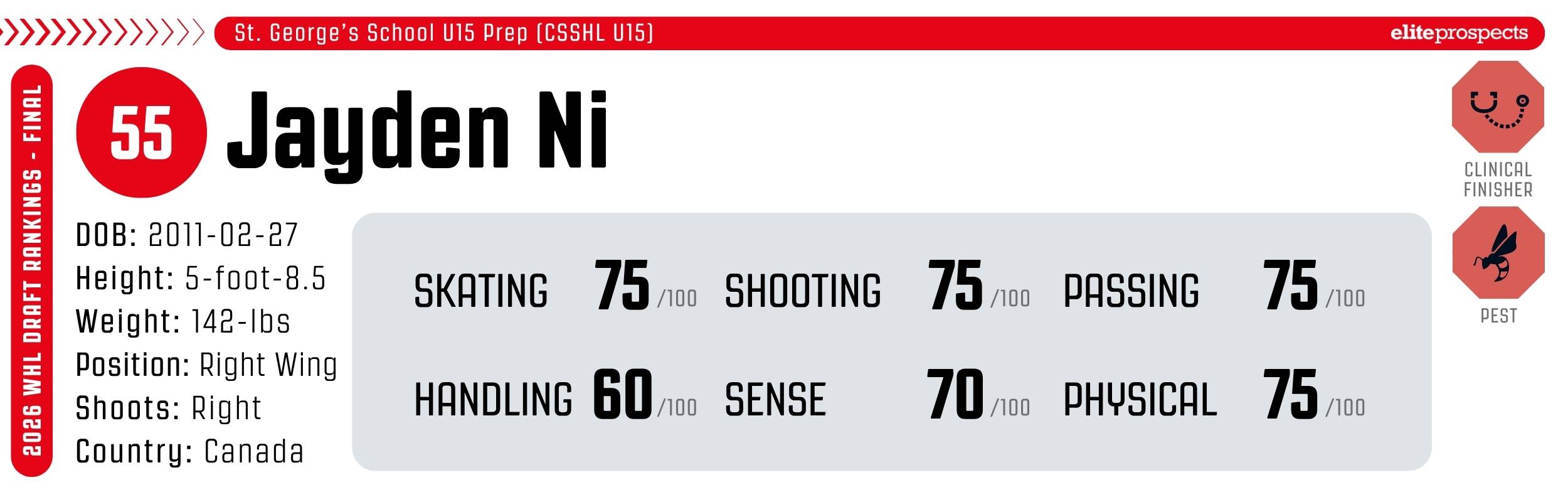
Jayden Ni is everything you want in a supporting winger. He can carry the puck up the ice, break through the first layer of defence, and make a strong pass to keep the play moving the right way. He has good skating, with a powerful lower half. A strong battler, Ni will not give up on any pucks and will work the puck back onto his stick so he can make a set-up pass to a teammate. He’s a good defensive winger, routinely winning board battles. A few tweaks to his puck-handling fundamentals could unlock his potential as a middle-six winger.
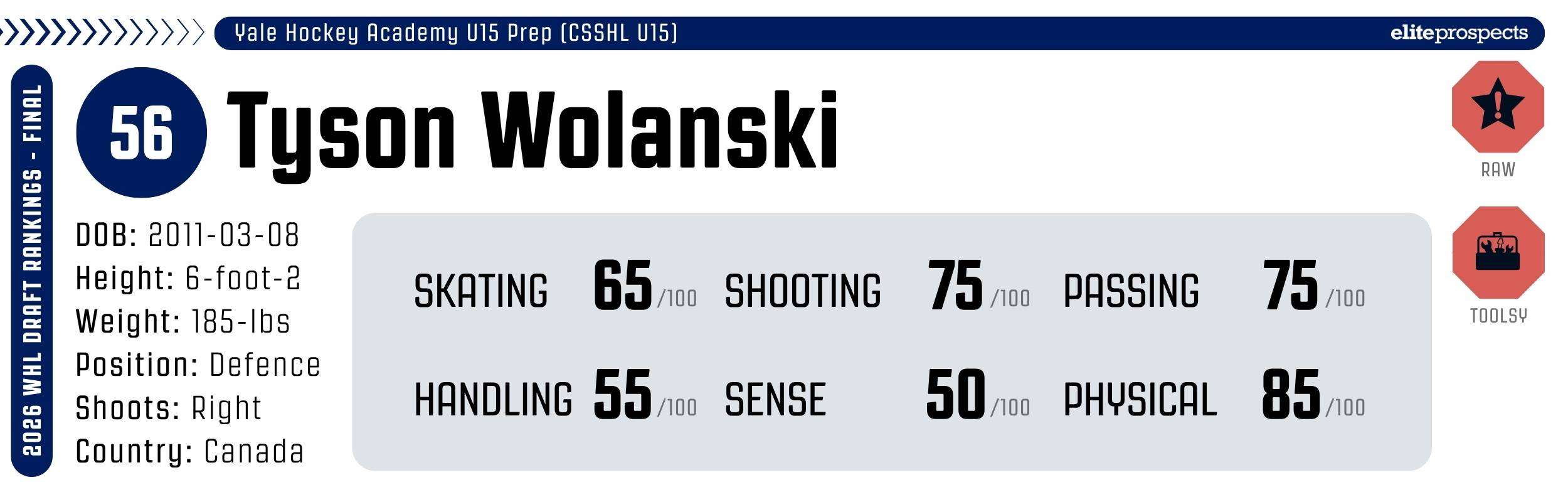
Already bigger than the average WHL defenceman with a 47-point season, Tyson Wolanski is a high probability bet to play in the WHL. In his best games, he snaps long-range breakout passes through traffic and sets up cross-slot chances. He has puck-retrieving skills, too, leveraging his size and vision to shield pucks and escape. He’s a raw player, with mistakes compounding at times, and he’ll have to develop his defensive pace further. Given his measurables and clear pathway to play a role, expect to see him off the board far sooner than this ranking.
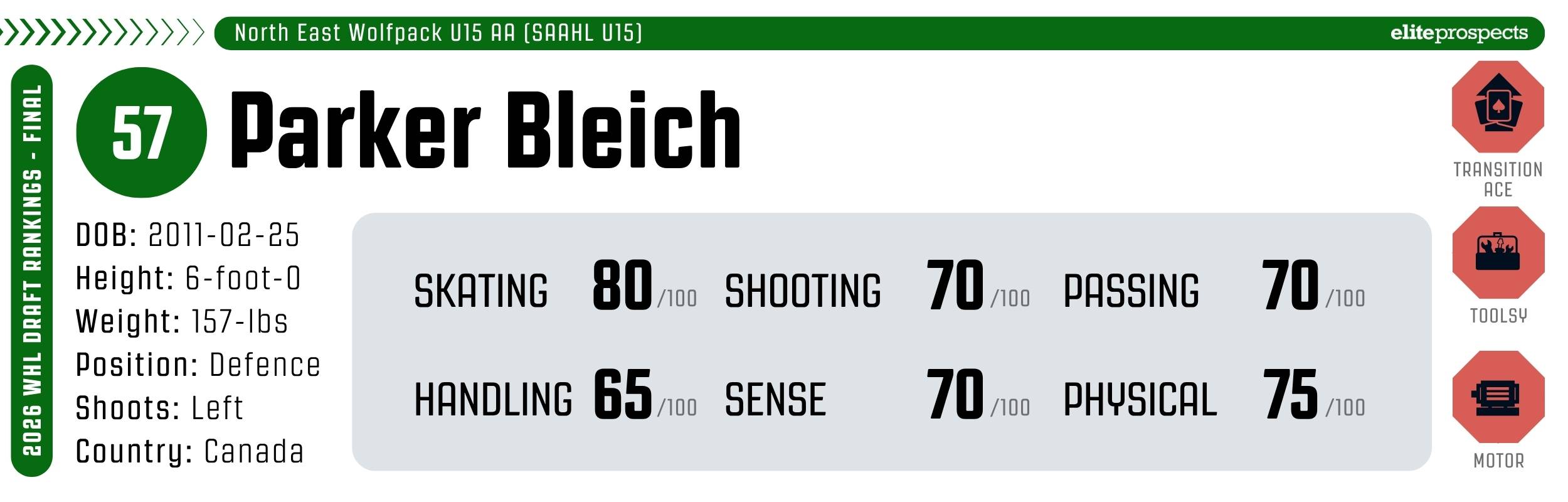
Parker Bleich plays an incredibly tight gap at the offensive blueline, keeps his head up with an active stick that takes away options before forwards can act, and activates with confidence. He uses cutbacks to create clean passing lanes on breakouts, makes quick decisions offensively, and manages space effectively on the power play. His transition puck-moving is efficient, and his three-zone engagement is consistent. With continued development of his offensive reads, he projects as a dependable WHL defenceman who earns trust quickly.
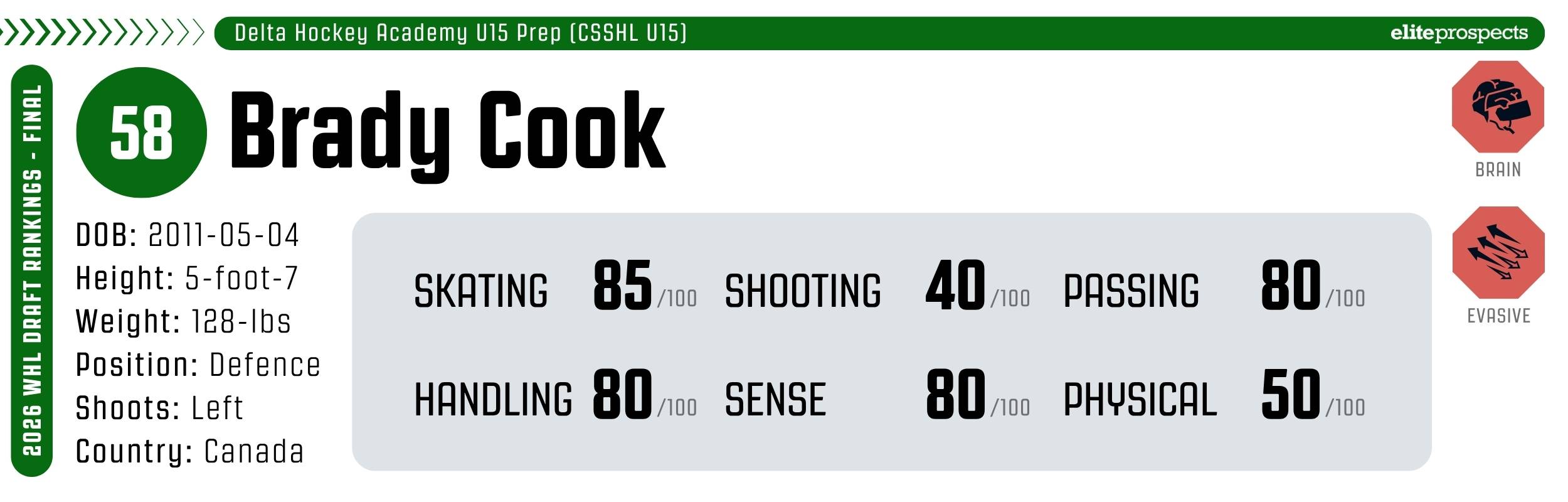
While spending his season potentially overshadowed by Delta’s other offensive defender, Brady Cook is absolutely deserving of this high ranking. He’s an incredibly smart defender, always seemingly one step ahead of the play and consistently making great breakout passes. He works the offensive blueline well, combining strong edgework with skill and the intelligence of when to engage versus back off. He uses his feet to evade pressure and scans the ice constantly. Cook will need to get bigger and stronger, but could end up as a top-four power play quarterback.
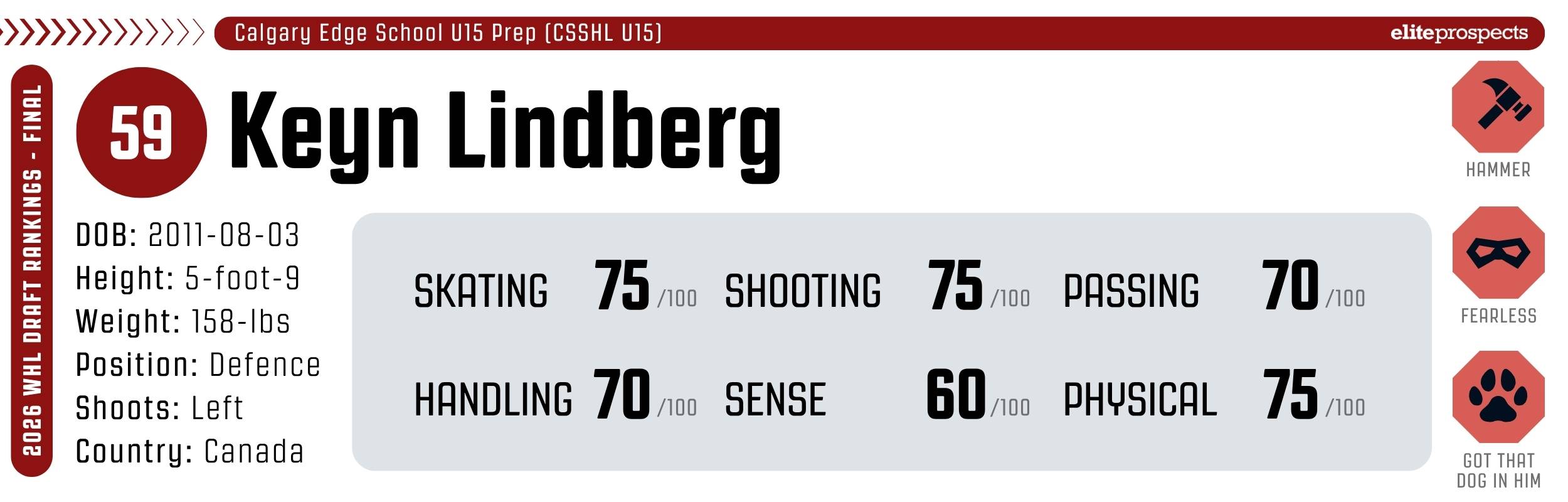
Keyn Lindberg is a physical shutdown defender who makes his presence felt every shift. He steps into opponents for big hits, blocks shots, kills plays along the wall through pure strength and engagement, and holds the zone seemingly every time. His lateral explosiveness and stick work give him real range, and the offensive flashes, including a precise cross-slot pass through layers, show there is more to develop offensively than the style suggests. Dialling back the aggression that leads to penalties and scanning more before committing to passes will be the key. He projects as a WHL shutdown defenceman who could earn heavy minutes down the road.
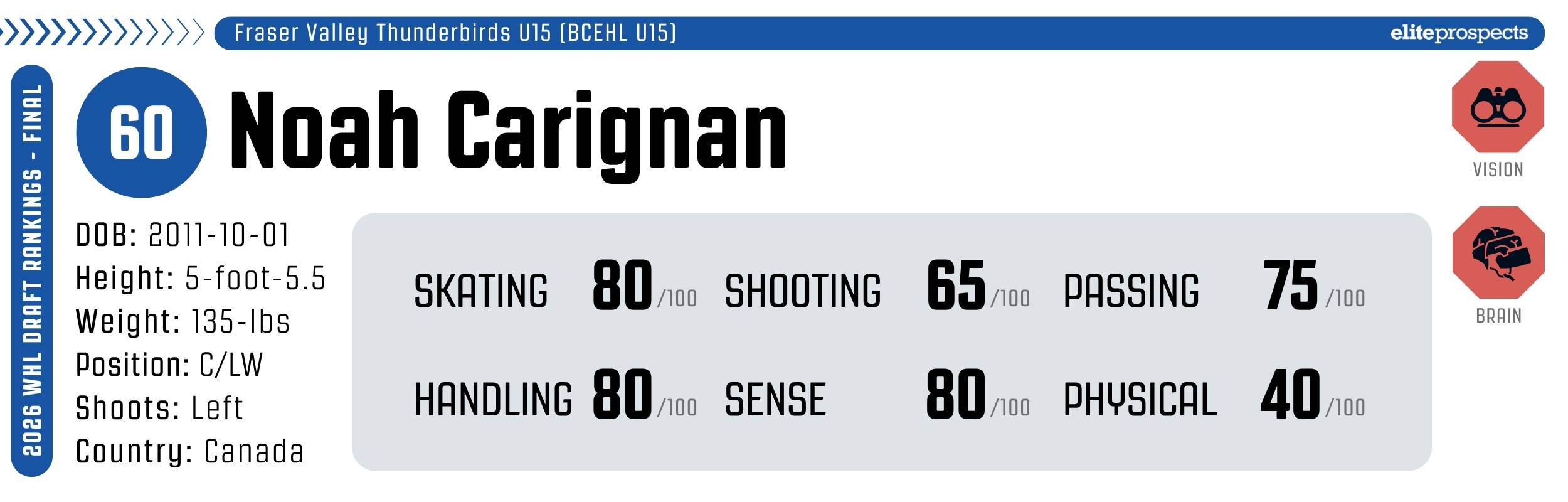
The BCEHL U15’s MVP, Noah Carignan, led the league in scoring with 78 points – 16 more than the next closest. He’s a playmaker, through and through. He threads gorgeous passes through traffic, plays that other players simply do not see. Not only does he make the flashy passes, but also the subtle, short-range ones that put his teammates in great spots. The lower level of competition and size are concerns, but the potential is real. If he grows a fair bit, he could become a real point-producer in the WHL.
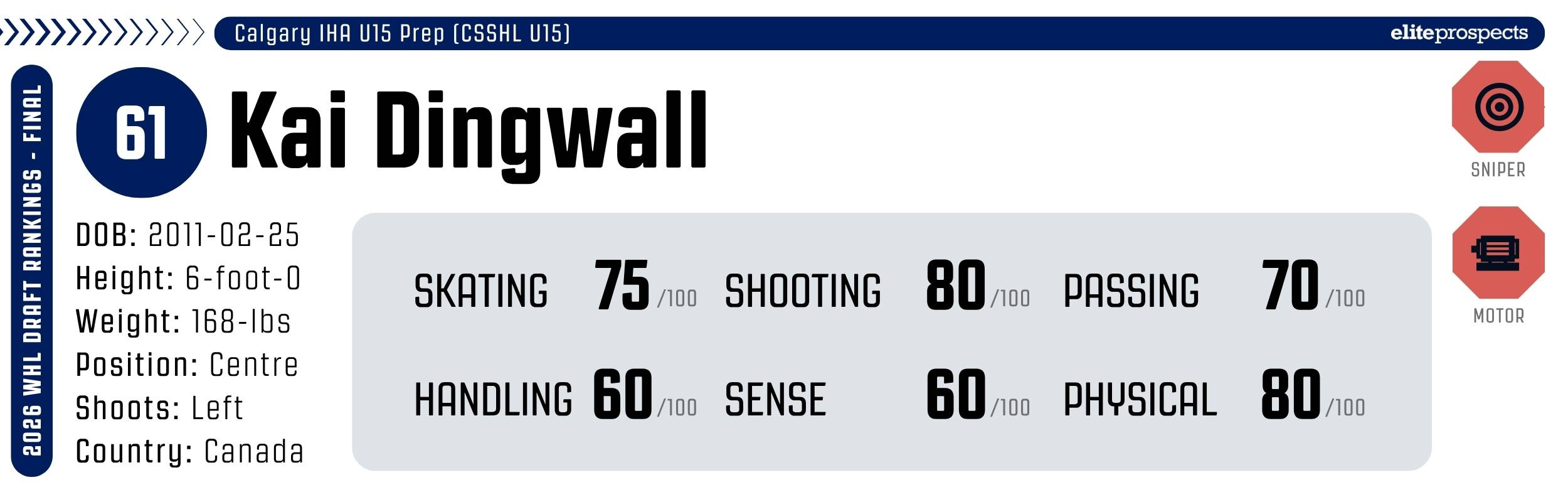
Kai Dingwall is a power forward whose value starts with his frame and the way he uses it. He drives the net with defenders draped on him, wins battles along the wall through body positioning and raw strength, and shoots with authority from multiple angles and positions. His ability to make plays while absorbing contact and his net-front instincts are already reliable and projectable traits. Getting inside more and developing a bit of deception would expand his projection beyond a checking and possession-extending role. He’s a likely WHL player with a clear and translatable floor.
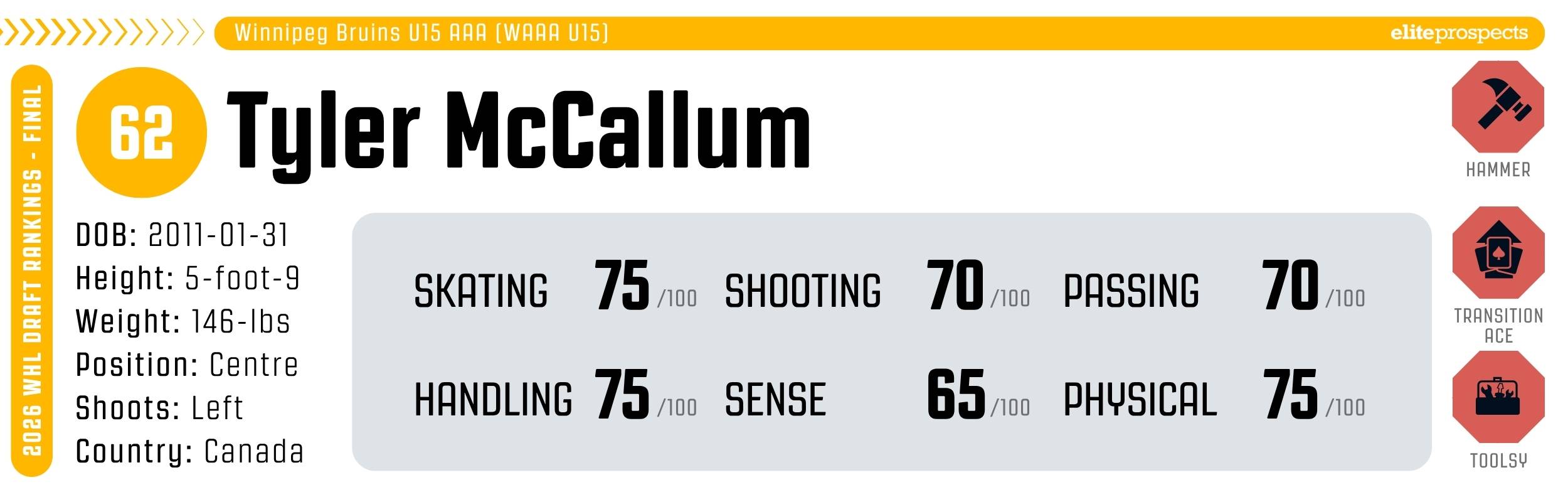
Tyler McCallum is a big, powerful centre with the skating and skill to back it up. He attacks off the rush with confident edgework, slips pucks through defenders' legs to cut inside, and has shown the ability to drive play with different line combinations without losing effectiveness. His point shot is powerful, and his vision translates into unselfish puck distribution after drawing pressure. Simplifying reads and trusting early passes will unlock more of his offensive production. The combination of strength, pace, and two-way reliability gives him a strong floor with legitimate top-nine upside to grow into.
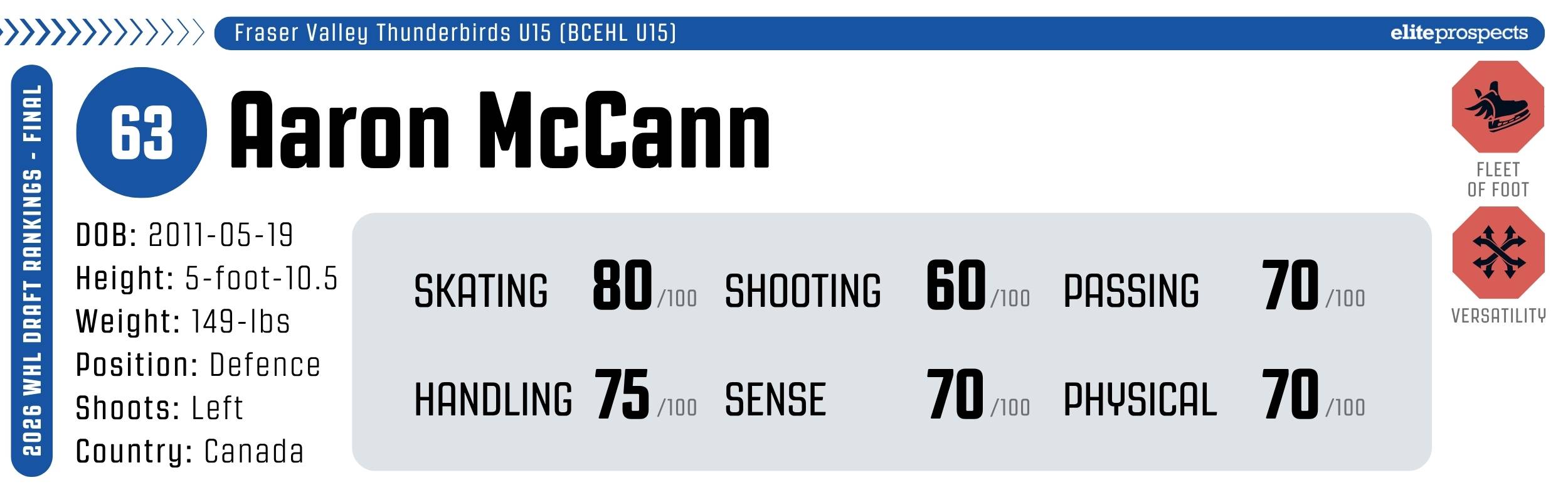
Another high upside BCEHL U15 swing, there’s lots to like in Aaron McCann’s game. His footwork is a true separator, using a balanced stride paired with good edgework to be a strong lateral mover. The combination of reach and mobility makes him difficult to beat off the rush and a disruptor of the cycle. Once he stifles the opposing attack, he explodes away from opponents and can carry the puck out of his zone. He has puck skill to complement his feet and is also a capable passer, which adds to his breakout ability. If his processing speeds up, McCann could hit as a top-four two-way defenceman, though the development curve might be lengthy.
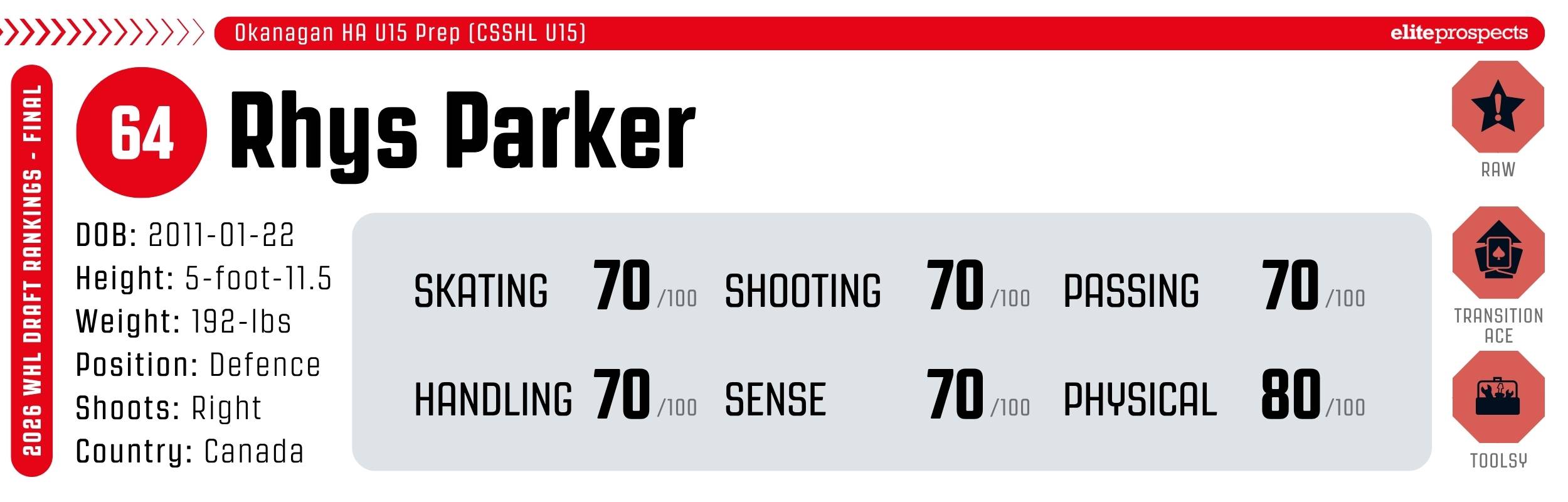
Rhys Parker possesses the physical tools to become a strong possession defender. He gets up the ice quickly and can get low and wide to protect the puck. He flashes high-end skill and has a willingness to attack the middle of the ice. He can flash deception as a puck carrier, and makes solid breakout passes when he decides to go that route rather than carrying it. He shows good poise on the offensive blue line and understands when to activate down low, while also showing the ability to sneak into unguarded areas. He wins puck battles with raw power, which he also uses to play through contact. Developing his skating and scanning habits will be key to becoming an impactful WHL defenceman.
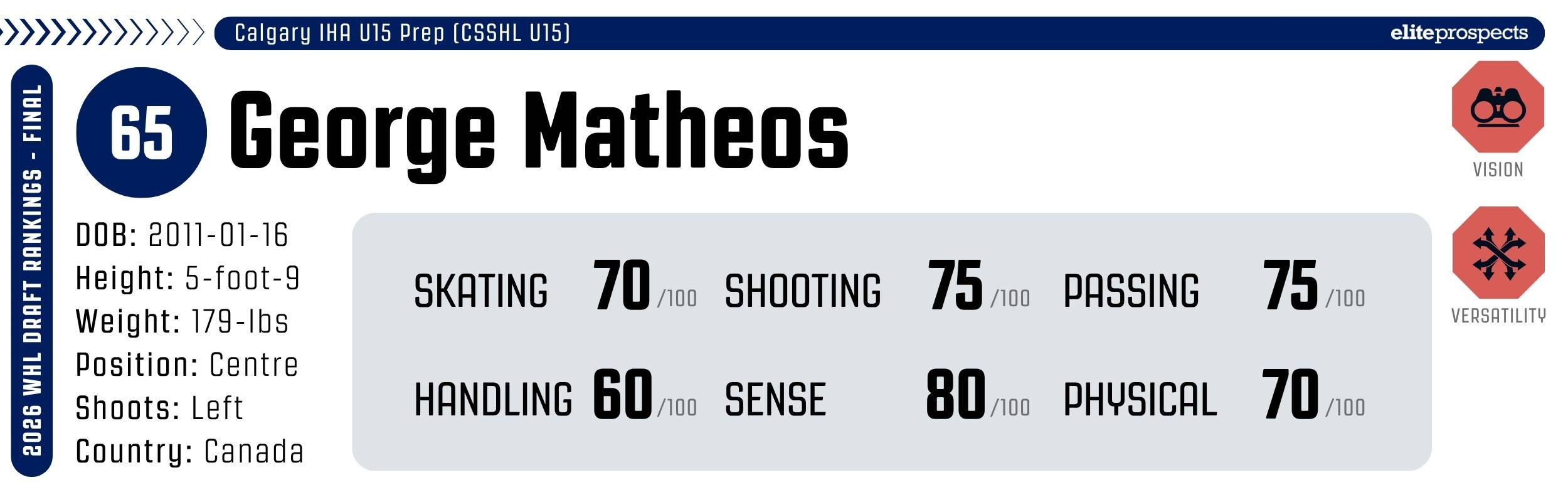
The well-rounded nature of George Matheos’ game, combined with his separating strength and physical tools, makes for a pretty endearing profile for WHL teams. A relentless end-board crasher, Matheos separates pucks from defenders with ease. He wins the inside, extends possessions, and rips pucks away from opponents, overwhelming them with his intensity. Out of these recoveries, Matheos flashes vision through deft finds off the backhand, incorporating one-touches, delays, and patience, buying time with his protection skill. Combine that with a hair-trigger release, and Matheos has enough upside to make an impact at the bottom of a WHL lineup, potentially graduating into a bigger role as his physical tools grow.
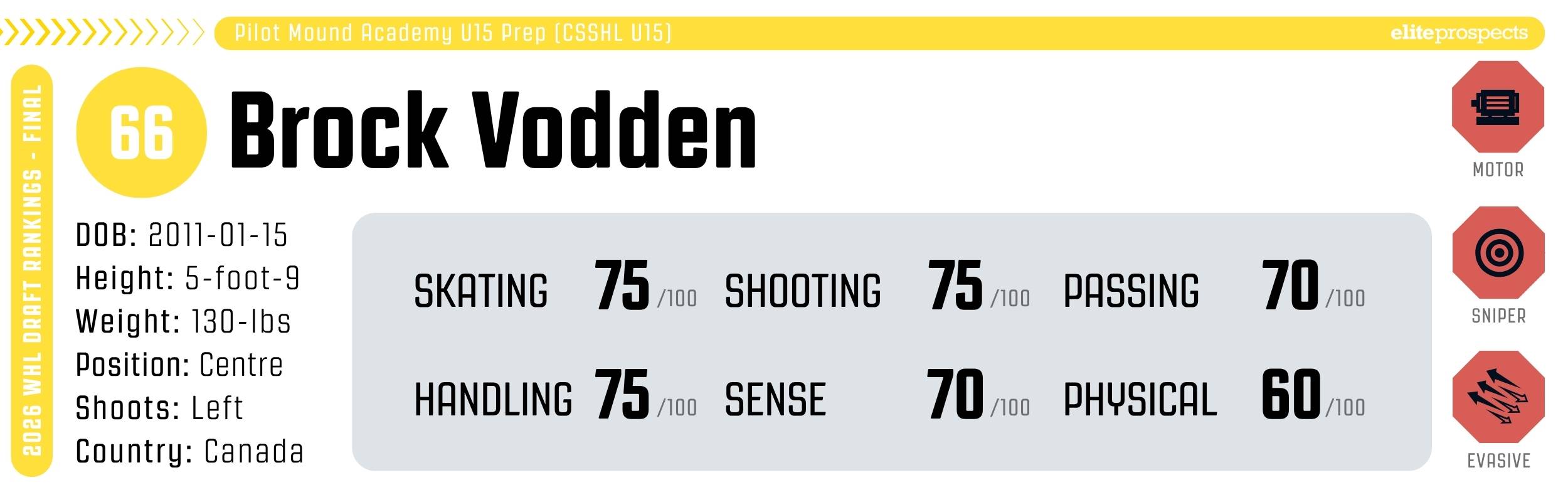
Brock Vodden is a relentless worker with genuine offensive tools layered underneath the compete. His pull-and-release shot is a legit threat from range, while his edgework allows him to absorb contact and spin out for clean exits. The connective habits he shows in transition, rotating into pockets, supporting give-and-gos, and threading passes through small windows, show a player who understands how to keep plays alive. Already a solid checking line projection, refining his skating mechanics will unlock a higher gear and push his projection into a complementary scoring role.
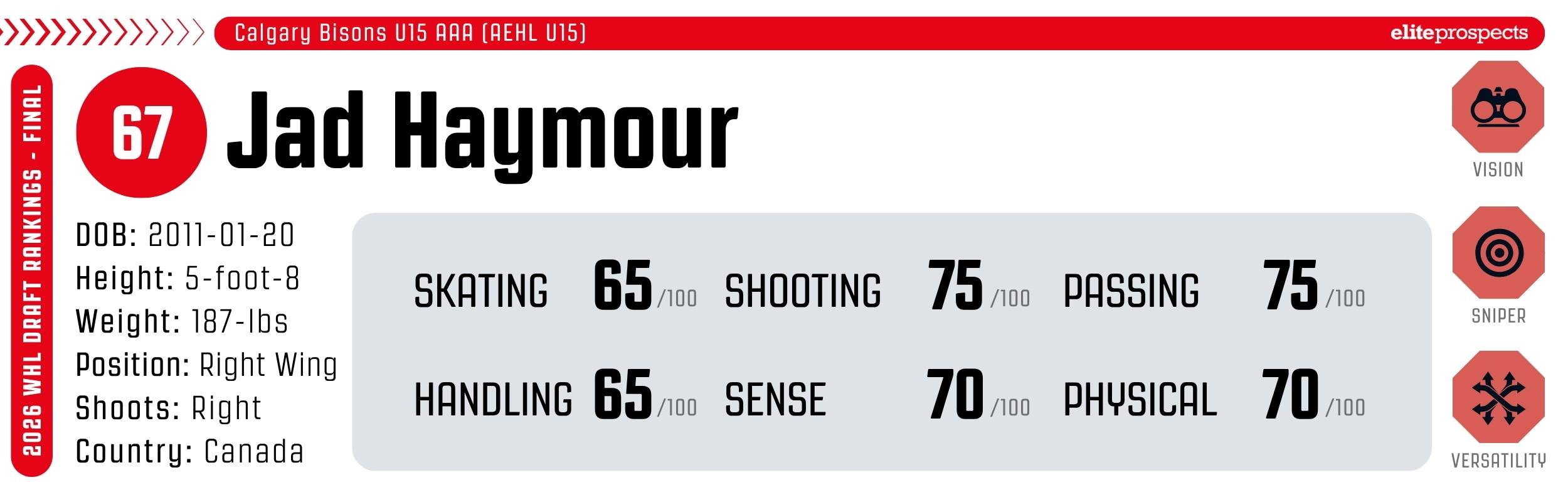
Jad Haymour mastered the art of AEHL U15 scoring this season. He’s a true dual-threat operator and plays the game with a rare level of connectedness. Give-and-gos, one-touch shots and passes, and delays off the rush to use the trailer are all staples in his game. He’s an engaged off-puck player, skating his routes and ramping up the physical intensity when necessary. Translating his game to the WHL will likely require a significant increase in pace, with possession and developing his overall speed. If he can do that, he could become an effective complementary scorer.
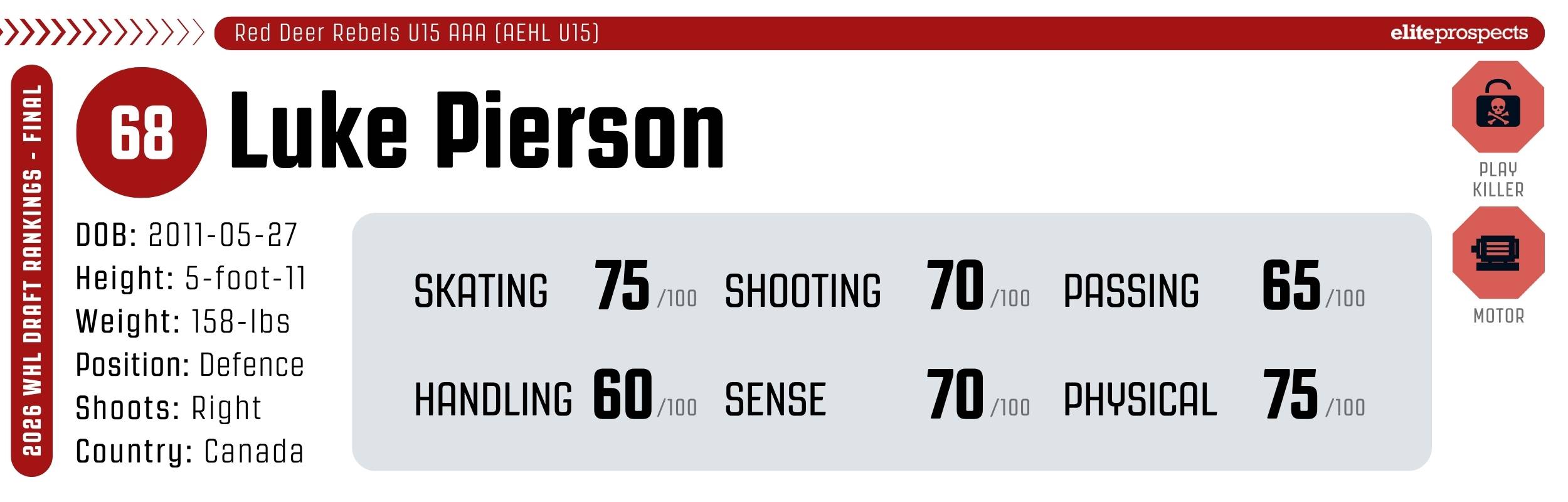
Luke Pierson in a word: Steady. On a high-powered Red Deer Rebels team, he faced tons of rushing coming back the other way and usually found a way to stop them. He’s sturdy in battles, precise in his gap, and mobile enough to make up ground and correct rare mistakes. Rounding out his skill is physicality, shooting skill, and flashes of advantage creation in transition. He’s an easy projection to the next level, with a chance of becoming a wins-his-minutes second- or third-pair WHL defenceman.
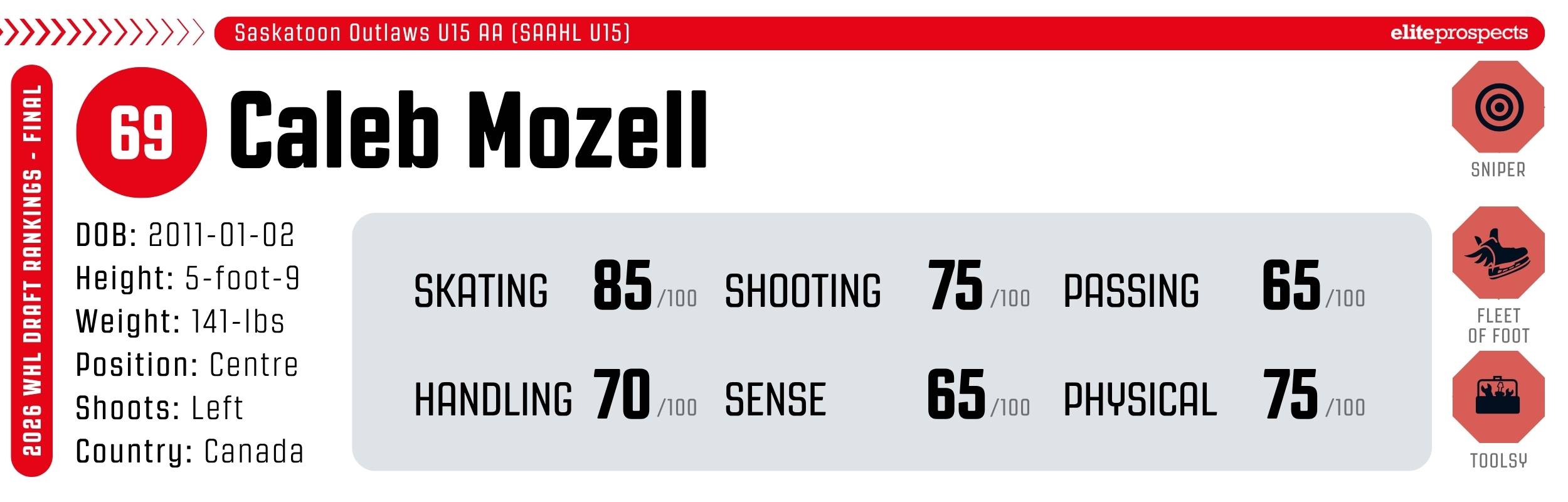
Skating is Caleb Mozell’s biggest advantage, and it is a legitimate weapon. He builds speed through his crossovers faster than almost anyone at this level, and once he has space to operate, the combination of acceleration, a heavy off-rush shot, and sharp positioning gives defensive systems a genuine problem to solve. His defensive reads and engagement without the puck reflect a player whose hockey sense is developing in step with the physical tools. Adding playmaking vision and creation is the natural next developmental step. As that layer develops, he projects as a middle-six centre at the WHL level.
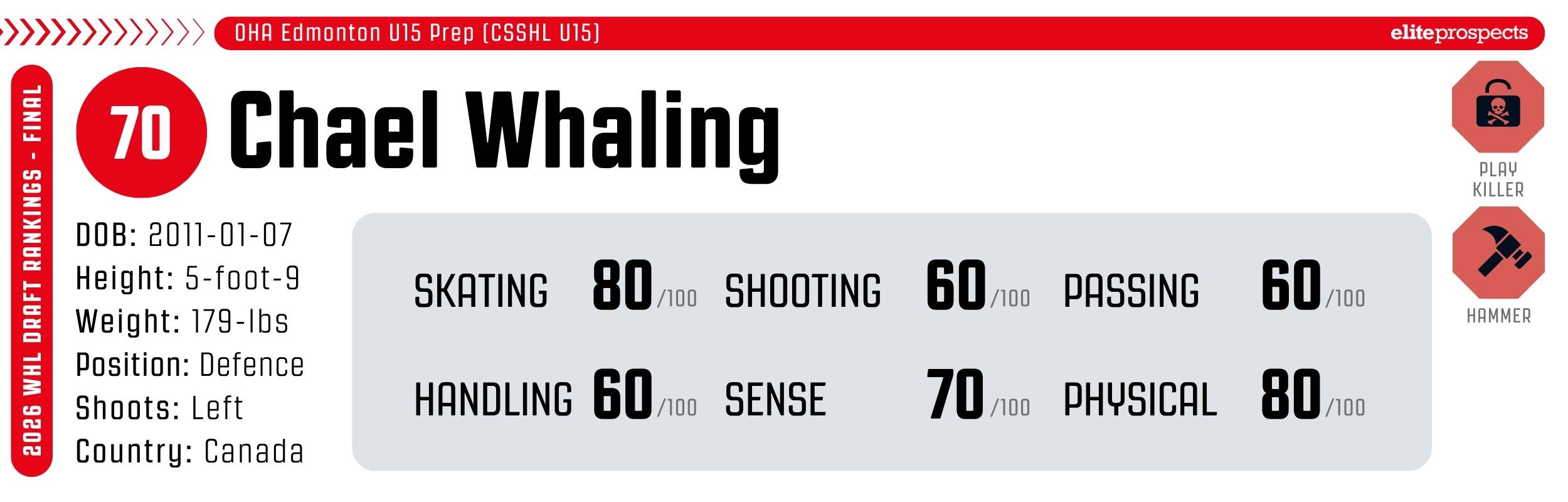
One of the best rush defenders in this age group, Chael Whaling is impossible to beat some nights. It starts with mobility, as Whaling easily closes gaps and makes up large distances to get stops. He’s physical, and doesn’t chase, instead angling opponents to the perimeter. He’s active in joining the rush, and occasionally creates. In all likelihood, his shutdown skills will be what gets him to the WHL, perhaps in a third-pair role.
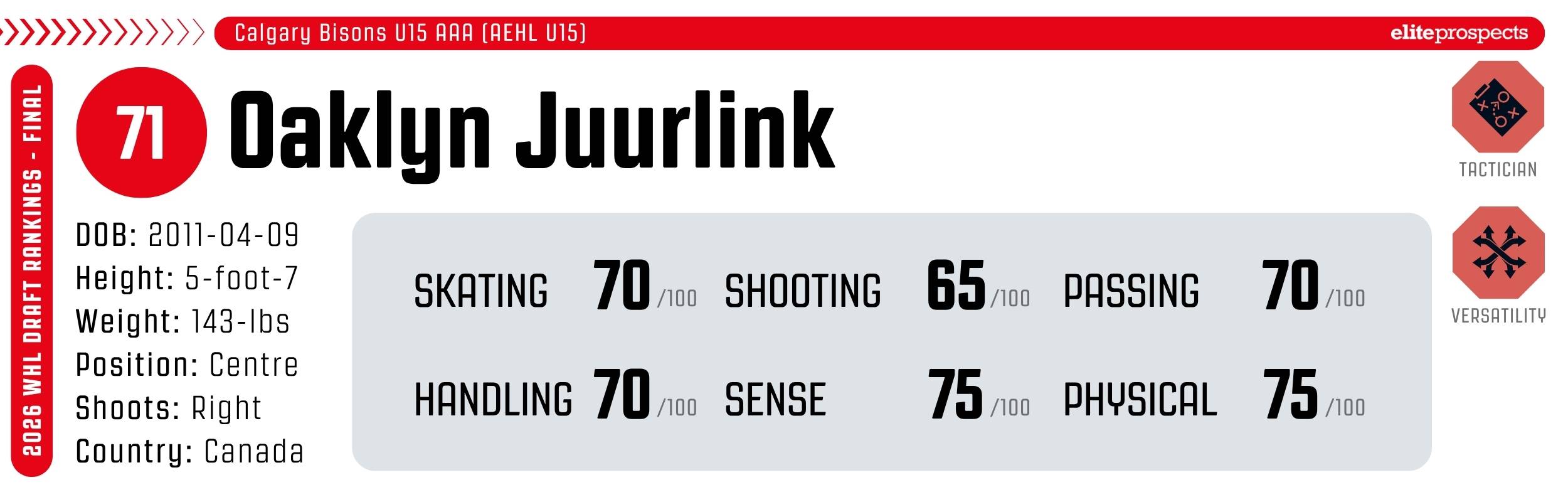
Oaklyn Juurlink is a connected, detail-oriented forward whose value shows up most clearly in the way he keeps plays alive. He leverages give-and-gos and slip passes to find teammates in dangerous positions, and his frame gives him a genuine physical edge along the wall that he uses effectively. He uses his speed to pursue pucks on the forecheck and shows the ability to strip pucks and immediately transition while outrunning pressure. Adding explosiveness is the next step. He profiles as a smart, supportive middle-of-the-lineup piece at the WHL level with the competitive fire to carve out a role.
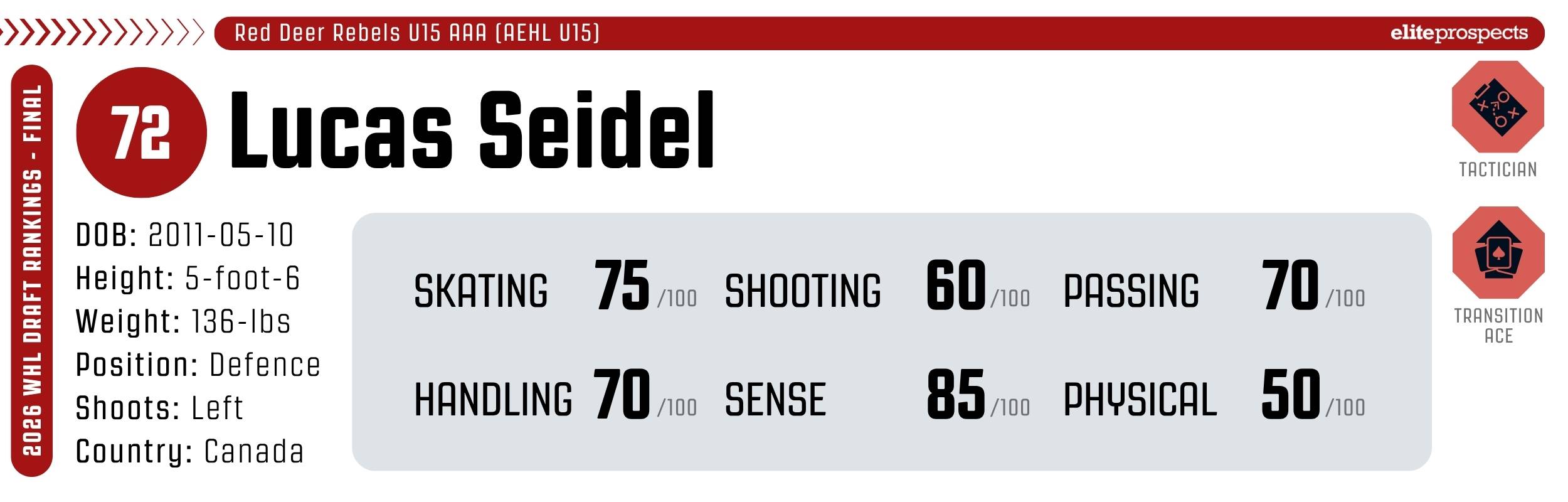
Lucas Seidel might be undersized for a defenceman, but it was largely irrelevant watching him play. His mobility, hockey sense, and activation habits compensate for his physical disadvantage. He walks the offensive zone with a poise that keeps defenders hesitant to press him, makes breakout passes that are clean and consistently on time, and activates with the sense to know when jumping creates an advantage and when holding is the better read. The intelligence and mobility are already projectable, with more offensive upside to develop.
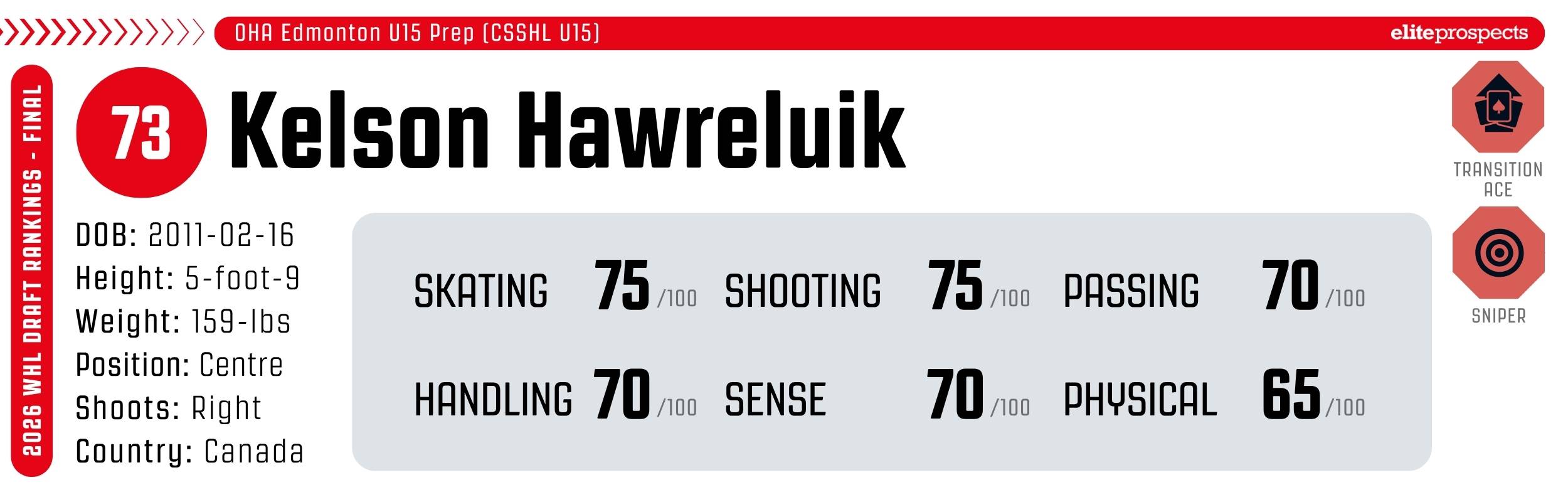
On a loaded OHA Edmonton team, Kelson Hawreluik was one of its most consistent contributors, going pointless just six times in 31 CSSHL games. He’s an all-around skill player, making plays off the rush and cycle, firing pucks off the catch, and setting up chances. Over the course of the season, he impressed us with his improving checking skills and defensive acumen. Above all else, we want to see Hawreluik develop a standout dimension. He has a strong base, and there are lots of avenues for him to help a WHL lineup.
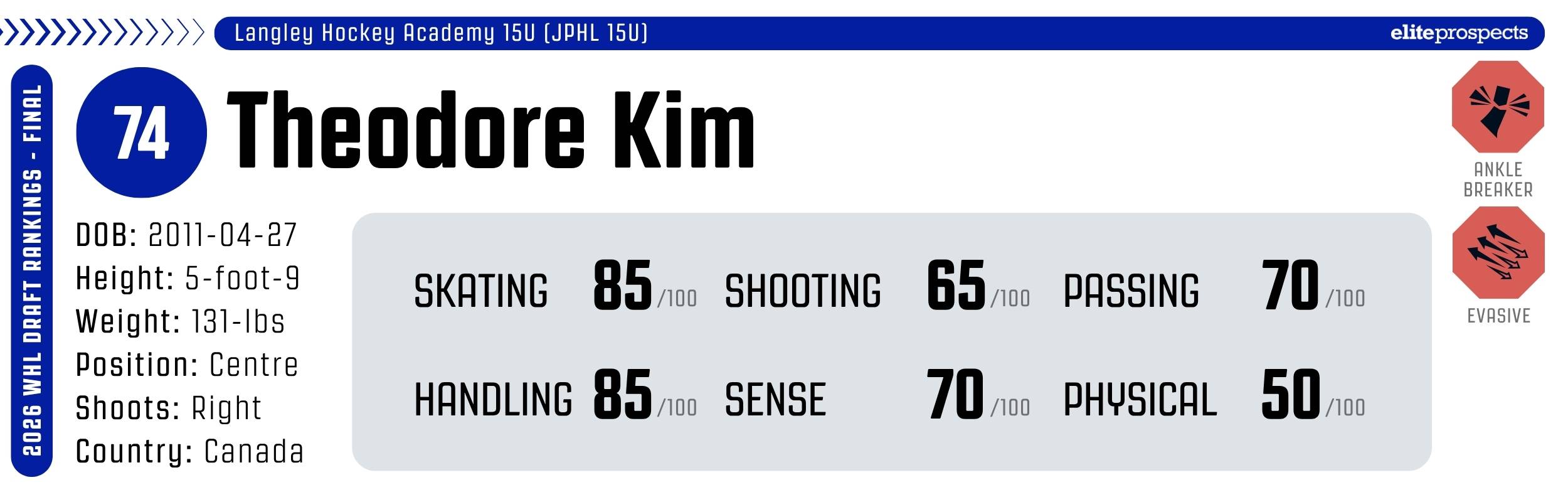
The top offering from the JPHL this season, Theodore Kim is elusive and explosive. He’s incredibly fun to watch, as he will consistently attack defenders with his strong puck skills. He has a level of deception that allows him to trick opponents into committing one way before he explodes another. He’s a skilled passer too, especially when he’s leveraging his skating ability to beat defenders into lanes. He has enough talent and vision to become a future top-six scorer, but he will need to get inside and funnel more to the net to hit.
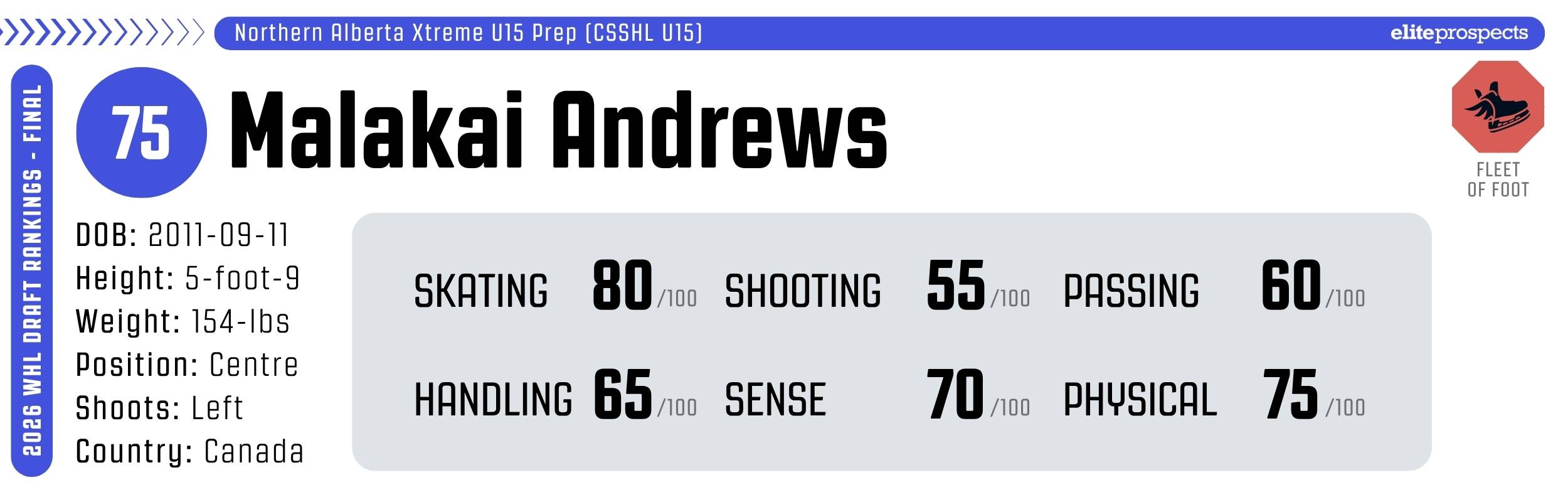
Driven by speed and details, Malakai Andrews could surprise. He’s a diligent off-puck player, skating hard for pucks, closing lanes, battling for every inch of the ice, and always moving. Given that skill set, it’s no surprise that NAX uses him primarily in a defensive and penalty killing role. But there were times where we wondered if the role was masking his skill, as he showed in-motion handling skills and deceived to create passing lanes. Likely, he’s a checking projection in the WHL, but there’s breakout potential, too.
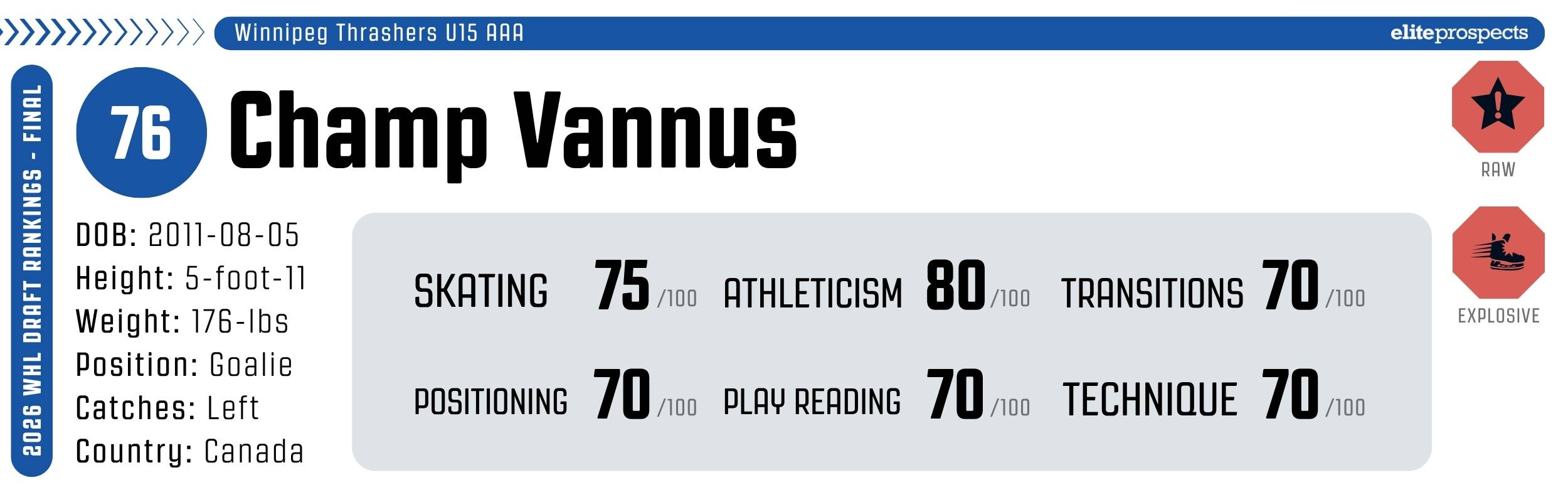
Champ Vannus has cemented himself as the top goaltender out of Manitoba this cycle. Vannus earns his spot as our fourth goalie off the board with tantalizing flashes of athleticism and a super high compete level. His stellar explosiveness gives him the chance to stop any opportunity, and he’ll do whatever it takes to make the save. Vannus also has a heroic, game-stealing ability, with multiple 40-plus-save wins this season. At times, he can put himself in sticky situations where he has to lean on his athleticism to bail himself out, but if he can adopt a more grounded style of play, there’s a lot of potential.
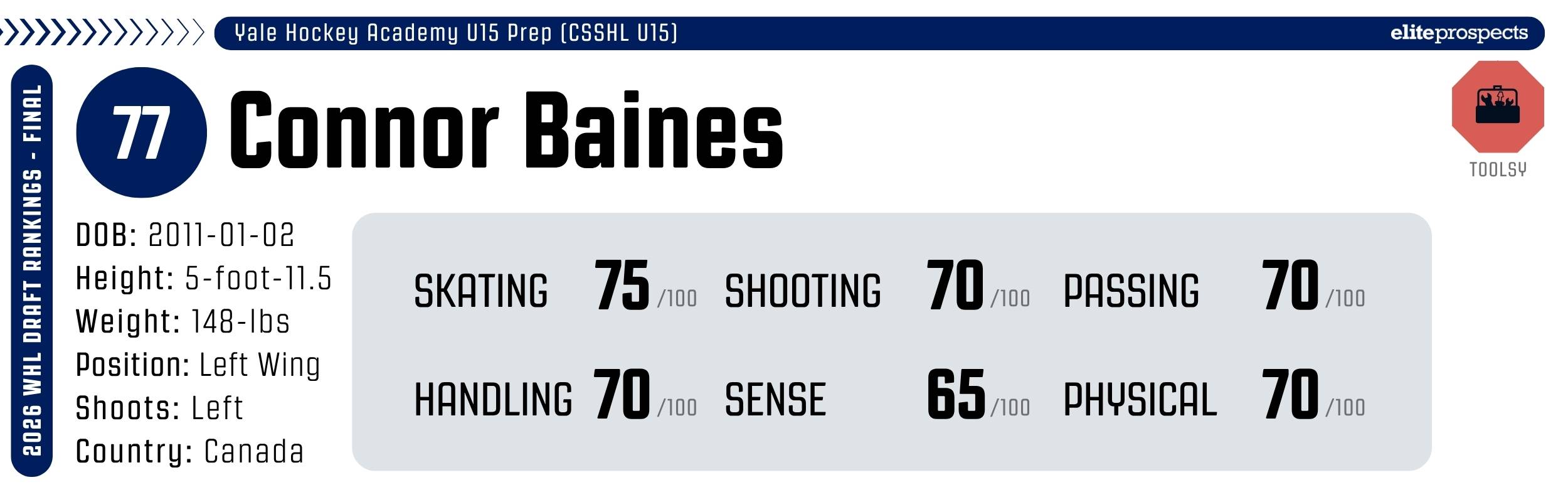
Connor Baines spent his season playing with two of the top prospects in this draft, which is no easy task. With only so many puck touches to go around, he made his impact through his work ethic and connective passing. He has physical tools, with his skating and puck skills both being above average. Baines is a support player, digging pucks out of dirty areas and making smart, simple passes to his teammates. His shooting is also translatable and adds to his toolkit. If he hits, it’s likely as a bottom-six supporting winger.
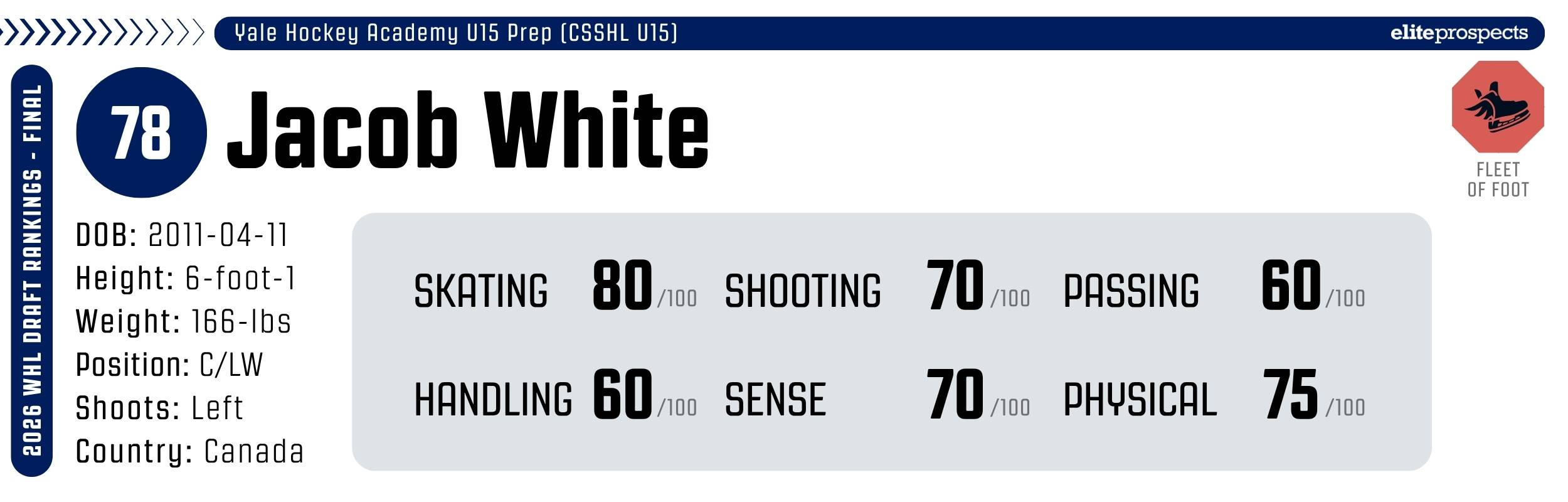
The physical profile of Jacob White is incredibly intriguing. He’s a strong skater, using his speed to put pressure on his opponents, specifically while forechecking, but also while backchecking. He uses his reach and speed to be incredibly disruptive to opponents’ breakouts, reading where the play is going and getting in the way – he’s constantly turning defence into this offence this way. Producing at nearly a point-per-game clip, he packages offence in with his high-end defensive profile. He was a big part of Yale’s elite penalty kill this season. Adding playmaking and deception could up his ceiling, but as of now, he projects as a bottom-six penalty killer.
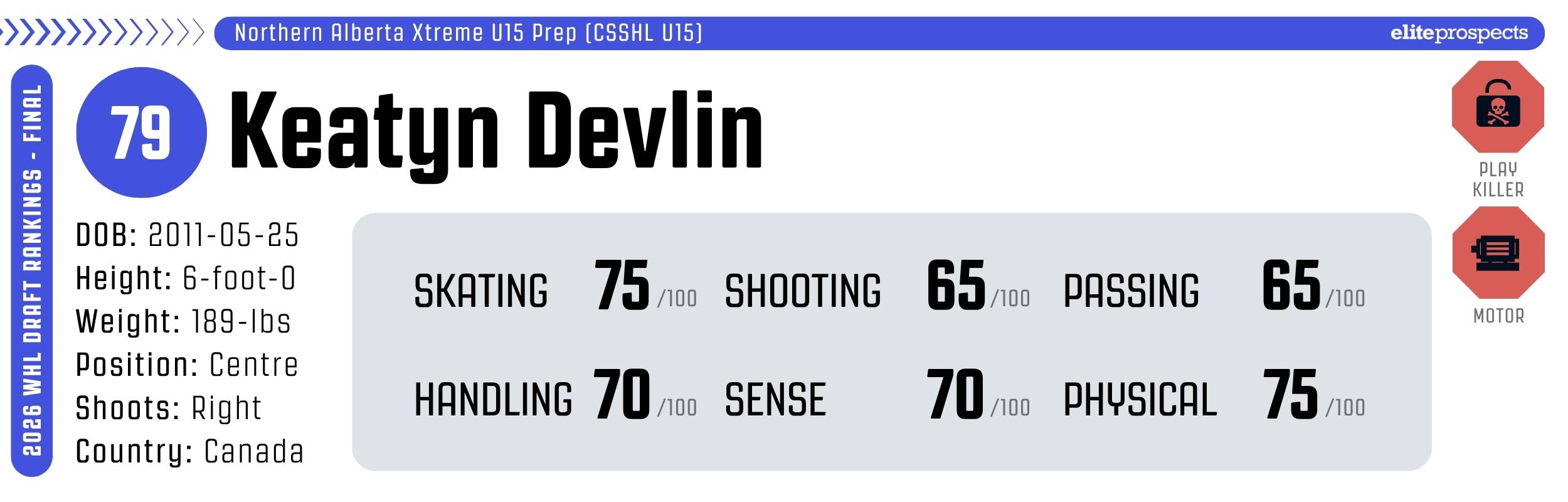
Keatyn Devlin’s game is built on reliability and effort. He backchecks responsibly, forechecks with urgency, and uses his stick to disrupt entries and create turnovers rather than waiting for plays to come to him. The skill layer is there underneath: well-timed cutbacks through defenders in transition, clean wall retrievals, and dangerous slot-passing ability reflect a player whose details extend beyond energy alone. He projects as a high-impact checking forward.
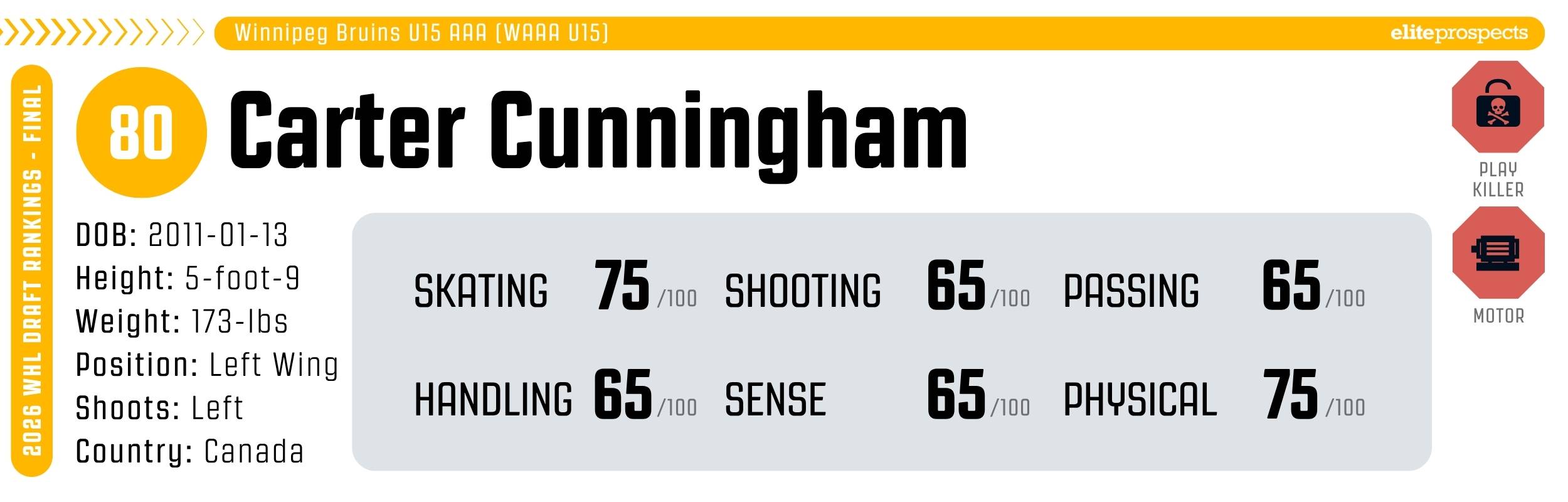
Carter Cunningham's motor is always running, intercepting breakouts, turning steals into immediate transition attacks, and competing fearlessly on the penalty kill, including throwing himself into shooting lanes without hesitation. While his game is built on work rate, his offensive ceiling is rising as he shows increased confidence in his puck skills, rush patterns, and ability to take calculated risks in the offensive zone. Improving his defensive zone positioning and adding lower-body explosiveness will raise his ceiling. He projects as a bottom-six checking forward.
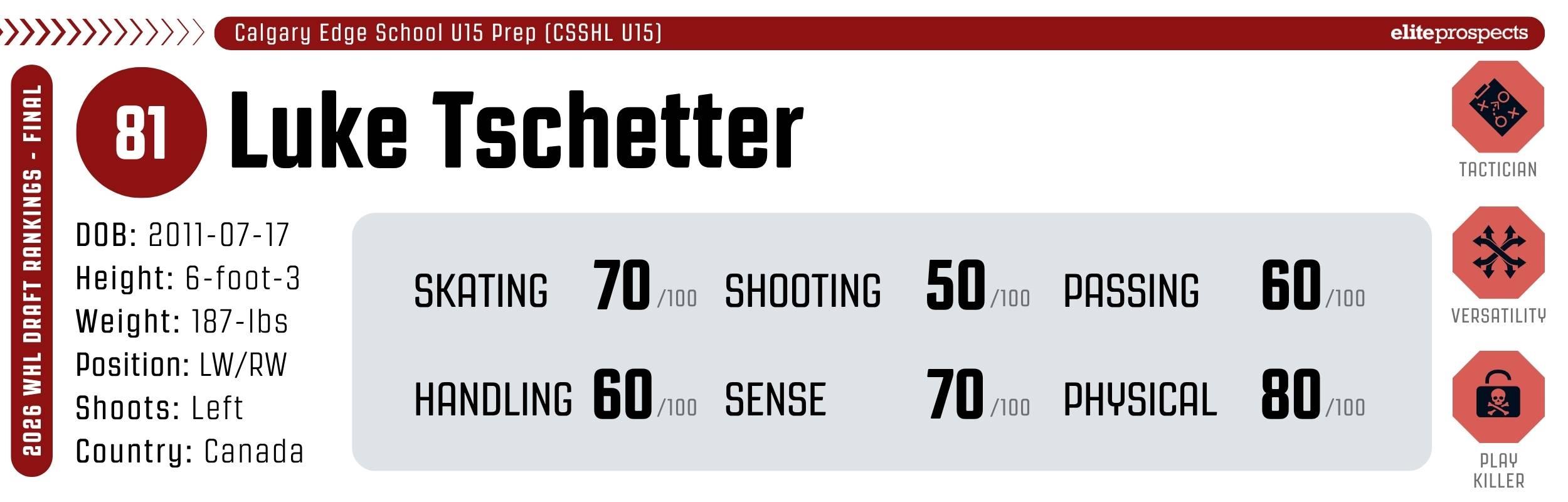
Luke Tschetter is a pain to play against. He leans into opponents, completes his checks on the forecheck, converts puck battles into immediate transition attacks, and plays with an edge that never turns off. The offensive dimension is more present than the points suggest, whether that’s a feathered pass to a trailer on entry or a quick-release wrister under pressure. Developing the change-of-pace game and leaning into the transition could make him a versatile bottom-six forward.
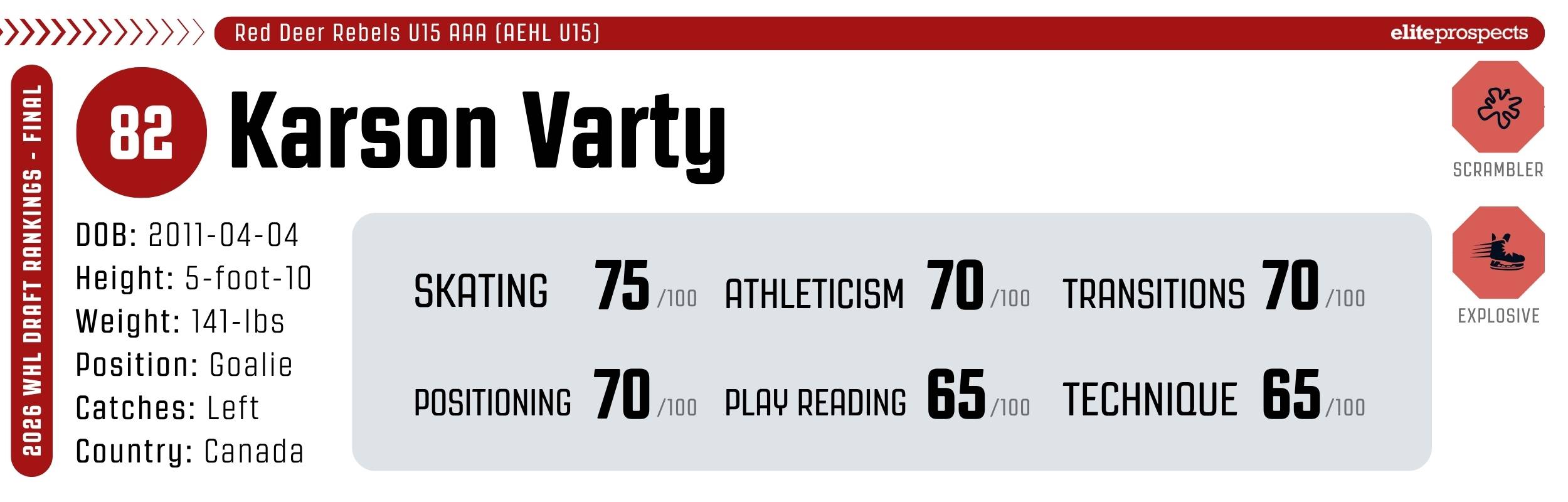
If you’re looking for eye-popping athleticism, look no further than Karson Varty. At the Alberta Cup, he wowed the crowd with repeated dazzling saves. Varty flies in full extension in the slide, but can slam on the brakes and change directions in an instant. The skating is a big upside as well, with quick feet and nifty edgework. What holds back Varty is his size. He’s listed at 5-foot-10 and is susceptible to getting beaten high above the shoulders. If Varty grows and improves on his positioning, he’ll be worth the bet.
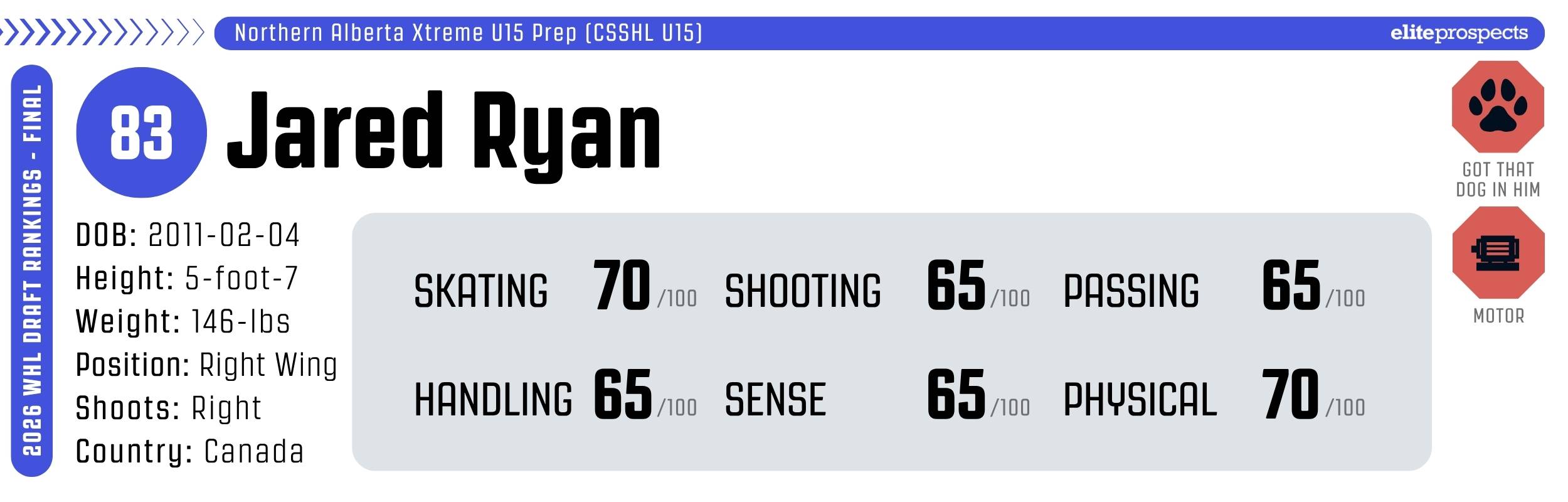
Jared Ryan is tailor-made for a WHL checking role. One of the most intense players we saw all year, he makes his impact through non-stop contact, heavy hits, and immense pressure on the penalty kill. It’s not just effort, but also details: Getting above the puck, angling, etc. There are flashes of in-tight skill, too. The caveat is that Ryan is significantly undersized for the WHL, but he won’t need to grow that much to make it.
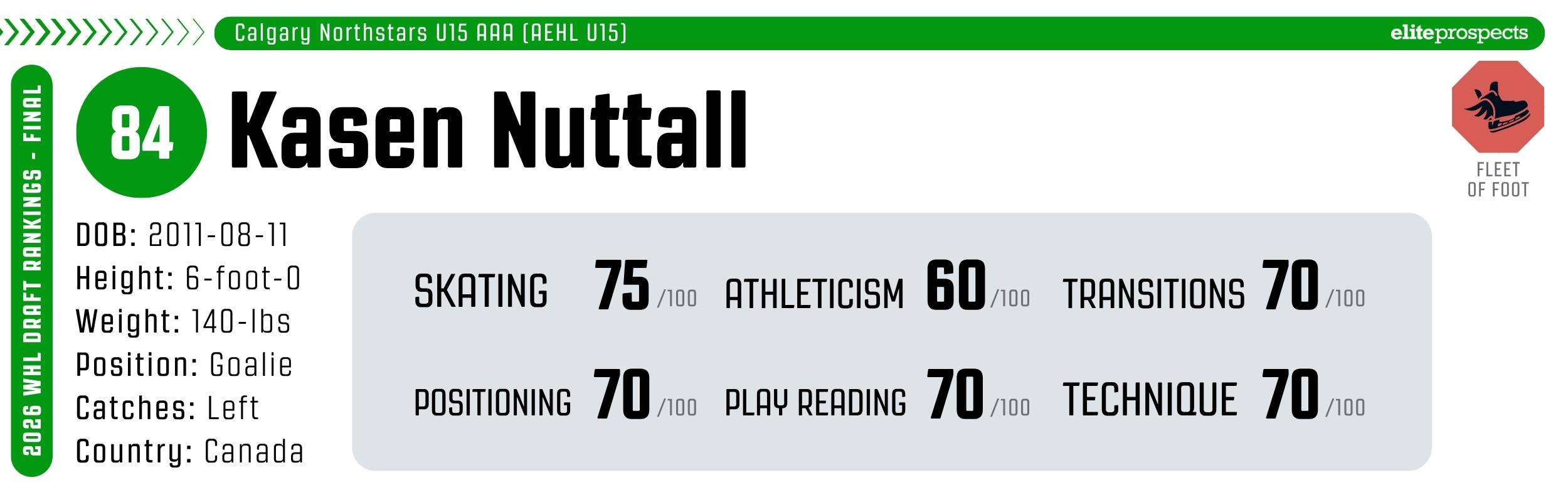
Kasen Nuttall led all 2011s in save percentage in the AEHL and gave the Calgary Northstars a chance to win every night. He was remarkably consistent despite being subject to 40-shot onslaughts game in and game out. Nuttall trusts his positioning and hands to make saves. He’s composed under pressure and skates quite well. The footwork is efficient and tactical. Tracking is another strength as he’s able to both read releases and track through the trajectory of the shot. Nuttall lacks explosiveness, but at 14 years old and having a slimmer frame, there’s room for growth.
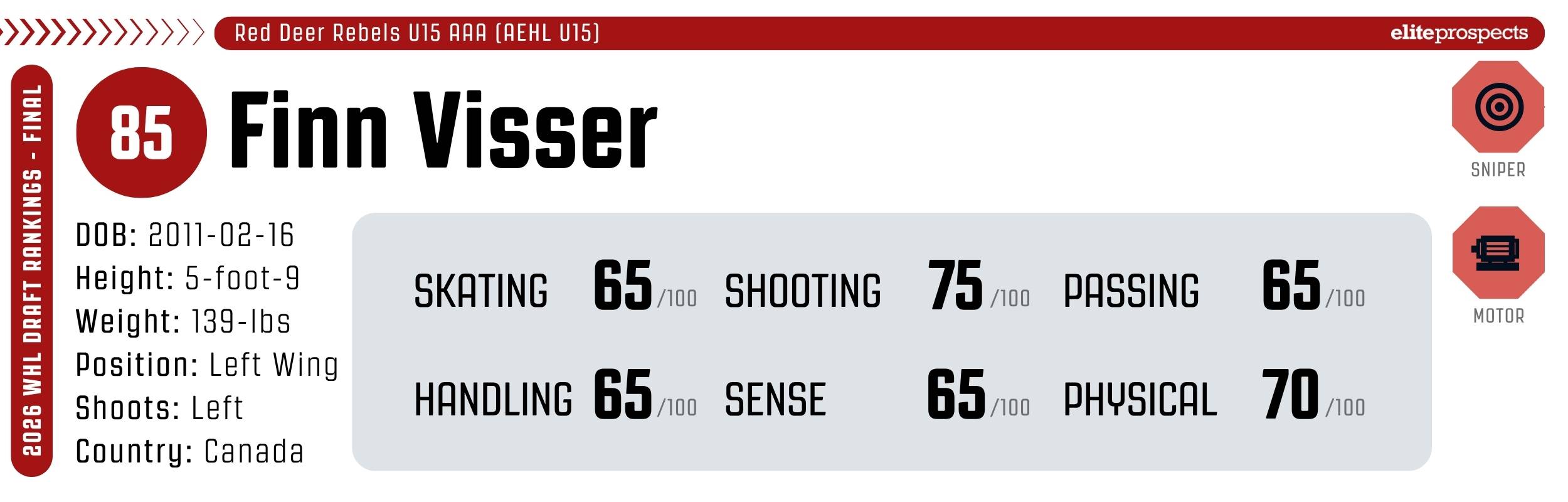
Playing with top-end talents like Daneault is a skill in itself, and Finn Visser was up to the task. A shoot-first winger, he powers around traffic and pump fakes to open shooting lanes, and most importantly, he’s a really skilled off-the-catch scorer. Rounding out his skill set is his forechecking value and physical skills. He gets on opponents quickly, forcing turnovers and instantly redirecting them towards the net. In time, he will have to develop a playmaking side, as his pace advantage will decrease against better competition. He’s a potential third-line scorer in the WHL.
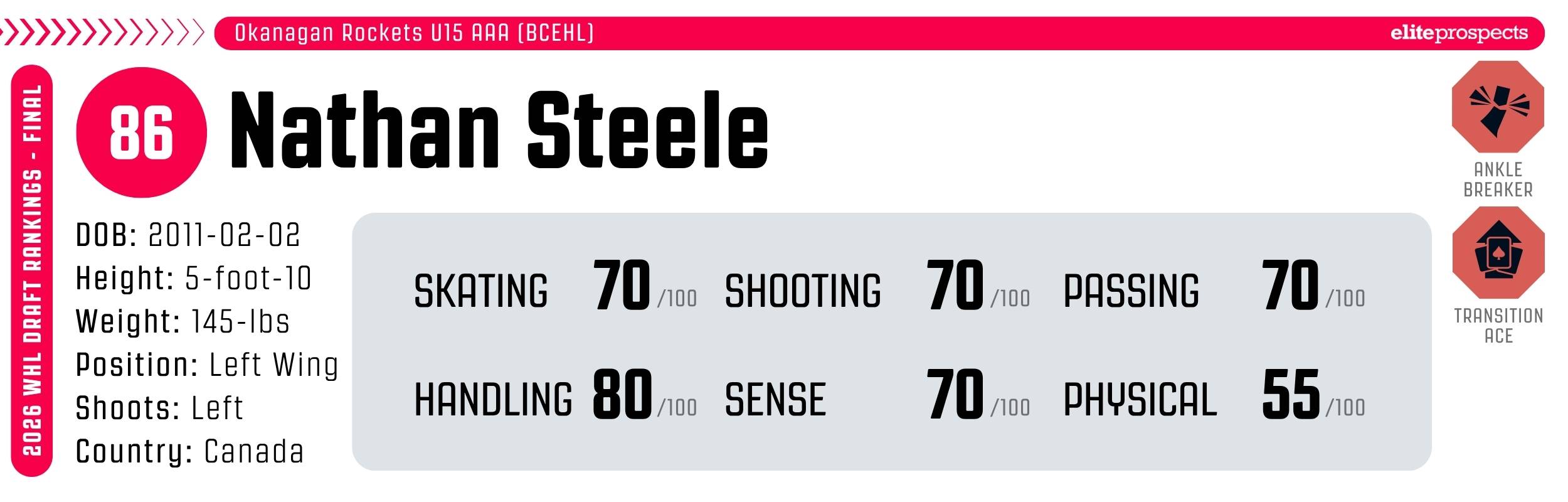
Nathan Steele was the top producer for his team this year, and one of the BCEHL’s top overall scorers. He’s able to create offence with smart passes and high puck skills that allow him to take the puck out of the corners and off the walls into the heart of the ice. He has the skill to beat defenders head-on, sliding through them and into dangerous areas. His playmaking got better as the season went on, contributing to his overall offensive profile. It’s an uncertain projection, but given that Steele can both complement high-end players or drive play himself, he could develop into a middle-six forward.
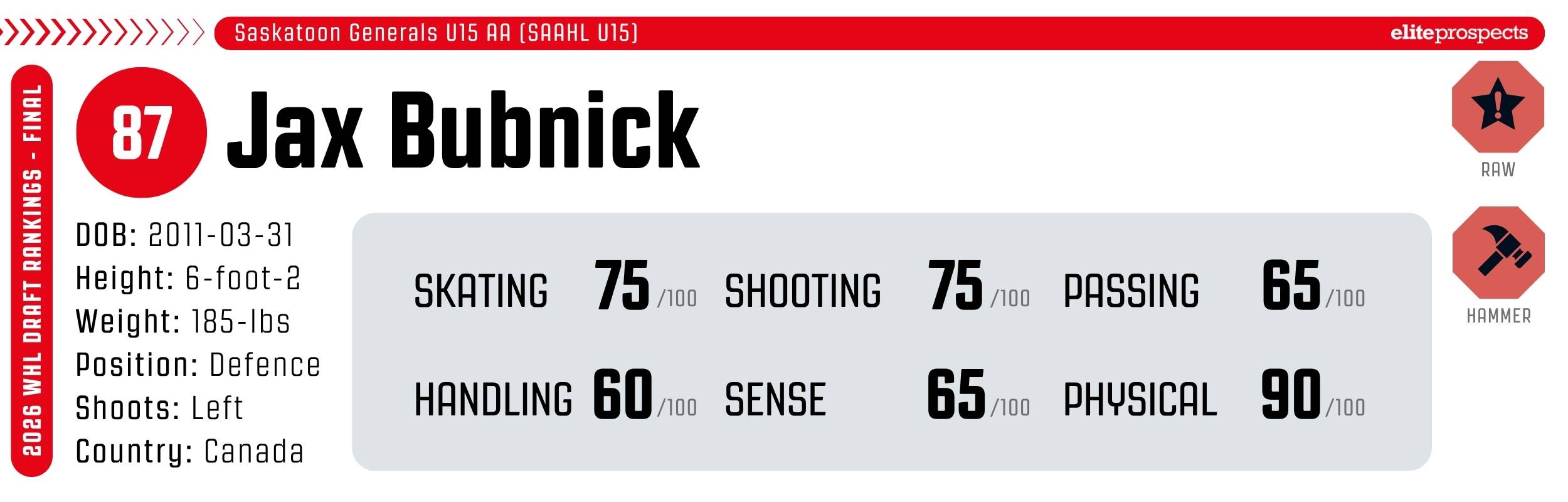
Jax Bubnick is an imposing 6-foot-2 defender who plays with physical authority. He shuts down wall battles with size and reach, defends the rush through solid positioning and an active stick, and brings an offensive drive that gives him a dimension beyond pure shutdown ability. His activation habits are a genuine strength, and a heavy point shot gives him real power play upside as those instincts continue to refine. The first-step acceleration and pivot speed will need to develop, but the size, physical edge, and instincts are already projectable. The skating development will define how high this projection ultimately sits.
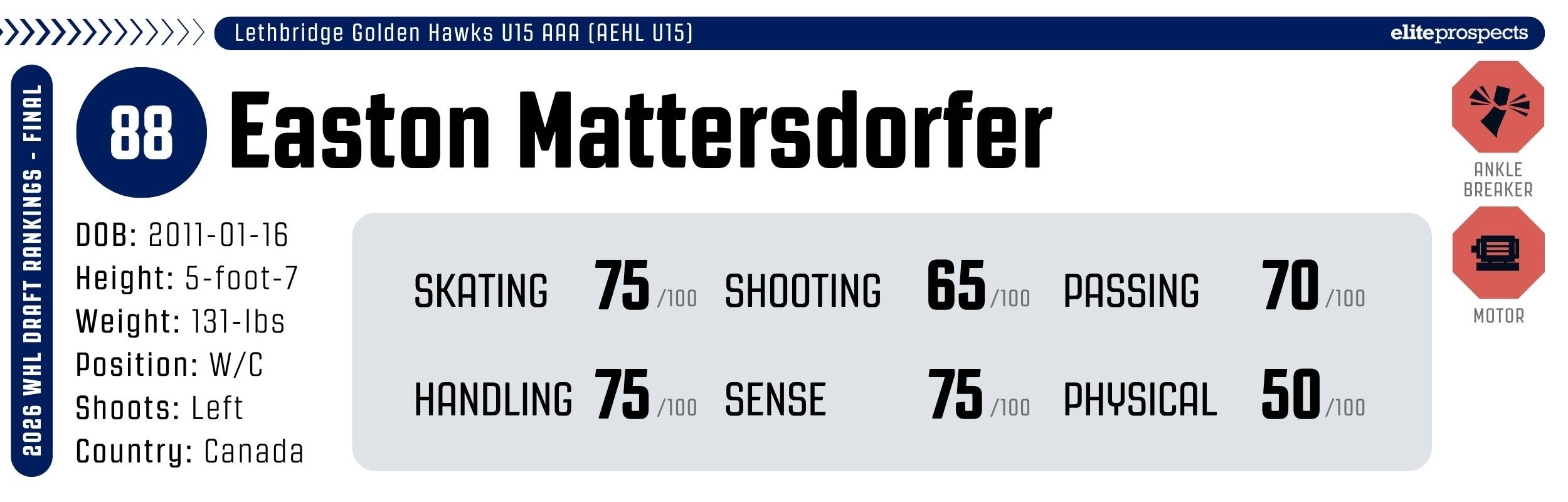
Easton Mattersdorfer may be smaller in size, but he never lets that define his play. His strong edgework, puck handling, and creativity in traffic make him a real offensive threat, even though his physical profile might suggest otherwise. He consistently battles hard along the boards and never shies away from physical play. He moves past defenders with quick edges, uses soft hands to drive to the middle, and always stays engaged. As he gets stronger, his mix of skill, effort, and creativity should serve him well. A patient, development-focused WHL team could be rewarded with a productive middle-six forward.
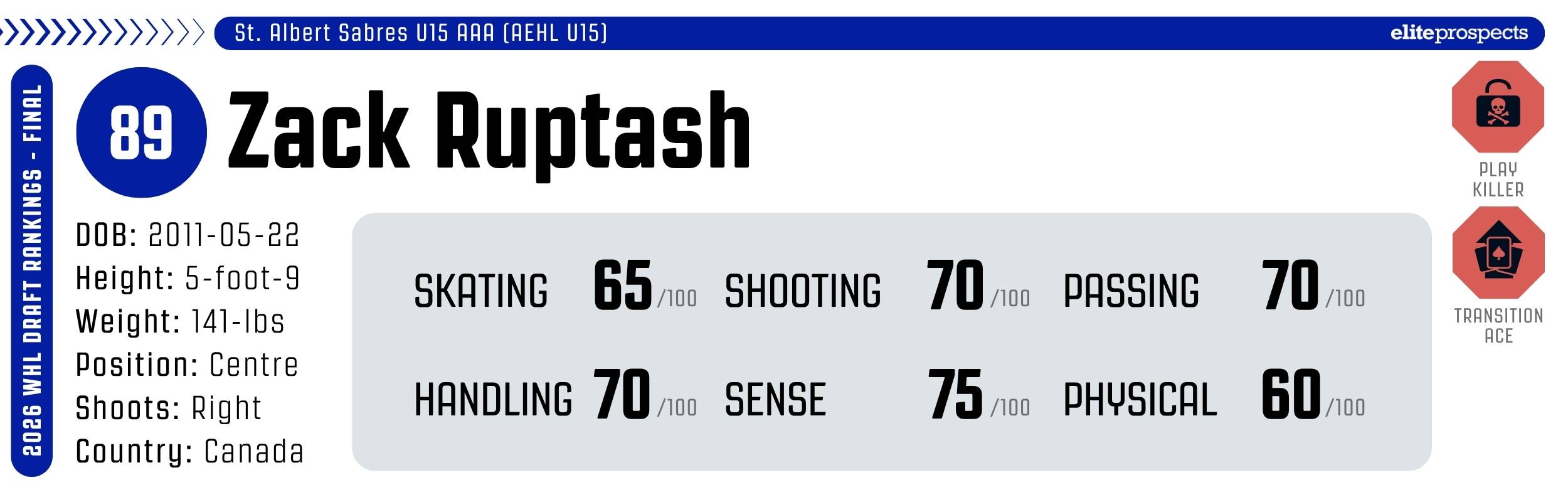
Zack Ruptash is a two-way centre with skill and tools. His east-west transition style, combined with deception to open lanes, makes him difficult to contain in the neutral zone, and his scoring ability from distance and off the rush is a constant threat. He is equally reliable defensively, with an active stick in the slot and high-effort backchecking. That versatility and dependability across situations is a real and projectable asset. If he grows, he could play a versatile middle-six role in the WHL.
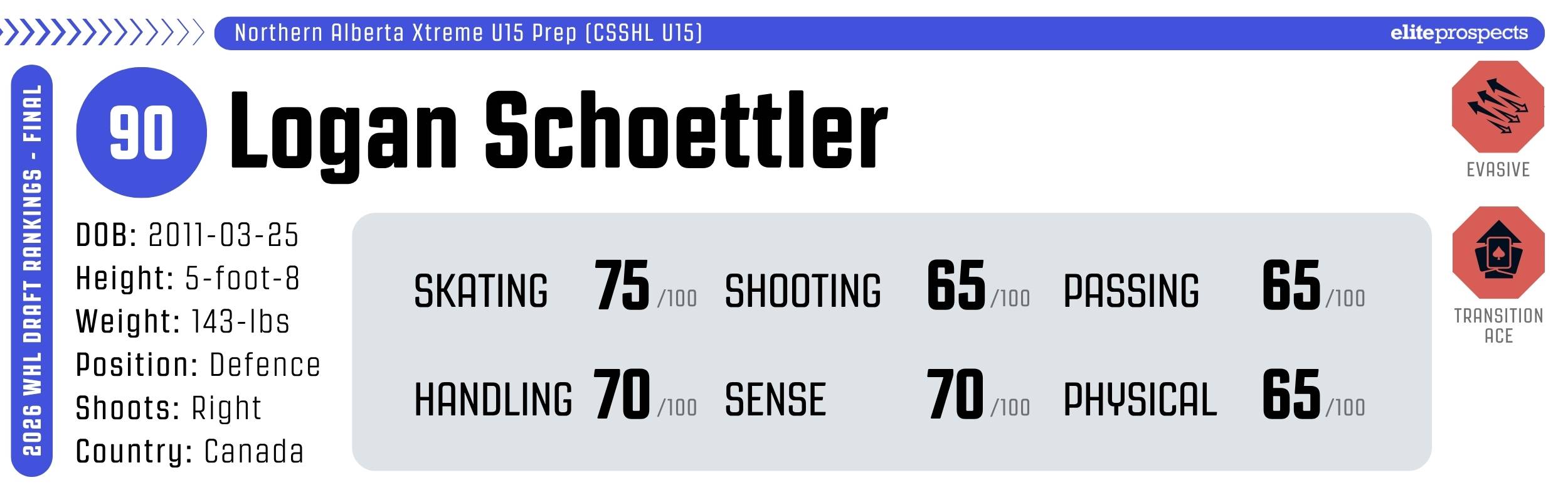
With Logan Schoettler, it’s all in the little things. Precise footwork and a keen sense for timing allow him to make up gaps and angle opponents to the outside. On retrievals, he’s picks up pucks in motion and bumps them back to open teammates. He’s a non-stop scanner, and a frequent participant in his team’s offence through activation and quick-possession reads. He’s not flashy or dynamic, and likely doesn’t project as a scorer to the next level. But his mobility and game management skills give him a chance to play big minutes, provided he can ramp up the defensive pace.
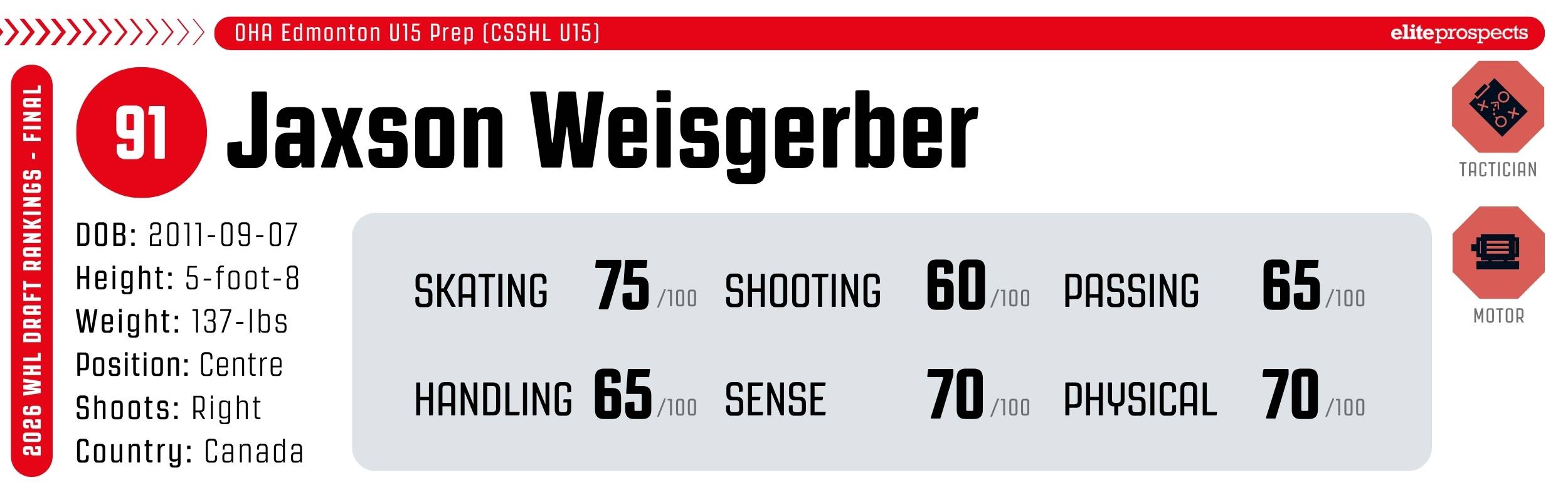
Pace is the engine of Jaxson Weisgerber’s game. He pressures constantly, darts into soft ice, creates screens, funnels pucks inside, and returns defensively with the same urgency he brings offensively. Route changes and delay moves off the rush show a skill layer, and his off-puck creativity generates advantages that do not always show up in the production column. The skating mechanics need refinement to fully unlock how fast his feet actually are. The activity rate and hockey sense are already projectable to the WHL level.
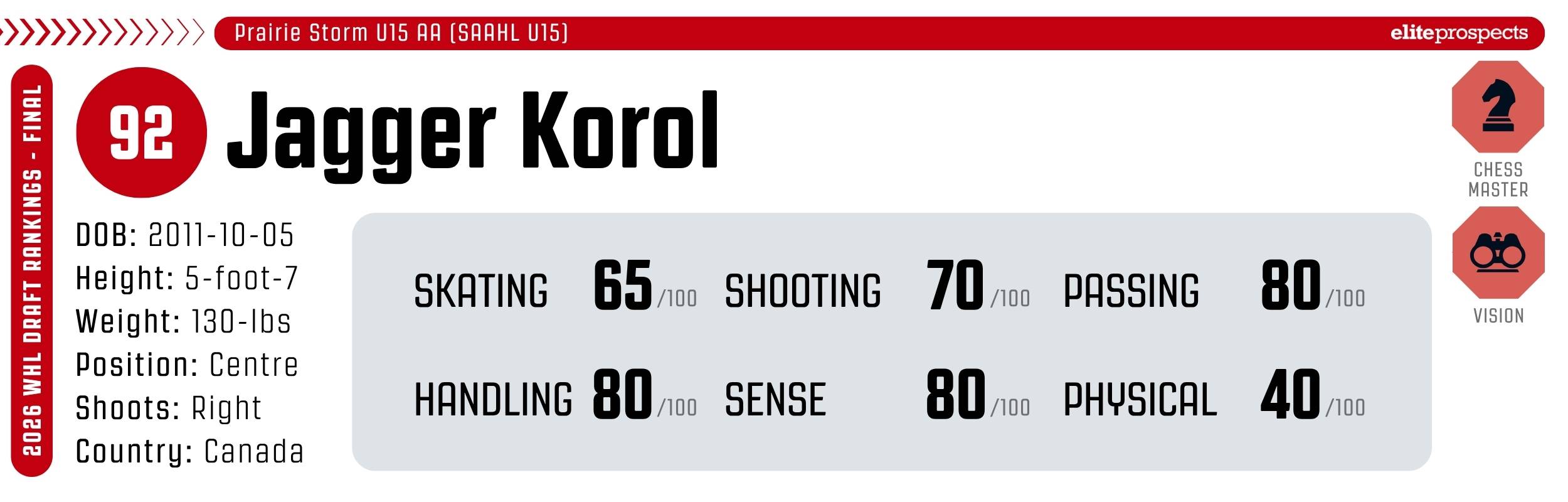
Jagger Korol is a natural playmaker with the patience to look away from his eventual target until the last possible moment. He escapes pressure by slipping pucks back into the slot before defenders can commit, and his deception in tight spaces consistently opens passing options that appear closed. His versatility near the net is evident through his ability to convert one-timers and skilled deflections under pressure. His inside play and net-front creativity give him the profile of a player who could score in the WHL, but his skating and physical skills will have to improve.
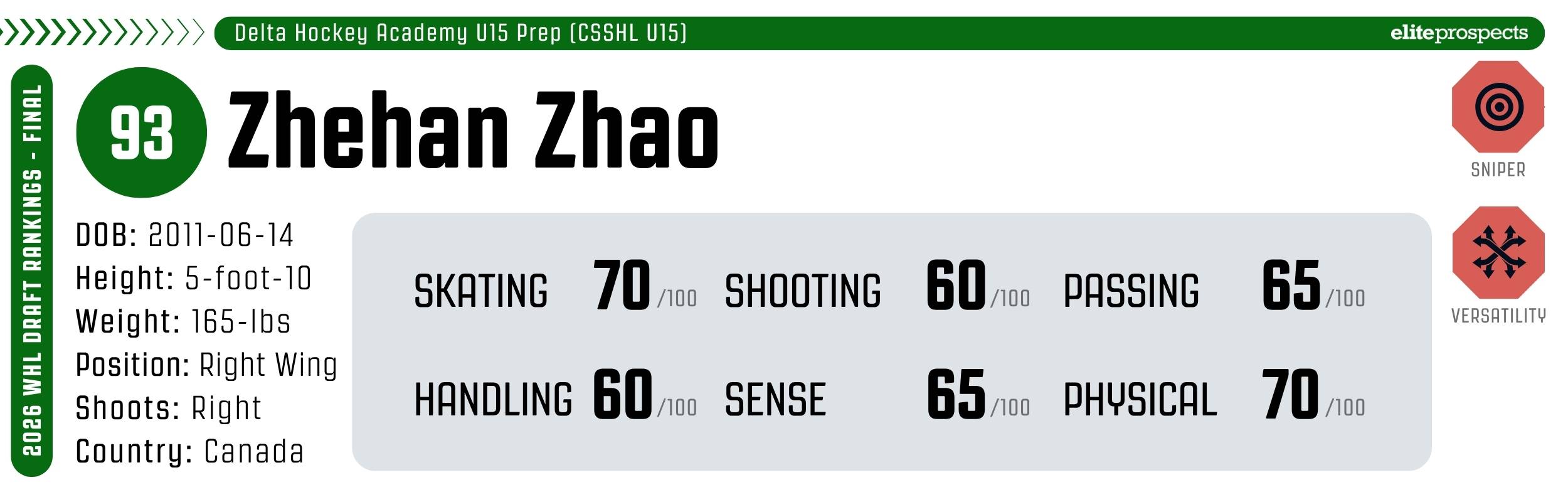
Zhehan Zhao is a great supporting forward, using his skill and great pre-contact skills to win a lot of 50/50 puck battles, getting the puck off the wall and into the hands of his team's most dangerous forwards. He’s a hard worker, with a good motor, and uses his already filled-out frame to overpower opponents, specifically on the forecheck. His smart, simple passes show his poise and help his team attack the middle of the ice. Zhao’s shot can pop, but is inconsistent, showing that there could be a true weapon there with more polish. He could develop into a supportive forward, perhaps in a middle-six later in his WHL time.
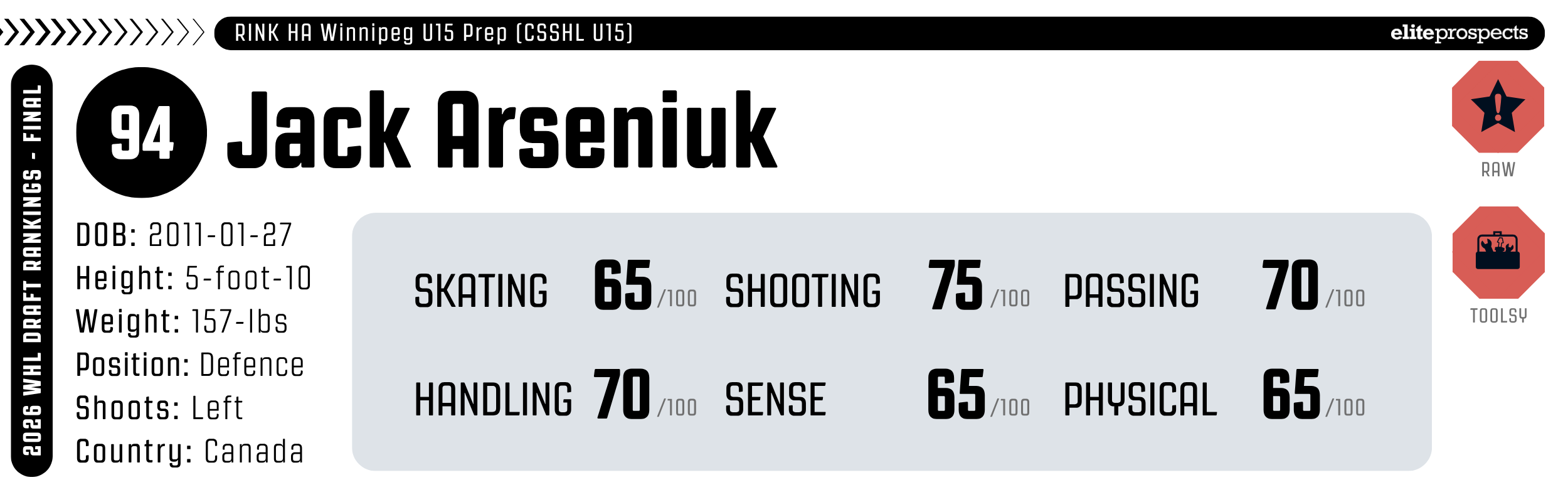
Jack Arseniuk is an active, mobile defender with a two-way profile that he executes well within his current role. He drops opponents in transition with well-timed aggression, defends with composure through his stick and positioning in rush situations, and shows offensive flashes through a heavy point shot and effective power play work. His ability to use cutbacks in the offensive zone to create passing lanes hints at developing puck-management detail. With more minutes and continued development of his offensive assertiveness, a bottom-four two-way WHL role is within reach.
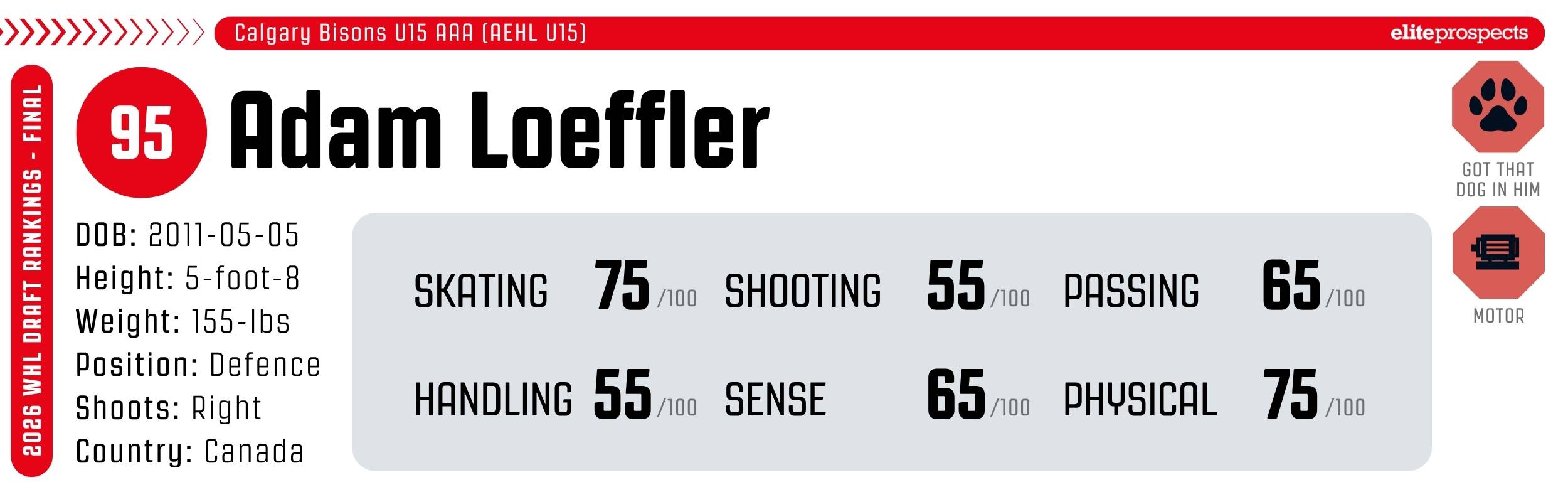
Averaging the fifth-most minutes per night in the AEHL U15, according to InStat Hockey, it was impossible to miss Adam Loeffler. Most big-minute players at this age have to be selective with their energy, but Loeffler never is. He’s physical, intense, and competes every single shift. There’s skill in his game, highlighted by his work to shake pressure on retrievals and then find clean breakout lanes. He’s adaptable, too. He might lack the standout tools of other players in shutdown roles in the WHL, but his motor makes him worth betting on.
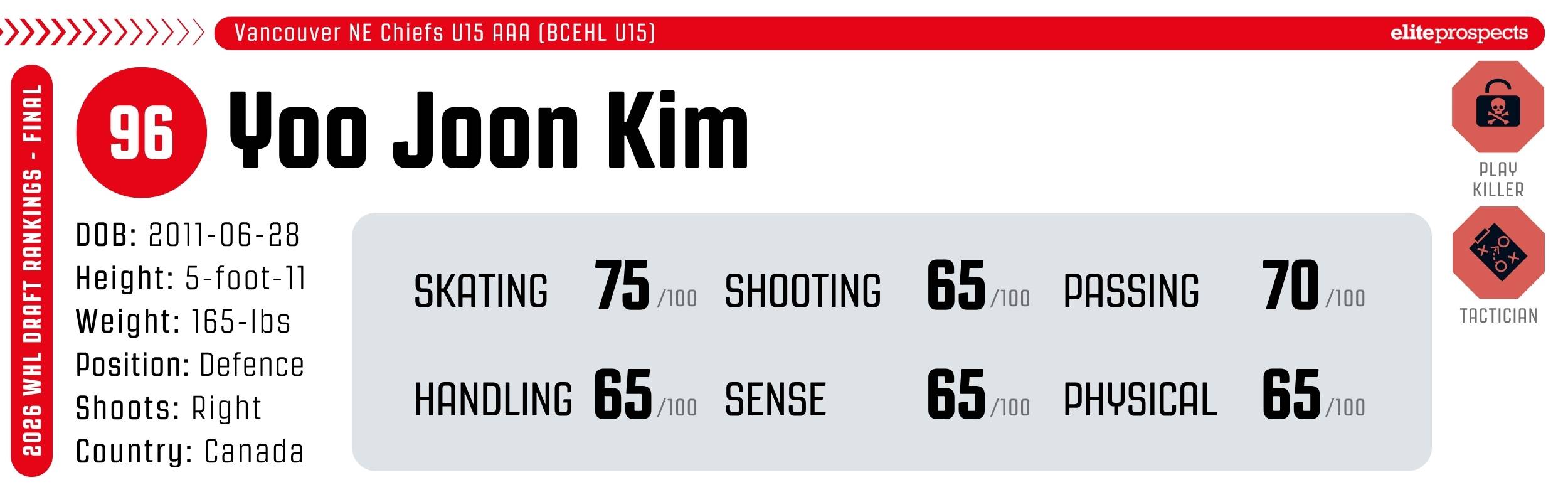
Yoo Joon Kim is a game manager. He’s basically a quarterback on the back-end, able to read plays and make smart passes to cut through defences. When he needs to, he can carry the puck efficiently up the ice, driving into the offensive zone while using his reach to keep the puck out of danger. He does his best work in the neutral zone, as he shuts down plays with his feet before making a smart pass to move it back the other way. Polishing his decision-making and increasing his pace will be crucial to his development.
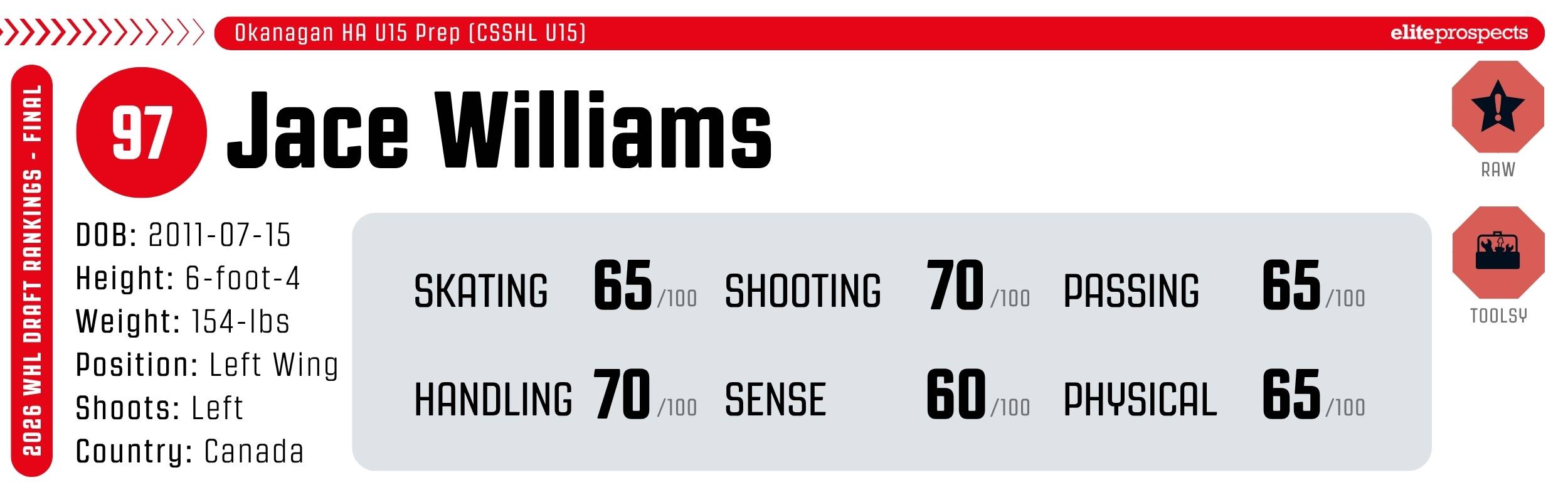
Jace Willliams combines puck skills with lateral mobility to explode and beat defenders wide. His shot comes off his stick with power, and he has the complementary skills to support, such as corralling bad passes. Defensively, he uses his reach to disrupt plays and steal pucks. Still adjusting to his frame, he’s not a particularly smooth skater but he’s naturally quick. Opening himself up to the middle of the ice and scanning more will increase his playmaking. He projects as a bottom-six winger.
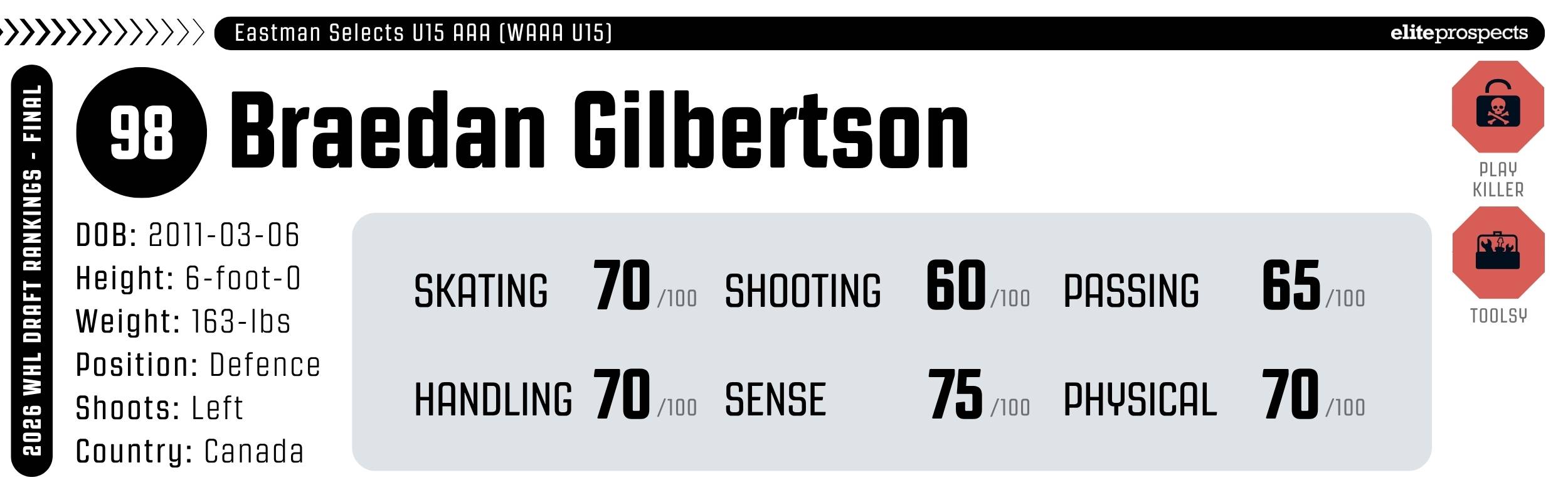
Braedan Gilbertson is a composed, reliable defender. He skates well, defends with an active stick and sound positioning, and rarely looks chaotic or risky with the puck. A smooth first pass under pressure and confident cutbacks behind the net show that his puck management is already above the floor projection. Adding physical assertiveness in tight areas and more initiative with the puck in transition would raise his ceiling. He projects as a reliable, low-risk bottom-four WHL defenceman.
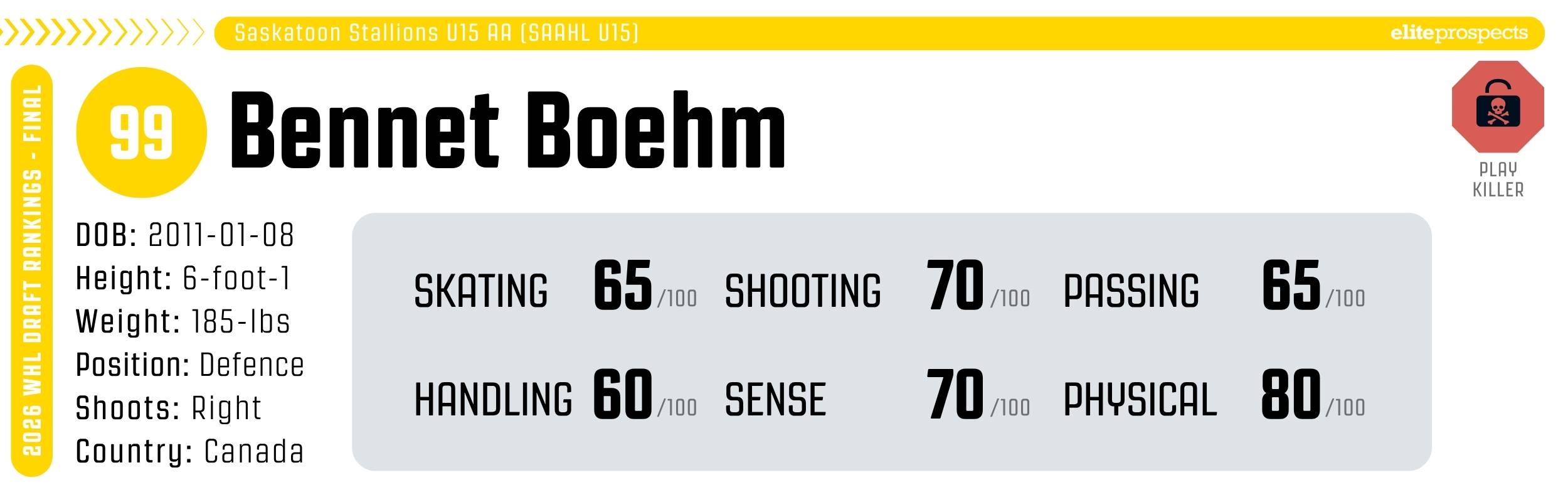
A controlled, intelligent defensive player, Bennet Boehm could earn the trust of a coach quickly. He moves pucks safely and efficiently, communicates well with his partner and his forwards, and prioritizes positioning over aggression. His rush defence is patient and composed, combining lateral movement and an active stick to angle attackers wide and protect the slot. The offensive instincts are present, particularly a shoot-first mindset at the point and the ability to carry pucks end-to-end with clean crossovers. Sharpening the timing on his pinch decisions and building more confidence with the puck on the breakout will determine whether he develops into a 200-foot defender or settles into a reliable shutdown role.
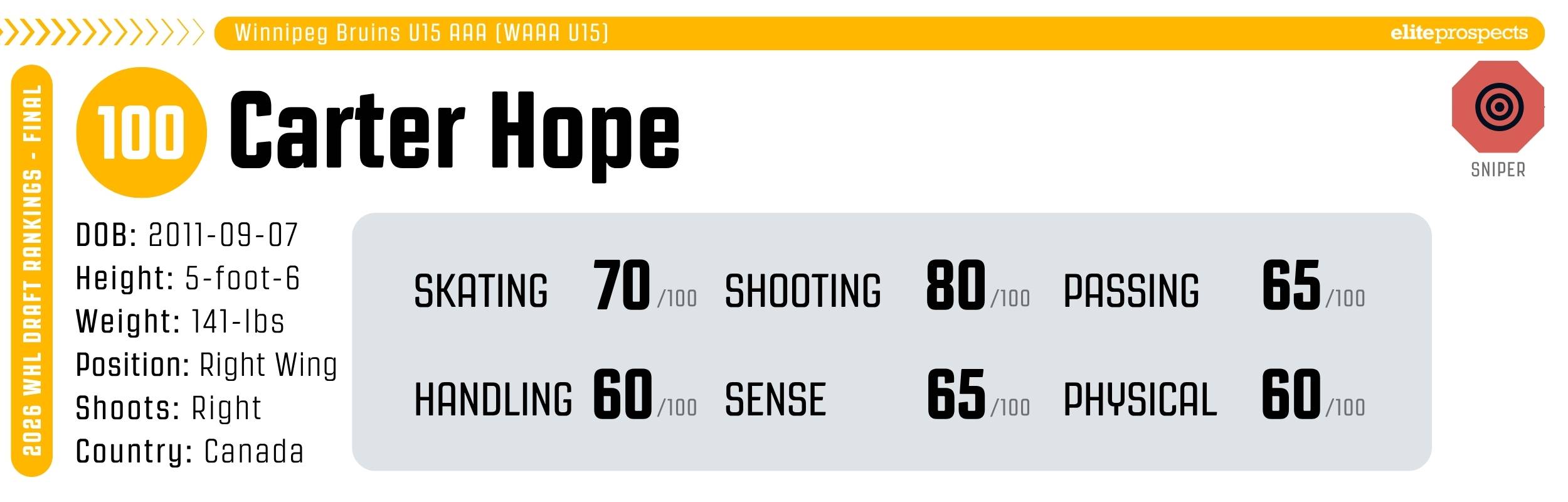
Carter Hope has a dart, and it makes him dangerous from virtually anywhere on the ice. He can turn a low-percentage look into a clean goal with no help, and his ability to score off the rush, off the pass, and from range makes him genuinely difficult to account for. Beyond the shot, he moves well with the puck, makes confident carries through the neutral zone, and shows smart, low-risk decisions when a shooting lane is unavailable. Layering consistent playmaking onto his dangerous scoring profile will make him even harder to defend. He has a chance to develop into a top-nine scorer.
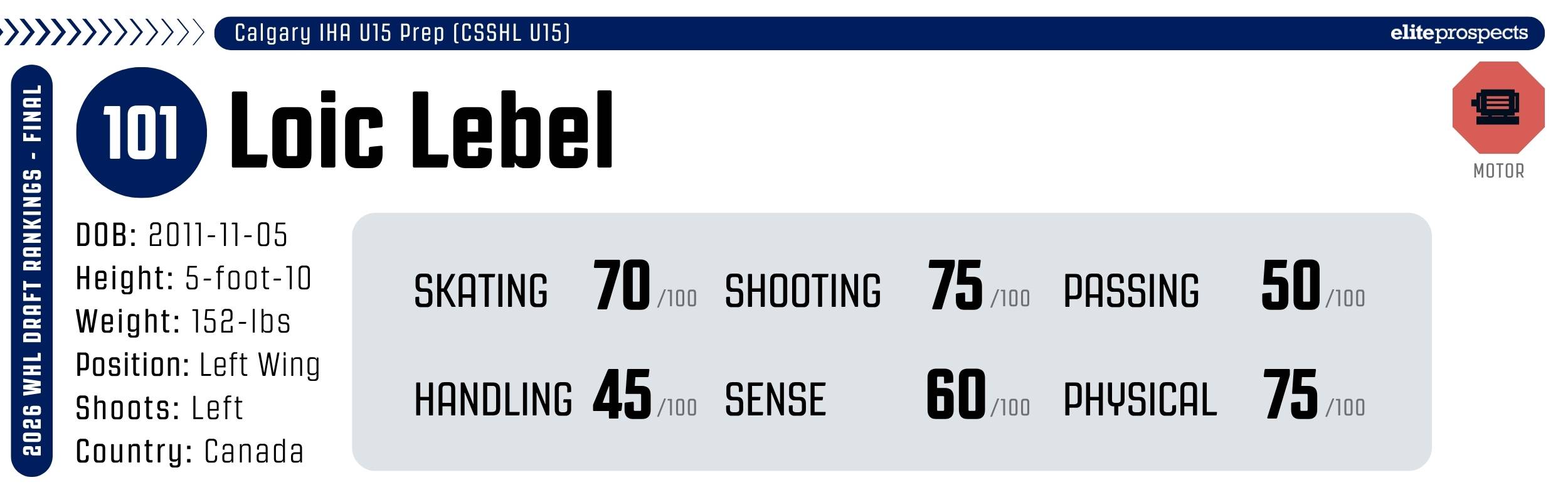
It doesn’t take much imagination to picture Loic Lebel in the WHL, playing with a physical edge and winning plenty of pucks. He’s an intense forechecker with the skill to capitalize on the turnovers he generates. A heavy wrister is his standout offensive trait, capable of picking his spot through traffic. He also shows transition skills that, with more of a playmaking focus, could allow him to thrive in a third- or fourth-line role in the WHL.
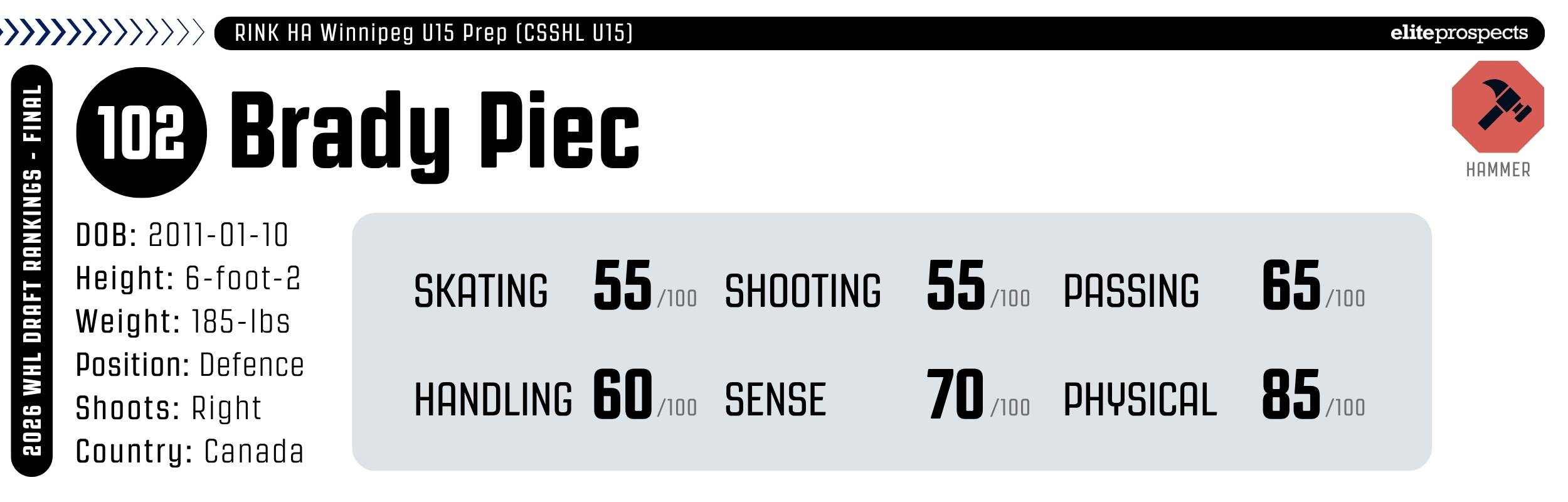
A big, imposing defenceman, Brady Piec has a lot of WHL elements already. His positioning and stick detail are reliable, his rush defence is patient and composed, while his power play intelligence shows a player who understands how to manipulate defenders and leverage his heavy shot in different ways. Skating is the biggest limiter in his game, but it should deep and develop in time. He already projects as a dependable, defence-first WHL defenceman.
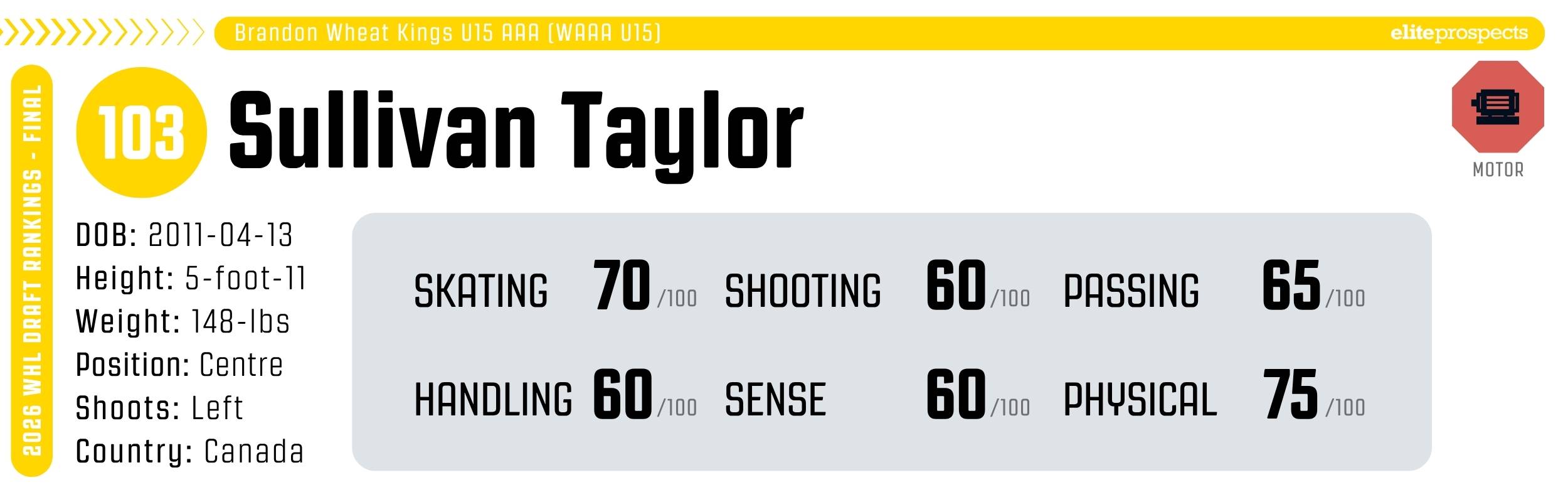
Sullivan Taylor plays a hard, abrasive game built around physical engagement and defensive responsibility. He arrives on the forecheck with purpose, completes his checks decisively, wins battles through the middle, and defends with an active stick that closes lanes and disrupts entries. Beneath the physical game, he shows flashes of playmaking touch with an ability to find teammates in high-danger areas. As the offensive instincts and puck touches continue to round out, he projects as a dependable, hard-to-play-against centre.
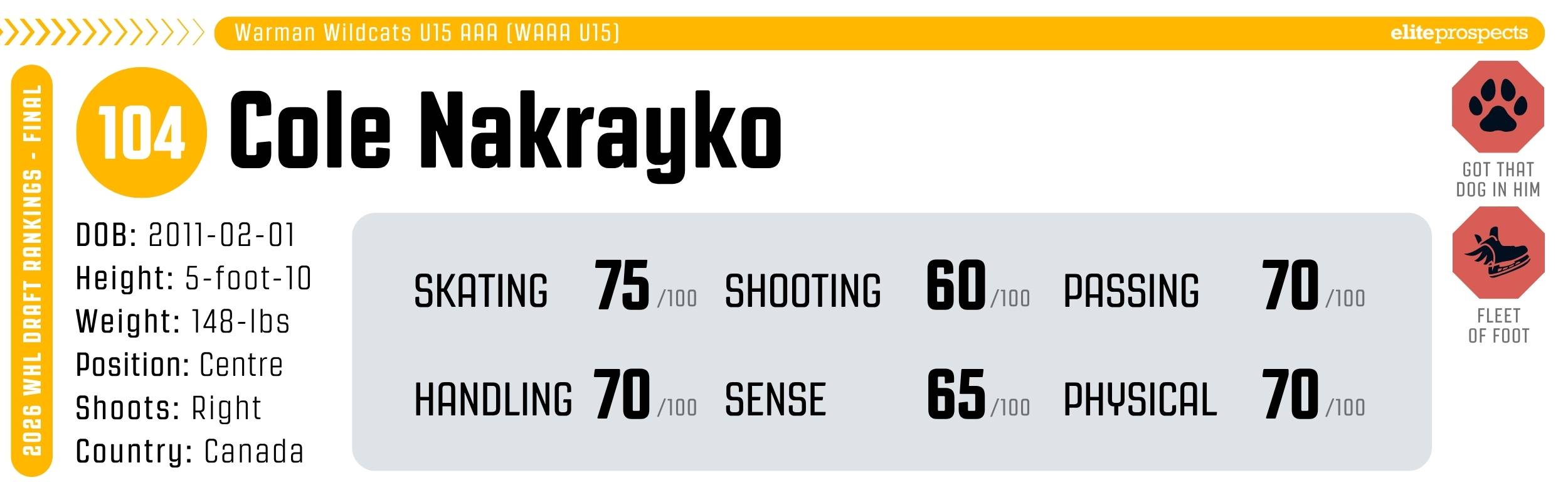
Cole Nakrayko plays fast, plays hard, and never cheats the game. His first step allows him to close quickly on loose pucks, his forecheck pressure is relentless, and he works through contact along the wall with the kind of consistency that earns coaches' trust across a long tournament. The offensive awareness is reflected in smart positioning, habit-driven chance creation, and the confidence to carry speed through the neutral zone. Asserting himself more directly with the puck and converting that work rate into more consistent offensive involvement is the primary development item. He projects as a reliable bottom-six winger.
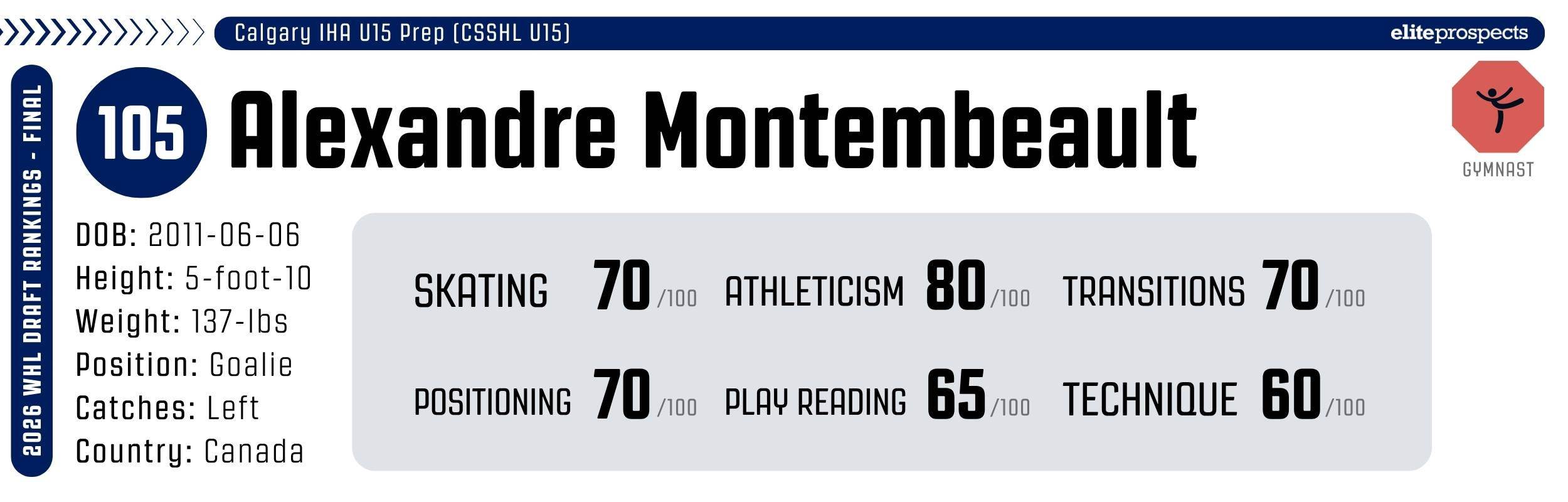
Alexandre Montembeault made a name for himself in the CSSHL U15 Championships. His performance in net was a decisive factor in lifting CIHA to an underdog victory in the tournament. Montembeault is disadvantaged by his size, but makes up for it with his speed and aggressive positioning. He attacks shooters to cut down the angle and leaves it to his athleticism to recover. He’ll do anything to make a save, and he’ll do it in electric fashion: splits saves, diving desperation, and anything you can think of. His technique has a ways to go, but the athletic talent and tenacity give him a shot to make it at the WHL level.
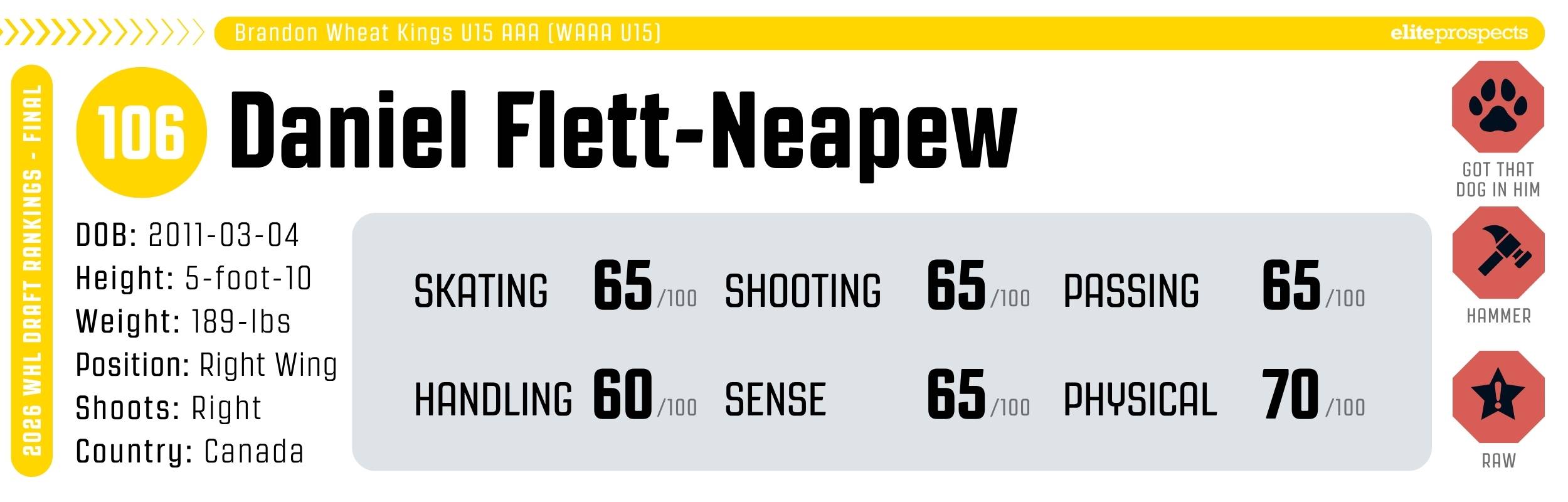
Daniel Flett-Neapew is a heavy, direct forward who creates real problems when he is fully engaged. He drives pucks into the slot off the rush, wins wall battles through patience and frame, and shows advanced handling to manipulate defenders in the neutral zone. His net-front scoring instincts are a notable strength of his offensive game. When the intensity rises, he hunts pucks, completes his checks, and overwhelms defenders physically. Improving his first step and work rate away from the puck will be key to filling a WHL role.
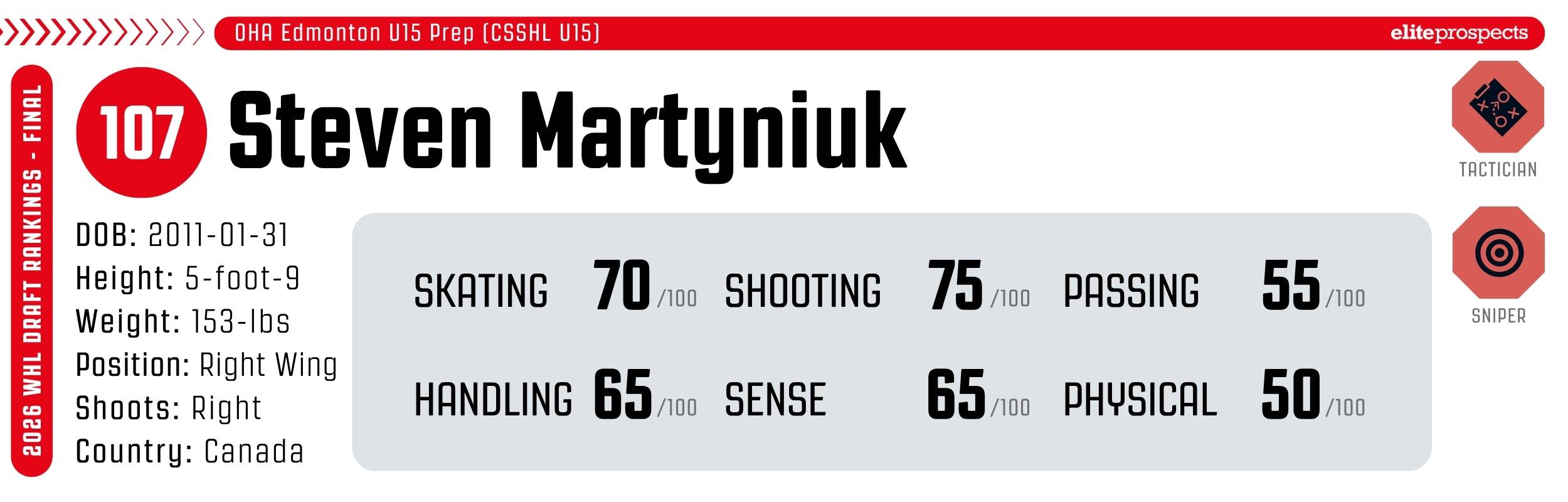
Injuries made it hard for Steven Martyniuk to get momentum this season, but he’s one of the most intriguing goal scorers in the group. Martyniuk doesn’t rely on individual speed or skill, preferring to play the off-puck game. He moves between checks, timing his dashes inside to ensure his stick’s always free. Then, he hammers one-timers and cleverly places catch-and-release wristers. There are flashes of physical skills, but they will have to be expanded to play his game at the next level. Still, he’s a WHL-calibre shooter who doesn’t need the puck much to make an impact. Provided he stays healthy, he could become a third-line finisher.
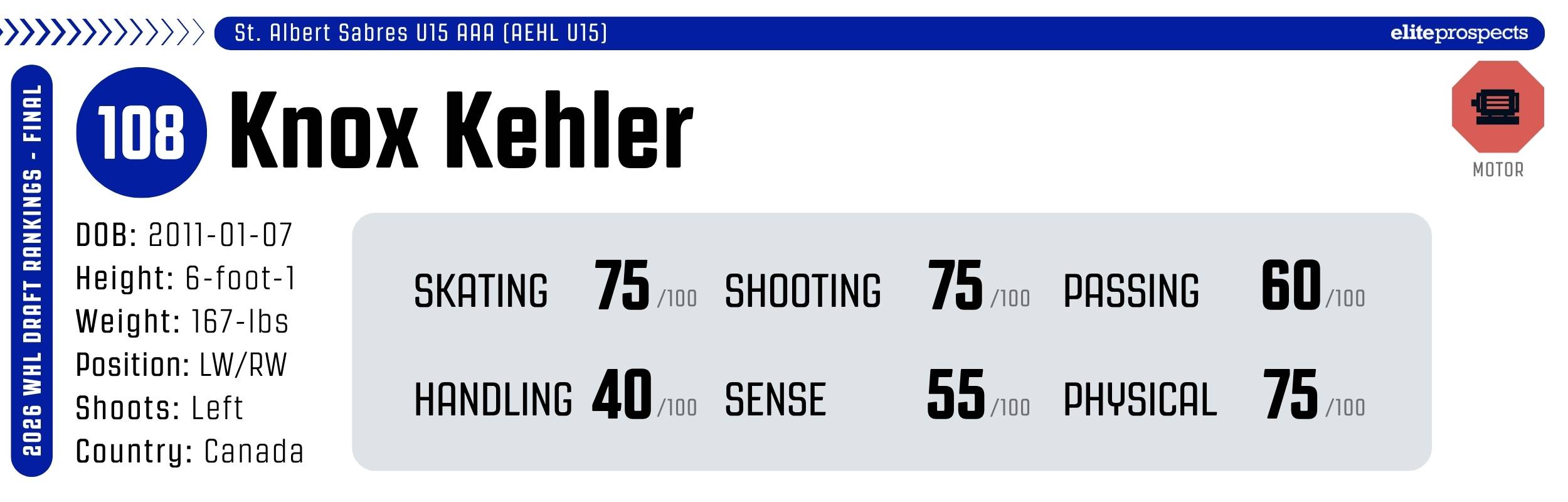
Knox Kehler is a power forward with offensive potential. He leans into opponents in transition, drives wide using his reach to keep the puck away from defenders, and drops his shoulder into net-front situations with conviction. His shooting ability from the slot and playmaking vision show offensive potential that will only become more dangerous as he develops more ways to get inside. In all likelihood, he’s a role player in the WHL, but there’s a chance for secondary scoring, too.
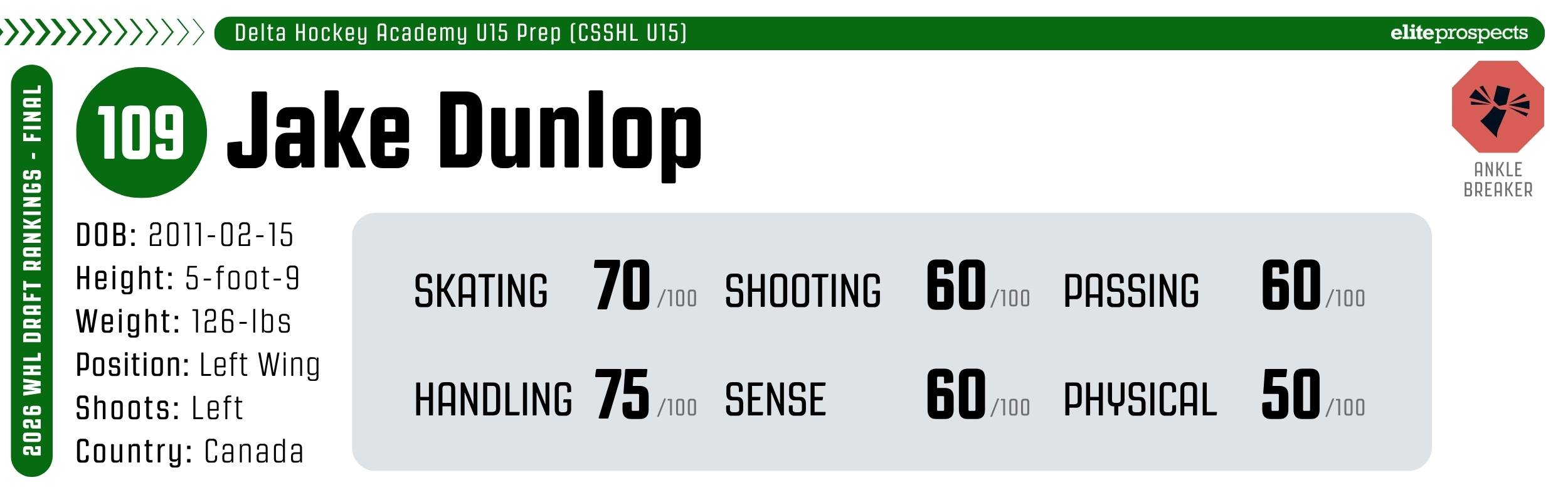
With flashes of high-end skill, Jake Dunlop is an exciting upside swing in the middle part of the draft. In his best sequences, he weight-shifts around opponents and gets inside. He spins off checks, navigates traffic, and makes plays while off balance. Plus, he adjusts to receive pucks straight into his hip pocket for catch-and-release wristers. His creativity will have to be supplemented with more consistency and physical skills, but there’s scoring potential here.
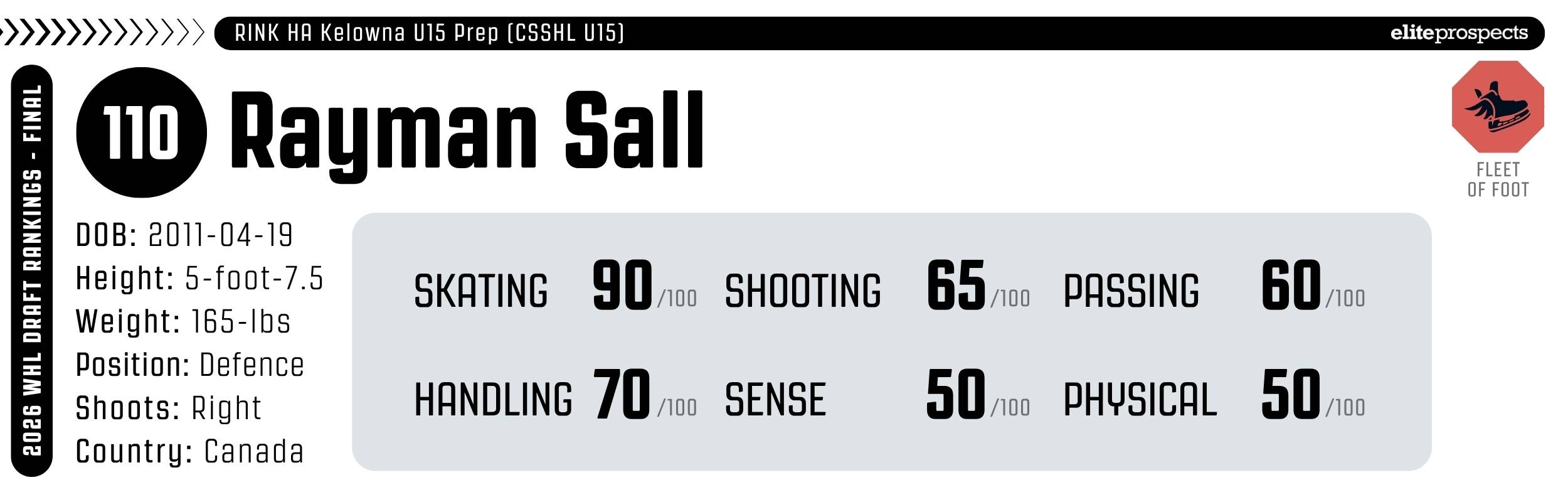
If you’re looking for special, Rayman Sall has it: Skating. He can explode in any direction, and he’s a rare skater who builds speed through his transitions at this age. Off the rush, his feet allow him to burn opponents and get to the inside. Though undersized, his skating could make up the difference defensively. His special element gives him clear WHL upside, but he will have to develop his impact beyond mobility, starting with his decision-making. He’s a long-term projection, but one who could become quite exciting.
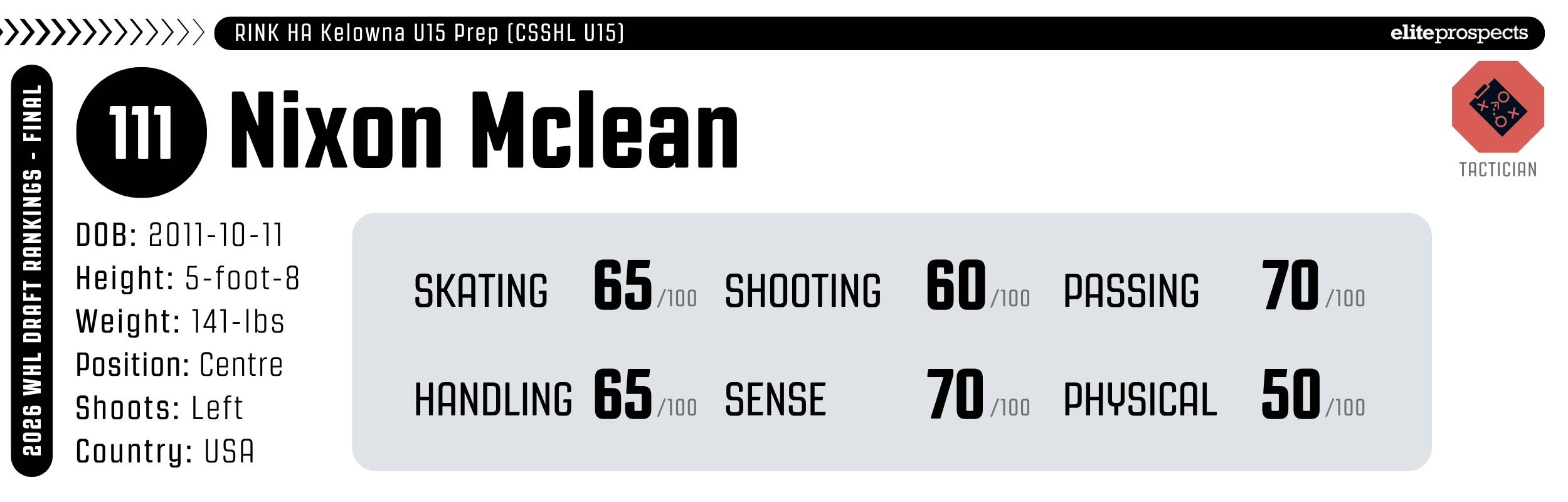
Nixon McLean’s game runs through his vision. He reads the ice well, threading the needle through defenders, setting up backdoor feeds, and using the trailer. Plus, he’s deceptive, looking one way before attacking in the other after the defender commits. He’s a skilled skater too, but will have to develop separation speed, pace, and physical skills. He’s an upside swing, with the potential to surprise in a few years’ time.
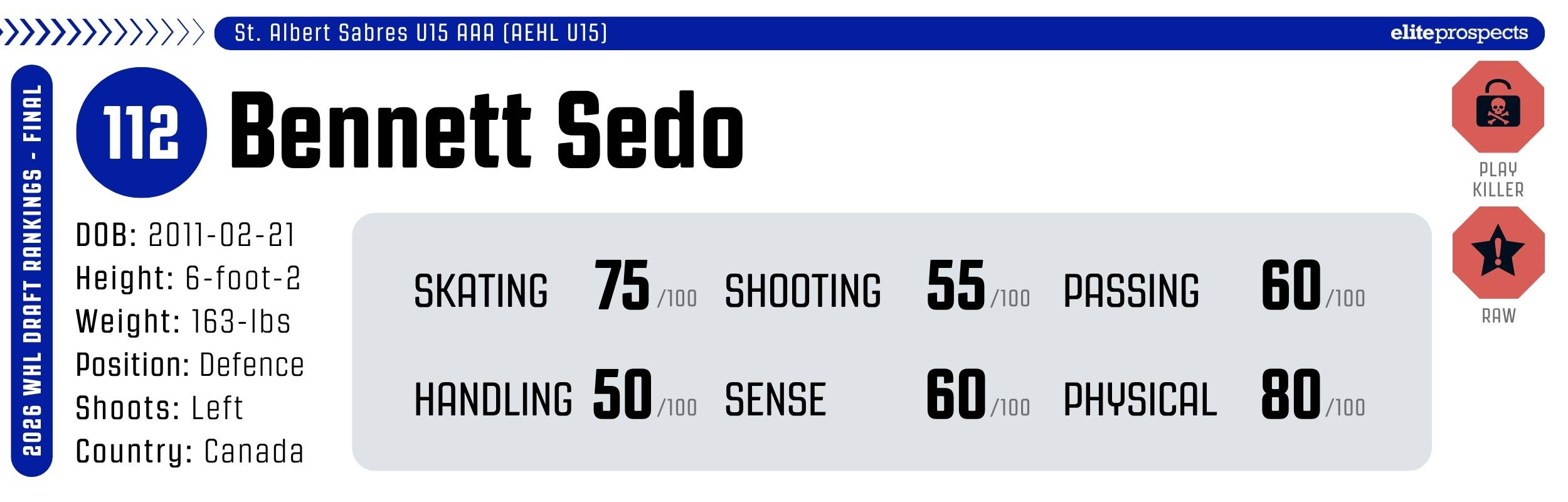
Though limited in production, Bennett Sedo already has the size and skating combination that WHL teams covet highly. He moves fluidly along the line, evades pressure on retrievals, beats opponents to the middle, and kills high-speed attacks. He is physical, attentive, and consistent in his defensive details across a full game. Offence and puck-moving are not his primary contributions at this stage, but the shutdown instincts and skating base give him a clear path toward a reliable WHL defensive defenceman role.
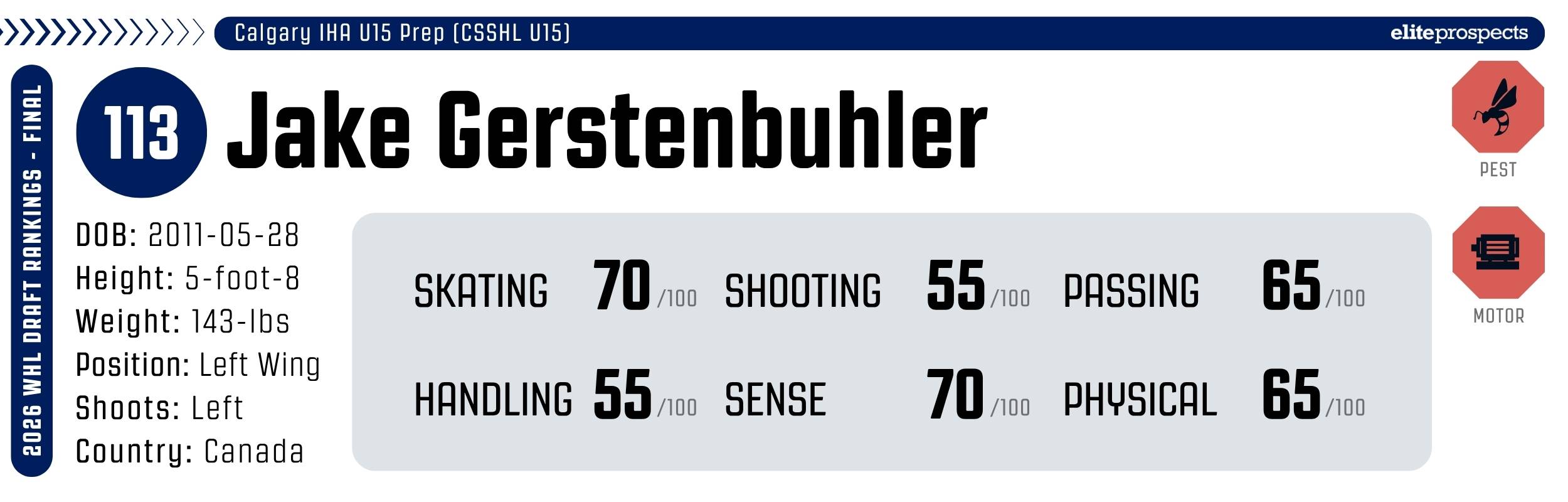
One of the better forecheckers in the age group, Jake Gerstenbuhler does the dirty work for his line. He hounds the puck carrier with feet that never stop moving, frees the puck, and gets it to an open teammate. There are flashes of skill, too, as he cuts inside under pressure, finds teammates with look-off passes, and weight-shifts around opponents in open ice. His reliability could make him a checking line forward in the WHL, and there’s a chance for him to move up in the lineup if he builds upon those skill flashes.
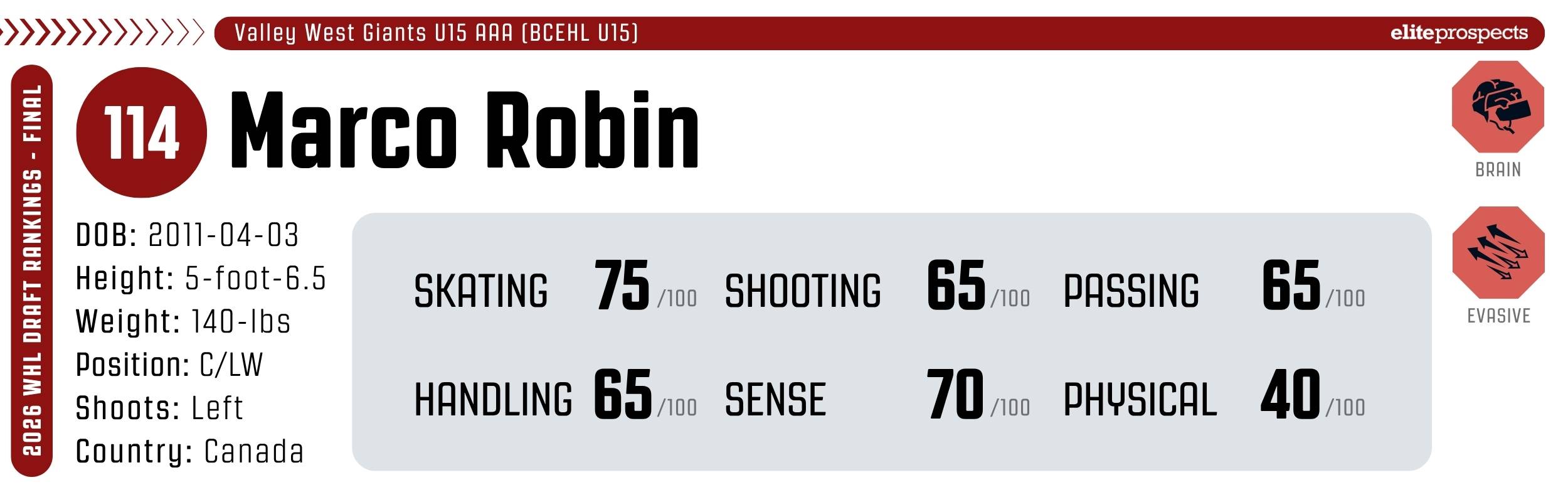
We can’t help but love how Marco Robin plays. His head is always up, constantly scanning the ice to dissect how he’s going to slice through the defensive structure. He has the skill and footwork to attack defenders head-on, but also possesses the vision to thread passes through to open teammates. But what stands out most is his motor – he never quits. Size is the biggest detractor here, but some growth could help turn him into a middle-six forward in time.
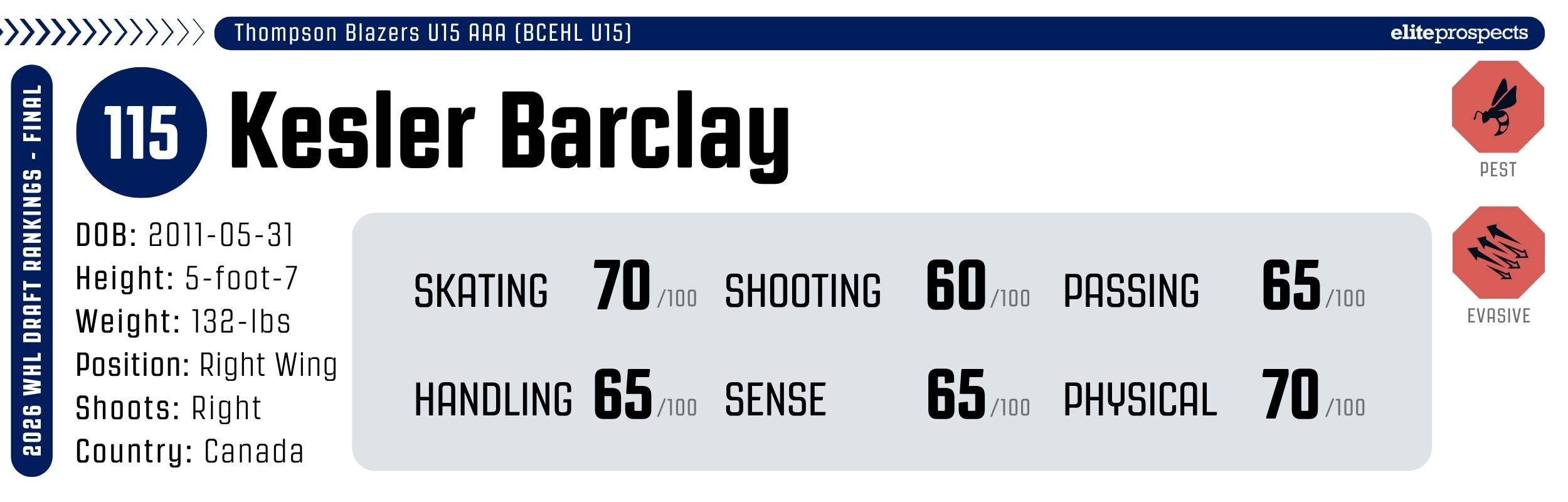
Kesler Barclay is a classic pest, battling like crazy and constantly working the walls. Never giving up on a puck, he wins pucks through sheer effort. He has the puck skill to slip through defenders, and the feet to get off the wall once he’s created a lane. In open ice, he can make smart passes cross-ice, but prefers to attack the defender head-on, relying on his skill and speed to overwhelm his opponents. His skill level and reads need polish, but his unique skill set could earn him a bottom-six winger role.
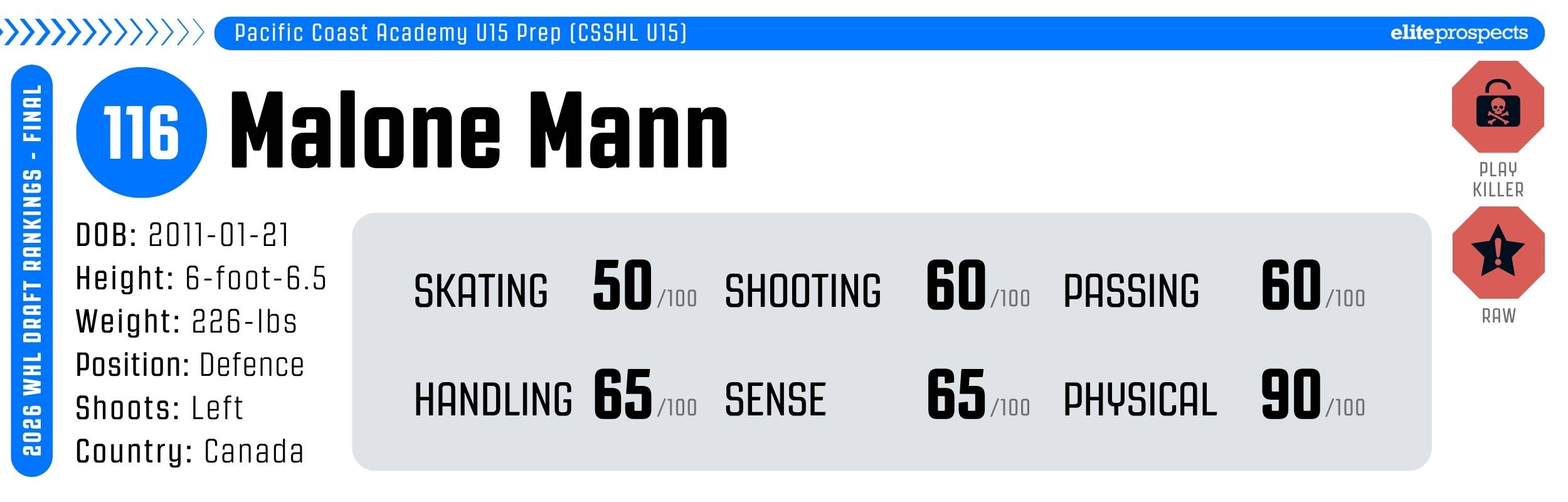
If you’re looking for a towering, mean defender with upside, Malone Mann is the player for you. He uses his length and reach to disrupt and outright eliminate plays off the rush, and doesn’t even think about coming off the wall when he’s the one pressing. His skating fundamentals are solid, but he will have to gain power in order to get up to WHL speed. His puck skill pairs with his reach to keep the puck out of danger, and allows him to make simple but effective plays on the breakout. With more refinement to his footwork and puck skills, Mann could end up as a bottom-four and penalty-killing defender.
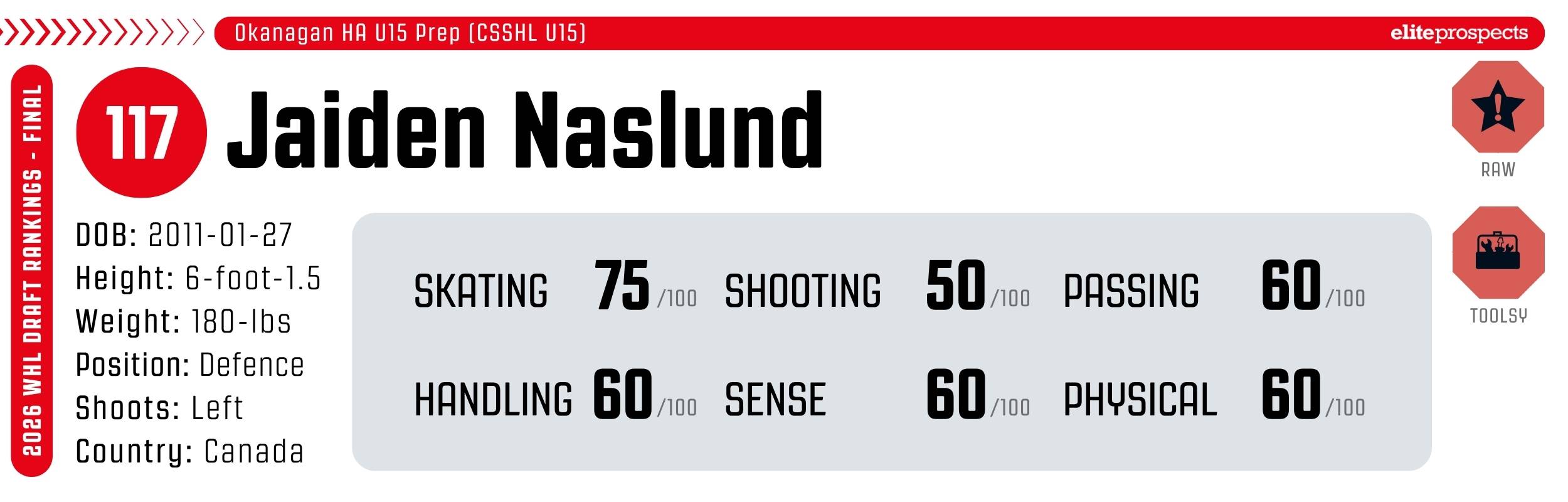
Jaiden Naslund has many attributes that teams are always hunting. His edgework is good, pivoting and transitioning with ease and able to spin off of contact along the walls. He’s adept as a handler, using his length to pull the puck out of danger before making his breakout passes. Naslund senses pressure well and will make safe plays in his own zone. He will draw opponents in before making his passes, and also possesses the ability to skate the puck out of his own zone. Naslund’s decision-making and pace must improve, but he could become a solid bottom-pairing defender.
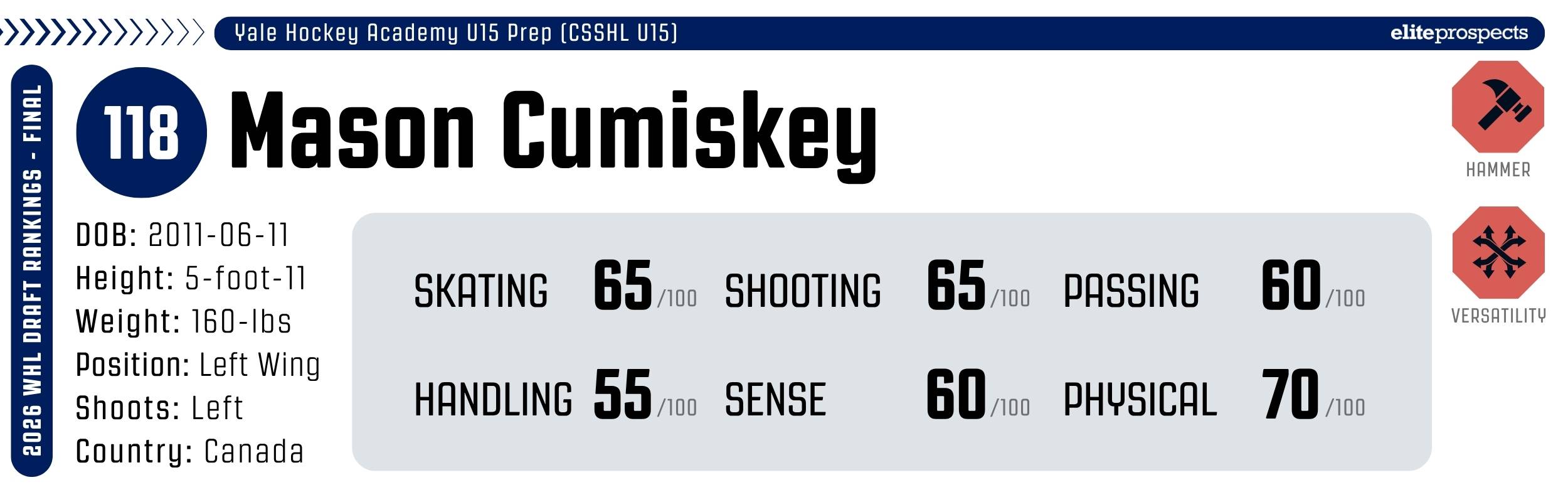
Mason Cumiskey is a rush attacker who pushes the pace and carries the puck into the offensive zone. He uses his heavy frame to protect the puck, positioning his body between his attackers and the puck. With a lot of strength in his game, Cumiskey wins a lot of battles by overpowering his opponents, making him very effective at both blue lines.His heavy, high-pace game shows elements of deception and playmaking at times, too. Skating growth could power him to a bottom-six role.
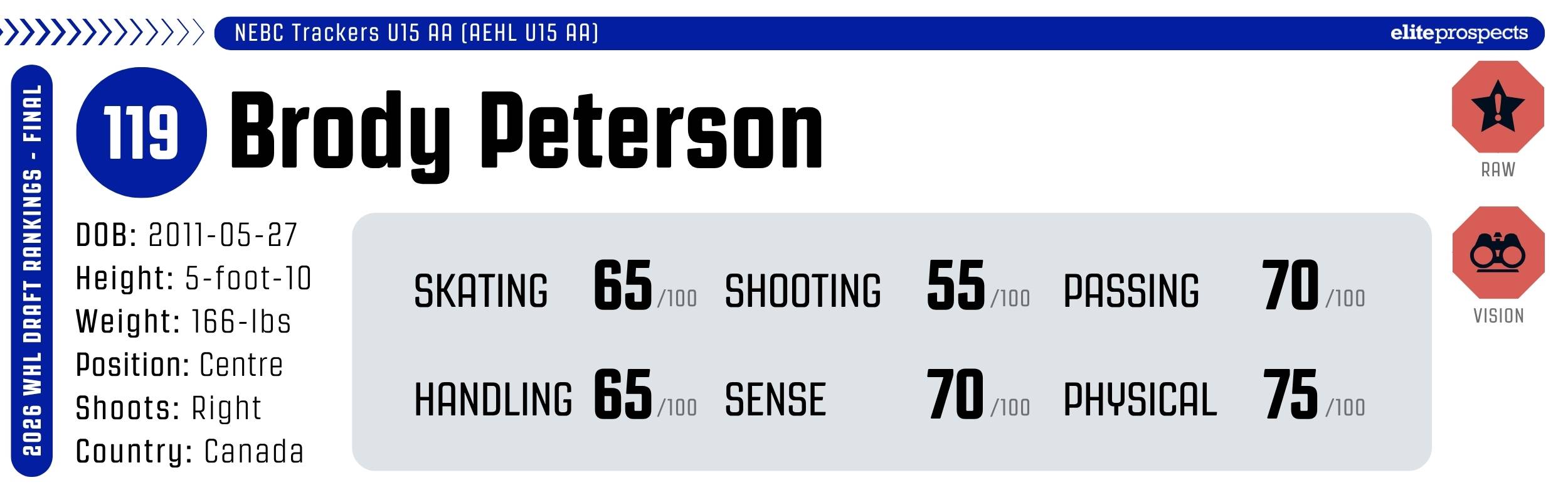
Brody Peterson has one of the more interesting profiles in this draft. He played at the AEHL AA level and absolutely dominated it, scoring over three points per game. He works well off the rush, possessing the footwork and puck skill needed to attack the middle of the ice. He shows a lot of deception with the puck, using his hands and feet to trick opponents. When given the time and space, he makes good decisions and smart passes, showcasing a strong playmaking ability. The concern of playing in AA is real, but so is his brain, making him a raw prospect worth taking a chance on, as the upside could be a middle-six centre.
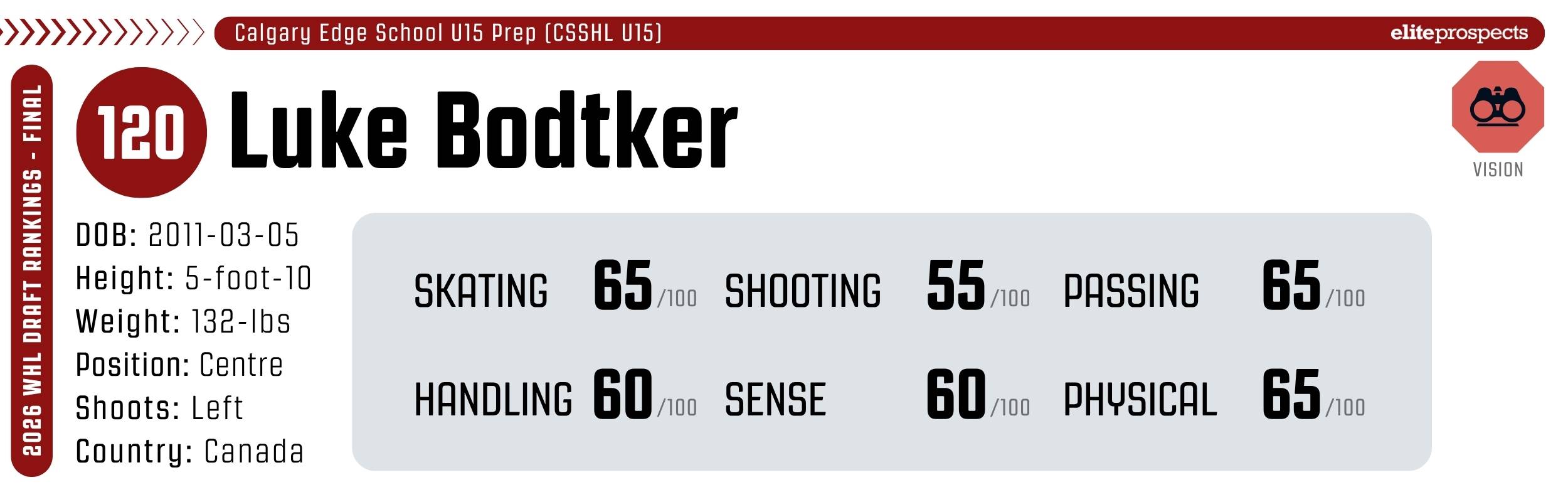
Simply put, Luke Bodtker makes his linemates better. He’s a consistent worker, with the playmaking skill to operate alongside other skilled players. He receives pucks in motion, rips pucks across the slot, and fakes shots to create backdoor looks. Though not a dynamic creator, he’s a highly anticipatory player and consistently finds cracks in the defence. He may have to add a special element, but his intelligence makes him worth betting on.
Honourable Mentions
Alex Dyrland, C, Winnipeg Thrashers U15 AAA
Bennett Pattison, D, Calgary IHA U15 Prep
Berkeley Reid, LW, RINK HA Kelowna U15 Prep
Braelyn Nunley, LW, Delta Hockey Academy U15 Prep
Casey Minnabarriet, C, Thompson Blazers U15 AAA
Cohen Wood, G, St. George's School U15 Prep
Colby Walker, RW, Delta Hockey Academy U15 Prep
Hudson Lesk, D, St. George's School U15 Prep
Jace Woloski, D, Brandon Wheat Kings U15 AAA
James Butterwick, LW, Calgary Edge School U15 Prep
Jaxon Lodge, RW/C, RINK HA Kelowna U15 Prep
Jaxon Scherr, LW, Sherwood Park Flyers U15 AAA
Josh Anderson, C, Delta Hockey Academy U15 Prep
Kai Genereaux, D, Calgary Edge School U15 Prep
Kash Andersen, G, Northern Alberta Xtreme U15 Prep
Landon Ruck, D, Okanagan HA U15 Prep
Logan Chang, D, Burnaby Winter Club U15 Prep
Luca Rogers, C, St. George's School U15 Prep
Maguire Hendry, D, Humboldt Broncos U15 AA
Max Faulkner, W, Pilot Mound Academy U15 Prep
Michael Puddicombe, D, Burnaby Winter Club U15 Prep
Miles Teiffel, C, Delta Hockey Academy U15 Prep
Nate Harrington, D, OHA Edmonton U15 Prep
Nelson Sonna Soufo, C, SAHA U15 Prep
North Gilbertson, D, Northern Alberta Xtreme U15 Prep
Patricio Chavarria, D, Fraser Valley Thunderbirds U15
Reed Sherry, C, Eastman Selects U15 AAA
Ryder Bui, RW/C, Burnaby Winter Club U15 Prep
Ryder Pavlic, RW, Delta Hockey Academy U15 Prep
Taylor Mowbray, C, KC Squires U15 AAA
Our Team
Daniel Gee: WHL Draft Lead
Rylan Wiest: Alberta
Tyson Soobotin: British Columbia
Seth Ditchfield: Prairies
Max Lee: Goalies
Mitchell Brown: Crossover/Support


