Elite Prospects top 30 wingers going into the 2025-26 NHL season



Welcome to EliteProspects' fifth annual NHL player ranking! The summer's over, training camp is here, and that means it's time to take stock of where things stand as we enter the 2025-26 NHL season.
If you're new here, here's the breakdown. We go position-by-positioning, ranking the 30 best players based on how I expect them to perform in the upcoming season. First up, wingers.
This ranking isn't just based on sorting players by Wins Above Replacement; as with every season I take a holistic approach including my own eye test, macro-level metrics from TopDownHockey, manually tracked microstats from Corey Sznajder's AllThreeZones project, and data from InStat Hockey, incorporating as much information as possible to present not only a coherent ranking but the best possible stylistic snapshot of each of these players.
The graphics, inspired by the work done by Elite Prospects' prospect writers, include projected player ratings for the 2024-25 season in four categories: offensive zone play, defence, transition play, and miscellaneous. Departing from the percentile rankings I use on my player cards, here I use a 1-to-10 rating based on projected finish to respect the uncertainty at play here. The idea is to provide a broad impression of every player's strengths and weaknesses and give you as accurate an impression as possible of how they play.
Here's an example:
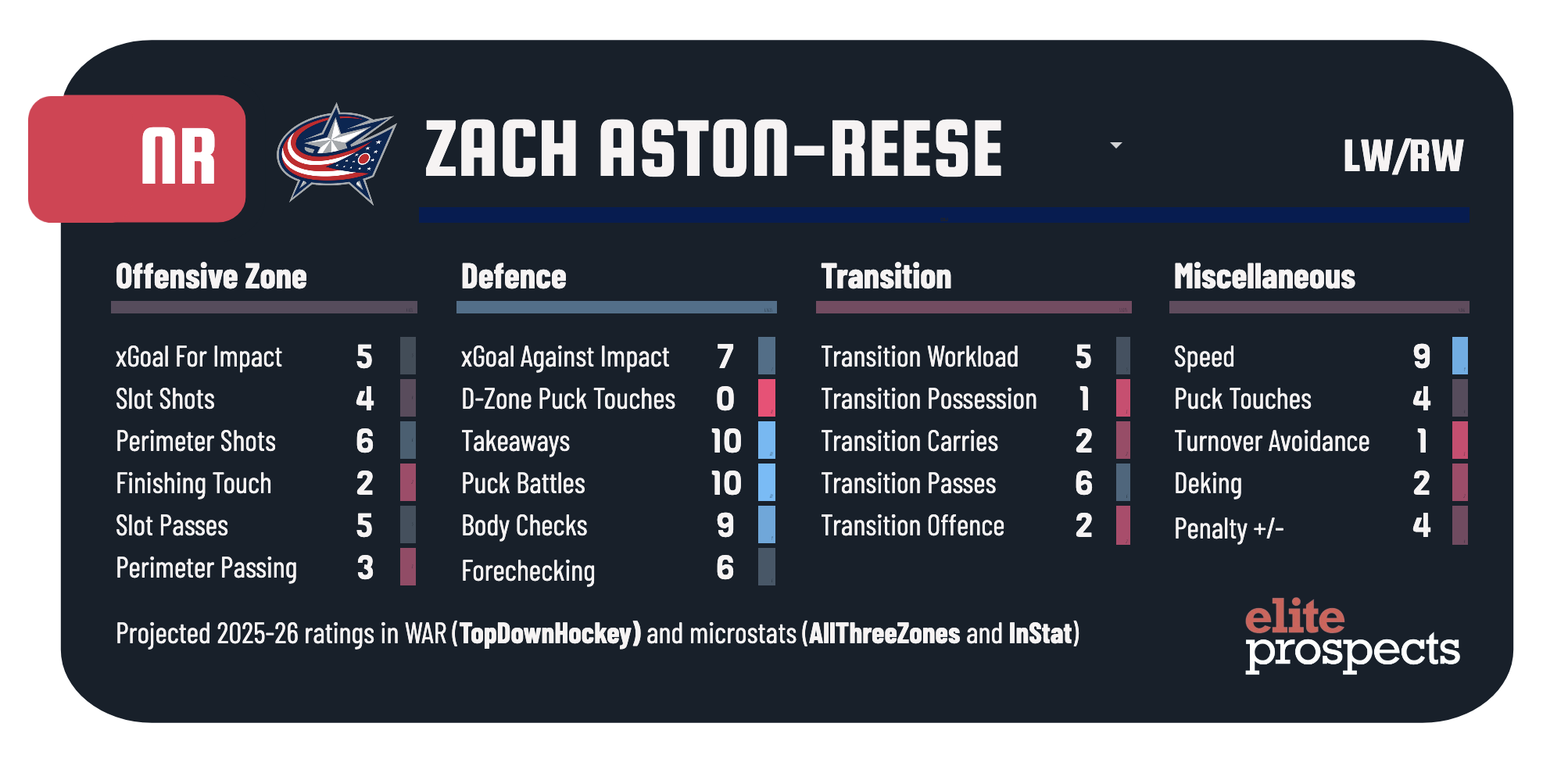
That's a lot of data points, so here's a glossary of the metrics used, all of them per 60 5-on-5 projections for the 2025-26 season based on the previous three seasons of results, including their source (TopDownHockey = TDH, AllThreeZones = A3Z, InStat = IS, NHL = NHL)
Offensive Zone
- xGoal Impact: Isolated impact on his team's generation of expected goals (i.e. shots weighed by likelihood of going in) when he's on the ice (TDH)
- Slot Shots: Scoring chances from the slot (A3Z)
- Perimeter Shots: Shots from other areas of the offensive zone (A3Z)
- Finishing Touch: Goals scored above expected given quality of shots (TDH)
- Slot Passes: Passes to the slot resulting in a shot (A3Z)
- Perimeter Passing: Passes to other areas of the offensive zone resulting in a shot (A3Z)
Defence
- xGoal Impact: Isolated impact on his team's prevention of expected goals when he's on the ice (TDH)
- D-Zone Puck Touches: Puck touches within the defensive zone (A3Z)
- Takeaways: Pucks stolen from opponents (IS)
- Puck Battles: 50/50 battles for the puck engaged in (IS)
- Body Checks: Hits as counted by the league (away only to filter out recording bias) (NHL)
- Forechecking: Offensive zone puck recoveries and pressures on opposing defencemen (A3Z)
Transition
- Transition Workload: Transition plays with the puck (A3Z)
- Transition Possession: Rate at which the player makes transition plays with possession as opposed to dump-ins and clears (A3Z)
- Transition Carries: Transition plays by carrying the puck into or out of the neutral zone (A3Z)
- Transition Passes: Transition plays by passing the puck into or out of the neutral zone (A3Z)
- Transition Offence: Shots and passes leading to slots off the rush (A3Z)
Miscellaneous
- Speed: Weighed combination of a player's top speed and frequency with which they exceed 22 miles per hour (NHL)
- Puck Touches: Puck touches in any zone (IS)
- Turnover Avoidance: Turnovers per puck touch (IS)
- Deking: One-on-one dekes (IS)
- Penalty +/-: Net non-coincidental minor penalties drawn versus taken (TDH)
Player positions used in this list will be based directly on the work of @NHL_Rosters on Twitter, who has been running the most accurate depth charts in the league for several years now.
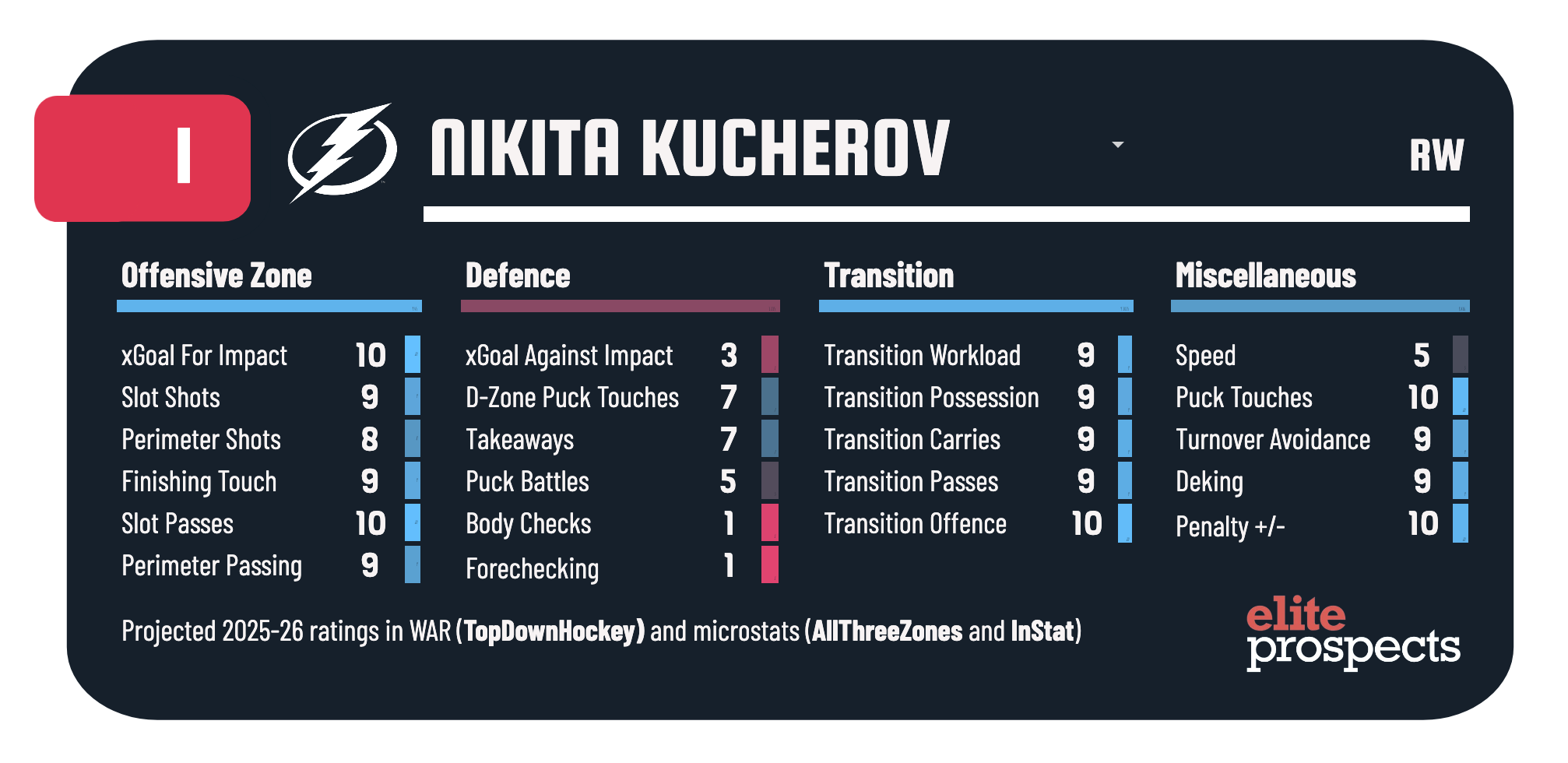
Nikita Kucherov almost flies under the radar for a back-to-back Art Ross Trophy winner, consistently piling up points through his unshakable control of the game offensively. His generational playmaking makes 5-on-5 sequences look like powerplays, with brilliant one-touch and give-and-go plays culminating in him deceiving defenders and dishing maddening passes to open linemates at just the right moment. Add in his silky wrist shot and excellent hands in transition and there’s a reason he’s scored at a 100-point pace in seven straight seasons. We’re at the point in his career where the better question than “where does he rank the league’s best players right now” might be “where will he rank all-time when all is said and done?” If the Lightning get their postseason performances back on track, he could finish his career top-five in all-time playoff points.
.png)
If there was even the smallest lingering doubt that David Pastrnak could be a superstar without Patrice Bergeron or Brad Marchand flanking him, it’s completely gone now. To say that he carried the Bruins this season would be an understatement, as the 43-goal, 106-point Czech was the only player on the team to surpass 60 points, and for good measure in the 18 games after Marchand was traded he put up 28 points (25 of them primary). That he’s not just a triggerman should be no surprise to those who have watched him jet through the neutral zone and deke his way through blueliners for years while flexing underrated passing ability to make the players around him better. Until they can find some better talent to put around him (or, God forbid, trade him), the Bruins will be the Pastrnak Show, and frankly that's well worth tuning into.
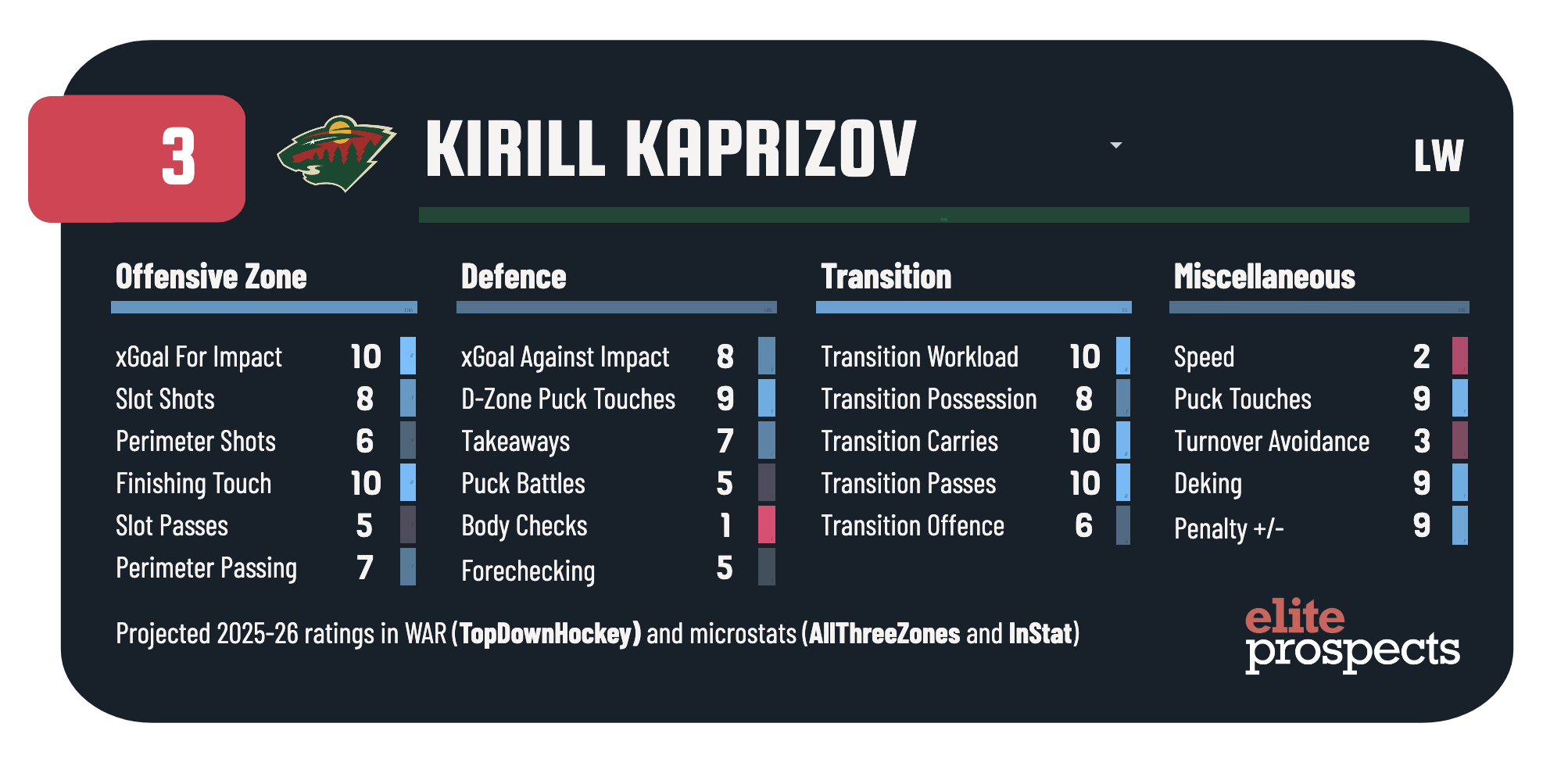
Kirill Kaprizov continues to do his best to drag the Minnesota Mild out of the league’s middle tier, and 2024-25 was shaping up to be his signature season before injuries capped him at 41 games. He produced at his best pace yet, 56 goals and 112 points, and backed it up with five goals and nine points in a first-round playoff loss to Vegas. Few can match both the impact he has on the game and the flair with which he plays, stunning opponents with spinaramas, no-look passes through multiple sticks, and creative routes down the ice that often involve deking through at least one defender. He’s one of the rare elite playmakers who can also threaten 50 goals thanks to a great one-timer and a nose for the net. Far from a flashy zero-calorie scorer, he’s the most prolific winger in the league at exiting the defensive zone, playing with a serious motor and doing the hard work on the forecheck to maintain and reclaim possession of the puck. It might not be exaggerating to say that a contract extension is a life-or-death moment for the Wild organization.
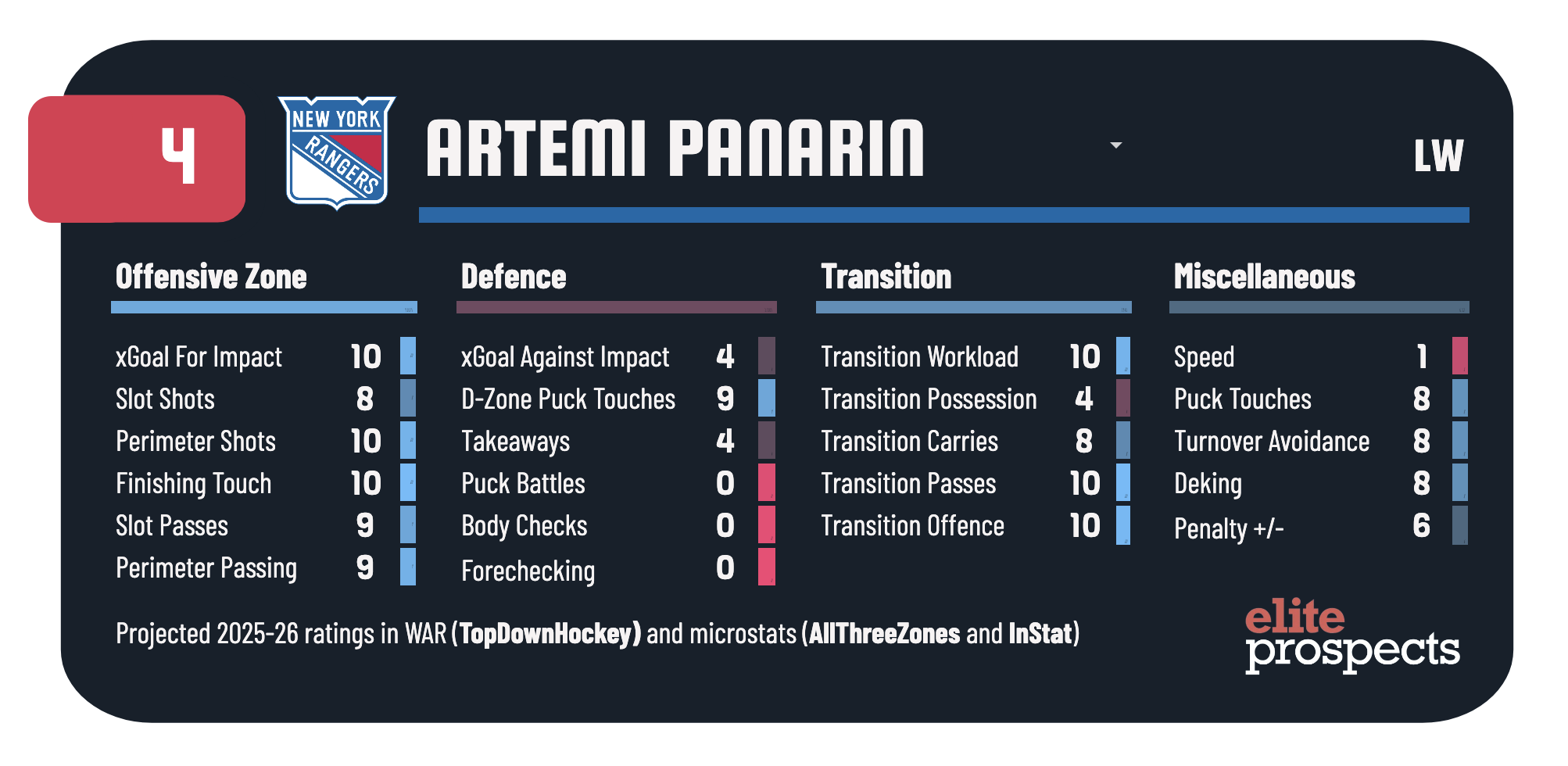
Artemi Panarin’s consistency and status as one of the game’s premier playmakers is maybe best represented by the fact that he’s led his team in points for eight straight seasons, by far the longest active streak in the league. Even as the team around him seriously floundered in 2024-25 -- and his teammates forgot how to finish for long stretches of the campaign -- he was still one of the most dangerous offensive players in the league and continued to flex the goal-scoring prowess he discovered the year before. His best asset is his offensive awareness, which combined with his nearly unmatched patience with the puck and creative problem-solving abilities leads not only to plenty of passes to the slot but goals from distance as well as the few extra handles he makes before showing his cards keep defenders and goalies guessing. His physical tools aren’t exactly staggering considering he’s undersized, very slow, and one of the least physical players in the league, but that only makes it more impressive how thoroughly he controls the game.
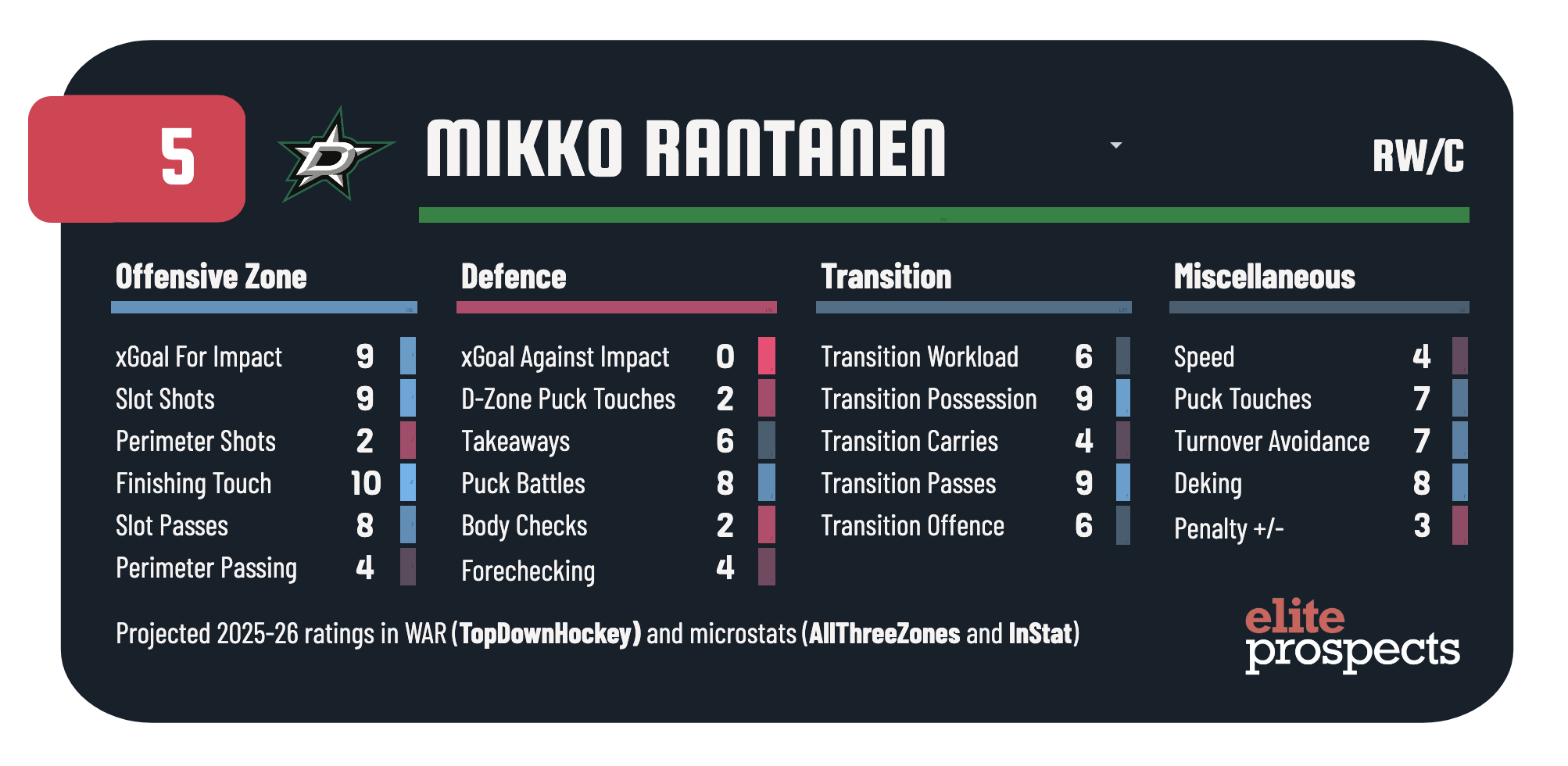
Mikko Rantanen’s stock wasn’t in the best shape in spring 2025, coming off a disappointing stint in Carolina and a solid but unremarkable stretch run with his permanent new team in Dallas. Then, in just a few playoff games, he reminded everyone why he’s been held in such high regard for years. Because he’s not as puck-dominant as the vast majority of star producers, he can occasionally fade into the background a bit, but when he’s on few can match his combination of size, puck-protection, passing skill, and finishing touch. He’s a dream linemate offensively who makes great simple plays along the wall, commands space in the net-front, and can be counted upon to make the most of the chances he’s given. His greater reliance on who he plays with and his poor defensive impact hurt him relative to some of his peers, but it’s hard to ignore the seven straight post-seasons above a point-per-game.
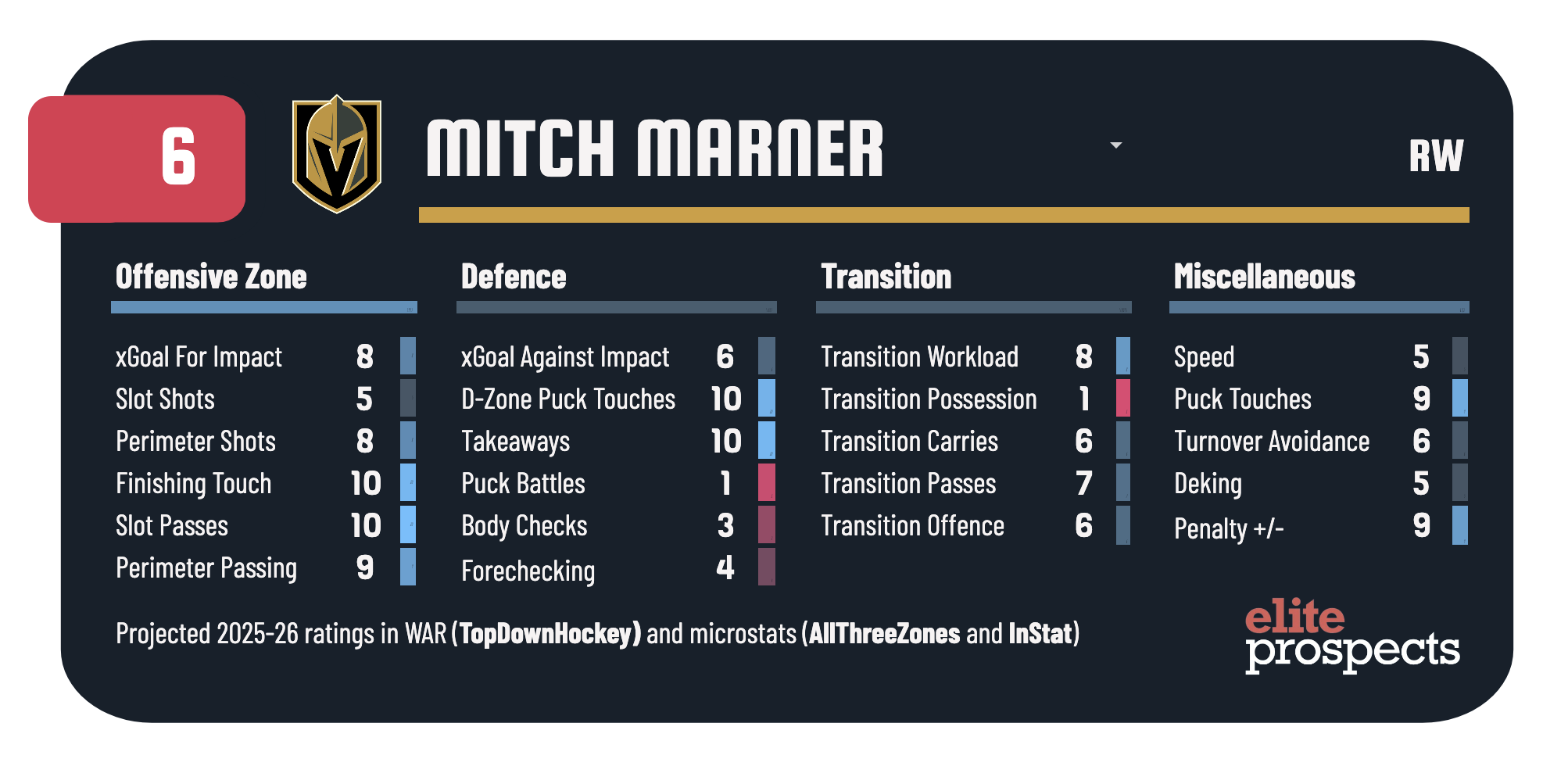
A career-high 102 points, point-per-game in the playoffs, two clutch assists in a gold-medal-winning performance -- what’s not to like about the year Mitchell Marner had? Well, that depends on who you ask. Marner’s elite playmaking skillset has made him one of the league’s most consistent producers, but some disappointing playoff showings soured him among a lot of Maple Leafs fans on his way out of town. He’s one of the best players in the league at transporting the puck from the perimeter to a linemate’s tape in the slot, reading plays extremely quickly and taking pucks off the wall with ease and grace. He’s also a great supporting player in transition and deadly puck thief, both qualities that should make him a fitting heir apparent to Mark Stone in Vegas. Would it be nice if he was more willing to get to dirty areas of the ice himself and remain a shooting threat in tight games? Perhaps, but he’ll be making linemates better for years to come.
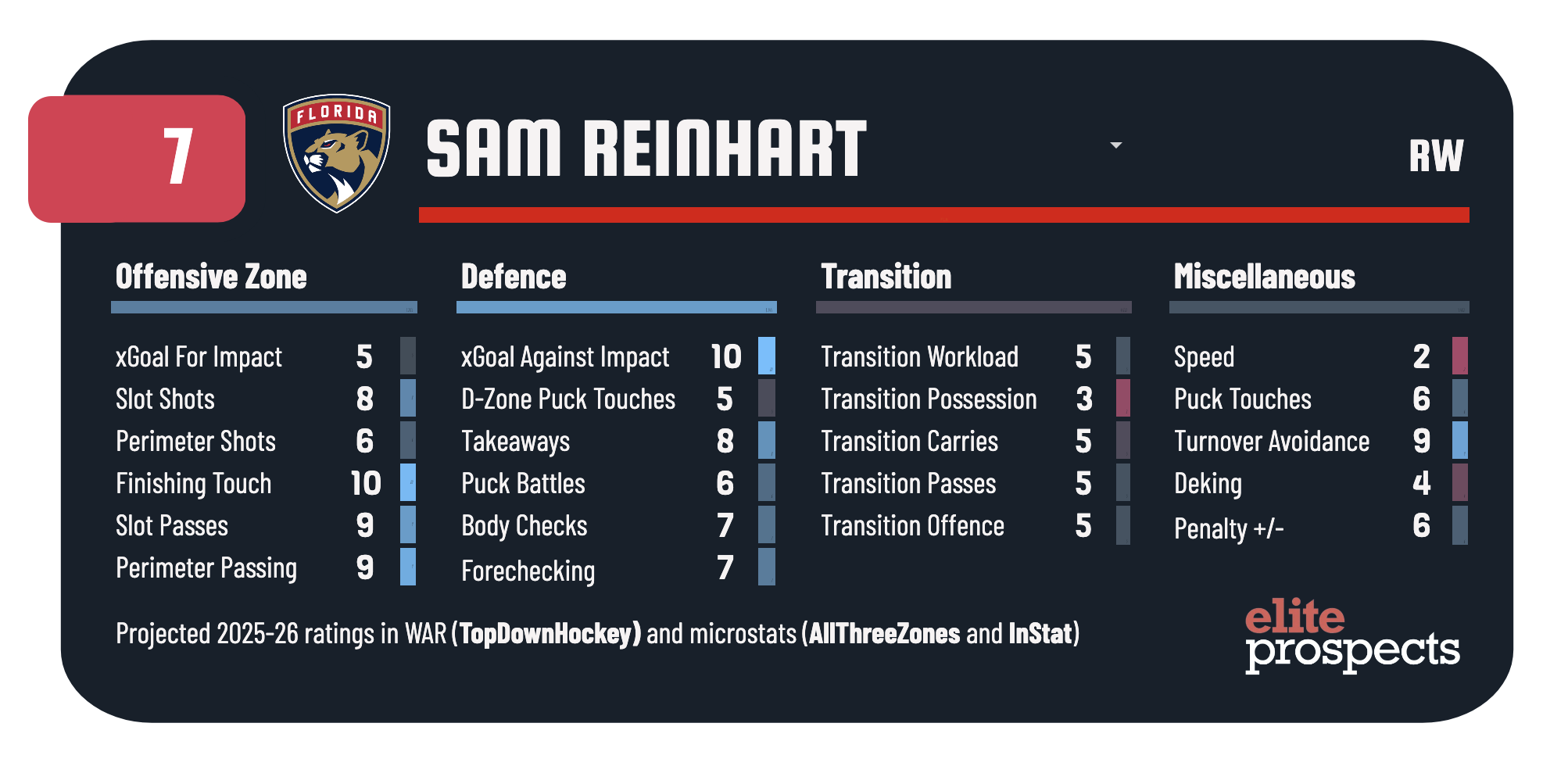
Regression predictably hit Sam Reinhart this season, but fortunately his baseline ability is so high that he still flirted with 40 goals and produced above a point per game in both the regular season and playoffs while finishing a well-deserved second in Selke trophy voting. Reinhart’s trademark is efficiency and economy of movement, using his high hockey I.Q. and skill to make brilliant first touches and always improve the condition of the puck, whether by choosing shots carefully, extending possessions, slipping slot passes through sticks, or disrupting plays with a clever poke check or stick lift. Dominant defensively, effective as a passer, and an elite finisher, unless you’re fixated on foot speed there’s not much not to like in his game.
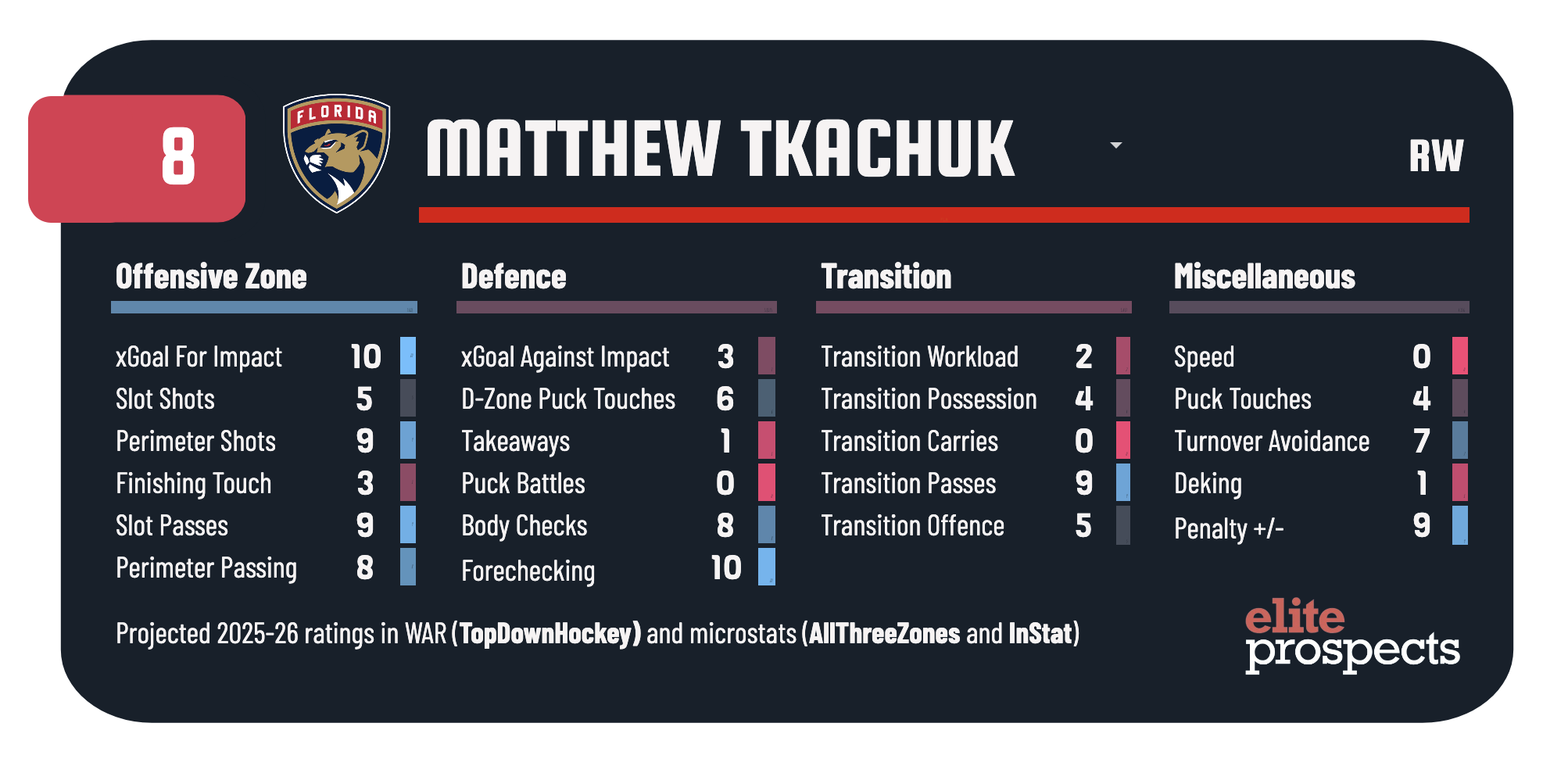
We won’t be seeing Matthew Tkachuk for a while (other than presumably in endless Olympic promotions) due to surgery, but given the second Cup ring I doubt he regrets playing through injury during the playoffs. He’s the perfect Panther, blending legitimate high-end skill with physicality and one of the best motors in the game. Despite being constrained by a lack of foot speed, Tkachuk is nonetheless a workhorse forechecker and committed puck retriever who eagerly crashes the net (and anything else in his vicinity) and plays through contact to get the puck to the slot. He doesn’t always make it look pretty, but the results speak for themselves, and it doesn’t hurt that he drives opponents crazy in the process.
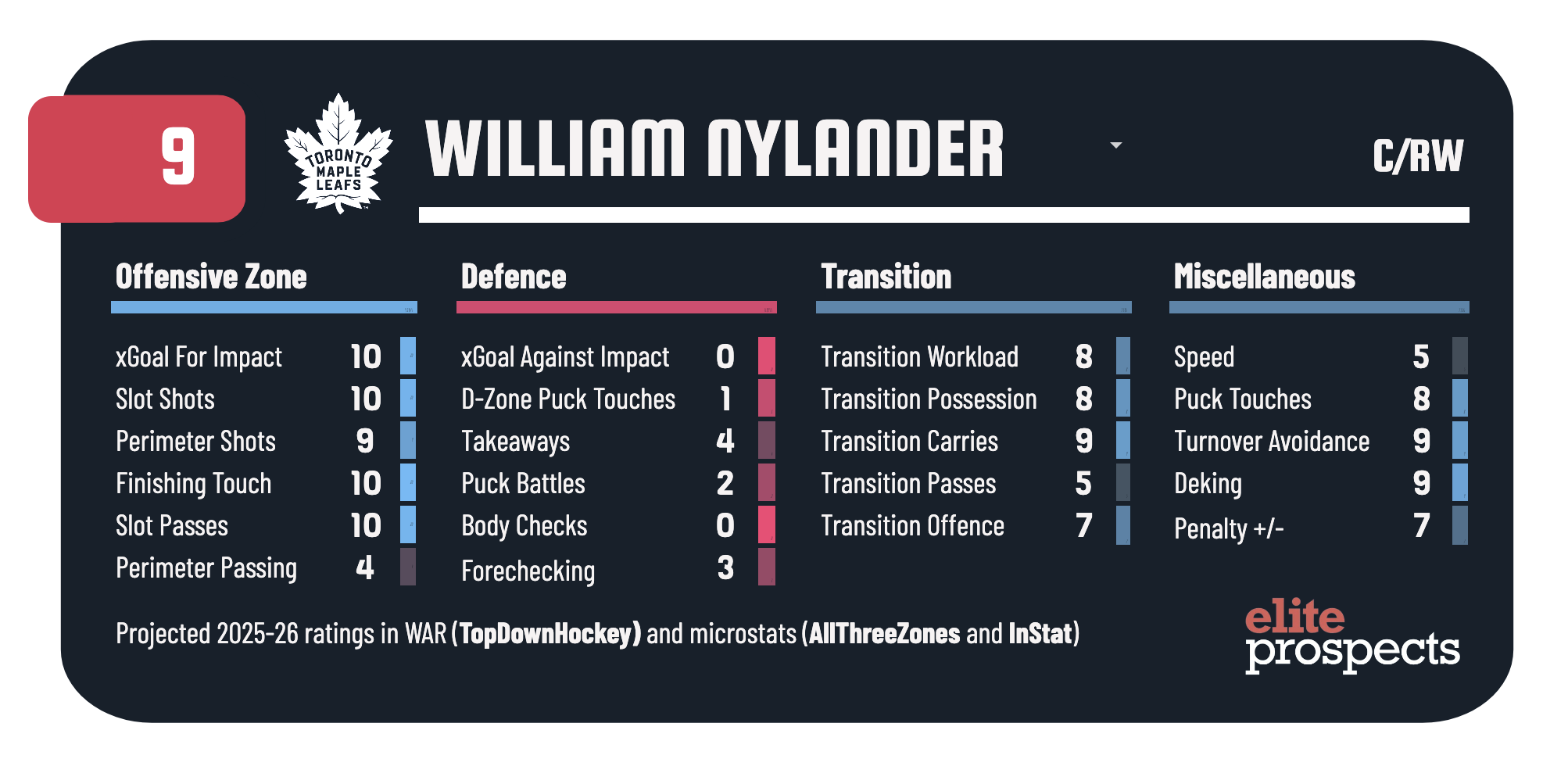
Now the Leafs’ undisputed franchise winger, William Nylander is firmly in the prime of his career and consistently producing 40-goal, point-per-game seasons while earning fans’ respect as a playoff performer. His ability to put the puck in the net in practically any way, whether by wiring wrist shots from above the hashmarks, slamming home cross-ice one-timers, dangling the goalie on a breakaway, or crashing the net, combines with slick play-making ability and puck skills to make him one of the deadliest 5-on-5 offence creators in the league. The defence (and certainly the physicality) will likely never be there, but there's a level of offensive impact that makes those sacrifices acceptable, and Willy's got it.
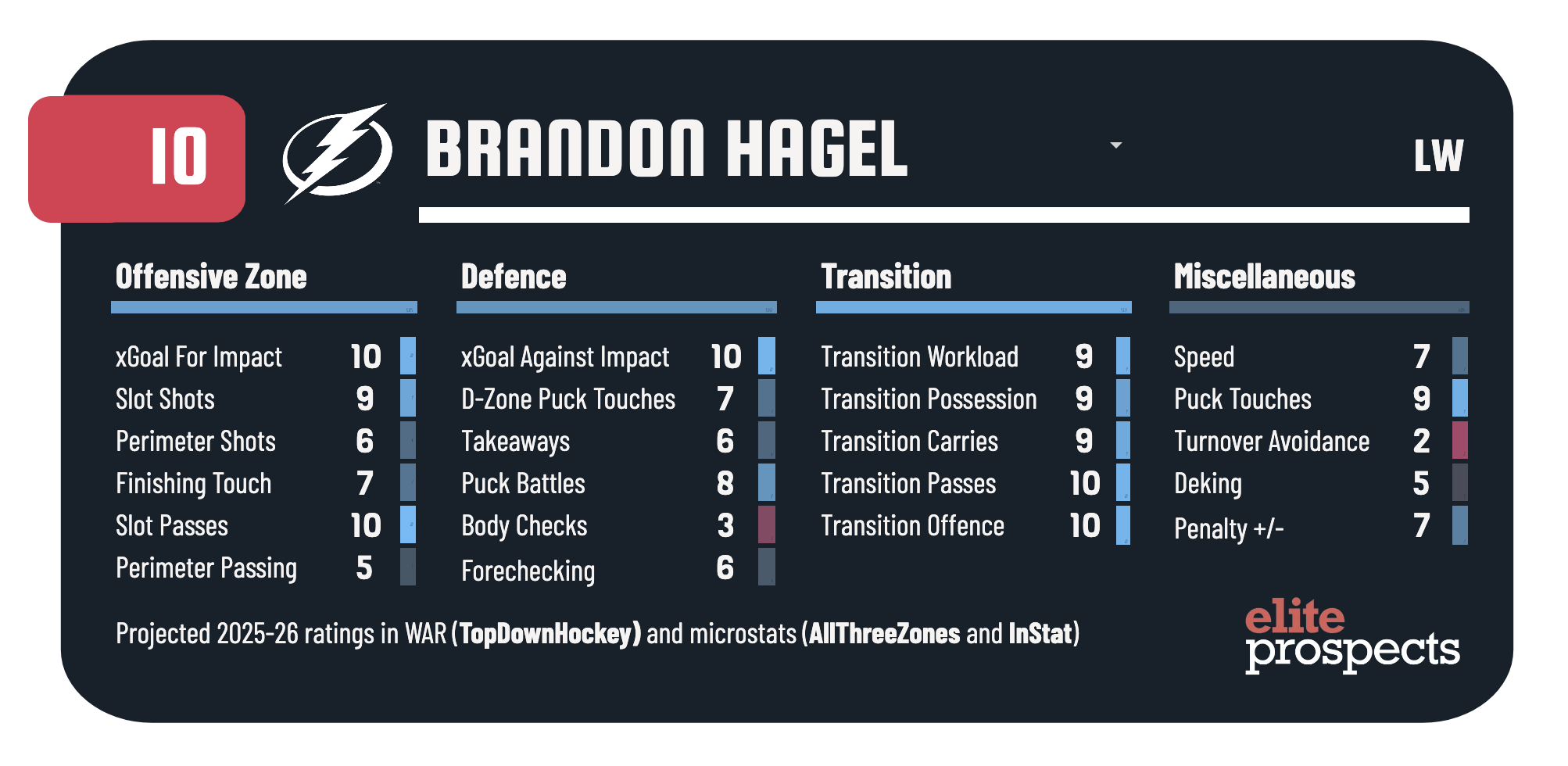
Trying to identify a weakness in Brandon Hagel’s game is almost as difficult as playing against him. He’s got foot-speed, pace, motor, determination, creativity, and plenty of skill. Setting career-highs in goals, assists, and points in top-line match-up minutes, he made a major difference in all areas of the ice and put up eye-popping play-driving results in the process. He gets plenty of breakaways using his speed and can beat defenders with his hands even if they do catch up to him. He crashes the net and plays through contact with almost reckless abandon to win loose pucks, but thinks the game as quickly as he moves and can execute one-touch passing plays and take advantage of tiny windows to connect tape-to-tape saucer passes. On top of all that, without the puck he’s a terrific forechecker, puck-battler, and play-disruptor. Maybe he’ll never produce at a 100-point pace, but the list of more holistically effective players in the game is a very short one.
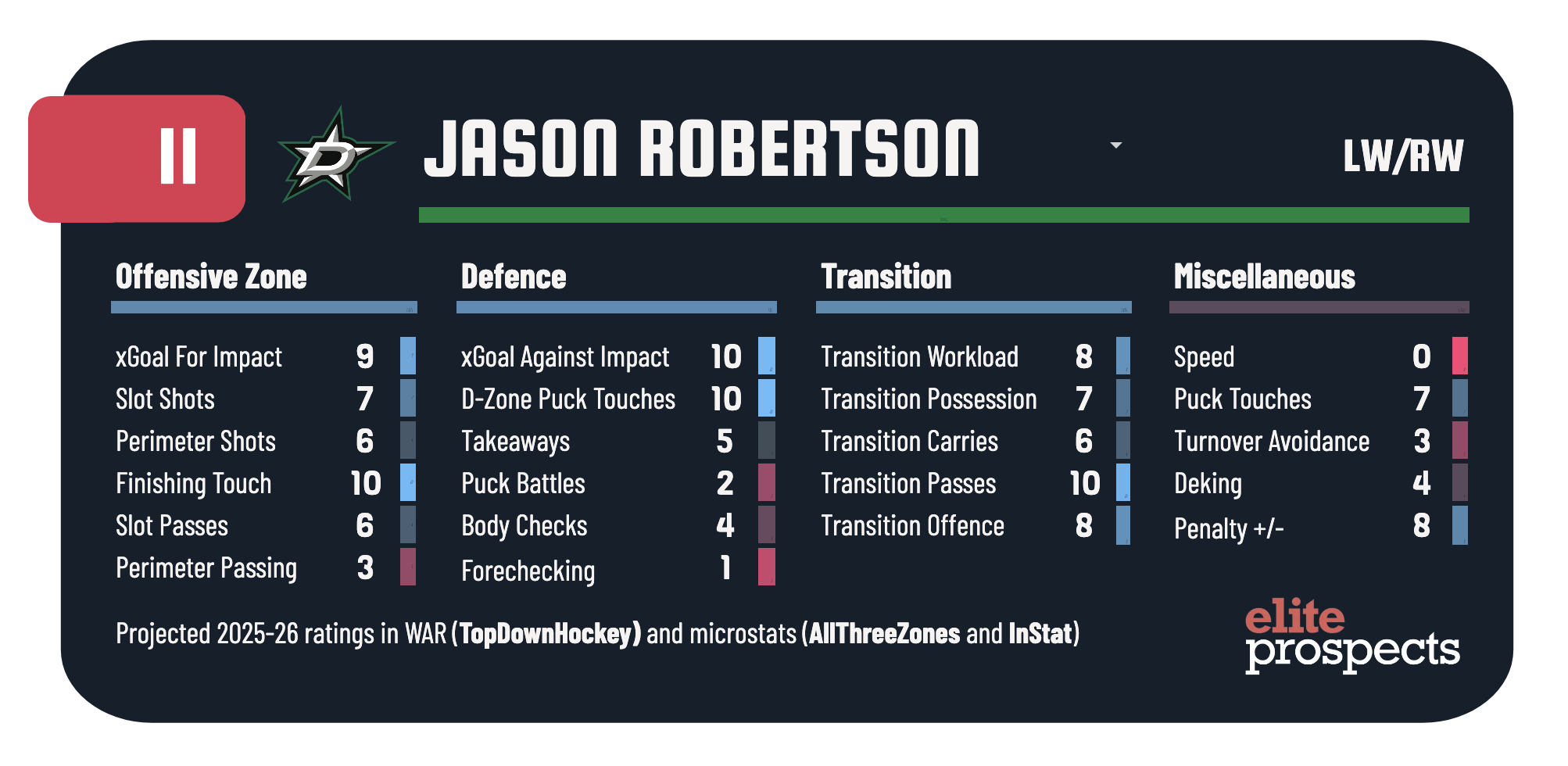
After two 40-goal seasons and a 109-point campaign it seemed as though Jason Robertson was done being disrespected. Apparently not! Trade rumours surrounded the 26-year old ahead of his pending restricted free agency in 2026, with many doubting whether he’ll deserve the big extension he’s due for after scoring at an 80+ point pace in four straight seasons. He admittedly may lack the speed, agility, and puck skills that are typically characteristic of elite producers but he makes up for it with size, smarts, and a heavy and accurate wrist shot. Sure, he doesn’t blaze down the ice at top speed, but he makes clever, subtle plays in transition to advance the play to his linemates and give himself room to get to soft spots on the ice. He’ll punish defenders who give him space and isn’t above playing through contact to grab garbage goals as well. His defensive value has also been underrated as he’s become a serious two-way ice-tilter who gets to loose pucks and initiate zone exits.
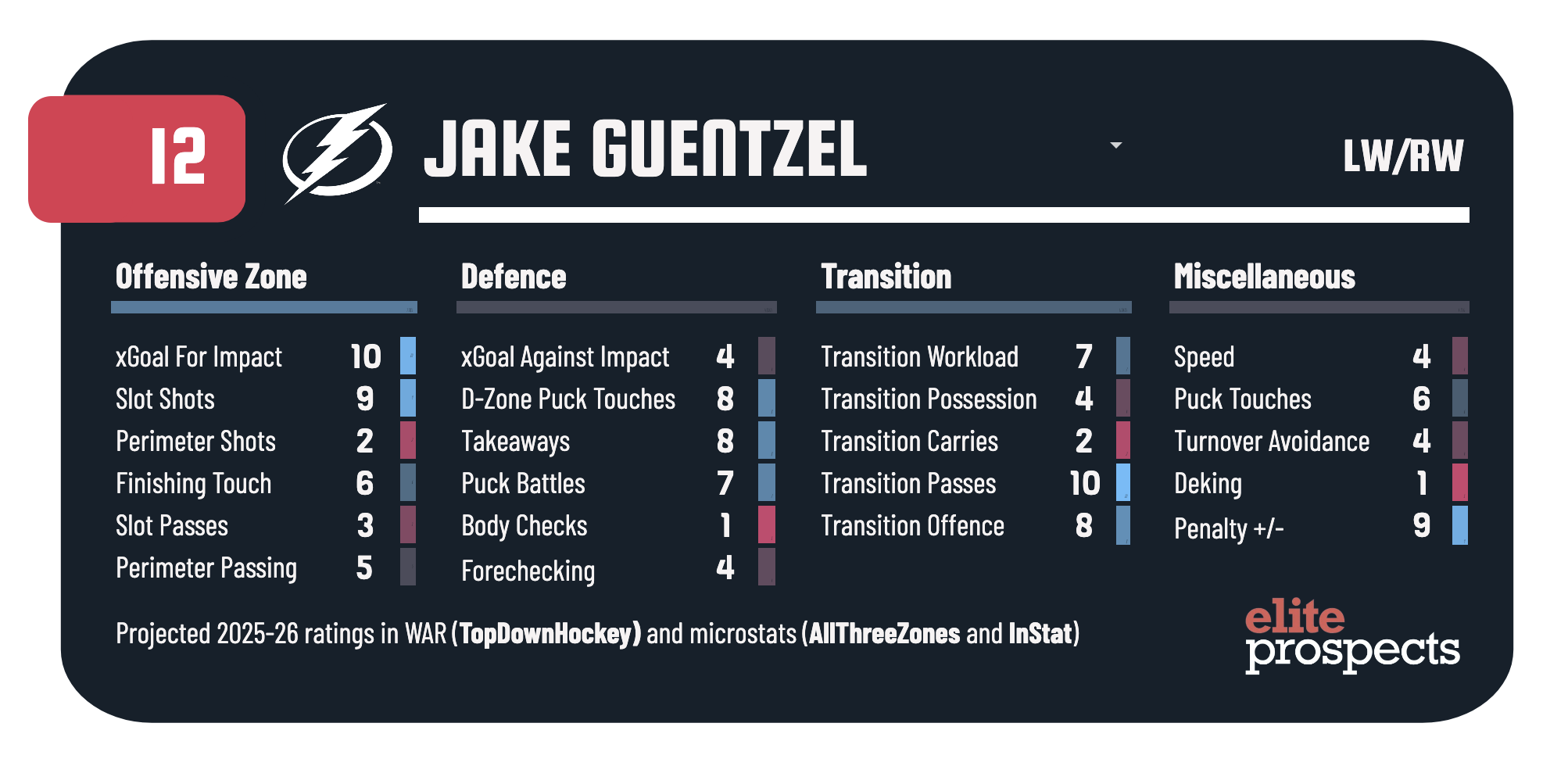
For years, Jake Guentzel was the second-best player on his line next to Sidney Crosby, and excelled by thinking the game at a similar level as his generational linemate. Then he went to Carolina and proved that he could be a legitimate star in his own right playing with guys closer to his level. Tampa Bay has presented a new challenge: being the third-best player on his unit. A 40-goal, 80-point season with Brayden Point and Nikita Kucherov suggests that things didn’t go so badly. As might have been expected, sharing the load means less individual activity on the offensive zone, but his game has always revolved around his intelligence and efficiency off the puck, timing his routes to dangerous areas and getting lost in coverage until it’s too late and the puck’s on his stick in tight. Despite his lack of size, he’s extremely effective at winning position at the back door, deflecting pucks, and getting to rebounds cleanly which has made him a major asset on the powerplay. His adaptability is also visible in his new-found focus on supporting the break-out on exits and improved defensive game, previously a major weakness.
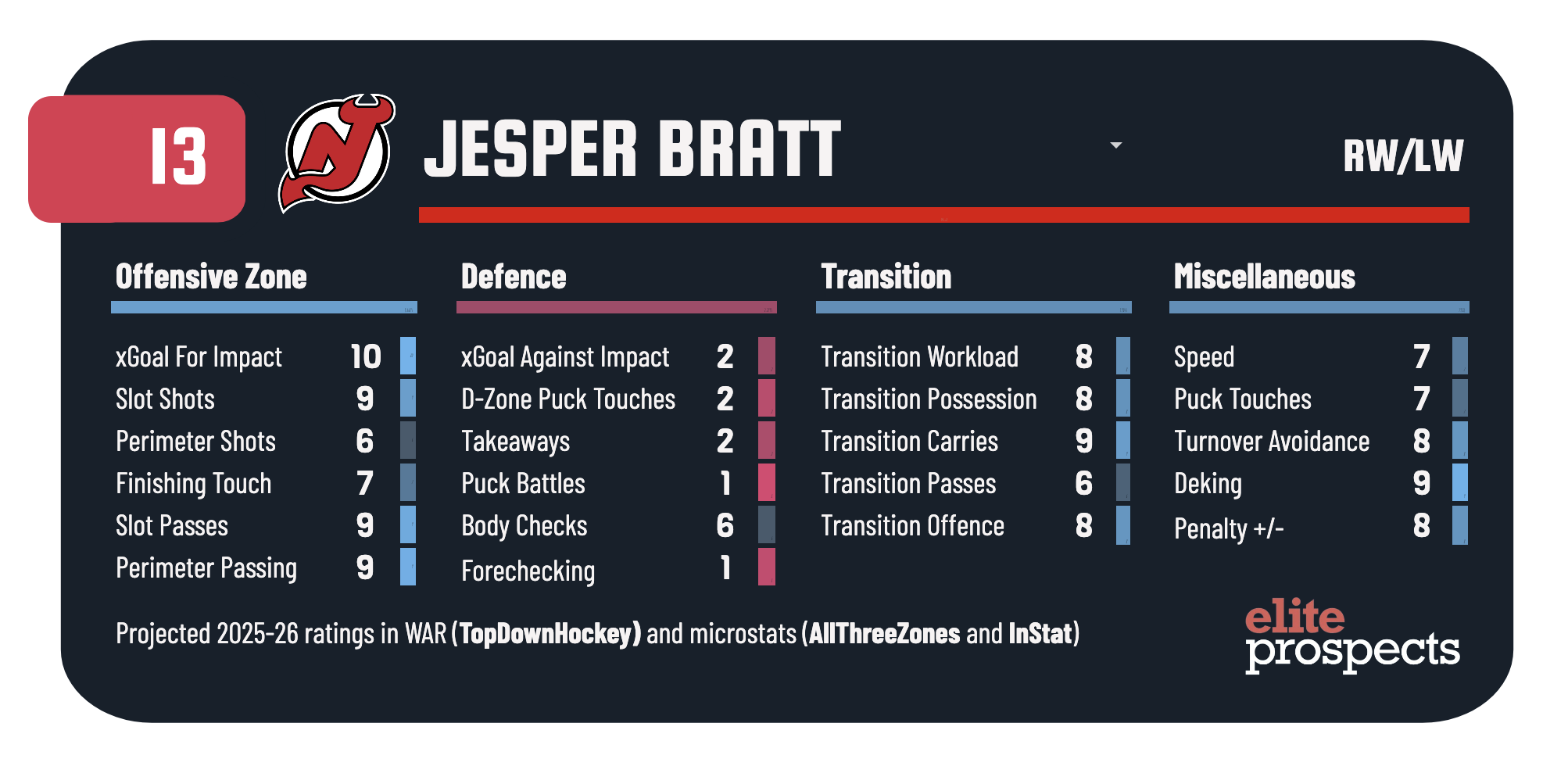
With Jack Hughes so often on the shelf, Jesper Bratt has become the Devils’ most important (or at least impactful) offensive player, leading the team in points two years in a row including a career 67-assist, 88-point performance in 2024-25. His dynamic rush play and passing ability make him one of the most prolific drivers of 5-on-5 offence in the league and he makes everybody he plays with better. Defence isn't exactly his strong suit and he mostly stays above the fray and waits for chances to push play up-ice, but it's a formula that works for him and his offence more than makes up for it.
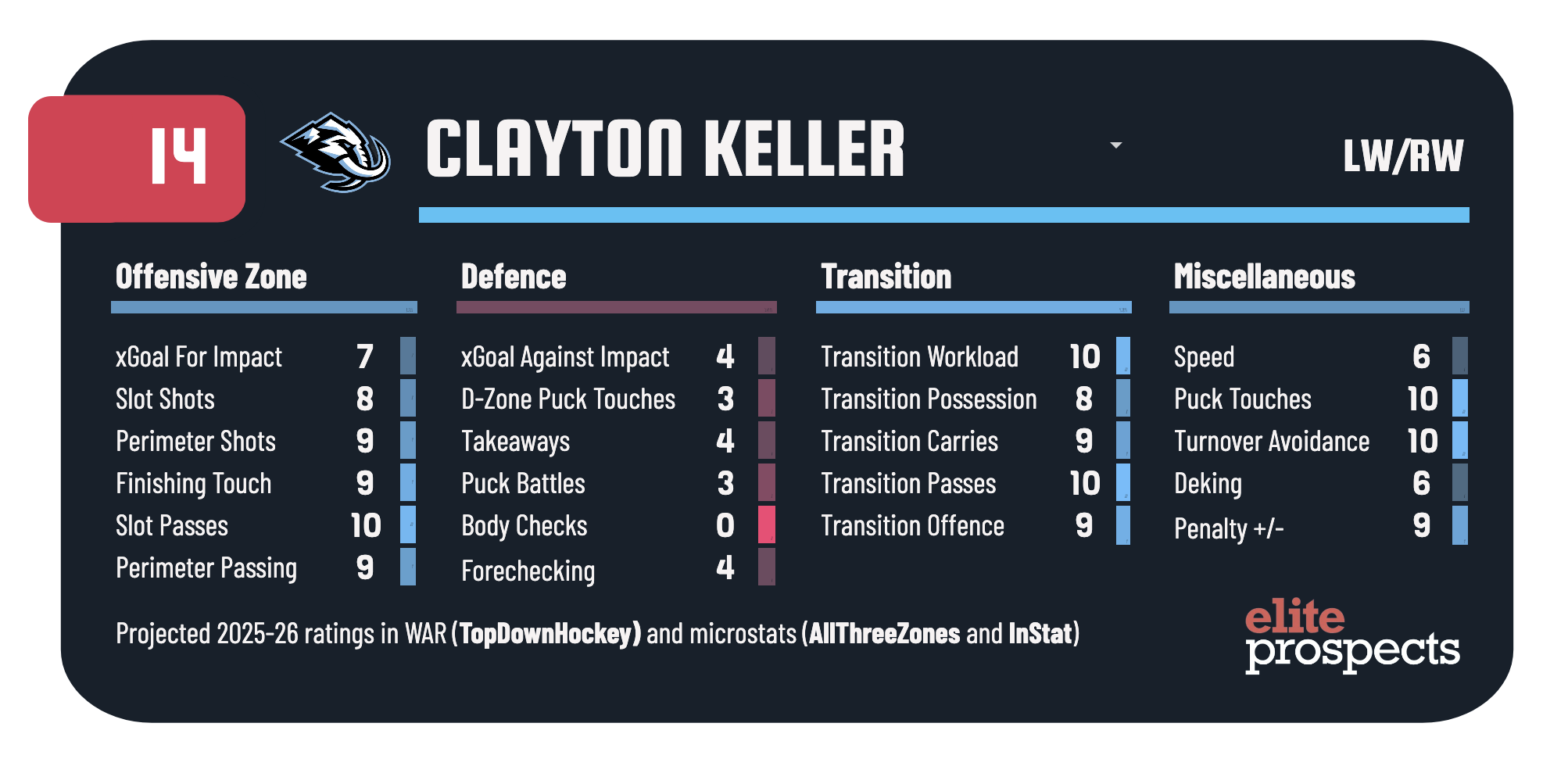
The Utah Hockey Club didn’t make the post-season in their first year in Salt Lake City, but at least they have a star in captain Clayton Keller. Few forwards control the perimeter as well as Keller does, owning his lack of size and physicality and taking advantage of areas where he’s guaranteed space so he can reward linemates for getting to dangerous areas. He’s always focused on getting the goalie moving and loves a good east-west pass. Three straight 30-goal seasons are the result of a hard one-timer and a wickedly accurate wrist shot which is especially deadly from the circles on the powerplay.
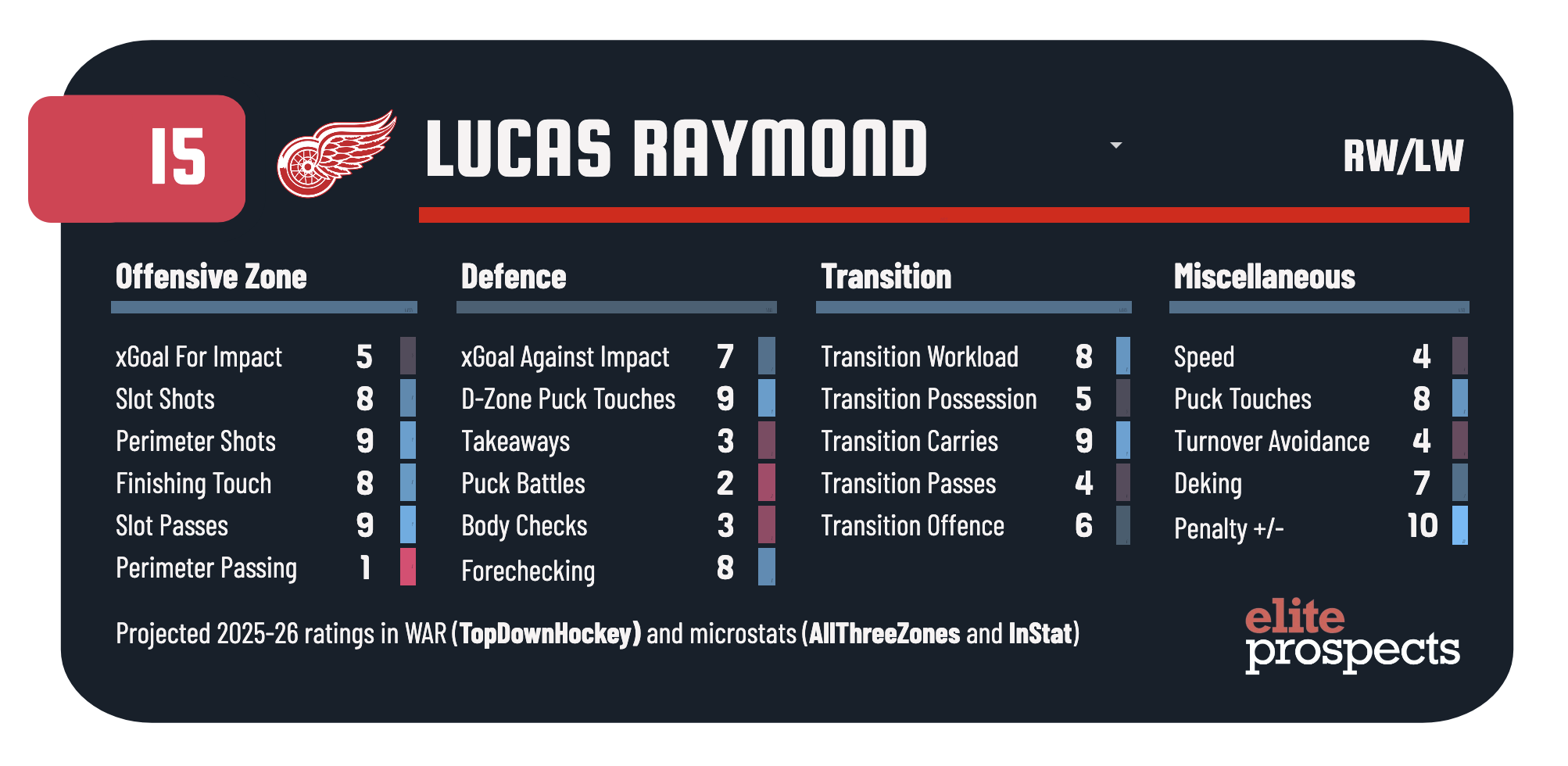
Amid all the questions about the status of the “Yzerplan” and the trajectory of the Red Wings’ rebuild, there’s little doubt that Lucas Raymond the crown jewel of their young forward core. While it was his second consecutive season leading the team in points, 2024-25 represented a big step forward for Raymond in terms of driving play at both ends of the ice at 5-on-5 and in particular creating more offence in the slot. He's playing a more crucial role in transition, marrying the high-end hockey sense he's possessed since he was a prospect with hard work in all three zones, and has become increasingly trusted to handle difficult match-ups in critical minutes. Once the Wings get back to the playoffs, expect him to be a big game player.
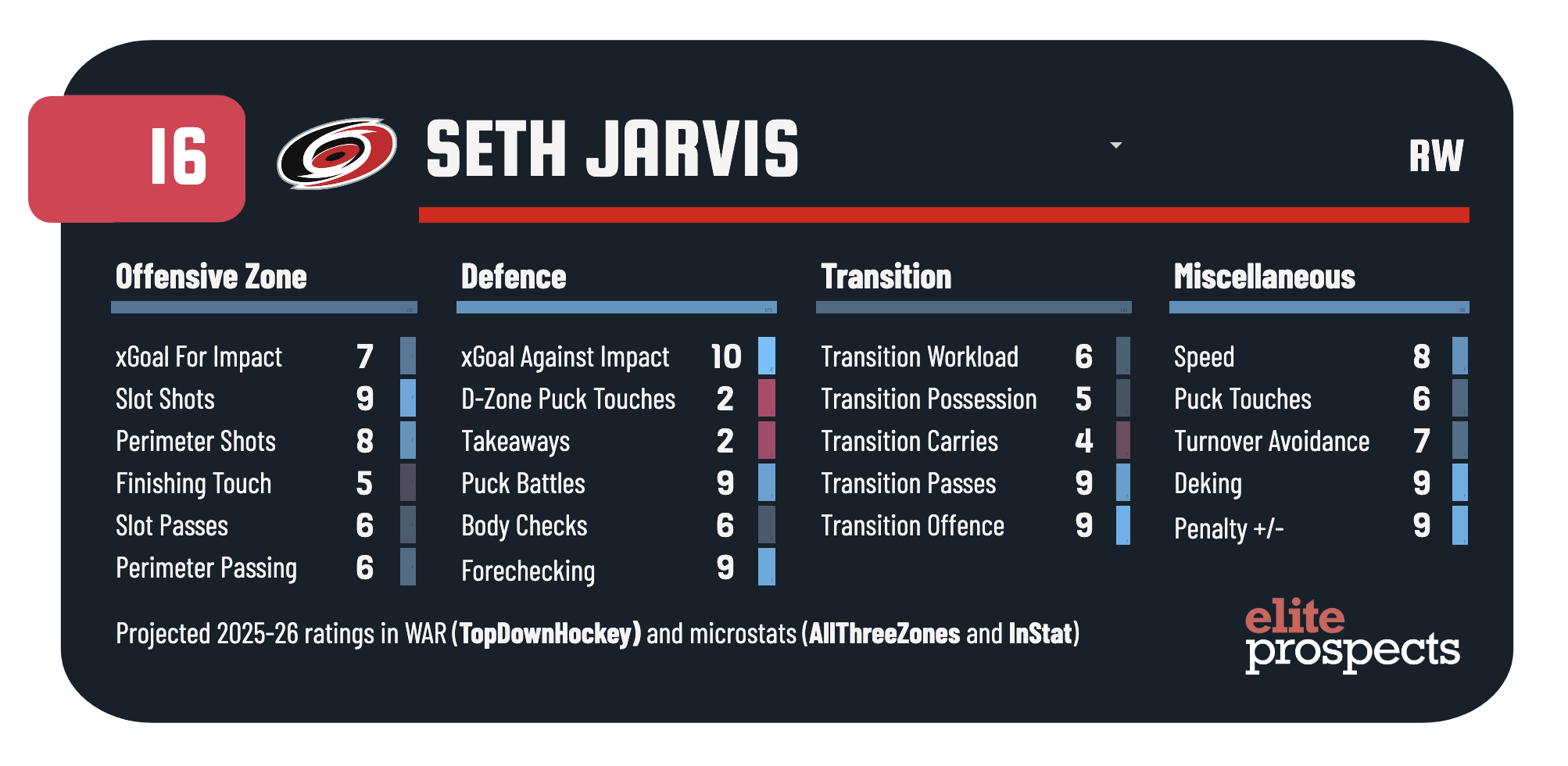
In a league where size is once again paramount, Seth Jarvis’ example might provide a critical counter-comparable for young undersized players hoping to break into the league. Drafted as a high-upside offensive player, Jarvis forechecked and battled his way to an unexpected but well-deserved spot on Team Canada in 2025, balancing finesse and hard work to establish himself as not only a consistent 30-goal threat and slot shot machine but among the league’s best defensive forwards. He breaks through the Canes system with plenty of rushing flair while exemplifying the best qualities of their intense possession system, playing through contact and exerting maximum pressure on top competition. He has the passing skill to reach another level too.
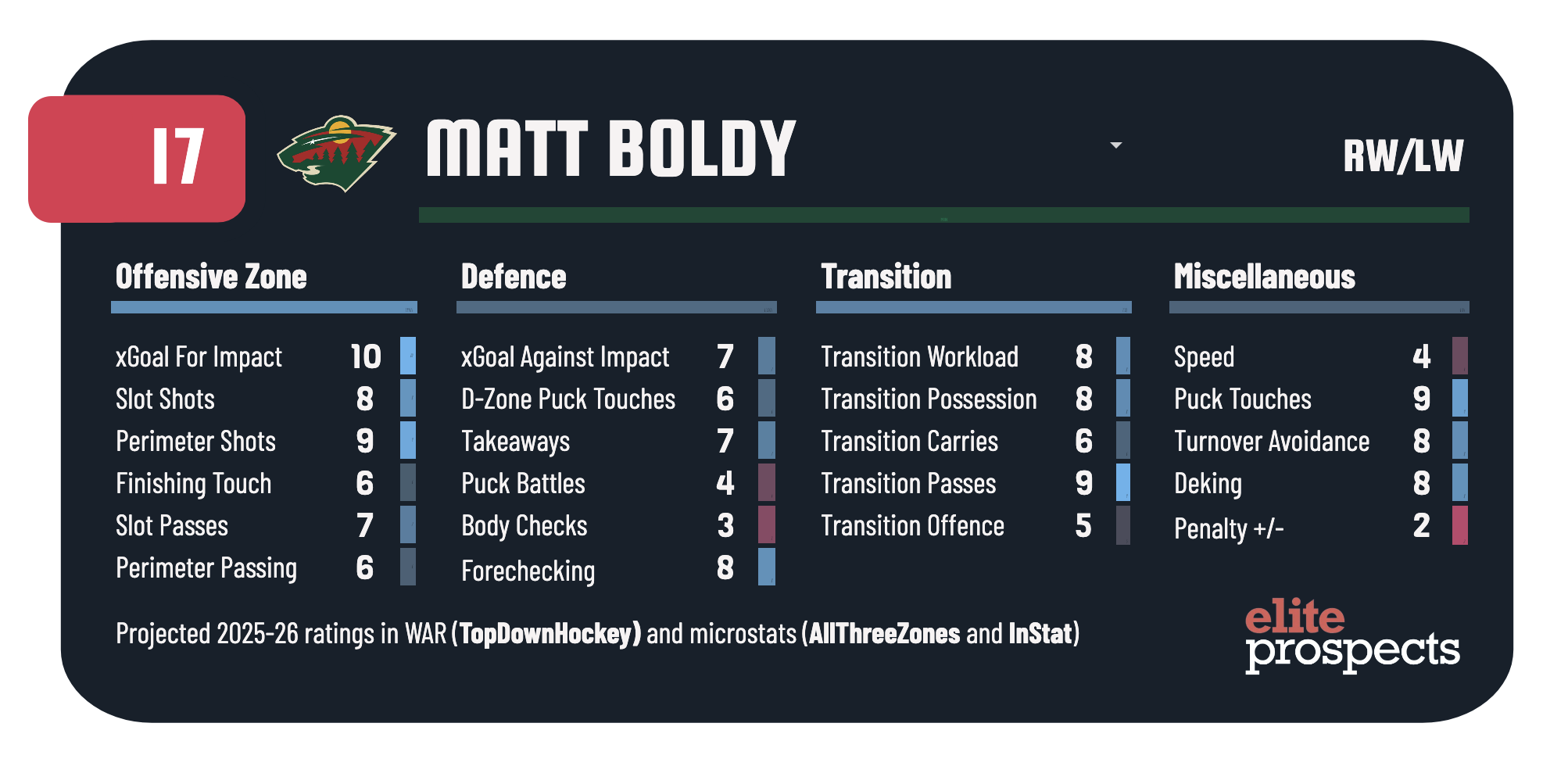
Matt Boldy’s been a model of consistency since stepping into the NHL four seasons ago, but you still get the sense that there’s another level he can reach. That said, he’s so good now that if he plateaus it will be hard to get too upset about it. He’s one of those players that makes everyone around him better, using his combination of strength on the puck, hands, and hockey I.Q. to terrorize opponents on extended offensive zone possessions. Watching him on cycles protecting the puck, reading the play and anticipating his linemates’ movements, catching defences off-balance with unexpected passes against the grain, and shooting from anywhere is a treat, and when his team loses the puck he’s an absolute pest on the forecheck.
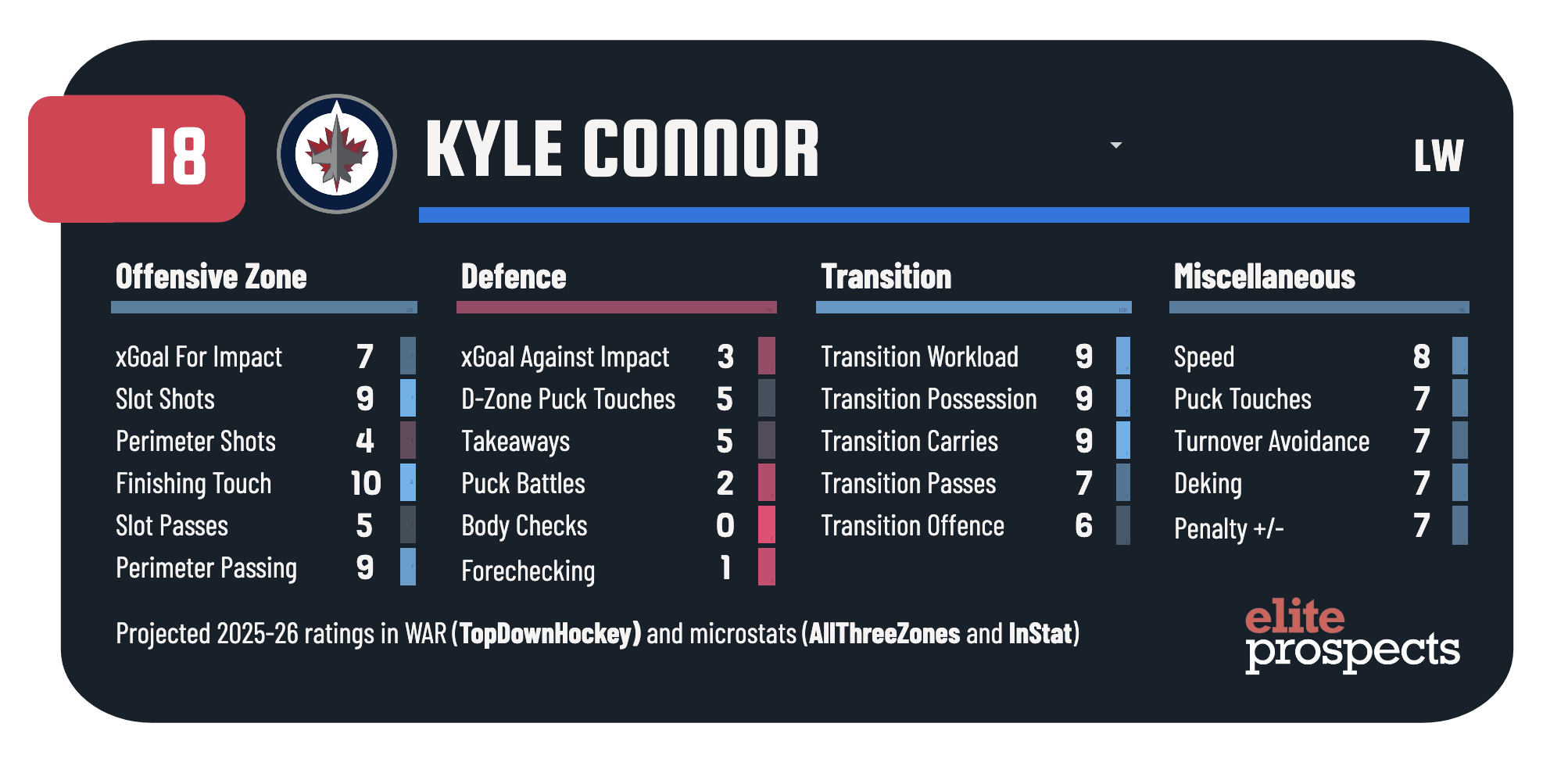
Kyle Connor enjoyed a career year in 2024-25, picking up his second 40-goal campaign and setting highs in assists and points (plus 17 points in 13 playoff games). He’s been one of the league’s most effective snipers for years, boasting a deadly wrist shot and the feet and hands to create space to use it. His ability to beat defenders (and goalies) one-on-one makes him tough to contain off the rush, but on extended possessions he flips the script and sneaks around the zone without the puck like a phantom, evading anyone’s notice until it’s too late. While he’s never been an analytical darling (in part due to his love of blowing the zone early and disinterest in battling or forechecking), his finishing touch alone is an all-star asset.
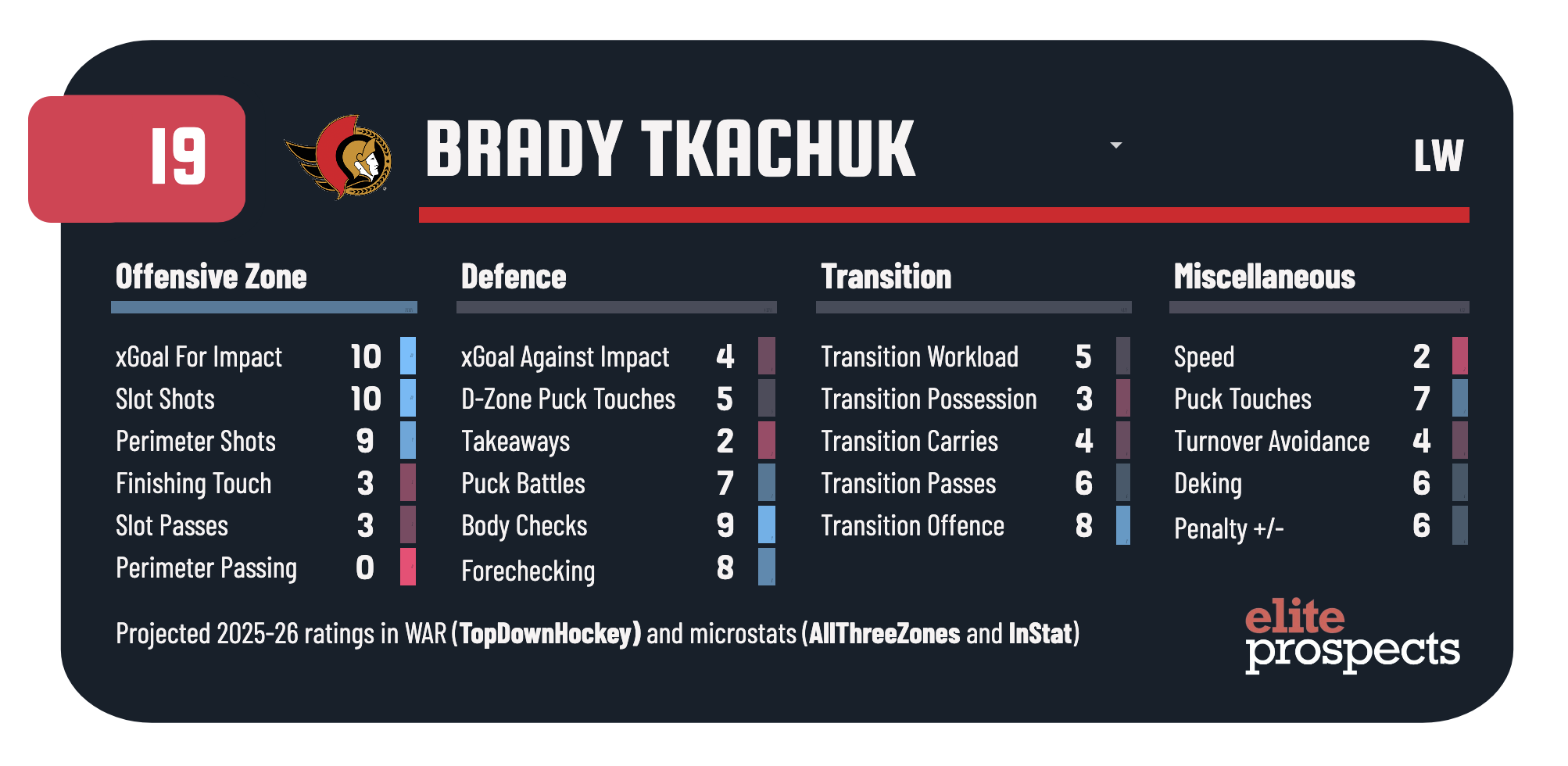
2025 was a big season for Brady Tkachuk: he and his brother were the face of American hockey following a gusty and pugilistic showing at the 4 Nations and he played his first NHL playoff games. Amid all of this it was easy to forget that his 55 points were his lowest total and pace since 2020-21. Nonetheless, he kept doing his usual thing, finishing top five in shots, slot shots, inner slot shots, rebounds, cycle shots, and forecheck shots. If it involved firing a puck towards the net, Tkachuk did it. It wasn’t a banner year for his inconsistent playmaking but he did improve his defensive impact quite a bit, not getting caught deep on the backcheck as often and participating in his own zone more.
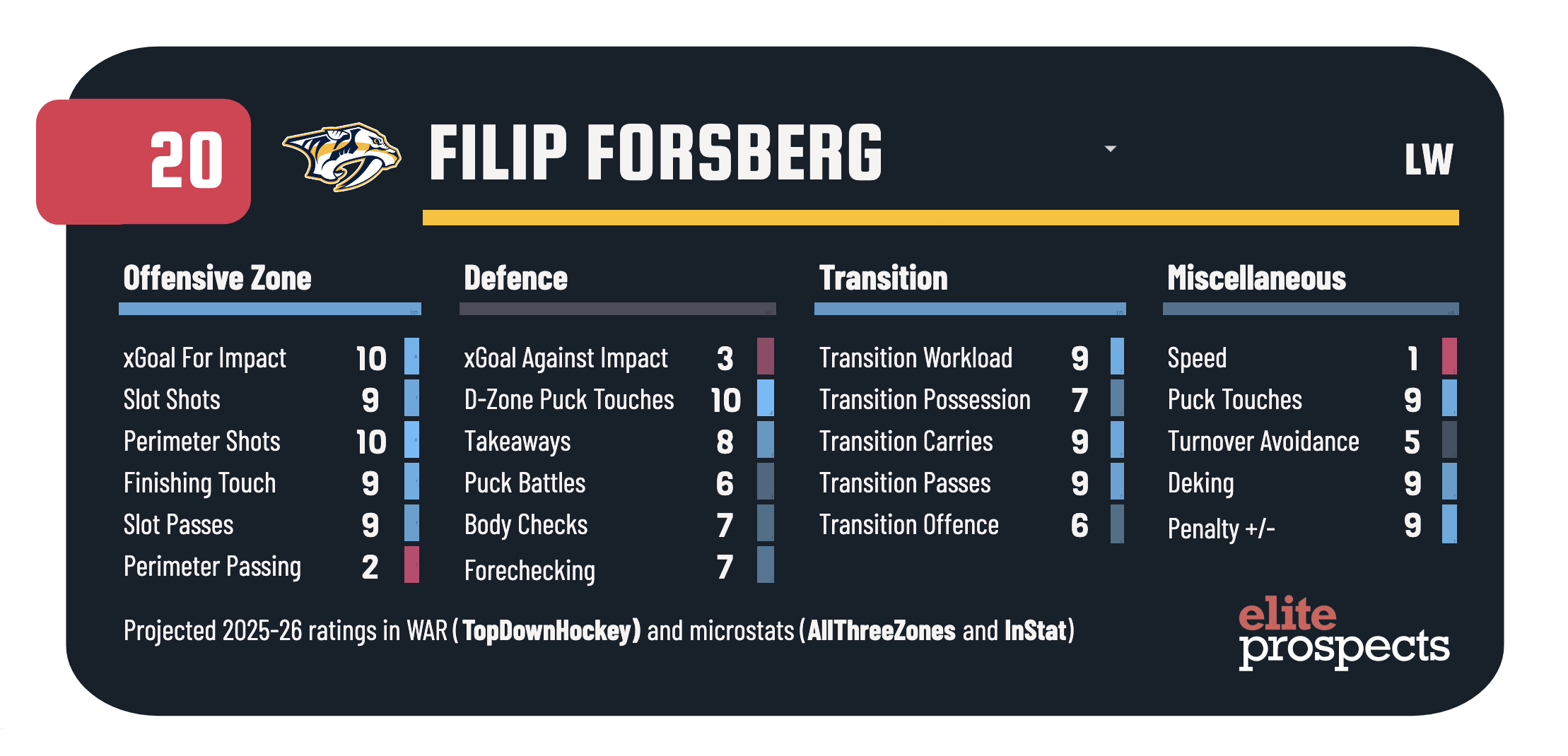
Even as the Predators’ grand “unrestricted free agency our way to contention” plan completely imploded, Filip Forsberg still managed to tally his obligatory 30 goals and flirt with another point-per-game season. His skill-set is pretty well-insulated from everything around him being a disaster because he’s so puck-dominant and can score from pretty much everywhere. His trademark dangling remains a core part of his game and leads to some seriously pretty goals as he carves his way through the offensive zone, and even though his straight-line speed isn’t what it used to be he doesn’t need a lot of strides to get where he wants to go. When he’s really clicking he’s a dedicated puck hound who disrupts plays in all three zones and turns takeaways into counter-attacks, and his passing game is high-ceiling although he usually elects for the safe option to the point (which is fair when Roman Josi is the guy waiting there).
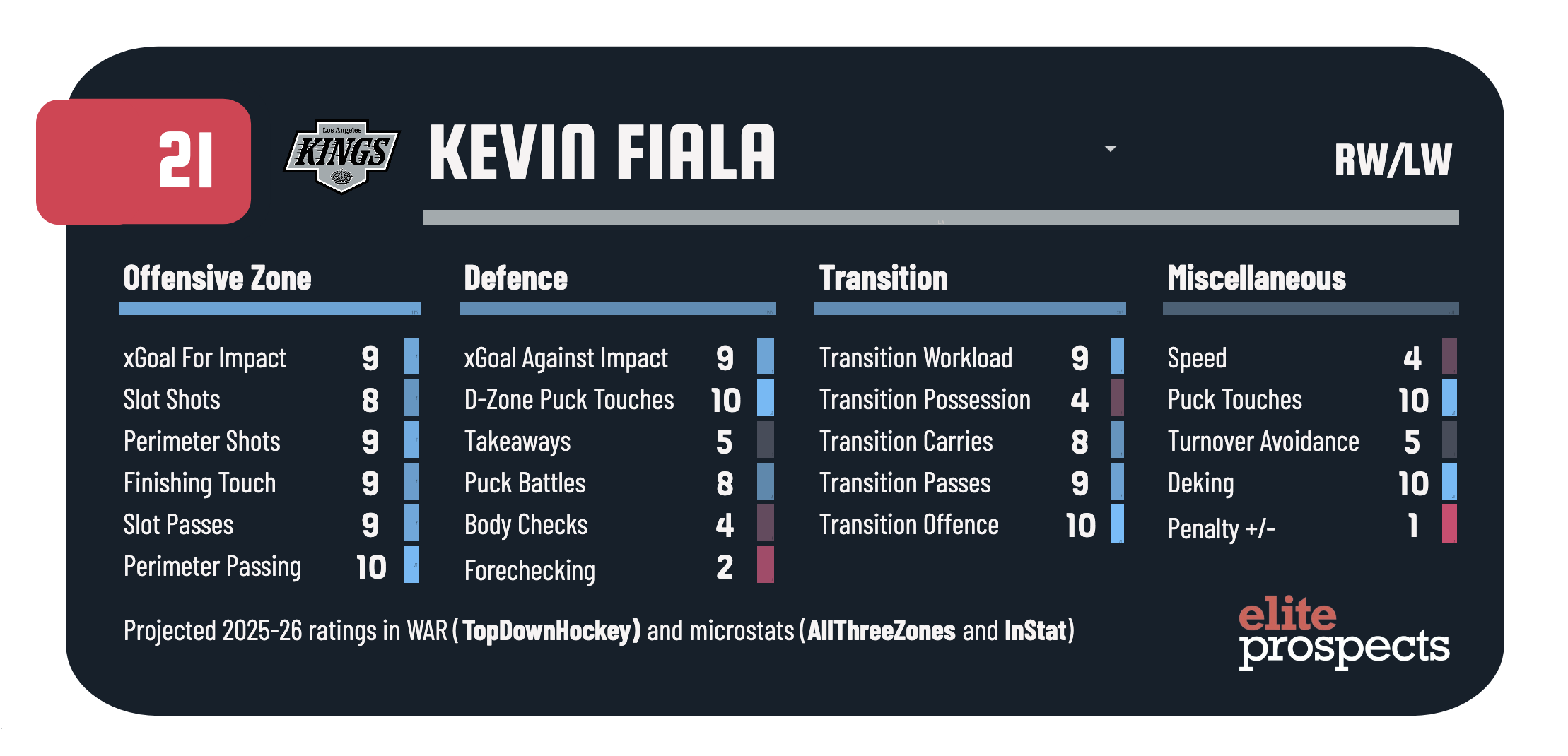
It’s easy to look at Kevin Fiala’s pedestrian production last season -- only 60 points -- and argue that he’s out of place on this ranking. But a deeper look at the process and underlying results make it clear that this dip is unrepresentative of the quality of his play and the significant impact he has on the ice. He’s an abundantly skilled puck carrier who spend a lot of time with possession and has the ability and confidence to pull off moves that few would even attempt. One of his best and most underrated assets is his strength, which allows him to gain and maintain possession of loose pucks and drive to the net through heavy contact. Add in a terrific finishing touch and high-end passing and it’s no wonder he’s one of the premier play-driving wingers in the league.
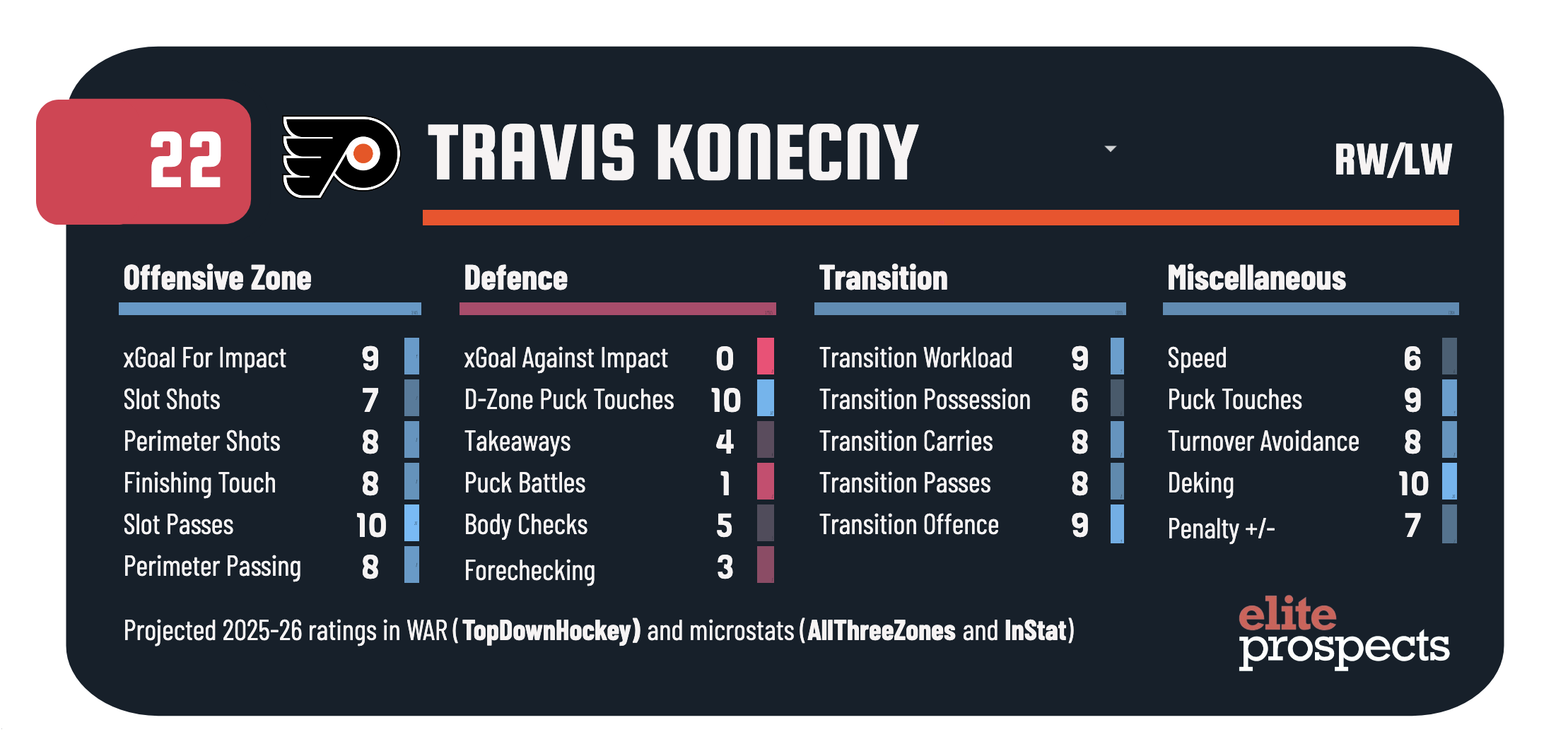
Not many players in the league are more creative than Travis Konecny, and few share his mastery of the rush game. He has the hands and vision to take unconventional routes through the neutral and offensive zones, the short-burst acceleration to blow past defenders, the awareness to open up passing lanes and slip pucks over or under the sticks of blueliners, and a curl-and-drag wrister that can beat goalies consistently. Team Canada also saw a high motor and solid defensive stick suitable for a bottom-six forechecking role, but given his centrality to the Flyers’ offence (which he has led in scoring for four straight seasons) he is very much more focused on blowing the zone early and playing run-and-gun than preventing chances against.
.png)
It was probably pretty fun to be Martin Nečas last season, not only producing at a point-per-game pace for the first time in his career (including, it’s easy to forget, 55 in 49 for the Hurricanes before the trade to Colorado), but enjoying a bigger stage for his considerable talents next to an MVP contender. The dynamic skills he showcased next to Nathan MacKinnon, like the high-speed end-to-end rushes, the dekes through multiple defenders, the dizzying high cycles, and the high-danger feeds into the slot were all there before, but playing next to a guy who can not only skate and think as quickly as him but is also fully willing to attack creatively has helped him level up.
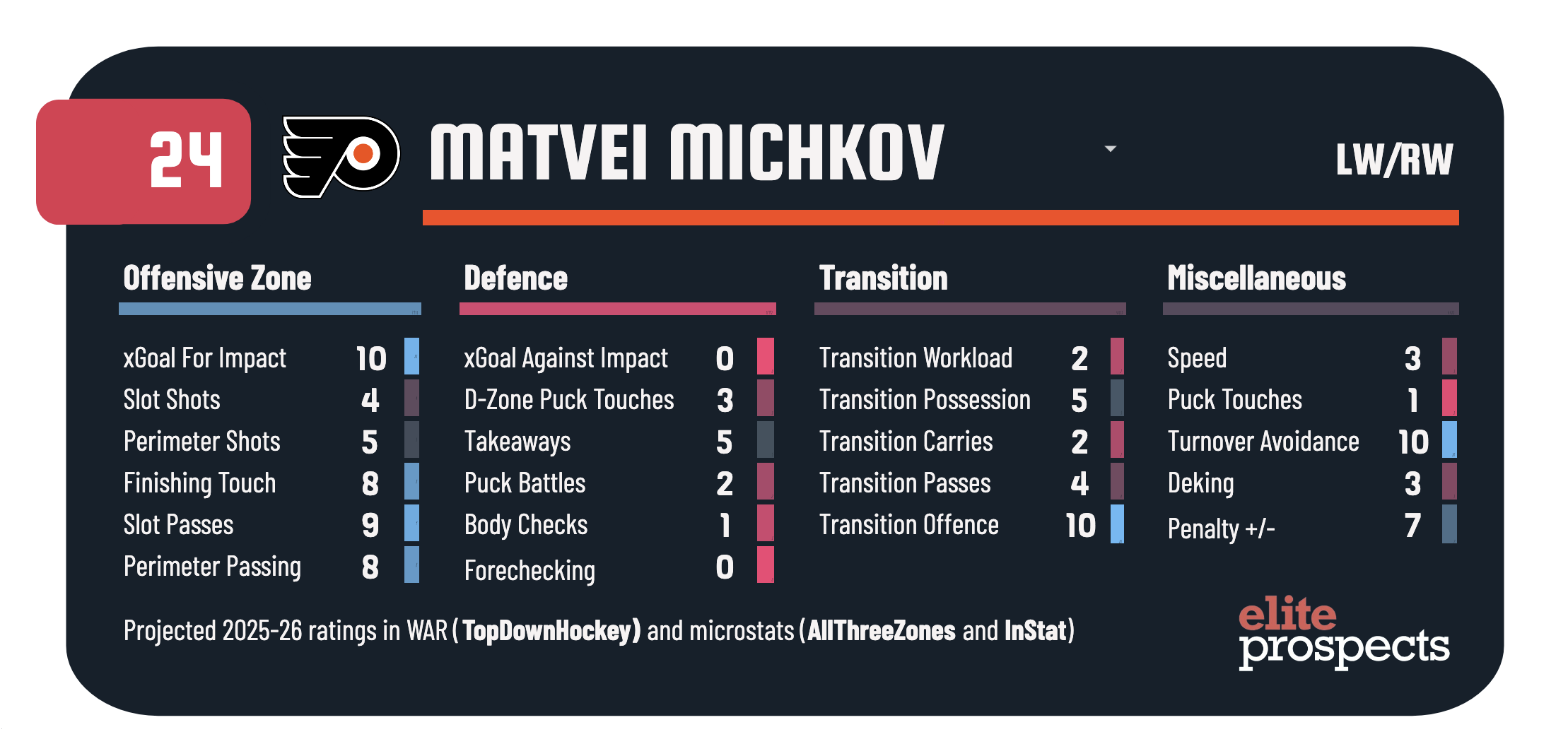
Year one of Matvei Michkov’s career was solid enough on its own terms, with 26 goals and 63 points, but it mostly served to foreshadow what’s to come. As we wrote halfway through the campaign, he spent a lot of the year figuring out -- under the strict tutelage of John Tortorella -- what he can and can’t get away with at the NHL level. What comes next is leveraging his unbelievable hockey sense and already-high-end playmaking to impact the game more extensively. His game was highly efficient, with relatively few puck touches and zone entries as he focused more on connecting the dots in the neutral zone and getting himself available to receive feeds on the rush. He’s a master manipulator of defencemen who sees the ice as though he has a bird’s eye view and can connect unlikely east-west passes to get goalies moving. Paired with linemates who can think the game at a level approaching his and with a bit more puck time, he could take a leap quick.
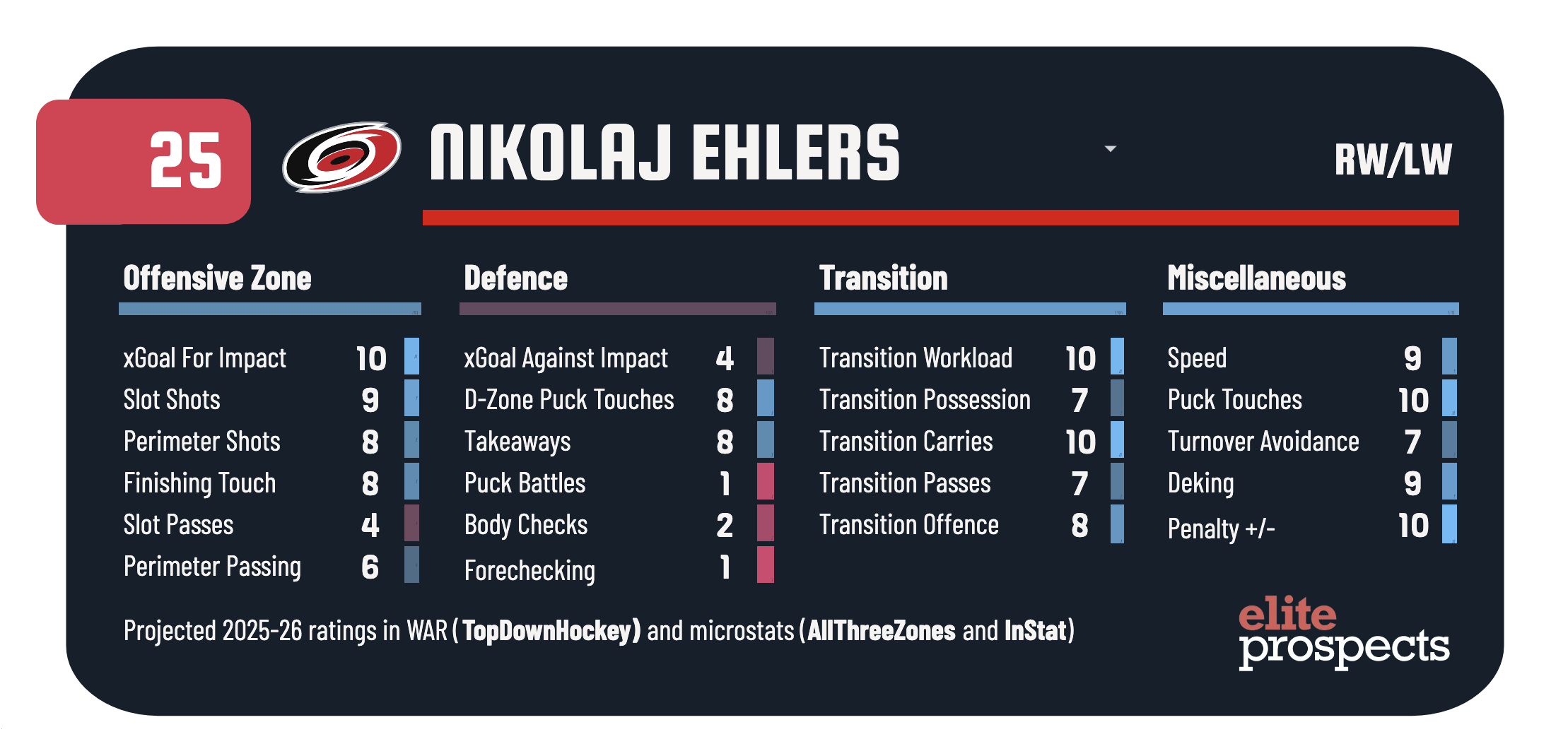
The Hurricanes need a star and Nikolaj Ehlers has a chance to prove the Jets were wrong to limit his ice time all these years. All the tools are there for both sides to get what they need: Ehlers is a graceful and deadly scorer who uses high-end speed and excellent hands to jet through the neutral zone, back off wingers, and open up space to whip wrist shots from the middle, unload old-school clappers from the wing, and send dangerous passes to his linemates. He should bring a dynamic element the Canes have lacked, although it will be interesting to see how his incomplete defensive game (which is mostly opportunistic) will fit within the team’s structure.
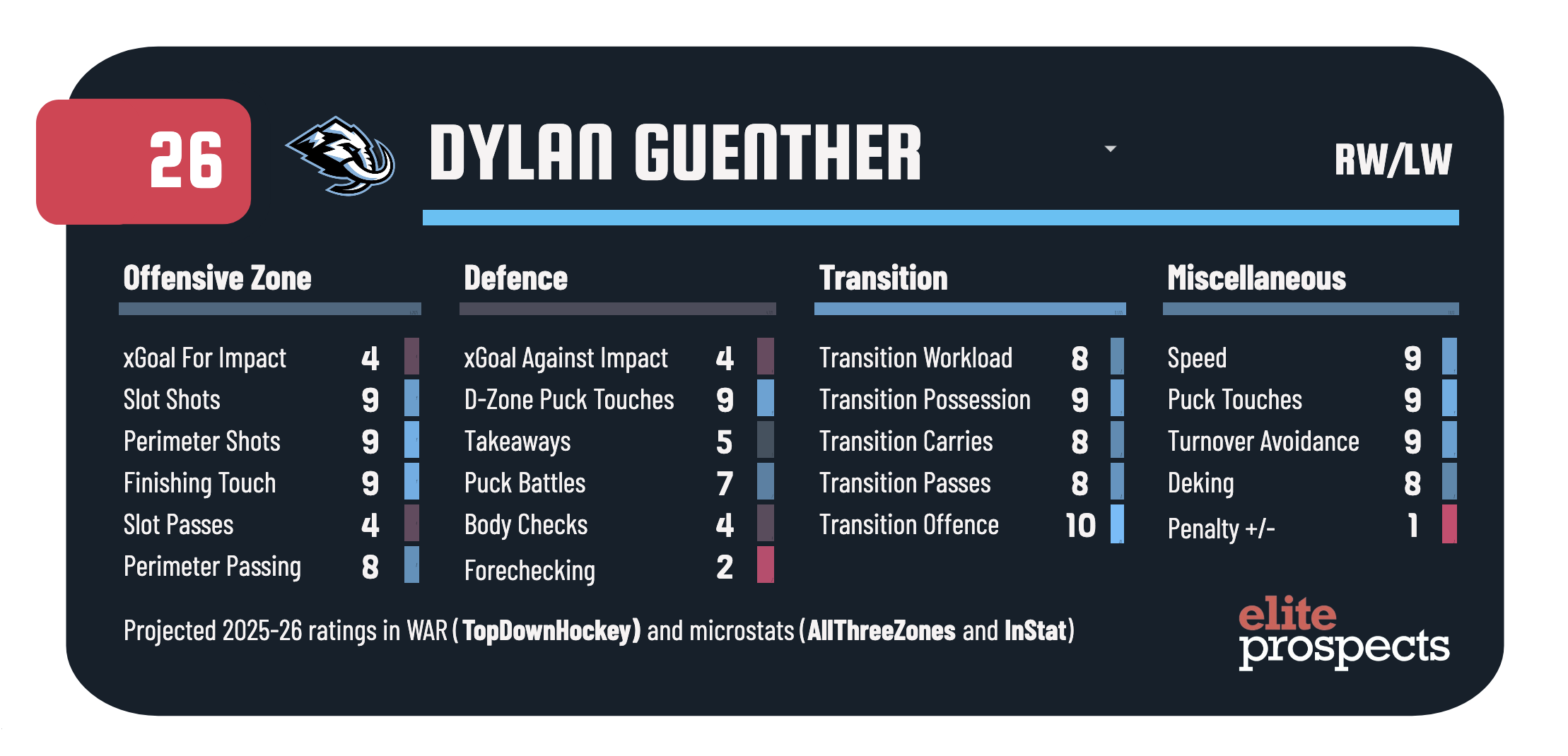
It was justifiable to look at Dylan Guenther’s game as a prospect and conclude that he would likely get as far as his shot would take him. All the way back to junior, his thunderous left-circle one-timer and lethal wrist shot combined with a clever instinct to quietly get to soft spots in the offensive zone were his signature traits, and we projected that “in a few years, we could see him line up seasons of 25 to 30 goals simply by complementing [playmaking linemates].” What’s happened instead is a thorough leveling-up of his game to the point that he’s the one dictating play, not his linemates. Instead of being a shrewd off-puck winger he’s become an essential part of the Mammoth’s transition game, using speed and skill to transport the puck and create his own space. He’s also shown encouraging defensive tools and flashes of playmaking skill that could combine to make him a top winger in this league.
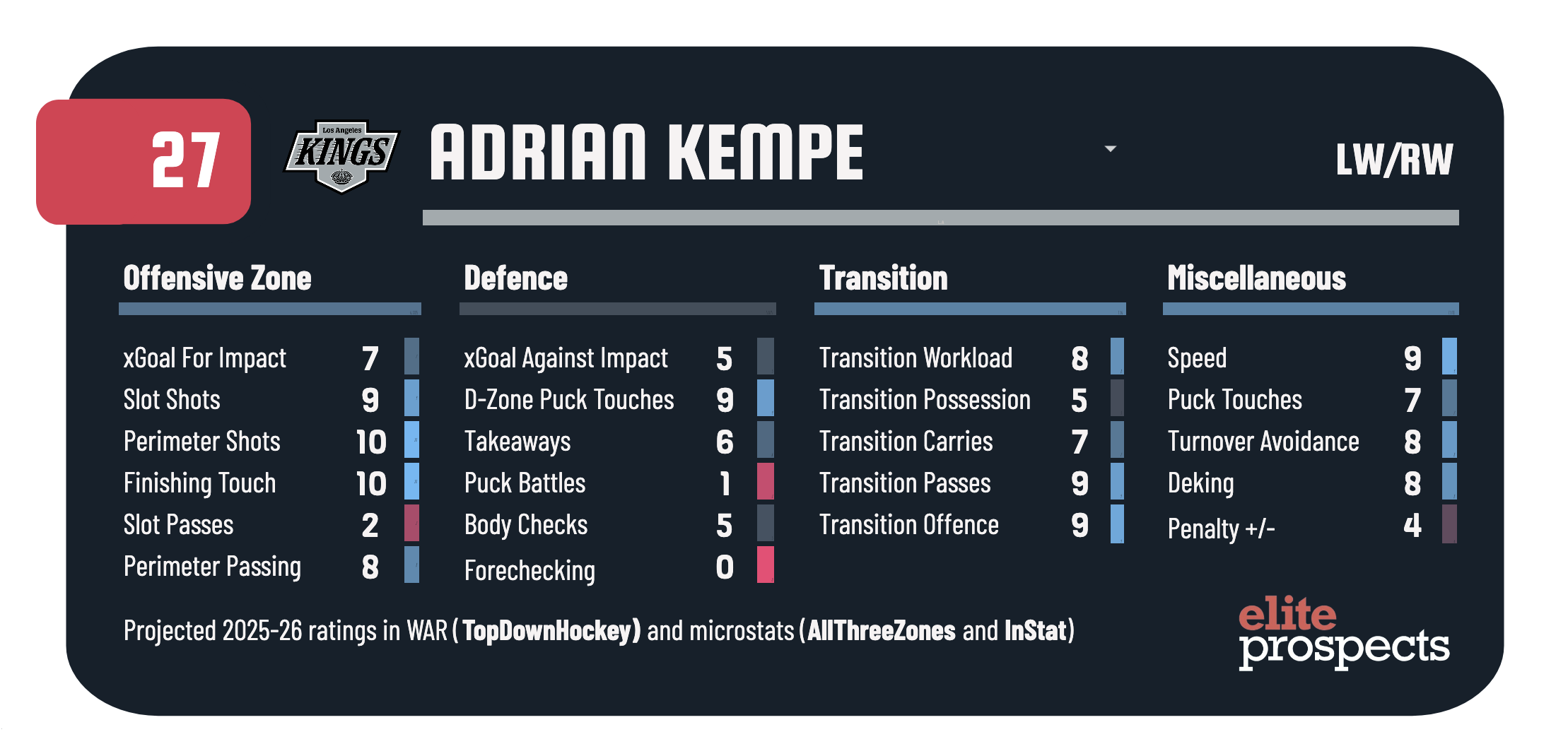
One of the league’s best rush attackers, Adrian Kempe has scored at a 35-goal pace in the past four seasons and added 13 in his past 17 playoff games in large part by bolting up-ice with a head of steam, backing defenders off, and then wiring pucks in from distance. His catch-and-shoot wrister is lethal and he’s great at playing give-and-go in transition as well. He's not a fully well-rounded player, although he’s great on the penalty kill and known to throw insane hip checks when covering for the defence, but he’s a very productive first liner.
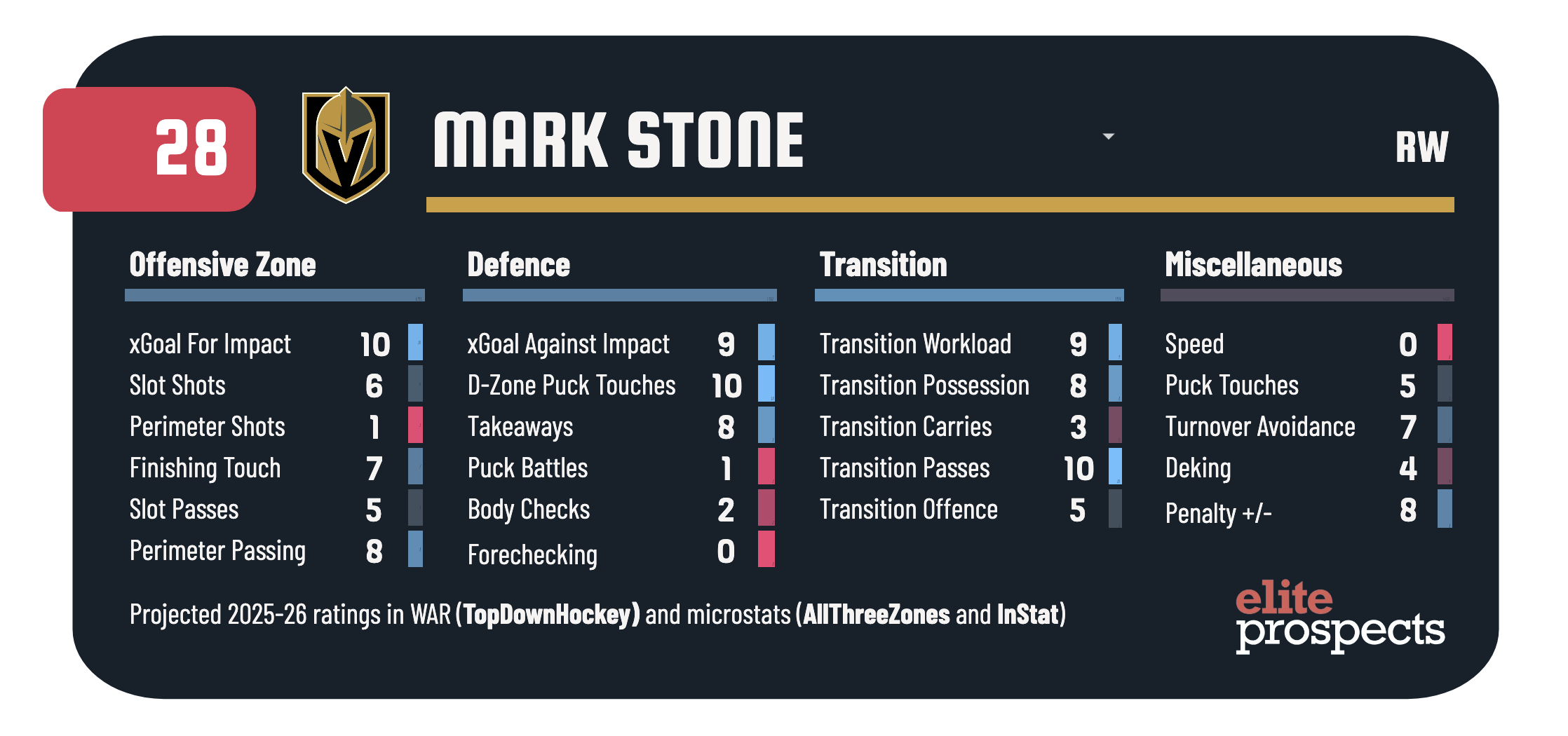
At 33, Mark Stone still has plenty of ability but not quite as much availability as you'd like to see. When he's healthy, he remains one of the NHL's top two-way play-drivers through elite hockey I.Q. and a kleptomaniacal defensive game that go hand-in-hand to make him an ideal linemate. He hounds opponents with flurries of stick checks, intercepts passes with the shaft of his stick, and uses his hands and awareness to navigate the puck out of trouble and get it to a teammate right away. Even though his speed – always a weakness – is falling off even more, he's the master of the area pass to a teammate with wheels and advances the puck through playmaking rather than carrying it end-to-end himself. The volume of chance creation wasn't what it usually is in 2024-25 and it will be interesting to see how he performs this season with heir apparent Marner taking up more ice time.
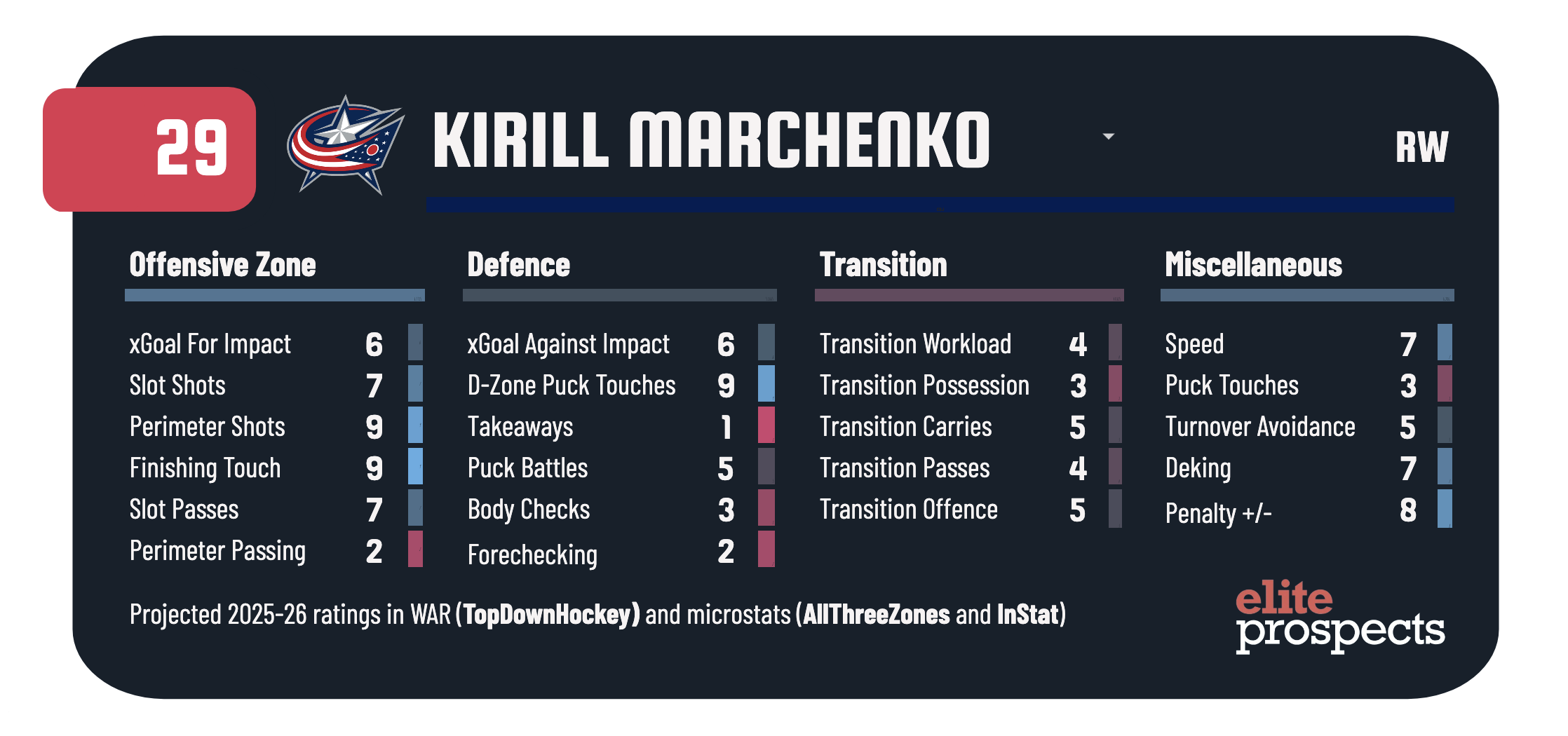
Few players enjoyed the glow-up that Kirill Marchenko did in the 2024-25 season. While he showed promise before, his 31-goal, 74-point campaign cemented him as one of the most electrifying players in the league (even if most fans haven’t noticed yet). I don’t know this for sure, but I’m guessing his favourite player growing up was Pavel Datsyuk based on his sheer ambition and creativity with the puck; it seems as though he’s not happy with a shift unless he’s completely embarrassed at least one defender and maybe the goaltender with a sick curl-and-drag move or by crossing them up through the triangle. Good acceleration and a solid 6’3 frame give him that extra push to pull off unbelievable moves, and slick playmaking combined with one of the silkiest wrist shots in the game allow him to take advantage of the space he creates with his hands.
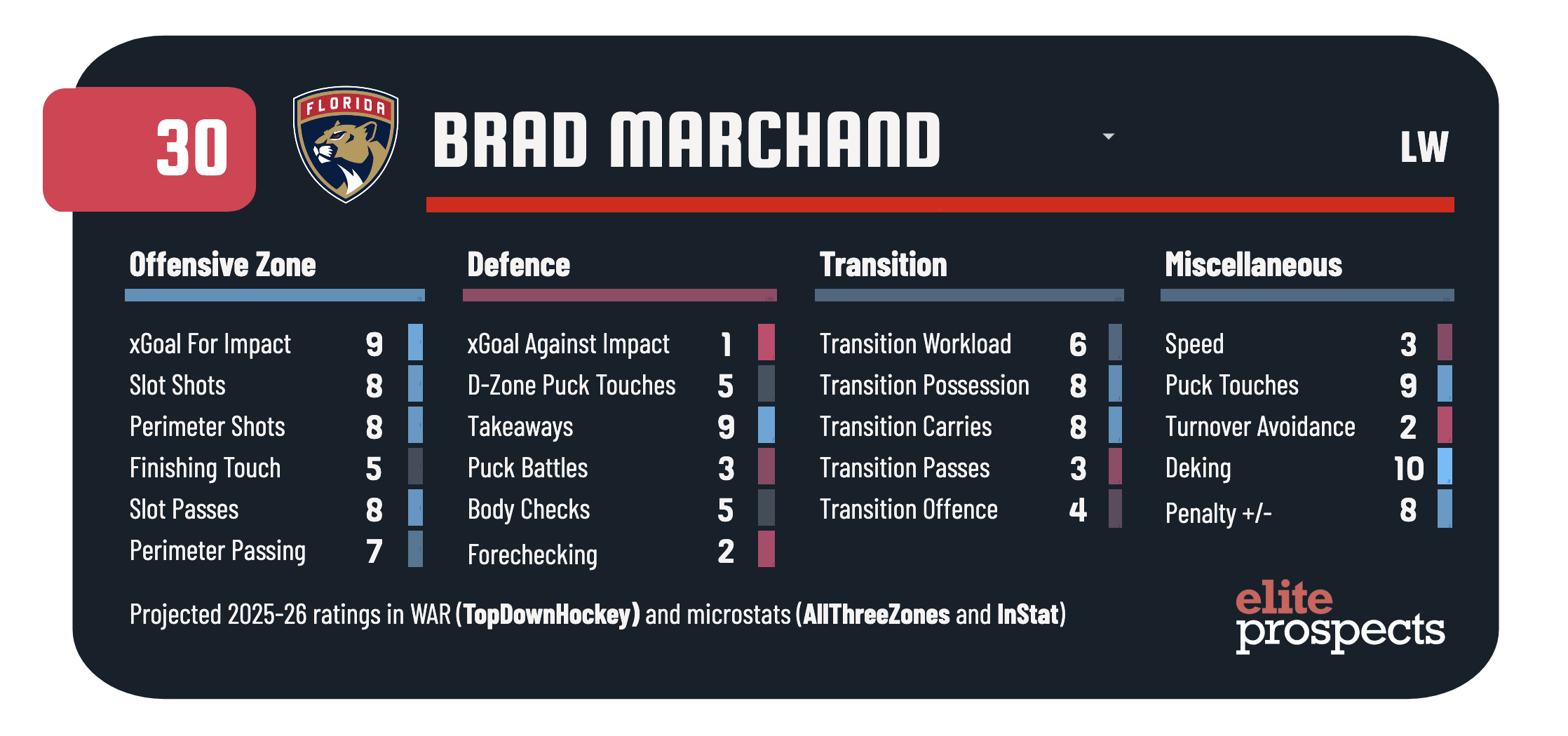
This blurb would probably look a lot different if Brad Marchand had stayed with the Bruins -- it’d focus more on his pedestrian 58 point pace and long-overdue decline from surprise superstar to solid playmaking contributor. Except he didn’t. Instead he went to Florida, led a line that outscored opponents 13 to 4 on the route to a Stanley Cup, and arguably was robbed of a Conn Smythe Trophy at age 37. With an absurdly long contract extension in his back pocket, it’s probably safer to expect top-six calibre all around offence with some peskiness mixed in and utility on both special teams than a return to point-per-game production, but you do never know with him.
Honourable Mentions
Alexander Ovechkin - Washington Capitals
I'm going to assume that the most controversial exclusion will be the greatest goal-scorer in NHL history. Fair enough, considering he scored at a 55-goal pace in the regular season and was excellent in the playoffs as well. However, he is 40, and his game has become increasingly one-dimensional and dependent on the players around him. In terms of transition workload and puck touches he ranks well below everybody on this list and his defensive impact is near-league-worst as well. Scoring is the most important thing but I had to make the tough call here.
Cole Caufield - Montréal Canadiens
Caufield set career-highs in goals (37) and points (70) in 2024-25 and I'm a big fan of how he's developed his offensive game to be more efficient while improving his play-making as well. However, with similarly gifted scorers like Kyrou and Kempe in the bottom parts of this ranking I couldn't ignore his defensive and physical deficiencies relative to them.
Jordan Kyrou - St. Louis Blues
We’re deep enough into Kyrou’s career that it might be time to stop thinking about upside and appreciate the consistent and effective player he’s been for a few seasons now. His breakaway speed, superb hands, creativity, and elite shot make him one of the most dynamic wingers in the league and unlike many comparable players he’s sorted out how to avoid giving too much back defensively as well. We can hold out hope that a 40-goal, 80-point season is on the horizon, but the point is that he’s got the skill to play at that level when he’s at his best.