


Welcome to Elite Prospects' fifth annual NHL player ranking! The summer's over, training camp is here, and that means it's time to take stock of where things stand as we enter the 2025-26 NHL season.
If you're new here, here's the breakdown. We go position-by-positioning, ranking the 30 best players based on how I expect them to perform in the upcoming season. Next up, we're going to take a look at the top centres in the game.
This ranking isn't just based on sorting players by Wins Above Replacement; as with every season, I take a holistic approach, including my own eye test, macro-level metrics from TopDownHockey, manually tracked microstats from Corey Sznajder's AllThreeZones project, and data from InStat Hockey, incorporating as much information as possible to present not only a coherent ranking but the best possible stylistic snapshot of each of these players.
The graphics, inspired by the work done by EP's prospect writers, include projected player ratings for the 2024-25 season in four categories: offensive zone play, defence, transition play, and miscellaneous. Departing from the percentile rankings I use on my player cards, here I use a 1-to-10 rating based on projected finish to respect the uncertainty at play here. The idea is to provide a broad impression of every player's strengths and weaknesses and give you as accurate an impression as possible of how they play.
Here's an example:
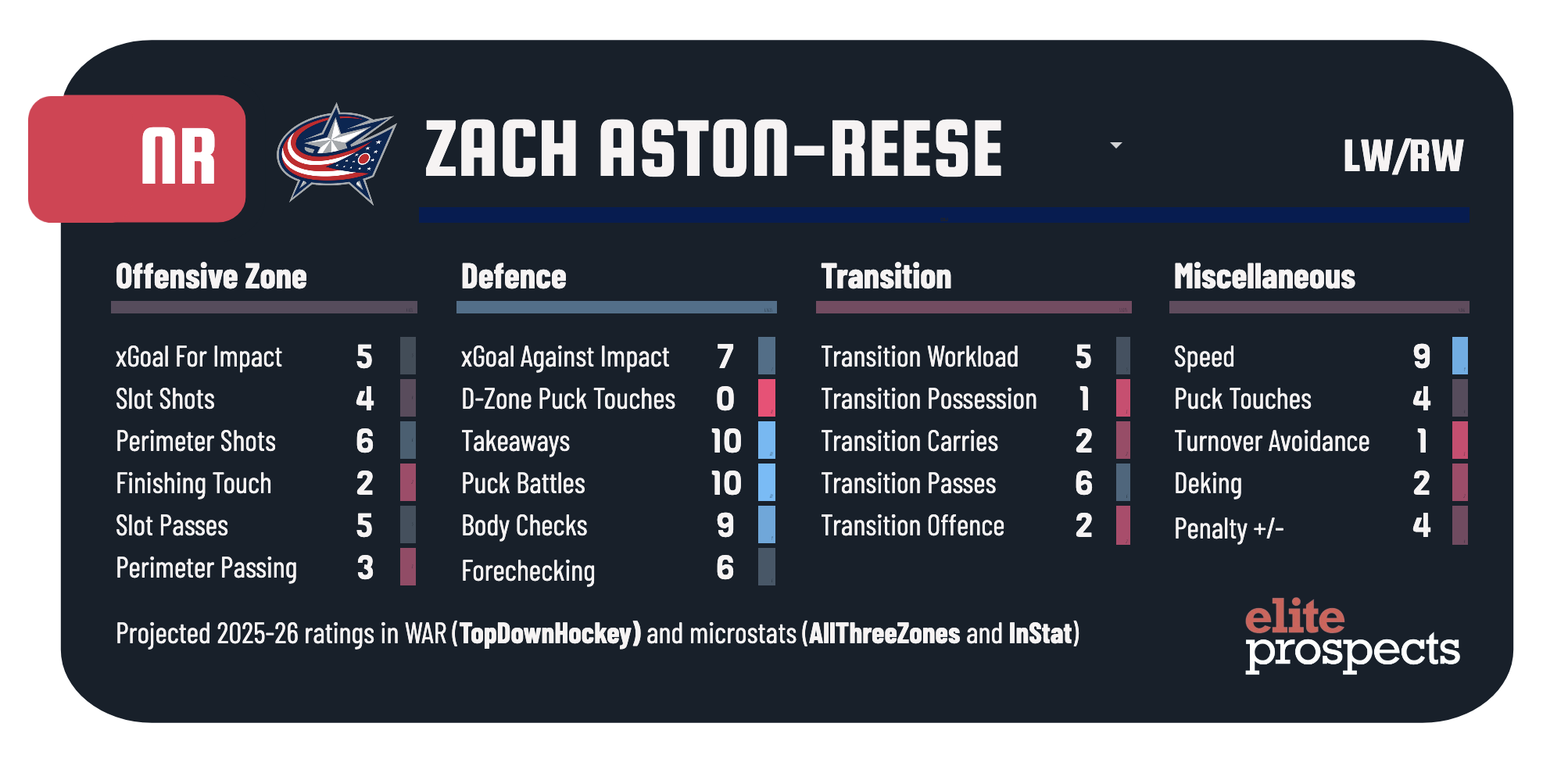
That's a lot of data points, so here's a glossary of the metrics used, all of them per 60 5-on-5 projections for the 2025-26 season based on the previous three seasons of results, including their source (TopDownHockey = TDH, AllThreeZones = A3Z, InStat = IS, NHL = NHL)
Offensive Zone
- xGoal Impact: Isolated impact on his team's generation of expected goals (i.e. shots weighed by likelihood of going in) when he's on the ice (TDH)
- Slot Shots: Scoring chances from the slot (A3Z)
- Perimeter Shots: Shots from other areas of the offensive zone (A3Z)
- Finishing Touch: Goals scored above expected given quality of shots (TDH)
- Slot Passes: Passes to the slot resulting in a shot (A3Z)
- Perimeter Passing: Passes to other areas of the offensive zone resulting in a shot (A3Z)
Defence
- xGoal Impact: Isolated impact on his team's prevention of expected goals when he's on the ice (TDH)
- D-Zone Puck Touches: Puck touches within the defensive zone (A3Z)
- Takeaways: Pucks stolen from opponents (IS)
- Puck Battles: 50/50 battles for the puck engaged in (IS)
- Body Checks: Hits as counted by the league (away only to filter out recording bias) (NHL)
- Forechecking: Offensive zone puck recoveries and pressures on opposing defencemen (A3Z)
Transition
- Transition Workload: Transition plays with the puck (A3Z)
- Transition Possession: Rate at which the player makes transition plays with possession as opposed to dump-ins and clears (A3Z)
- Transition Carries: Transition plays by carrying the puck into or out of the neutral zone (A3Z)
- Transition Passes: Transition plays by passing the puck into or out of the neutral zone (A3Z)
- Transition Offence: Shots and passes leading to slots off the rush (A3Z)
Miscellaneous
- Speed: Weighed combination of a player's top speed and frequency with which they exceed 22 miles per hour (NHL)
- Puck Touches: Puck touches in any zone (IS)
- Turnover Avoidance: Turnovers per puck touch (IS)
- Deking: One-on-one dekes (IS)
- Penalty +/-: Net non-coincidental minor penalties drawn versus taken (TDH)
Player positions used in this list will be based directly on the work of @NHL_Rosters on Twitter, who has been running the most accurate depth charts in the league for several years now.
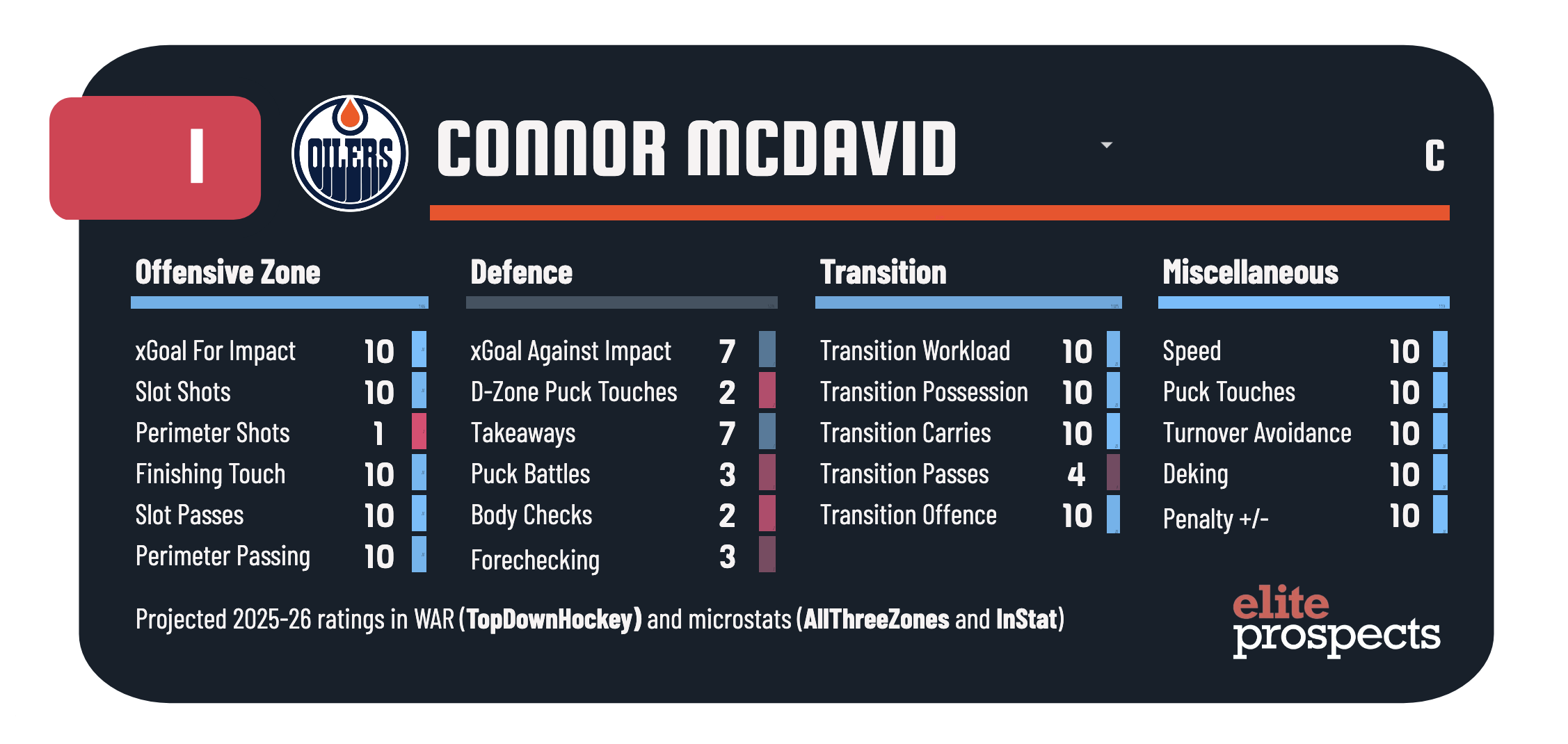
It says something about just how astounding Connor McDavid’s first ten seasons in the NHL have been that a 122-point pace regular season followed by a run to the Cup final (in which he produced at an identical pace) seems underwhelming by comparison. Such is life with a 60-goal, 150-point season and a 42-point Conn Smythe victory on your resumé. Nonetheless, he remains the best hockey player in the world, dominating the game offensively in a manner not seen since Mario Lemieux’s prime. Nobody can break a game open like he can when he gets into full flight, and it doesn’t hurt that he’s arguably the best passer and stickhandler in the NHL, nor that his game reaches yet another level when the stakes are high. All that eludes him are a Stanley Cup and a Gold Medal, both of which he can check off the list this season.
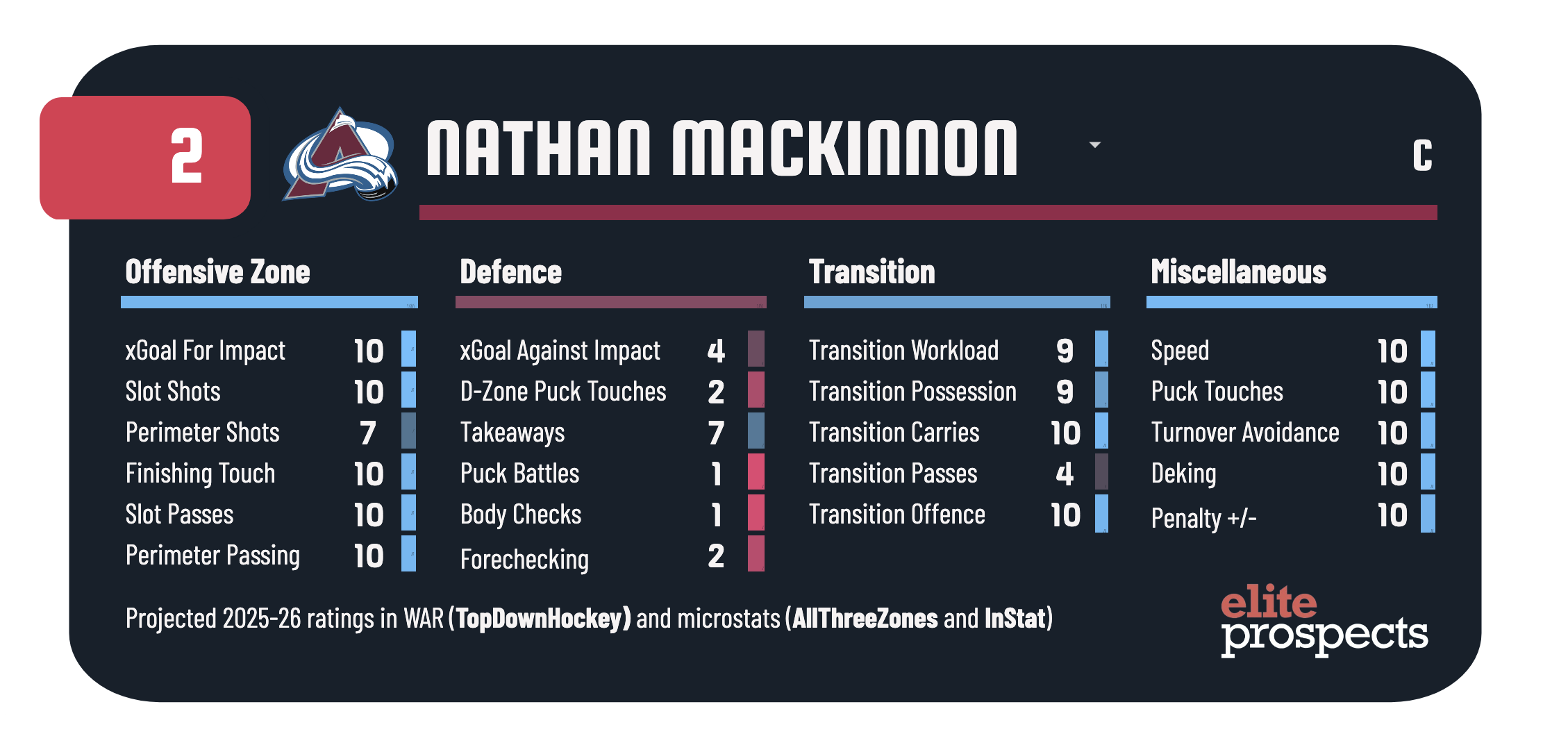
Few things strike more fear into the hearts of defencemen like the sight of Nathan MacKinnon bearing down on them with a head of steam. Speed, skill, strength, and a hyper-competitive nature allow him to bulldoze through basically everyone in his path, whether on highlight-reel end-to-end rushes or extended offensive zone possessions where his gravity pulls defenders away from their assignments and open lanes for him to exploit with elite passing ability. Considering how effective he is at executing tape-to-tape passes to the slot, it’s almost unfair that he’s also the league’s most prolific shooter and possesses such a deadly one-timer. It’s a shame that his famously superb postseason play has had a relatively limited sample size since the Avalanche won the Cup in 2022.
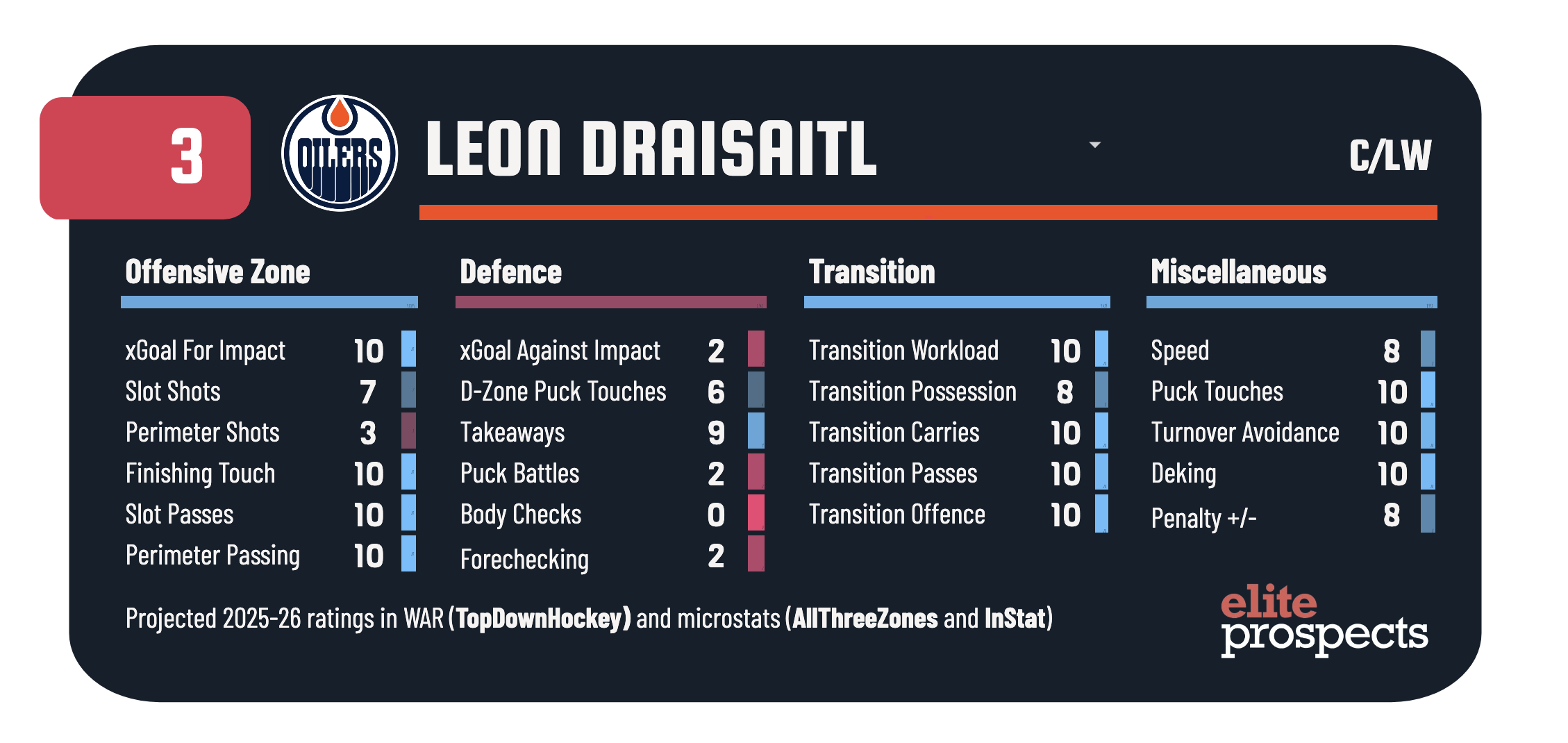
It’s not difficult to make the case that Leon Draisaitl was the best forward in the NHL in 2024-25, an especially impressive feat considering the calibre of competition in the league’s upper echelon at the moment. The game’s most efficient shooter terrorizes defences by simultaneously being capable of finishing from the most outrageously thin angles and creating high-danger passes at a level that very few in the game can match; when you’re an elite finisher and playmaker, there’s not much that can be done to stop you from producing. Add in excellent hands, strength on the puck, awareness, and even underrated speed to the mix and it’s not surprising why, even apart from No. 97, he’s so effective. 2024-25 even saw him improve his defensive play – maybe not as much as some Selke voters thought, but enough to make a big difference in his overall impact.
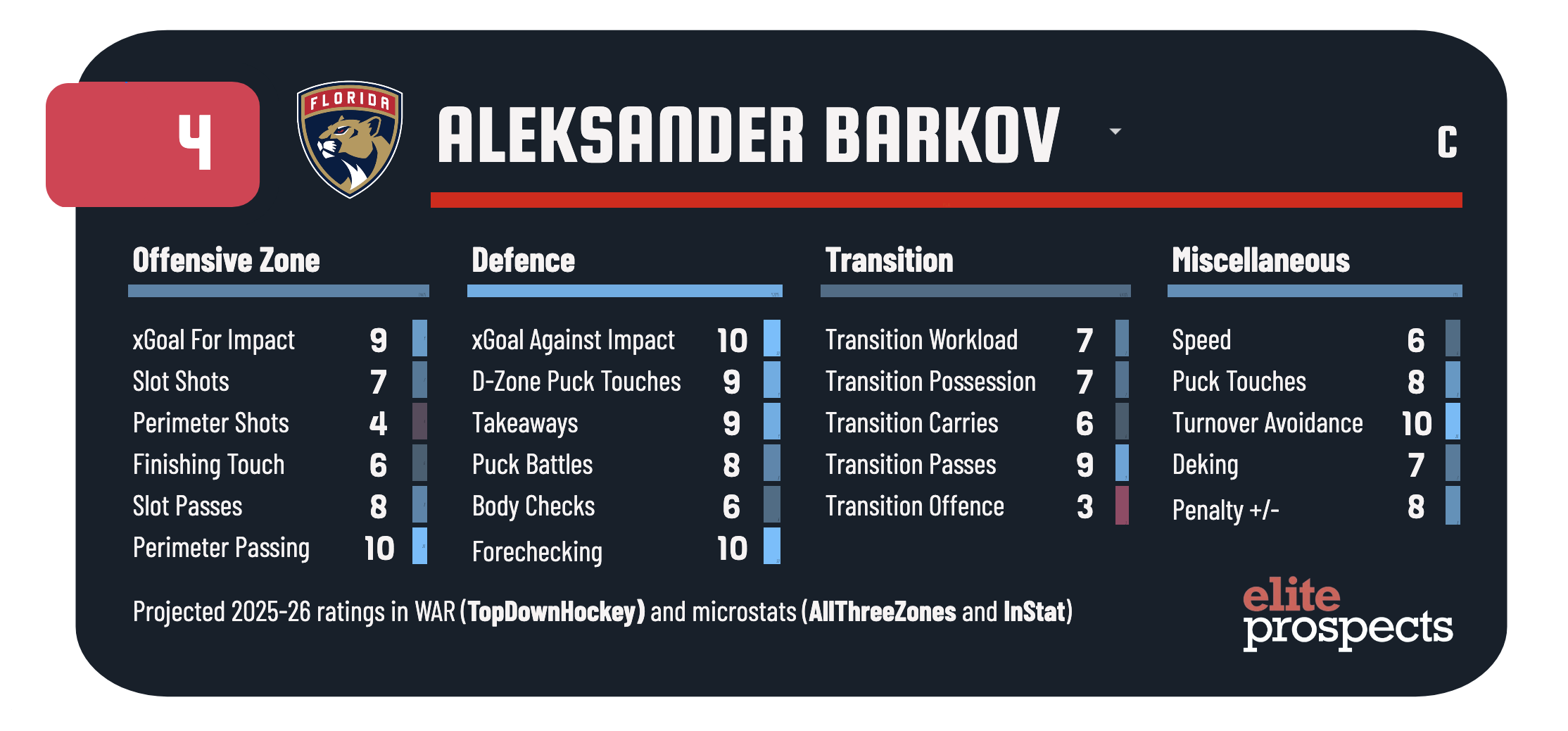
Practically made in a lab to be a coach’s ideal number one centre, two-time Cup champ and back-to-back Selke winner Aleksander Barkov has produced at a 94-point pace in the past five seasons (and a 77-point pace in those Cup runs) while providing the gold standard in shut-down play against the league’s most dangerous offensive players. Case in point, McDavid’s line has mustered two goals against Barkov in 124 minutes of Stanley Cup Final play. His size, strength, awareness, and craftiness make him incredibly frustrating to play against as he leverages every part of his toolkit to get pucks away from his opponents and to his linemates. Not only can he win puck battles at an extremely high clip, but he can make that extra play to make a clean pass off the wall out of a scrum and he rarely makes a false move. He can play basically any role on the ice, but focuses on doing the hard work to make his linemates better.
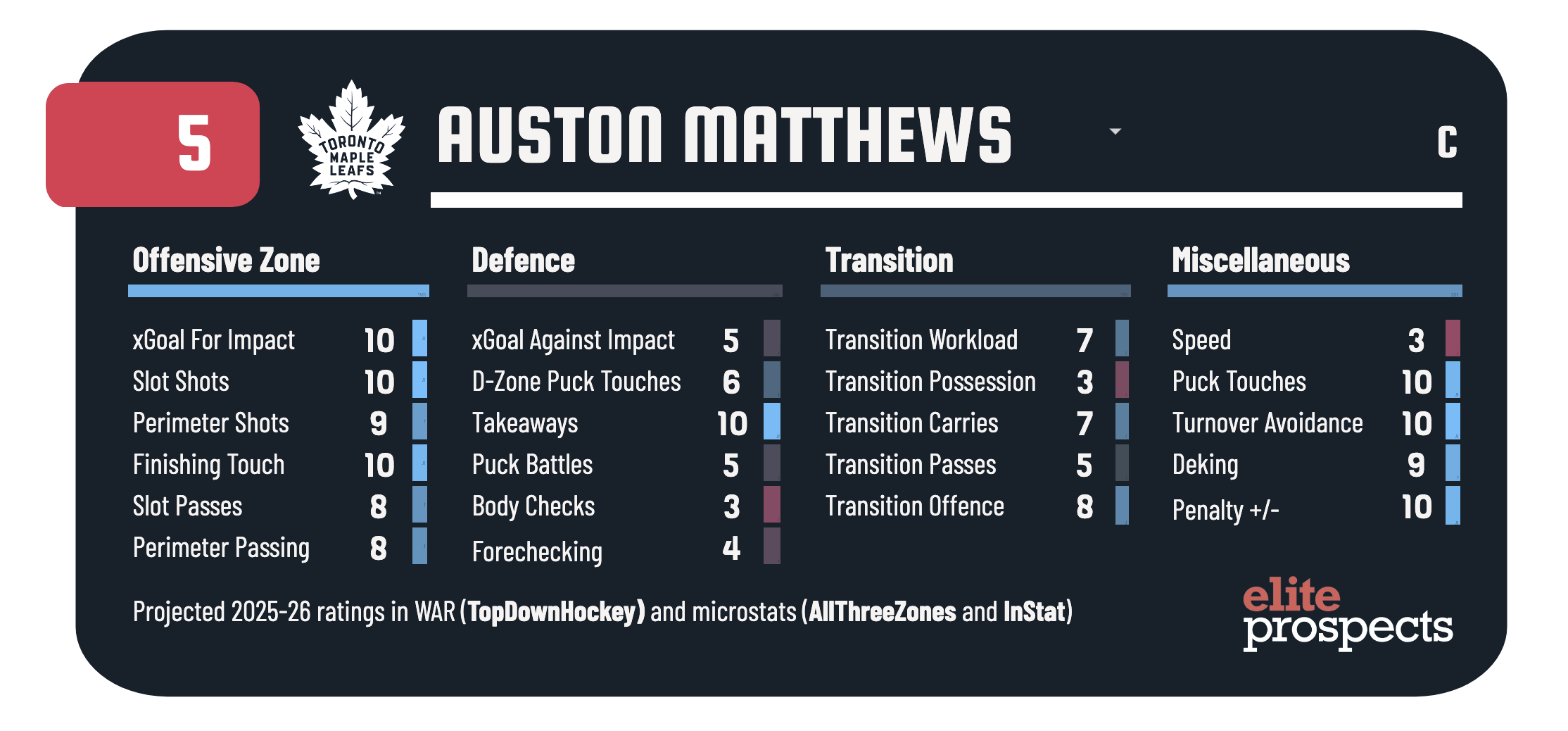
There isn’t a ton of room for error at the top of the NHL, and a 40-goal pace isn’t going to cut it for the league’s best scorer (let alone three goals in 13 postseason games). Hearing people talk about Auston Matthews lately, you’d be forgiven for forgetting about his 69-goal 2023-24 performance. He’s not the first elite sniper to see an abrupt drop in production -- remember the 38-goal Ovechkin season that preceded four straight Richard trophies -- but the uncertainty surrounding the health of his wrist does give a bit more cause for concern. We know that healthy Matthews is both a generational scoring chance generator and finisher, a combination that has led to gaudy efficiency and totals at even strength throughout his career. Strength and hockey I.Q. make him likely the best off-puck offensive player in the league, in addition to his uncanny catch-and-shoot release. While losing Mitch Marner will be an adjustment, there’s little reason to think it will compromise his effectiveness. Similarly, for all Marner’s defensive skill, Matthews has plenty of his own, stealing pucks on the forecheck, winning battles, and rarely coughing up the puck. As long as he’s at full strength, expect a bounce-back.
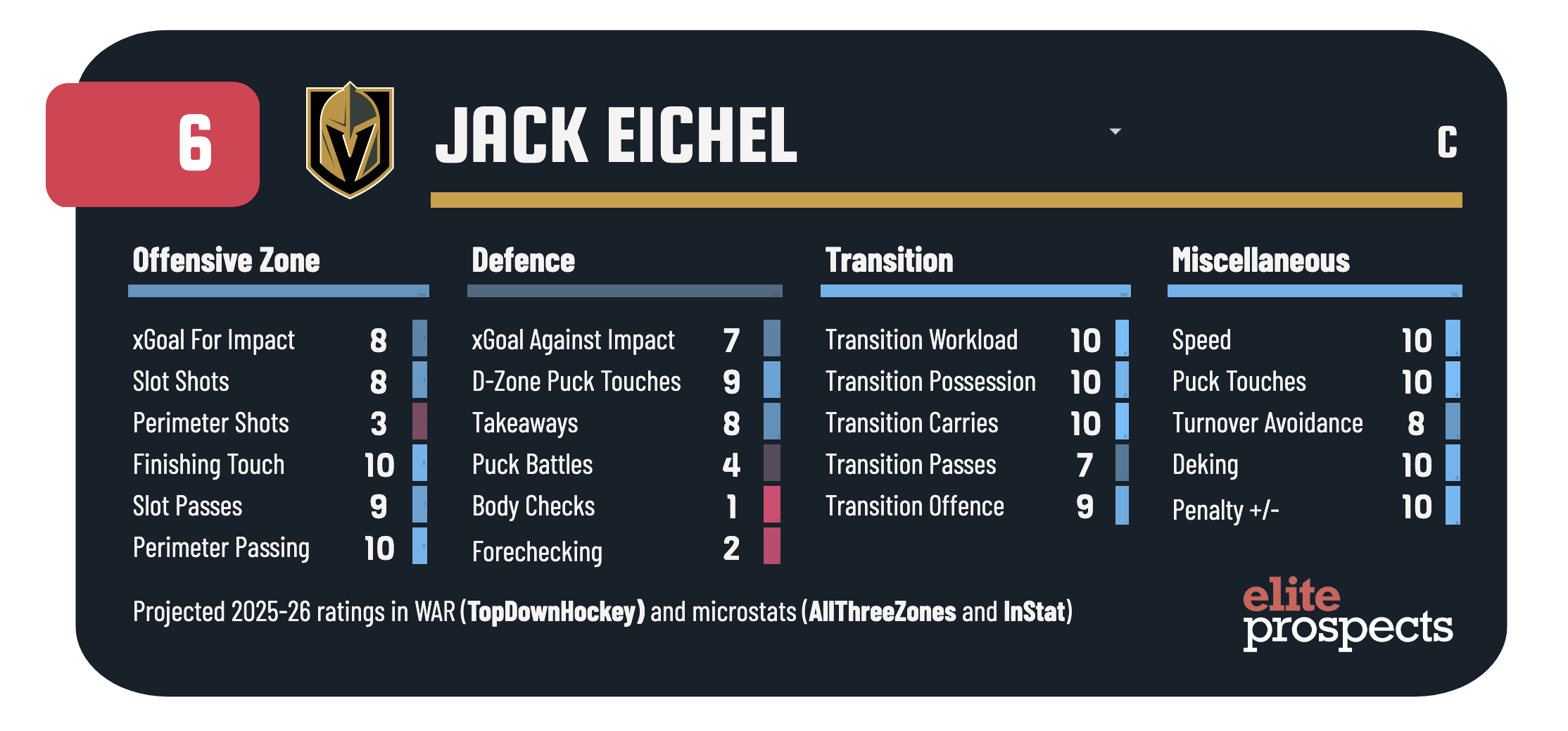
It took ten seasons and a change of scenery, but in 2024-25 Jack Eichel finally put up a full season of elite results, producing at a 100-point pace over 77 games and finishing top-five in Hart voting (and Selke voting) for the first time in his career. The few players who rival his combo of speed and puck skills rank ahead of him on this list, and even some of them can’t match his sheer workload with the puck on his stick on a night-to-night basis. He’s a transition machine, using his feet, hands, and strong frame to blow past opponents in the neutral zone (and to disrupt opponents when he doesn’t have the puck). Meanwhile, his game has matured and his patience and willingness to make the safe, possession-maintaining play instead of forcing more low-percentage tries have paid defensive dividends as well. The Knights use him in all situations, and it will be interesting to see how he meshes with new co-star Mitchell Marner.
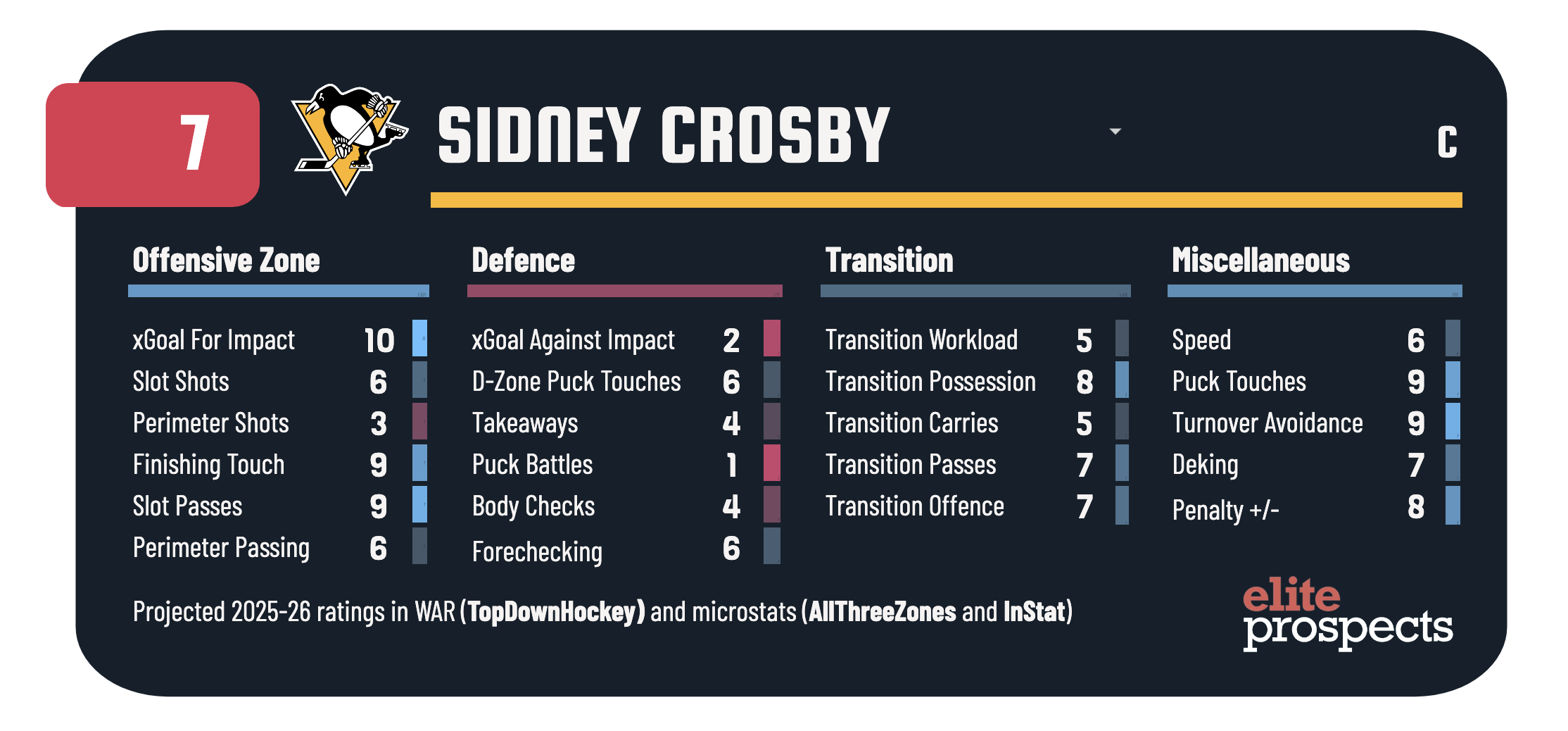
You could copy and paste an assessment of Sidney Crosby’s game from five or ten years ago, and it would still be almost entirely applicable. Even at age 38, all the hallmarks of his game, from the backhand passes to the slot to the dominance behind the net and in the faceoff dot to the absurd deflections, have held up, and he’s even managed to maintain most of his footspeed and edgework. Less than ideal circumstances in Pittsburgh have forced him to make defensive sacrifices in the interest of creating offence, but watching him defy age has been one of the few pleasures of watching Penguins hockey lately.
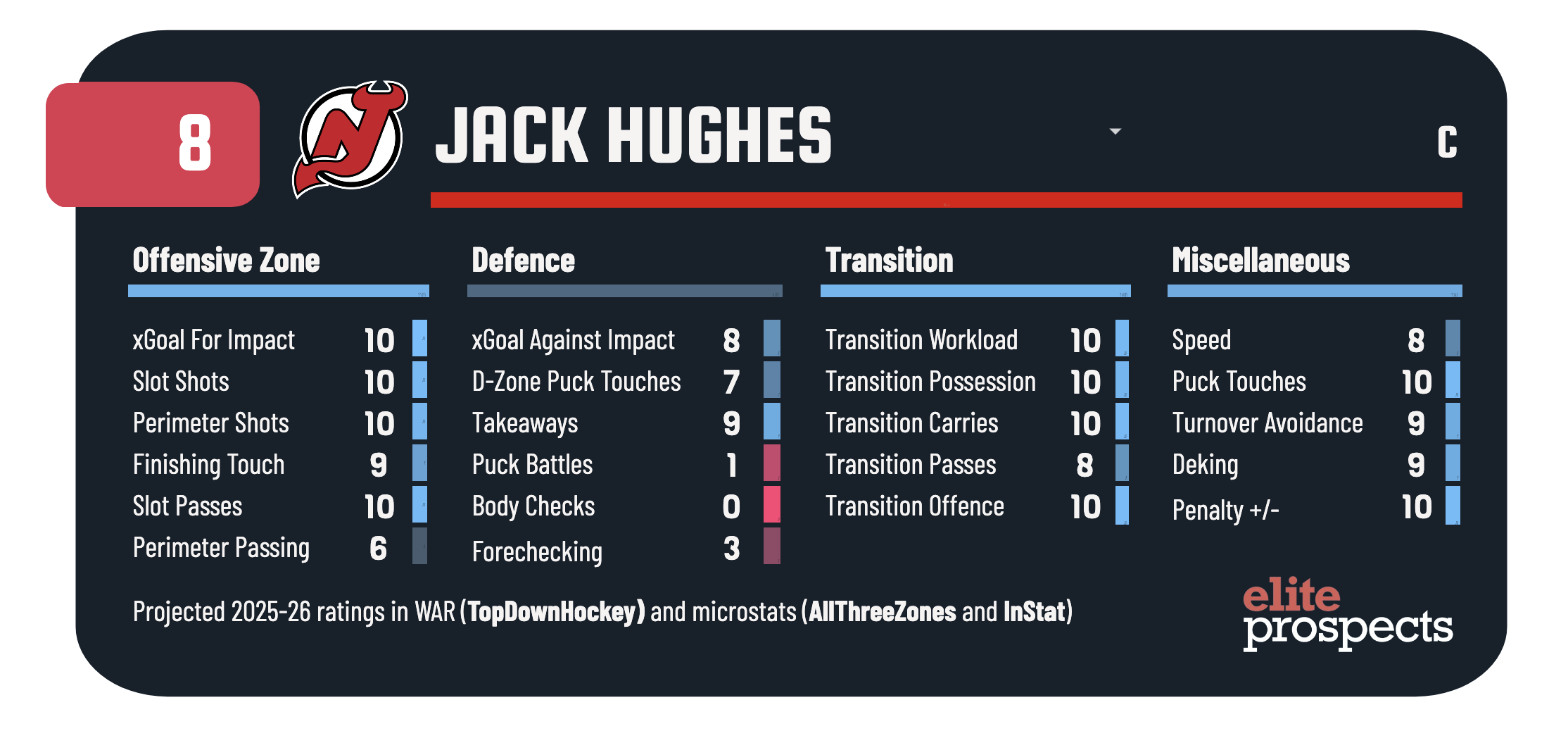
Wouldn’t it be nice to write about Jack Hughes without using the phrase “when he’s healthy?” When he’s healthy, Hughes is one of the most impactful players in the sport with nearly unmatched puck skill, creativity, and deceptiveness, allowing him to create scoring chances both by passing and shooting the puck at elite rates. He gets involved all over the ice, buzzing around with or without the puck, stealing it from opponents, getting to the slot, and constantly keeping defenders guessing. It’s a shame that the small frame that allows him to move so swiftly has also contributed to a string of injuries that’s forced him to miss 20 or more regular season games in four of his six NHL seasons. Getting to the No. 6 spot on this list is not outside the realm of possibility if he can just stay on the ice.
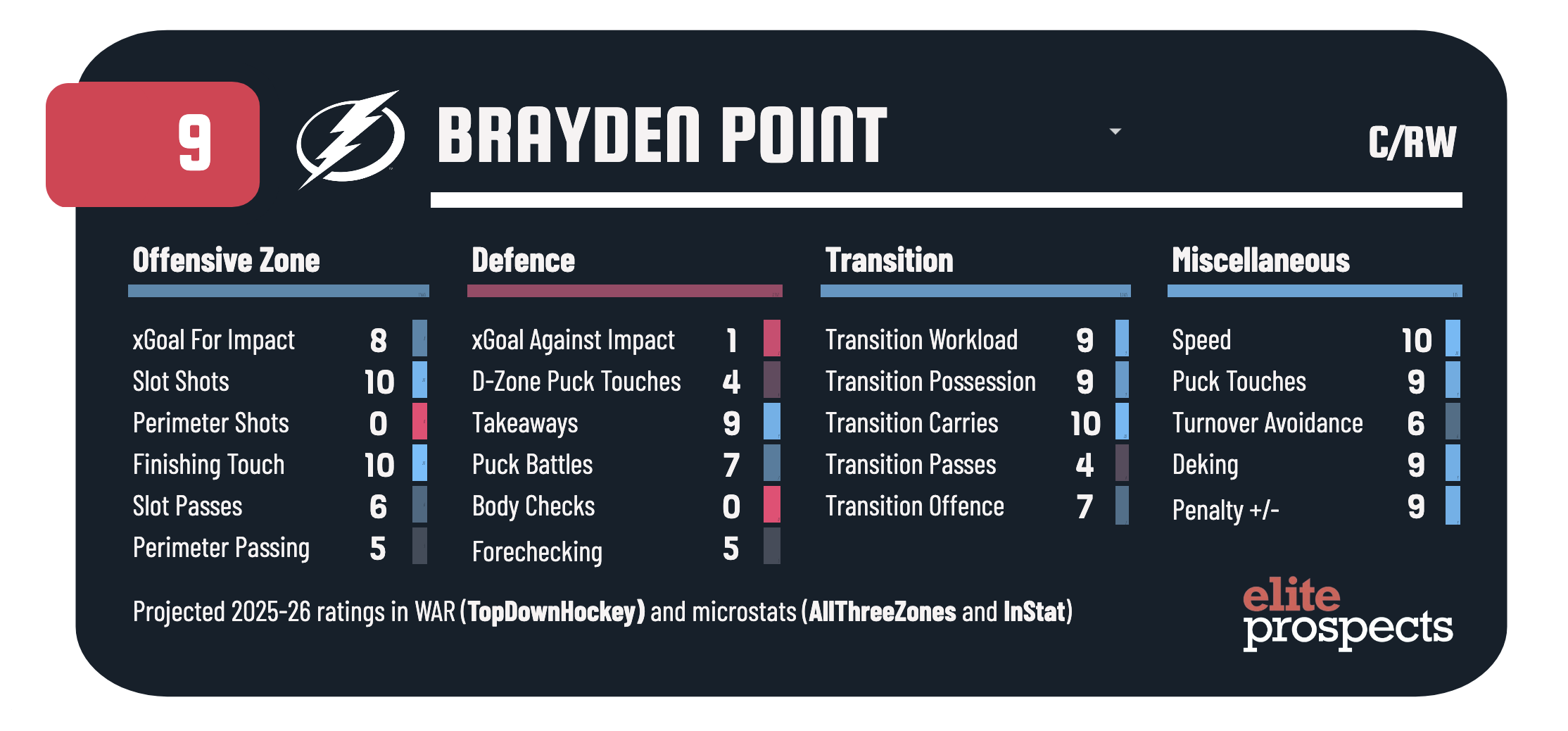
Another year, another 40-goal season for Brayden Point. While he may not grab the headlines that his Art Ross-winning linemate does, his mix of speed, skill, and especially finishing touch maintain his status as an elite centre. One of the more intelligent and patient players in the game, he plays with precision and extreme efficiency, making the most out of every pass and shot, using every weapon in his toolkit to open space and move defenders and goaltenders out of the way. It’s a shame that his once-high-end defensive game has gone mostly to pasture, but I doubt the Lightning are complaining too much.
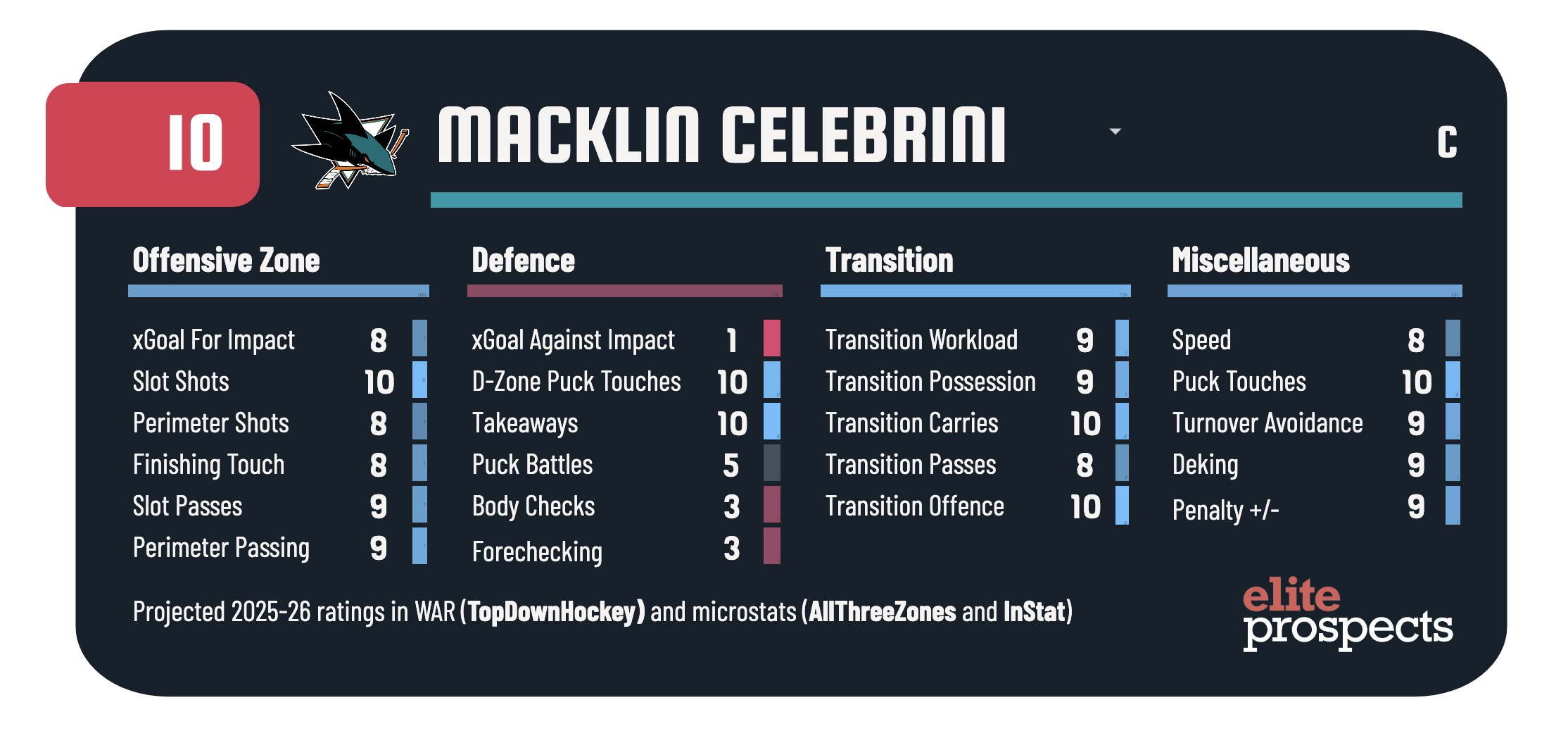
The hype around Macklin Celebrini is real, and it’s 100 percent justified. He stepped into the league at 18 with the skill of a superstar, the motor and effort of a player fighting for a spot in the lineup, and the confidence of an established veteran. He’s quick, agile, creative, and plays with his head always up, always scanning for new information and opportunities, ready to unleash his vast array of offensive and defensive tools. Soft hands, strength on the puck, a wicked wrist shot, a hammering one-timer, endlessly deceptive movements, energy that keeps him constantly buzzing around the zone and making himself available for passes – and that’s before mentioning his already-elite ability to win pucks along the wall and pick-pocket opponents. His game without the puck still requires a lot of polish, namely working on what he can and can’t get away with and how to defend when full-tilt attack-the-carrier mode isn’t an option, but the skillset screams two-way superstar – and offensively, he’s not far off already.
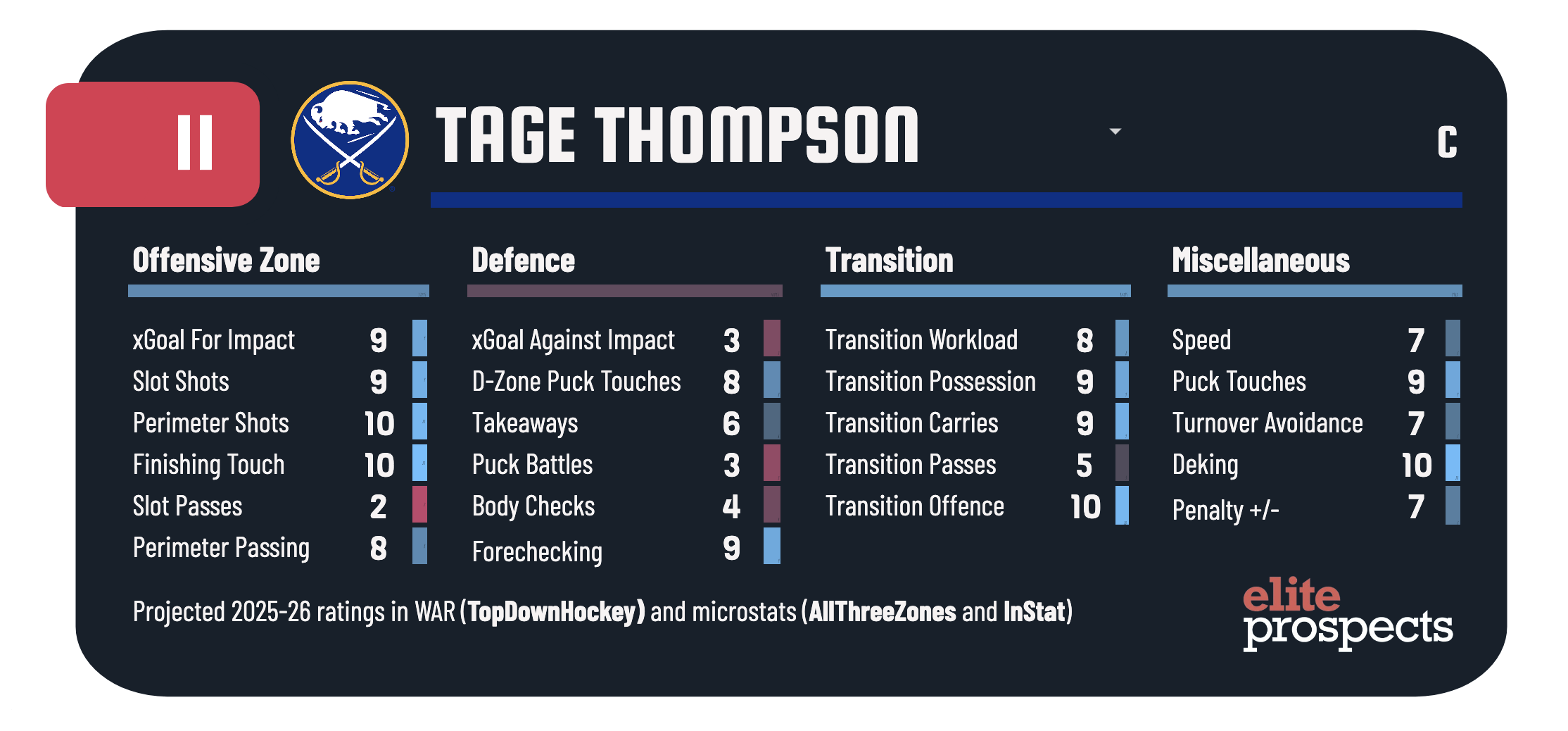
After a spotty 2023-24 campaign, Tage Thompson was right back to business last season, scoring at a 47-goal, 77-point pace. He notably led the league in 5-on-5 goals per 60 minutes by a country mile, and in the past three seasons, he actually narrowly leads that category as well. Watch him for even a few shifts and it's immediately clear how he does it; his size and reach often make him look like a hockey camp coach playing keep-away against kids as he dangles and protects the puck, and his release is so unstoppable when given any space that it forces defenders to expose themselves to the risk of getting walked. A valid question, however: is he actually a centre? Increasingly not, since the Sabres seem to finally have lost patience with his bewilderingly terrible ability in the dot, but not only is he listed at that position, but he often plays like one anyway, waiting above the fray for a puck-retrieving winger to find him in the middle of the ice.
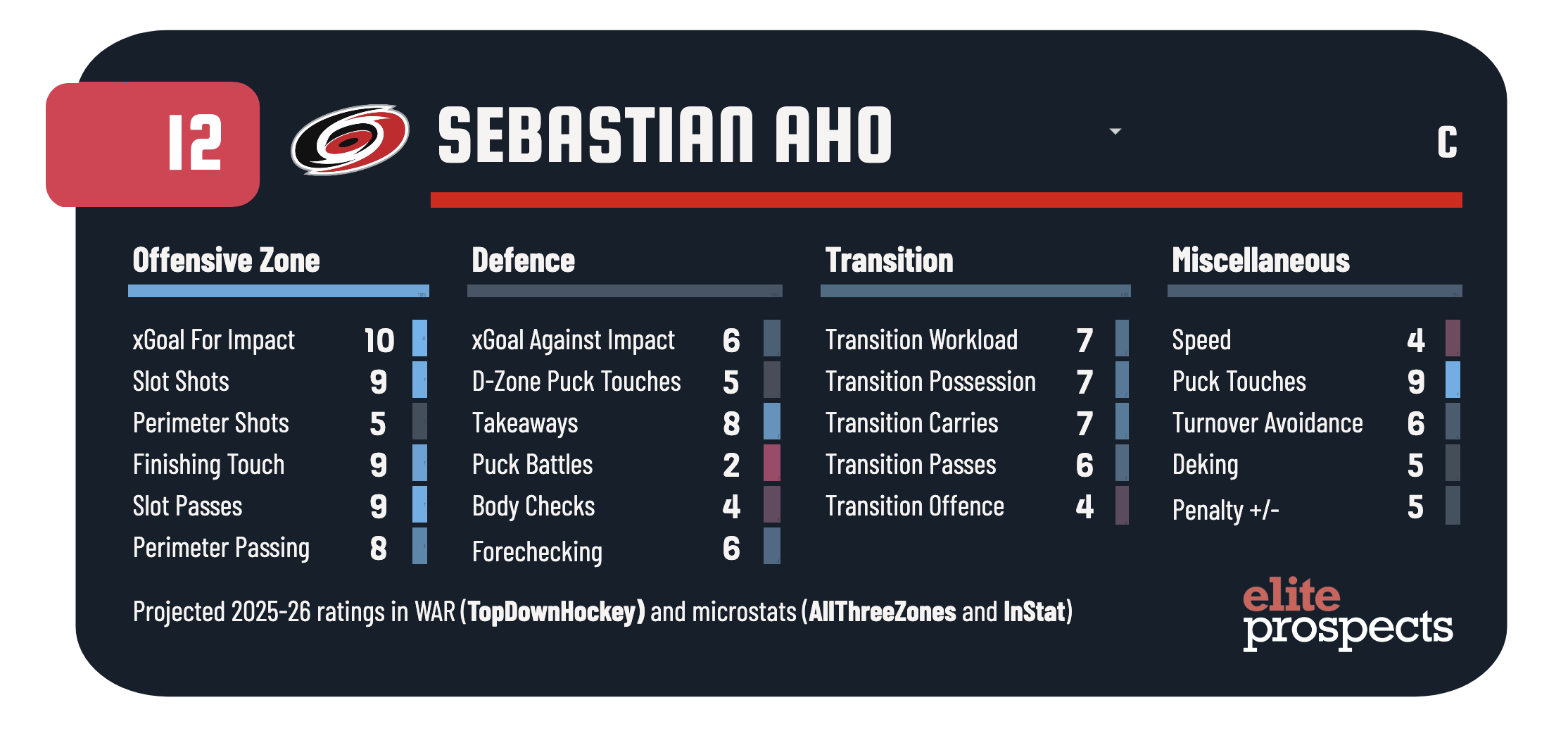
It must be annoying to be Sebastian Aho and have to constantly hear about how the problem with the Hurricanes as Cup contenders is their lack of star power. His skill may not jump off the screen as much as some of his peers, but he’s been the model of a consistent top-line centre, contributing in all situations in all three zones against top competition while producing around a point-per-game. His versatility, which comes through in his ability to contribute both through skilled rushing sequences and grimy forechecking possessions, will be even more valuable as the team’s emerging young core and new acquisition Nikolaj Ehlers continues to transition the squad away from its dump-and-chase orthodoxy.
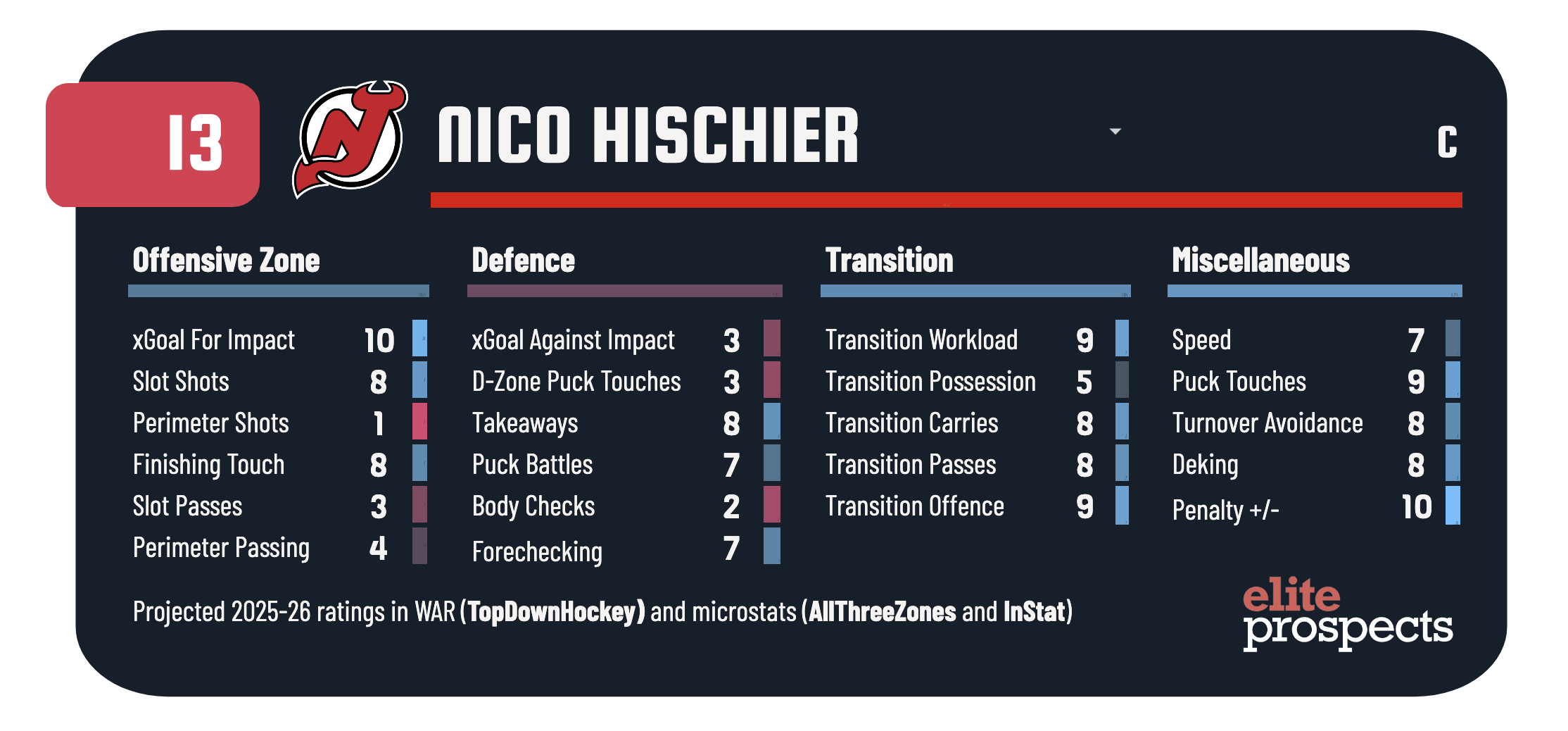
The one-two punch of Hughes and Nico Hischier at centre has been a luxury for the Devils the past five seasons, and it’s one they had to live without down the stretch in 2024-25. Pressed into top-line duty and the heaviest minute load of his career, he scored 22 points in 19 games and then added four goals in the team’s first-round defeat. Hischier’s versatility makes everyone he plays with better, whether he’s transporting the puck cleanly up the ice, winning battles along the wall, creating breakaways with his speed, stealing pucks on the forecheck, or crashing the net for loose pucks or back-door one-timer opportunities. Next to a high-end playmaker, he’s an ideal target, boasting a terrific finishing touch in tight, but he can also be the main puckhandler on his line and dish it himself. Meanwhile, despite plenty of defensive stickwork, he stays out of the box while drawing lots of penalties.
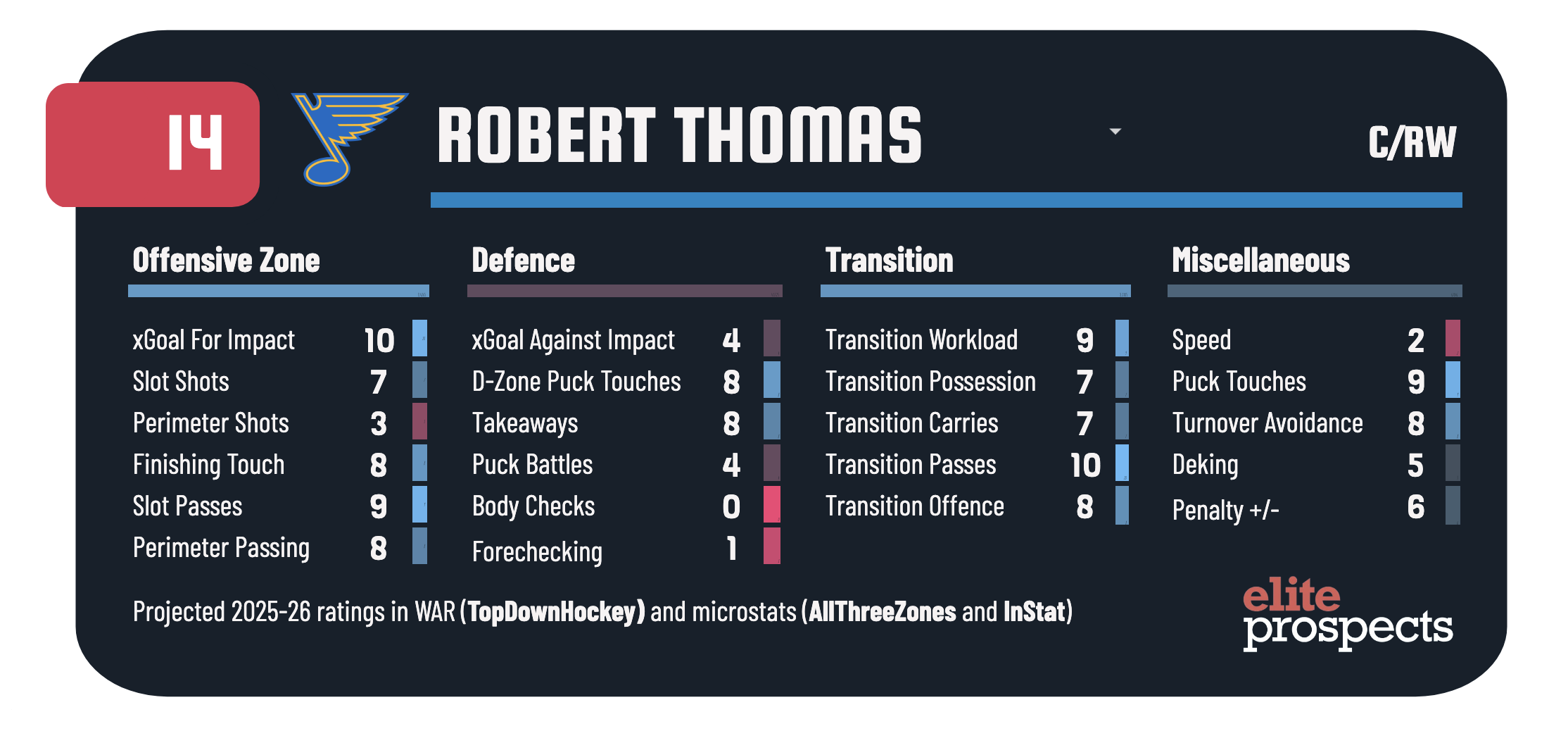
It flew under the radar, but it’s not tough to argue that Robert Thomas had the best season of his career in 2024-25, producing at a 25-goal, 94-point pace with a great showing in the Blues’ first playoff appearance in three seasons. His hockey sense is uncanny, and he scans the ice constantly, identifying the best passing target before the puck is on his stick and then dealing either the “obvious” pass through several sticks and limbs or delivering improbable no-look tape-to-tape feeds. The way he supports the play all over the ice and distributes the puck both through subtle short feeds and home-run plays has made him a serious play-driver, with defensive results finally starting to match the skill-set. His lack of foot speed and physicality might be holding him back from a spot on Team Canada at the moment, but I wouldn’t rule him out, especially if he starts the season hot.
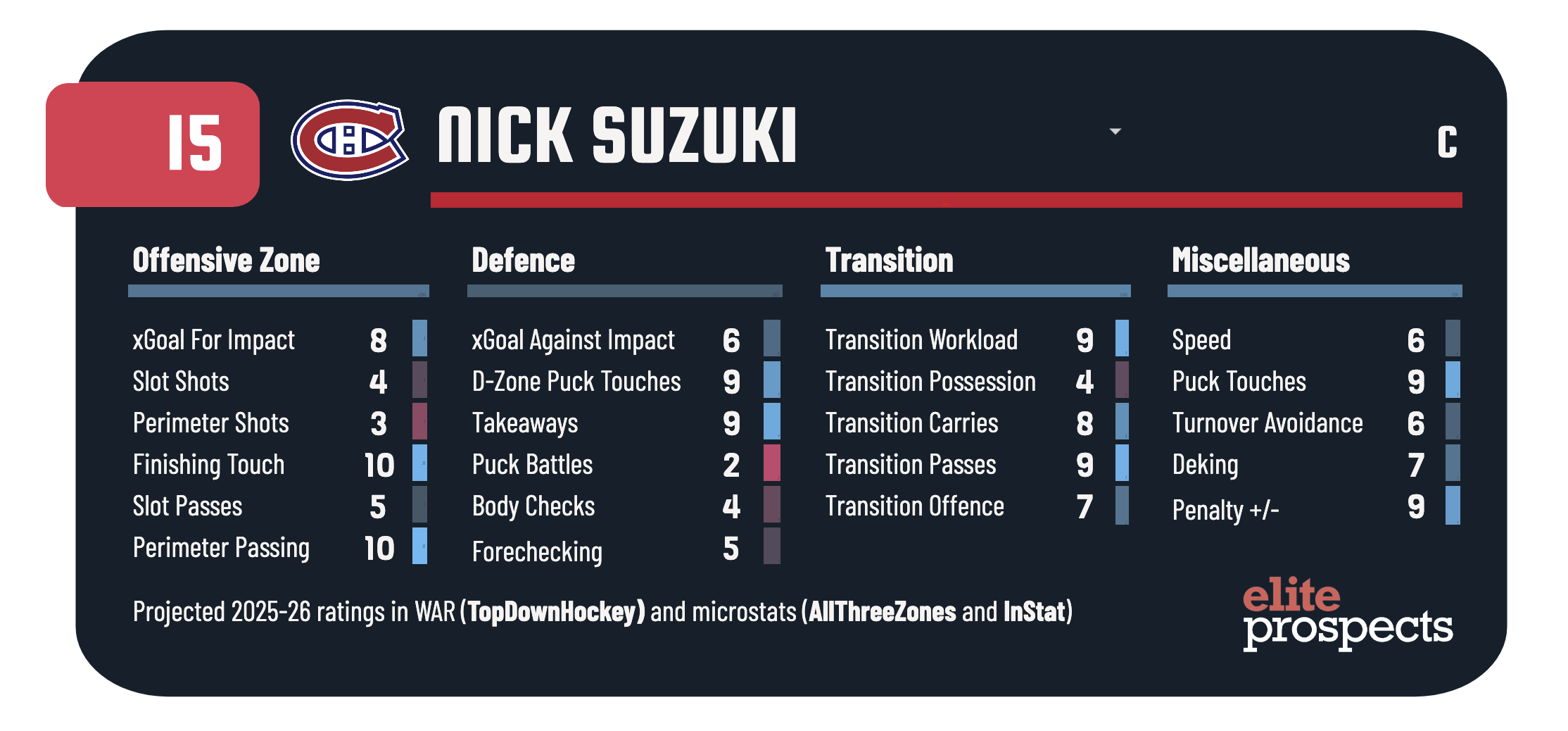
Nick Suzuki hasn’t missed a game in the past five seasons, and in each of those campaigns he’s increased his point totals, culminating in 89 in 2024-25. He’s always possessed the pieces needed to be a true top-line centre, and the past few years have seen him progressively work out how to combine them without sacrificing one area or another of his game. It’s possible that he will never be as prolific a 5-on-5 scoring chance creator as most of his peers on this list, but he’s developed a clever, cerebral game that exploits the perimeter areas of the ice with east-west and low-high passes that set his linemates up for one-timers and keep defenders off-kilter and goaltenders moving. Meanwhile, he’s gotten more effective off the puck offensively, cutting to the back door and giving playmaking linemates like Lane Hutson a great target for high-danger passes. With end-to-end transition skill and trademark puck thievery completing the package, the notion that the Canadiens can win a Cup with him as their star pivot seems more likely than it did a few years back; a bit more 5-on-5 scoring efficiency wouldn’t hurt though.
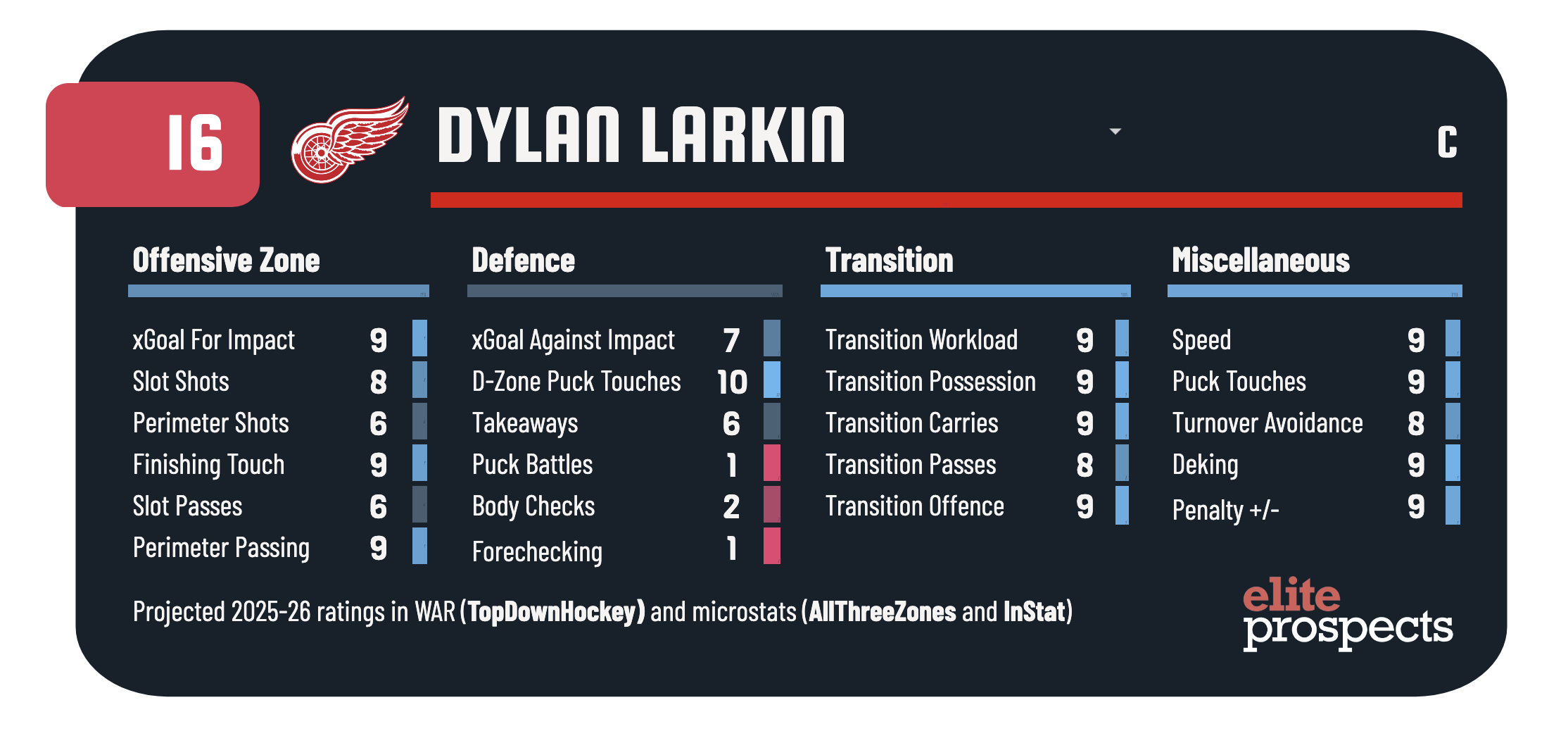
Dylan Larkin has been playing consistent, quality, all-around top-line centre calibre hockey for years now, waiting for the team around him to get good enough to make the postseason. That hasn’t happened yet, and as he caps off his twenties there might be grounds for some concern that by the time the Wings are ready to contend he won’t be at his best anymore. A drop to 70 points after hovering around a point-per-game in the previous three seasons combined with some struggles down the stretch doesn’t convince me that that time has come, though. He remains one of the more well-rounded players in the league, with great wheels and puck skills and a captain’s willingness to do whatever is needed to help the team win. He’s a utility scorer who’s equally keen to crash the net or bash pucks in out of mid-air as he is to make finesse plays off the rush, and he’s got the ability to make sneaky dangerous passes out of puck battles and puck retrievals. Hard work in his own zone, a great stick, and a positive penalty differential further help tilt the ice. Point-per-game with solid defensive results might be the ceiling, but that’s tough to complain about.
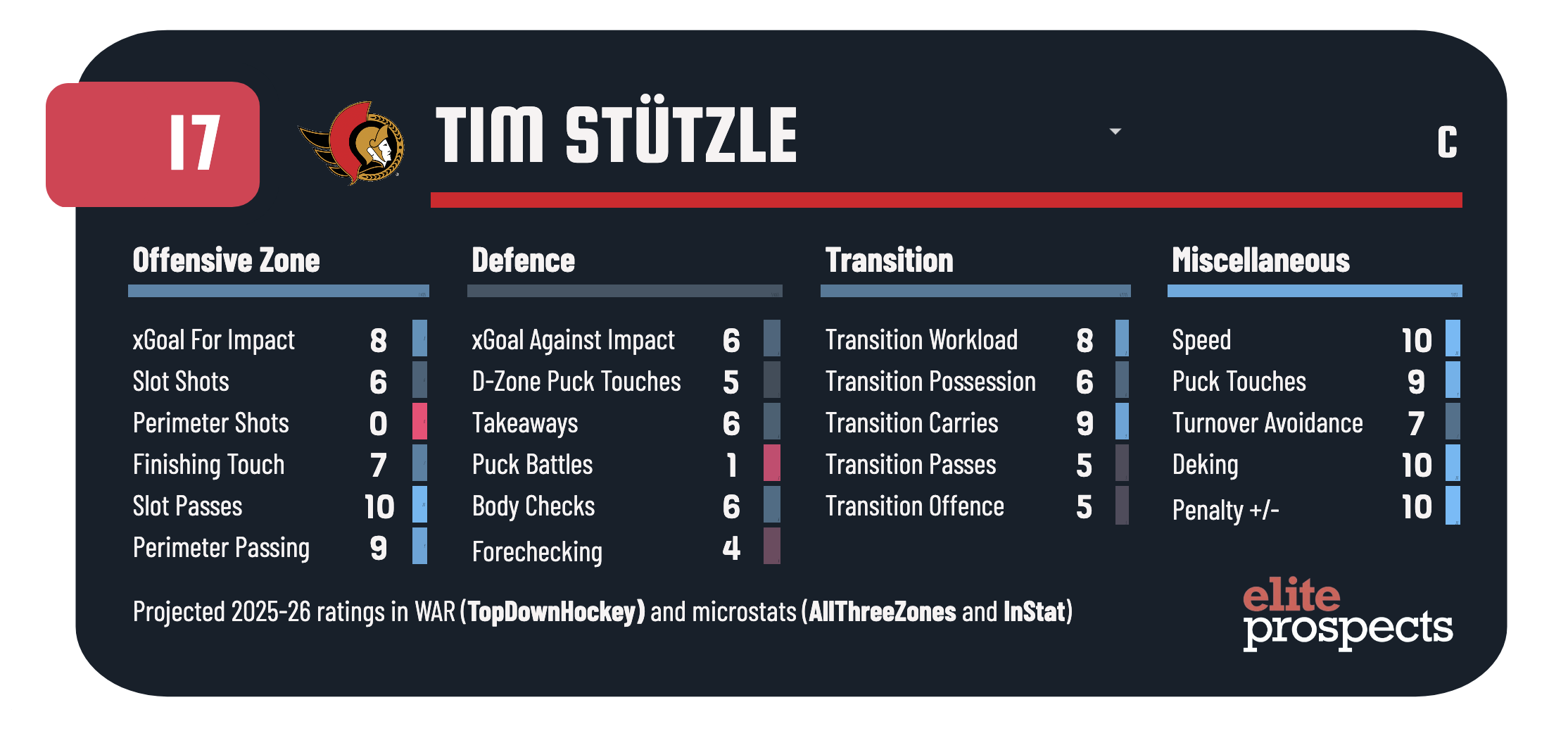
That Tim Stützle’s 39-goal, 90-point 2022-23 campaign remains at this point an outlier in his career defies logic, given the incredible skill he flashes on a night-to-night basis in Ottawa. The pieces are all there for stardom: elite speed, unbelievable hands, creativity in transition. But while few players spend as much time with personal possession of the puck in the offensive zone, consistently turning this ability into a high quantity of deadly chances has not always come easy and to take the next step, he’ll need to translate ability to more concrete results. His defensive improvements last year showed that he’s not done evolving as a player, and it would be great to see him return to the level of production he’s capable of. In the meantime, expect more highlight reel sequences (and GIFs of embellishments angrily posted by opposing fans).
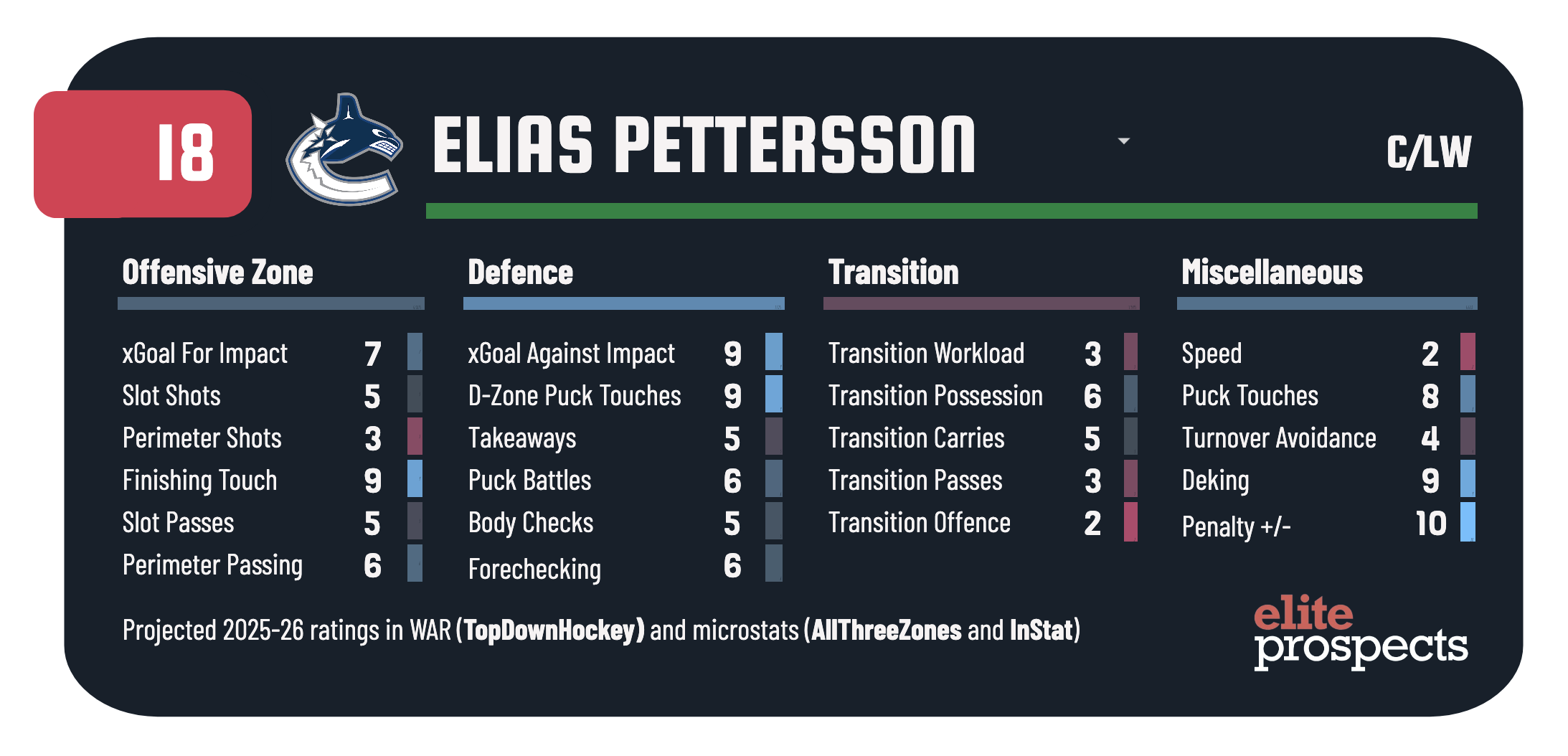
Few players in recent memory have seen as sudden a reputational crisis as Elias Pettersson, who in the span of a year went from stud prime-aged centre with 40-goal, 100-point upside to possible albatross contract status. Scoring at a 19-goal, 57-point pace while making $11.6 million will do that. Reportedly not only healthy this coming season but also quite a bit stronger, he’s got plenty to prove. At his best, Pettersson is a model of elegance and efficiency, gliding around the offensive zone and through defenders with the puck, patiently waiting to expose and exploit holes in the defence while prioritizing possession over rushed plays. His best asset, and the one that suffered most last season, is his whippy long-range wrist shot, and the threat he poses from distance allows him to focus on dominating the perimeter. His willingness to battle for pucks and play through contact has often been underrated (contributing to a league-best penalty differential), and a few more pounds should only help with that. There may be no bigger gap between a player’s ceiling and floor on this list.
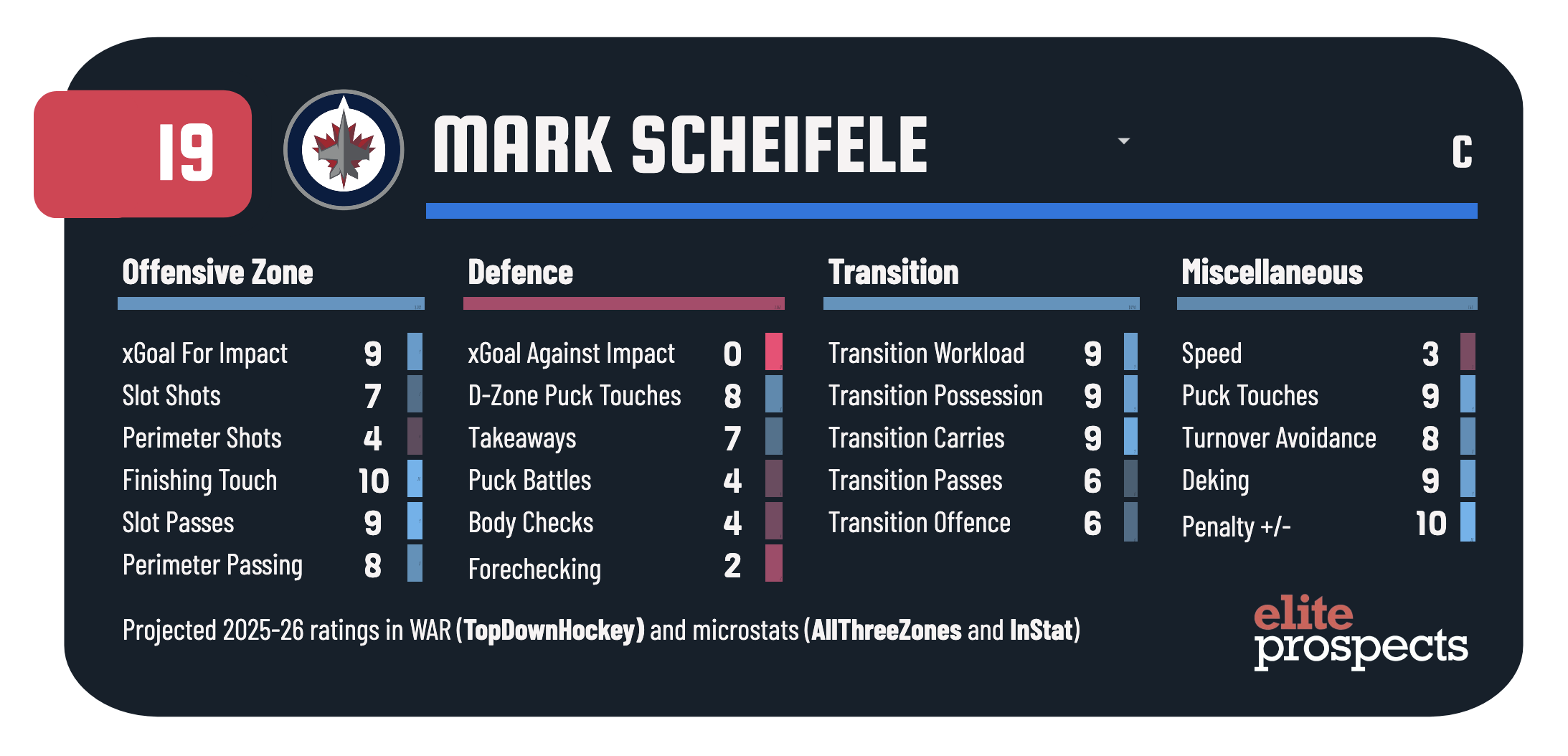
Mark Scheifele’s cerebral and skilled offensive game has driven the Jets’ offence for almost a decade now, with the 14th-most points in the league since 2016. His size and strength allow him to control the pace of the game from low in the zone, patiently opening passing lines by protecting the puck and using his hands to create space until a linemate has arrived in the right spot in the slot. His own scoring has been less consistent, but his quality-over-quantity approach and ability to carve out space in tight makes him an efficient finisher. If not for his longstanding deficiencies in his own zone, where he’s frequently late getting back and a bit lost, he’d be further up this list.
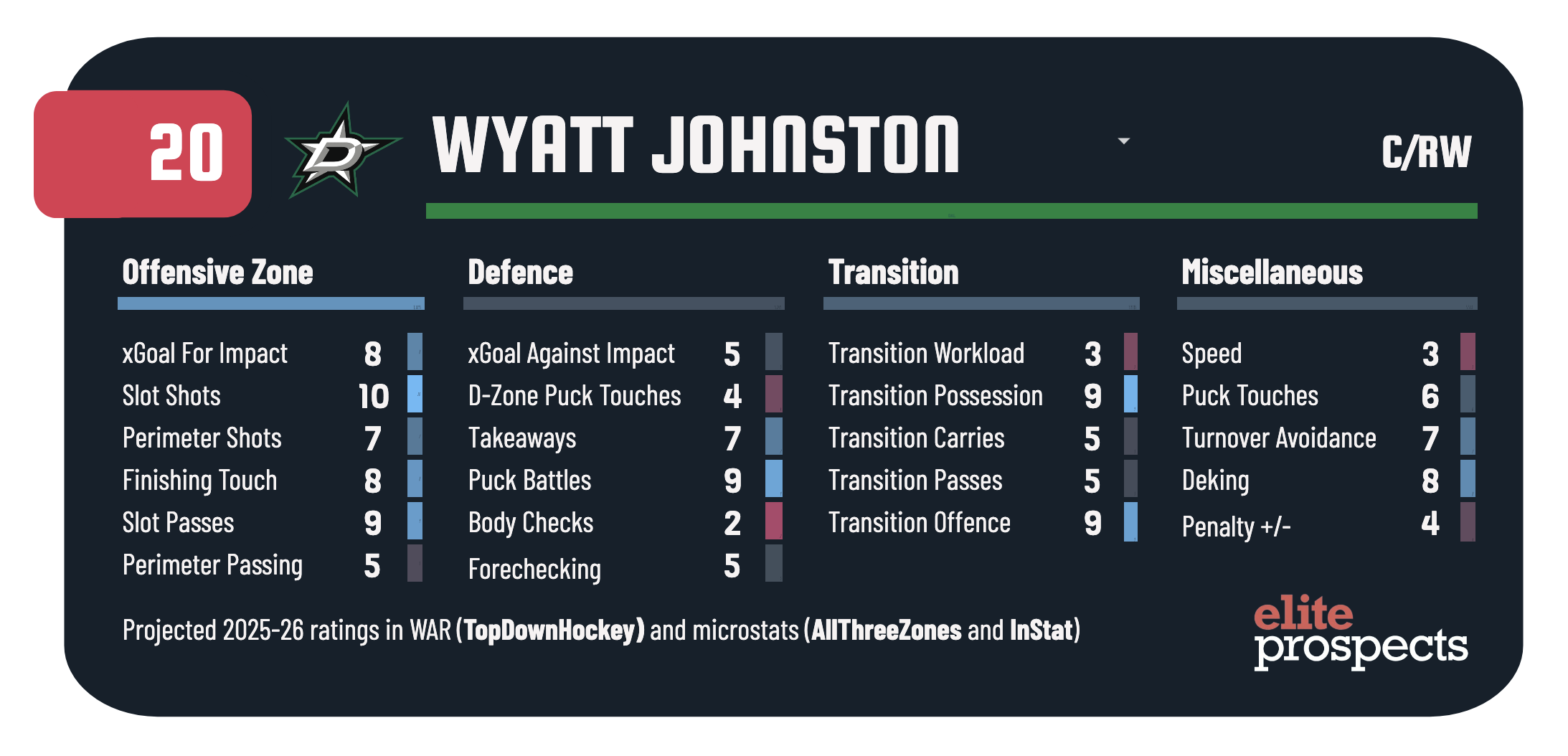
Another season of steady improvement for Wyatt Johnston (and a big extension to show for it) begs the question of how high his ceiling might be. Career-highs in minutes, goals, and points – and three full seasons of perfect health – are a good sign, as is the marked improvement in his passing ability. He’s a deadly scoring chance creator who uses high-end hockey sense to carefully time routes to the slot and get lost in coverage, hiding out along the goal-line and jetting to the crease at the right moment to receive a back-door feed. The theoretical limits imposed by a lack of size and straight line speed are made up for by his willingness to play through contact and his agility, respectively, and his deceptiveness with the puck coupled with a nice release and burgeoning ability to send pucks across the slot make him tough to contain. An underwhelming showing in the 2025 playoffs is practically the only stumbling block he’s yet faced.
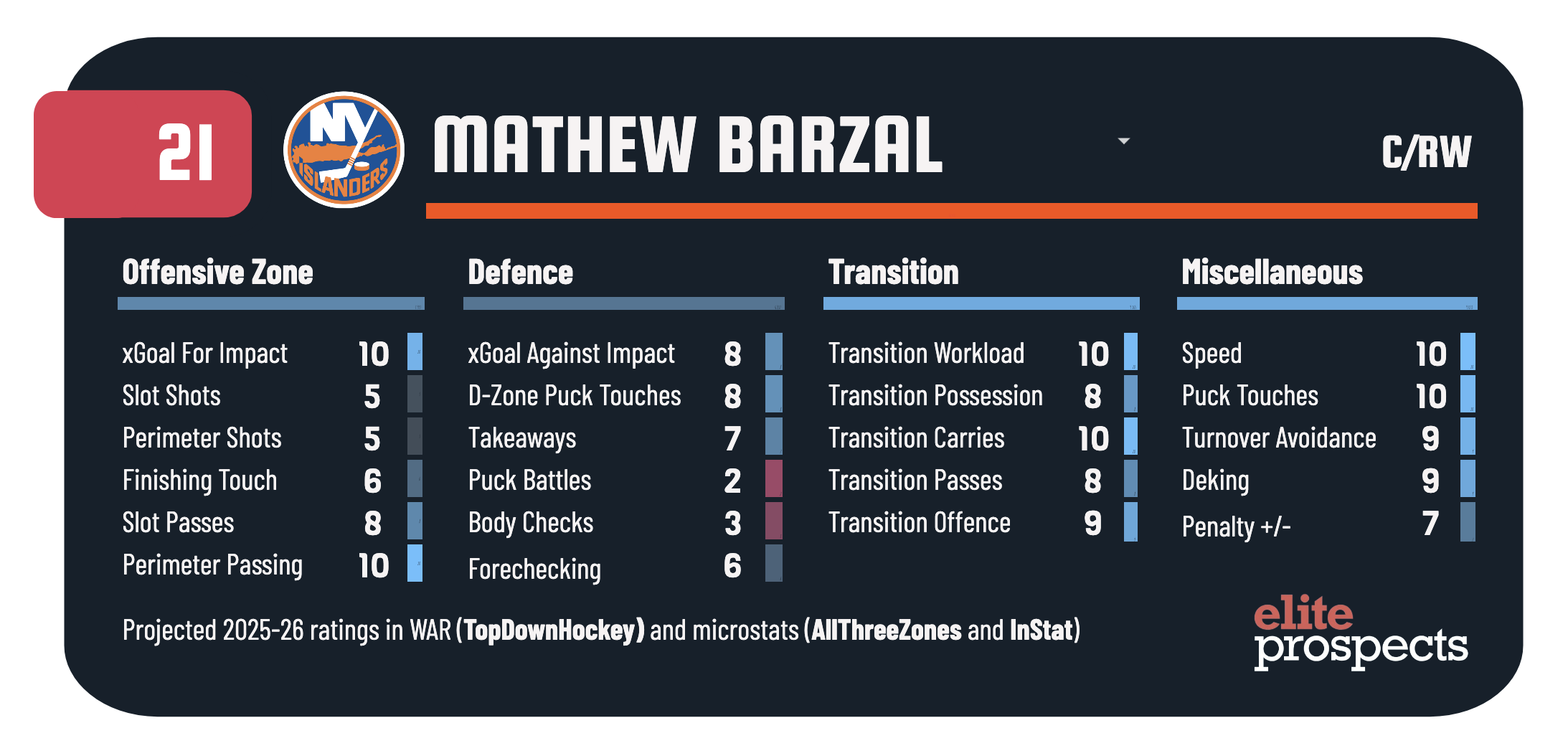
Mathew Barzal's status as a centre-iceman has been an open question since the Isles acquired Bo Horvat, with whom he developed a ton of chemistry before the Brock Nelson trade forced the team to spread the wealth in the middle of the ice. Things didn’t go great for him last season, playing only 30 games and scoring at a 16-goal, 54-point pace, but under the hood things looked basically the same as ever (with exceptional defensive metrics that probably won’t hold up in a larger sample given his track record). Anyone who’s watched Barzal in his nine NHL seasons pretty much knows the package of skills here: blazing speed, lightning-fast hands, creativity, and above all patience with the puck. Maybe a bit too much patience sometimes, since he all-too-often settles for the safety valve of a low-to-high or drop pass to a linemate on the perimeter, but next to a running-mate smart enough to get to the right spots at the right time, he can deliver jaw-dropping passes. A successful 2025-26 season would see him continue the strides he made in his last healthy season and sustain some of last year’s improved defensive results.
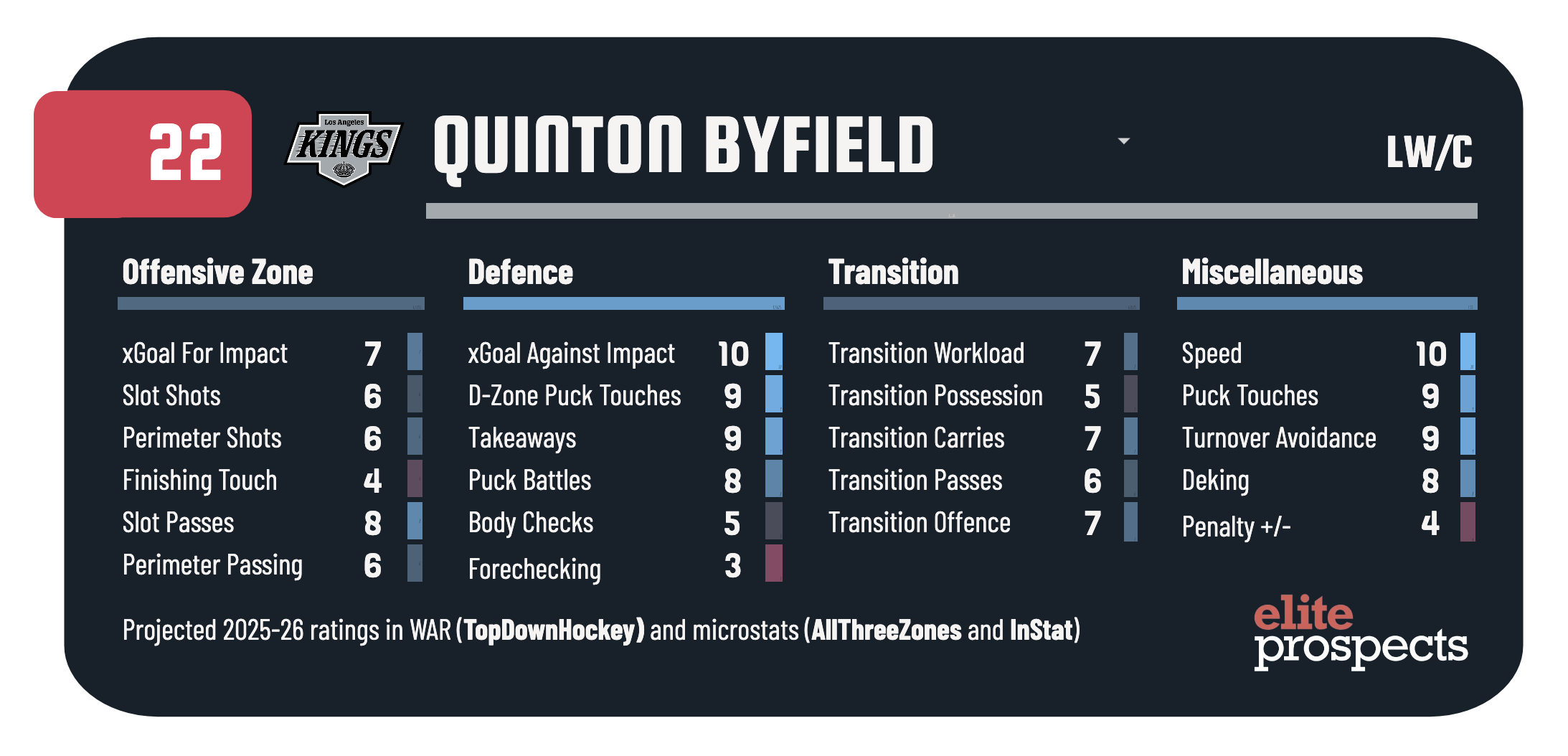
Quinton Byfield is a very good player, but he has the tools to be a great one and the Kings really need him to hit that potential soon. For now, he’s known mostly for his draft pedigree and the occasional absurd highlight reel goal, but the skills he displays in those efforts pay dividends at both ends of the ice. Byfield is what hockey people like to describe as “toolsy,” with some of the fastest straight-line wheels in the league, strong puck protection skills, excellent physicality without chasing hits, and a high-end motor without the puck. He’s active in the play and responsible with the puck and in his early 20s has already established himself as one of the Kings’ key defensive drivers and a regular penalty killer. The hands, transition ability, and passing skill chart a path to legit No. 1 centre status in the immediate future, but 20-goal, 55-point production won’t cut it. Time to level up.
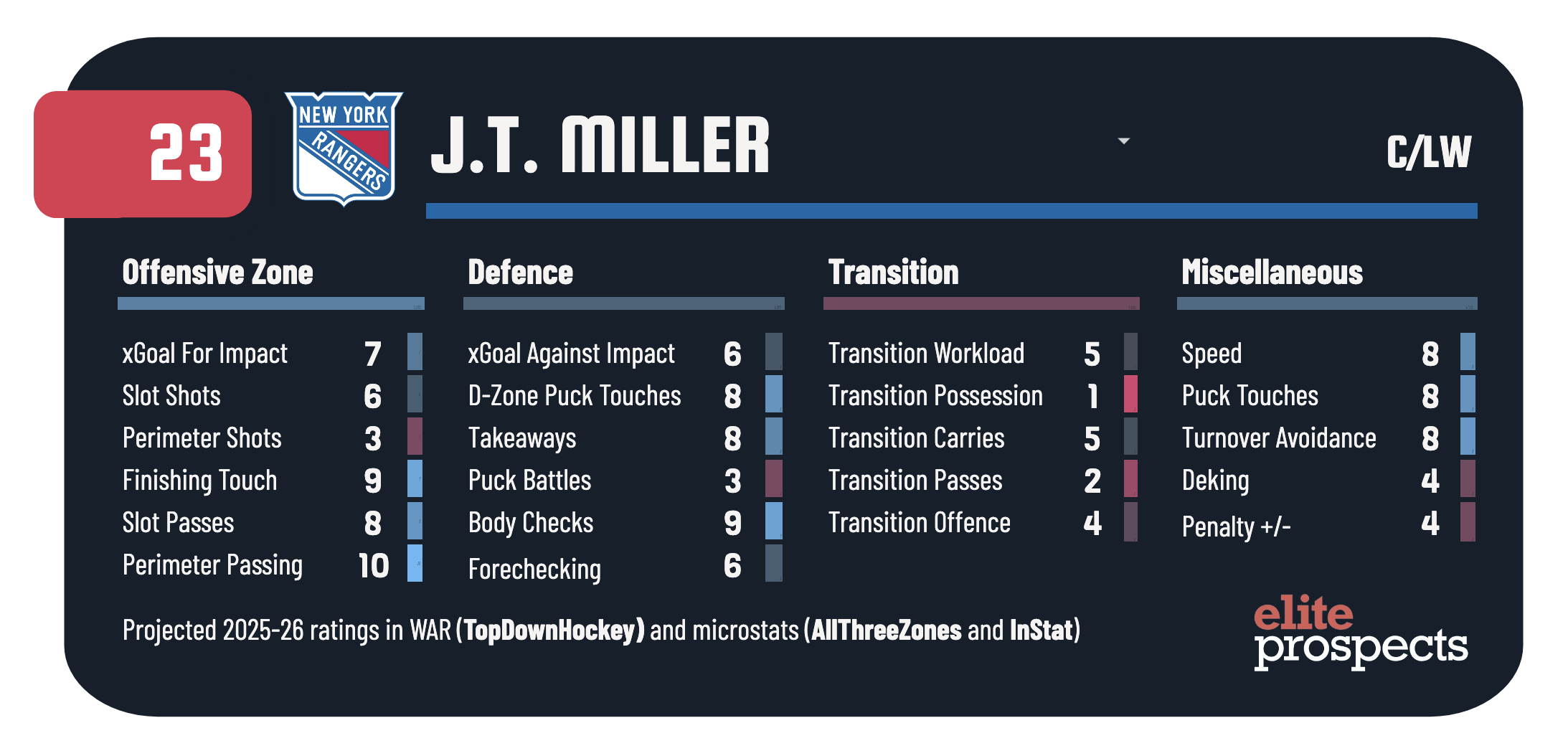
J.T. Miller is something of a unicorn, a power forward-playmaker hybrid with high-end speed, physicality, and an ultra-competitive edge. The latter quality may have hastened his departure from Vancouver amid rumours of locker room feuds, but an 89-point pace after his acquisition by the Rangers is a promising sign. He’s solid and strong with a knack for stripping pucks and taking them cleanly off the wall and onto a linemate’s tape quickly. For all the grit and grind of his style and reputation, Miller’s game is a lot more cerebral than he gets credit for, and he almost always knows where he wants to pass the puck before it even winds up on his stick. Swift one-touch feeds improving the condition of the puck are his trademark, and while this can lead to him overusing the points instead of driving the slot, it’s hard to argue with the results: the seventh-most primary assists in the league in the past three seasons.
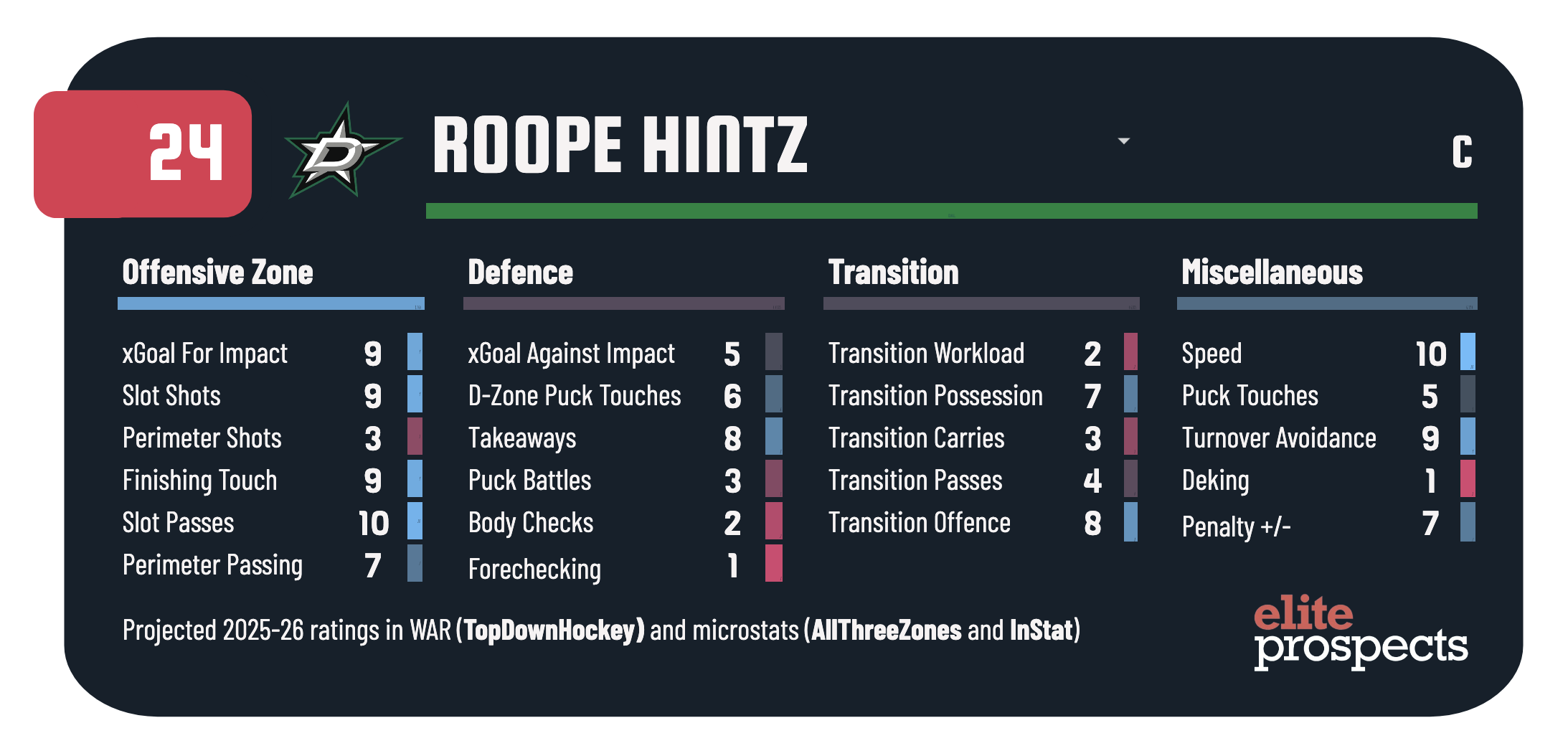
A lot of the hype around Roope Hintz's game has died down recently as his production has levelled off from a 40-goal, 80-point pace to closer to a 30-goal, 70-point pace, and emerging young talent on the Stars roster has taken attention away, but that doesn't mean he's no longer a legitimate difference-maker. He plays a major role in all situations for the Stars, using his elite acceleration, hands, and strength to carve through the neutral zone and punish defenders who try to disrupt him early. He's an especially great passer who sees the ice well even at full speed and uses his gravity to create and manipulate space off the rush with drop passes, and provides value on both special teams as well. The Stars need him to play at the level he's demonstrably capable of.
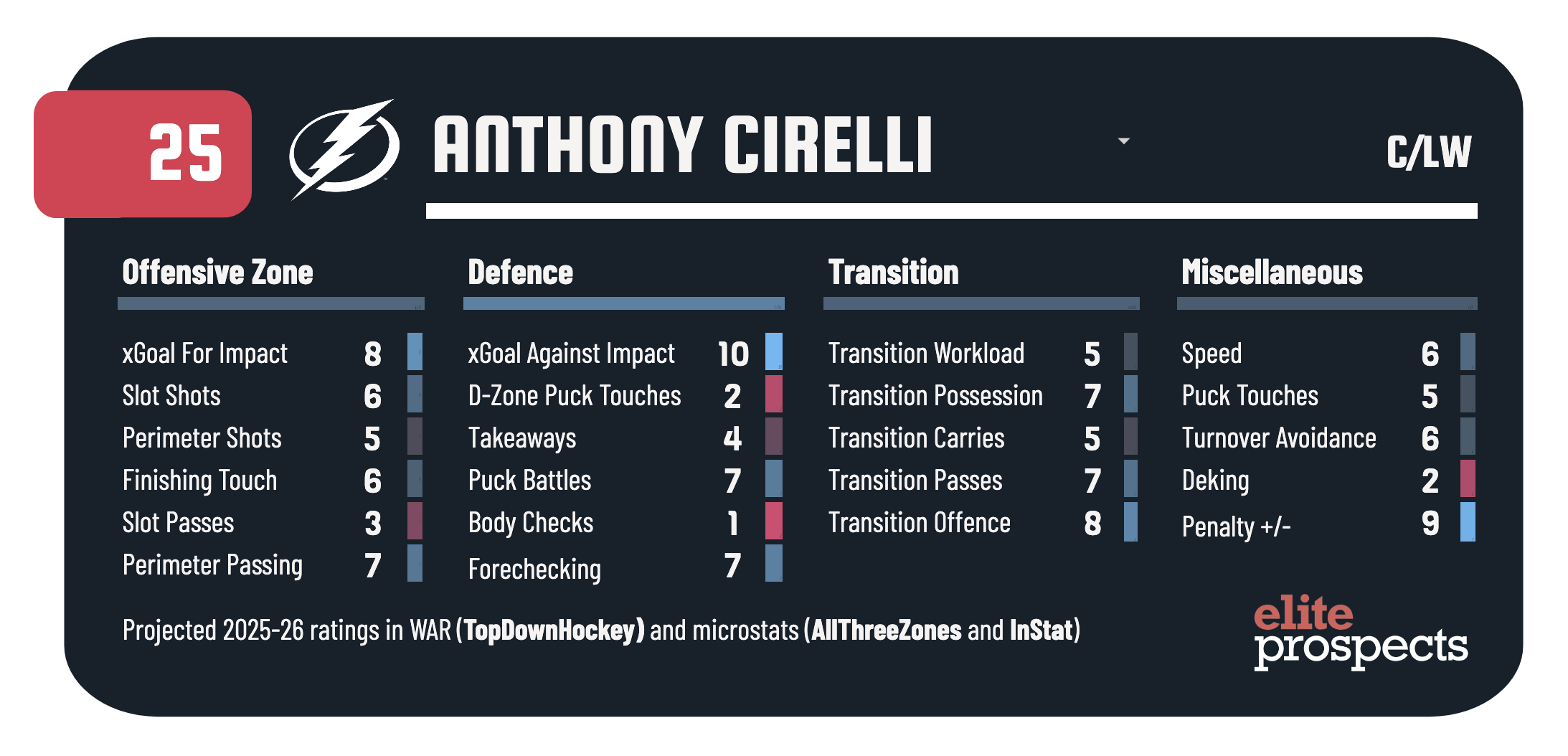
Anthony Cirelli doesn't have the flash or production of many of the other names on this list, but his two-way impact is so considerable that he warrants inclusion nonetheless. The offensive value he provides is subtle but well-rounded, whether he's setting up in the inner slot to screen goalies and tip pucks, getting to the backdoor at the right moment, or executing short-range passes through the offensive zone and connecting the dots in transition. Everything he does has an air of control and calm, which aligns with the stabilizing presence he provides defensively. In some of the league's toughest deployment, he led the league in expected goal share at 5-on-5, a testament to his ability to just keep playing his game regardless of who's lined up on the opposite side.
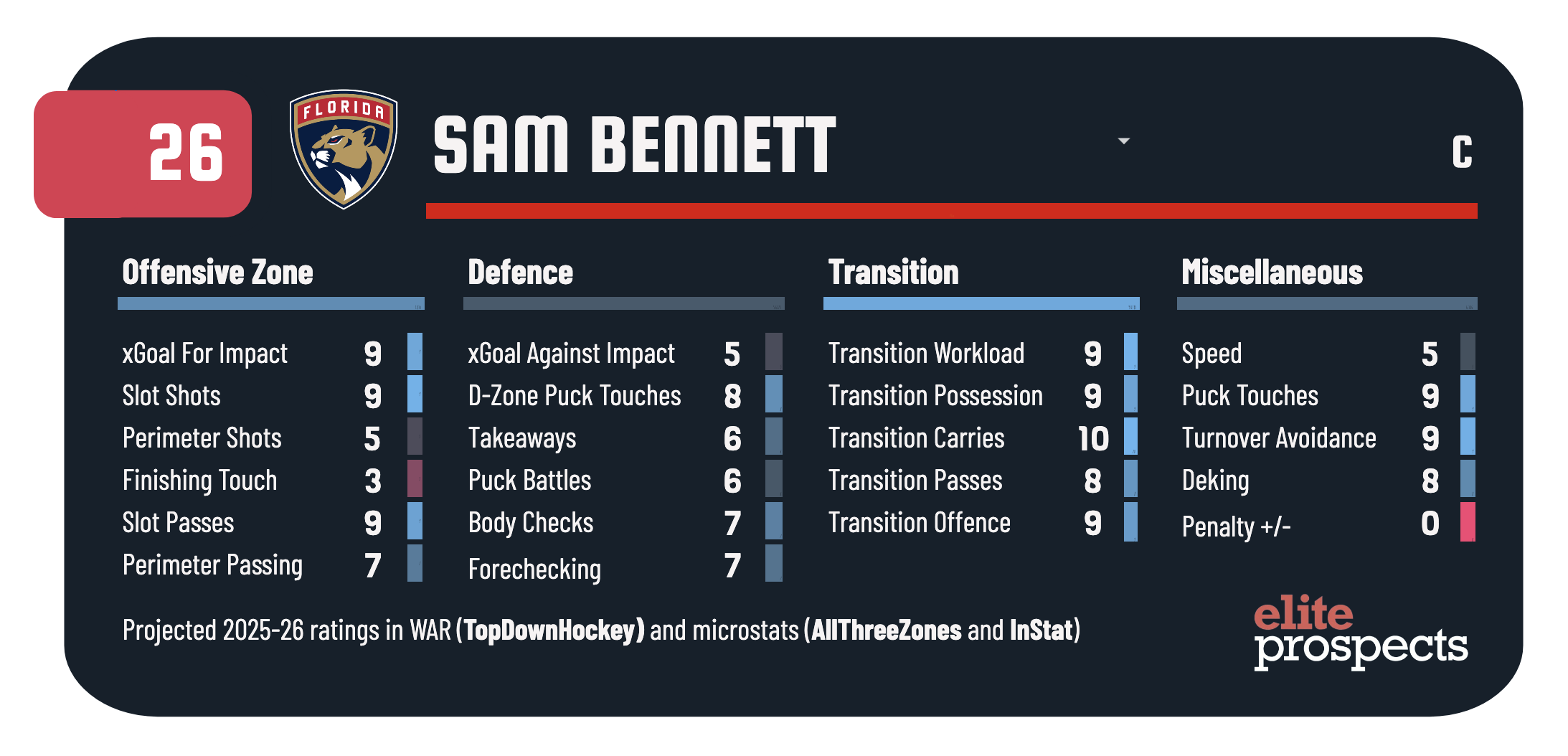
2025 Conn Smythe winner Sam Bennett's ability to level up in the playoffs is well-established at this point, but let's be clear: he's a hell of a regular-season player as well. Does a career-high of 51 points jump off the page? Not so much. But look under the hood and you see so much more than a grit-and-grind power forward. Like his frequent linemate Tkachuk, Bennett blends high-end skill with maddening peskiness and aggressiveness, not only crashing the net but controlling the puck through the neutral zone like a star and creating opportunities for both himself and his linemates. His hands are superb, he manages the puck well, he's got that trademark Panthers motor on the forecheck, and he's fully willing to traverse the line of legality in the name of finishing checks and antagonizing opponents.
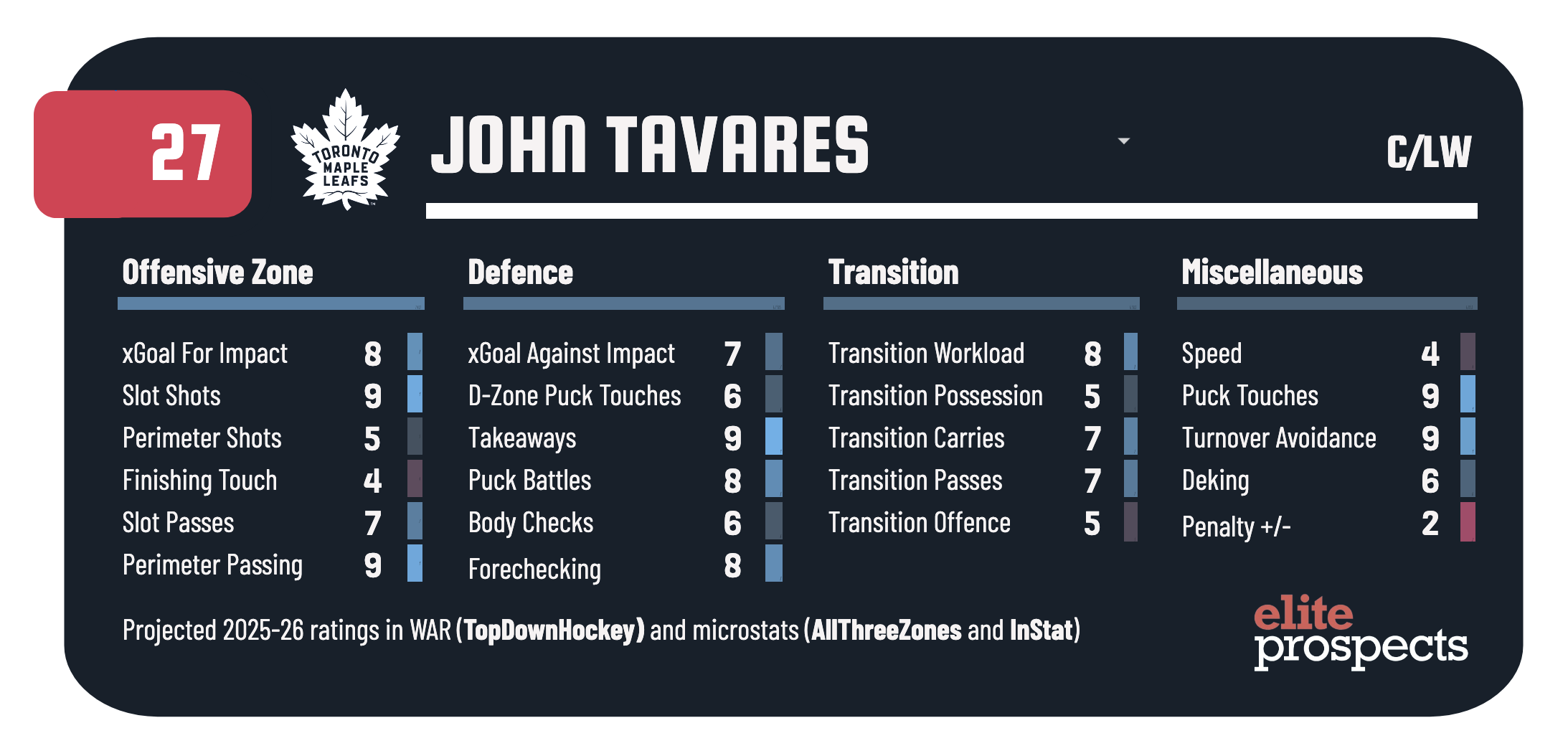
The final season of John Tavares' blockbuster seven-year deal with the Maple Leafs was a successful one, just a hair short of point-per-game with a 41-goal pace. While he may no longer be the star he was back in 2016-17, the mid-thirties version of Tavares is in many ways a more well-rounded contributor and he's proven the durability of his play style. For all the hand-wringing throughout his career about foot-speed, he's managed to maintain rather than lose a step and remains a robust rush contributor on top of his trademark net-front dominance and elite board-play. The biggest difference in his game recently has been away from the puck, where he's gone from a major negative to a legitimate asset, winning battles, stealing pucks, and avoiding turnovers. This development bodes very well for the duration of his hometown discount four-year contract.
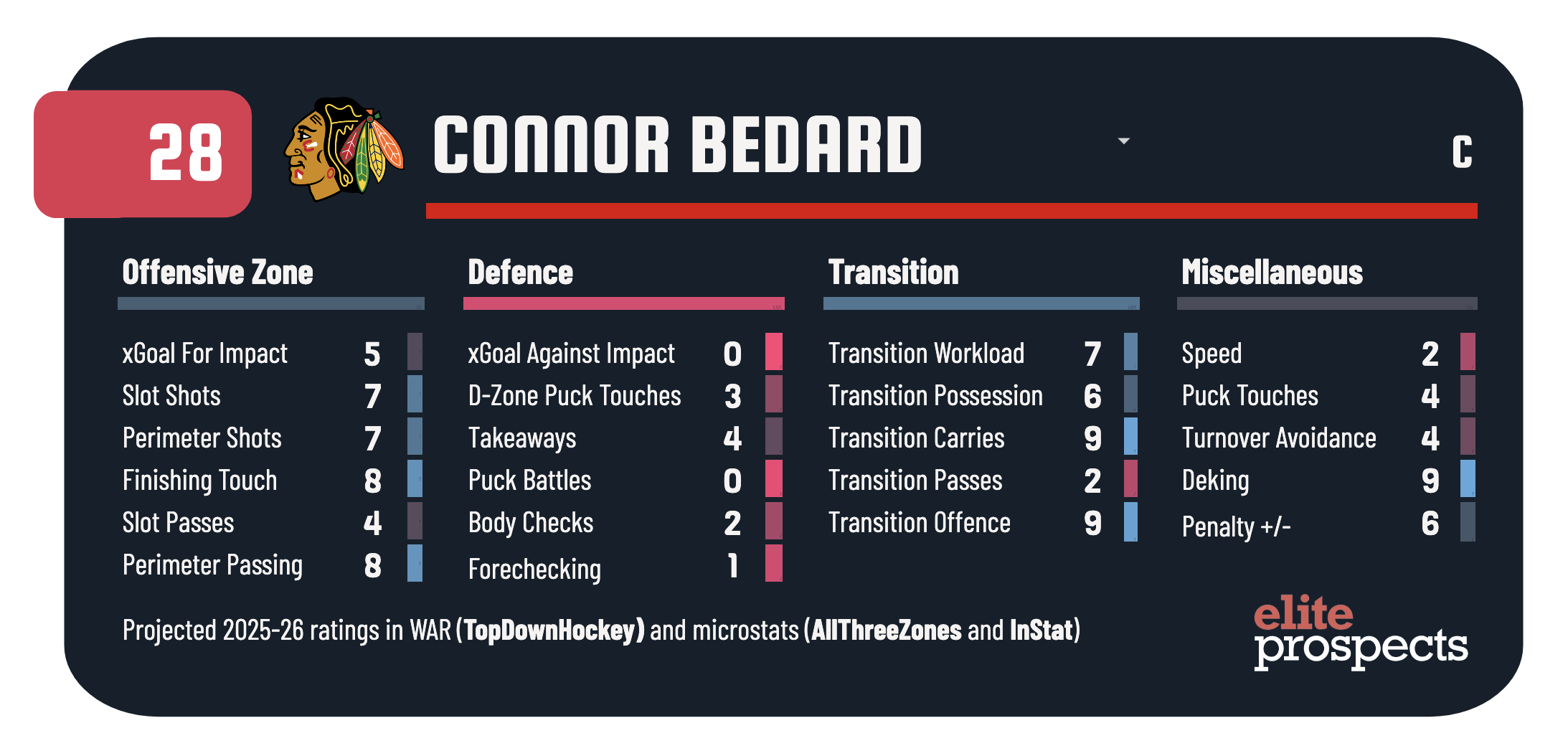
Last season I placed Connor Bedard at 13th on my centre ranking, optimistically extrapolating what he did essentially on an island as a rookie in Chicago. What happened instead was a pretty comprehensive step backward in which he created a lot less and spent less time with the puck while continuing to struggle considerably without it. There’s plenty still to like about his game, namely his creativity, handling, hockey I.Q., and ability to turn rush entries into chances by manipulating defenders. Pace is an issue though, as his lack of foot speed – a key difference between him and other late-bloomer first overall picks MacKinnon and Hughes – makes it tough for him to overwhelm opponents and forces him to slow the game down instead of imposing his will shift-to-shift. His shot is still a formidable weapon and he does beat goalies cleanly with it, but the notion that he would step into the league as one of its best snipers is looking quite optimistic. That said, we remain believers that a full, healthy offseason and maybe even the addition of skilled puck carrier André Burakovsky to his line will help him bounce back and build on that promising rookie year.
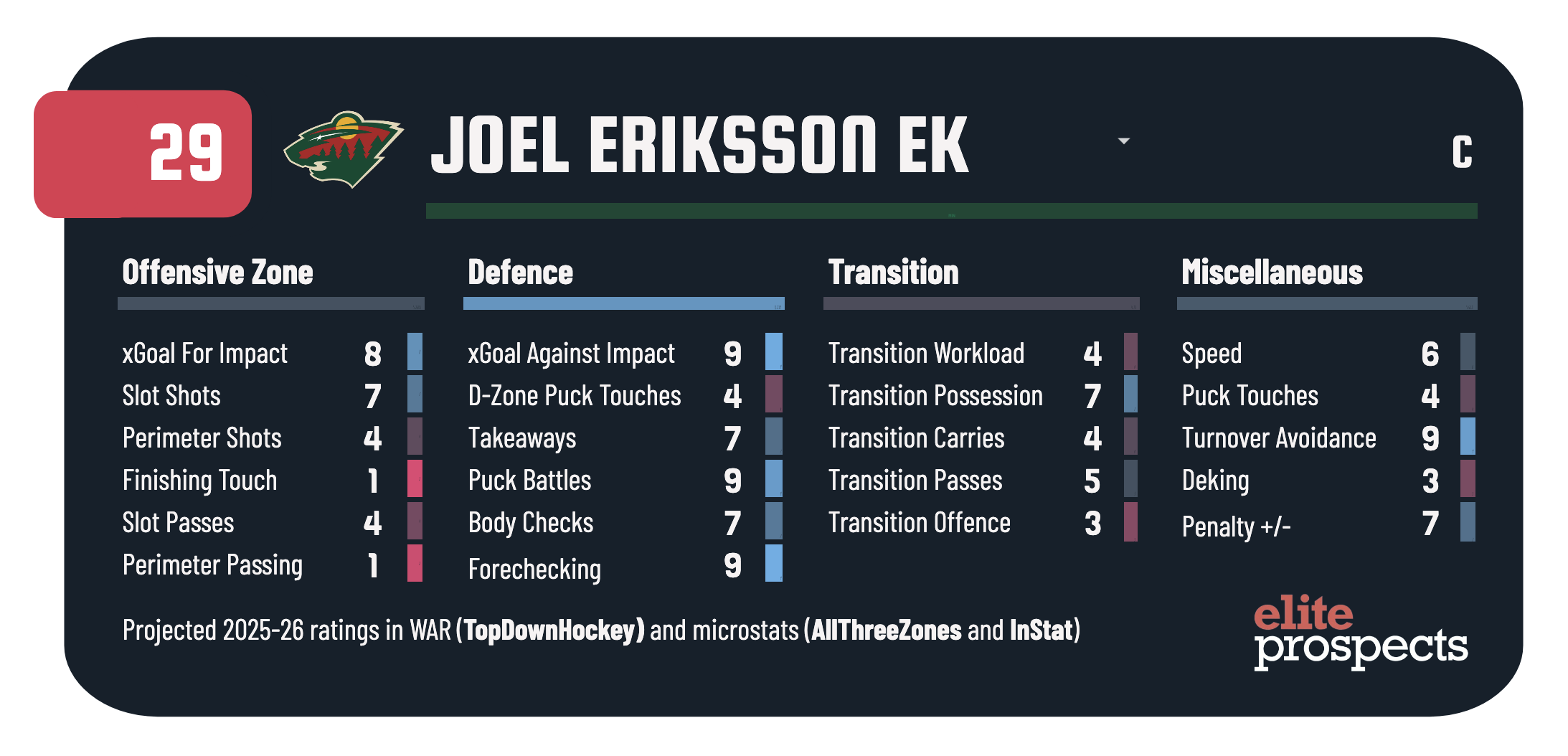
2024-25 wasn't a banner year for Joel Eriksson Ek in terms of production, as he dropped from a 28-goal, 66-point pace in the previous two seasons to a 25-goal, 50-point pace. It's true that he spends less time with the puck on his stick than any other player listed here and is particularly deficient in terms of playmaking skill and creativity relative to most top-line pivots. So why is he here? Like Cirelli, it's because of the two-way impact he has on the game against tough competition, winning tons of battles, putting pressure on opponents on the forecheck, and stripping pucks. At 6'3" 207, he's an immovable object in the slot and makes a great target for tips, passes to the slot, and rebounds. Finishing touch isn't his strong suit, but the volume of grade-A chances he gets mostly compensates for that.
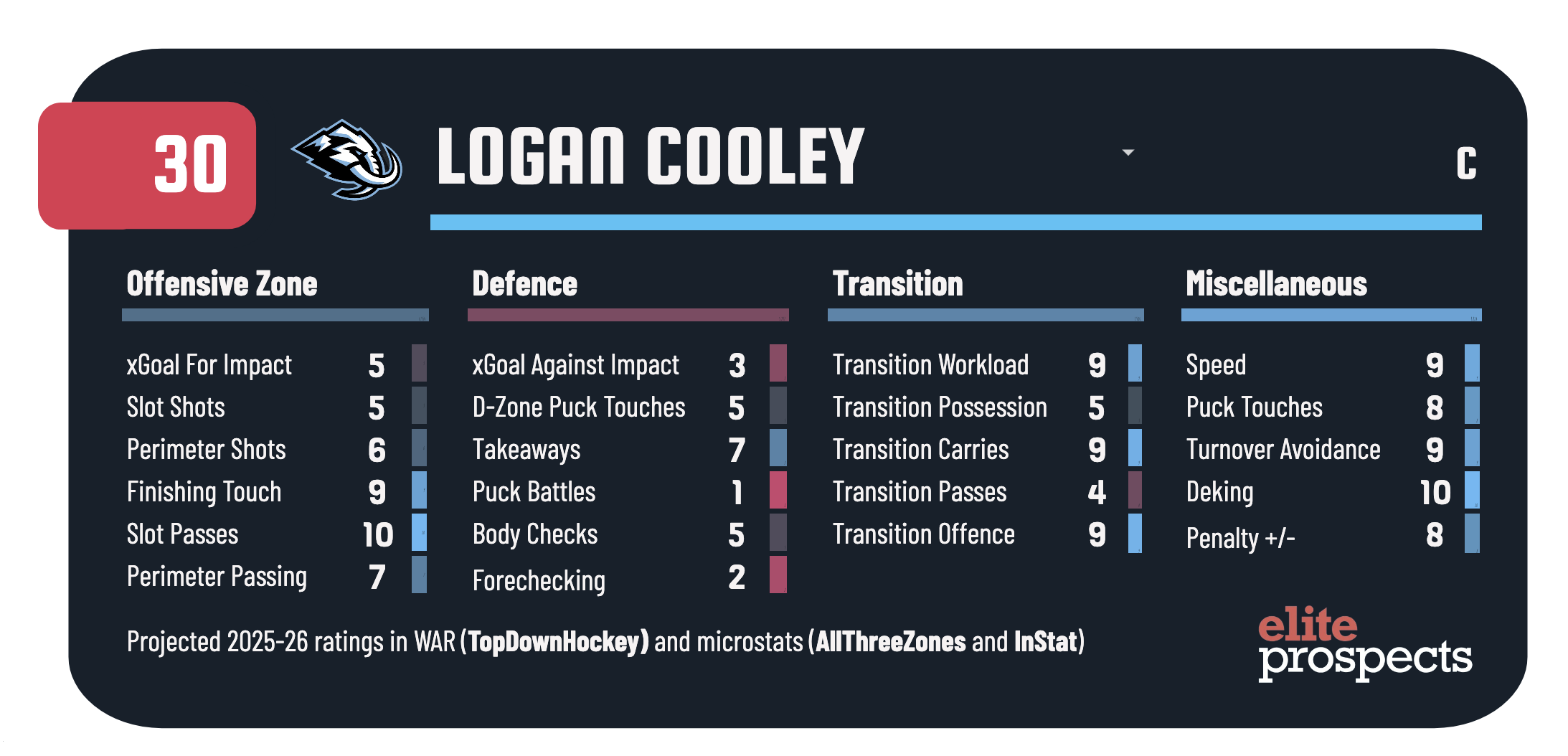
Logan Cooley's dynamic, high-skilled rushing game has transferred beautifully to the NHL, and he should be filling up highlight reels with end-to-end rushes and dekes for years to come as Utah's number one centre. Like many up-and-coming high-end players, deception is his forté as he deploys barrages of head-fakes, stick-handles, and pivots to leave defencemen in the dust (often sprawled on the ice), and he's got a high-end wrist shot and terrific passing instincts to turn these rushes into legit scoring chances. He's not exactly mammoth, but he is willing to play through contact to get to the net and can hopefully expand his defensive game in the coming seasons.
Honourable Mentions:
Bo Horvat - New York Islanders
While Horvat's production isn't always consistent from season to season, he has been a reliable contributor straddling that line between the low tier of first-line centres and high-end second-line guys for several seasons now. He doesn't have the unreal skill of players further up this list, including his frequent linemate Barzal, but he's a very smart player who reads developing plays well, knows where to go and how to make a subtle play to advance the puck, and can execute when the pass comes to him in the slot. His underrated wheels help him dart to open ice, and his sturdiness ensures he can establish position and finish through contact. That's not to say he lacks ability with the puck on his stick though; he has great hands and, because of his awareness, can execute quite impressive one-touch passing plays.
Dylan Strome - Washington Capitals
This was a very difficult cut and I wouldn't blame Capitals fans for being miffed. While Strome has by far the slowest feet on this list, his brain and hands run at top speed and you can't help but be impressed at how he can control the pace of the game and find the right play so often. A pass-first player with a great shot (always an effective combination), his defensive numbers plummeted as his production skyrocketed, including the sixth-most powerplay points in the league, and I would expect him to end up a bit closer to his usual 65ish points. If not, he won't get snubbed again.
Pierre-Luc Dubois - Washington Capitals
After struggling to find a home for a few years, Dubois set a clear path to redemption in 2024-25, delivering defensively in a heavy match-up role and setting a career high with 66 points (including the eighth-most 5-on-5 primary assists in the league). A good chunk of that production is very regression-vulnerable, but at only 27 years old, he has a superb chance to crack the top 30 if he can exert a comparable two-way impact again.
