Elite Prospects top 30 defencemen going into the 2025-26 NHL season



Welcome to Elite Prospects' fifth annual NHL player ranking! The summer's over, training camp is here, and that means it's time to take stock of where things stand as we enter the 2025-26 NHL season.
If you're new here, here's the breakdown. We go position-by-positioning, ranking the 30 best players based on how I expect them to perform in the upcoming season. Next up, we're going to take a look at the top defencemen in the game.
This ranking isn't just based on sorting players by Wins Above Replacement; as with every season, I take a holistic approach, including my own eye test, macro-level metrics from TopDownHockey, manually tracked microstats from Corey Sznajder's AllThreeZones project, and data from InStat Hockey, incorporating as much information as possible to present not only a coherent ranking but the best possible stylistic snapshot of each of these players.
The graphics, inspired by the work done by EP's prospect writers, include projected player ratings for the 2025-26 season in four categories: offensive zone play, defence, transition play, and miscellaneous. Departing from the percentile rankings I use on my player cards, here I use a 1-to-10 rating based on projected finish to respect the uncertainty at play here. The idea is to provide a broad impression of every player's strengths and weaknesses and give you as accurate an impression as possible of how they play.
Here's an example:
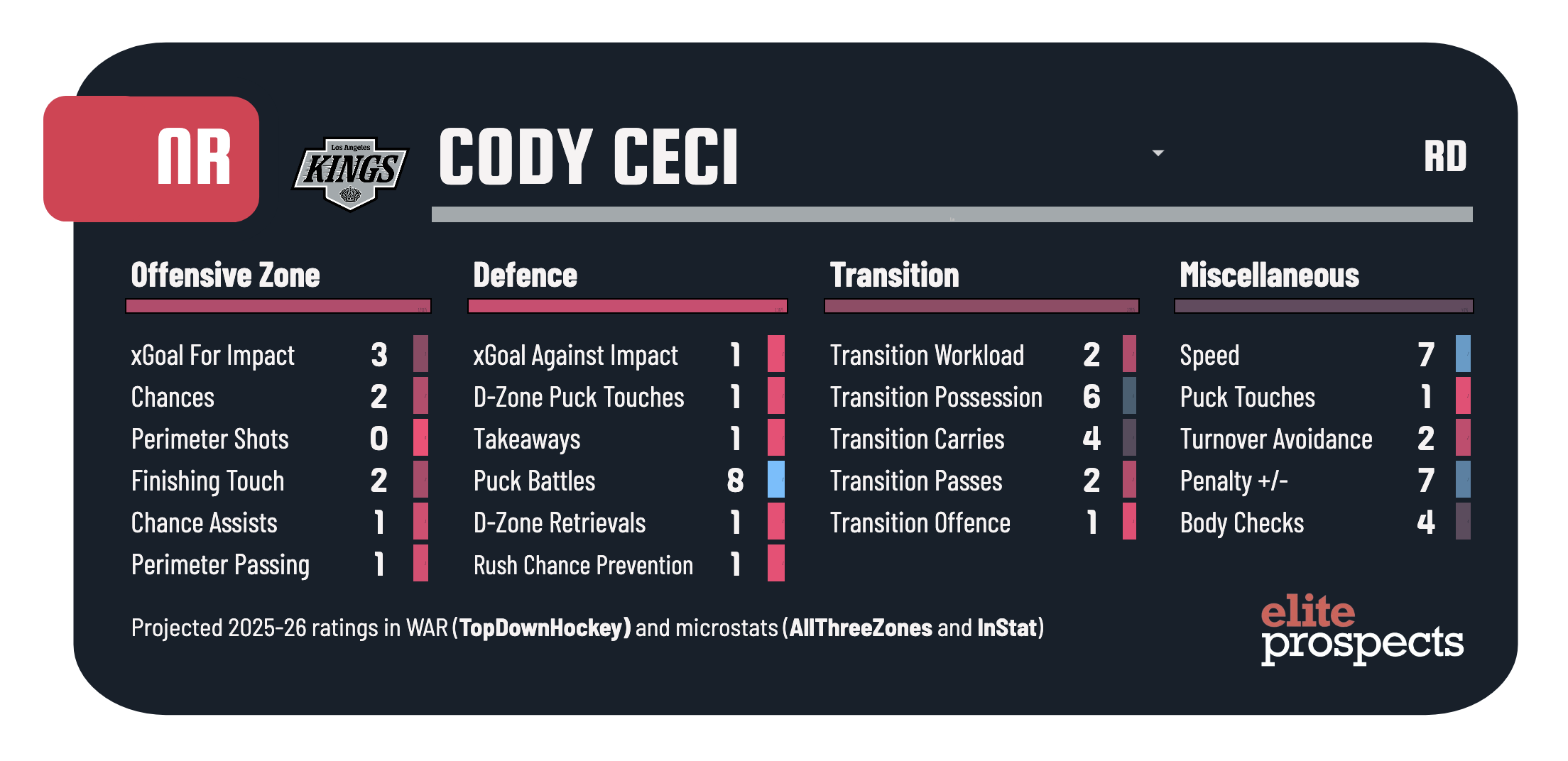
THere's a list of the metrics used, all of them per 60 5-on-5 projections for the 2025-26 season based on the previous three seasons of results. I've also marked their source (TopDownHockey = TDH, AllThreeZones = A3Z, InStat = IS, NHL = NHL)
Offensive Zone
- xGoal Impact: Isolated impact on his team's generation of expected goals (i.e. shots weighed by likelihood of going in) when he's on the ice (TDH)
- Chances: Scoring chances (A3Z)
- Perimeter Shots: Shots from other areas of the offensive zone (A3Z)
- Finishing Touch: Goals scored above expected given quality of shots (TDH)
- Chance Assists: Passes leading directly to a scoring chance (A3Z)
- Perimeter Passing: Passes to other areas of the offensive zone resulting in a shot (A3Z)
Defence
- xGoal Impact: Isolated impact on his team's prevention of expected goals when he's on the ice (TDH)
- D-Zone Puck Touches: Puck touches within the defensive zone (A3Z)
- Takeaways: Pucks stolen from opponents (IS)
- Puck Battles: 50/50 battles for the puck engaged in (IS)
- D-Zone Retrievals: Loose puck retrievals in the defensive zone (A3Z)
- Rush Chance Prevention: Chances against per zone entry target by an opposing player (A3Z)
Transition
- Transition Workload: Transition plays with the puck (A3Z)
- Transition Possession: Rate at which the player makes transition plays with possession as opposed to dump-ins and clears (A3Z)
- Transition Carries: Transition plays by carrying the puck into or out of the neutral zone (A3Z)
- Transition Passes: Transition plays by passing the puck into or out of the neutral zone (A3Z)
- Transition Offence: Shots and passes leading to slots off the rush (A3Z)
Miscellaneous
- Speed: Weighed combination of a player's top speed and frequency with which they exceed 22 miles per hour (NHL)
- Puck Touches: Puck touches in any zone (IS)
- Turnover Avoidance: Turnovers per puck touch (IS)
- Penalty +/-: Net non-coincidental minor penalties drawn versus taken (TDH)
- Body Checks: Hits as counted by the league (away only to filter out recording bias) (NHL)
Player positions used in this list will be based directly on the work of @NHL_Rosters on Twitter, who has been running the most accurate depth charts in the league for several years now.
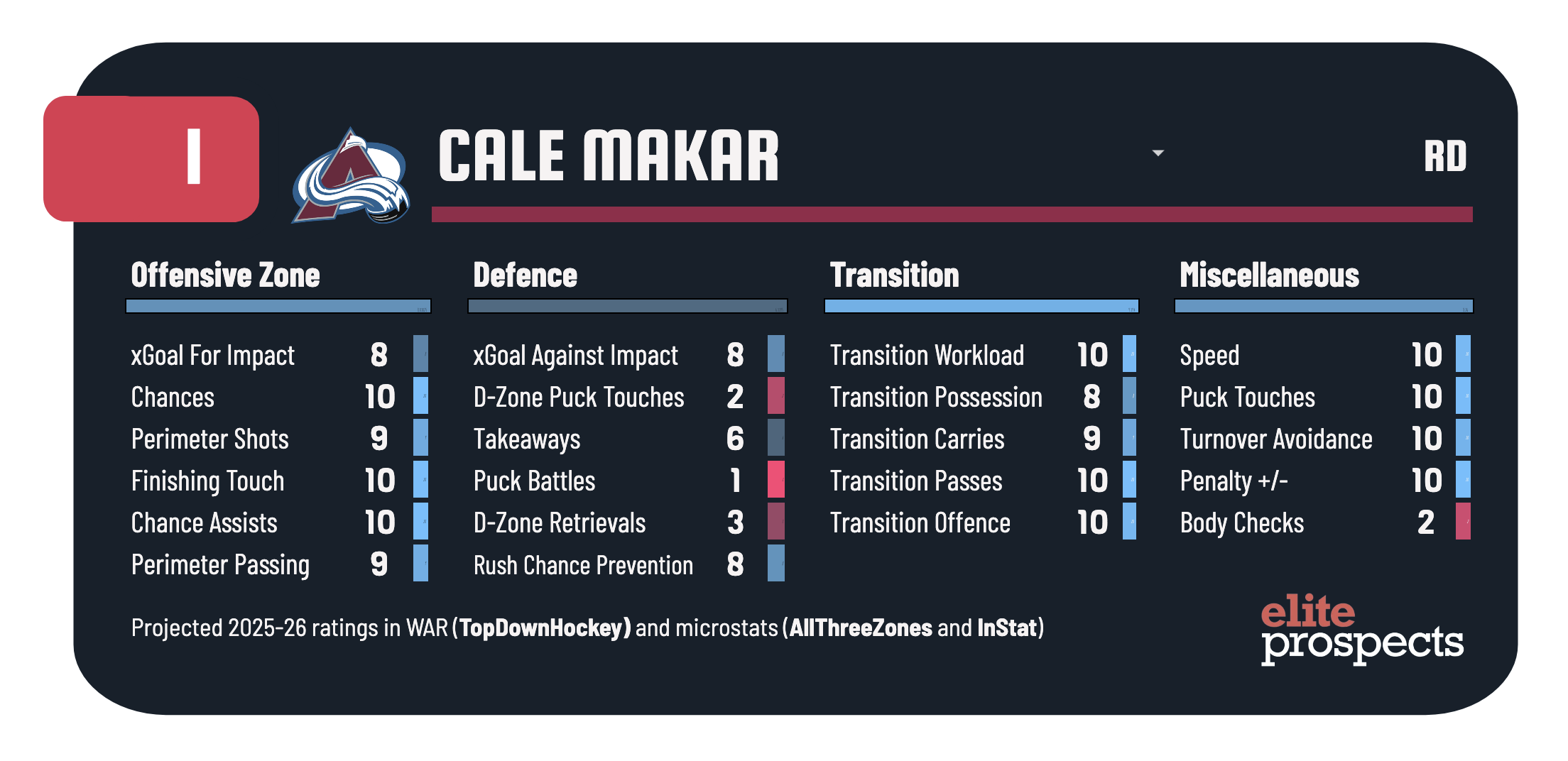
The most contentious debate in NHL player ranking at the moment is the question of who is better between Cale Makar and Quinn Hughes. After a season in which the Avalanche blueliner hit a career-high in goals (30) and points (92) and won his second Norris trophy, I lean towards him. He’s a generational defenceman, a singularly dynamic player who blends elite speed, agility, brilliance with the puck in transition, passing skill, and sniping ability. What sets him apart from every other player at his position is the sheer volume of scoring chances he creates both for himself and his linemates, driven by a willingness not only to walk the blueline and control the perimeter but take charge and make the difficult plays closer to the net. He benefits from the elite talent he plays with, there’s no doubt about that, but his deployment also forces him to face top competition on a nightly basis, putting his strong defensive abilities to the test. Makar’s play in his own end involves a lot more than pure possession play; he’s an active defender who blocks passing lanes, recovers pucks, and has always defended the rush well using his excellent skating to disrupt opponents. Add in that he backs it all up in the postseason, where he’s got a Conn Smythe on his resumé and an identical point-per-game rate to the regular season, and it's a solid case for number one.
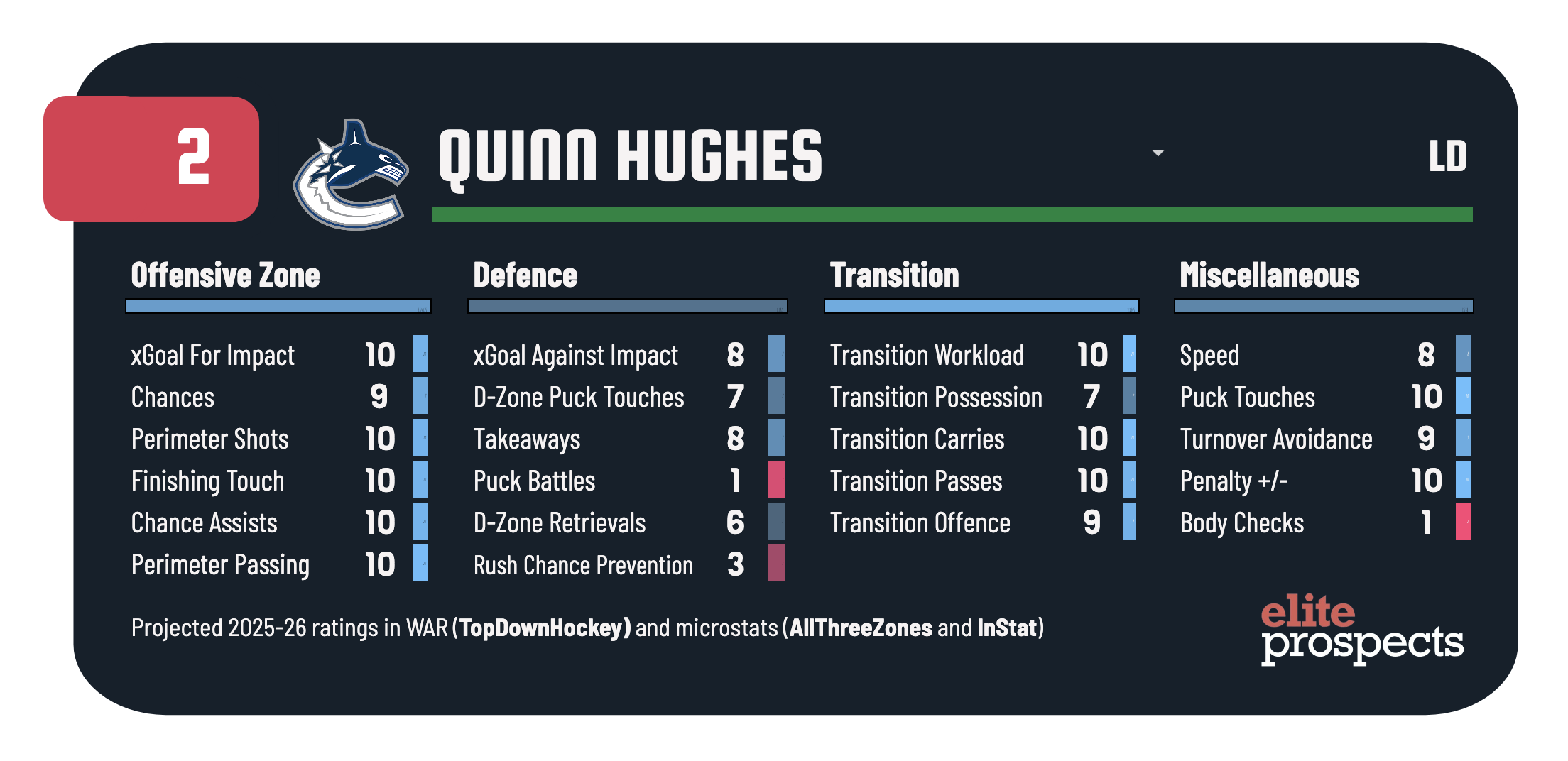
Hughes’ leap to the elite tier of the league in 2023-24 was not an outlier, as he backed up his first Norris victory with a performance that equalled it in practically every way, save a playoff appearance. Arguably no defenceman is as central to his team, as the Canucks rely on him to basically do everything on the ice from controlling play in the offensive zone, managing the break-out, carrying the puck end-to-end, and sending pinpoint stretch passes up-ice. He spends more time with the puck on his stick than any other defenceman, and when he receives a pass at the point anything can happen. He’s uncontainable walking the blue-line, spinning off checks, faking passes, dropping the shoulder and driving up the wing, and he’s a one-man cycle initiator. Even though he’s small and can get pushed around at the net-front, he stays on the right side of the defensive ledger through skating, awareness, and a disruptive stick. He’s at the point where anything but a Norris nomination would be considered a disappointing season.
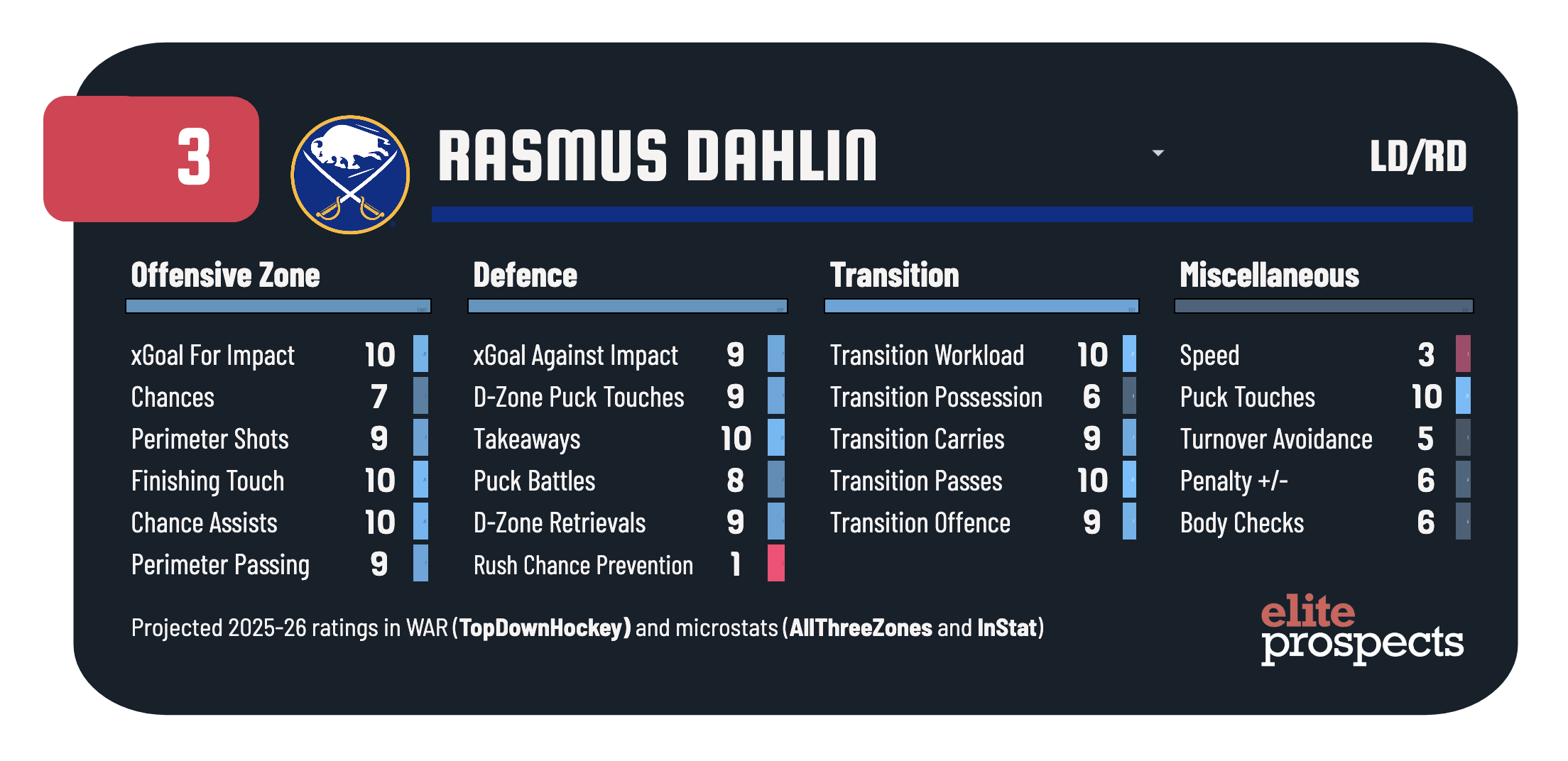
It speaks to the broader dysfunction of the Buffalo Sabres that 25 minutes a night of Rasmus Dahlin in the past three seasons hasn’t been enough to get them into the playoffs. It’s not hard to make the case that he’s the game’s most well-rounded blueliner at this point. His elite skill with the puck makes him difficult to contain whether he’s leading the rush, walking the blueline, pushing towards the slot from the point, or blasting a shot from range. That would be dangerous enough if he wasn’t also one of the best passers in the game and capable of clogging passing lanes, killing plays, and winning battles in his own zone. Continuing to develop his physical edge, which he occasionally lets loose with big body checks, would only further distinguish him from his peers atop the league.
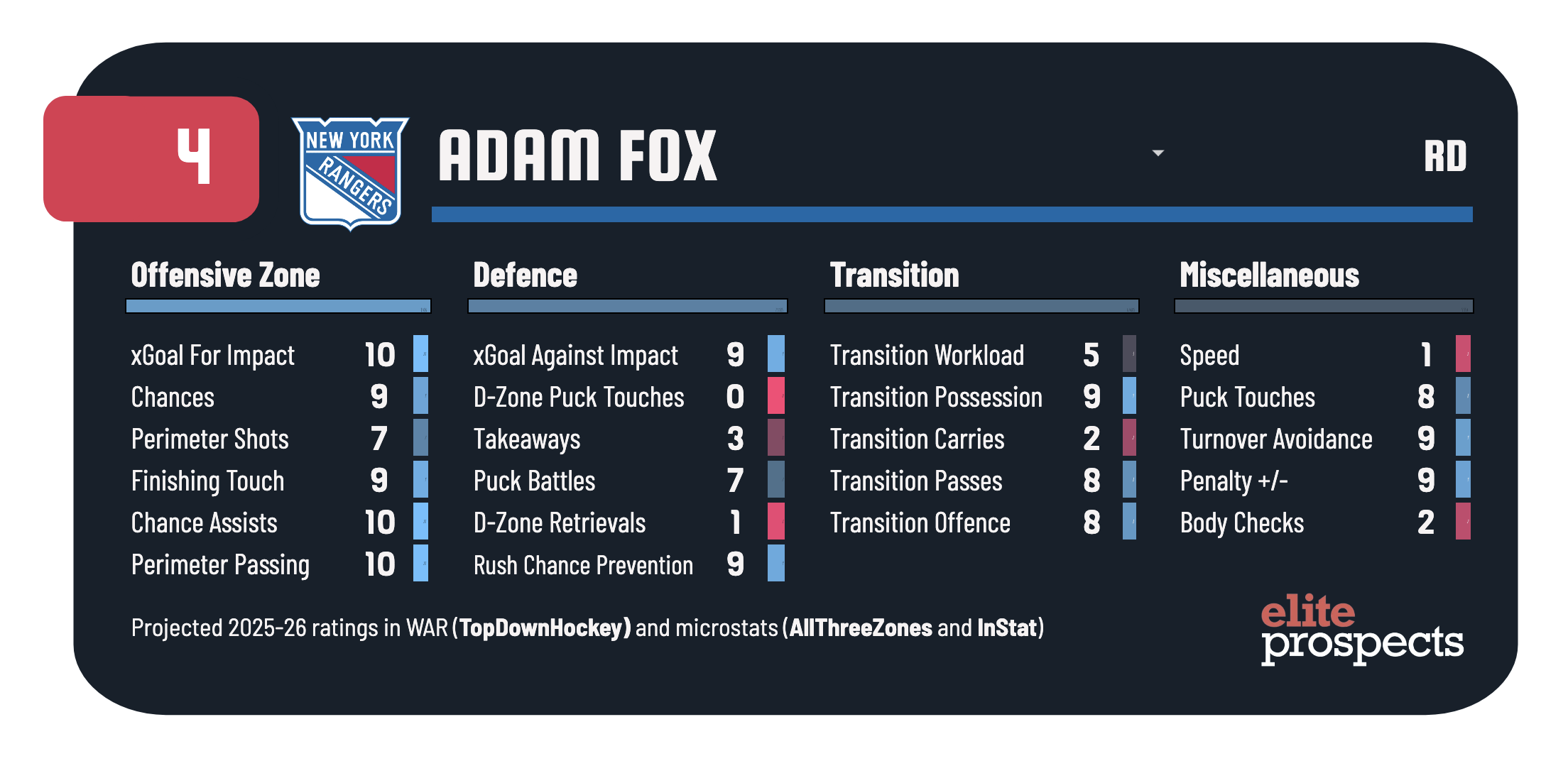
It seems as though everyone in and around the NHL has decided that Adam Fox had a poor season in 2024-25. The reasons they list, like slow foot-speed, lack of agility, and underwhelming physical presence, are exactly the defects that dropped him to the fourth round and exactly the qualities shown to be beside the point as Fox emerged as one of the premier defenders in the league. Should the extra eyeballs on his poor showing in the 4Nations final really cancel out a season in which his presence on the ice at 5-on-5 was the difference between the Rangers playing like a President’s Trophy winner and a lottery team? The fact of the matter is that Fox, as always, exerts an almost-unmatched two-way impact on the game through hockey I.Q., skill, patience, and execution, rating among the elite as both a conscientious puck-mover and dynamically skilled passer in the offensive zone. Without the puck he’s one of the best pass blockers in the game and, impressively considering his skating defects, a consistently strong rush defender who has always been excellent at pushing forwards wide and preventing scoring chances. Mike Sullivan might find that “fixing” Adam Fox is an easier task than he expected.
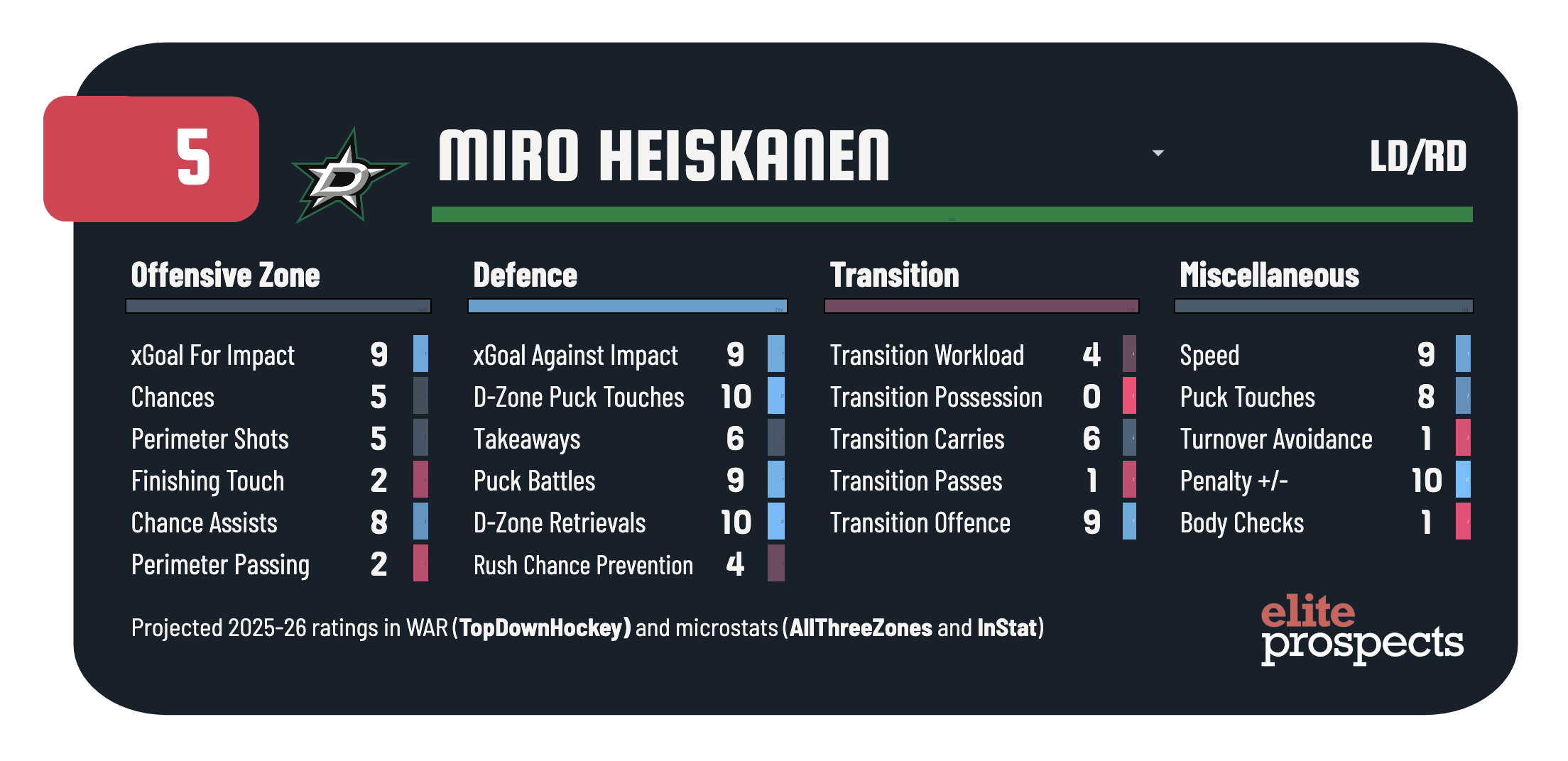
Few would argue that 2024-25 was among the better seasons of Miro Heiskanen’s career, but it speaks to his incredible track record that nobody is doubting his status as a truly elite defenceman. At his best, he’s a one-man army controlling both ends of the ice, beating everybody to loose pucks with his skating before embarking on daring end-to-end rushes that culminate in flashy passes to a streaking forward. He’s a brilliant play disruptor who suffocates opponents, engages on the wall, and gets his stick in the way of whatever they might want to do. All that skill remains in place, but he’s not getting quite as many touches as he used to, sinking a bit more in the background as the forwards do more heavy lifting with the puck and new kid on the block (and sometimes partner) Thomas Harley gets in on the fun. Even if he’s not the one on the scoreboard, he’s often the one starting the play.
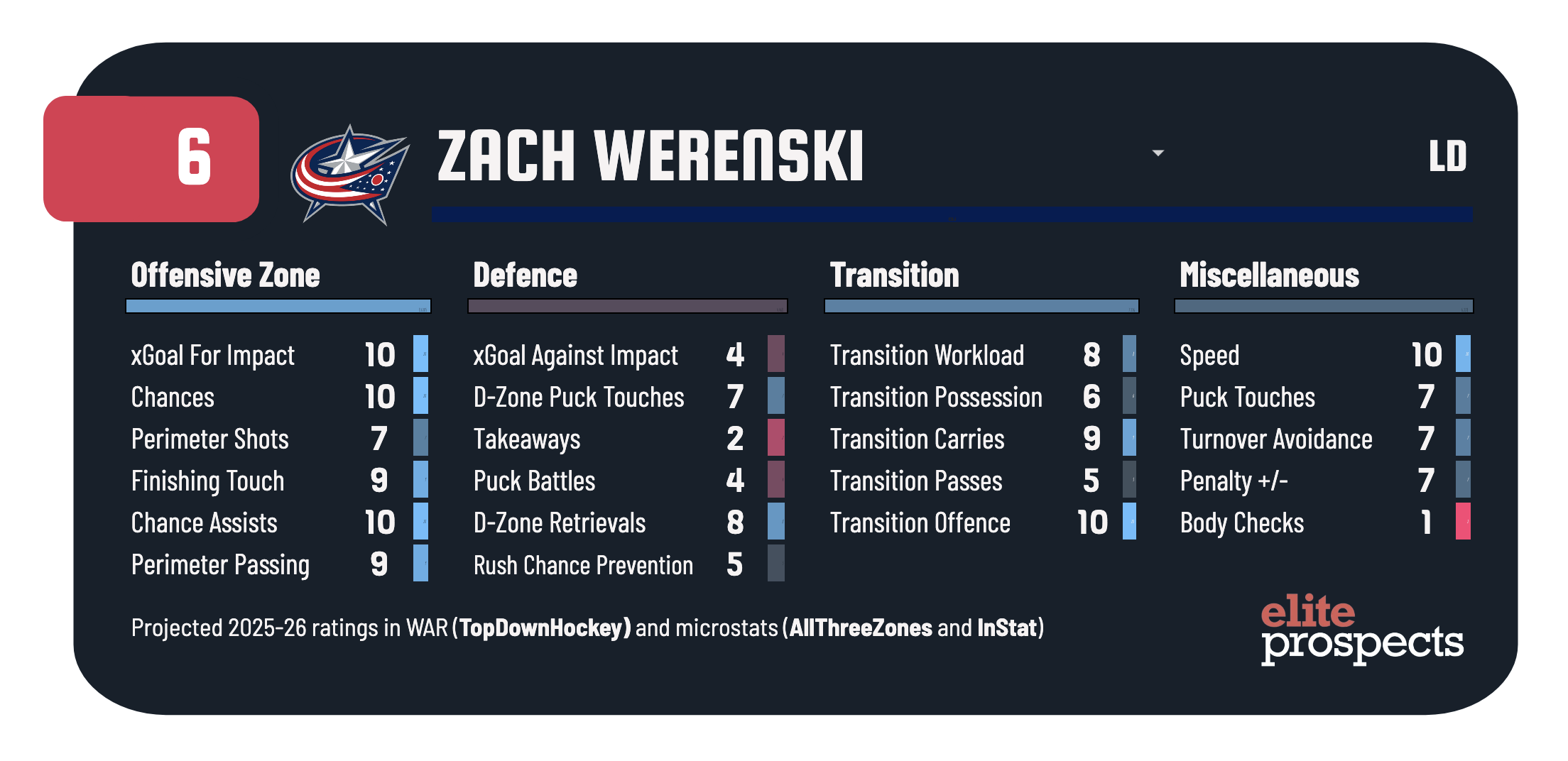
Ever since the moment he stepped into the league, Zach Werenski has been a terrific offensive defenceman, often occupying that tier of blueliners just below elite -- All-Star but not Norris calibre. While some people might have believed him to be capable of a true break-out season, his miraculous 82-point performance playing almost 27 minutes a night (including seven games above 30 minutes) was a lightning bolt out of nowhere. The Jackets were a completely different team with him on the ice, and the biggest determinant of how strong their other blueliners’ offensive numbers looked was “how much did they get to play with Werenski?” He was the only defender to come even close to Makar in terms of scoring chance creation, doing so with a lot less help, and ranked near the top in practically every offensive stat while being just as involved without the puck. If he can repeat this performance it will be tough to keep him out of the top three.
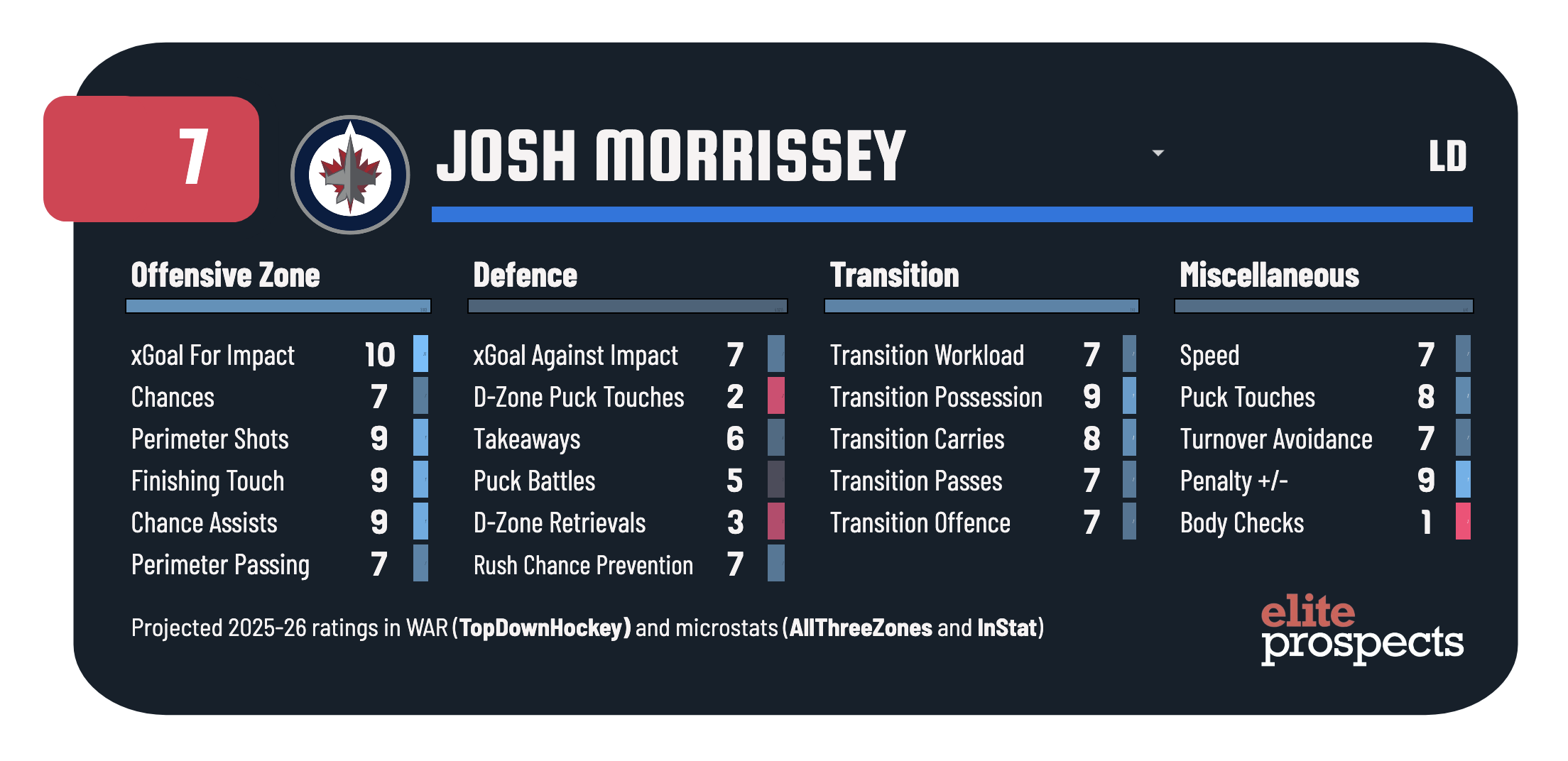
Josh Morrissey maintained his status as an elite number one defenceman for the third straight season, quarterbacking the Presidents Trophy winning Jets and finishing top-five in Norris voting for the second time in his career. His smooth skating and ever-increasing confidence with the puck on his stick has made him one of the league's premier scoring chance creators from the blueline as he's capable of joining and leading the rush, jumping up in the offensive zone, and forcing turnovers to keep plays alive. He's also managed to reclaim the strong defensive results that fell a bit by the wayside when he decided overnight to become a high-end offensive defenceman.
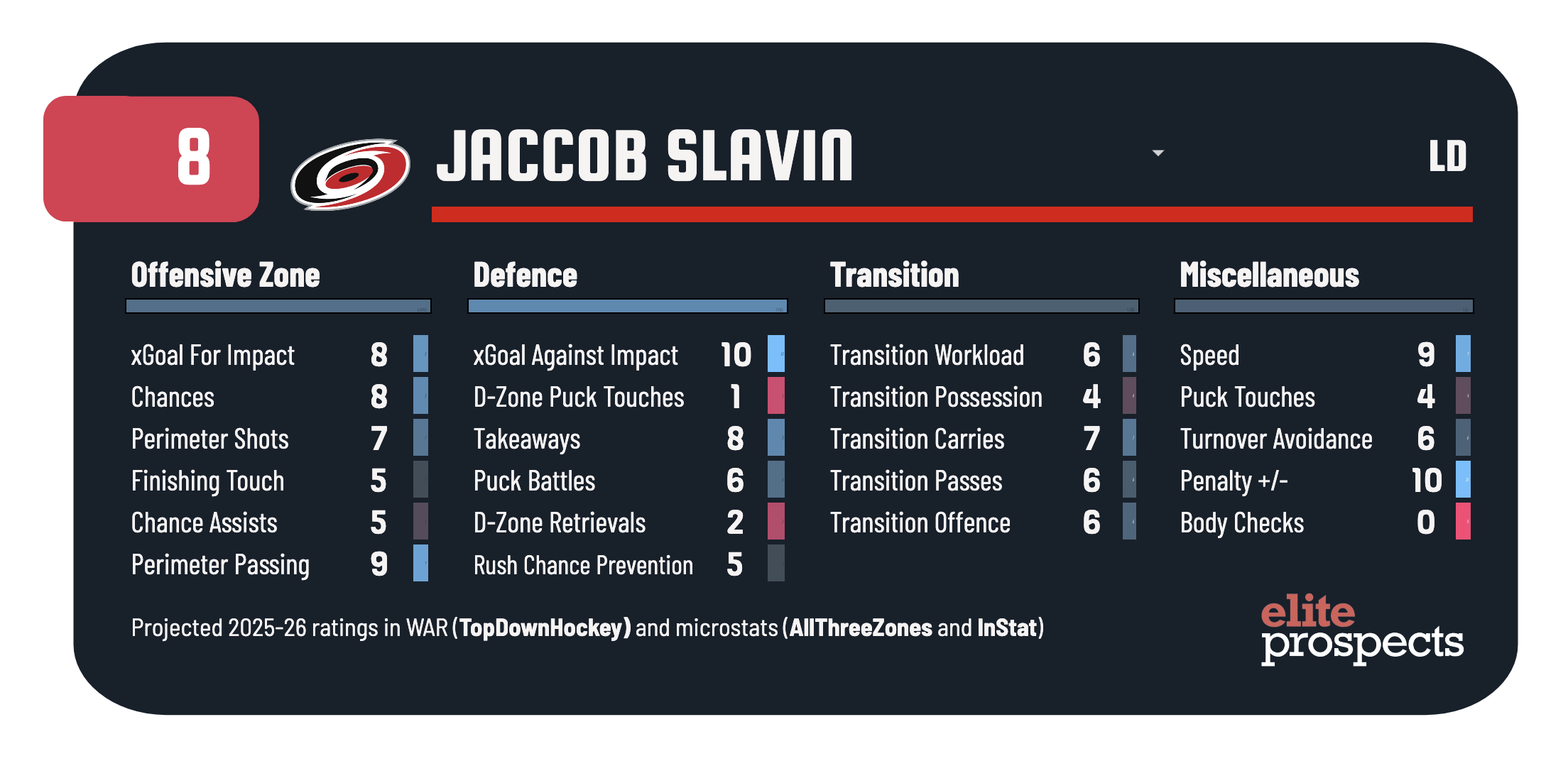
Possibly the most universally-touted defenceman in the league, Jaccob Slavin has earned a reputation as the best defensive player in hockey through years of maddeningly effective shut-down play, although it’s his ability to hold up offensively as well that elevates him above other stay-at-home specialists. There simply isn’t a better play-disruptor in the game, as Slavin has made a science of blending quick feet and an even quicker stick to attack the puck-carrier aggressively, and unlike others who try that strategy, he always has a plan B to kill the play even if he gets beat. When you see a blueliner down on the ice it’s usually a sign they’ve made a huge mistake, but in Slavin’s case it’s all part of the plan; in this sense he’s kind of the Dominik Hasek of defending. Whether it’s blocking shots, knocking passes aside, or defending the blueline, he does it all, and when combined with solid enough transition play and some subtle offensive zone skill the result is a player who 32 coaches would love to have on their side defending a lead late.
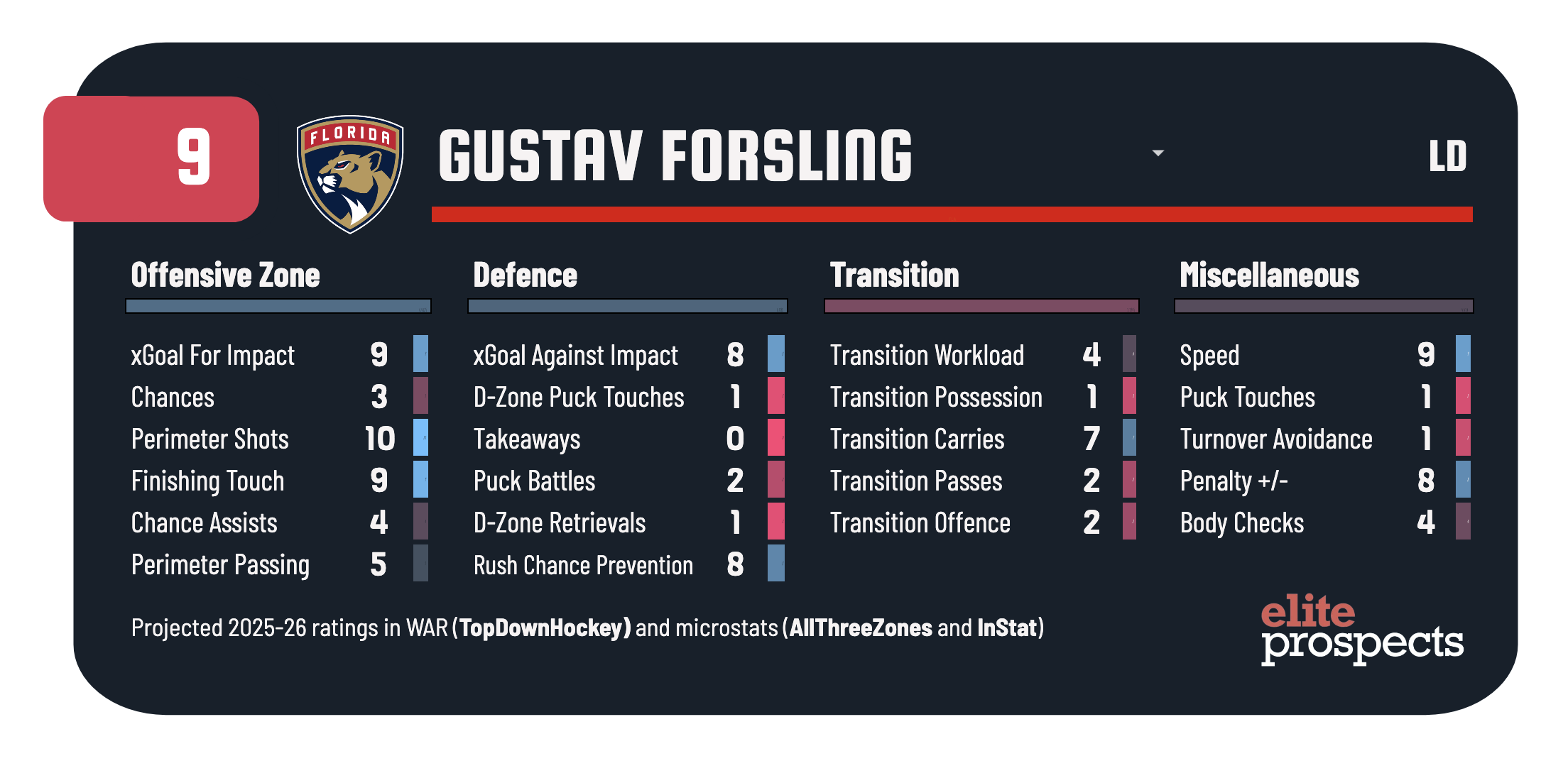
Did you know that Gustav Forsling is only 6’1? I feel like if you told that fact to a lot of hockey fans, it would really surprise them. The reason isn’t that he’s some violent physical specimen a la Zdeno Chára, but that the way he plays you’d kind of think he was using a Chara-sized stick. He covers a tremendous amount of territory on the ice and excels at making the home-run possession-killing play to close down his defensive zone and above all make sure that you can not enter without either dumping the puck in (where his partner can retrieve it) or losing it. These plays sometimes involve him wildly flinging himself across the ice to knock the puck off an opponents’ stick, a strategy that really shouldn’t work as often as it does. His approach to offence is quite a bit simpler -- pucks on net -- but if it works, it works. And two Cup rings says it works.
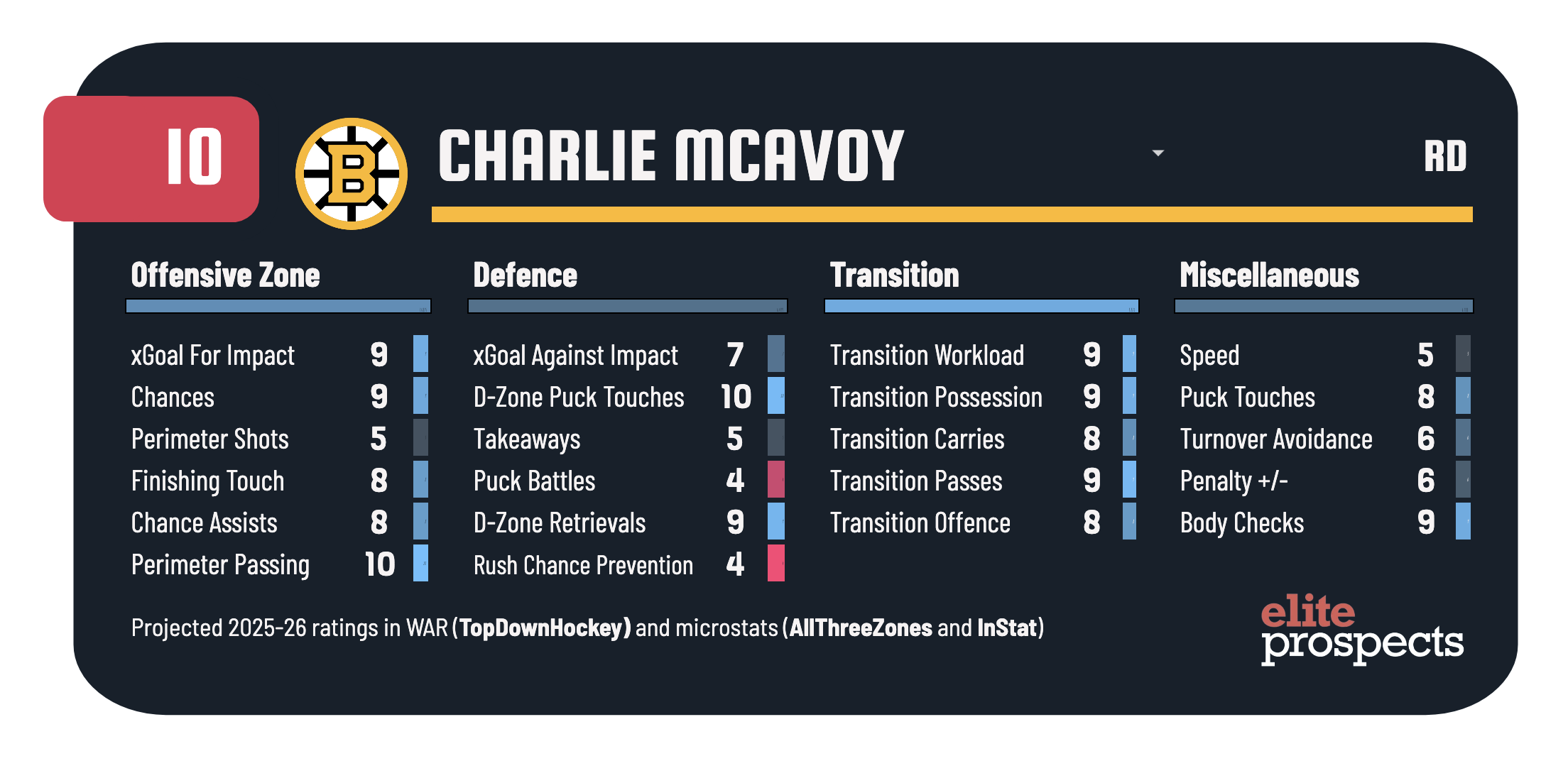
As the Bruins try to ward off utter collapse in a new post-Patrice Bergeron, post-Brad Marchand era, they desperately need a full return to form from Charlie McAvoy. That’s not to say he was bad last year, because he wasn’t by any stretch. But considering he was a top-five blueliner in the league from 2019-20 to 2023-24 (at least in this analyst’s opinion), an abbreviated season in which he was merely great doesn’t quite cut it. McAvoy at his best is excellent at practically everything except the powerplay -- mobile, physical, skilled carrying and passing the puck, conscientious defensively at even strength and the penalty kill, and adept at creating offence at 5-on-5 in every regard. This is a player who through his entire career had never had a 5-on-5 goal share below 55%, exceeding 60% for three years a row, and had to settle for 53% in 2024-25 with barely break-even chance metrics this time around. Can a reunion with Hampus Lindholm, who missed most of last season, get him back to the league’s top tier?
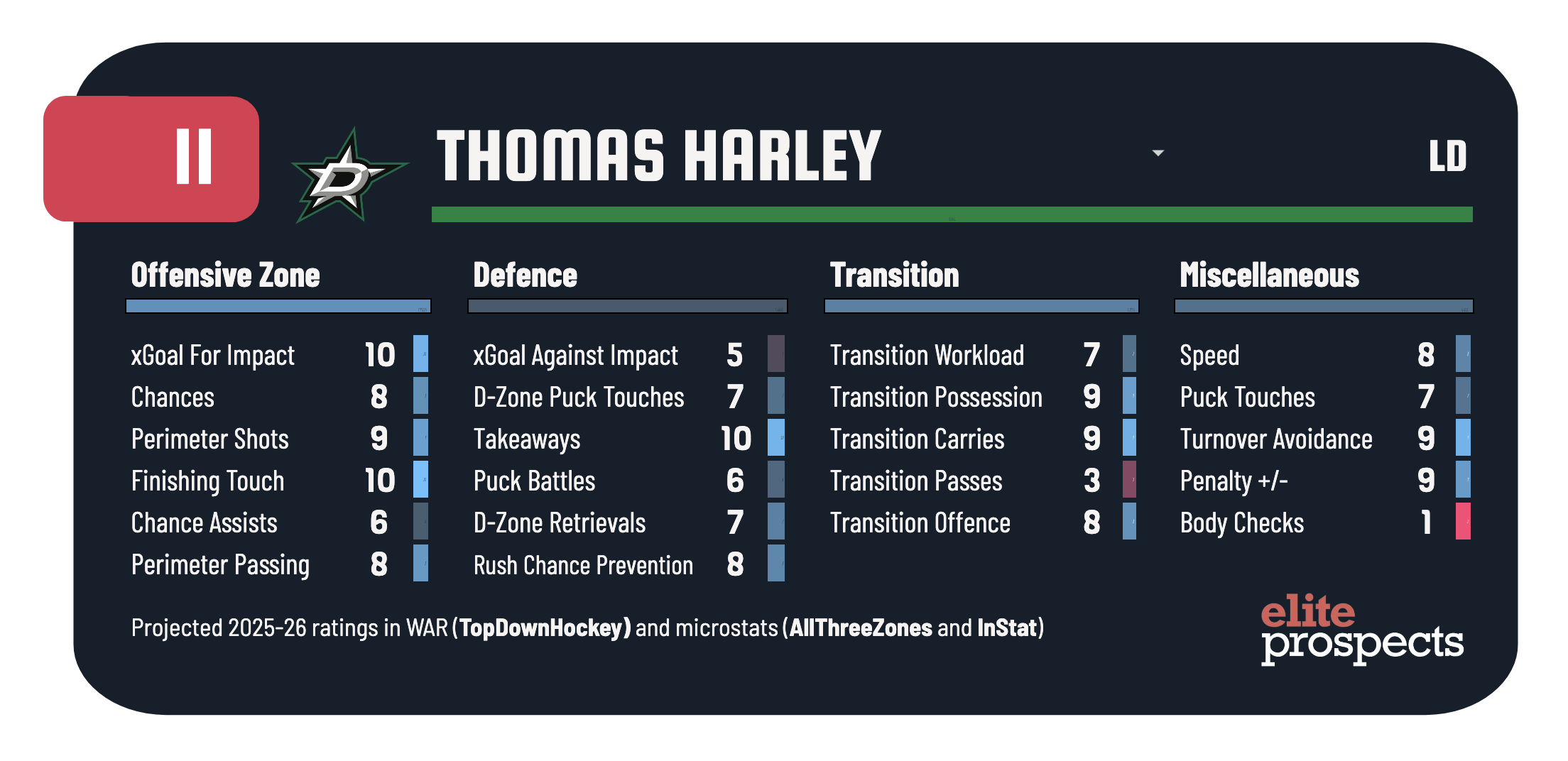
At one point a total long-shot to qualify for Team Canada, Thomas Harley’s showing at 4 Nations and high-end all-situations performance for the contending Stars has opened a lot of eyes to just how impactful he is. He wants to be in the middle of everything that’s happening on the ice, joining the rush with astonishing aggressiveness and often beating forwards up the ice to catch a pass and lead the entry. When he fires off a stretch pass, he wants the puck back as soon as possible, and it wouldn’t be unfair to mistake him for a forward while watching him deke opponents in the neutral zone and carry the puck down the left wing. Fortunately, his commitment to defending and mobility means he almost always gets back in time and is terrific at disrupting plays and protecting the zone. Smart opponents can exploit that aggressiveness and draw him away from the net, but he’s already a plus defender and continuing to improve in that area.
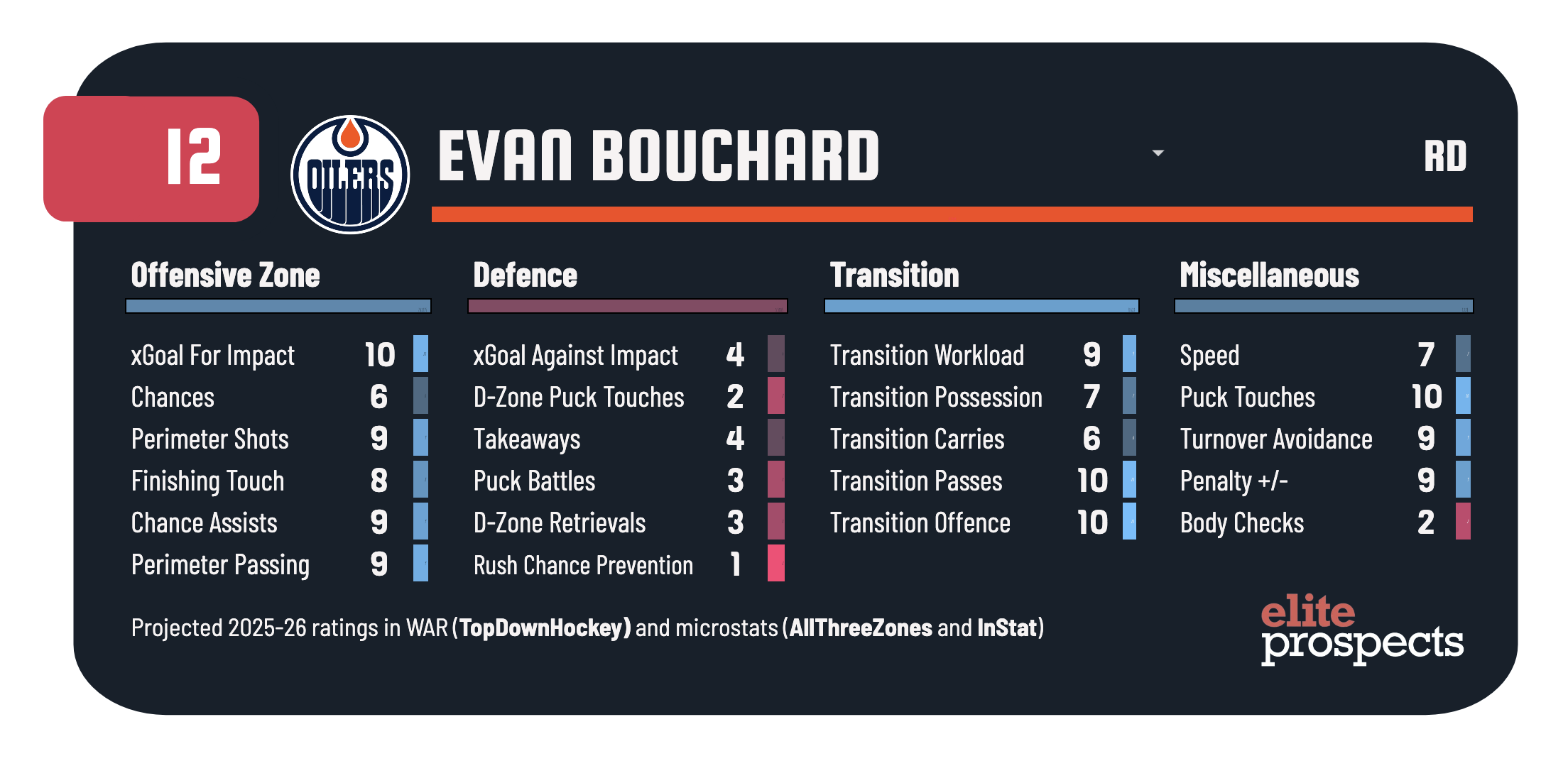
Flawed but effective number one offensive defenceman playing with a generational talent is a lucrative job, but also comes with a certain level of disrespect built in. You can ask Kris Letang, Mike Green, John Carlson, and now their heir apparent Evan Bouchard. This is a player who’s produced at a 100-point pace in his past 59 playoff games, winning his 5-on-5 post-season minutes 66 to 45 in that span with sparkling underlying results that remain superb even when he’s not on the ice with Leon Draisaitl and Connor McDavid, and yet few star defencemen are as maligned as he is. I guess the $10.5 million per year probably softens the blow a bit. The problems with Bouchard’s defensive game are real, and show up in high-pressure situations where he is prone to panicking and making a bone-headed read when things go suddenly wrong, but the thing is that he’s so good both in transition and in the offensive zone that they don’t actually come up all that often. His puck-moving, creativity, booming shot, and -- believe it or not -- very low turnover rate keep the puck where he wants it far more often than not.
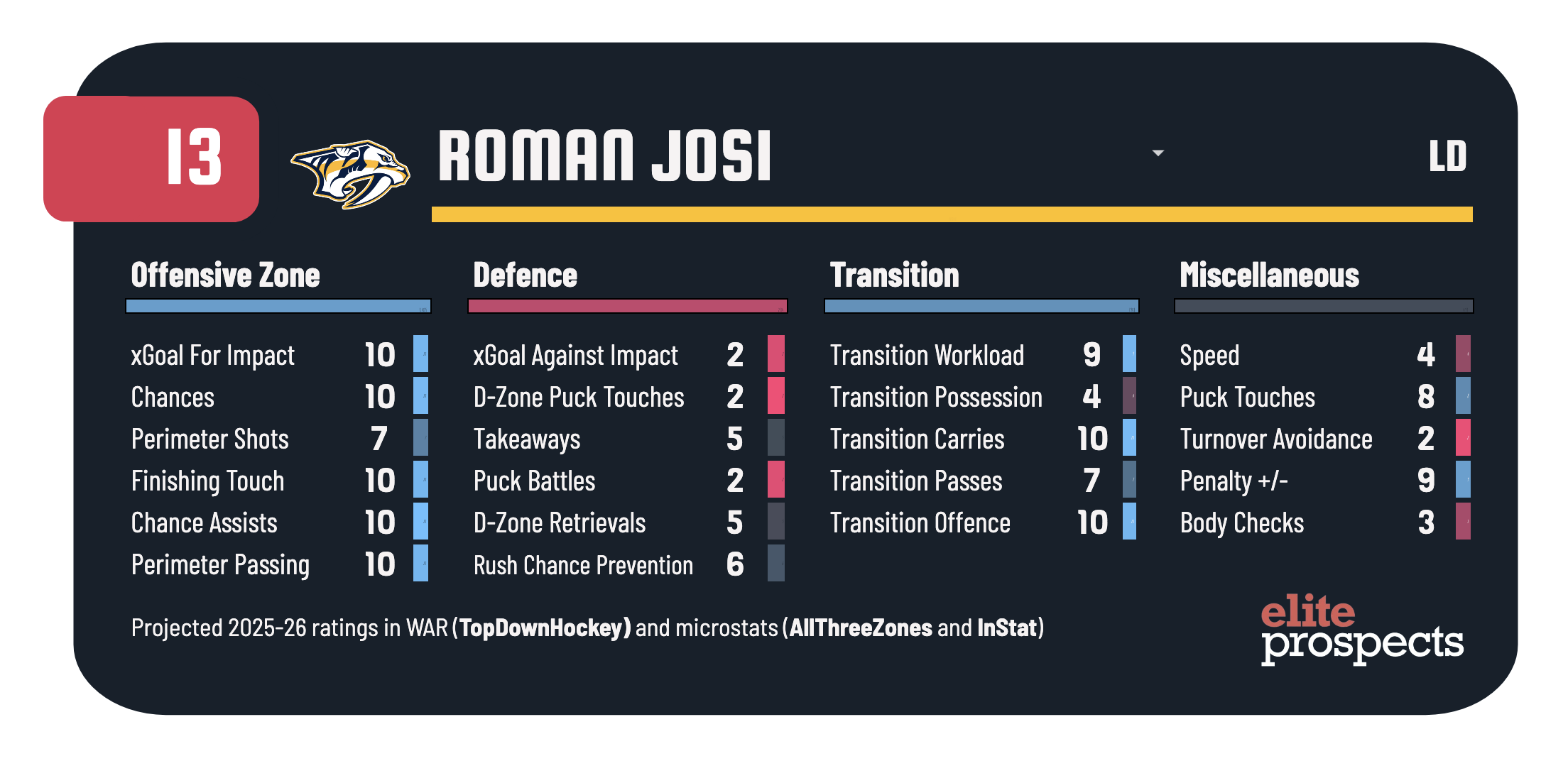
If you look at the hockey card numbers, it looks like Roman Josi's game tumbled alongside the Predators' fortunes: just a 58-point pace and -26?! Things are a lot less scary under the hood, especially when you consider that he had a 96 PDO. His transition volume is no longer in a league of its own (Hughes has inherited that mantle) but it remains considerable and few defencemen make such a difference in the neutral zone, whether it's entering the offensive zone cleanly or sending a sneaky pass to a streaking winger, and his chance creation and success rate with the puck remain considerable. His defensive impact is slipping year-over-year and at 35 it's safe to assume he's on the down-swing, but he hasn't significantly fallen off yet.
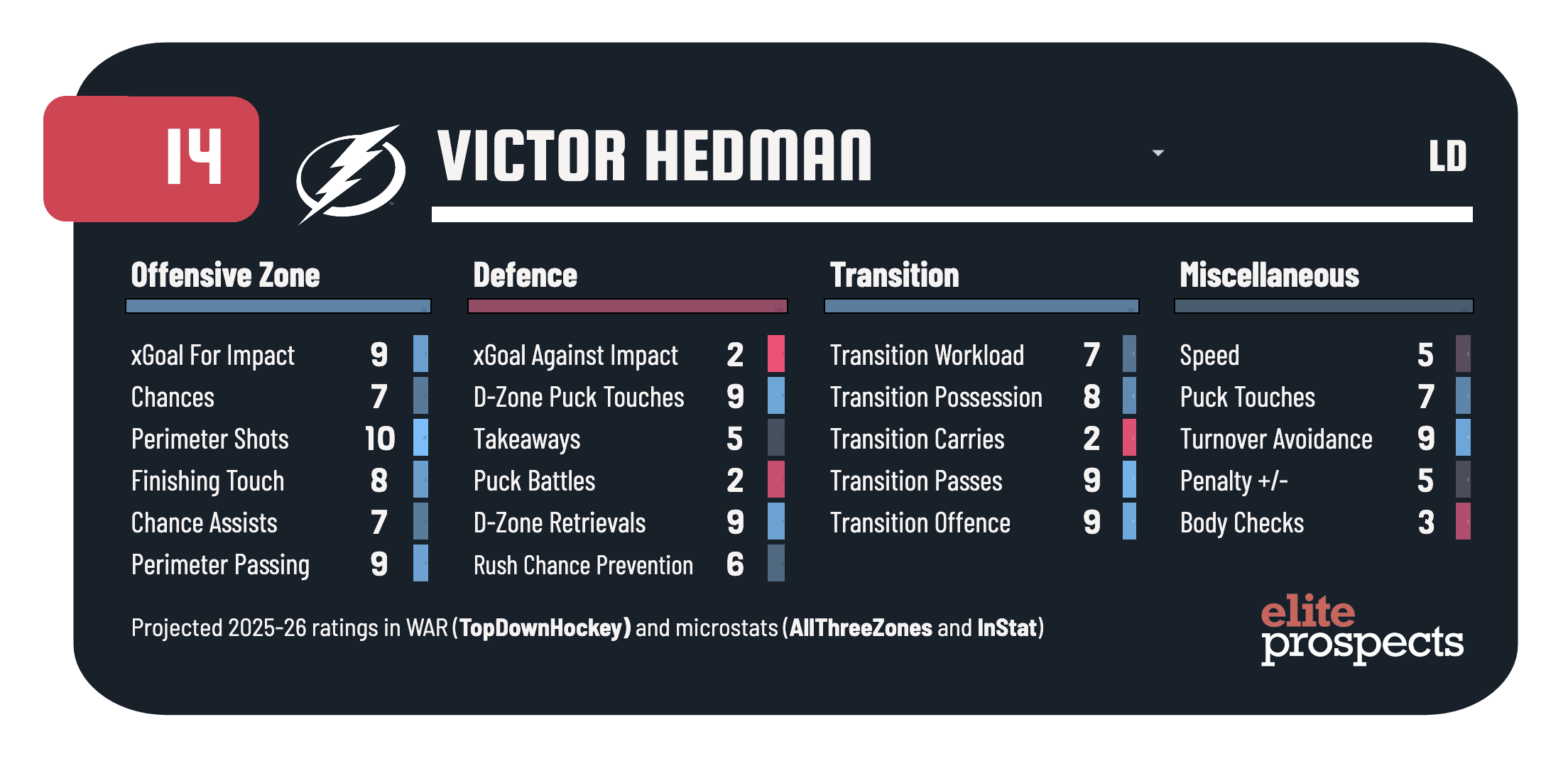
The days when hockey writers could cheat on their Norris ballots by just assuming Victor Hedman deserved a nomination might have passed, but he remains one of the most effective puck-movers in the NHL even solidly into his mid-30s. The Bolts’ decision to move Mikhail Sergachyov last offseason indicated just how confident they are in Hedman’s ability to maintain the performance of a #1 defenceman, but while I expected that move to entail an role increase, he actually saw his time on ice drop to its lowest point since 2018-19 with relatively soft deployment in terms of match-ups and zone starts. While the Lightning clearly value him mostly for his superb skill with the puck and chemistry with their top stars, that’s not to say he doesn’t still have some solid defensive chops. He’s maintained enough mobility, smarts, and strength to successfully retrieve loose pucks in his own end and he’s one of the most careful puck-managers in the league relative to his workload, even if his defence is leakier than it used to be.
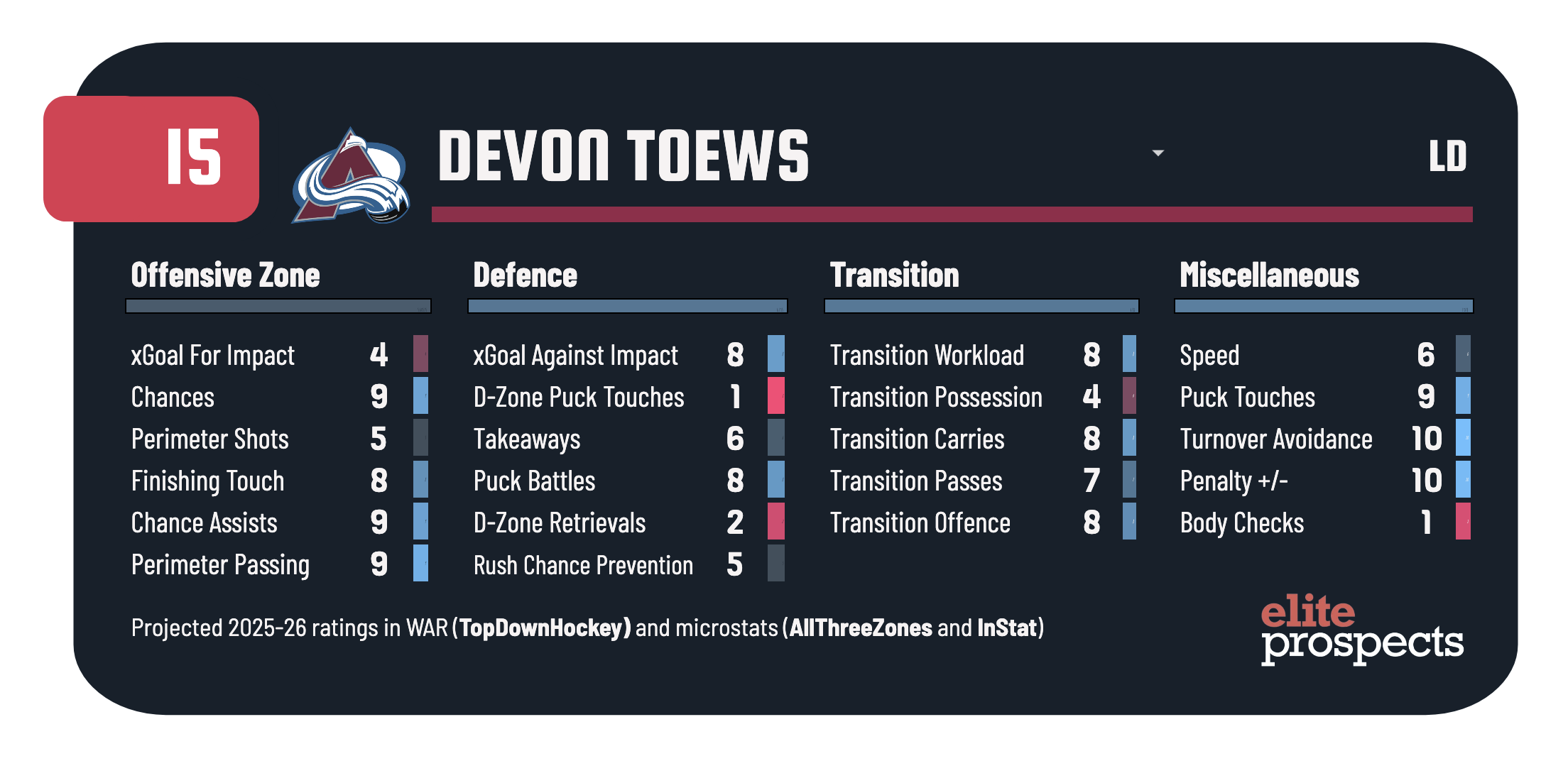
We’ll never know if Devon Toews could have been a franchise number one defenceman leading his own team, but I’m willing to bet that Makar is pretty pleased about that. Their partnership since 2020 both on the Avalanche and Team Canada has given Toews the chance to show off his versatile two-way skill-set, playing a crucial utility role that involves connecting the dots on a lot of plays in transition, keeping pucks alive, and using his skating and defensive stick to block lanes, disrupt opponents, and win loose pucks. He lacks the dynamic quality of his partner but can send a stretch pass as well as practically anyone in the league. That his on-ice impacts have dropped in the past two seasons is curious (and potentially an artifact of the Avs’ unique deployment of Nathan MacKinnon with the team’s top pairing) but given strong overall results and solid process is not too deep a cause for concern.
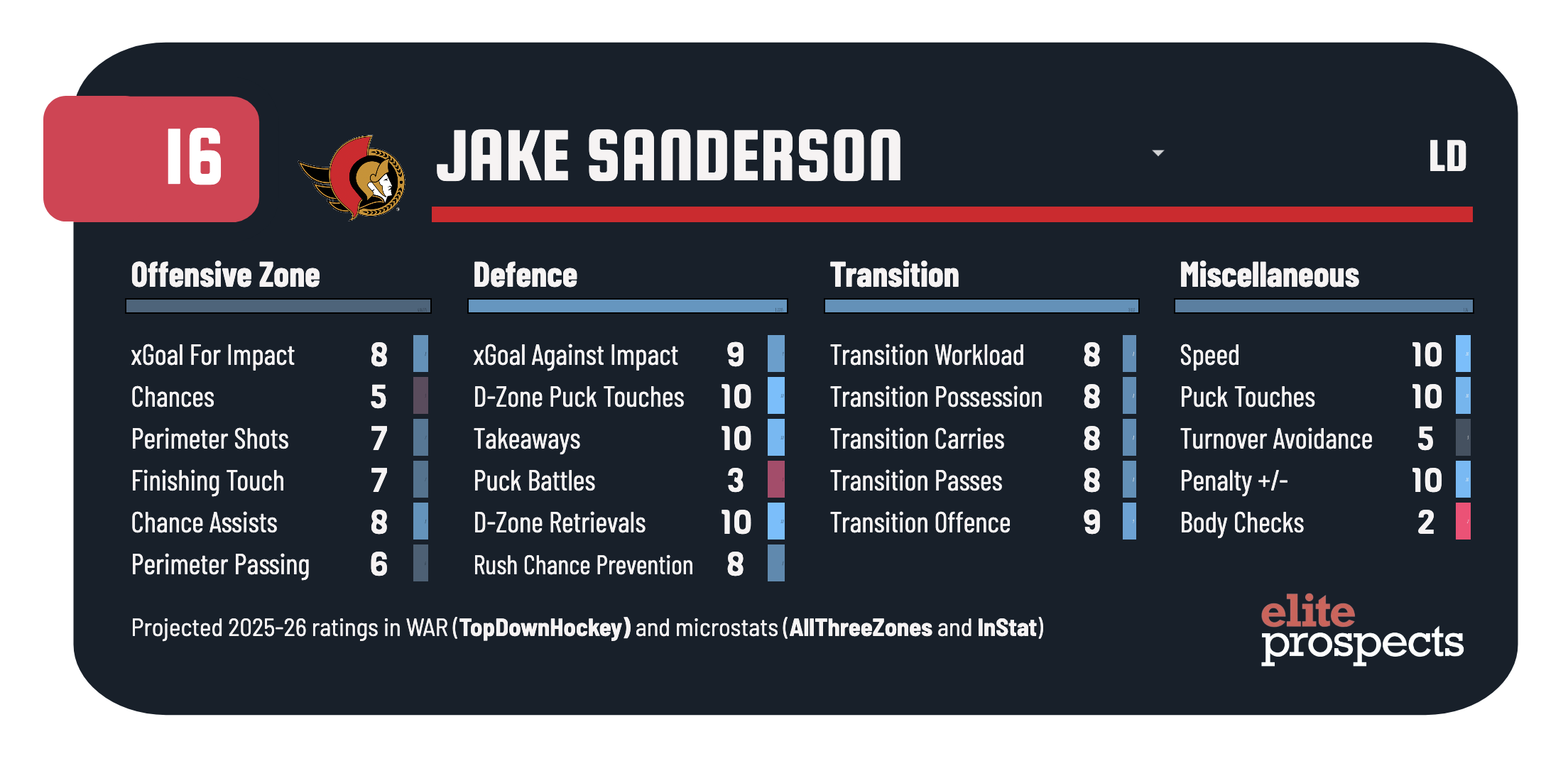
While he might never produce like the names at the top of this list, Jake Sanderson impact on the game is obvious to anyone who looks closer than the score-sheet. Now solidified as the Sens’ number one defender, his stabilizing all-around impact is the model for a modern play-driving defender, blending elite skating, aggressive but responsible defensive disruption, and high-end puck-moving to tilt the ice heavily in his favour. His ability to win races to loose pucks and turn them into clean zone exits won’t get him on highlight reels but it does make things much easier for his linemates. All that’s missing is that extra gear in the offensive zone (and admittedly maybe some physicality as well).
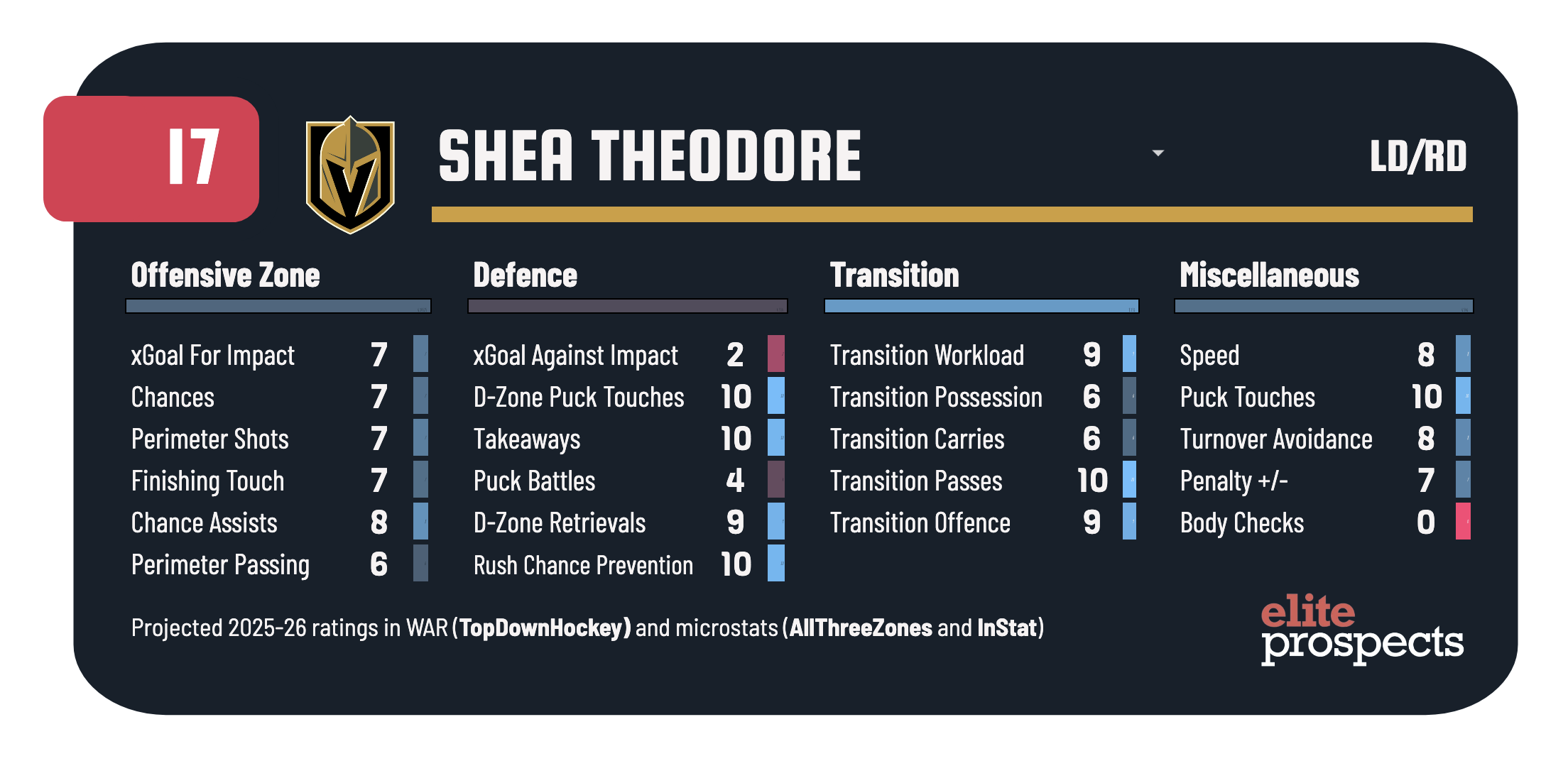
Shea Theodore enjoyed a career season in 2024-25, producing at a 61-assist, 67-point pace and solidly winning his 5-on-5 minutes as usual. Only Hughes, Makar, and Fox have produced assists at a higher rate in the past three seasons and if you narrow in on 5-on-5 primary assists per 60 he trails only Werenski. Suffice to say we’re talking about a truly skilled puck-mover, one who sends his linemates on breakaways and odd-man rushes through home run stretch passes from his own end and clever tape-to-tape feeds from the neutral zone. His ability extends to terrific agility and excellent puck-handling skills which he shows off with insane dekes both in his own end and at the top of the blueline where he exposes wingers’ inexperience defending one-on-one. He himself has a strong defensive tool-kit with an active and aggressive stick and a knack for executing loose puck retrievals, but he can get caught up-ice and lacks the physicality to win battles in front. With Alex Pietrangelo out, expect him to exceed 23 minutes per game, a mark he surprisingly has only hit once in his career.
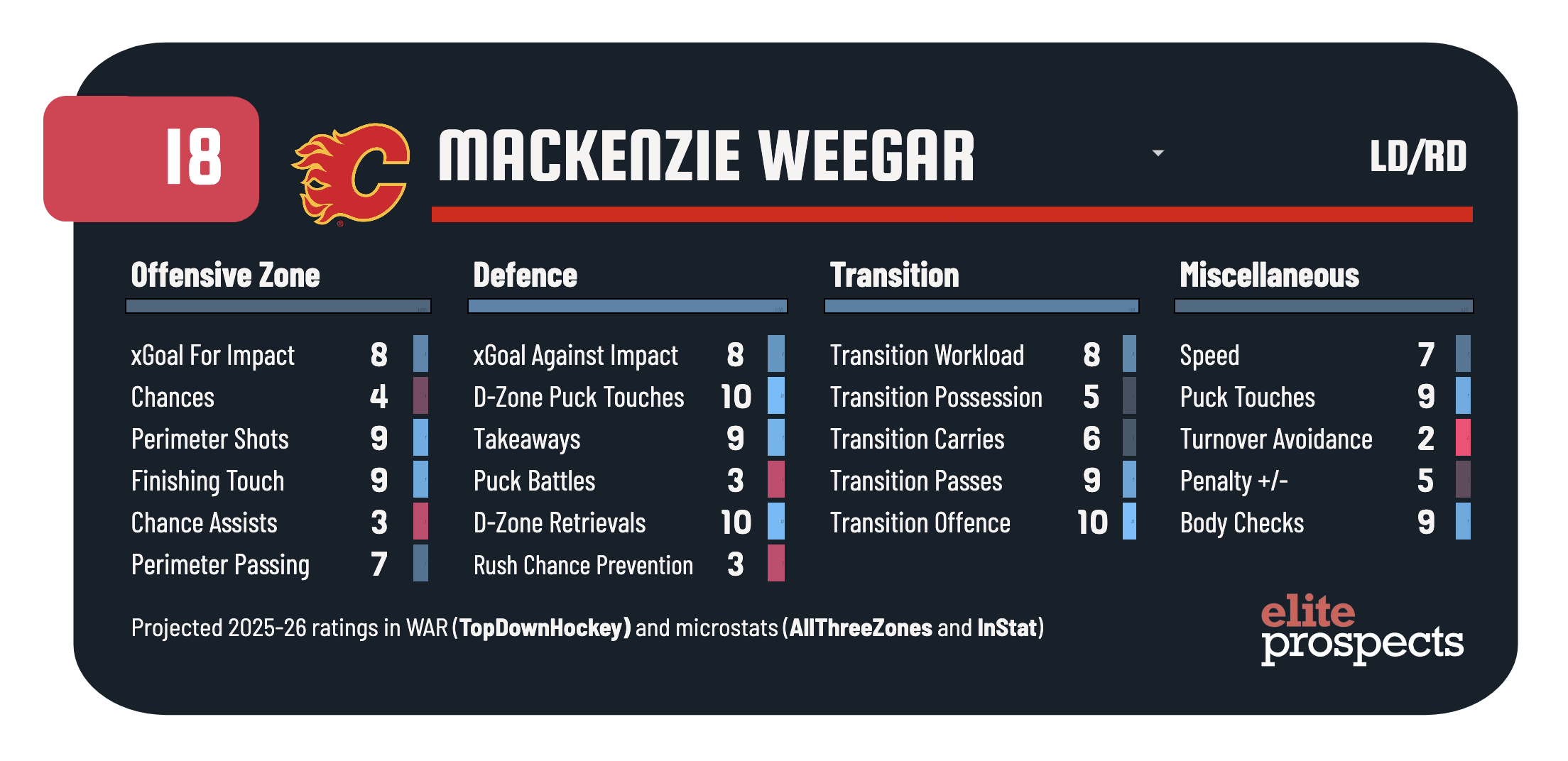
I can’t imagine it’s easy for MacKenzie Weegar to watch his former team pile up Stanley Cups while his Flames toil in mediocrity, but a number one defenceman workload and long-overdue recognition should offer some comfort. He may not be the two-way analytical darling force he was between 2020 and 2023, but he still carries an extremely heavy burden for the Flames as quite possibly the most active defender in the league; nobody is asked to do more in the defensive zone whether it’s retrieving loose pucks, breaking up passes, or defending the blueline. This did weigh on him more this season than in the past, as his turnover rate skyrocketed and his offensive contributions at 5-on-5 took a major hit, but he remains a solidly positive-impact contributor at both ends.
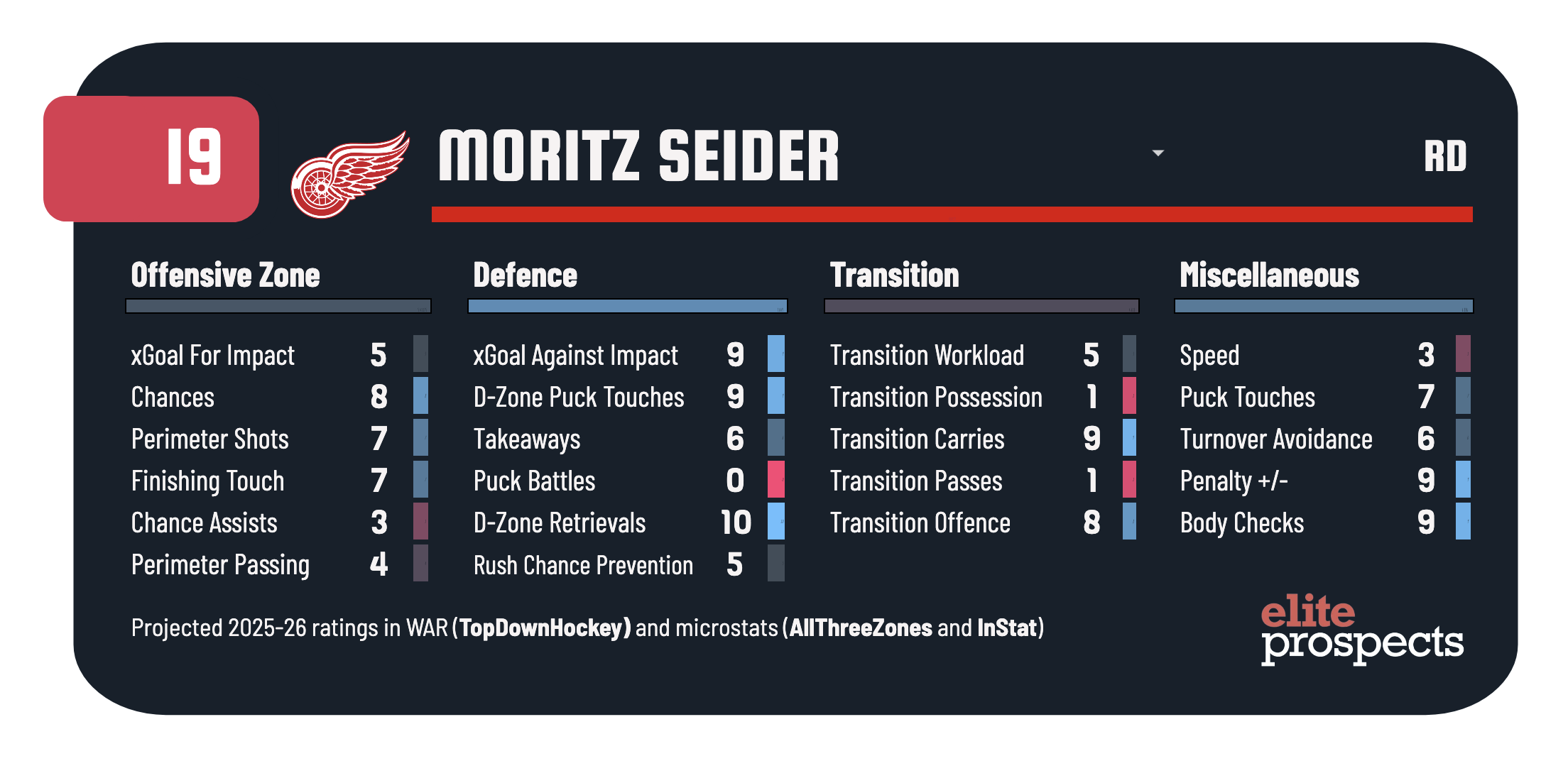
This list features quite a few players who are asked, due to their team circumstances, to basically carry their team’s blueline on their back, handling the toughest minutes with sub-par partners and doing all the work. That’s Moritz Seider in a nutshell, the sin-eater for the Red Wings’ inability or refusal to bolster their blueline with legitimate contributors while they wait and pray for their young guns to be ready soon. One of only nine defencemen to play more than 25 minutes per night, his results finally matched his reputation as he kept the play nice and low-event despite consistently facing top competition. Tasked with a heavy workload as a puck retriever and point-man on zone exits, Seider rarely made a mis-step, playing things safe and responsibly making the right play. It helps that he’s absurdly strong on and off the puck, capable of laying out opponents even when they’re the ones trying to check him.
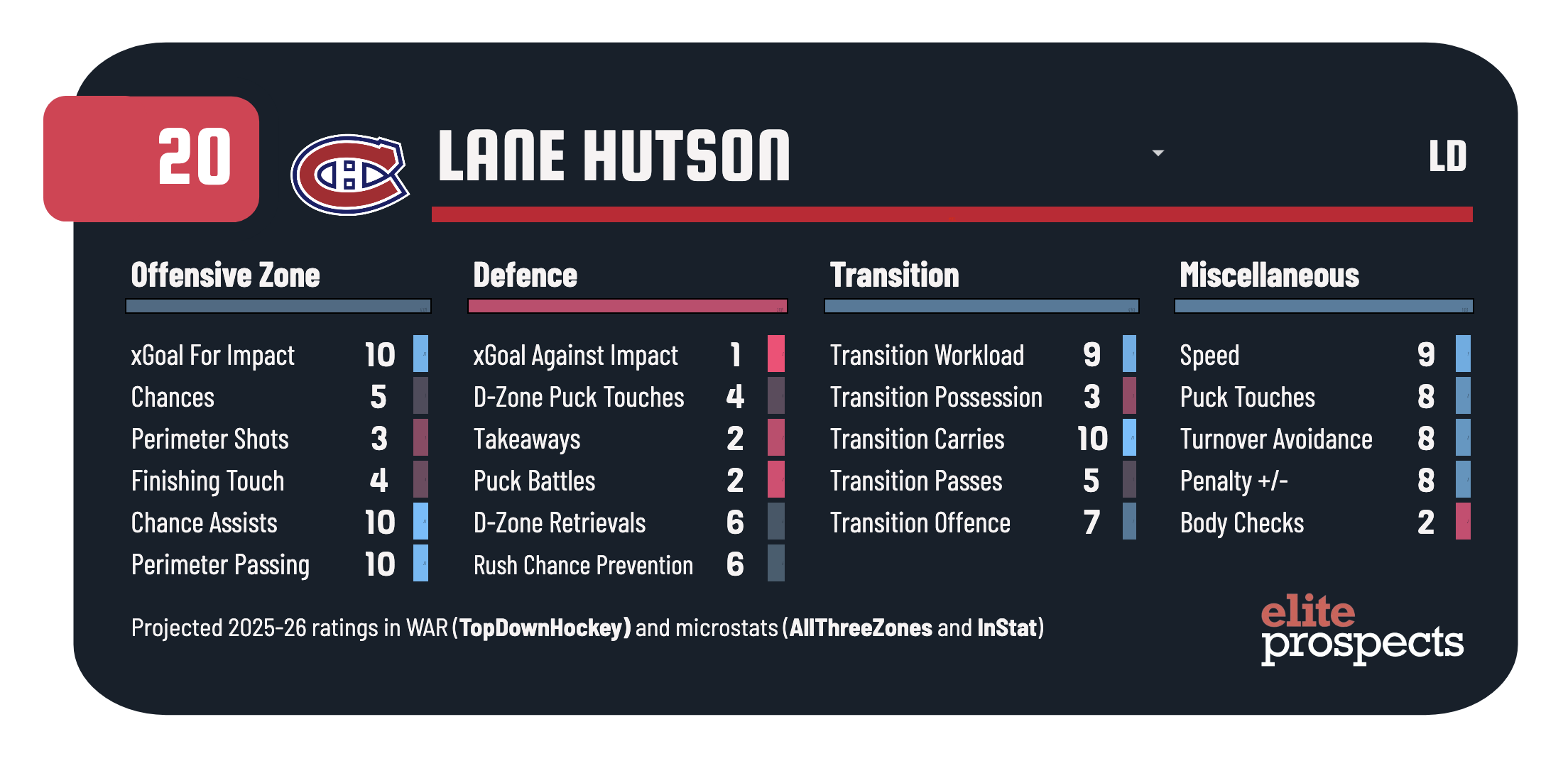
Lane Hutson has been proving people wrong since he was drafted late in the second round in 2022, and his Calder-winning NHL rookie season was no exception. Size be damned, he stepped into the league playing with unshakeable consequence and forcing opponents to adjust to him rather than the other way around. Not only is he able to consistently pull off the daring end-to-end rushes he was known for as a prospect, complete with flurries of fakes and stickhandles, he’s also instantly one of the most dangerous passing blueliners in the game. His mobility, creativity, and aggressiveness in the offensive zone are a deadly combination. In year two he has to show that the steps he took in the second half to improve his defensive play were for real, and Hughes could be a useful model for how he can use skating to overcome his physical limitations in his own end. If he can leverage skating, stick-work, and smarts to kill rushes and angle play away from the net-front, he can shoot up this list quick.
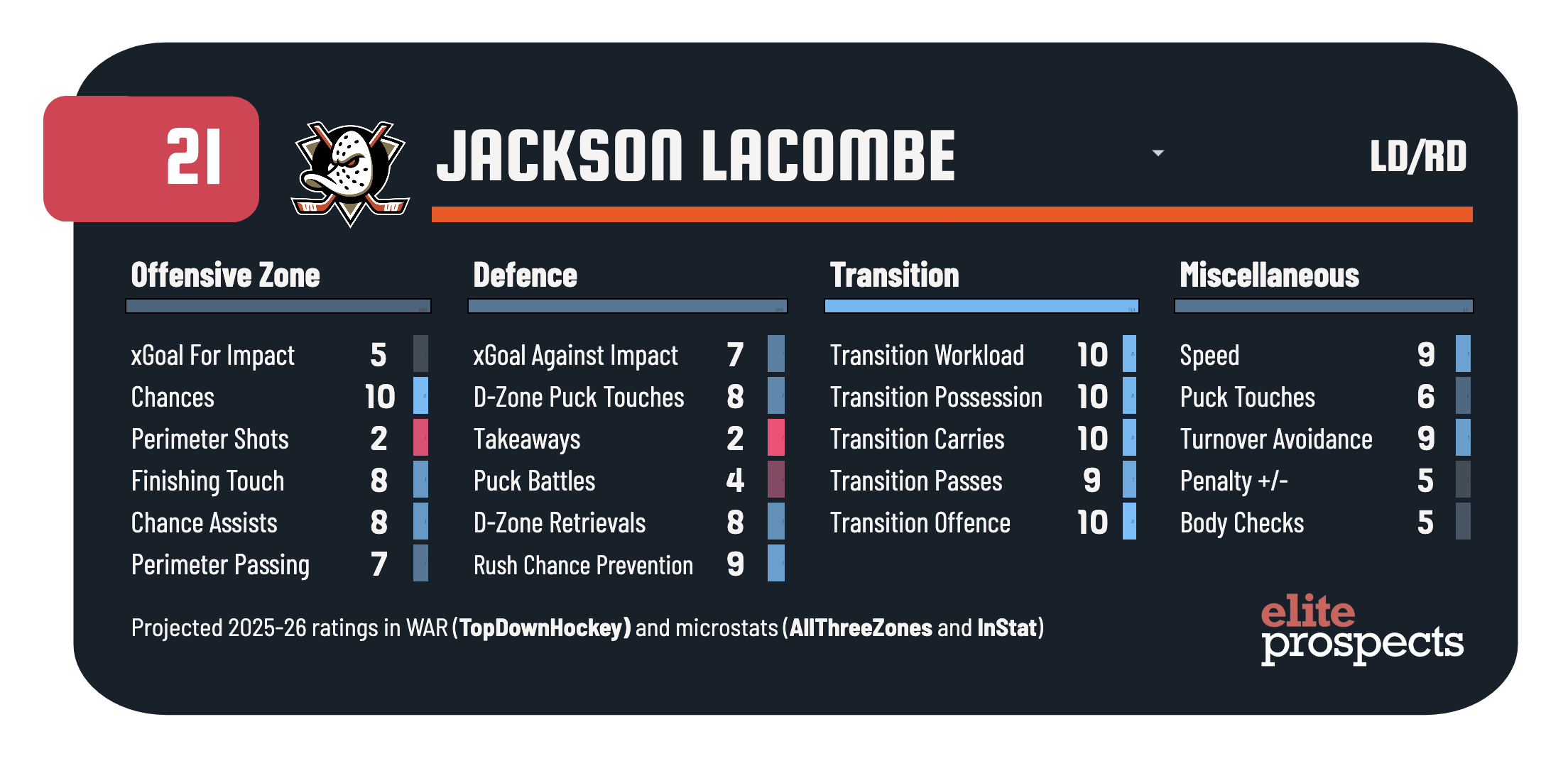
There’s going under the radar and then there’s what Jackson LaCombe did last season -- the US military should probably consult with him on their next stealth plane. Here’s a list of NHLers who played more minutes after January 1st than him: Werenski, Mike Matheson, Seider. Were they sheltered? Nope, they were the most difficult match-ups on the team with the heaviest defensive-zone start share in the league in that span to boot. Did they go poorly? Nope, the Ducks were respectable in those minutes and an embarrassment outside of them. Was he a passenger? Absolutely not -- not only did he produce at an exceptional rate, but he was among the class of the league in chances, stretch passes, zone entries, exits, possession plays in transition, success rate with the puck, entry denials, possession entry prevention, rush offence, and successful retrievals. He was also an asset on the powerplay and penalty kill in addition to this 5-on-5 aptitude. Considering all this, how many NHL fans even recognize his name? It may seem premature to put him on this list, but it would be ridiculous to look at this performance by a #1 defenceman in a tough role on a crappy team and leave him off -- and he will be a lot higher on next year’s list if he can repeat it.
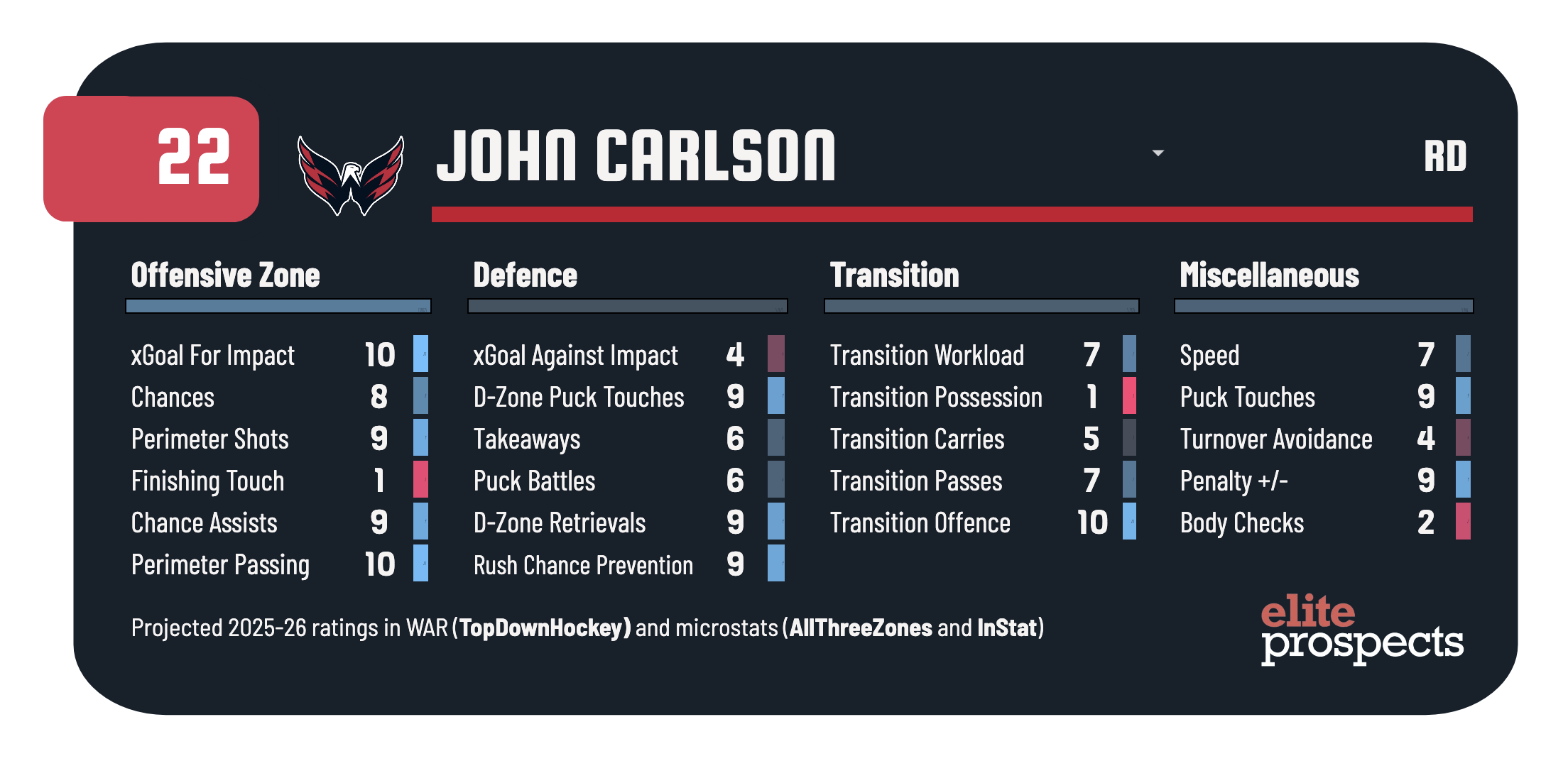
You don't really hear much about John Carlson these days, which is a shame because he's still logging serious minutes for the Caps and putting up some of the strongest results of his career into his mid-thirties. He solidly won his minutes at 5-on-5 this season without any percentage luck assistance and his defensive game, something of an afterthought through much of his prime, was an asset as well as he kept the door shut defending the rush and was an active puck retriever. His masterful control of the perimeter in the offensive zone remains his signature skill at both even strength and on the powerplay. For all we exalt Alexander Ovechkin for his agelessness, Carlson deserves serious credit as well.
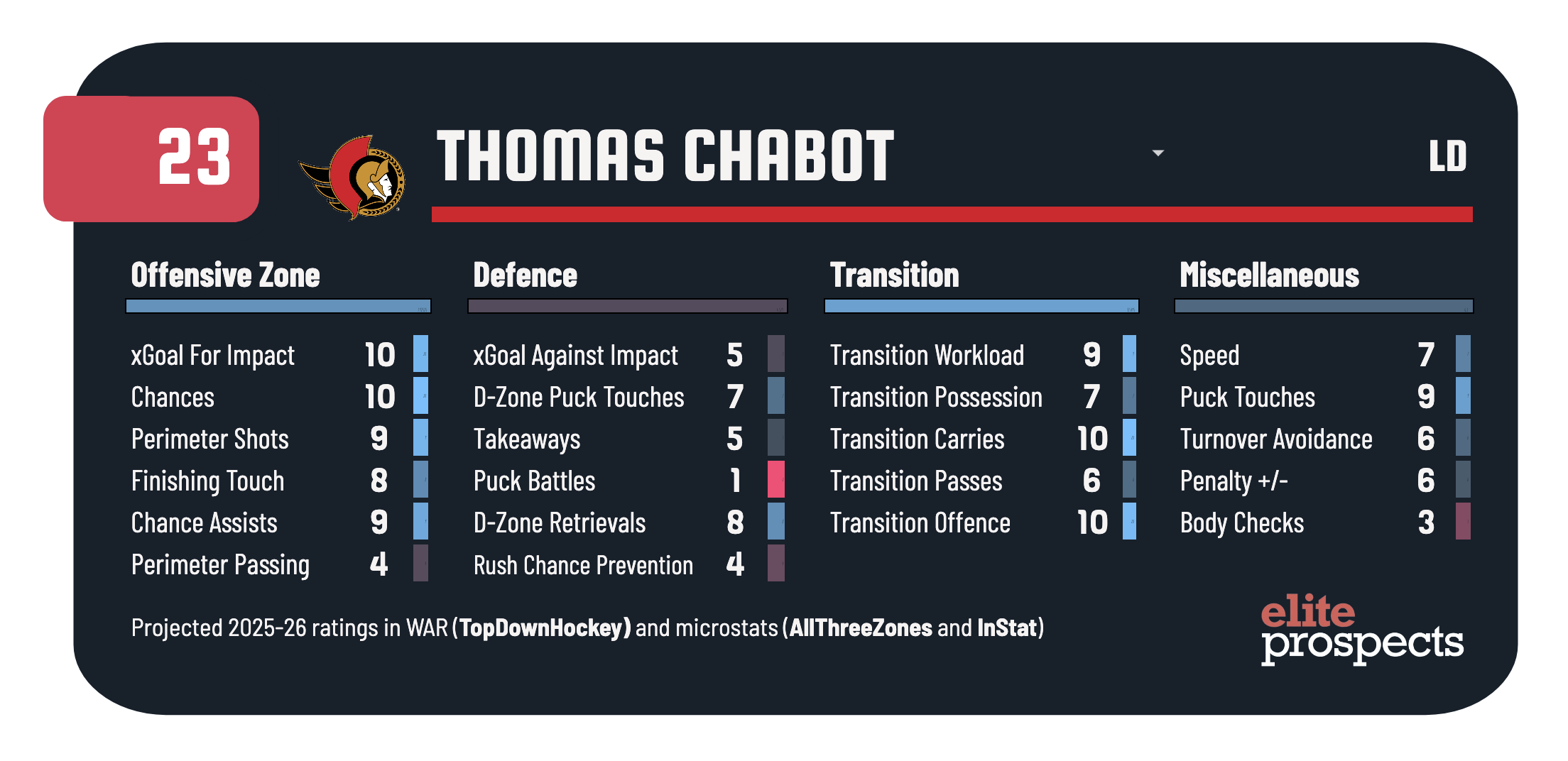
If Thomas Chabot feels a bit forgotten at the moment, frankly I don't blame him. Sure, he no longer plays as much as he did in that absurd three-season stretch in his early twenties where he was out there for 26 minutes a night, but his offensive impact at 5-on-5 remains considerable and his defensive issues are not nearly as pronounced as they used to be. Sanderson might be the shiny new toy, and he's certainly more complete defensively than Chabot, but there aren't a lot of defenders who command the offensive zone like number 72 and his ability to carry the puck end to end or dish clean break-out feeds has become underrated as well. He even kills penalties! As the Sens continue to push into proper contender territory, he'll be a key piece of their success, whether he's appreciated or not.
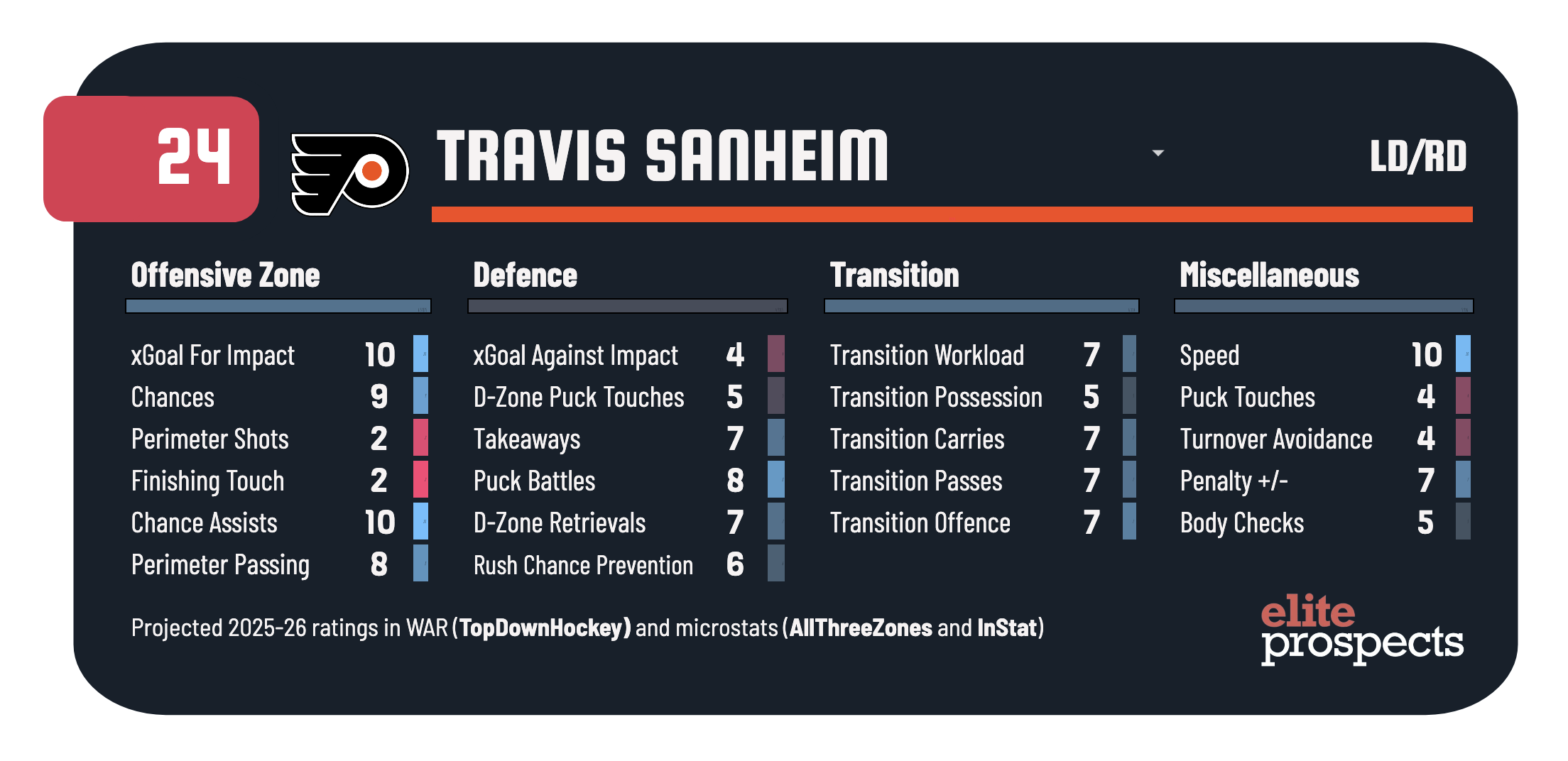
When Hockey Canada picked the depth defencemen for their 4 Nations roster, they were looking for two qualities above all: size, and mobility. It's no surprise, then, that they took Travis Sanheim, who exemplifies those characteristics as well as anybody in the game. Between his massive reach and elite speed, he can cover an enormous amount of ground in no time, which pays off defensively where he's an aggressive and effective one-on-one defender. He's taken his promotion to the Flyers' number one defenceman job as the green light to get involved in everything, taking every opportunity he's presented whether it's crashing for rebounds, pinching to the half-wall, skating the puck around the net, even screening the goalie from time to time. His puck-moving in transition is shakier than his puck-carrying and he still has chip-off-the-glass habits, but if he could play every position on the ice he would. His adventures often leave his linemates covering for him and he could stand to cool it on the turnovers, but if he maintains his 2024-25 form next year he'll grade quite a bit higher.
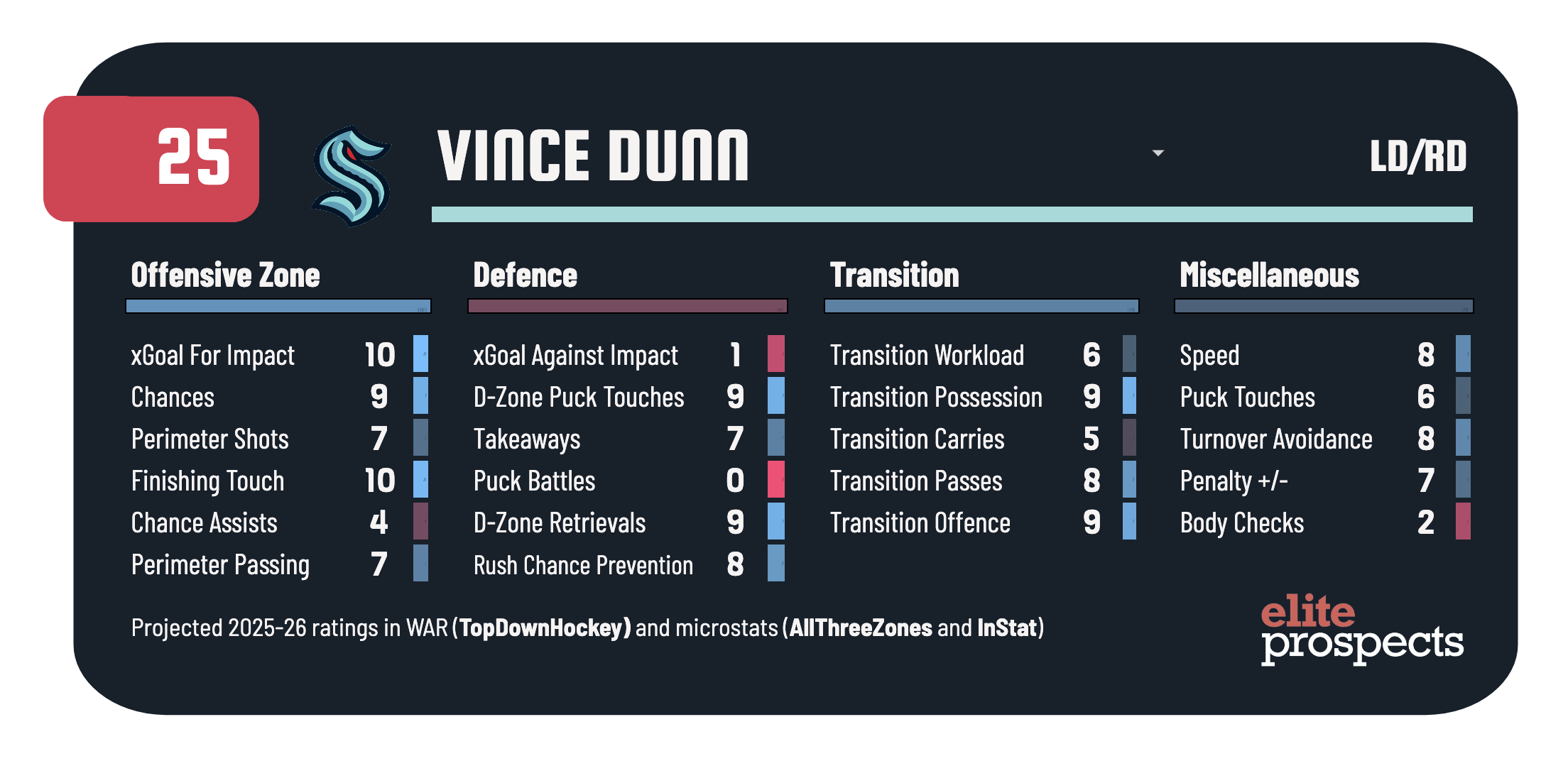
For all the time hockey fans spend bemoaning the great players who have bad analytical results just because they're on a bad team, they often overlook the players whose results remain terrific even as their squad devolves into a mess. Vince Dunn is a great example. Acquiring him from the Blues was one of the few unambiguously smart moves the Kraken have made, and while his minutes have been cut into by the less-ideal Brandon Montour signing, he remains by far the team's most important offensive driver from the blueline. His smooth skating, creativity, deceptiveness, and high-end passing and shooting ability make him a major threat every time he steps on the ice, and the Kraken's rush game completely falls apart without his elite stretch passing ability. The defence is dipping, unfortunately, but despite his lack of size and physicality he does have some upside in that area because he is quite involved as a puck-retriever and play-killer.
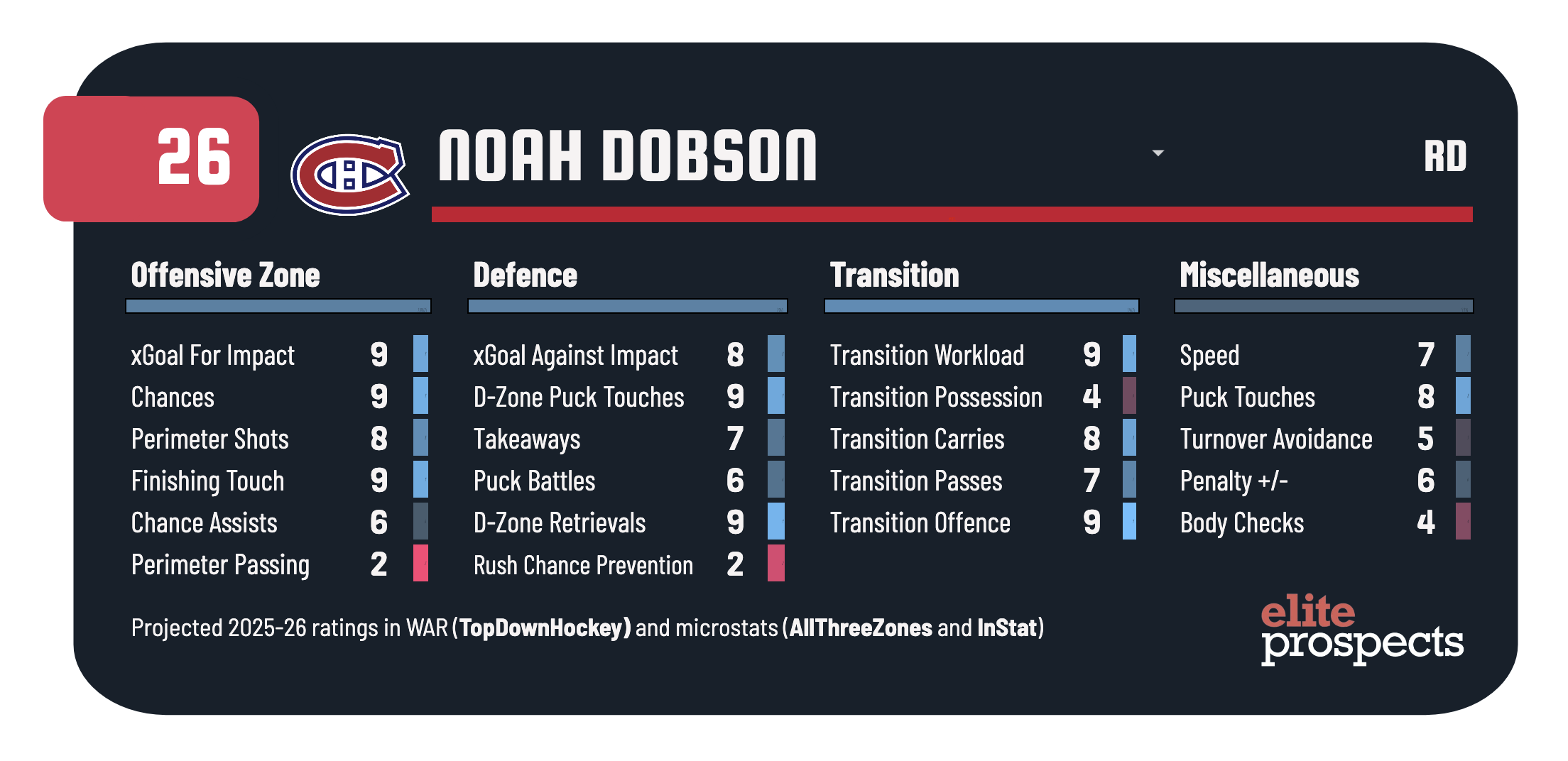
The Noah Dobson trade, probably the biggest one of the summer, has Canadiens fans thinking they’ve stolen a legit #1 two-way stud and Islanders fans relieved to have dropped a soft, overpaid defensive liability. Both sides are probably wrong as the answer likely falls somewhere in the middle. It’s simultaneously true that Dobson put up the best chance suppression metrics of his career in 2024-25 and that he led the league in errors leading to a goal against; essentially every mistake he made ended up in the back of the Isles’ net, and for all his strengths Dobson is a player who does make mistakes. Like Bouchard, his closest comparable, Dobson is very good at keeping his team out of the defensive zone and getting them out of it effectively because of his skill, mobility, ambition, and creativity, but he is exploitable off the rush where his gap is often either way too aggressive or way too soft and can be caught looking a bit clueless losing track of where he’s meant to be in his own zone and getting trapped behind the net. That said, he does have some solid defensive skills and playing with a partner like Kaiden Guhle, a mobile and physical defender, would lighten the load and give him more license to push hard offensively.
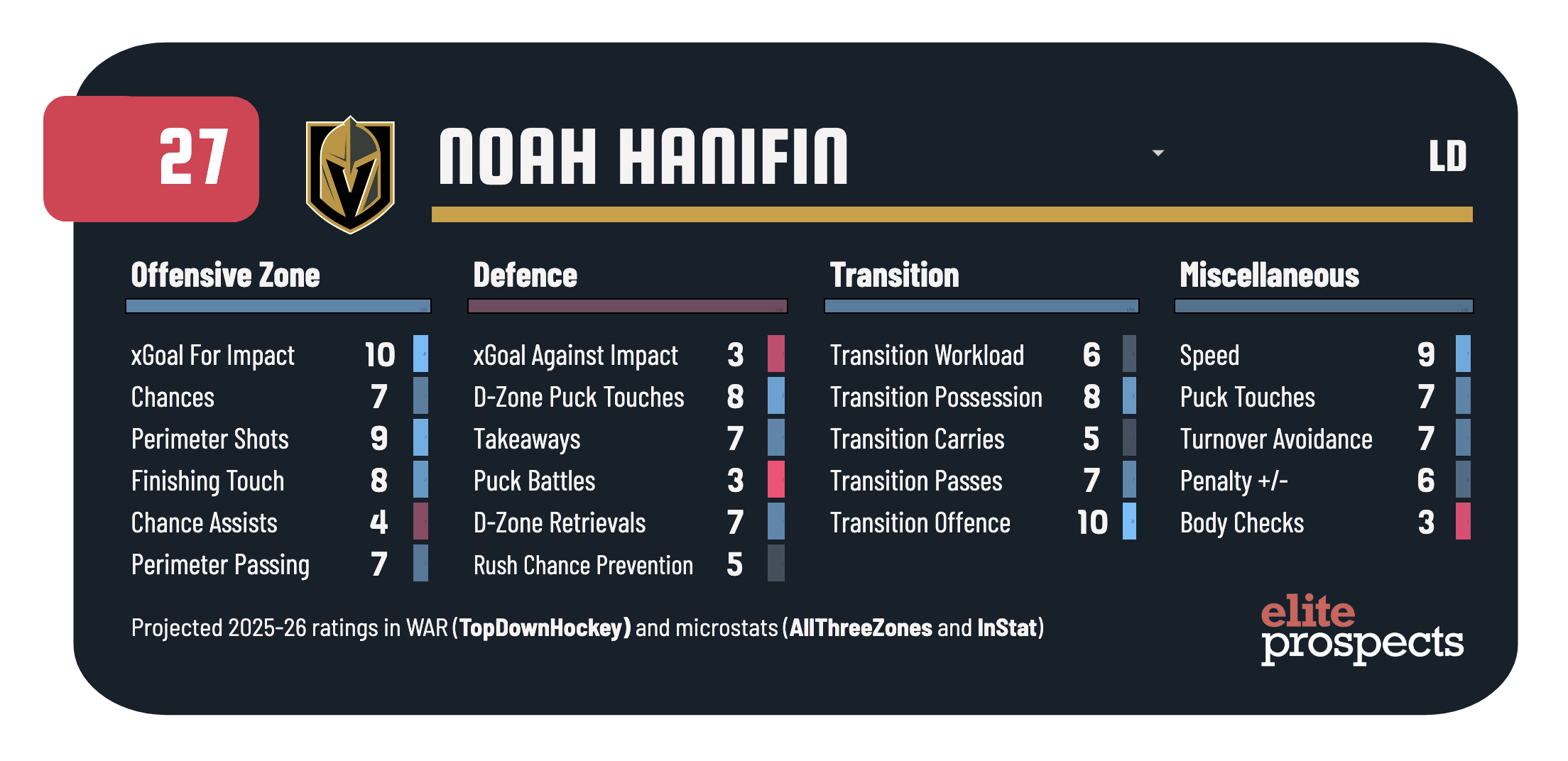
Noah Hanifin will have to adjust to life without Pietrangelo as his primary partner from 2024-25 heads to the long-term injured list, and that likely means a heavier workload both in terms of minutes and time with the puck. Given his gifts as a skater and a puck-mover, we could be in for the most effective season of his career. Hanifin is a generous provider of rush scoring chances to the forwards he plays with, always keeping his feet moving and his head up to identify and exploit lanes through the neutral zone. He's not particularly physical for his size but does have an active defensive stick, wins races in his own end, and kills plays early off the rush, indicating that while his defensive results since 2023 have diminished there might be some possibility of redemption there.
Drew Doughty (2024-25 Graphic not Available)
After earning his way back towards the upper echelon of defencemen in the previous two seasons, it was a shame to see Drew Doughty's 2024-25 campaign so abbreviated. Whereas he had previously vindicated those who saw effort as the only thing holding him back from being a legit number one defender during the Kings' brief rebuild, something else was missing in the stretch drive and the playoffs and it remains to be seen if he can reclaim the mantle once more in his age-36 season. At his best, Doughty is a true stabilizer, constantly scanning and processing information, moving the puck carefully at a high volume, playing defensive mind-games against opposing puck-carriers, and exhibiting high-upside puck movement. Let's hope a full healthy season gets him back to those peaks.
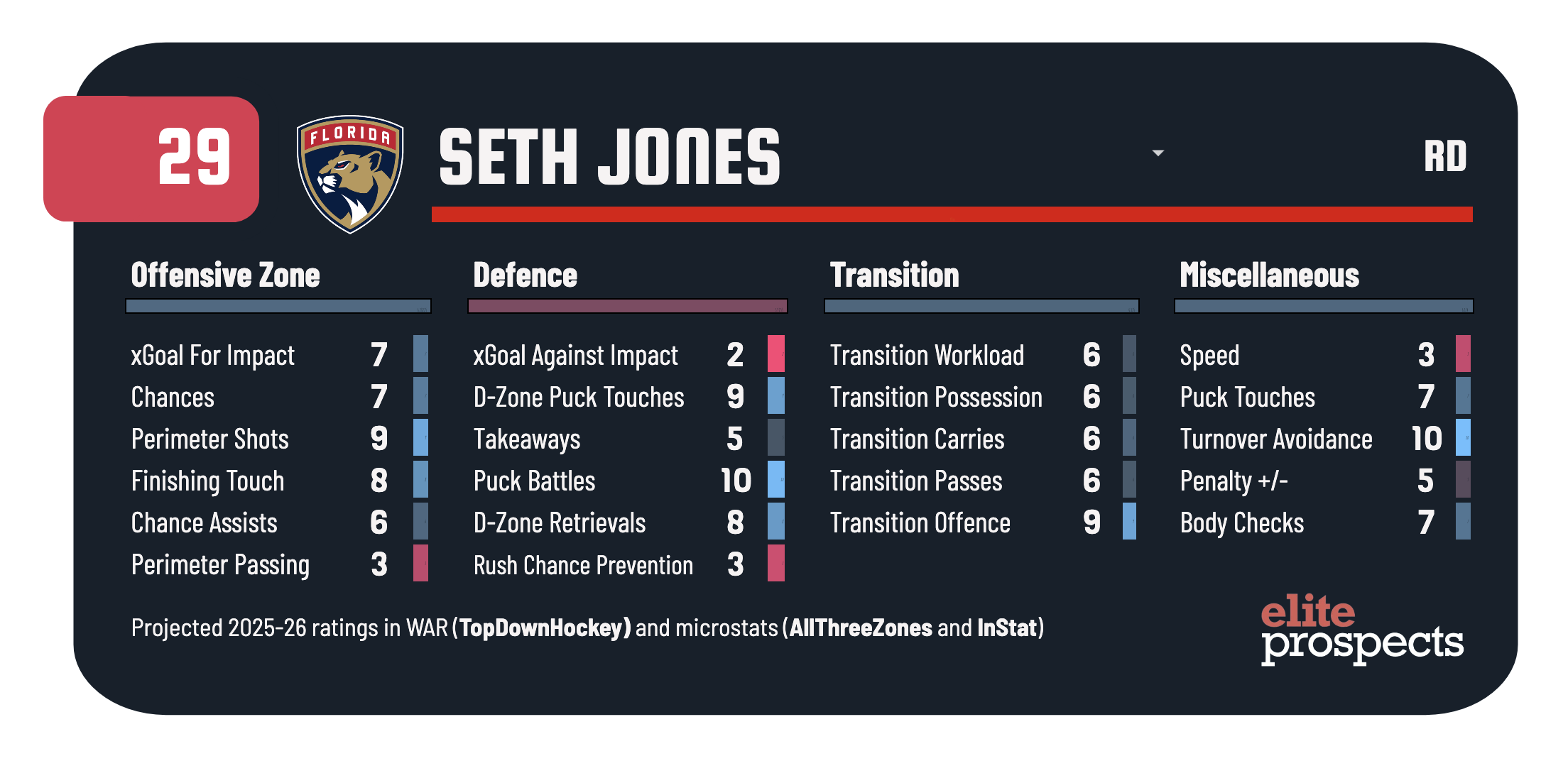
It must feel pretty good being Seth Jones at the moment. A few months ago, he was staring down several more years as the disrespected number one defenceman of a hopeless Blackhawks squad; now he's a vindicated Stanley Cup champion who was not only not a passenger but in fact led Florida in ice time. Jones' physical gifts and above-average ability in most areas of the game have almost always made him a capable if unexceptional minute-muncher, even in Chicago, and the key with him was always to avoid overpaying him and mitigate the weaknesses in his game, and that's exactly what the Panthers have done. Jones' solid in-zone offensive ability, strong puck protection, and physical presence in the defensive zone are well-suited to the way Florida plays, and his Achilles' heel of defending speed off the rush is well-insulated in their high-pressure defensive structure. Franchise number one is beyond his reach (and always was), but effective big-minute player is a role for which he's well-suited.
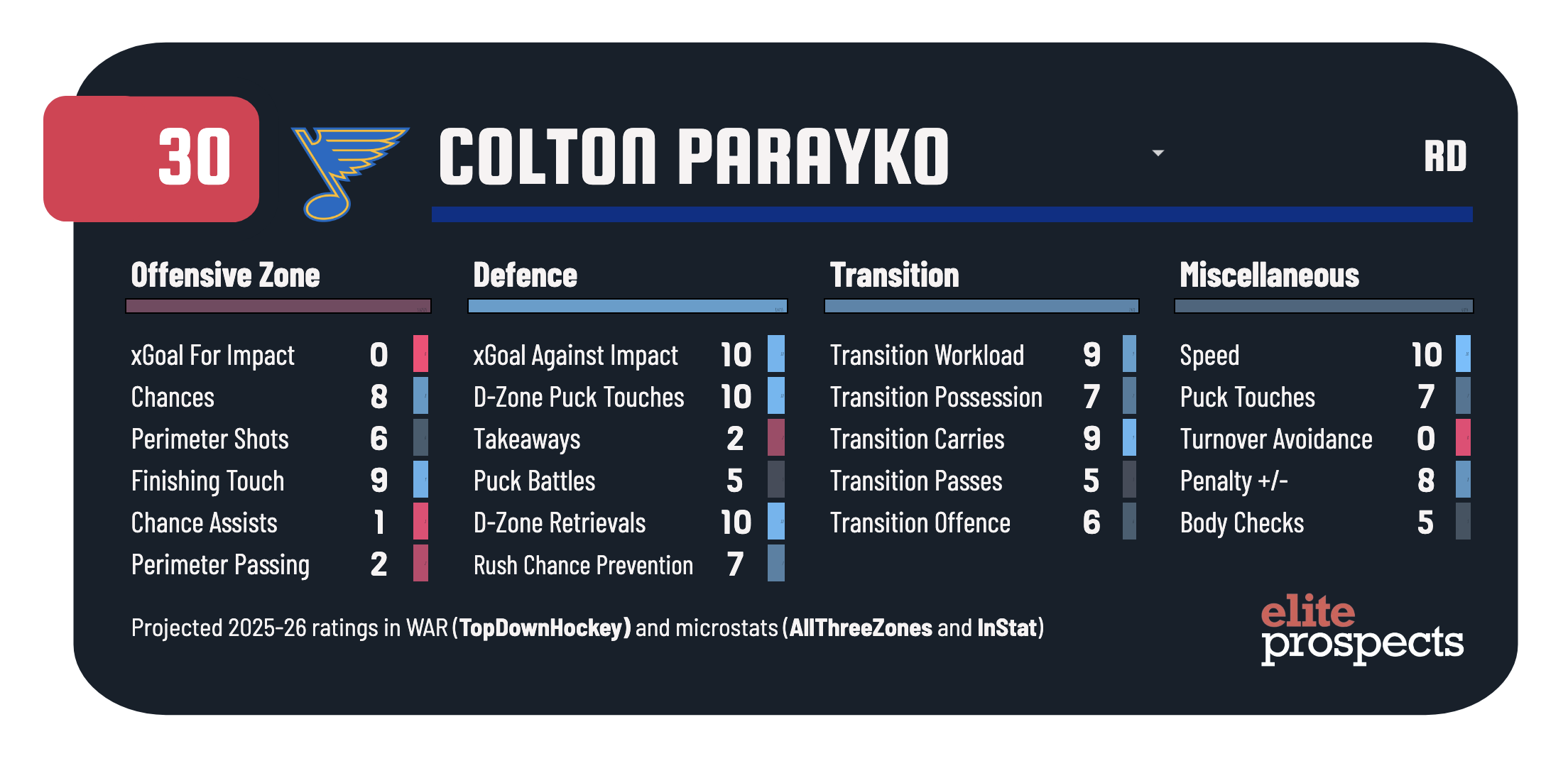
One of the more unique defenders in the league, Colton Parayko's speed, strength, and size have made him a reliable minute-muncher for the Blues in the post-Alex Pietrangelo era as he can absorb a major defensive workload in match-up minutes with a ton of success. Whether he's retrieving loose pucks, clogging lanes, or forcing opponents to the outside, he's a very effective shut-down player. Unfortunately he can tend to have, for lack of. a better term, main character syndrome, taking it upon himself to transport the puck down the ice and jumping up to shoot the puck in the offensive zone, often at inopportune times. These instincts have led him to have surprisingly terrible on-ice offensive impacts as the puck stays out of the hands of the Blues' most dynamic forwards, but there were promising signs after the coaching change and his pairing with Cam Fowler that they can be mitigated without losing the dominant defensive impacts.
Honourable Mentions
Erik Karlsson - Pittsburgh Penguins
The doomed marriage of late-career Erik Karlsson with an over-the-hill Penguins team has done a lot of damage to his reputation, such that two years after a Norris Trophy win his game is widely disrespected. Yes, the 55-point pace he’s produced at since joining Pittsburgh is a far cry from the 101 he put up in 2022-23, but even a quick look below the hood (and a look at the 4Nations tournament) makes it clear that his exceptional offensive skillset remains firmly in place. He moves the puck up-ice with brilliant stretch passes or simply by carrying it himself and letting his elite wheels get him through the neutral zone, and he’s a menace in the offensive zone who quarterbacks the play from the point, creating and identifying lanes for passes and shots while always keeping his feet moving. The elephant in the room is obviously the defence, and it is rough. Now, there are bright spots - his defensive stick has always been a major asset and he’s a graceful and effective puck retriever who excels at turning loose pucks into clean exits. The less good part: he responds to offensive zone turnovers by recklessly trying to keep the play alive and often gets caught in the dust, his backwards agility is exploitable, he often finds himself in the completely wrong spot in his own end, and he has a bad habit of losing focus and track of what’s going on around him when he doens’t have the puck. Ideally, pretty soon he’ll be on a team where he can focus on the good stuff and spend a lot less time with those weaknesses exposed.
Mikhail Sergachyov - Utah Mammoth
I kind of assumed that Sergachyov would be here but the more I watched and the more I dug into the numbers, the harder it was to really justify. He plays big minutes and produces quite well in them, but he's not as involved in transition as you'd expect, he's nothing special defensively, and there isn't really a stand-out aspect of his game apart from size. It's possible I'm overthinking this, though.
Brock Faber - Minnesota Wild
I think it's safe to say that if you showed this list to an NHL GM, they would say that Faber's absence disqualifies it out of hand. Maybe they'd be right, but I feel as though his absurdly high minute load and some key physical tools are doing an awful lot of reputational heavy lifting that are not reflective of the actual results. He's got great mobility, a nice stretch pass, and a solid net-front presence, but he's got some clear weaknesses as well and if he was playing 20 minutes a night I doubt he would turn as many heads.
Christopher Tanev - Toronto Maple Leafs
I couldn't in good conscience put somebody who plays second-pairing minutes on here, but Tanev's elite defensive ability, workload in his own zone, and underrated puck moving made him tough to cut. What a beauty.
Dylan Samberg - Winnipeg Jets
Just read the paragraph above and replace “Tanev” with “Samberg.”