The Dustin Wolf contract shows the Calgary Flames think they have a unique goalie
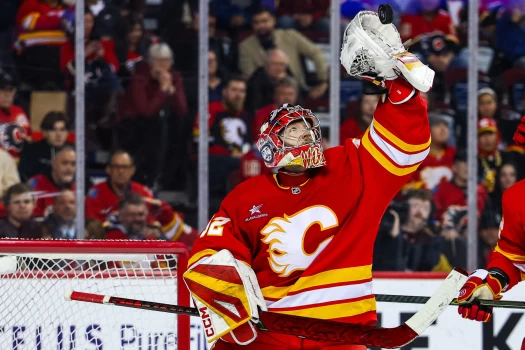


Dustin Wolf is one of the most interesting goaltending prospects in some time.
Go ahead and click on that little link where his name is. You see a lot of accolades under the "highlights" section: World Junior gold, two-time WHL goalie of the year, CHL goalie of the year, two-time AHL goalie of the year, AHL MVP (one of just two goalies to win it this century), and NHL all-rookie team. And he should have won the Calder, but secondary assists count the same as primaries.
He played basically his entire rookie year in the NHL as a 23-year-old, appearing in 53 games and posting a .910 save percentage behind a team that frankly wasn't supposed to be very good. Instead, the Calgary Flames missed the playoffs on a tiebreaker, and he was the team's most valuable player by a fair margin. The number of goalies in the cap era who had seasons that good at that age is exceptionally small. We can talk about John Gibson, Carey Price, Jake Oettinger, and then the list starts to get iffy. (Fun fact: Goaltending was so good in Steve Mason's Calder-winning rookie year, when he finished second for the Vezina, that his .916 save percentage didn't even come with a positive goals saved above expected.) Indeed, Wolf's GSAx last year (26.4) is the best by a 23-and-under goaltender in the advanced-stats era, dating back to 2008-09.
So when the Flames announced that they had come to terms with Wolf on a seven-year extension that would pay him $7.5 million against the cap into his early 30s, it felt like a major coup. Goalies with his track record don't come along very often; he's been one of the best goalies in his league at every level, not including the NHL. And even there, he's been close at a relatively young age.
Which is why the contract is so interesting. Wolf's deal kicks in for the 2026-27 season, when the league currently projects that the salary cap will be $104 million. So some back-of-the-napkin math says that's 7.2 percent. Since 2017, the number of goalies under 24 who have gotten a deal of any length, let alone seven years, at more than 5 percent of the salary cap, let alone 7.2 percent, is just two: Wolf's new contract, and Spencer Knight's bridge deal. That's it. If you wanna make the cutoff 4 percent, you can throw in the bridges for Oettinger, Jeremy Swayman, and Carter Hart. Again, those guys didn't have the track record that Wolf does, because the number of goalies who have all those pre-NHL accolades plus a stellar rookie year, in the history of the league, is basically zero.
But that's the risk here. There are goalies with a great pre-NHL track record. There are goalies who have great rookie years, even at an age where most netminders don't get a chance to play 50-plus games. How many build on that early success? Again, the Flames would take seven seasons of Wolf being exactly as good as he was last year, but if this is a situation where there's some regression, people might start to question this deal. The path to this point is unique in the cap era; no one in recent memory has done what Wolf has.
Just to name some elite goalies of the cap era: Price bridged out of his ELC, as did Henrik Lundqvist, Jonathan Quick, Connor Hellebuyck, Pekka Rinne, Andrei Vasilevskiy, Ilya Sorokin, Gibson, Swayman, and Oettinger. Igor Shesterkin didn't bridge, but he was also older as an NHL rookie than Wolf is now. Tuukka Rask didn't get paid until he was 26, and that was on his fourth contract.
Point being, most NHL teams take a wait-and-see attitude for goalies who look really good when they're relatively young. Usually, all involved are happy to bridge for a year or three, pay the guy mid-level goalie money, and wait for the returns. As you see with the names above, that's often a winning strategy. Flames GM Craig Conroy seemingly has less compunction about going long with Wolf than any of his predecessors; in fact, the only goalie to even sign beyond a three-year term before their 25th birthday in almost a decade is Pyotr Kochetkov, who went four years at just a $2-million AAV. Conroy believes he's found a unicorn, basically, and is compensating him as such.
Fortunately for the Flames, by the time this deal is even three or four years old, and the salary cap has climbed north of $125 million, say, Wolf will be earning the equivalent of like $6 million in today's cap dollars. That's Jordan Binnington/Jacob Markstrom/Philipp Grubauer money. If Wolf is even pretty good, the Flames will live with that all day long.
But hey, if you believe in the player, and you're a market like Calgary where let's just say young, super-talented American players haven't been too keen to stick around long-term, you make the deal. Especially when this particular young, super-talented American player happens to play the most important position on the ice.
Wolf's 2025-26 season would have to be a complete disaster for anyone involved to start feeling the pangs of buyer's remorse. The team greatly overperformed expectations last season and still didn't make the playoffs. And that was Wolf being a roughly top-8 goalie in the league behind either the best players on earth (Hellebuyck, Vasilevskiy, Shesterkin) or those who self-evidently punched above their weight (Anthony Stolarz, Sam Montembeault, Darcy Kuemper). Now, Wolf's cap hit is currently 11th for the 2026-27 season, so if the bet is that he's roughly a top-10 goalie in the league and that'll slide down the ranking almost every year until 2032. The cap, you may have heard, is going up.
Allowing for the possibility that Wolf isn't as good this coming season as he was last year, which is well within the range of potential outcomes, how much worse would he have to be for the hockey world writ large to say this contract was a mistake on Day 1? Or, how many years in a row would he have to underperform before we rope this one off like a superfund site? Mason is the most obvious comparable, because he excelled in the OHL (for one season), but didn't have the intermediate step in the AHL.
A goalie with Wolf's track record has to be considered pretty high-floor, right? Swayman was much the same and just had an awful season, but missing training camp and the team deteriorating around him were certainly contributing factors. With this extension, there's no looming contract dispute (and you wonder how much that was in Conroy's mind when he negotiated the deal).
Even if you think the Flames probably won't be as good as they were last season anytime soon — and who could blame you? — the question becomes very simple: How good is this deal if Wolf, a 24-year-old with a closet full of "best goalie" awards, takes a step at some point in the next two or three years? You can't say that's not on the table. And if he does, this contract will look like a bargain.