Elite Prospects final 2026 QMJHL Draft top 100 ranking








Our top-100 QMJHL Draft board kicks off our trio of June 2010-born rankings.
This ranking is a culmination of hundreds of live and video viewings across Québec, Atlantic Canada, and New England. We had boots on the ground at nearly every major event on the calendar, and now it’s time to share our thoughts on an exciting age group.
This is a forward-heavy class, defined by its multitude of two-way centres and, likely, the six forwards who lead this ranking.
At No. 1 is Jacob McKinnon, who's held down that spot since February’s ranking. Though we don’t anticipate him being the No. 1 overall pick, no one brings the combination of high-end physical, pace, and physical skills.
Similarly, we don’t expect our No. 2, Zaac Charbonneau, to be drafted in that spot, either. Tendered to the USHL’s Muskegon Lumberjacks, where exactly he gets picked will be one of the major storylines to follow on draft day.
Our biggest riser since February has been Pierre-Alexandre Lemieux, skyrocketing from No. 23 to No. 4. His combination of intelligence, skill, and power forward potential makes him a contender for the best prospect in the draft.
As always, our rankings are not a mock draft and don’t reflect where we anticipate a player to go. Instead, the focus is on projecting players to the QMJHL level, emphasizing long-term upside at that level, followed by anticipated role and certainty. Projecting 15-year-old players certainly is humbling, but don’t be surprised to see many of these players enter NHL Draft discussions in the next two seasons.
Our QMJHL Draft team was also responsible for evaluating USA players who are eligible for the QMJHL and how they project to that particular environment. As such, there will be some discrepancies from our May 2nd USA 2010-born ranking.
For grading, 50 represents a baseline QMJHL-calibre ability, 70 is equivalent to middle-six/pair-level, and 90 is the high-end tools that you’d expect to see in top-line and top-pair players.
The QMJHL Draft begins with round one on June 5th at 6:30 pm ET. With that, here’s our top 100, and you can find a downloadable list here.
.jpg)
Our opinion hasn’t changed on Jacob McKinnon since the midway point of the draft cycle; he is still the best prospect in this draft class. His playoff performances and QMJHL Cup showings only further confirmed what we already knew.
Highly dextrous, lightning-quick, and always looking to create advantages for himself, McKinnon dominates by operating quicker than most defencemen can react. Supported by a deep stride, mechanically refined edges, and a desire to get inside positioning that borders on obsessive, McKinnon’s transition and forechecking games already project as well above QMJHL average. He leverages his compact frame astoundingly well, throwing perfectly timed proactive checks heading into battles, planting his feet hard to sustain bigger defencemen’s cross-checks, and then doing considerable damage off the wall with his processing.
Once he gets into positions to score, there isn’t much opponents can do to contain him. McKinnon’s skillset is fairly complete and versatile; a blistering release keeps him lethal off the catch, as he quickly shuffles his feet to set up his one-timer or changes his grip to catch pucks outside his wheelhouse and whip them on net off the catch-and-release wrister. A significantly above-average passing and handling game uplifts his skill base, and he has an uncanny knack for picking the right skill at the right time to pick apart defensive structures.
Although he won’t be the first player off the board because of his stature, we’re not the least bit worried about McKinnon’s size holding him back. He was manhandling defencemen twice his size all season and should continue to leverage those same skills against the QMJHL’s top blueliners. He looks the part of an instant-impact top-liner, with potential NHL upside.
.jpg)
Heading into the 2026 QMJHL Draft cycle, Zaac Charbonneau was being talked about as the runaway first-overall pick in this class. Now he has competition. Still, we’re confident Charbonneau offers unmistakable upside.
Primarily a shooter, Charbonneau excels when attacking downhill off the cycle. His ability to separate from board battles, time his routes off the wall, and crash pockets of space between the dots made him a lethal scorer at the 15U AAA level and even earned him a cup of coffee with Mount St. Charles’ 18U team. He isn’t just effective at stepping off the wall for his own looks, either; he was one of the most effective off-the-wall playmakers in his age group across North America. Dextrous heads-up passes, often off the first touch, showcased his high-end offensive scanning habits and processing.
Charbonneau brings a QMJHL-ready frame to the table, too. He often finds opportunities to plant his feet hard inside contact, working cutbacks and hard protection on his outside edges to force defenders onto his back. While adding more transition impact through a quicker first step and fuller crossover mechanics would help elevate Charbonneau’s game to unstoppable territory, his combination of high-end skill, reach, and awareness makes him the clear best cycle offence creator in the draft class, and an easy selection for us at second overall. If he comes over to the QMJHL after his stint with Muskegon, he could be an immediate top-10 scorer with true power forward elements.
.jpg)
Transition impact is essentially Charbonneau’s only area of improvement; that happens to be the area in which his most frequent linemate this season excels. Thomas Boisvert’s explosive crossover skating, tremendous edges, and quick-step acceleration make him the best end-to-end rusher in the entire class, and he used that blistering on-puck pace to its fullest extent on nearly every shift with Mount St. Charles Academy.
Opposing defencemen who faced him more than once this season quickly learned that stepping up on Boisvert was a mistake; he leaves them scrambling with hard backhand dekes, weight-shift fakes, and incredible wide-drive attacks. When they rush back to catch up, Boisvert slams on the brakes, instantly looking for trailers to exploit the massive gaps he leaves in his wake. When the best option is a shot, Boisvert shows no hesitation; quick pull-and-drag releases through triangles, hard backhand moves after net drives, and outside-step snap shots across the grain feature regularly in his shooting arsenal.
The question with Boisvert is offensive diversification. Learning to downshift, bait back pressure or poke-checks, pattern wide, and re-accelerate into gaps would help Boisvert scale his game up – not only to the QMJHL, but to the NHL down the line. Multiple sources have all but guaranteed that he’ll be Rouyn-Noranda’s first-overall pick, and we can clearly see why. He has instant impact value as a top-six forward, with the dynamic pace and skill to become a multi-year top scorer in the league.
.jpg)
Few players increased their draft stock more at the QMJHL Cup than Pierre-Alexandre Lemieux. Following the momentum of his brilliant playoff run, the 6-foot-3 forward left the tournament looking like a top-end prospect. His combination of size, intelligence, puck protection, and offensive skills is the perfect recipe to make a two-way forward.
What separates Lemieux from many other physically mature forwards is the versatility of his offensive toolkit. A dual-threat attacker, he can finish around the net, attack off the cycle or off the rush, distribute through traffic, and beat goaltenders with his heavy shot. His puck protection and small-area game are already major strengths, as he constantly plays through contact, attacks the middle, works low cycles, and extends possession through smart body positioning.
Away from the puck, Lemieux’s pace and forechecking engagement have been on an upward trajectory since the start of the year. He has now become more effective at disrupting plays and forcing turnovers. The primary area for improvement remains his skating mechanics, but the foundation is already in place, so adding that last piece to the puzzle shouldn't be too difficult. If he continues to refine his mechanics and mobility, Lemieux has the potential to develop into a dominant top-line centre in the QMJHL and, ultimately, a legitimate NHL prospect.
.jpg)
Julien Bergeron finished as the highest-scoring 2010-born player in the QM18AAA this season, and third in the entire league. Yet, what makes him such an intriguing prospect is that his production is almost secondary to his profile. Bergeron is skilled, but does not necessarily dominate through flashy puckhandling or high-end creativity. Instead, he is one of the most mature forwards in this draft and consistently impacts games through his anticipation, details, and motor.
The two-way forward links sequences together through quick puck movement, intelligent routes, and smart reads. He facilitates plays and can do a lot of the heavy lifting on a line. That does not prevent him from being a dangerous scoring threat, though. In conjunction with his heavy shot, his ability to find soft ice and attack high-danger areas played a major role in making him one of the most productive forwards in the league this season.
What makes Bergeron special, though, is his hockey sense and competitiveness. He battles hard for pucks, embraces physical contact, and has an impressive work rate. Few players his age play with such mature habits and understanding of the game. As he continues adding strength, pace, and speed, Bergeron projects as a smart, physical, versatile, top-six forward in the QMJHL and a player who could eventually generate NHL interest.
.jpg)
Every viewing of Aslan Tremblay reinforced the same conclusion: He is one of the most complete players in this draft. Built like a power forward, but armed with the habits of a reliable two-way forward, Tremblay combines size, intelligence, competitiveness, and skill into a highly projectable package.
Whether he drives the offence, disrupts plays defensively, or wins battles along the wall, he consistently finds ways to impact the game. With his high-end compete level, Tremblay powerfully engages opponents physically and outworks them, allowing him to win disadvantage battles with second efforts. Being able to manoeuvre and fire through contact makes him particularly difficult to defend.
While his physical engagement immediately stands out, Tremblay’s hockey sense is an underrated asset. He processes the game quickly, anticipates breakouts, sets up give-and-gos, and consistently makes the right decisions with or without the puck. Offensive execution may not be at the same level as other top prospects in this class, but his combination of puck protection, handling ability, and scoring touch gives him promising offensive upside. It doesn't take much imagination to picture Tremblay developing into a highly dependable, top-six forward, capable of contributing in all situations and becoming a player coaches can rely on.
.jpg)
As the season went by, Justin Gagnon continuously rose on our board. What initially looked more like an intriguing collection of physical tools gradually evolved into one of the most exciting long-term projections in this draft class. Standing at 6-foot-3, Gagnon embodies the modern power forward archetype, blending size, handling ability, offensive instincts, and physical engagement.
Offensively, Gagnon manipulates defenders with body fakes, changes of angle, misdirections, and daring manoeuvres. Despite his size, he constantly executes difficult plays under pressure, slips through coverage, dangles through triangles, attacks defenders 1-on-1, and creates advantages off the rush through delays and inside drives. His tight-area puck handling is simply among the best of this draft class and marries well with his improving board play. Not many players his size can be that crafty and elusive at this age. His shot is another weapon in his arsenal, pairing nicely with his deceptiveness to keep defenders guessing.
There is still room to improve his skating mechanics, puck control, consistency, and physicality, but those feel more like opportunities than true limitations. Considering the high-end tools, the progression curve, and the hints of advanced playmaking ideas, Gagnon has the potential and runway to develop into a high-impact top-six power forward.
.jpg)
Vincent Boutet’s identity never wavered this year. The Blizzard’s most utilized defenceman has used his tremendous physical tools and clever puck management to build the single best shutdown package in the entire draft class.
A sturdy frame and impressively fluid skating allow Boutet to stifle opposing rushes with impressive ease, without sacrificing an ounce of aggression. He surfs across on carriers, keeping his stick positioned to the inside and forcing them to either dump the puck towards his toes or get sealed off. When better skaters cut back across his surfing arcs, he quickly engages his feet, clamping down on them as they try to escape up the wall. Once he’s within battle-engaging distance, very few QM18AAA forwards can separate from his grasp. He also brings the best cycle-defending habits in the class, bordering on elite when it comes to clearing the net front, identifying slot threats, and rotating in coverage.
While offence doesn’t come as naturally to Boutet as defence, there are promising signs: he has shown a willingness to activate down the wall in the offensive zone and has used those touches to create cross-ice looks. He gets more comfortable offensively the higher up the ice he gets, with some scanning issues rearing their heads when he tries to kickstart the breakout. A lot of Boutet’s ideas and offensive decisions are QMJHL-calibre; he could very well develop that side of his game in the league’s high-pressure forechecking environment. His shutdown game requires no adaptation, however – it’s plug-and-play. He’ll be a dominant disruptor on a QMJHL top pair in no time.
.jpg)
A high skill base that remains as effective from a standstill as it is at top speeds has made Malik Tremblay a clear top-10 pick for us throughout the entire season. When he gets the jump on a forward bursting out of his zone, he is incredibly hard to catch. A variety of lane-switching moves, from wide stutter steps to mid-weight shift drags across his body, make him a highly deceptive carrier, and he has shown the ability to leverage change-of-pace attacks to allow teammates to join the play. This high-end transition ability is supported by two key elements: Tremblay rarely has to slow down to catch pucks, and he plays highly connective hockey, often finding teammates with first-touch passes when he senses pressure he can’t solve himself.
Supporting that dominant transition game with a hard-nosed forechecking game, Tremblay places and chases when no better options arise, and on the few occasions he fails to get to pucks first, he pesters defencemen into hasty decisions, applies relentless backpressure, hits through his opponents’ hands, seals them off the puck, and starts the cycle with low-to-high passes and high-slot reloads.
The next step with Tremblay is consistency. There are shifts, and sometimes games, where his impact fades; these lows are directly tied to his effort level. Becoming a constant thorn in opponents’ sides, with the quick-strike offensive skill and contact skills he shows in stretches, could make him one of the highest-producing forwards in this draft class and a potential NHL prospect. Even without developing that consistency, he remains a clear top-six projection at the next level.
.jpg)
In his best games, no defenceman in this draft class controls the tempo of the game over 200 feet better than Eliot Faucher. A high panic threshold allows him to unleash the full extent of his tremendous tools, with his effortless edgework and four-way mobility setting the table for high-end two-way impact. On one end, he hangs onto pucks when facing hard pressure, moving laterally to open seams while also activating vertically to support rotations down the wall. On the other end, he picks up threats early, detaches from checks to intercept rim passes before forecheckers can react, and quickly wheels pucks out through gaps in coverage and up the ice.
Everything in between, however, is where Faucher’s skill shines the most. A refined neutral zone defender with tremendous stick discipline, Faucher matches footwork with carriers, closes his gaps with impeccable timing, and pivots comfortably to retrieve the dump-ins he forces with his footwork. He creates rushes the other way with the same poise, waiting for lanes to materialize and creating them with clever routes across checkers’ paths.
With a more complete scanning game and physical maturity, Faucher could develop a true shutdown game. For now, he is more of a dictator than a disruptor, preferring to control play by having the puck for long stretches and shortening the time he spends away from it with proactive defending. He could easily develop that style further and become a top-pair transition ace at the QMJHL level in a year, but developing a more consistent defensive-zone game could both fast-track that path and ensure a legitimate NHL pathway.
.jpg)
Samuel Nowlan didn’t play among the 2026 QMJHL Draft’s prospect pool until April, having missed October’s QMJHL Cup Atlantic. The New Brunswick native was the most productive Atlantic Canadian at the Shawinigan showcase, scoring four points in four games, and looked like a pro dropped into a top prospects game. The natural playmaking ability we’ve seen all season with Little Caesars shone against his future QMJHL opponents, and his play-driving ability was much more obvious. His connective passing game, facilitated by his smarts, makes him the best pure playmaking winger in this class. It seems like he’ll be able to build chemistry wherever he finds himself in the Q, playing off his linemates with high-IQ yet intuitive plays. The way he creates and distributes on the cycle looks very translatable to the league, and his big-bodied puck-protection game along the wall insulates that ability. The one weakness in Nowlan’s profile is footspeed, but it will by no means preclude him from becoming a cerebral creator in the QMJHL.
.jpg)
Since the QMJHL Cup in April, our team knew that both Nowlan and Max Brien would be getting a boost in our final ranking. The pair of Maritimers are relatively similar, both 6-foot-something forwards with high production and mean streaks. The big separator is that Nowlan’s scoring comes from smarts and some finesse, while Brien’s comes from the most intense killer instinct in this draft class. He makes a statement in every game, whether he has five points or none, and is impossible to ignore with his wrecking-ball approach. Offensive in every sense of the word, the puck skills sprinkled into his wall game make him an effective checker, and his dog-on-a-bone consistency in battles makes him an unforgiving opponent. His puck plays showed more skillful flashes down the stretch, and his skating, while remaining blunt, hasn’t held him back on the ice. Brien was ranked 14th in our midseason ranking, where we predicted that he would be drafted in the top 10. Though he’s just outside our top 10 once again, we still expect he’ll hear his name called early in Halifax – scorers this mean are hard to come by.
.jpg)
Despite Émrik Ménard suffering a season-ending injury mid-year, our staff still believes in his potential to become an impact top-six forward in the QMJHL. Starting the season with the Connecticut Jr. Rangers in the 15O AAA circuit south of the border, Ménard was a standout in every matchup. He works at a very high pace and is able to mix in some skill along with his advanced playmaking ability. Even in matchups against higher-end teams, Ménard didn't look out of place – staying well within certain contact, angling pucks in front of the net while battling defenders, and manipulating opponents with his dekes and skate-fakes. If he can add even more physical edge in his development, the team that drafts Ménard will be thrilled with a creative power forward in their top six.
.jpg)
A favourite of our goalie scouts Jacob Titus and Liam Crouse, William Laplante has looked like an elite goaltending prospect over the course of the season. High-end play-reading and strong tracking have allowed him to get in front and square and make saves on direct chances. His tracking informs his rebound control, allowing him to see pucks through the release, direct rebounds away, and even react to changes in trajectory from tips. His elite mobility and flexibility give him a chance to bail himself and his team out on every play. The big concern is that he hasn’t really had the opportunity to do so, with the Connecticut Jr. Rangers 15O team folding early in the season due to visa issues and only getting into a handful of games with the out-of-region CSSHLE Under-17’s Ontario Hockey Academy. While he’ll need to work on taking a more active stance when facing screens and tidying up some of his over-aggressiveness, he’s our clear best goaltender in the class and a clear starter projection, even if he’s bound to go much later than where we have him ranked.
.jpg)
When Jack Cameron is on, he looks like a game-breaking defenceman. Consider the Monctonian AAA Challenge in November and his return from injury during the Nova Scotia U18 league semifinals as his ‘pure-upside’ showings – setting up and scoring game-tying and -winning goals in high-stakes situations, all without compromising defence. He falls to the bottom half of our first round due to the games in between; he remains a capable puck-mover in his lowlight games, but both the offence and defence falter significantly. The possibilities with a toolsy all-around defender like Cameron are endless, including the riskier profiles. Based on how he generally thrived with the Weeks Major Midgets U18 this season, a QMJHL team willing to give him reps in a structured environment could unlock his boom potential as a jack-of-all-trades blueliner.
.jpg)
Few prospects in this class offer the level of certainty that Bryce Lazare brings to the table. A reliable and energetic two-way centre with size, he spends the vast majority of his shifts influencing play from above the puck, staying connected defensively by predicting and responding to rotations, offering low support on breakout attempts, and sprinting his transition routes off the puck before leading the forecheck with hard-nosed efforts. He’s a sturdy forechecker, too, able to withstand checks, and his puck protection mechanics only improved as the season rolled on. He’ll have no trouble translating his checking game to the QMJHL, and from there, we predict the puck skills won’t take long to follow. He showed gradual progression in the way of creativity throughout the year, and got more and more comfortable prolonging his puck touches along the wall to find teammates in increasingly better scoring areas. His middle-six floor and potential as a low-end top-line centre in the league make him an easy bet for a first-round selection.
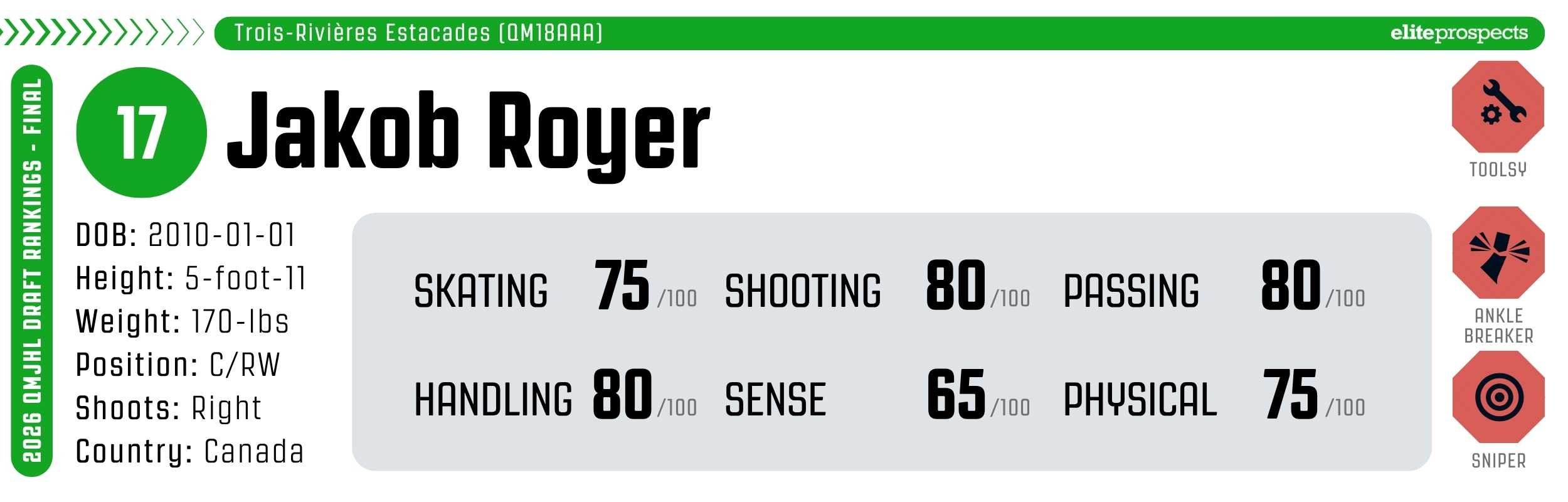
On his best shifts, Jakob Royer looks like a top-five prospect. A triple-threat scorer with equally impressive shooting, passing, and handling, Royer occasionally takes over an entire game, going end-to-end with deft full-paced handles through defenders’ triangles before ripping a hard wrister through a screen, or delaying to open up a cross-seam lane. In flashes this year, he also brought 200-foot value, scanning for threats in his zone and separating opponents from pucks along the wall before sprinting into neutral zone disruptions for additional puck touches. In some games, however, his work rate wanes, and his game starts breaking apart at the seams. If he can find that consistent game-to-game effort, his size and skating offer his profile some runway toward a power forward game, even if his willingness to engage physically will need to take a step to bring him closer to that projection. We’re betting on the flashes turning into staples of his offensive identity, and if they do, he’s a surefire top-line talent. The reward outweighs the risk in his case.
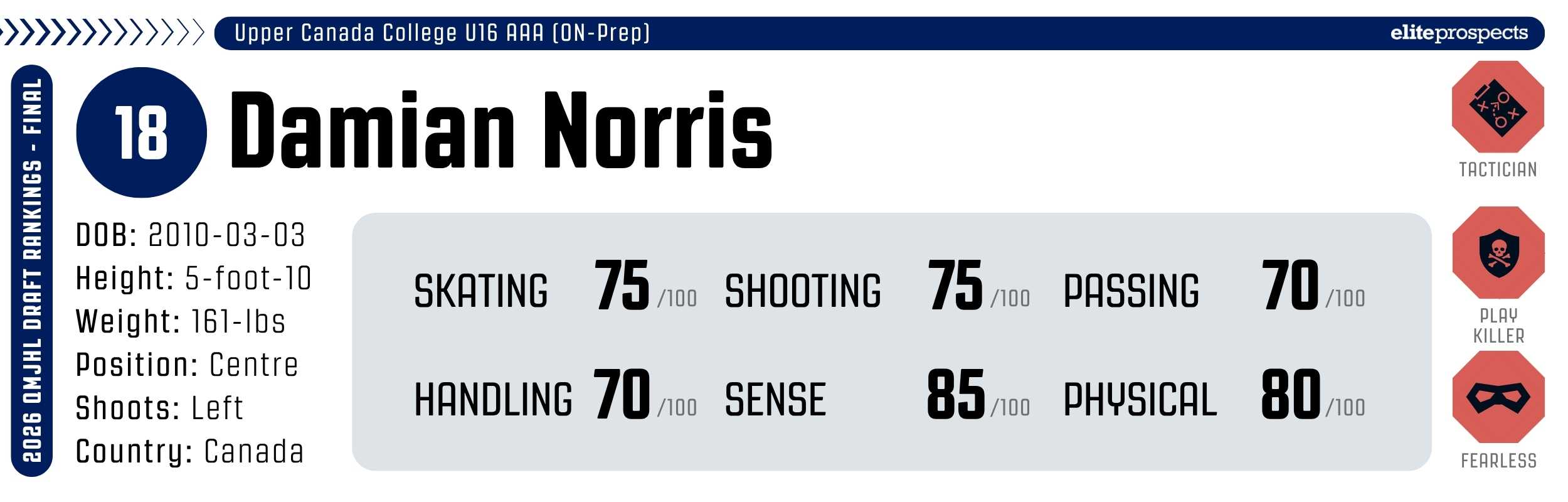
Rounding out our first round is Damian Norris, a projectable shutdown centre with offensive potential. Hailing from Newfoundland, Norris played this season at Toronto’s Upper Canada College and was a staple on the Blues’ penalty kill, lining up against the most elite U16 competition Ontario has to offer. His defensive IQ is second-to-none at centre, excelling in positioning, activity rate, and all the details to stifle offence. He also has the opportunistic flair to capitalize on turnovers and jumpstart the offence through his defence. He’s virtually insurmountable on the puck with his puck-protection skills on the offensive, plus he has the shot to also score from range. The tools themselves aren’t commanding, but his smarts and his strength have led to a productive season built upon translatable attributes. Though he isn’t explosive enough to remain in our top 10, Norris will likely be Q-ready on arrival and could flourish long-term with his reliable yet upside-laden profile.
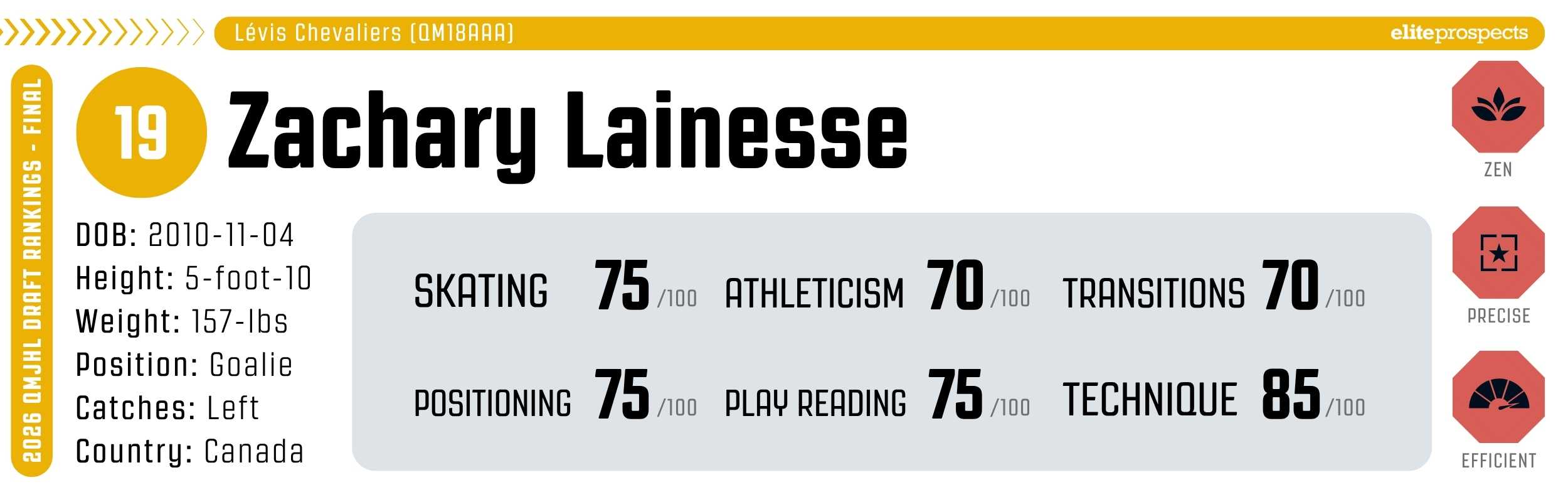
Every year in the QMJHL, there is typically one goalie from the most recent class who makes some kind of an impact (10-plus games) as a 16-year-old. The top candidate from this draft class is Zachary Lainesse, who could likely step into a full-time role as a solid backup right now. Lainesse is the most technically refined goalie in the class. He’s exceptionally calm, efficient, and structured, with strong hands and a very well-crafted stance. In fact, Lainesse is so far ahead in his technical development that he could be mistaken for a QMJHLer as is. He is also a strong, precise skater, well-positioned, decently athletic, with very strong tracking and play-reading capabilities. His only weakness – if it even counts – is that Lainesse lacks the dynamic elite talent that would place him in our first round. Yet, with no true hole in his game paired with his well-rounded toolkit and championship pedigree – as the starter for the Telus Cup-winning Lévis Chevaliers – gives him the highest floor in the class, projecting as a slam-dunk starting goalie in the QMJHL.
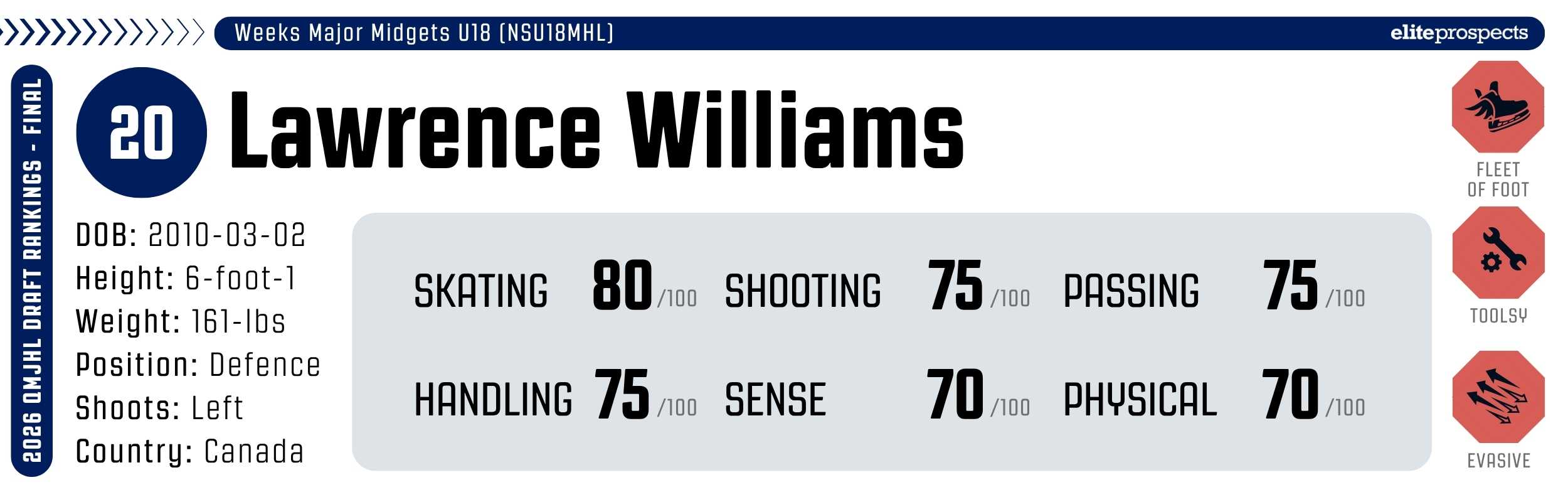
Another high-certainty pick from the Atlantic provinces, Lawrence Williams possesses all the hallmarks of a future QMJHL shutdown defenceman. He’s the most fluid defensive skater out of the East Coast, equalling his pace and power in backward skating to defend the rush with his head up and leveraging that positioning to seal off entries. His rovering abilities on retrievals bolster his current profile and future projection, refusing to lose footraces and blending puck-protection skills on the wall to make the first pass. He’s still working through the mean and physical aspects of his game, but not for lack of trying – on every zone entry against, he’ll corner puck-carriers against the wall and deliver a hit, sometimes ungraceful but most often effective. He has plenty of room to grow into and add strength to his 6-foot-1 frame, and a hard shot from the point adds to his toolkit. The puck skills fall behind those of the high-upside defencemen ranked ahead, and yet Williams is a masterful defender who could be selected well ahead of 20th for his poised game.
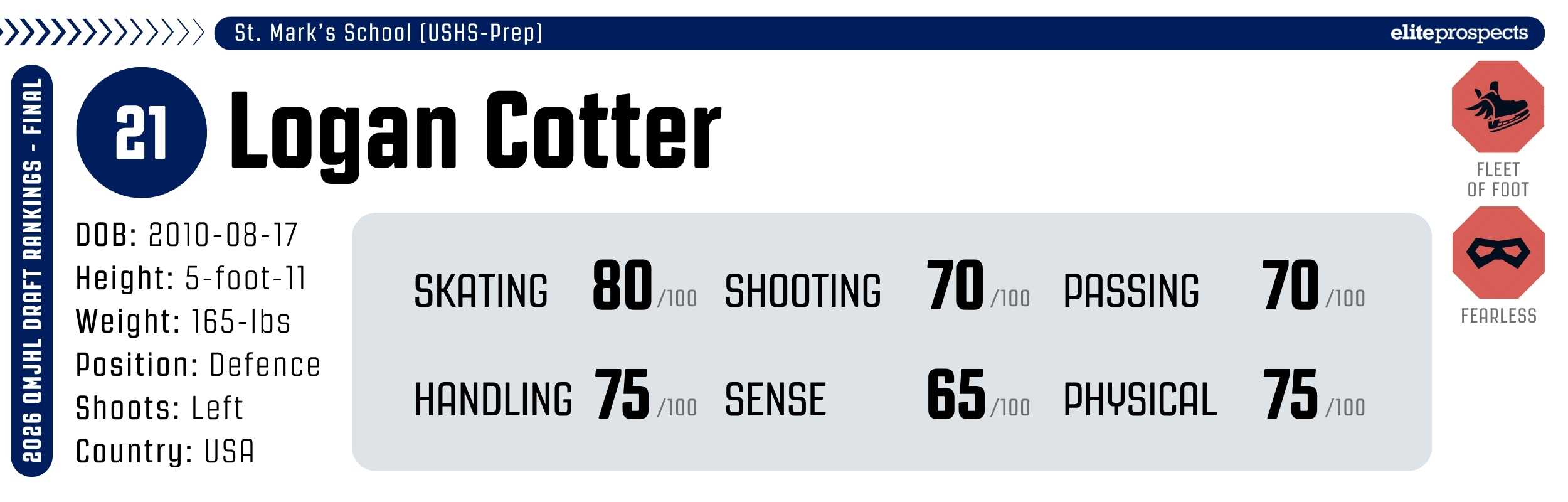
The story with Logan Cotter was pretty much the same most of the year, but when the NEPSAC playoffs and QMJHL Cup came around, he reached a new level. It felt like a lightning bolt struck Cotter in the first round with St. Mark’s, as he started to add more compatible hockey sense and defensive skills to his arsenal, which seemed to earn him a USHL tender with the Green Bay Gamblers. The cornerstone of Cotter’s game is his skating; he mixes in crossovers but also has the hip mobility to effortlessly evade opponents. He activates a ton, and his ability to confidently escape forecheckers and control play in transition is already CHL-calibre, thanks to his evasiveness. His defensive game isn’t perfect, but it has potential, mainly through his activity rate and recovery speed. He does show flashes of aggressive gap control, along with above-average stick-checking ability in his own zone. If a team in the QMJHL believes they can solve some of the hurdles in Cotter’s two-way play, there’s a possibility for him to be a top-pairing defender in the QMJHL. Cotter would probably be a little higher on our list if he weren’t a USHL tender, but after a splendid performance at the QMJHL Cup in Shawinigan as a late invite, the interest will still be quite high.
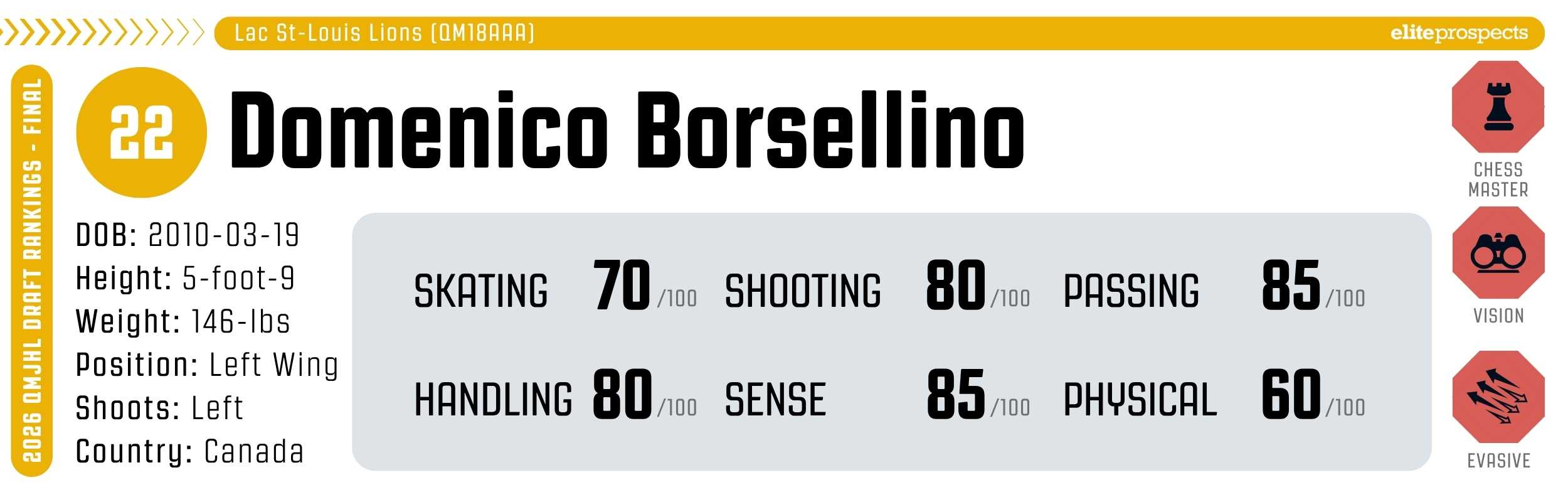
One of this draft’s best offensive facilitators, Domenico Borsellino’s playmaking reads allow him to play a collective game that elevates most around him. Always scanning for the next play with and without the puck, he quickly turns receptions under pressure into deft slip feeds into his teammates’ paths and uses his quick processing to leverage longer-range passing options just as effectively. His release offers just as much promise; he leans more towards placement than power, but given the precision of the former, he often doesn’t require the latter. With Borsellino, the key to his ascension to a top-line role will be to add fluidity and power to his stride. At his size, finding success in the QMJHL will hinge on his growth as a transition play-driver. Adding some explosiveness off the jump would be enough to help him fill a Philippe Veilleux-type role in the QMJHL and potentially become a top-10 triple-threat producer in the league.
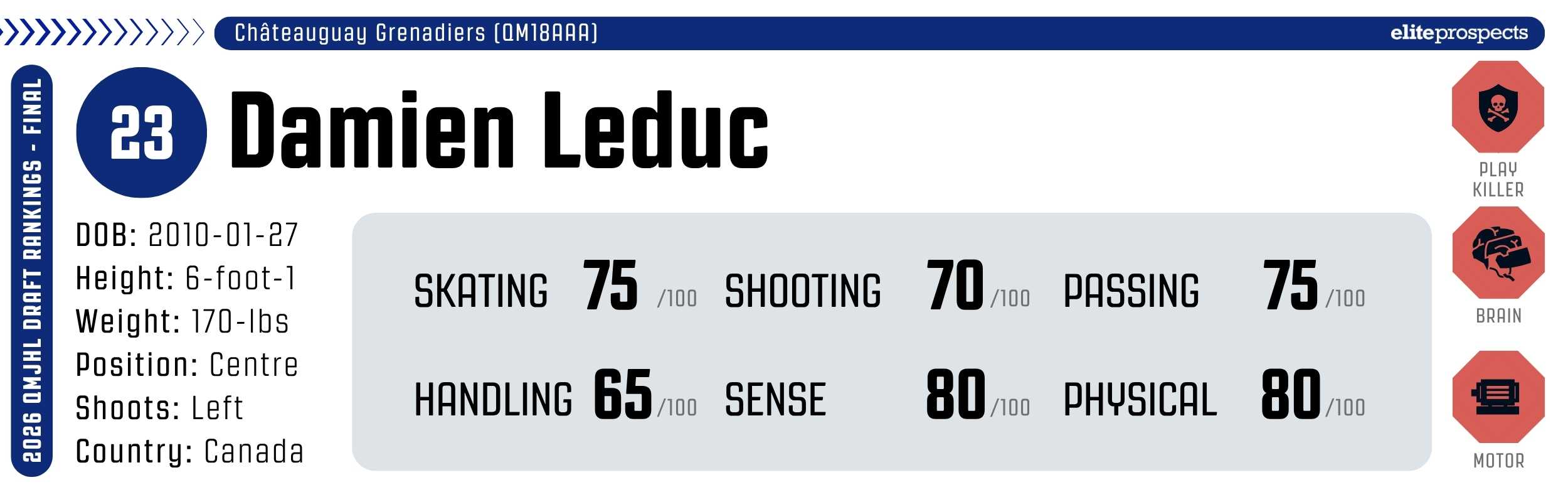
After starting his draft year looking like a pure two-way projection with size and power, Damien Leduc gradually added offensive flair to his game over the course of the season and now looks primed for a first-round selection. He started moving his feet more and more consistently, leveraging crossovers to take pucks in stride and drive right at defenders before ripping hard releases across the grain. Meanwhile, his playmaking remains spotty but highly effective in flashes; he pumps the brakes on entries, identifies trailers while fending off pressure, and quickly connects once he creates a lane. While he can work the boards effectively with his frame and motor, Leduc’s offensive impact off the cycle leans much more towards positional goal-scoring, attacking down the house off the puck to catch passes and snap them home. Adding some creativity with the puck while continuing to develop his passing and handling arsenal would push him into a clear top-line role in the QMJHL.
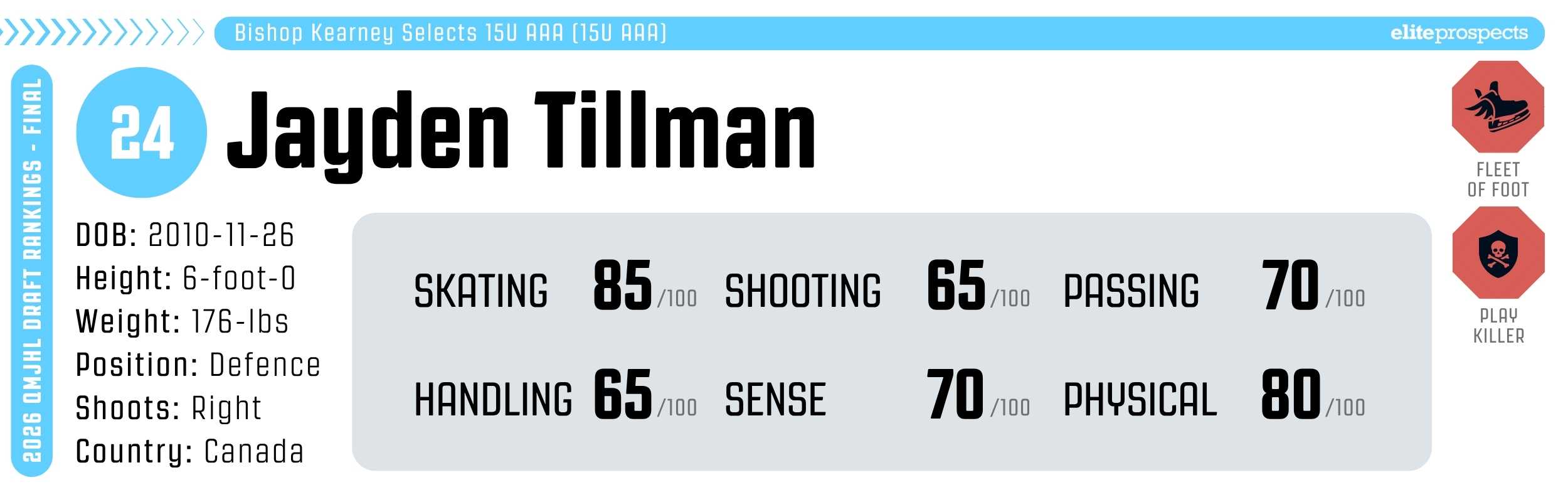
Jayden Tillman is one of the youngest players in our top 100, born in late November. Nevertheless, he’s one of the class’ boldest and most punishing defenders. On opposing forechecks, in open ice, anywhere he gets the chance, he throws crushing hits as early as his first shift of the game and puts opponents on constant high alert with his consistent intensity. He brings that same fervour to defending the zone with decent tools and reads, all underlined by his high-end skating ability. Tillman doesn’t do anything halfway, putting his body on the line whether it’s a high-speed retrieval or stopping high-danger chances at the netfront. The rush-defending ability already looks QMJHL-ready, combining straight-line speed with surfing habits and inescapable gaps. The physical and pure defensive aspects of Tillman’s game play off each other, and he’s improved the calibration of that balance over the season, reducing the trouble aggressive defencemen such as himself can find themselves in. The learning curve is significant for such defencemen, but we see it as a worthwhile investment in a prospect with Tillman’s poise and potential.
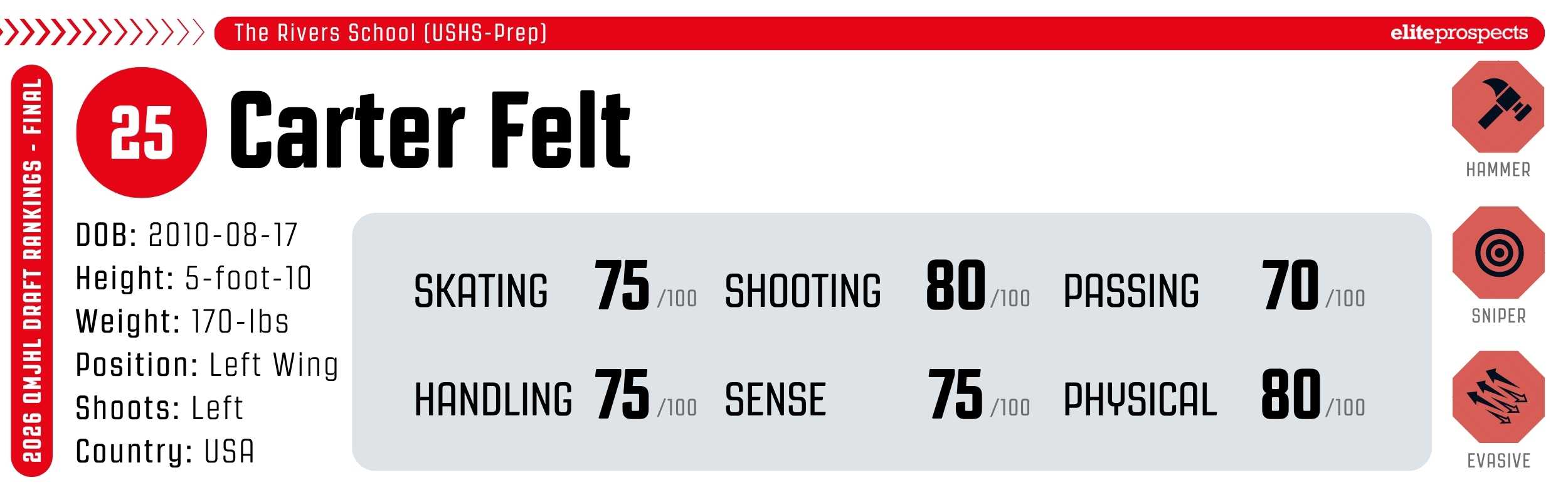
In late August, our team identified Carter Felt as one of the more punishing hitters in this class. His first game back then showcased that early, but he also showed translatable offensive flashes. His knack for playing around the net is eye-catching, as he scored most of his goals with the Rivers School from close range. Despite this, Felt still has goal-scoring ability from beyond the crease; he has a slick release, especially both off the rush and pass. His willingness to commit to both sides of the ice is quite impressive, especially on the penalty kill; he fully dives in front of shots for blocks, ties up opponents well along the wall, and uses active positioning to try to disrupt the cycle. The physicality of Felt’s game is his standout trait, as he’s easily able to throw older defencemen off pucks with timely, hard body checks. If he can showcase a full motor in every game, along with adding more layers and skill to his toolkit, Felt projects easily as a top-six power forward in the QMJHL.
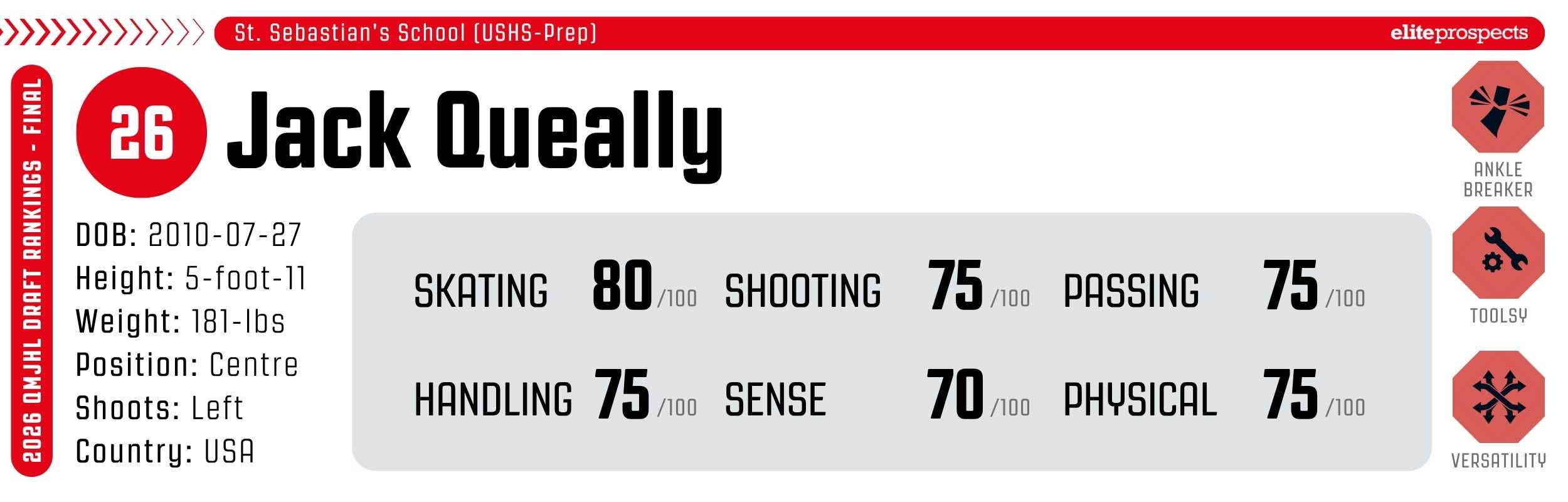
The first NTDP addition to our list, Jack Queally, remained a top-30 candidate in this class from start to finish. Queally’s slick handling mixed with two-way consistency makes him an intriguing centre near the top half of this list. His shot is a real threat when utilized; he picks corners, can fire the puck with high velocity, and release from an advanced shooting angle. His transition play is more complicated for opposing teams, especially when he relies on his manipulation skills. He brings a polished defensive game through strong stick positioning and can aggressively position himself with well-timed blocks and tie-ups along the boards. The physical side of Queally’s game will have to stay consistent to develop into a two-way scorer at the next level, but flashes of it at the halfway point of the season give us confidence that he will reach that potential.
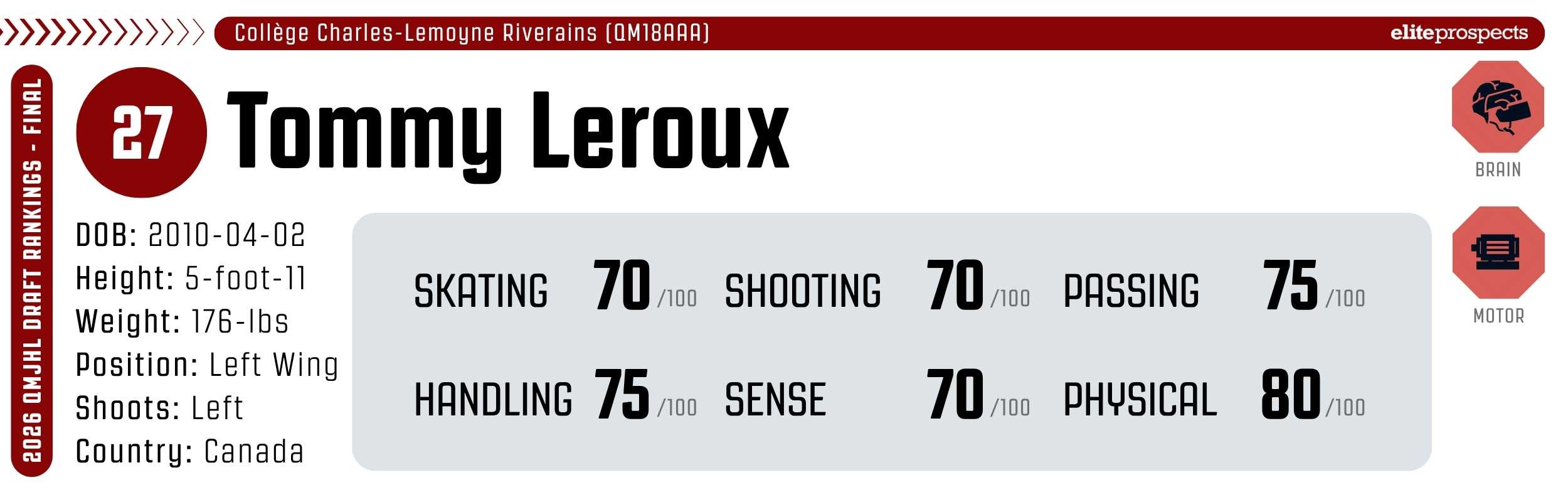
Tommy Leroux was one of the biggest risers on our board, earning 20 spots since our last ranking. The hard-working two-way forward consistently impressed through his motor, physical engagement, smart reads, and positioning. His off-puck awareness is one of his greatest strengths, allowing him to generate scoring opportunities and disrupt plays defensively. What increased Leroux’s stock, however, was the steady growth of his offensive game. Viewed more as a reliable checker with translatable habits early in the season, he began showing more confidence with the puck as the season progressed, resulting in better puck management and puck protection. Although he is not the most creative player, Leroux is quite good at controlling the puck in tight areas, and he can catch pucks on the fly. Overall, Leroux has a safe projection as a versatile third-liner, but his progression curve and skillset suggest there is a higher ceiling to unlock.
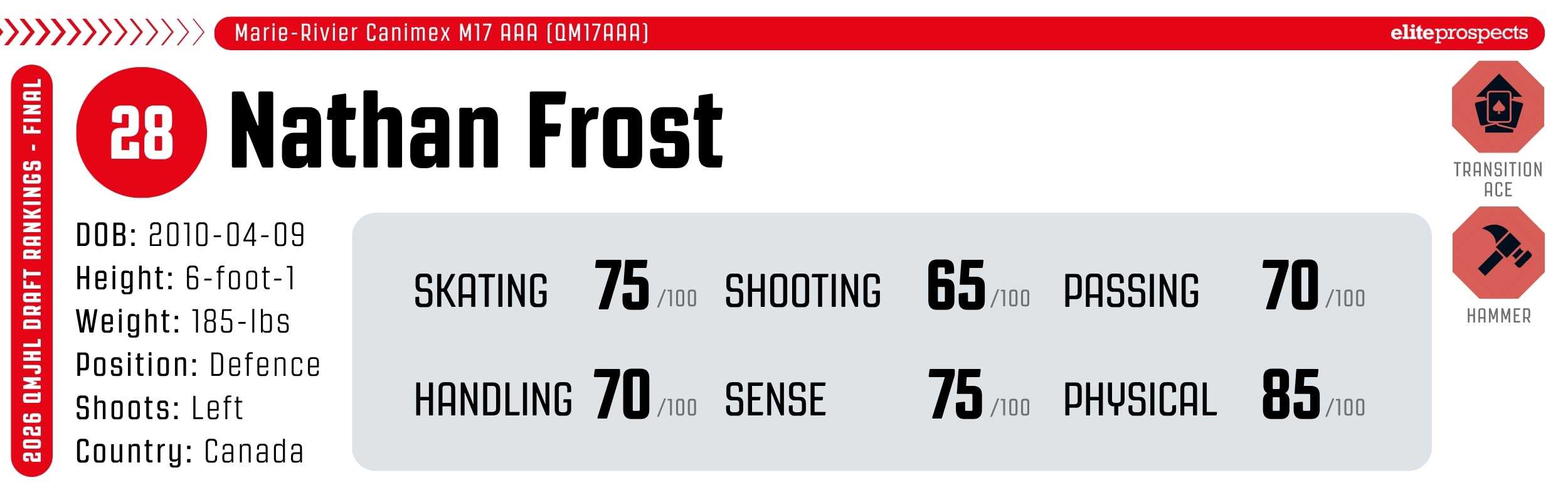
A U.S. stint with the Connecticut Jr. Rangers cut short by a Visa hiccup saw Nathan Frost return close to home with the QM17AAA’s Marie-Rivier Canimex. In the long run, this won’t hurt his projection and certainly hasn’t hurt his stock ahead of the 2026 QMJHL Draft. A high-energy defenceman with projectable skating and shutdown tools, Frost was one of the best blue-liners at the QMJHL Cup. He activates frequently, often right to the net, and connects plays up the ice with astounding control for his size. Defensively, he blends crushing physicality with impressive contact control, knocking opposing carriers off course with timed step-ups while also showing positive restraint in his ability to absorb and intercept checks when fighting for possession on retrievals. From there, he puts pressure on his back with quick cuts, wheels out from behind his net, and jumpstarts the offence before joining it. This high-octane style comes with its fair share of hiccups and misfires, but with time, Frost’s poise and composure likely develop into passable elements for the QMJHL’s pace of play. He could be a high-end top-four defenceman if he finds that layer.
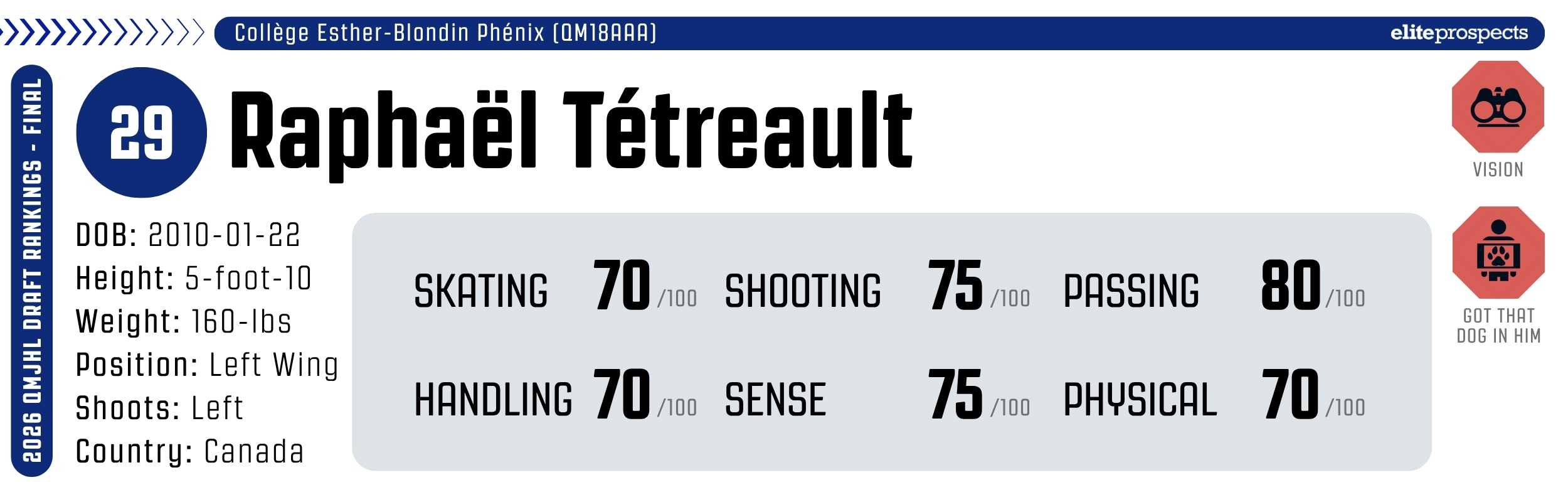
The draft’s biggest riser, Raphaël Tétreault, started the season barely getting looks at the QM18AAA level in Collège Charles-Lemoyne’s system. He made the switch over to Collège Esther-Blondin and quickly found his home to the left of Pierre-Alexandre Lemieux, ending the playoffs with 18 points in nine games. A high-energy playmaker with a powerful stride, Tétreault is always pushing the pace offensively. He turns wall receptions into pressure escapes, then quickly finds a play through pressure to an open teammate. His offensive explosion at the tail end of his draft year was a direct result of his physical and mechanical growth, as he got bigger, more resilient through contact, and more coordinated. This allowed his formerly sparse flashes of distribution and goal-scoring tools to find a foothold, as he wasn’t getting caught from behind or sealed to the outside as often. Now, he finds streaking teammates with deft area saucers, crashes the slot, powers his release through stick checks, and fights for rebounds along the wall. Tétreault’s late-blooming profile is a strong bet on continued progression; he could surprise a few and end up as a high-end top-six dual-threat winger.
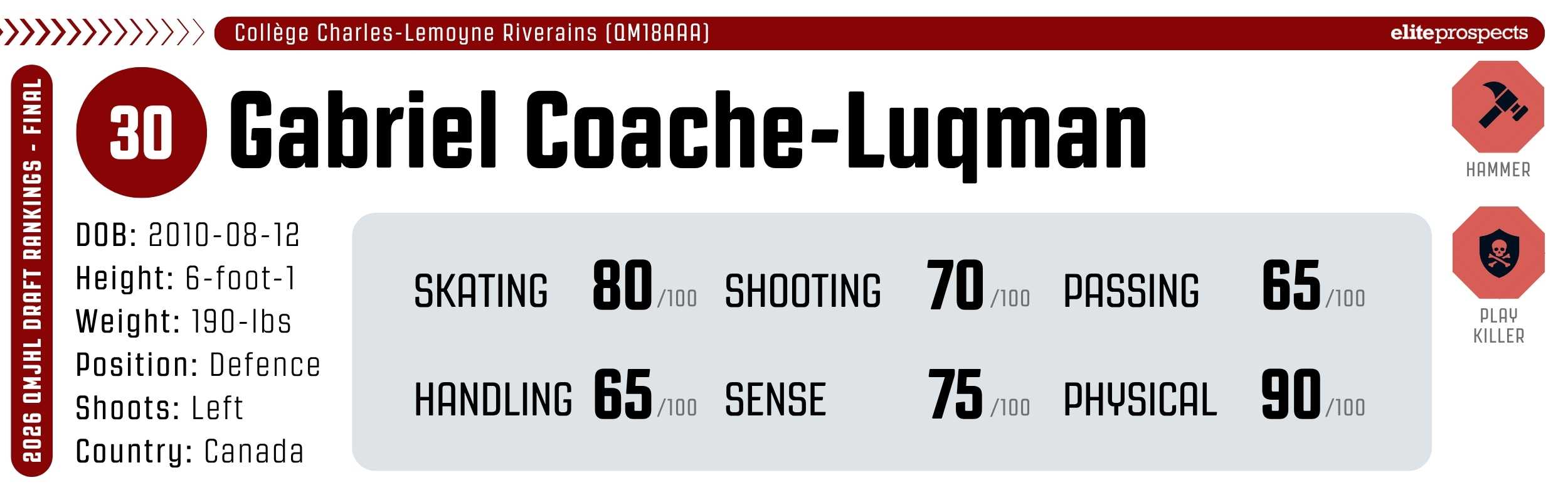
Few players in this draft class project as cleanly to the next level as Gabriel Coache-Luqman. While some higher-ranked prospects may offer more offensive upside, the poised and mobile right-shot defenceman already possesses many of the tools required to play in the QMJHL. His combination of skating, physicality, reach, athleticism, composure, and defensive awareness makes him one of the most effective rush defenders in this crop. He closes gaps quickly, forces opponents to the outside, and shuts down plays with his active stick and solid hits. Speaking of physical skills, the disruptive defenceman excels at sealing the wall, winning battles, and protecting the net front. He’s not just a good off-puck player, either; poised with the puck and willing to jump up in rushes, he effortlessly chains together simple yet efficient plays. Again, the offensive upside limited how high we could rank him, but there is no doubt that Coache-Luqman is one of the most translatable and highest-floor defencemen in this class. He will probably end up getting picked much higher than this.
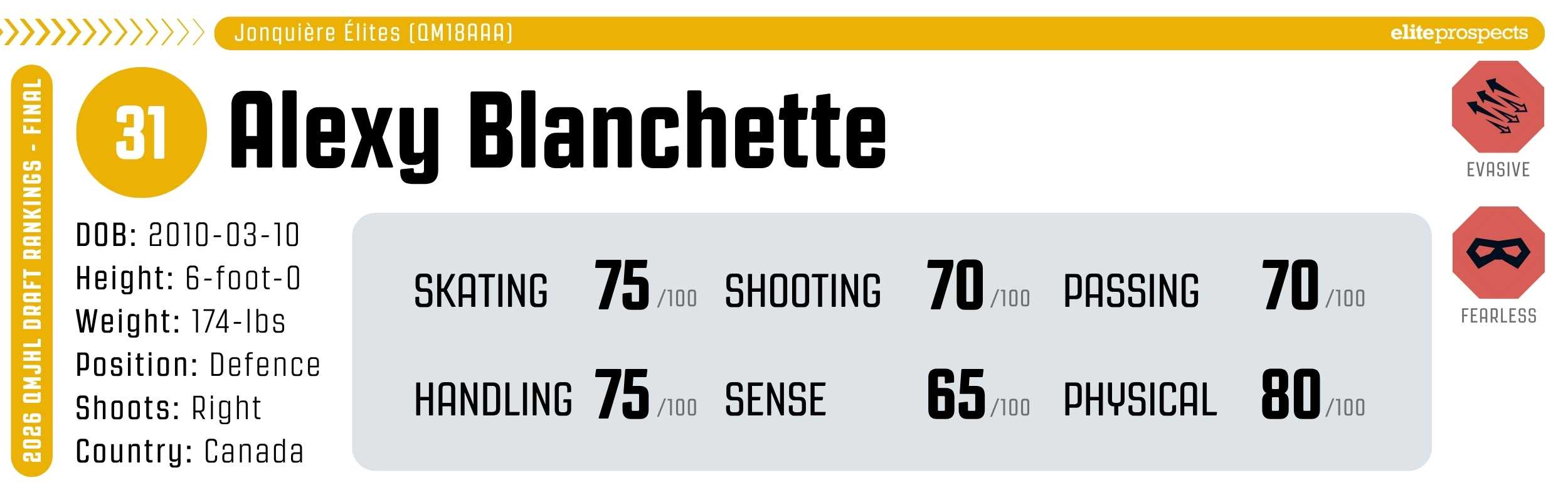
Alexy Blanchette may be one of the more underrated defencemen in this entire draft class. His production does not fully reflect the talent level and upside he possesses, nor how much he impressed some of our scouts this season. The right-shot blue-liner stands out immediately with his fluid skating, mobility, and confidence carrying the puck. He effortlessly changes directions, easily accesses his outside edges, and escapes pressure via cutbacks. When he plays assertively, he can look like one of the most dynamic puck movers in this class. He attacks open ice with weak-side activations and could become an impactful scoring threat once he gets the opportunity to use his shot more often. Defensively, Blanchette can play a mean, physical, and disruptive game, although his positional defence is currently much more sound than his rush defence. Blanchette is a bit raw, but he has the potential to develop into a mobile, two-way, top-four defenceman at the QMJHL level. With such an enticing blend of size, skating, and puck-moving ability, developing into a top-pairing blue-liner may not be out of the question.
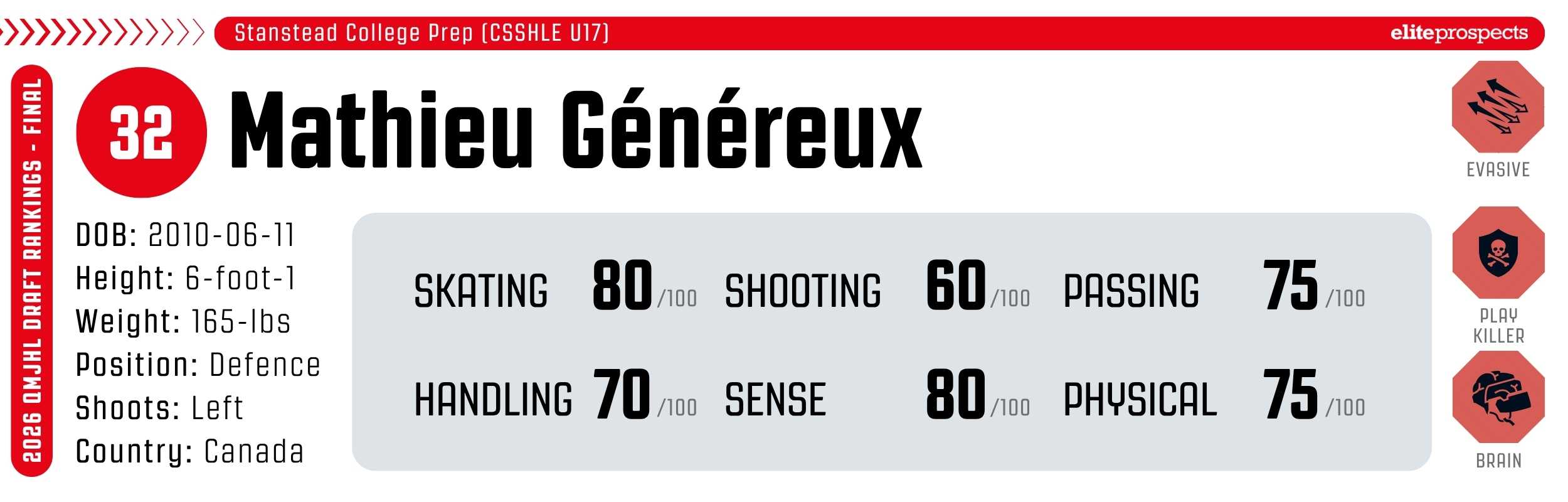
Mobility, skill, and poise are the name of the game for Mathieu Généreux. Effortless transitions from forward to backward skating and vice versa keep him ahead of the play heading both ways, setting the table for a crisp and proactive transition game. He shows some advanced details in first-touch scenarios, faking with his toes on retrievals before escaping the other way, and keeping his feet churning through weak-side activations and pass receptions to maintain a purposeful flow to his offensive game. Defensively, he reads and reacts effectively, using his edges to match footwork with opponents before letting them run themselves out of space, before closing the gap and making a play. If he can find an extra gear of pace and dynamism that his puck skills and mobility can clearly support, while also applying that same assertiveness to his shutdown game, there’s a chance he ends up out-playing the vast majority of defencemen we have ranked ahead of him.
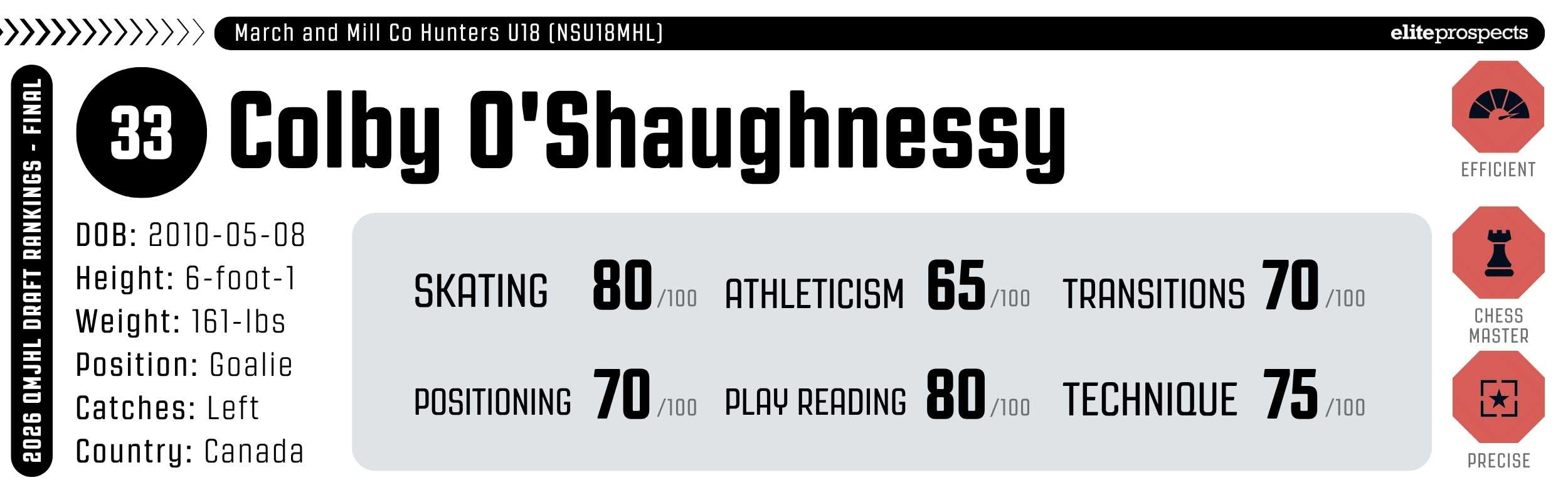
Despite playing for a weaker Hunters team in the NS U18 league, it became evident early on that Colby O’Shaughnessy has the tools to flourish in a better environment. As arguably the smartest goalie in the class, O’Shaughnessy has created a hyper-efficient, structured game, amplified by phenomenal edgework. In clear vision, no one can anticipate the play better than he does, as he uses plenty of scans, positional adjustments, excellent tracking, and rapid mental processing to consistently react quickly to passes and stay on top of the play. On top of this, he has some of the best technique in the class with extremely quick hands, a very well-crafted stance, and calmness and control under pressure that shouldn’t be normal for a 15-year-old goalie. He may not be a dynamic athlete, but he can pull the rabbit out of the hat when needed and has strong power and overall mobility. The only real concern is how he handles traffic, as he grows much more hesitant with his reads in those scenarios. It will surely be a hurdle to overcome, but he is well-equipped with high-end tools to do so, which can propel him to reach his potential as a starting goalie.
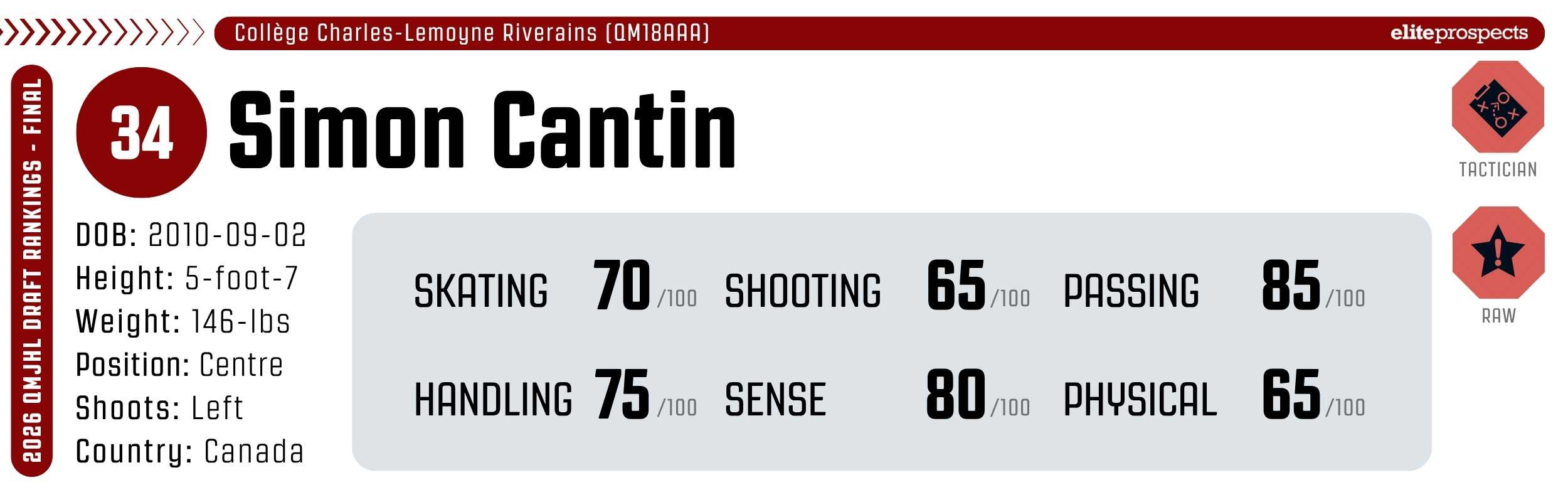
Meet one of the most creative playmakers in this draft class: Simon Cantin. A master of puck possession, the undersized forward quarterbacks the power play, creates off the rush, and consistently finds ways to connect with teammates through difficult passing lanes on the cycle. Adept at slowing the game down, he draws defenders toward him and manipulates them to create openings and extend lanes before threading deceptive cross-slot passes. What makes Cantin particularly intriguing is that his game extends beyond pure puck distribution. Despite his lack of size, he competes hard on the forecheck, supports the cycle, and gets involved in the play. He is agile and elusive, making him quite slippery in the corners. At 5-foot-7, getting inside often remains a challenge, but Cantin’s offensive skills and play-driving ability give him legitimate top-six upside at the QMJHL, and it would not be surprising to see him finish among the league’s top scorers during his final seasons.
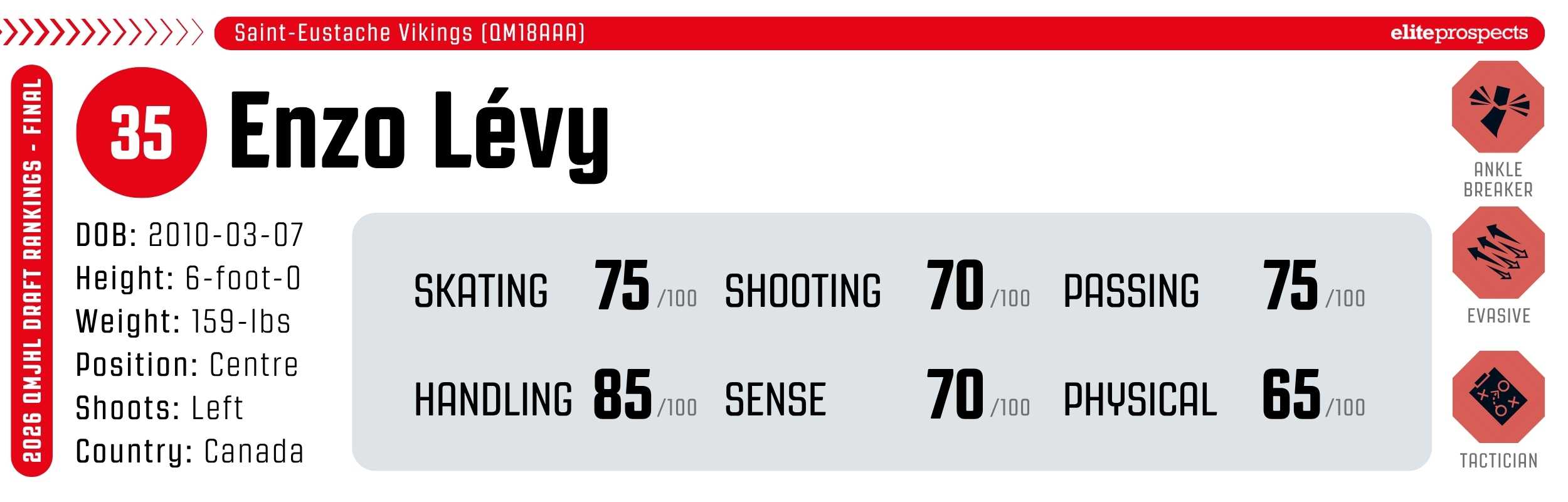
If the version of Enzo Lévy we saw in our first-half viewings had continued to show up for the rest of the year, he’d without a doubt be a first-rounder. In flashes, he looked like a dynamic triple-threat creator for Saint-Eustache, picking defences apart with his hands before stopping on a dime, delaying, creating passing seams, and delivering pinpoint dishes to teammates in better areas. His vision and offensive mapping kept him dangerous, as he spotted teammates in his blind spots and connected with them effortlessly, setting up his dishes with look-offs and angle-change dekes. In flashes, he also looked like a dogged backchecker with some defensive upside, but his B game was mostly nebulous. We believe in this prospects’ flashes becoming more consistent, and a more consistent Lévy could very well be a dynamic top-six creator in the QMJHL. Therefore, he earns a spot in our late second round.
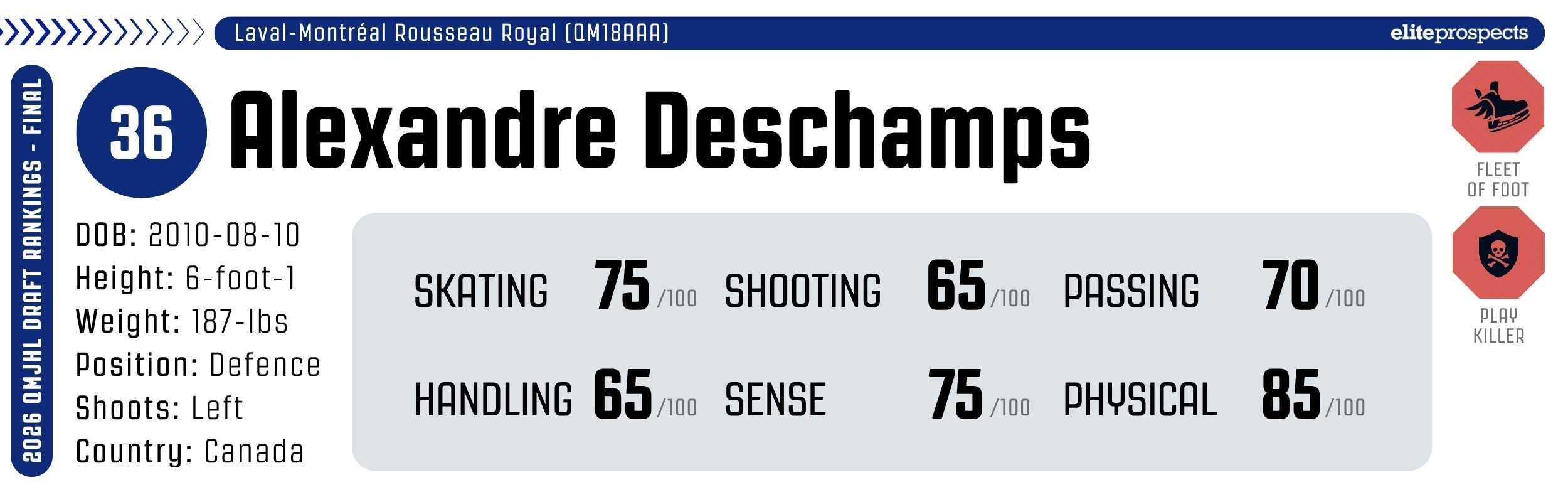
Despite missing significant time this season due to injury, Alexandre Deschamps showed more than enough shutdown skill in the first half for us to remain confident in his QMJHL scalability. He covers absurd distances with a single leap, erasing gaps before carriers can even look up. His stick discipline and physicality take over from there, as he layers stick and body to seal opponents off pucks and quickly delegates off the wall. Deschamps plays with just as much aggression when defending the cycle, with a particular knack for identifying and tying up potential threats on fly-bys through the slot. While his breakout game and offensive zone cycle facilitation will need more coordination and composure, there are flashes that suggest potential for growth in these areas. He takes pucks in stride, redirects his momentum off the blue line, and slips passes to the middle out of those micro-activations. Getting more confident in his skills could unlock true two-way potential in a top-four capacity, but even without that progression, we’re fairly confident in Deschamps being a QMJHL-calibre shutdown defenceman.
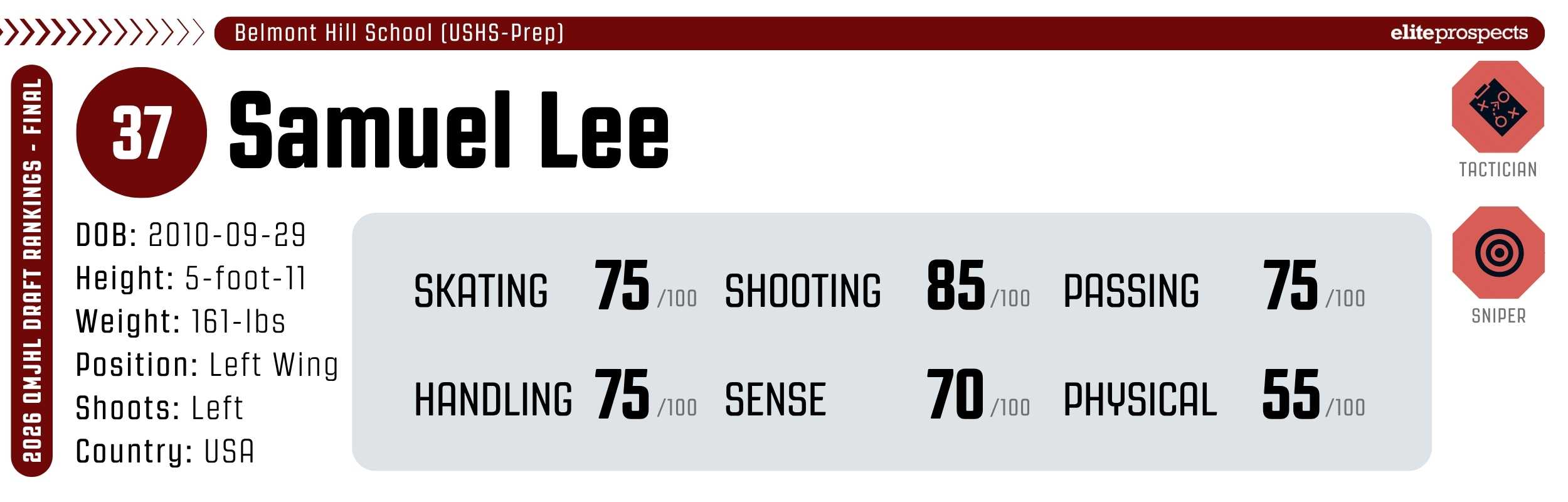
Samuel Lee profiles as one of the more gifted offensive-zone creators in this class; he’s a forward whose value goes beyond his production. Lee’s motor and skating technique are the most projectable assets of his toolbox; he has flashy edgework, mixes in lots of crossovers, and is always active in all zones on every shift. He’s a constant factor on the forecheck, but adding more physical layers in that area will go a long way. Along with Lee becoming a power play threat most of the year, his penalty-killing arsenal adds value. He consistently pressures opponents and actively disrupts passing lanes, making it hard for opponents' cycle game to flow. Lee also possesses a lethal shot that still seems to be improving. He can generate a lot of looks, but becoming more of a clinical tight-quarters finisher will only make Lee more of a dangerous scoring threat. If he can solve more physical layers regarding contact as well, Lee could become a monster at the next level. He plays one of the more projectable games in the QMJHL compared to other Americans in this class, but the catch is that he’s committed to the NTDP.
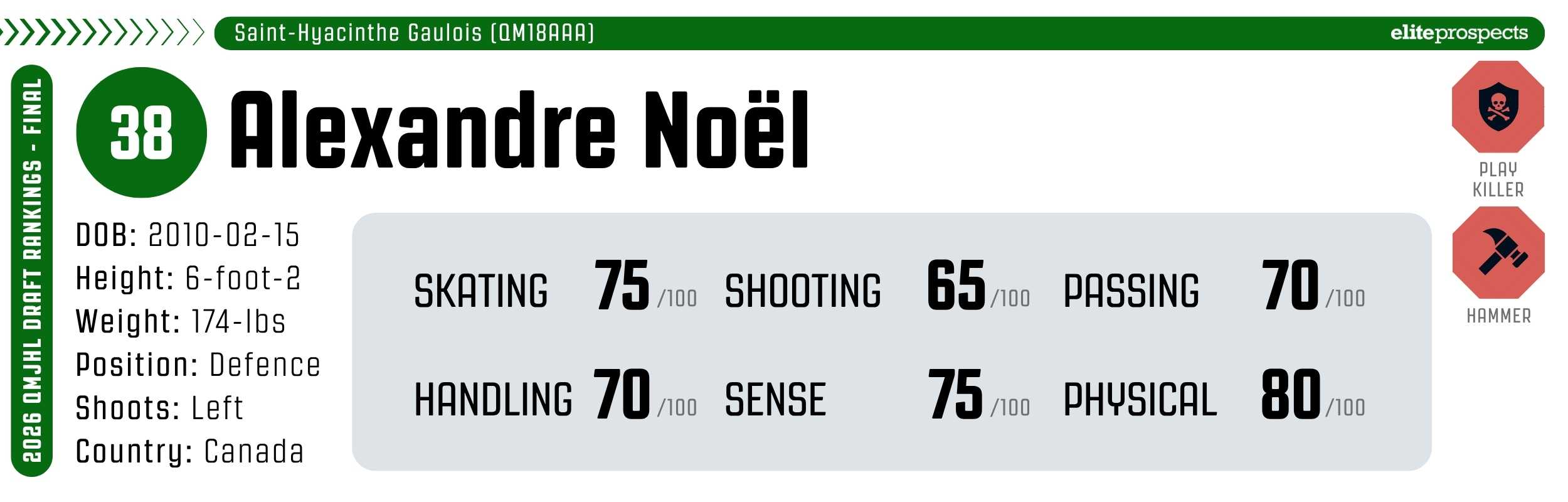
Few prospects did more for their stock at the QMJHL Cup than Alexandre Noël. He was the most detailed and polished defenceman at the showcase, displaying professional-level physicality and poise on the defensive end alongside remarkable aggression as an activator. He joined rushes with weak-side pushes and middle-lane sprints after distributing simple exit passes, and was the first man back when plays went the other way, quick to step up and stifle carriers through outside-lane angling and hard checks. While the skill and coordination limitations were still present in his game at the showcase, he offset them by quickly offloading the puck to all the right spots and supporting play positionally. Noël’s environment in Saint-Hyacinthe forced him to play much more reserved hockey, but the shackles came off in Shawinigan, and he looked like a completely different prospect – a clear top-four projection, to be exact. With more mechanical refinement, he could break out offensively, but even without that progression, he’ll be quick to translate his shutdown and support games to the QMJHL in a second-pair capacity.
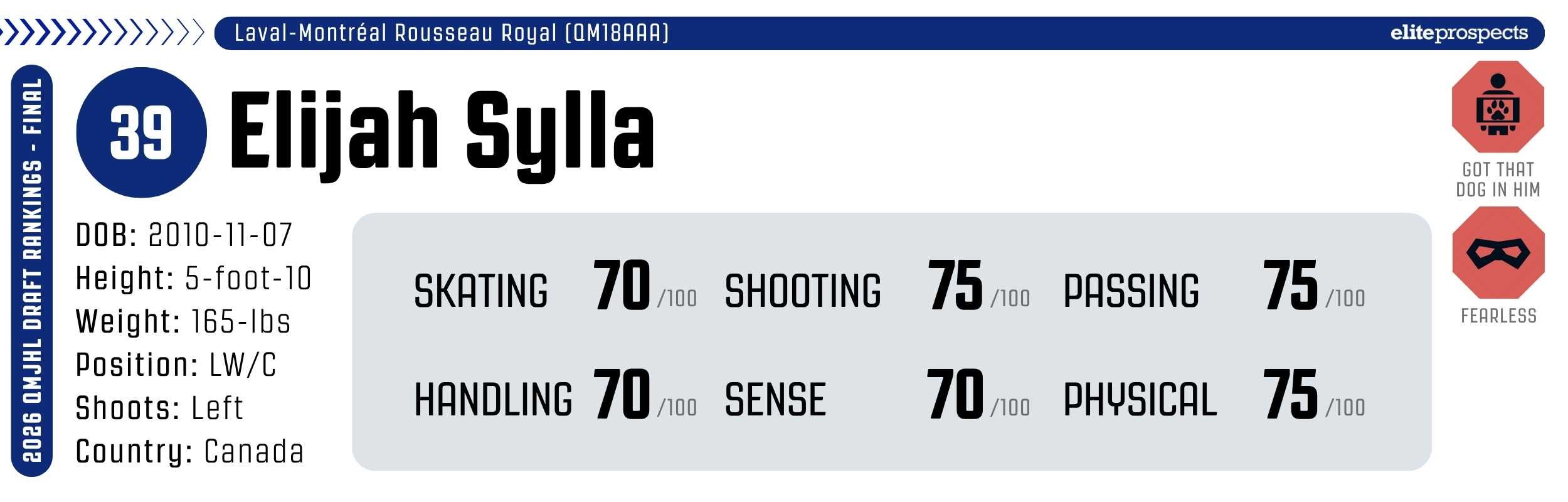
A late-November 2009 re-entry who earned 40 points in 42 QM18AAA games for Laval-Montréal this season, Elijah Sylla leveraged his physical growth since his draft year to become one of the most dogged and effective checking forwards in the league, while stacking high-end details on top of that growth. He pesters opposing defencemen on the forecheck with strategized pressure, forcing them into avenues occupied by teammates with his skating arcs and baiting cutbacks before intercepting them at the seams. He offers relentless aggression as an attacker, too, forcing mistakes in coverage with his offensive-zone pace before leveraging his above-average release and flashes of playmaking to create chances. Off the rush, his mechanics force him to delegate early and play a supporting role. He works that role in a QMJHL-scalable fashion; however, skating through defenders’ sticks with his off-puck routes to create gaps for his teammates to exploit off the carry. He could likely play in the QMJHL right away, but his top-six upside hinges on his skating and handling mechanics taking a step.
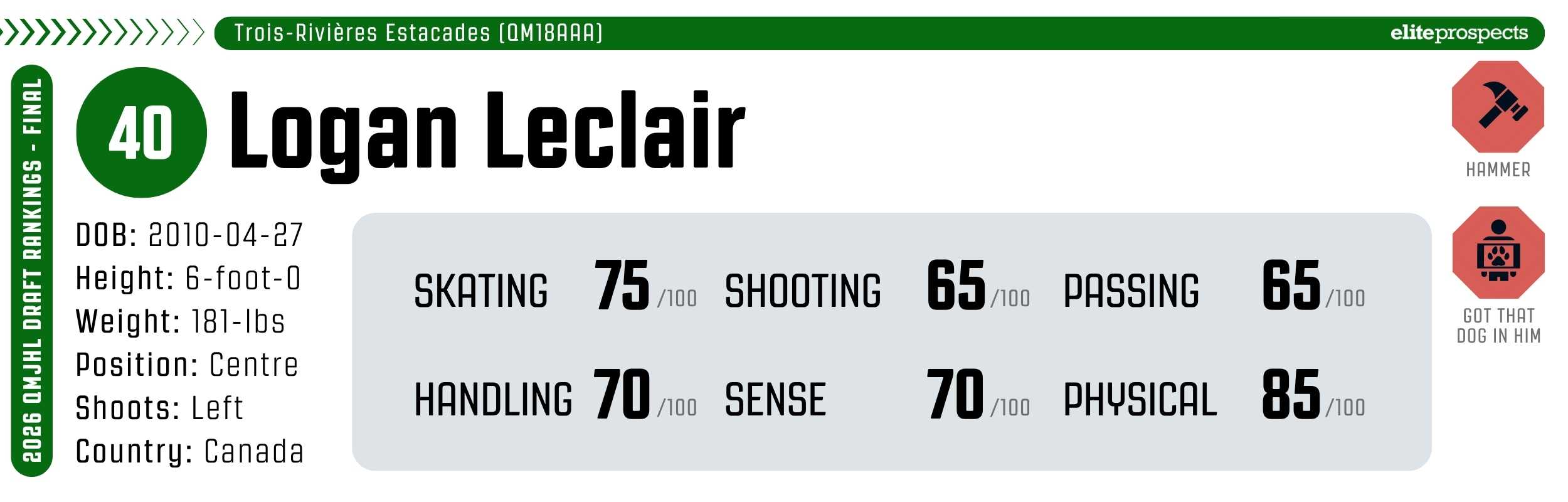
Logan Leclair’s identity is clear: He is the easiest checking projection in the second round. Big, fast, strong, and absurdly physical, he takes runs at anyone and everyone indiscriminately, both in open ice and along the wall. When he isn’t taking runs at opponents, he’s using his straight-line speed to beat defenders to chip-ins and putting them on his back as he heads up the wall. Highly effective in puck protection, he is nearly impossible to seal off pucks, as he can drag pucks into his feet, pivot off of checks, and keep cycles moving by kicking the puck to his stick through pins. When cycles break down, and the puck heads the other way, he catches up to opponents with hard straight-line backcheck efforts. While he’ll likely dominate the boards early in the QMJHL, Leclair’s progression into a second-line role will hinge on adding layers to his puck skills and showing more on-puck composure, but even without those progressions, he projects as a high-likelihood checking centre with a fast track to the league’s bottom six.
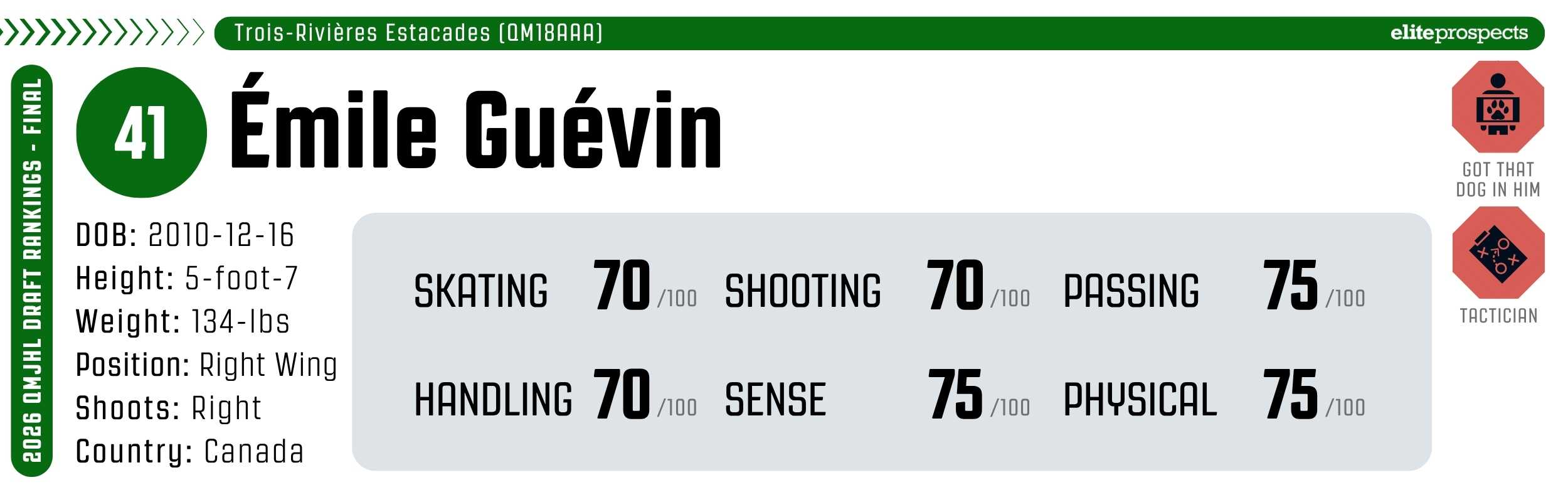
Émile Guévin is a power forward trapped inside a 5-foot-7 frame. Relentless on puck pursuits and equipped with a motor that never seems to stop, he pressures opponents, disrupts breakouts with his stick and pestiness, and creates opportunities through second efforts. His intensity is his defining trait, but it is not his only asset. Guévin combines that work ethic with strong skating, advanced rush patterns, and surprisingly good puck skills. This allows him to generate offence both off the rush and on the forecheck. Despite his size, he does not shy away from contact and actually embraces it. His defensive awareness, competitiveness, and willingness to outwork opponents give him a strong foundation for the next level. He also shows flashes of creativity, suggesting there might be more offensive upside than we think. Once he adds more strength and refines his on-puck execution, Guévin has the potential to become a highly effective middle-six forward in the QMJHL.
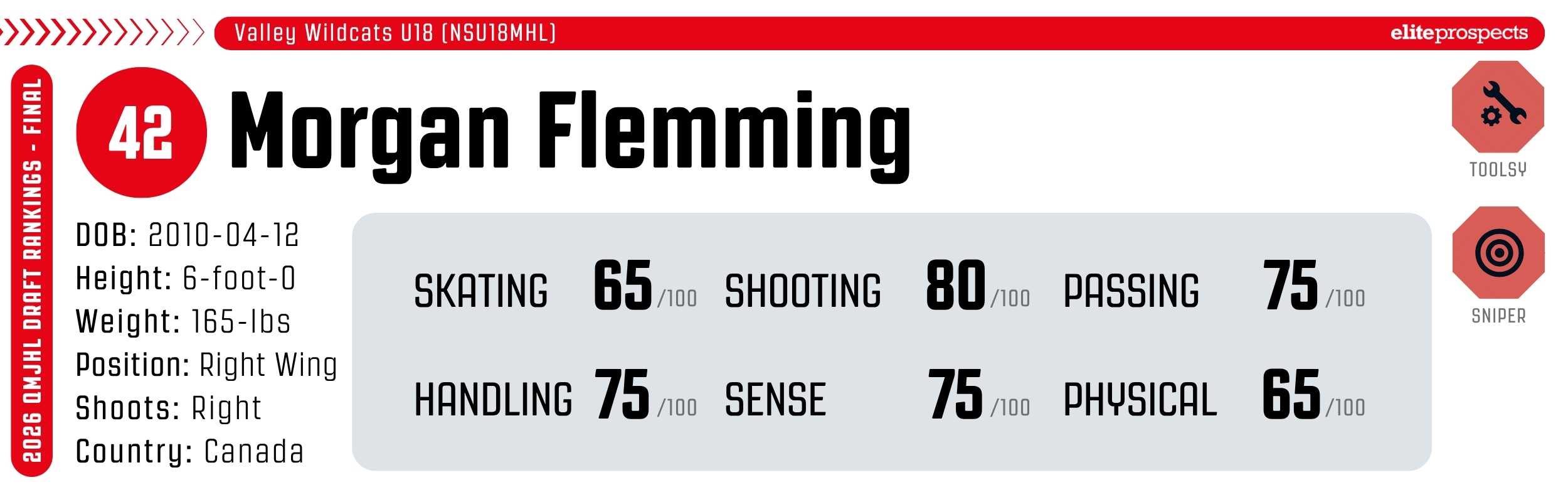
The Nova Scotia U18 league’s leading draft-eligible goal-scorer, Morgan Flemming, is a true dual-threat scorer. His 6-foot frame and nose for the puck can cause chaos in the slot, but the real money-maker is his best-in-region shot. His release from the wing is incredibly lethal on clear lanes, stupefying goaltenders with his precise shot placement, picking corners and mastering tight angles from the low wall. His other tools are also sufficient to be complementary, frequently flashing playmaking potential and weaving through the offensive zone on- or off-puck to provide additional offensive upside. The lacklustre skating and physical skills are why such a scoring threat drops to our third round. It’s a riskier pick without all the pieces already in place, but there’s still a good chance that the 6-foot, 165-pound Flemming can add strength to the benefit of both his contact skills and his stride. He can undoubtedly score; it’s merely a question of how much.
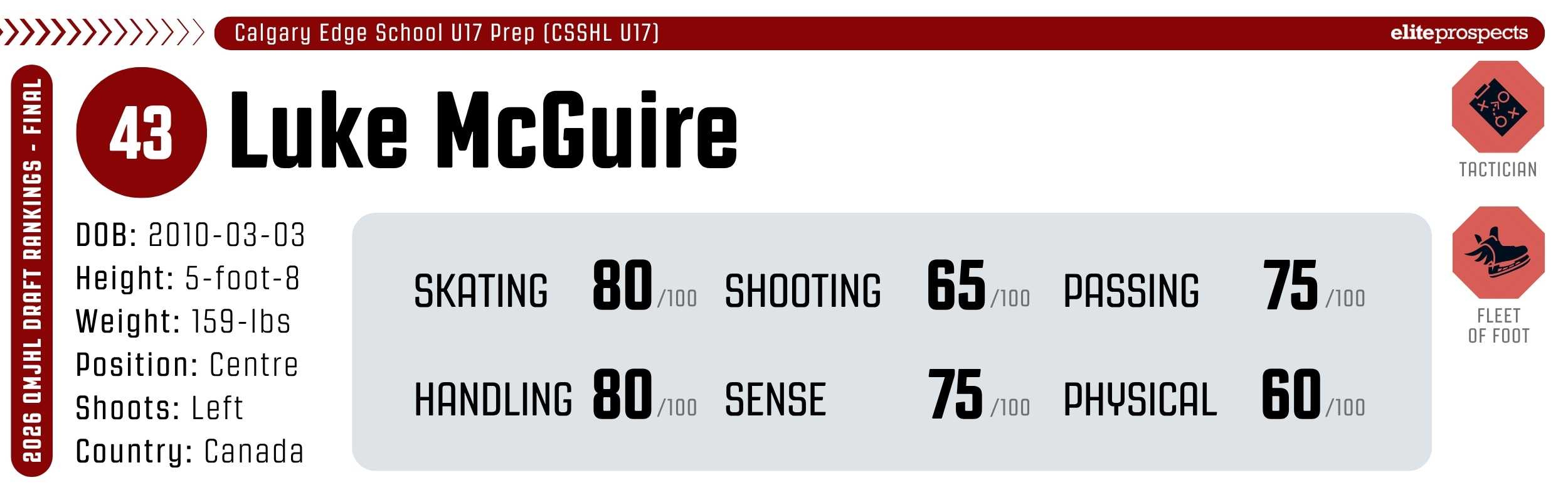
Luke McGuire impressed our team at our first major event of the season, the QMJHL Cup Atlantic in October. With the best hands at the 80-player event, he remains the best pure-skill Atlantic Canadian on our final board. A smart and evasive offensive player with puckhandling mastery, his profile fits the pattern of dominant QMJHL producers, and he could be among this draft’s all-time point-getters when all is said and done. As with Flemming, his skating and physical skills both lag due to a lack of strength and power, though McGuire’s 5-foot-8 stature implies more physical runway. Even if that doesn’t come to pass, McGuire is certainly skilled enough to see QMJHL ice. His first few seasons of major junior eligibility will be a considerable challenge to dominate through his skills at his current below-average size, but his play at the U17 and U18 levels this season showed that his advantages are scalable. He’s perhaps the highest-upside ‘maybe’ in this range.
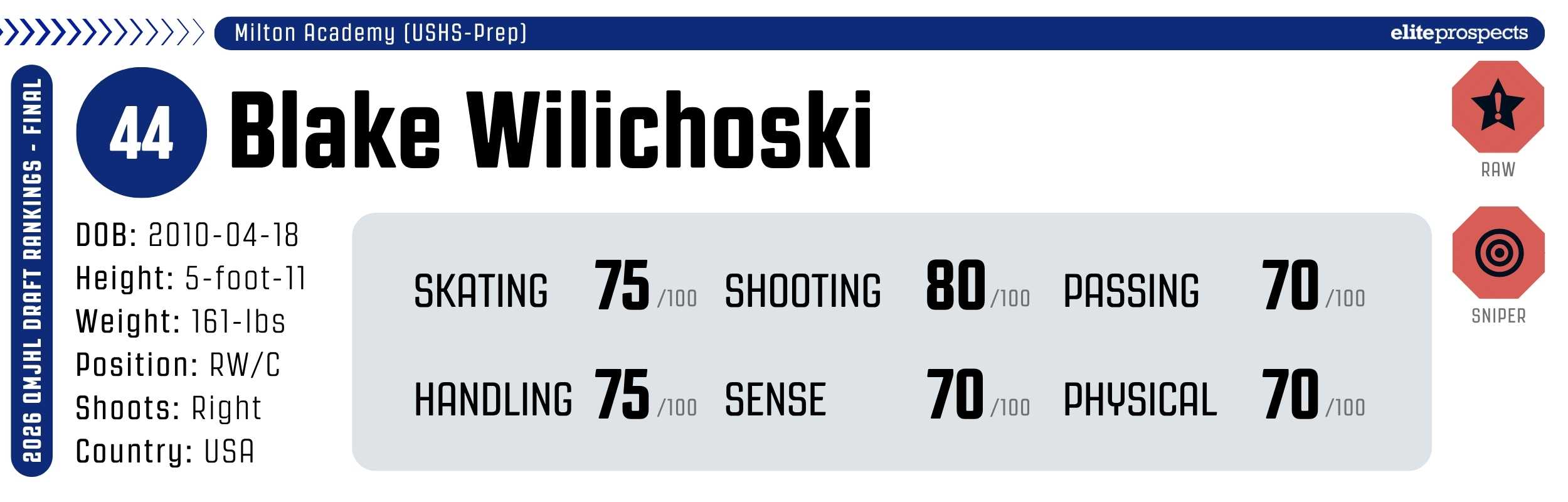
Blake Wilichoski profiled as one of the more creative offensive forwards all year; he provides value with his vision, puck protection, and patience to wait for the right play. His handling and skating are the most projectable tools he possesses, while playmaking is his identity; he reads the game quickly, identifies passing lanes amid defensive lapses, and creates high-danger looks from below the goal line or off the rush with slick deception. He plays a high-event, risk-taking style on most shifts – aggressive pinches, creative routes on entries, saucer passes through traffic – and it usually pays off more often than not. There is a bit of a physical edge, too. Defence is his main weakness. There’s easily a path to a top-nine role in the QMJHL, but first, he’ll head to the USHL’s Cedar Rapids Rough Riders after signing a tender.
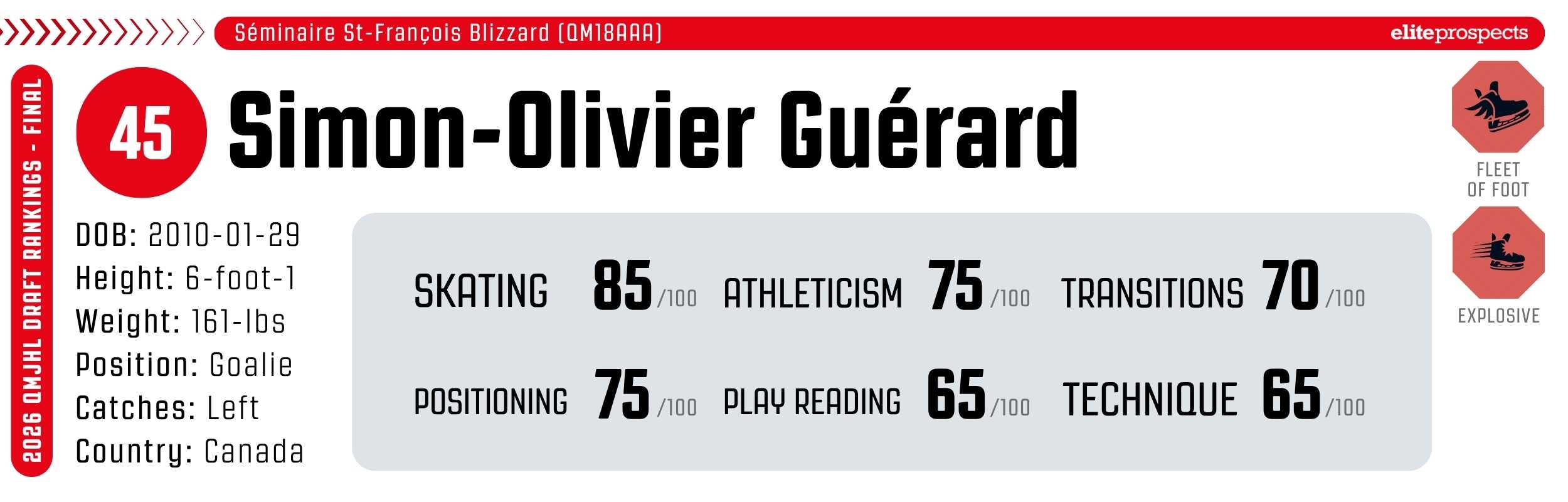
The Séminaire St-François Blizzard were unstoppable this year, with a deep offensive core and mature defencemen in their midst. When plays broke down and they needed a save, however, Simon-Olivier Guérard was there. One of the most explosive skaters in the draft, Guérard uses his crisp edges to burst across the crease on desperation plays, effortlessly covering ground while keeping full track of the puck throughout, and scanning proactively for blind-spot threats. His compete level supports that skating base, as he rarely backs down from second and third chances when he can’t cover the puck on those explosive lateral pushes. While still technically raw, with some cleanup to do around his butterfly coverage and transitions, Guérard still performs admirably in scramble scenarios and could easily maintain that effectiveness against QMJHL backdoor threats. He has a winning recipe in his size, mobility, flexibility, and effort, and should be a top-50 pick on draft day — maybe even top 30.
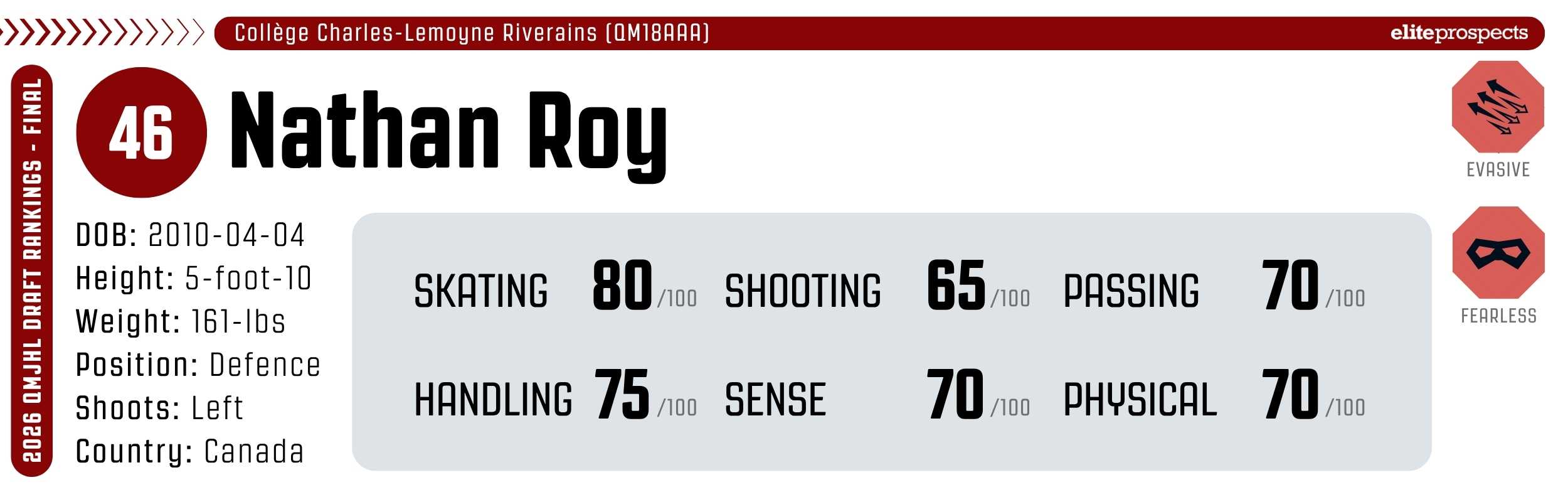
Nathan Roy’s game flows through his fluid edgework. A proactive gap closer off the rush, Roy matches footwork comfortably through backwards crossovers, anticipates opposing carriers’ intentions, and either cuts them off as they drive wide or engages his hips to explode to the middle when they cut inside. He picks up threats well in his own zone, using his polished stick positioning to dissuade carriers from shooting while cutting passing lanes with his legs. Once he secures the puck along the boards in his own end, Roy is quick to engage his feet and escape pressure, using a wide variety of skating techniques to side-step forecheckers. He also offers some offensive upside, shifting defences from the point with his lateral mobility before finding shooting lanes and timing his wristers with traffic. Adding a layer of deceptive playmaking could help him turn the corner from offensive facilitator to creator. That, combined with his physical limitations, keeps him lower on our final board, but there is legitimate boom potential in his profile.
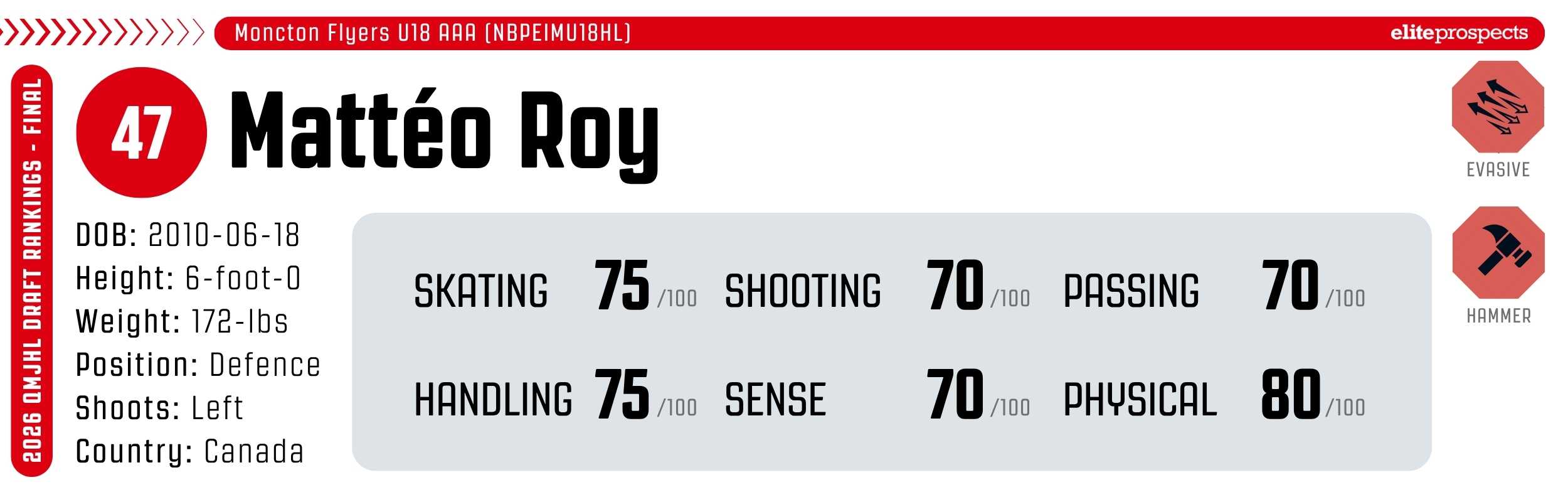
Entering our top 50 off the back of an impressive QMJHL Cup showing in April, Mattéo Roy can best be described as a competent ‘meat-and-potatoes’ defenceman. He absorbs all the retrieval assignments in his minutes with both his strategic approach on the chase-down and his physical skills on the wall. The contact skills, especially on the puck, are his standout skill as a defenceman, enabling his effectiveness as a rush stopper. He’s a solid puck-carrier and can distribute and enter the offensive zone in a support role. Roy isn’t the flashiest player, but he plays a mean and effective game when it comes to getting pucks out of his own end. The passing still requires some polish to be truly reliable, but it’s 90 percent there with his awareness of the play. A mean puck-mover like Roy won’t have a hard time finding an eventual fit in a QMJHL depth chart.
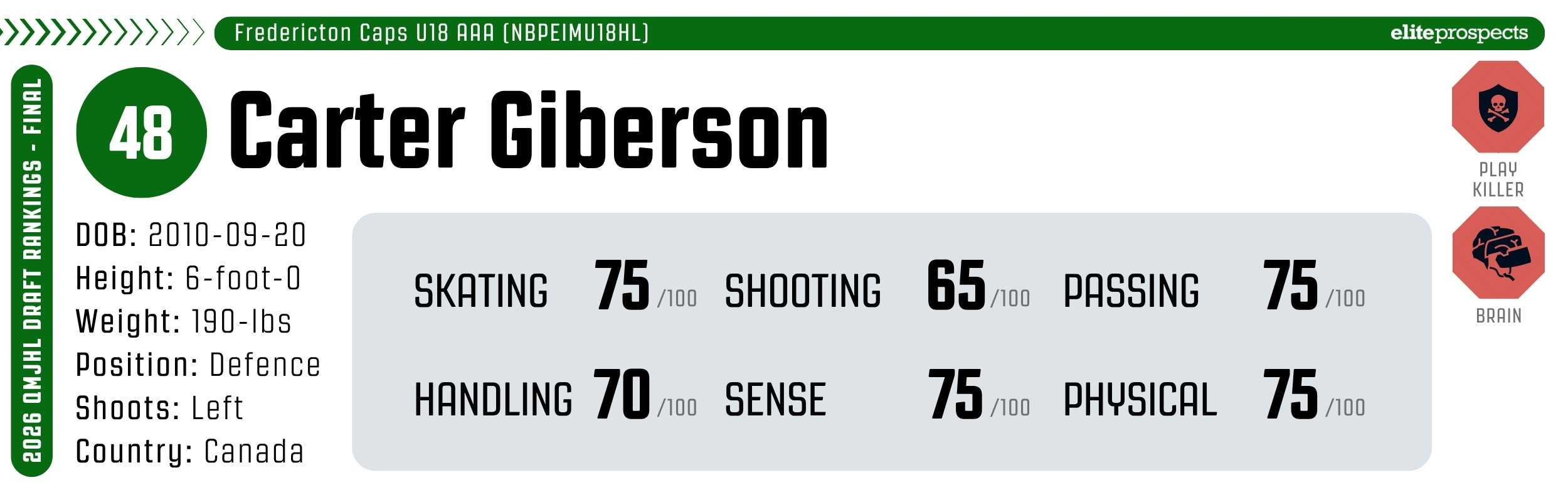
Carter Giberson is another New Brunswick-born defenceman who plays a simple and effective game. He cemented a place in our top 50 in April with his showing at the final leg of the QMJHL Cup, flashing a smart defensive game with an advanced skating base. With a high activity rate and consistent presence through his defensive coverage, Giberson’s pure shutdown projection works because of his extensive range of tools. He causes problems for opponents on every transition play, utilizing his reach and mobility to close off lanes and box out rushers. He’s shown some physical flashes throughout the season and has the frame to become even more menacing with added strength. When his defensive smarts are layered with a willingness to follow through with a throw of the body, he’s impressive. Though lacking the offensive-zone ability of a higher draft slot, Giberson’s proficient and detailed defence is extremely projectable to a QMJHL role.
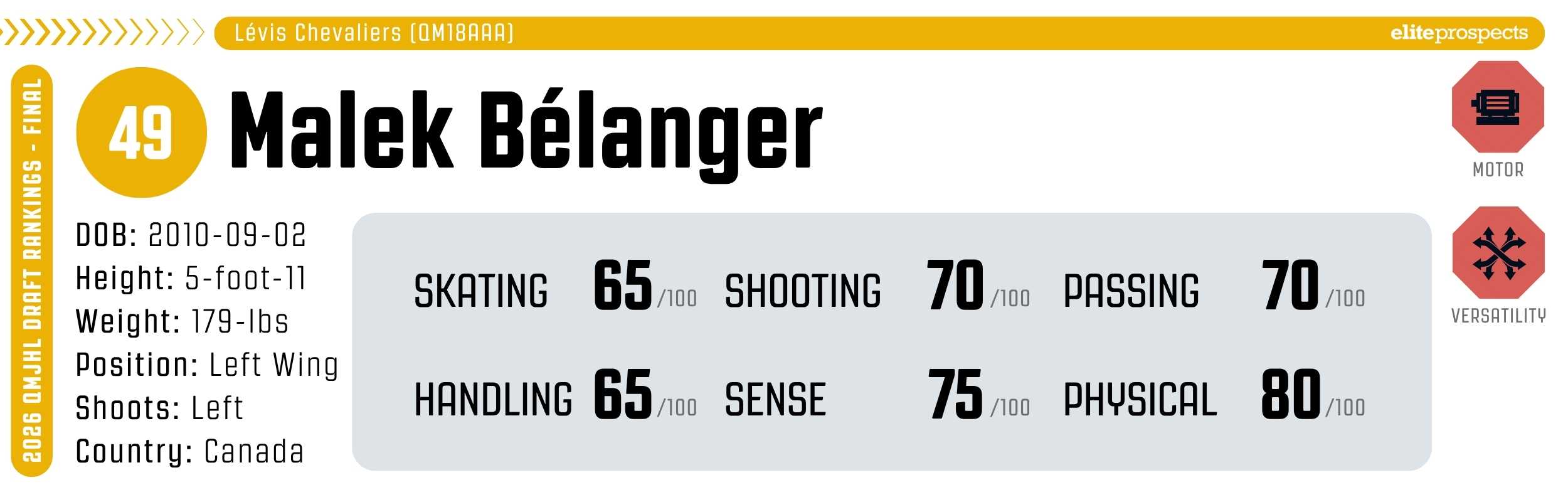
A powerful forward with a sturdy checking game, Malik Bélanger makes cycle offence look effortless at times. He drags defencemen on his back, shields the puck with his shoulders and back, detaches his bottom hand to power through sticks to the inside, and drives the net hard. While his first step and breakaway speed hold him back, he gets his fair share of quick-strike chances by being proactive with pressure, anticipating mistakes, and pouncing hard. That same anticipation applies to his forechecking and board play, as he predicts opposing defencemen’s rim plays. While his upside is limited by his mechanics, especially in terms of handling precision and mobility, he offers a safe and energetic profile, with the physical tools and details to play in the QMJHL in a checking role. There are enough special elements in his checking game to see him potentially develop ancillary skills around it; he could add passing vision off the cycle and do some damage as a retrieve-and-connect sequencer.
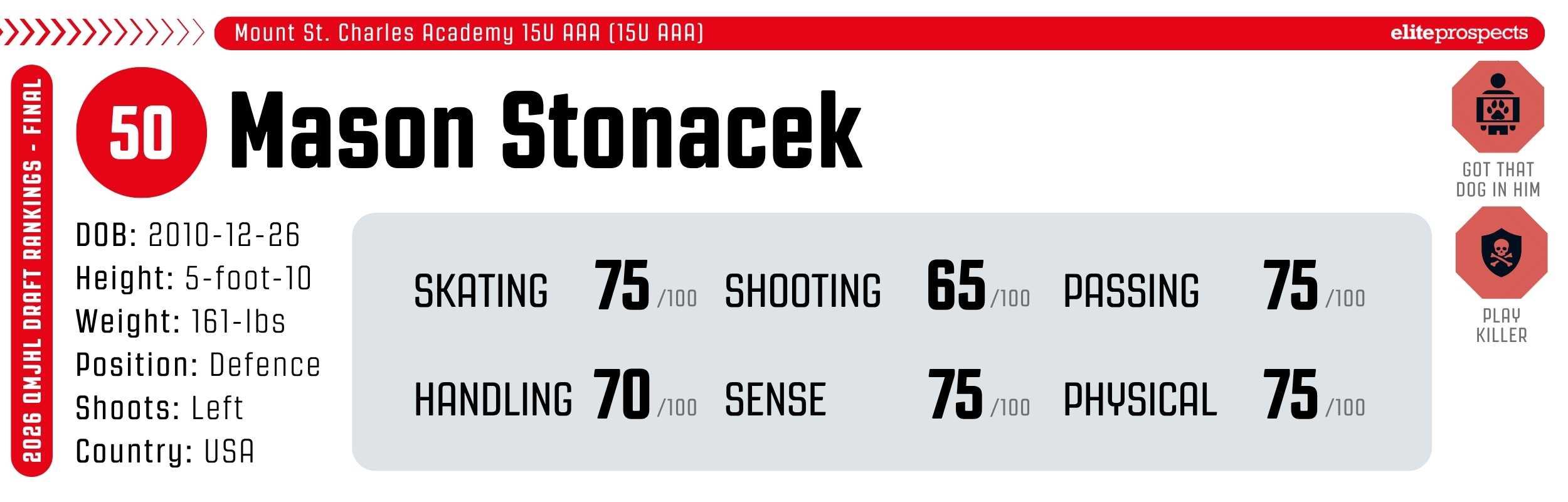
Mason Stonacek was one of the top anchors on the back end of a loaded group at Mount St. Charles Academy. After making some noise in the QMJHL New England Showcase, Stonacek was a late addition to the QMJHL Cup in Shawinigan, and he didn’t disappoint. He plays a pro-style game whose value starts with how reliably he defends, specifically on the rush. His gap control and rush defence are the most projectable in his game. Where he really shines is when the forecheck comes at him on the breakout. He is never in panic mode and shrugs off pressure on the inside to calmly find the first pass or carry pucks out himself with swagger. With these skills in his own zone, Stonacek can easily project into a reliable penalty killer in the QMJHL. He might need to add some more explosiveness to his skating to reach another level in his development, and maybe mix in some skill with the puck, but his rush defence is QMJHL-calibre already and should help him lock down a second-pair role.
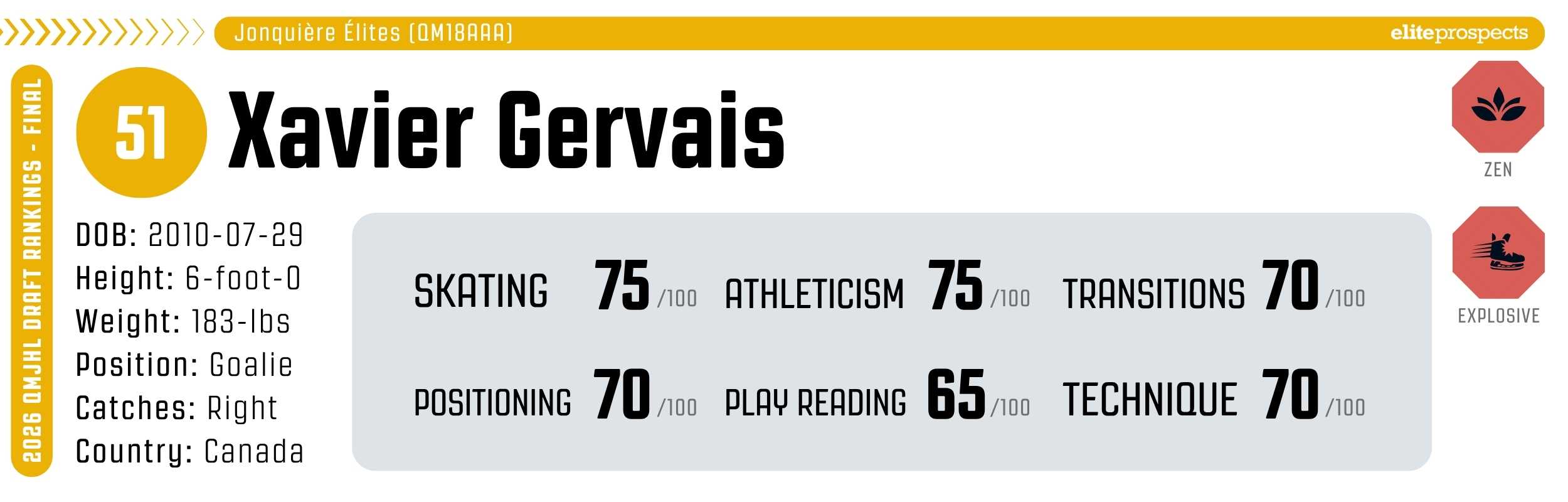
Despite the season statistically not going his way, Xavier Gervais' film paints a very different picture. His toolkit is very well-rounded, with his powerful skating really shining. His consistently strong edgework can be accessed in wide stances and butterflies with little effort to get power. He has a well-crafted stance and is extremely structured and composed in his movement. He’s very efficient, leading his movements with his eyes, taking quick routes, and always pre-scanning to anticipate play. He is also quite flexible and balances his composure with lots of intensity. His main issue has been struggling with screens, slowing his reactions and tracking, resulting in hesitation during saves, leading to some weaker goals. His physical skills, composure, and clear line of sight suggest starter upside, but if he doesn’t overcome his issues with traffic, he may fit better as a backup.
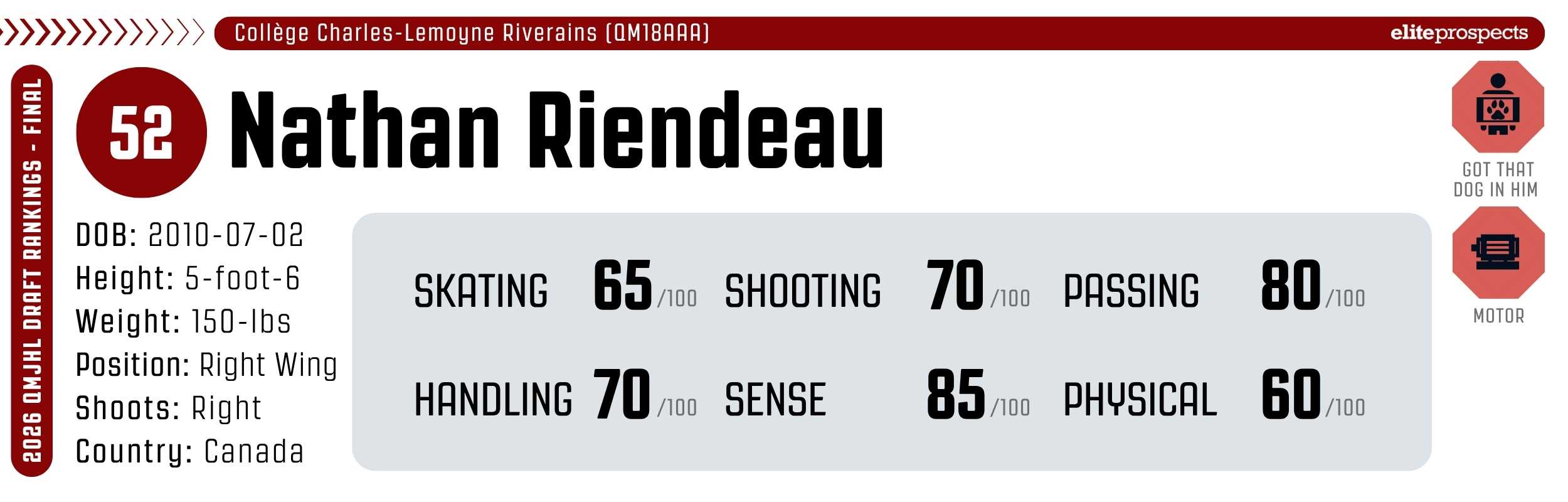
Nathan Riendeau plays like somebody forgot to tell him he is 5-foot-6. Being an undersized forward never prevents him from attacking the middle relentlessly, winning an absurd number of puck battles through a level of intensity rarely seen at this age. Time and time again in our viewings, he turned disadvantageous situations into offensive opportunities through his determination and anticipation. In that sense, what makes Riendeau more than just a high-motor forward is his hockey sense. He is often several steps ahead, has great vision, and connects high-complexity passes. Riendeau simply understands how to create and leverage advantages, and can alternate between high-paced hockey and slower, patient play-driving. Hands down, one of the most entertaining and consistently impactful players this season, and he could well have the same impact in the QMJHL despite his size and skating. The hockey sense and motor might just be enough on their own to compensate. There’s risk in his projection, but he could be a top-six forward in the right landing spot.
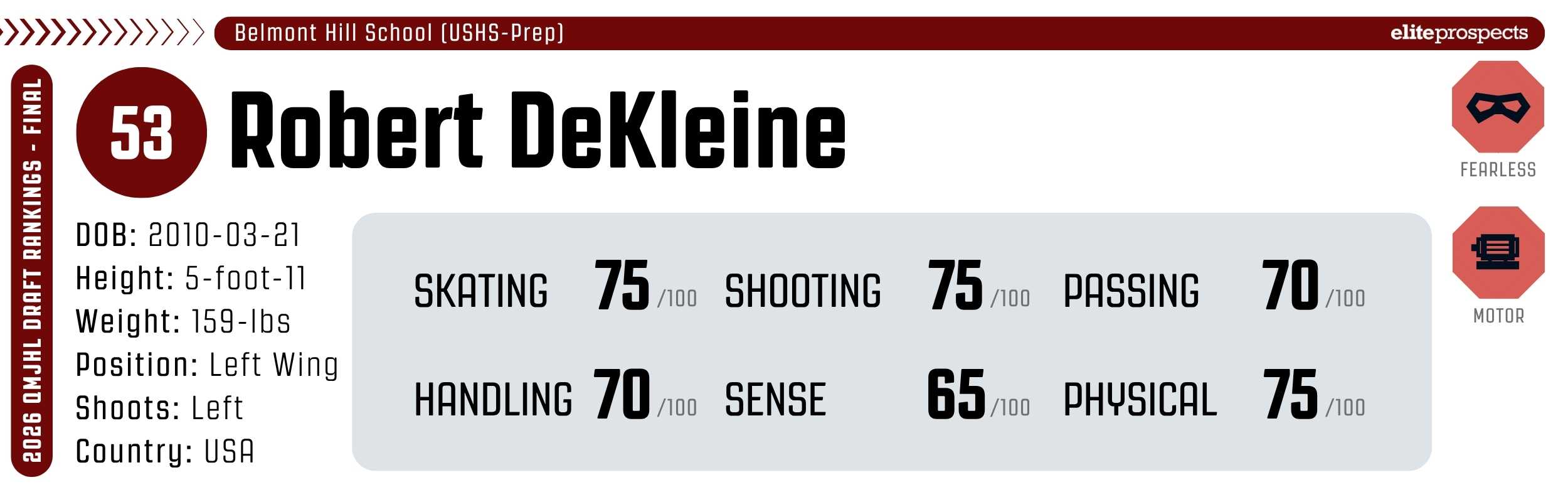
From his first shift of the QMJHL New England showcase in Boston, Robert DeKleine looked bound to draw league interest – and he did, earning a late invitation to the QMJHL Cup in Shawinigan off a noticeable performance. He’s a high-pace, high-motor, pressure-first attacker whose value comes mainly from effort and support details rather than flash. His forechecking is relentless; he hunts pucks with an active stick and finishes his hits no matter what the score or game situation, always giving 100 percent on every shift. Our team thinks there is more skill to be unlocked in DeKleine’s game; he does mix in some dangles, has absurd hand-eye coordination when playing net-front to redirect shots, and succeeds in lots of battles at the prep level. The skating and handling are still a question mark, but his high motor, physical skills, and compete level give us confidence he could be a great complementary piece for a QMJHL team one day.
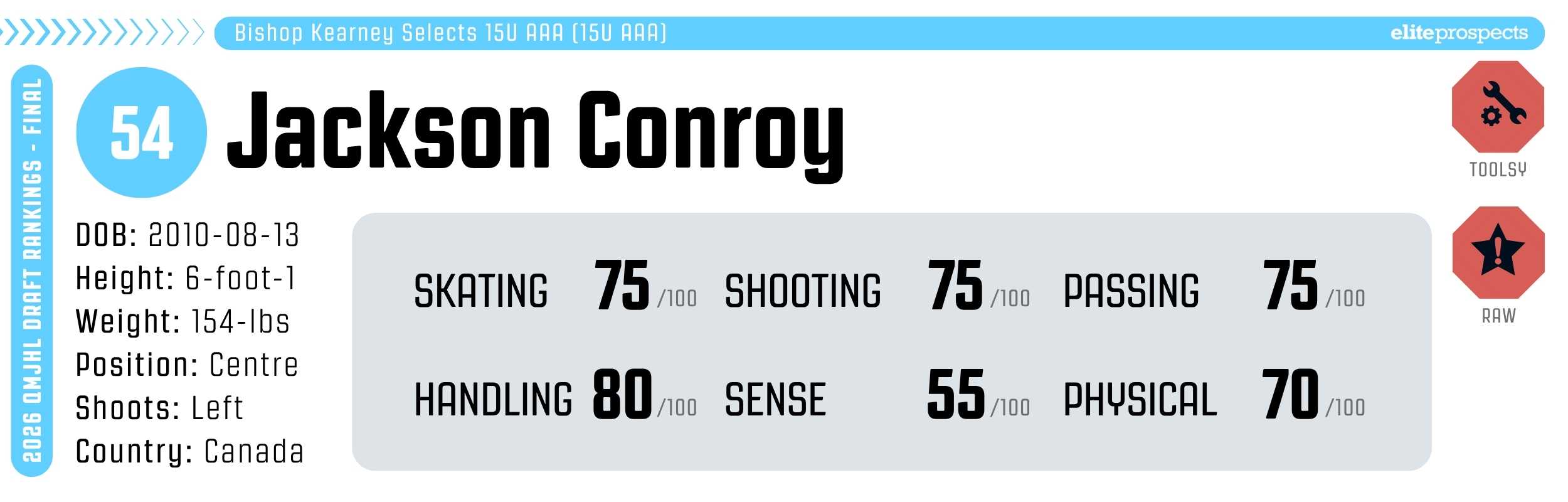
On tools alone, Jackson Conroy would be a clear first-rounder. Explosive off the jump, dextrous off the carry, and able to pick corners in full stride with his release, Conroy has been terrorizing defences in the 15U AAA circuit with his extremely direct offensive style. Meanwhile, he’s showing early flashes of physical skill, trucking through defencemen’s hands on chip-and-chase plays to extend the forecheck and leveraging his edges to protect pucks down low. There is, however, considerable rawness to his game, which makes him more of a long-term project. He attacks in haphazard patterns, overskates his entries in transition instead of delaying or switching gears, and lacks the required on-puck nuance to let those skills fly. He’ll need some time to develop into a scalable offensive creator in the QMJHL, but with the right development, he could be an incredibly potent goal-scorer and line-breaker in a top-six capacity.
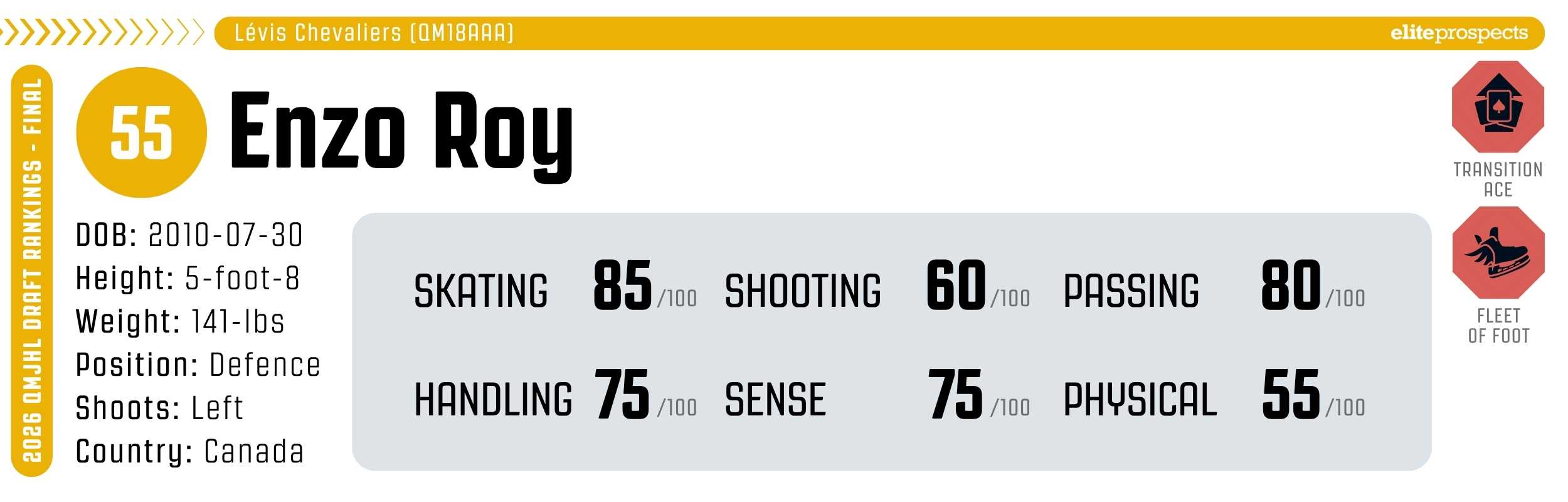
If coast-to-coasts per 60 were a tracked statistic, Enzo Roy would probably lead this draft class. Few defencemen are as eager to carry the puck through open ice and drive transition as he is. A gifted skater, he is not only fast in a straight line but also has impressive four-way mobility. In addition to his flashy carries, Roy is also a high-end passer. He connects sharp stretch passes on breakouts and combines agility and deceptiveness to create plays in the offensive zone. Reading this, it may be difficult to understand why he is ranked this low. The problem is that Roy stands at only 5-foot-8, which significantly hinders his projection, although other undersized defencemen before him have proven size is not always a limitation. Roy’s profile may be more risky – he certainly has room for improvement defensively, physically, and with his consistency – but he is one of the highest-upside blueliners in the class.
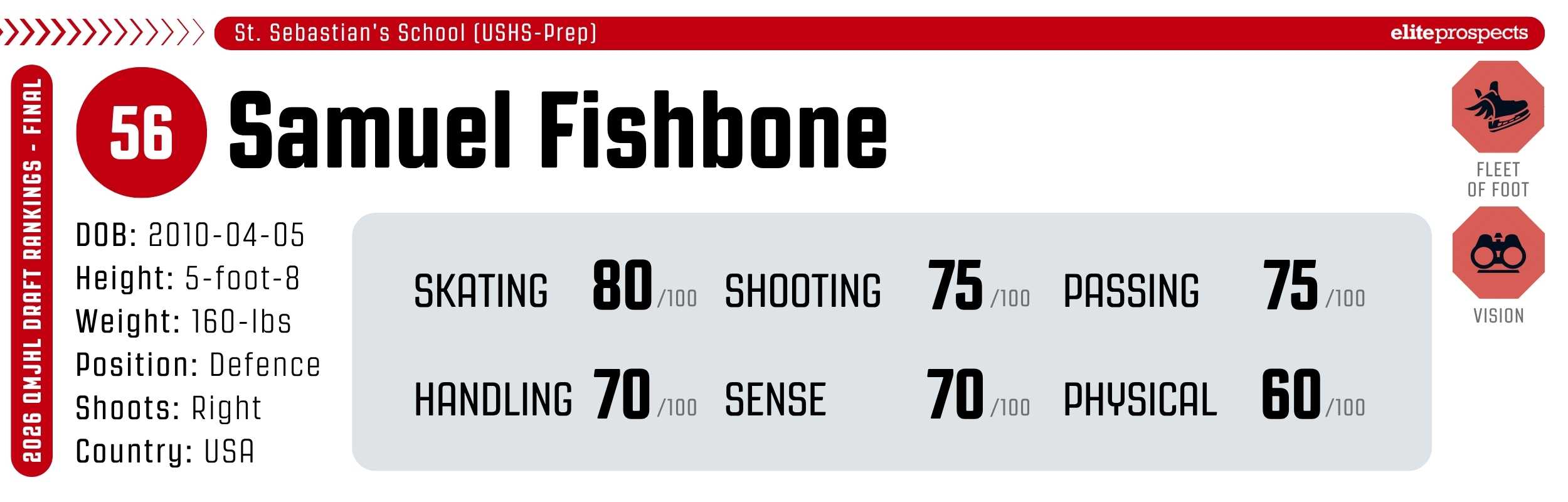
Once Samuel Fishbone got his feet wet this past season with St. Sebastian’s in the NEPSAC, he started to raise his stock rapidly. He’s a right-shot defender with tremendous mobility built on his skating stride, seamlessly through crossovers and cutbacks with his edges. His skating fuels clean retrievals, calm breakout passes, and aggressive rushes. He was one of the more skilled power-play quarterbacks in the region, running the Arrows’ first unit at pace, with a top-tier release through traffic and the vision and deceptiveness to make pre-shot passes for quality setups. Fishbone’s defensive inconsistency is what scouts are wondering if he can fix to reach the QMJHL. If he can continue the physical edge he started to bring towards the end of the year, along with more defensive skills to his arsenal, Fishbone will make the transition to the QMJHL look smooth.
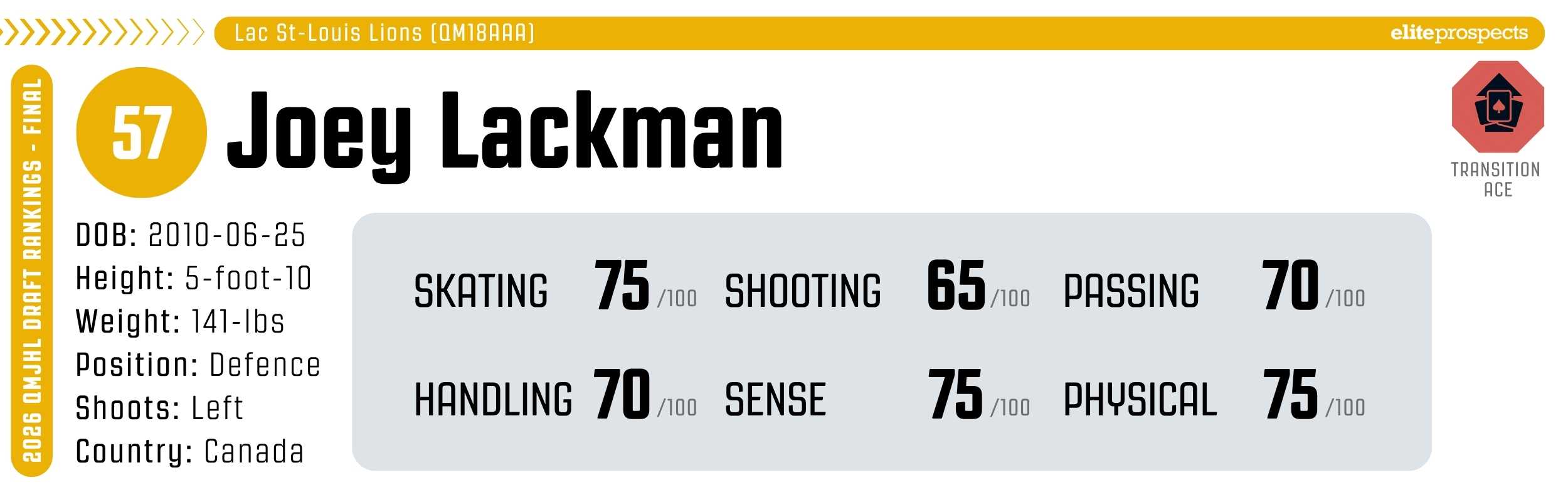
Combining mobility and shutdown skill, Joey Lackman has the foundations of a scalable QMJHL skillset, with flashes of offence to support them. Highly active when facing carriers, Lackman keeps his feet engaged to maintain consistent gaps, pushes carriers to the outside, and then pins them to the wall with impressive mechanics. He activates comfortably to join attacks as the second wave, and his offensive-zone support game is refined. Always seeking the next play out of pass receptions, he quickly sets up teammates down the wall, and has shown in flashes the ability to hit seams from the point. While he remains relatively raw in terms of his decision-making and confidence, Lackman could get more comfortable making plays through contact as he fills out his frame, which would unlock even further on-puck ease and poise. He offers a good blend of safety and upside, and could be picked much higher than we have him.
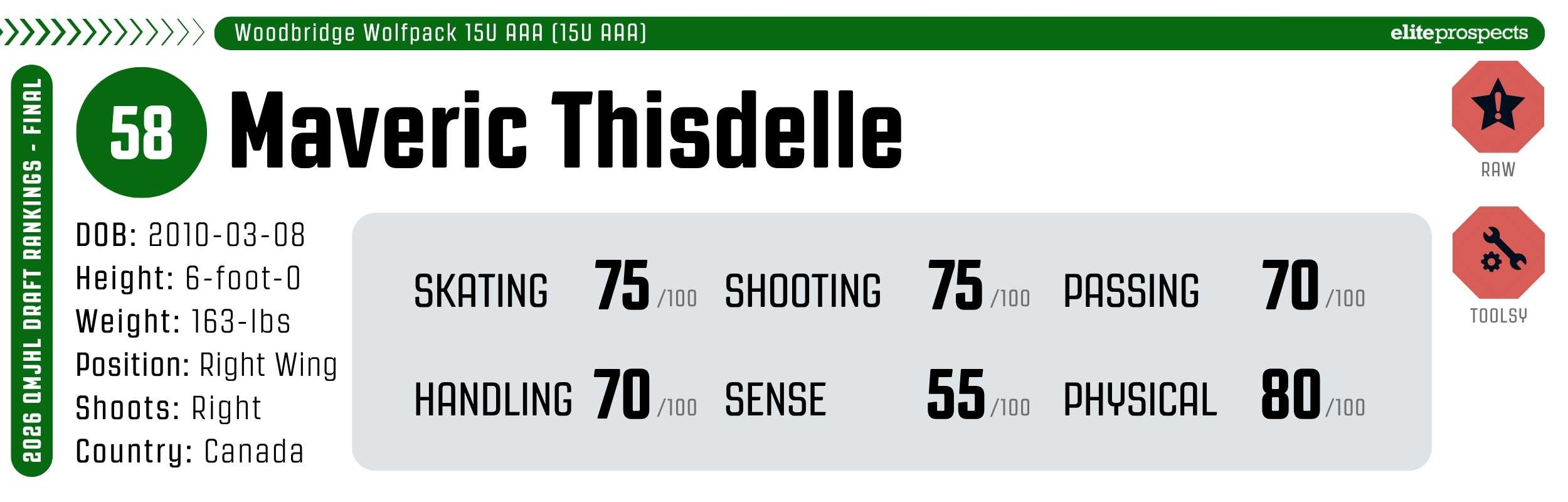
A creative, offensively inclined forward, Maveric Thisdelle shows that his impact grows the more involved he becomes. His value lives in the offensive zone, where he shows real skill and patience as a playmaker, manipulating defenders, delaying the rush to open up lanes, and setting up teammates in dangerous areas of the ice. There are clear flashes of creativity in his handling and deception, hinting at untapped potential. His shot is a clear QMJHL-calibre tool as well, with a tremendous release off the pass, along with nifty work off the backhand in tight. His skating is quite good for his size – he moves well with crafty edgework – but he needs to work on his competitiveness and improve his processing to become an impactful QMJHLer. With the combo of size and skating, there is a chance he becomes a middle-six forward in the QMJHL.
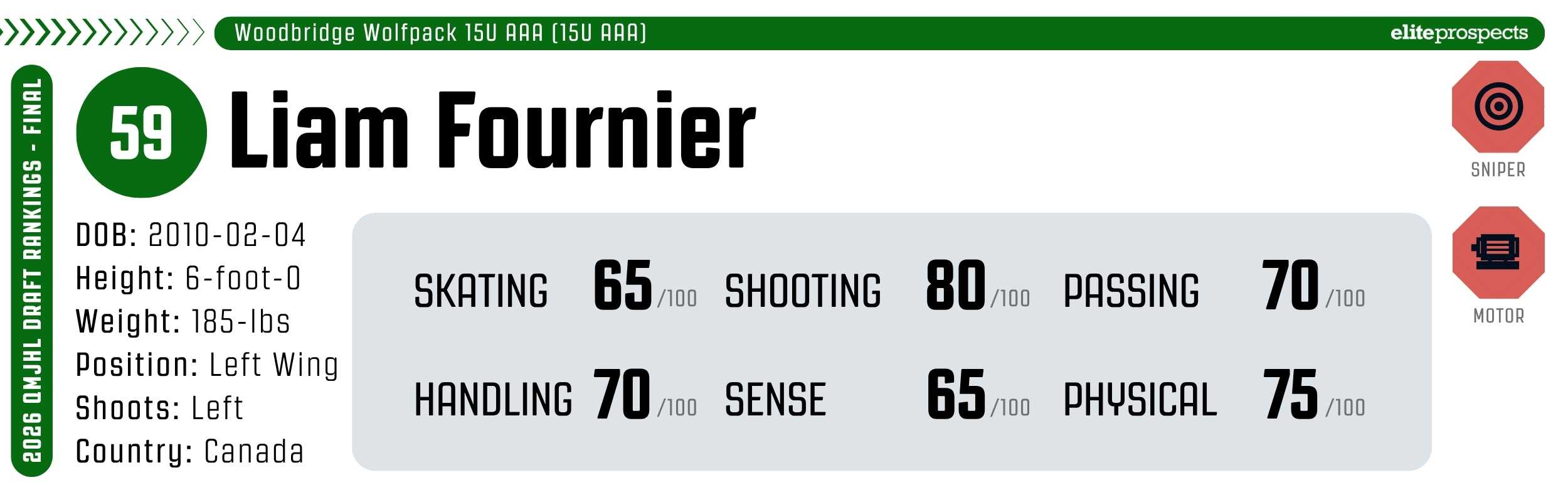
Right from the jump, Liam Fournier looked like the high-energy, goal-scoring attacker who can slot into any part of a QMJHL lineup. His hockey sense and motor set him apart, as he finds open ice with smart, deceptive movement off the cycle and rush, then lets his release take over. He’s a very dangerous threat off the pass; he loads up off cross-ice feeds, which makes him a real weapon on the power play, along with flashing vision to make backdoor setups when gaining speed. The clear development area is his skating; a narrow base and hunched posture could limit him through contact at the next level. Despite his high creativity, Fournier holds a USHL tender with Cedar Rapids and will likely land there first, which is why he’s a bit lower in our ranking. However, if a QMJHL team is confident it can convince him to join its squad, this would be a tremendous get for them.
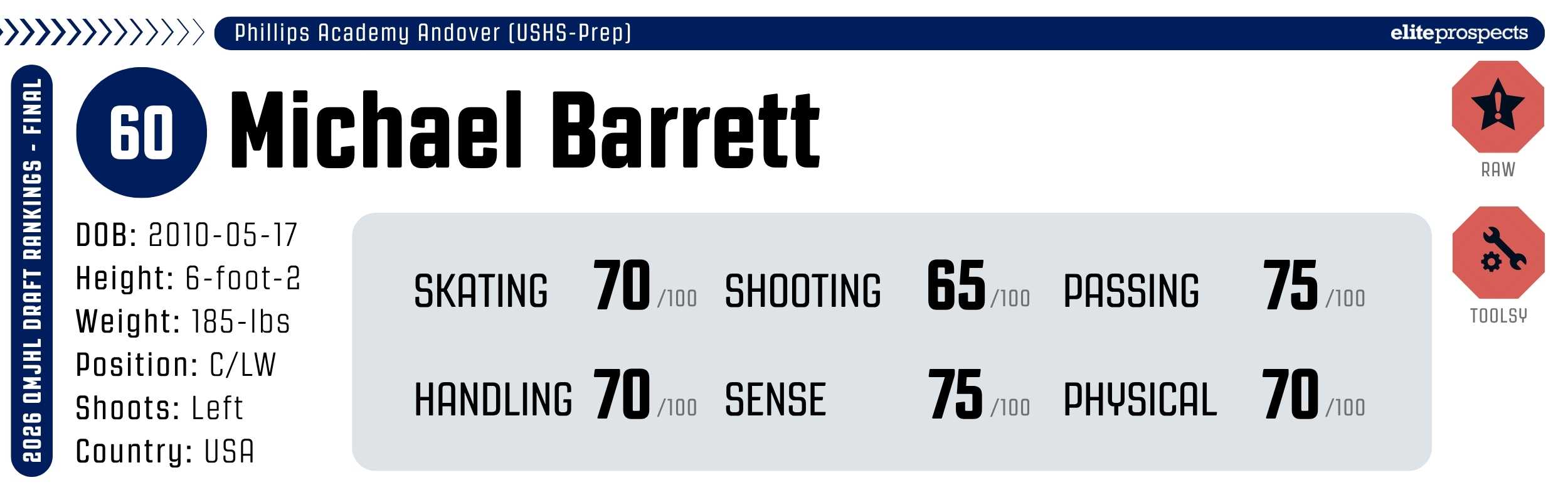
Michael Barrett is still not fully unlocked, but the tools and instincts underneath are real. He’s a physical, two-way forward who thrives below the goal line, hounding pucks and using his size effectively on the forecheck to create chaos for the opponent. An intelligent wall player, Barrett reads passing lanes off board retrievals and feeds quick, accurate feeds to teammates joining the rush. Despite his off-puck reads, he wasn’t utilized much on the penalty kill this year with Andover, but we think he has the tools and reads to do it well. He does need to ramp up his shot volume to become more of a finisher – he shows flashes of becoming a natural shooter with his release and shooting angle, but we’d like to see more of those flashes. At 6-foot-2 with a strong hockey IQ and a mix of physical skills, a team will mainly be betting on his untapped potential to develop quickly, as it’s still difficult to pinpoint what role he would fit in the QMJHL. An exciting bet in the early-to-mid rounds of the draft.
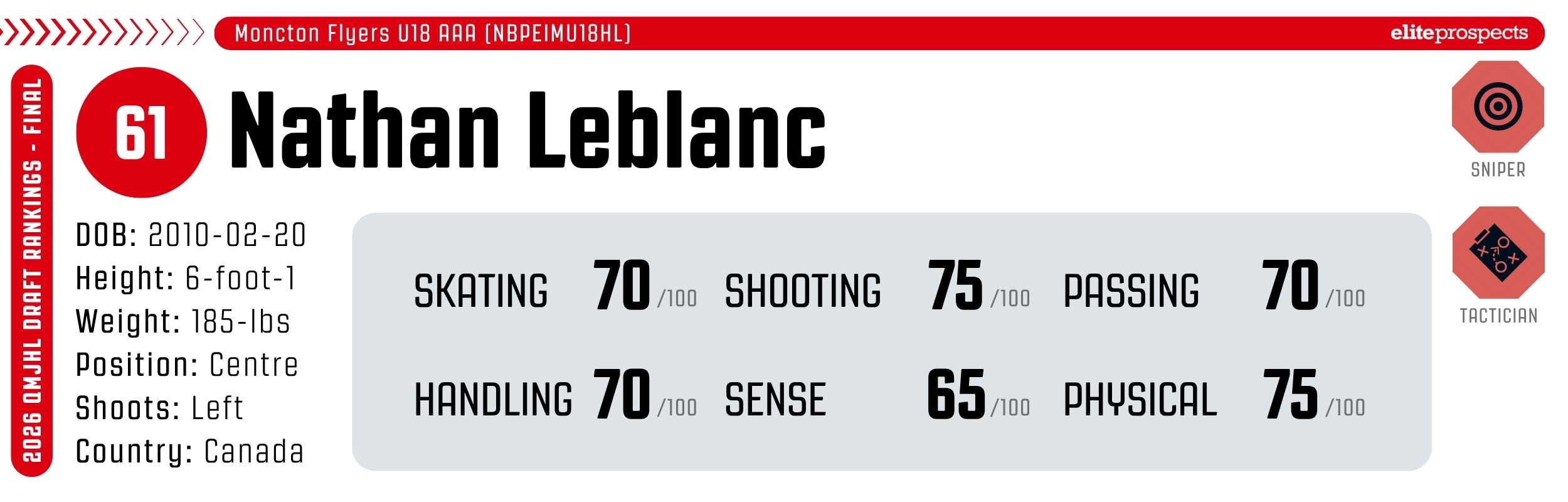
Nathan Leblanc led the NBPEIMU18HL in draft-eligible goal-scoring this season, and one look at his snipe of a shot shows you why. His release and shot placement are impressive, not to mention off-puck routes to find scoring position in the offensive zone. His game flows through high pace and quick decisions that keep the game high-event when he’s on the ice, and his quick processing is a large part of how he scores and otherwise creates offence. His vision falters when he’s carrying the puck, and recurring on-puck decision-making concerns are why he’s dropped out of our top 50. Still, Leblanc’s work rate and scoring prowess make him an intriguing mid-round option, with high upside as a scorer and transition carrier if his situational awareness improves.
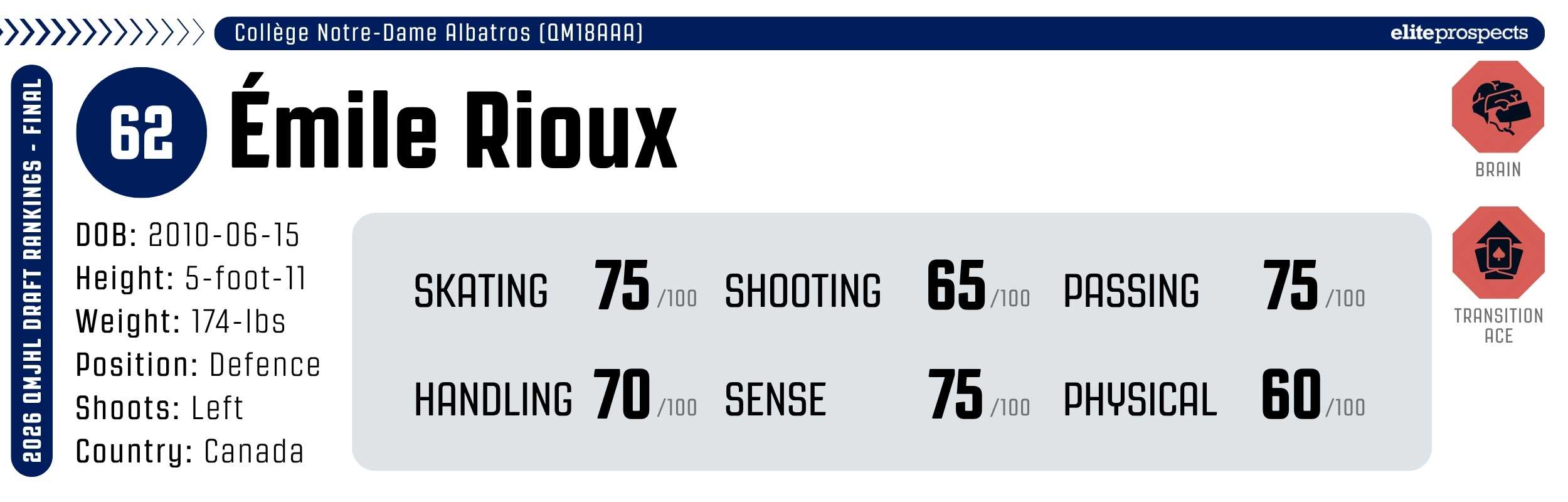
A two-way transition specialist with an undercurrent of poise and safety to his game, Émile Rioux leverages his awareness to its full extent every chance he gets. Defensively, he reads opponents’ intentions proactively, almost prescient in his ability to anticipate and predict them. He mirrors them perfectly when they try to cut across him, keeping his stick to the inside while closing space and adjusting its placement on the fly. Highly adaptable and willing to draw pressure to make a play, Rioux shines on the breakout, where his constant scanning and great processing allow him to quickly connect with his forwards up the ice without taking unnecessary risks, even when pressured intensely. While he’ll need to develop his physical tools, either by taking his skating foundation up a notch or adding muscle, or both, he has a QMJHL brain and will likely end up playing middle-pairing minutes as a smart transition specialist, with potential value on both special teams.
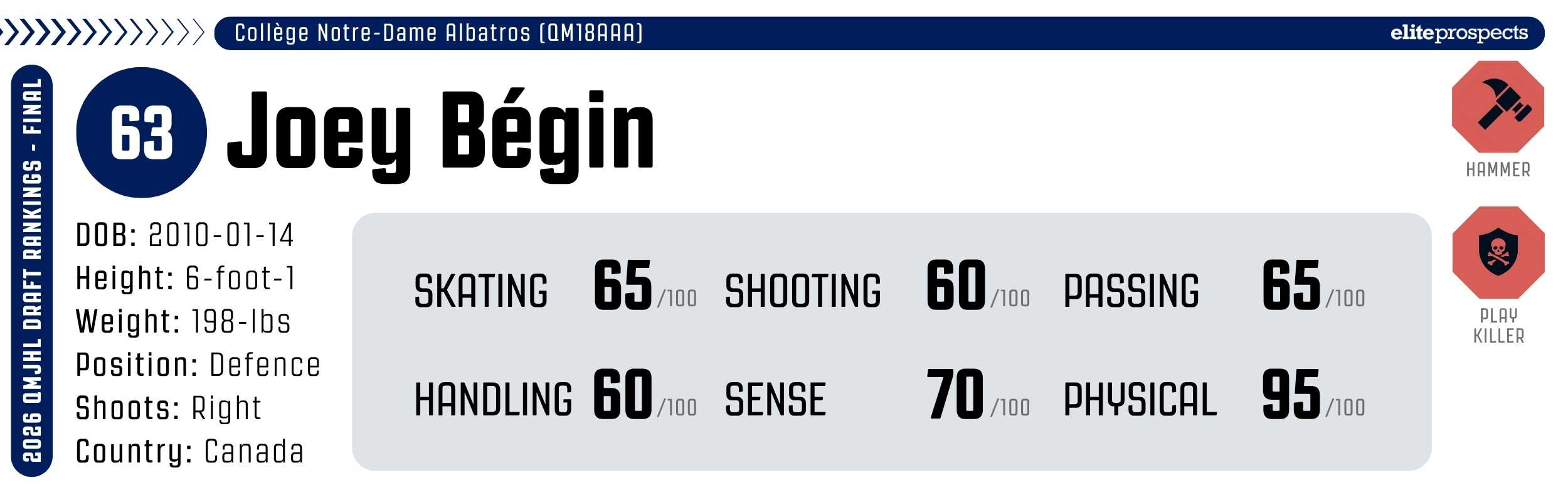
Ranking the most violent defencemen in this class, Joey Bégin would be near the top. A 6-foot-1, fearless, shutdown defenceman, who already possesses the frame and many of the habits required to play at a higher level. A fierce competitor, he boxes players out, blocks shots, and delivers bruising hits along the wall, making life difficult for his opponents. His offensive game remains fairly simple, like many players of this archetype, but he shows composure on retrievals and glimpses of breakout ability. Bégin’s combination of size and competitiveness gives him a strong chance of carving out a role in the QMJHL, where he projects as a hard-nosed, defensive-minded blueliner.
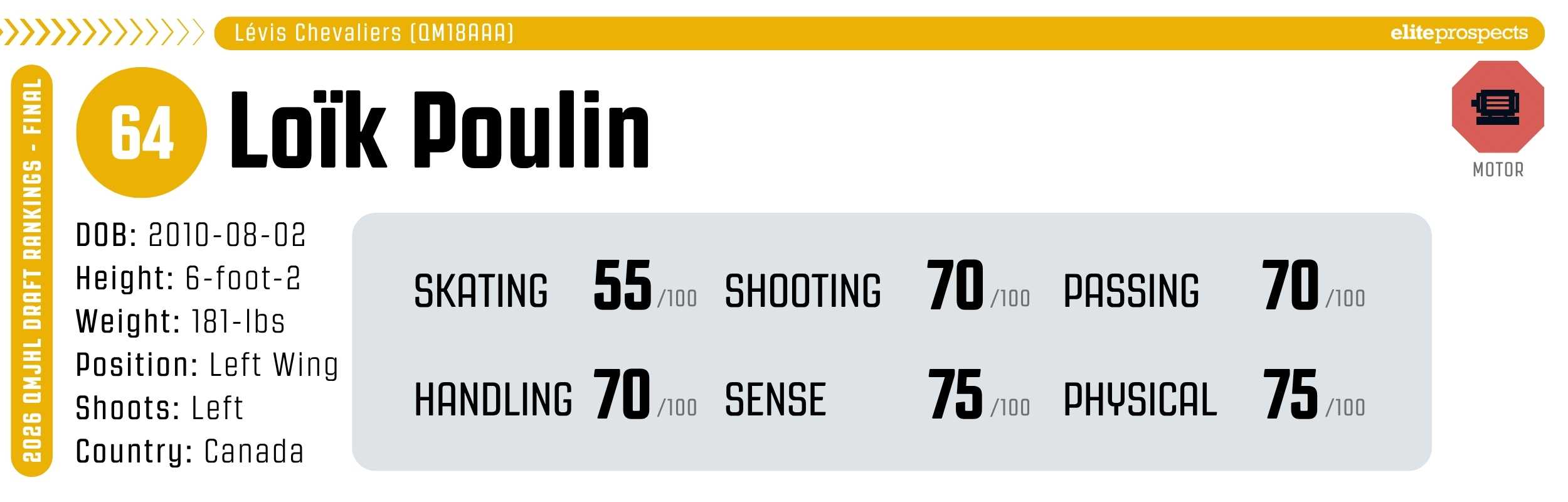
A 6-foot-2 forward with a sturdy checking game, Loïk Poulin never shies away from the tracks and actively seeks out contact along the wall. He is at his best when working the cycle, protecting pucks down low, and repositioning away from the puck to crash high-danger areas. There are some glimpses of transition intelligence in his game, as he takes most of his zone-entry touches straight to the inside, seeking to delay from there and create passing lanes. Poulin’s skating limitations shape a lot of his offensive habits, as he can’t quite explode into open ice and is instead forced to manipulate defencemen through angling and routes instead. He leverages his reach well to circumvent the need to separate with speed, and he can shoot or pass outside his wheelhouse fairly comfortably from those positions. He’ll need mechanical refinement, but Poulin wouldn’t be the first mechanically limited scorer to make that particular style of offence work as a middle-six QMJHL checking scorer.
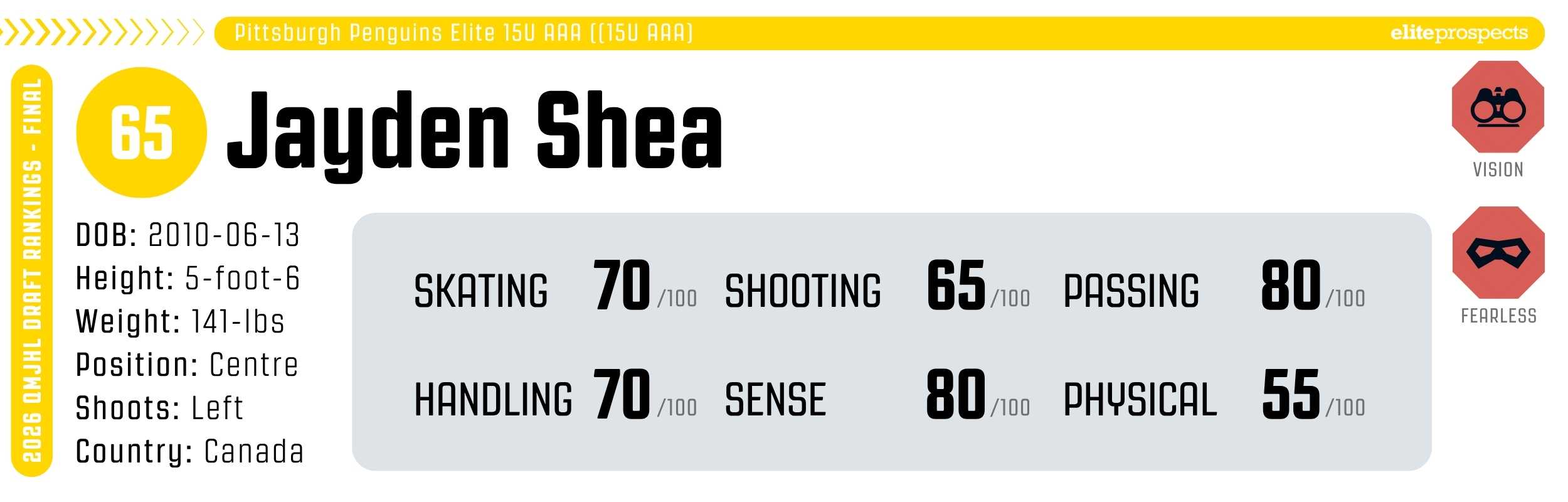
A fearless forward with leadership qualities and refined playmaking, Jayden Shea elevates most around him through a selfless and collective game. Constant scanning and a dextrous skill base elevate his passing range and allow him to find teammates through closing lanes and in spite of hard pressure. He circumvents his size concerns by staying a step ahead offensively, but on occasions that require contact, he has enough strength to withstand attempts to knock him off balance. Still, with a stride that lacks depth and a considerably undersized frame, the plays he can access are already quite limited, and will be even more so in the QMJHL. His projection is nebulous, but the payoff could be a top-six playmaker who will wear a letter. The fourth round is a good landing spot for his profile, in our estimation.
.jpg)
Olivier Lafrenière had to jump ship twice this season in the 15U AAA circuit before landing with the Woodbridge Wolfpack, but his identity never wavered. Constantly involved in wall battles and willing to engage physically despite his diminutive frame, he pesters defencemen, passes under their arms as they try to protect, and squeezes himself into advantageous positions before cycling pucks into teammates’ paths. A projectable release sits atop his toolbag, and he fires at will when attacking downhill. Chaining together rapid decisions, Lafrenière’s functional pace makes him a constant threat, even if his handling skill and speed sometimes don’t quite keep up. If he were half a foot taller, he’d be a clear-cut first-rounder, but his size gets in the way of his identity at times, which slightly muddies his top-nine projection. Still, we’re confident he finds a home as a hard-working checker in the QMJHL.
.jpg)
Axel Bolduc’s identity as an aggressive shutdown presence with refined defensive details makes him a logical fit in this range. He is borderline violent at the net front, hacking and shoving anyone who dares try to screen his netminder, but also displays projectable rush composure, toeing the line well between aggressive gap closing and angling with control. Fairly limited as a puck-mover, Bolduc opts for simple and effective board plays to create exits, supporting any ensuing battles with his high defensive motor and positional safety. He plays a clear role, sticks to his guns, takes available space in transition without putting his team at risk, and stays connected inside structure. With a bit of mechanical upscaling, he’ll be a highly competent and contagiously competitive wrecker.
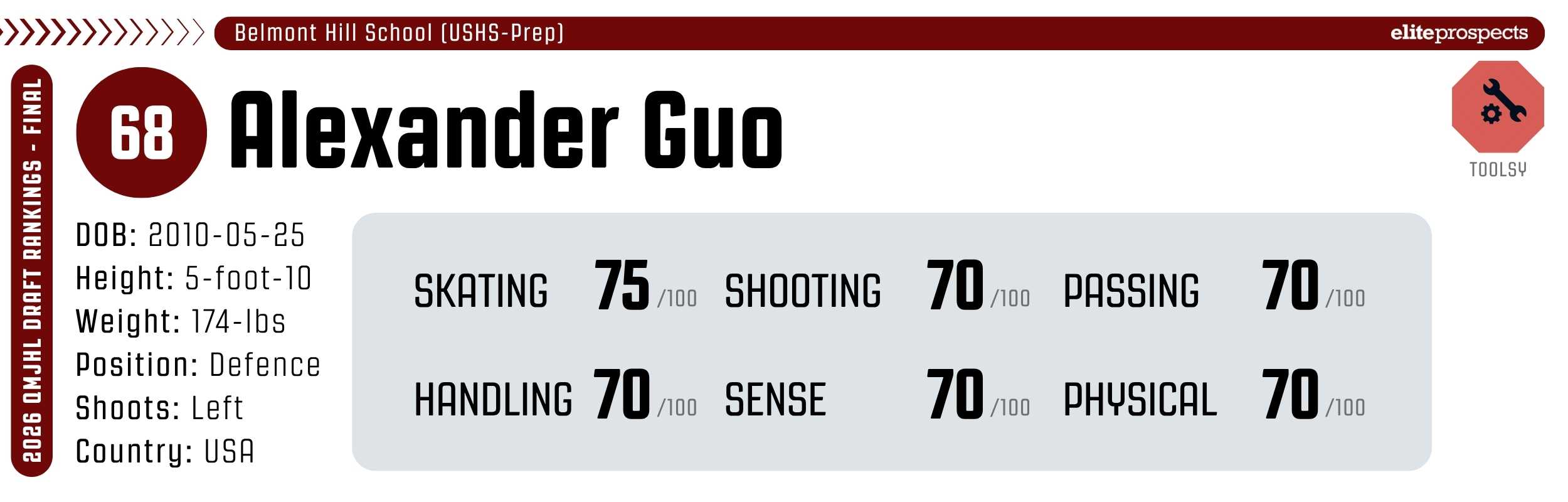
It felt like most of the year, you knew what you were getting out with Alexander Guo. He’s the steadying defender on a back end; a calm, cerebral defender who quiets games rather than chasing them. His brain and stick do the heavy lifting: he reads the rush a step early, clears out possession with a tight gap and active stick-checking, and isn’t shy to box out or tie up sticks. He’s also a neat shot-blocker, not afraid to get his leg or stick in front of shots in the slot. Quite patient under pressure, clean on retrievals, and trusted with the first pass that gets the breakout going with ease, Guo’s offence won’t jump off the page, but he shows some flashes. He probably doesn’t project to run a power play in the QMJHL and needs to develop consistency, but Guo could be trusted as a stable defender on a middle pairing.
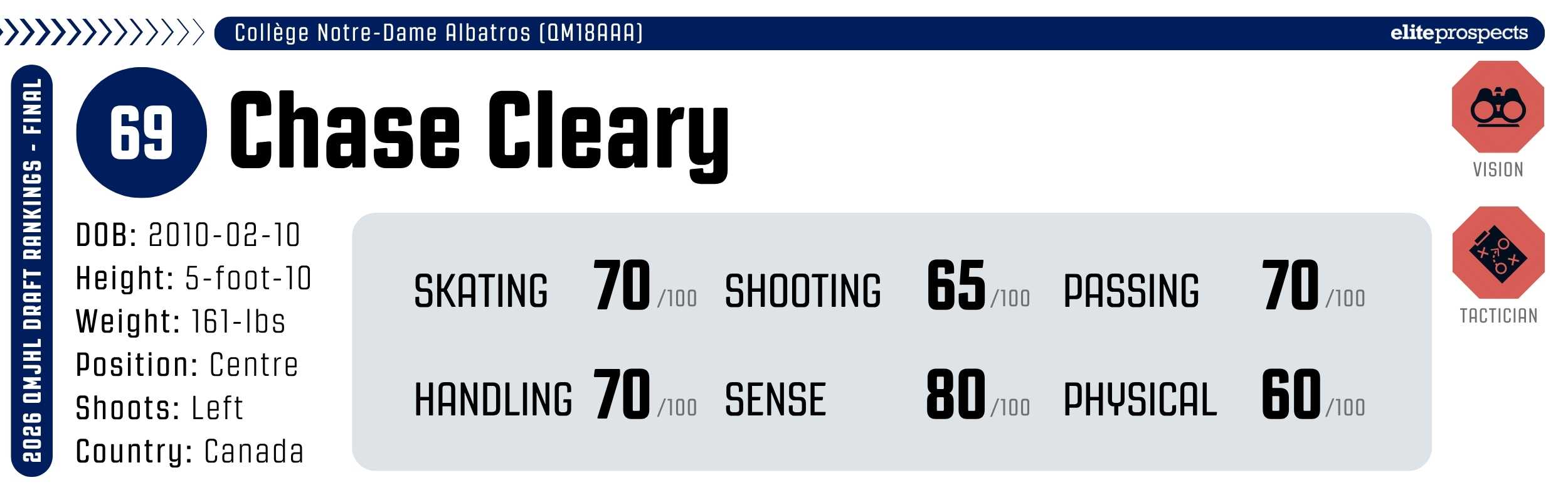
Chase Cleary is one of the smartest off-puck forwards in this draft class. He excels at finding pockets of space in scoring areas, sneaking behind defenders, and playing as the trailer. His skating and puckhandling complement that intelligence well, allowing him to evade pressure, make plays in tight areas, vary the tempo, and connect with teammates through difficult passing lanes. He also flashes some creativity as a playmaker, identifying opportunities that many players at this level simply do not see. Improving his pace, strength, and contact skills will be key in his development, as he tends to get pushed off pucks too easily at the moment. Unlocking these additional layers would help him become a productive middle-six forward at the QMJHL level.
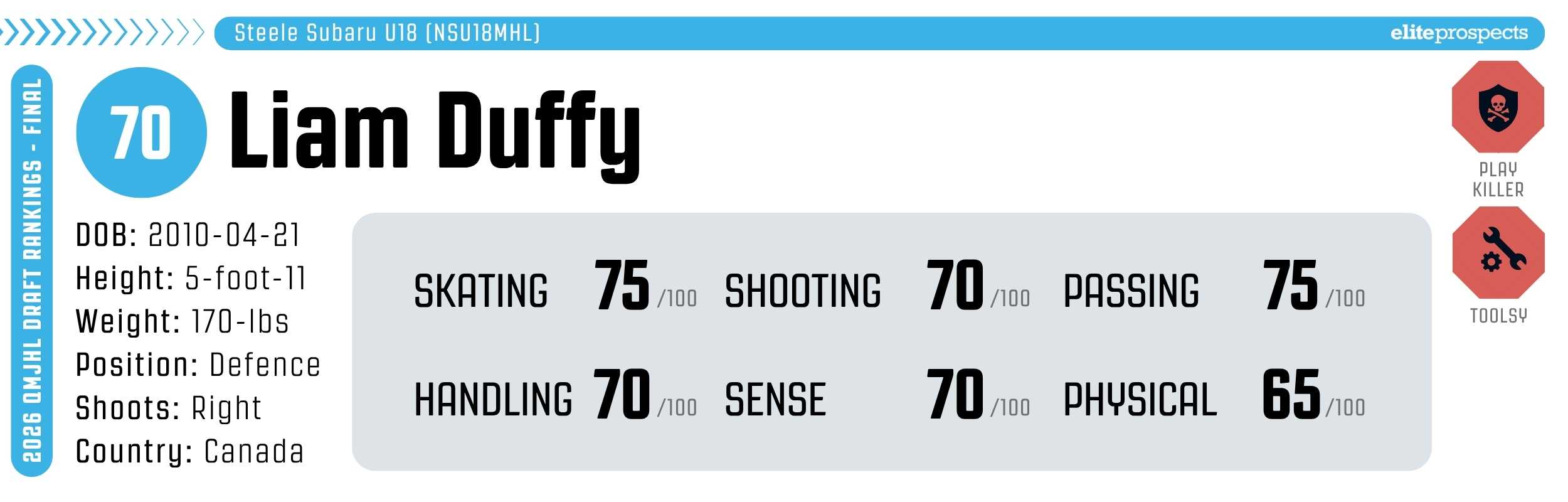
On a young Steele Subaru team with plenty of 2026 QMJHL Draft-eligible players, Liam Duffy stands out as a toolsy and incredibly capable defenceman. He’s calm and consistent in the staples of the defensive game: retrieving pucks with the preceding scans necessary to act on arrival with a solo recovery or a rim pass, being aggressive and forcing dump-ins at the line, and moving pucks through the neutral zone regardless of transitionary pressure. He lands at 70th without the layered defensive details of the shutdown defencemen ahead of him, but it’s not a foregone conclusion that Duffy can’t add those. He has legitimate top-four upside.
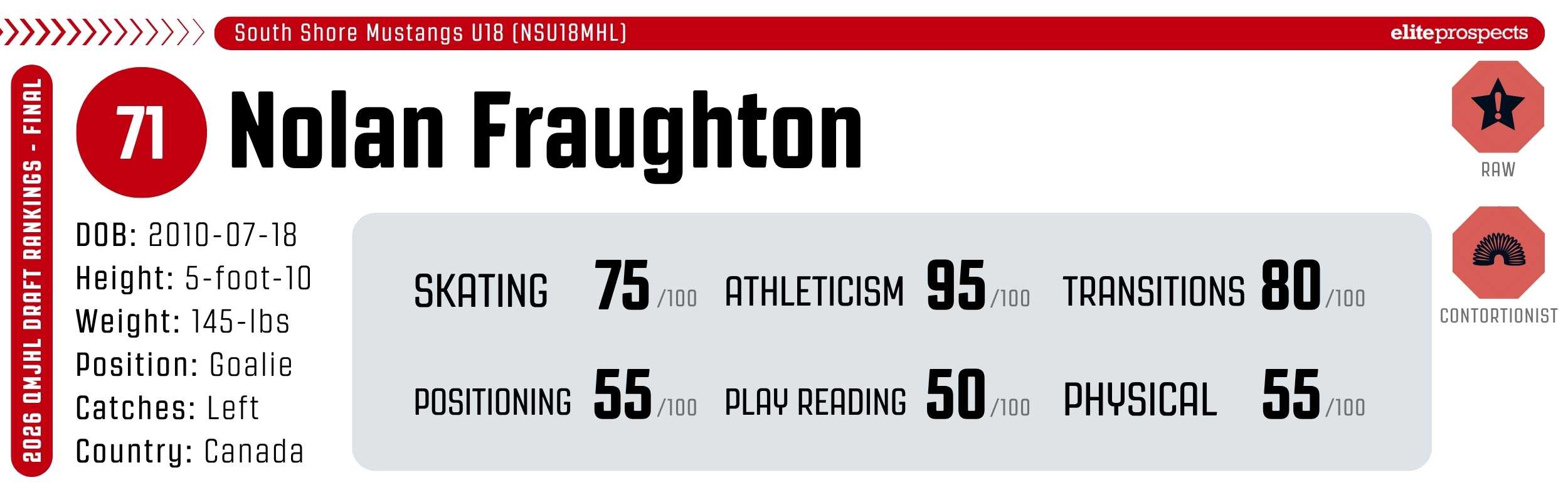
There may be a lot of skepticism about Nolan Fraughton as a fourth-round prospect, being a member of the five-win South Shore Mustangs. However, it only takes a few short clips to see that Fraughton is brimming with unreal raw potential. His flexibility, mobility, and explosiveness are so high-end that they fit the profile of a high-end NHL prospect more than a QMJHL one. He’s also a great skater with quick feet and strong edges that help him gain impressive control over his rampant physical talent. Though concerns have been raised thanks to the nature of his situation, as the nearly 50 shots per game he faces facilitated an erratic playstyle that does not project well, Fraughton has shown enough flashes of a calmer, technical game, giving us confidence that if handled properly, his elite ceiling may actually be reachable and not just a pipe dream.
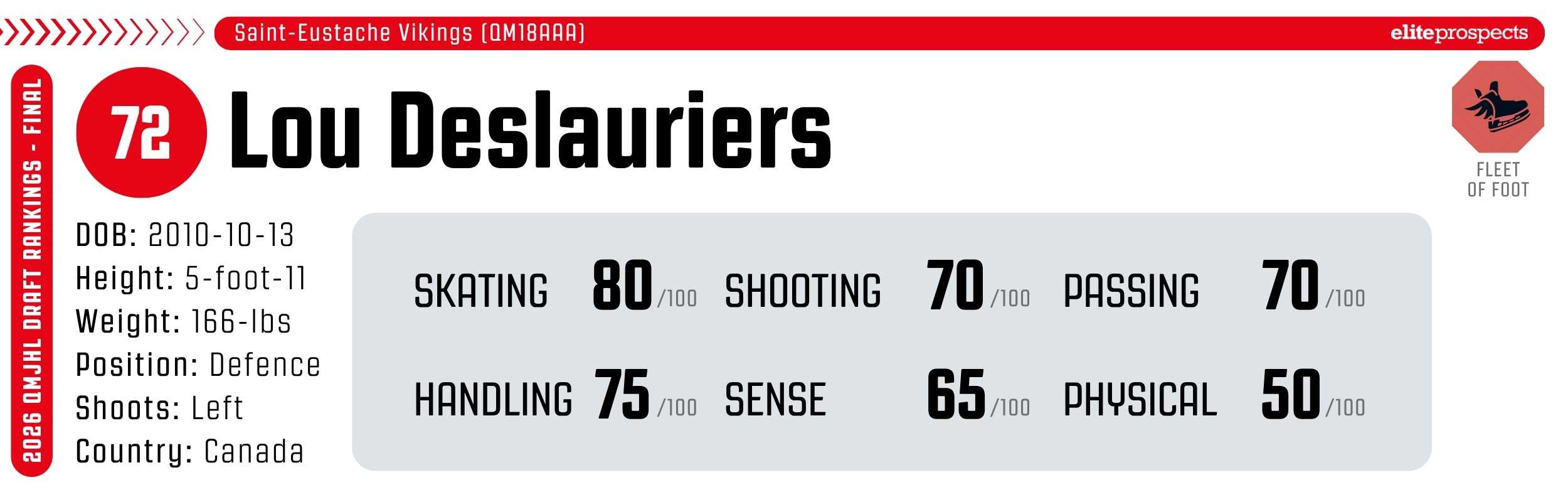
Lou Deslauriers is the exact kind of profile that could make us all look silly in hindsight. As a late 2010 birthday, Delsauriers is already one of the class’s more elusive and dynamic puck carriers from the back end. He shows impressive handling and skating in transition, manipulating defenders with his hands and feet to carry the puck up ice and to break in the zone. He’s also rather poised with the puck, making smart passes under pressure. Defensively, he’s shown that he has good gap control and uses his stick to disrupt play versus the rush. It will be integral for him to clean up his reads as he moves forward to reach a possible top-four projection, as he tends to pinch far too often defensively and opts for more chaotic and adventurous passes without pressure. A more effective in-zone defensive game could be what seals the deal.
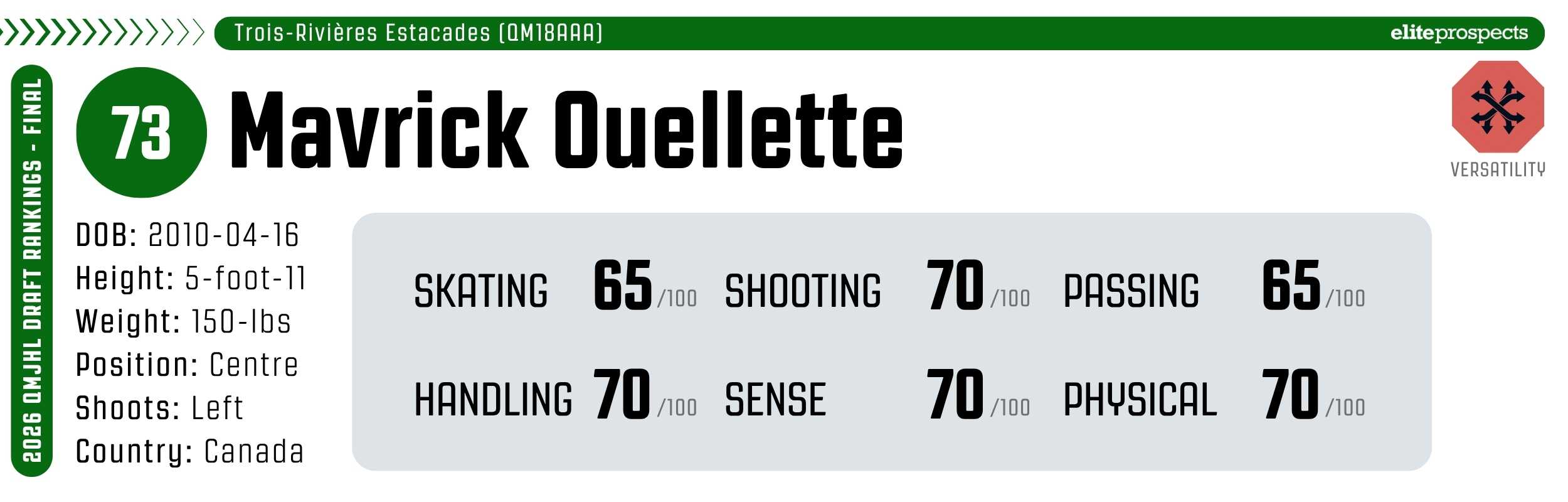
An industrious centre with a knack for winning battles in open ice, Mavrick Ouellette is a constant backchecking threat. Opponents who fail to look over their shoulder are bound to lose the puck when he is on the ice, and even when they spot him and try to escape his grasp, he engages his edges well and drives into their hands on cutbacks, pins them to the wall, and shuffles his feet into position to force the puck to open teammates. His defensive game is refined, with a solid base of shutdown reads allowing him to quickly identify gaps in coverage and beat opposing forwards to his mark. We’ve even seen him clear the net front on a few occasions when his defencemen ventured outside the dots to intercept cycling forwards. His upside is limited by his lack of on-puck fluidity and creativity, but he plays a straightforward game that should translate well to the QMJHL.
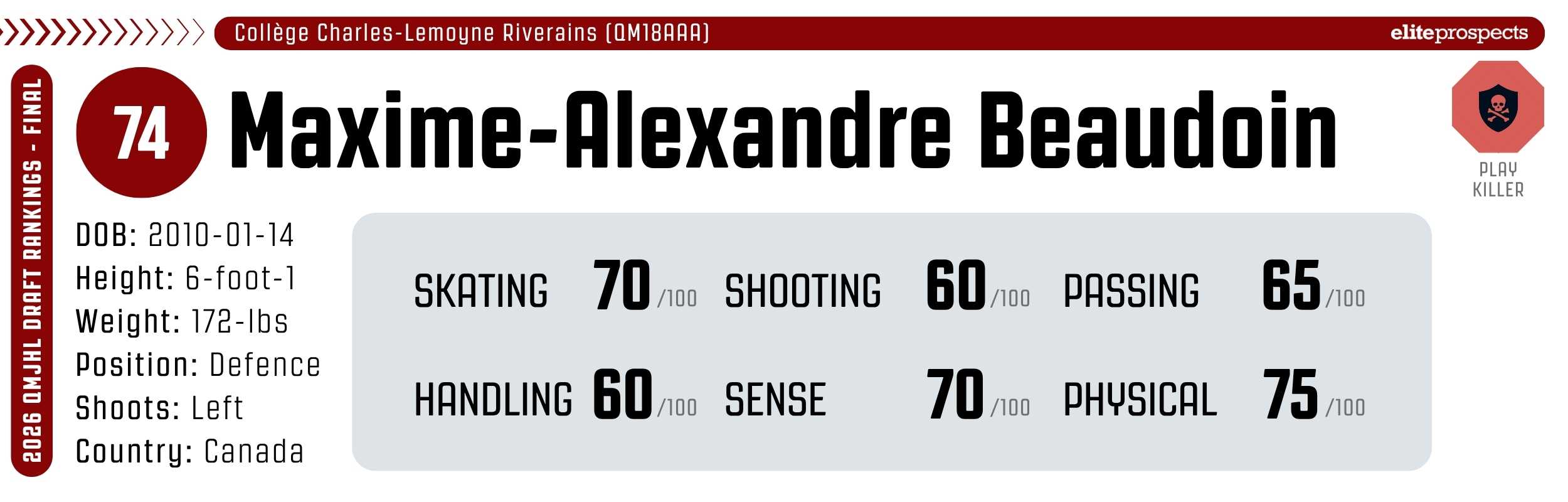
At this stage of our rankings, no defenceman comes close to Maxime-Alexandre Beaudoin in terms of shutdown tools. A patient stopgap with sound skating, he times his pivots into carriers’ paths, waiting for them to commit before taking away their options from there. He has the building blocks of an offensive game in his coordination and willingness to activate, but far too often, he backs out of rushes before those chances can materialize into something more. Preferring efficiency over risk, he keeps his wall plays short and sweet, quickly lobbing passes to open teammates. His decisions are hit-or-miss defensively, with the occasional passive gap offering time and space to opponents, but when he plays with confidence and decisiveness, few QM18AAA carriers can overcome him. He has the tools to play an insulator role in a second-pair capacity, especially if he can find that on-puck confidence consistently.
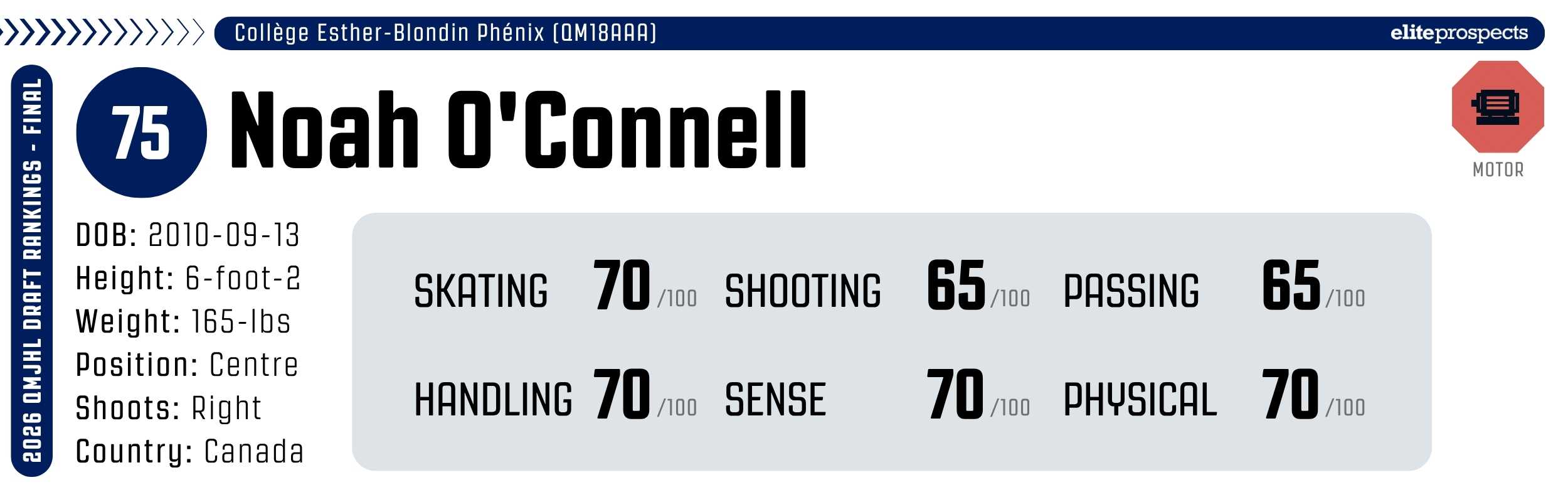
A powerful centre with both a refined positional game and flashes of skill to back them up, Noah O’Connell rarely takes a shift off. He backchecks with purpose, driving into carriers’ paths to knock them off course and engaging them along the wall. Once he secures the puck, he takes off in calculated patterns, driving across defenders’ toes in transition and baiting them into closing space with delays before cutting back across the grain to find trailers. While mechanically flawed, his skating carries power and relative stability, allowing him to operate as a playmaker at higher speeds without risking dispossession. Leaning into contact plays more frequently could unlock a layer of checking offence, as he has the motor skills to turn changes of possession into backdoor feeds from down low.
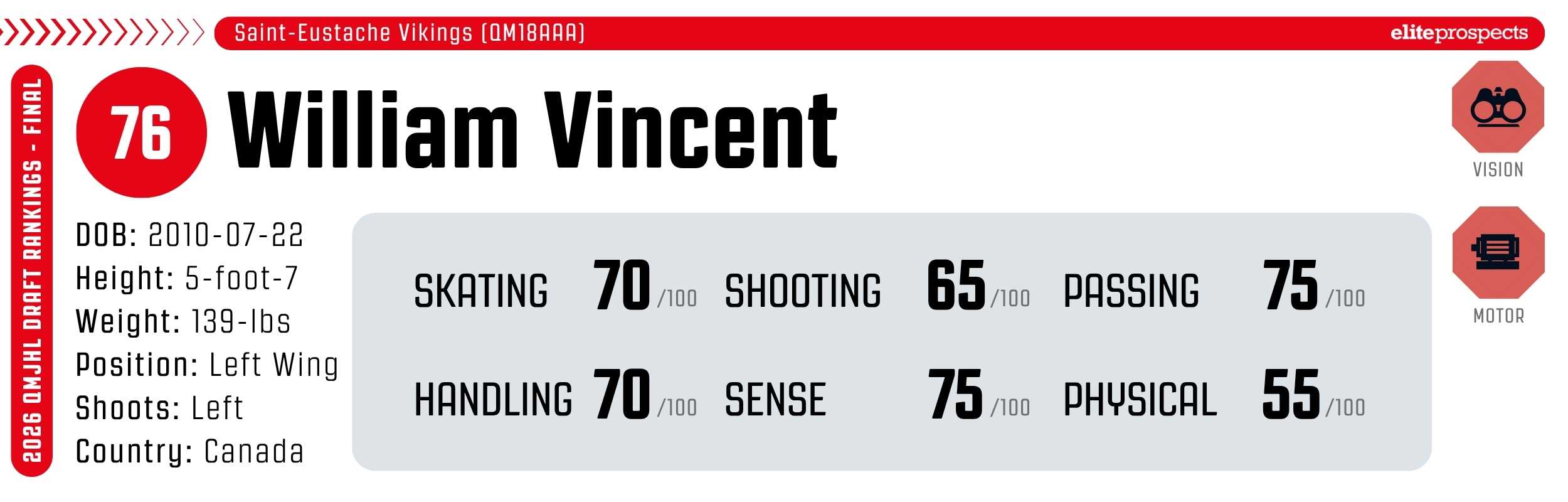
It’s easy to fall in love with a prospect like William Vincent. A high-motor, up-and-down winger with high-end puckhandling, he’s been a transition demon, getting the puck into the offensive zone with consistency. He also uses some simple deception through transition stop-ups to open up space for passes to players joining him on the rush. Vincent also uses his smarts to create offence, finding seams to the slot. With a 5-foot-7 frame, he’s got surprisingly solid puck protection and contact skills, bumping off defenders and keeping himself in between the puck and pressure. Though his speed and contact skills tend to falter against bigger, faster competition, Vincent is an easy projection for a forechecking, two-way winger role, with his smarts and handling helping him into a middle-six projection. If he can become even more contact-resistant, whether through continued growth or better leverage, there could be more room to unlock.
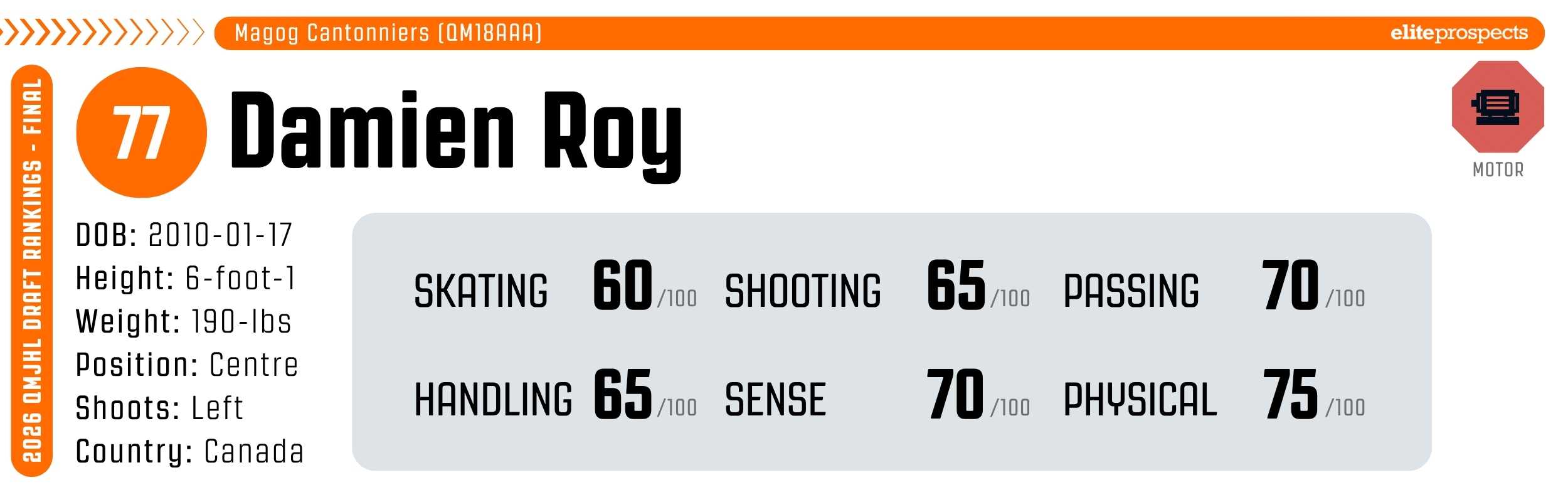
Damien Roy is a physically mature forward with a strong frame who consistently impacts games through his competitiveness, defensive habits, and ability to win battles. Roy excels at gaining inside positioning, using his reach effectively, and recovering loose pucks. While his offensive game remains a work in progress, he flashed intriguing playmaking ideas, made plays off the wall, threaded passes through traffic, and played a promising cycle game. He moves well in a straight line, which helps him on the backcheck, but he would benefit from adding agility. Roy projects as a reliable, two-way forward at the next level.
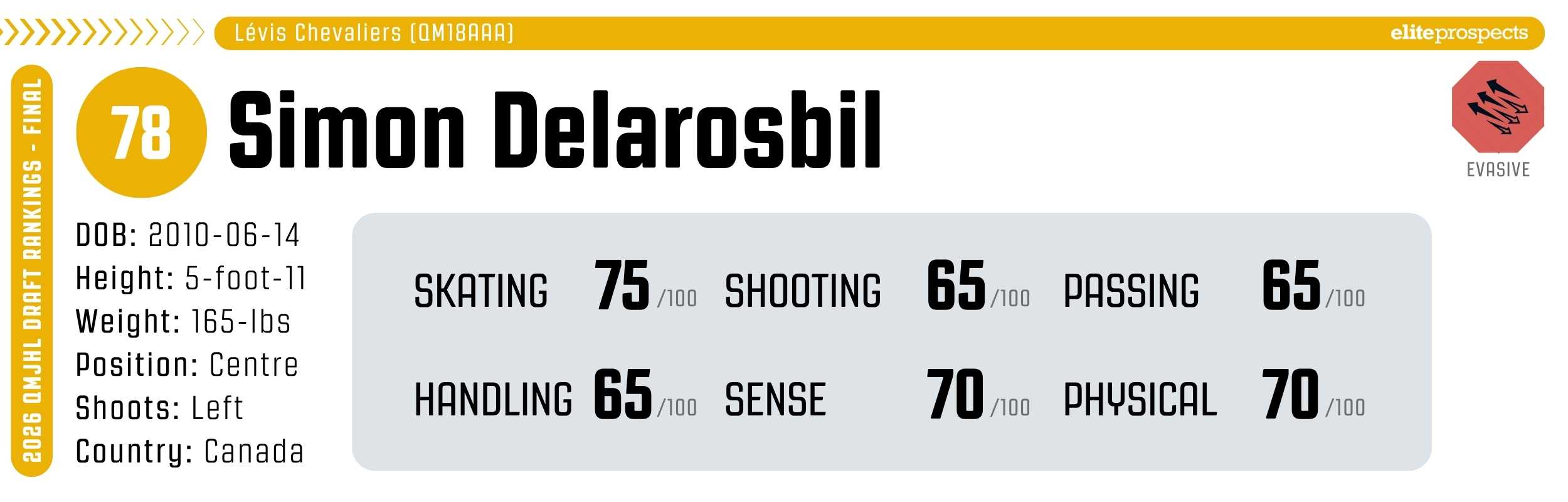
Simon Delarosbil is the type of player who impacts games through his skating, motor, and defensive habits. A fluid skater with long, powerful strides, he covers a lot of ice, pressures opponents relentlessly, and effectively recovers pucks. He is disruptive in all three zones with his constant work rate, making him particularly useful in defensive situations and on the penalty kill. While his offensive upside appears more limited, Delarosbil flashed quick processing and some encouraging puck skills. The foundation of his game is built on pace and reliability, giving him a realistic path toward earning a role in the QMJHL.
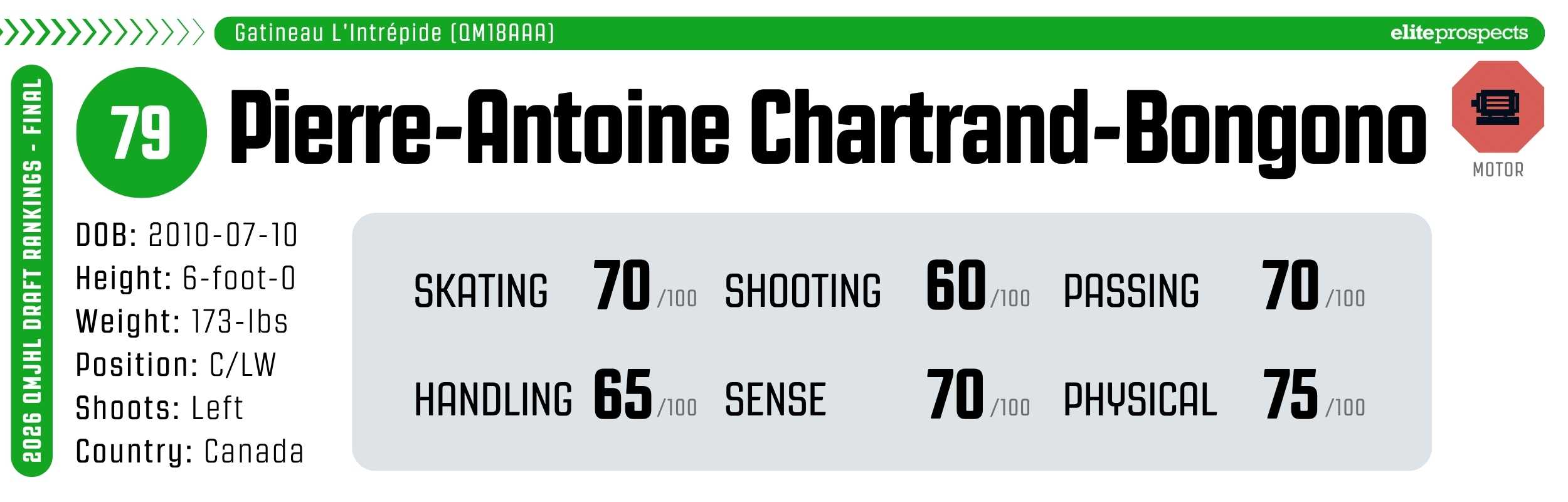
Bits and pieces of top-50-calibre elements have made Pierre-Antoine Chartrand-Bongono one of our favourite prospects in the draft cycle. The hard-working centre started off the season in a pure checking role before showing tremendous playmaking growth throughout the QMJHL Cup, initiating scissor plays before layering backdoor fakes into trailer feeds and working first-touch dishes off the wall. He pins opposing defencemen twice his size with flashes of high-end contact skills and offers enough straight-line speed to disrupt breakouts on the forecheck. While his game is unrefined mechanically and he could use some consistency in his precision across the offensive spectrum, he projects well to the QMJHL in a checking-line role. In the right development, he could bank on his playmaking to become a reliable middle-six creator.
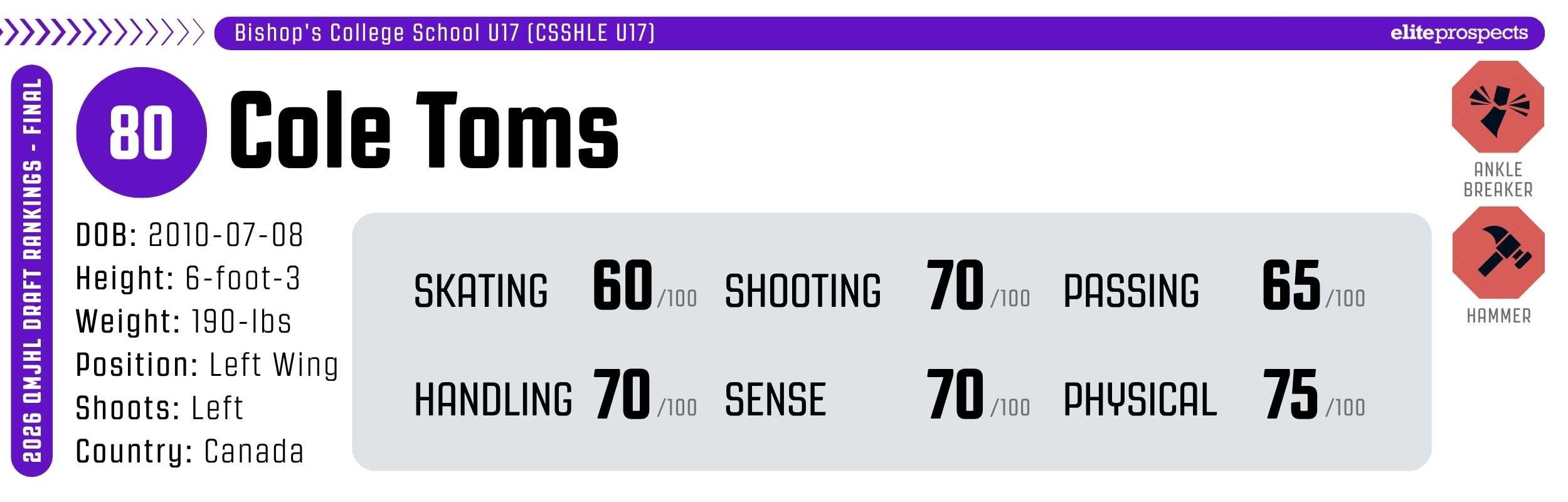
The mix of skill and power in Cole Toms’ game is going to provide great mid-round value to the QMJHL team that selects him. Though both sides of the coin are raw and lack refinement, he has a solid foundation of puck-moving and protection alongside pass-receptive offensive positioning and some pace. He’s eager to hit any unsuspecting victim with his 6-foot-3 frame, though the strength to withstand his own contact is still a work in progress. He’s already strong at protecting the puck as he wheels through the zones, though, and he’s generally efficient at making those transitions into scoring chances through shots or passes. With flashes of on-puck evasiveness in his best moments, Toms could become a decent power forward in the Q.
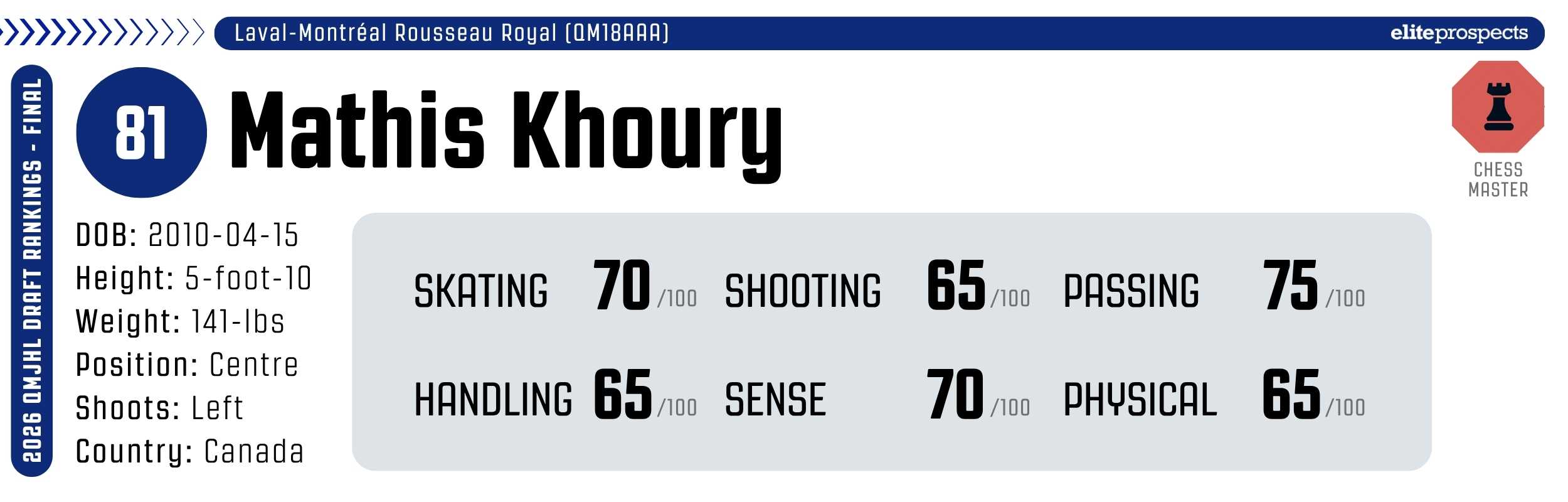
In moments this season, Mathis Khoury looked like a B-grade prospect. A crafty playmaker with some highly supportive habits, Khoury seeks to create advantages in all three zones through his positioning. Low support on exits allows him to offer easy outlets for pressure, and he quickly connects with his wingers off the catch. In transition, he spaces himself well, readying himself to catch pucks in stride and drive at defenders. Since he lacks the mechanical refinement to overwhelm defenders, he has effectively perfected the delay-and-pass sequence, drawing defenders in the high slot before slipping passes to teammates as they exploit the gaps he creates. He’ll need to add explosiveness and power to help support his intelligent playmaking, but if he develops those elements, he could be a capable middle-six, pass-first centre.
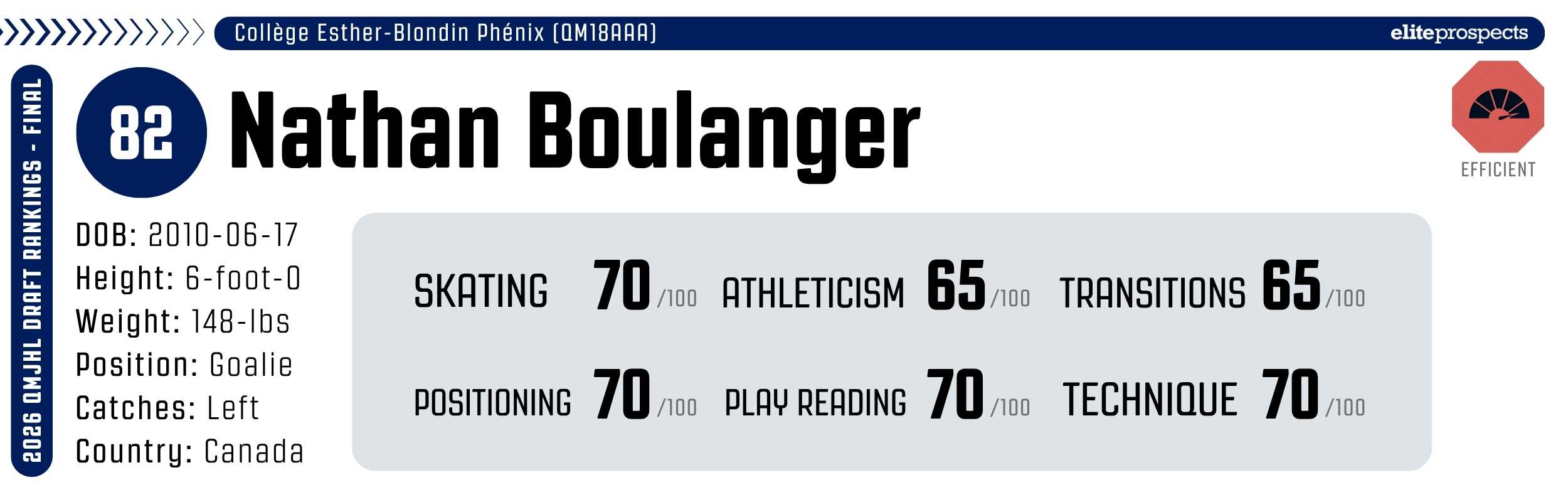
Raw in some respects, Nathan Boulanger’s game has a strong, projectable baseline to build on. The six-foot netminder is an effective skater, with strong edgework to follow play effectively and quickly. Boulanger is also a strong tracker and play reader, scanning and using those reads to inform changes in angle to respond to passing threats. Boulanger also challenges well, keeping his hands engaged and out to cut down on the angle further. The big areas for improvement will be his screen play, trusting himself more to hold his depth under pressure, and his explosiveness. Already with great edgework, explosiveness should come along with additional weight and strength training to his underdeveloped frame. More emphasis on looking around as opposed to trying to stare over screens would serve him better moving forward. All in all, Boulanger toes the line between a starting goaltender and tandem projection.
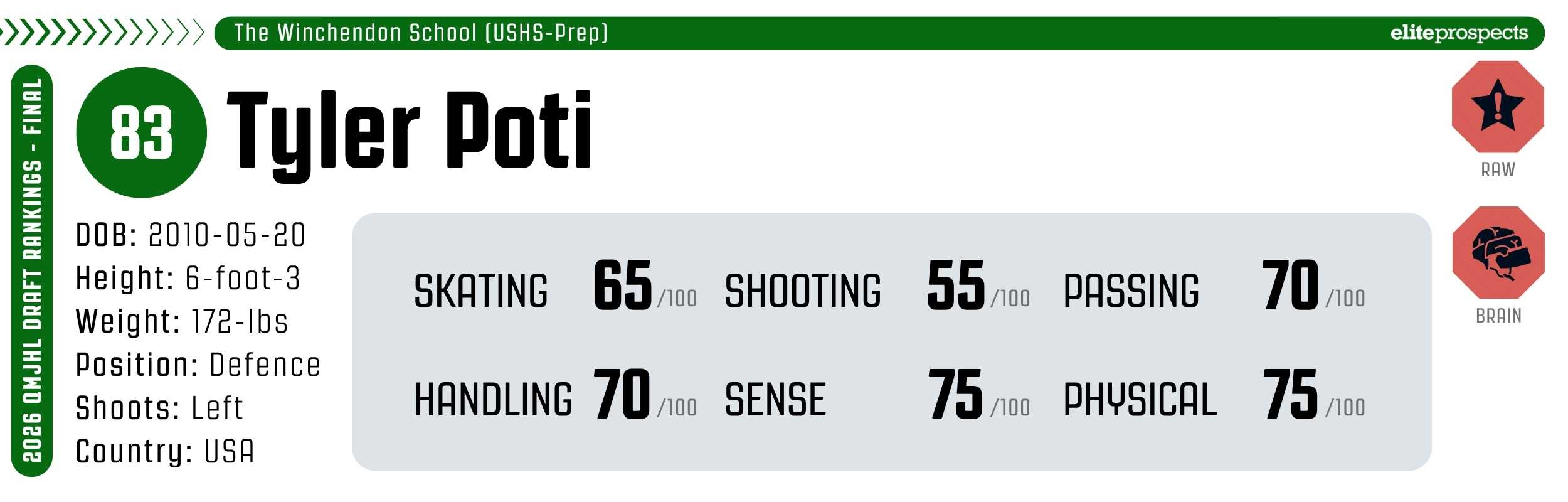
Tyler Poti plays a step ahead of everyone else. A big, left-shot 6-foot-3 defenceman, Poti reads coverage and passing lanes extremely well, and that intelligence shows most on the breakout. He calmly retrieves pucks, shrugs off forecheckers with his frame, and always seems to master the first pass through pressure, whether it’s a saucer over sticks or angled off or around the boards to the first outlet. The skating is what holds him back; his stride lacks explosiveness, and he can get loose with the puck in tight. Poti’s sense buys him time, even if his feet currently don’t. Because of his frame, it’s much easier to see a projection as an effective bottom-pairing defender in the QMJHL, with room to climb through skating growth.
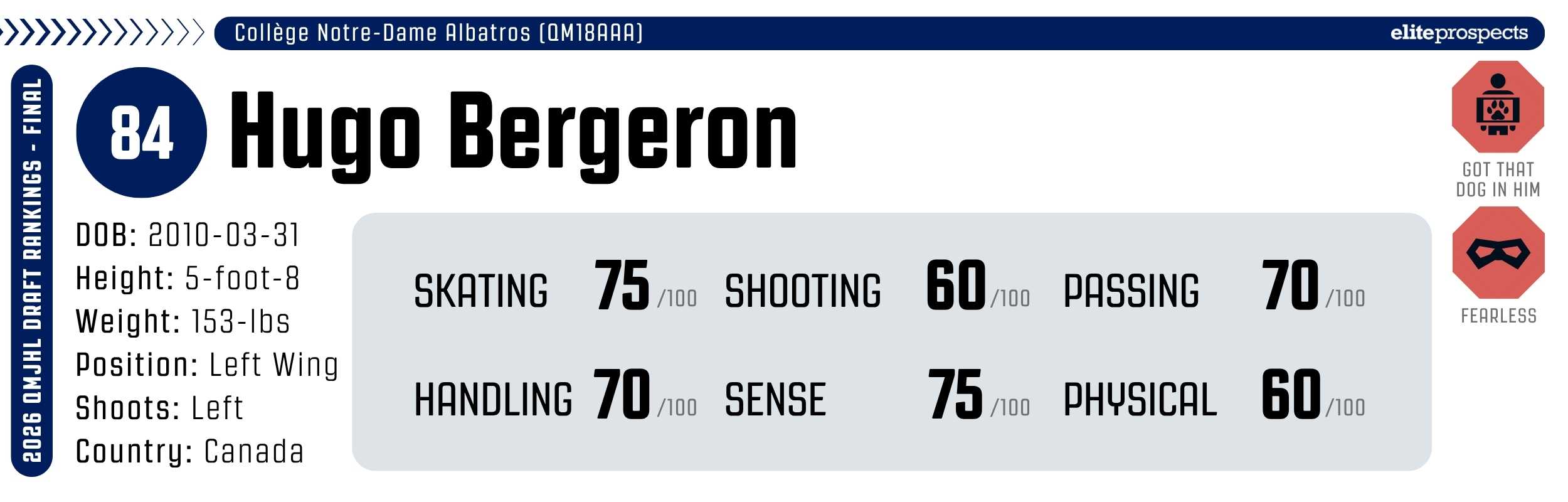
We have a soft spot for Hugo Bergeron. A contagiously industrious winger who never backs down from a single battle, Bergeron does everything at the highest pace he can muster. He forechecks incessantly, never letting up as opposing carriers try to shift across him and access open ice. He backchecks just as hard, disrupting delay attempts by keeping his feet and stick engaged. He attacks with just as much effort, driving in straight lines through the neutral zone to win races to space and quickly finding the next play before driving the net. With his style at his size, he’d have to be a pretty special physical player to crack the top 50, and he isn’t quite there. While his work rate, skating mechanics, and skill base as a connective playmaker offer a good foundation for scalability, his upside and effectiveness are in question. Still, he’ll get drafted in the top 100 and likely develop into a very likable third-line checker.
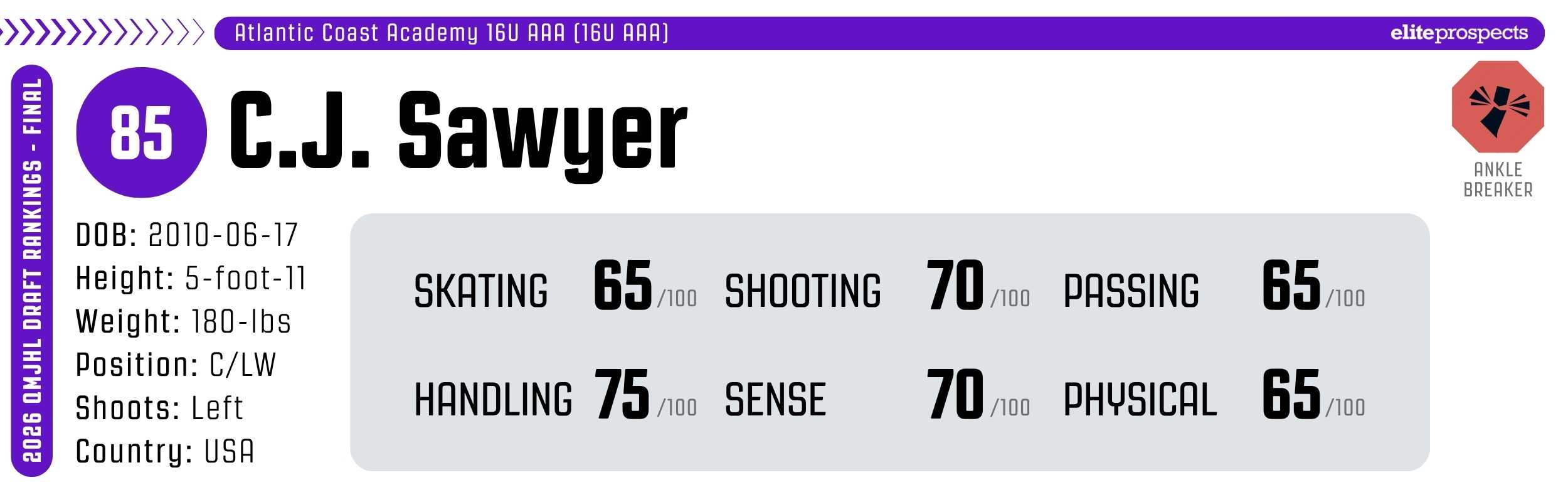
C.J. Sawyer is a problem-solver with the puck. A detail-oriented forward with creation tools, he threads passing plays with his head as much as he does with his hands. He slows the game down, confusing defensive structures with shoulder and head fakes, and finding passing seams that simply don’t seem realistic, especially as a distributor on the man-advantage. The two-way habits are usually present; he’s responsible on the penalty kill and dependable on the backcheck. The next step is to add more offensive layers and a higher pace to his game, along with leaning into finishing instead of always leaning on others – it will only elevate his stock and sharpen up his game as the speed rises. Sawyer could definitely carve a path as a middle-six complementary piece in the QMJHL if his development all goes his way.
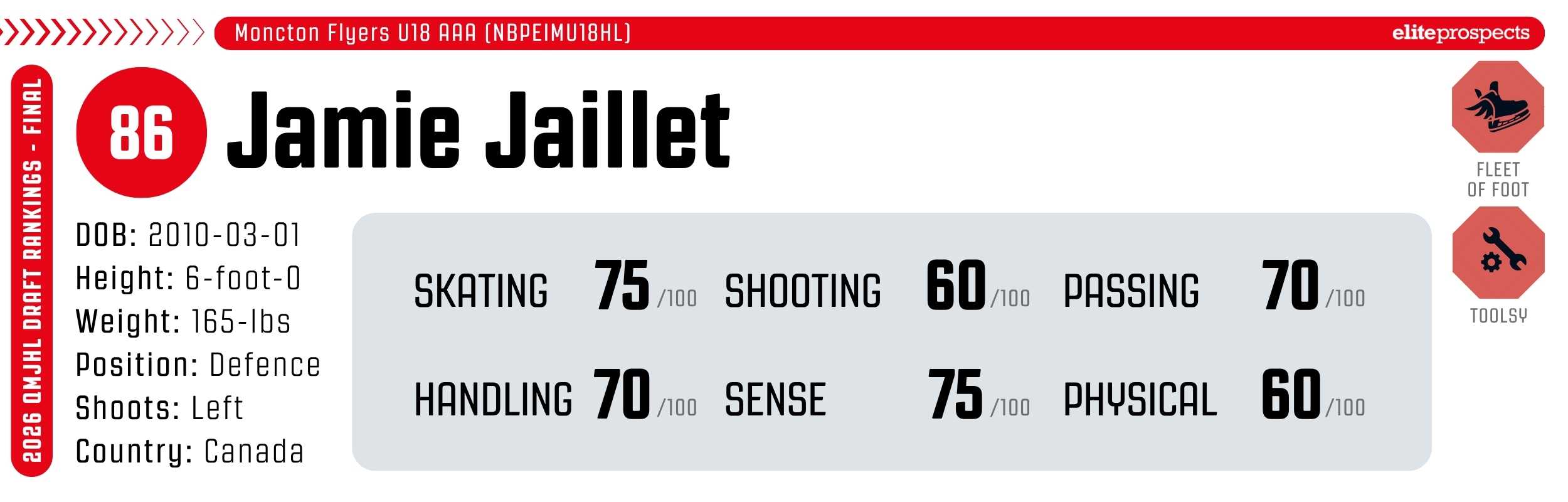
Jamie Jaillet’s expansive toolbox makes him a sort of defensive chameleon, his game taking on different shades in the many distinct situations we’ve watched him play in this season. He looked like a pure puck-rover at the QMJHL Cup Atlantic in October, showed more offensive daring through the season with the Moncton Flyers in the New Brunswick/PEI U18 league, and brought increasingly refined physical skills to the final QMJHL Cup leg in Shawinigan in April. His strong puck-retrieval game has been a constant with his heads-up play and high-end skating, the latter of which extends to his defensive play on the transition. This will be the foundation of Jaillet’s scaled-up game; what’s left to be determined is what else will come with it.
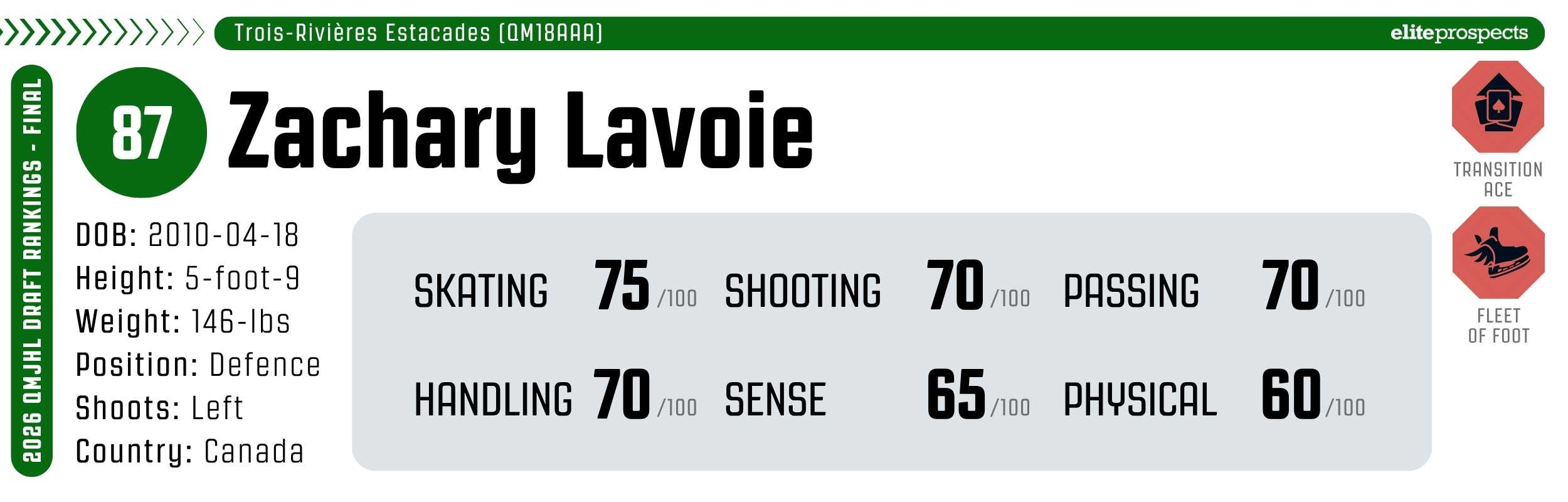
Strong puck-moving tools make Zachary Lavoie an easy add to our late board. Highly manipulative in transition, he draws opponents into passing lanes with hip fakes before exploding into the gaps they leave, facilitates entries through first-layer-beating backhand dekes, and uses toe fakes along the wall on dump-in retrievals. He offers an above-average baseline of skill, without a particularly clear standout among his skating, shooting, passing, and handling. He’ll need to get more precise in his reads and add execution speed to make his game at both ends work in the QMJHL, and his physical limitations keep him from having a stable B game as a rush defender, but the upside as a potential second-pair, top power play defenceman is enticing.
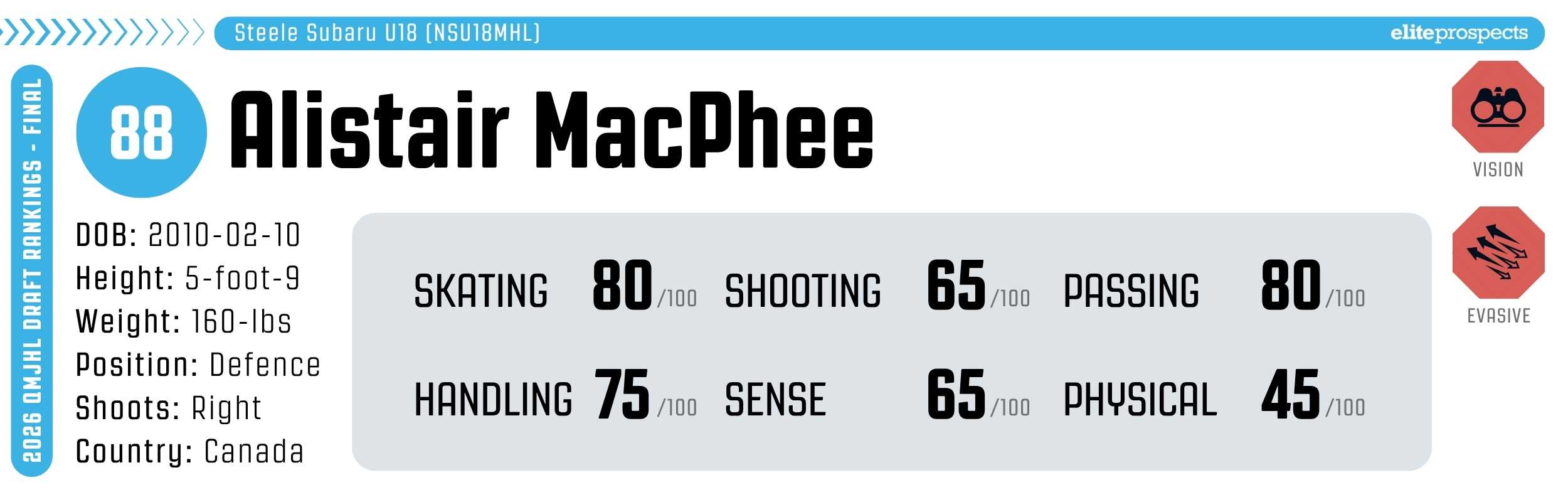
When Alistair MacPhee is comfortable, he is an incredibly poised and commanding defenceman. We first saw it in his final stretch in the Nova Scotia U15 league at the end of last season, playing a proactive and high-paced game with defensive returns in droves and some offensive-zone benefits from the point. Our scouts saw this ease in his game once again at the Montréal Meltdown in May, where he held his own defensively when playing against competition two years his senior. MacPhee projects as a sound stay-at-home option with his sound puck-moving abilities and the ability to shut down entries at the line with positioning and smarts, impressively effective at his 5-foot-9 stature when he’s rolling. Playing with consistent confidence will be the key to becoming a full-time QMJHLer.
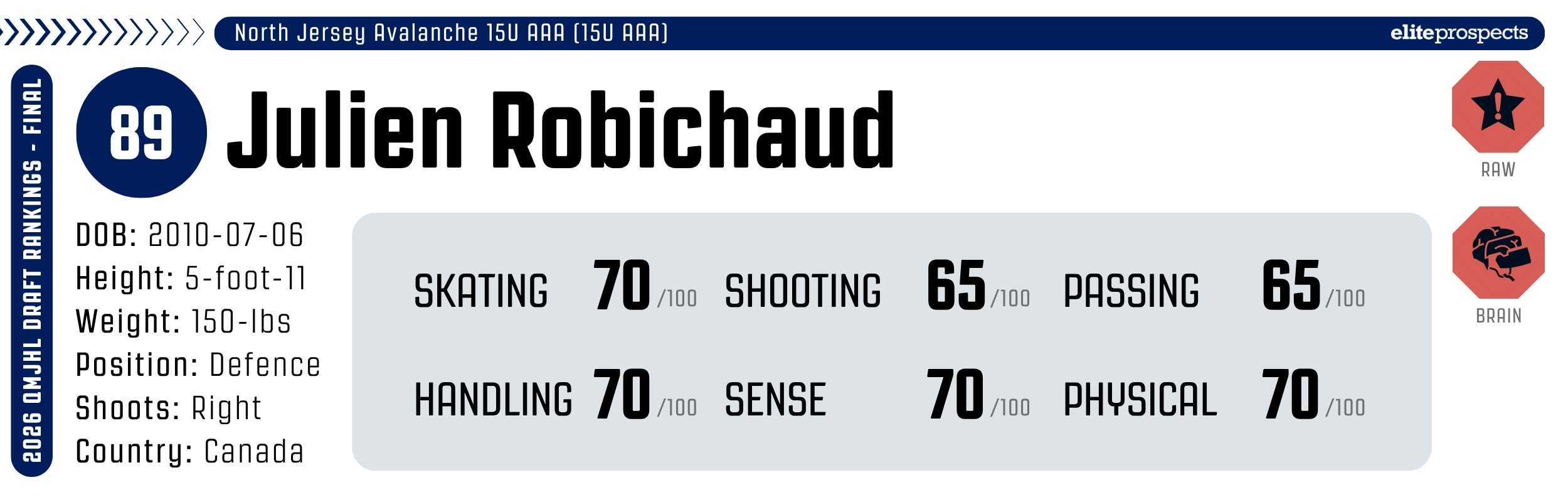
Julien Robichaud has a lot of the building blocks required to play a two-way game in the QMJHL. Poised and steady from the back end, he stays inside structure, relying on his reads to identify cues to detach from his spot and intercept carriers along the wall. In possession, he underhandles pucks, quickly setting up breakout passes through middle lanes. In flashes, he can beat layers with his hands to access the neutral zone himself, mostly in moments where his confidence is soaring. He’ll need to add urgency to his game as he develops; poise under pressure is a separating tool at this level, but mixing in more aggressive rush defending to force opponents to the outside is the next step in his development. The base of sense and tools with Robichaud is high, which leads us to believe he has the necessary components to develop that urgency and be a bottom-three defenceman on his team.
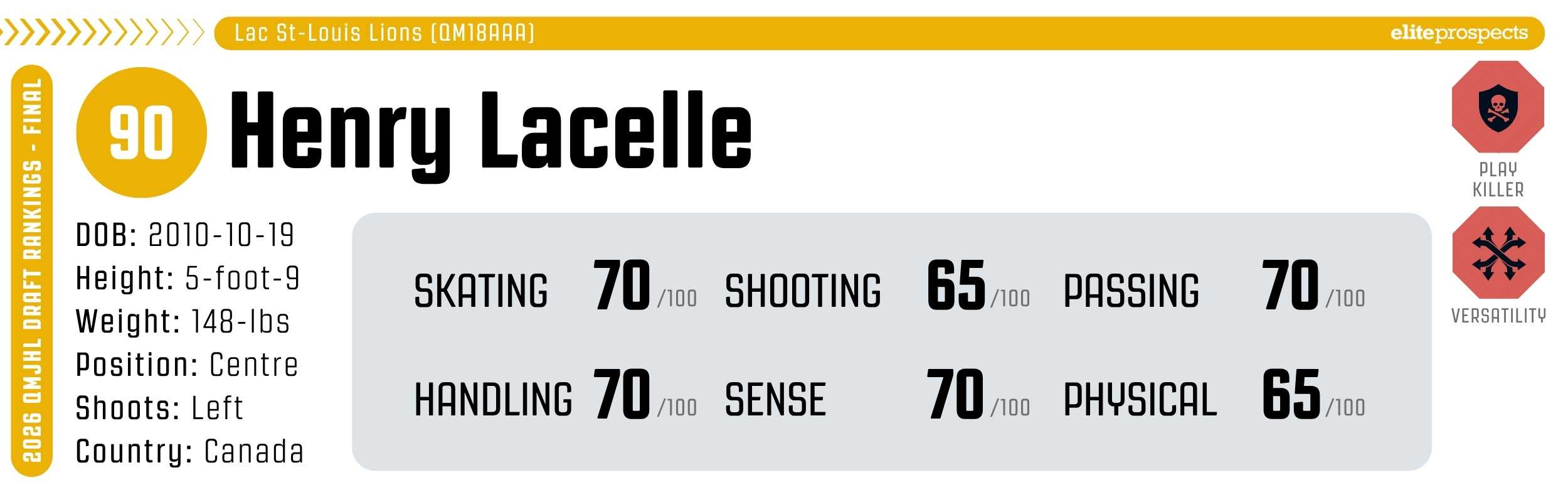
A defensive specialist with budding offensive skill, Henry Lacelle has shown impressive growth throughout the year while retaining his core identity as a suppressor. Spending the vast majority of his ice time above the puck, Lacelle offers constant positional support, reloading high in the offensive zone to trigger his defencemen to push down the wall. In his own zone, he gives defencemen easy outlets with low support, and his scanning allows him to deal with pressure on his back from those positions. His skill grew incrementally throughout the season, as he started leveraging those above-the-puck positions to catch pucks in motion, deke layers to the inside, and find medium-difficulty plays instead of settling for the simplest outlets. He needs to continue that progression while adding power and explosiveness, but projects well as a complementary producer with shutdown impact.
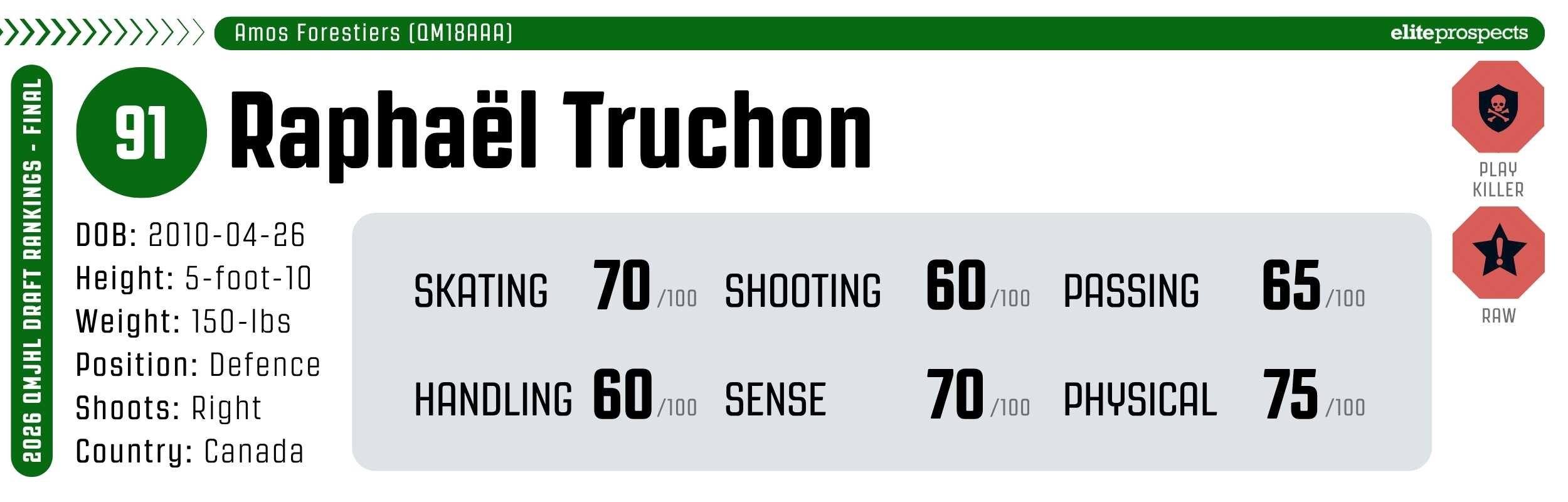
Raphaël Truchon took some time to land on our radar, but by the end of our season, he had us sold on his top-100 value. An engaged and active blue-liner with two-way value, Truchon pushes up offensively through weak-side activations, joining linear entries by stepping out of the dot lane towards the middle as the trailer. When plays go south, he has the recovery speed to often get back before opponents do, and from there, he defends with aggression. A sturdy wall-sealing game is supported by strong reads, as he quickly picks up on carriers’ intentions and cuts them off. His edgework to change directions could improve, as he often lacks the explosiveness to deal with sudden middle cuts off the wall, and if he adds that, he’ll only get more projectable as a bottom-pair suppressor in the QMJHL.
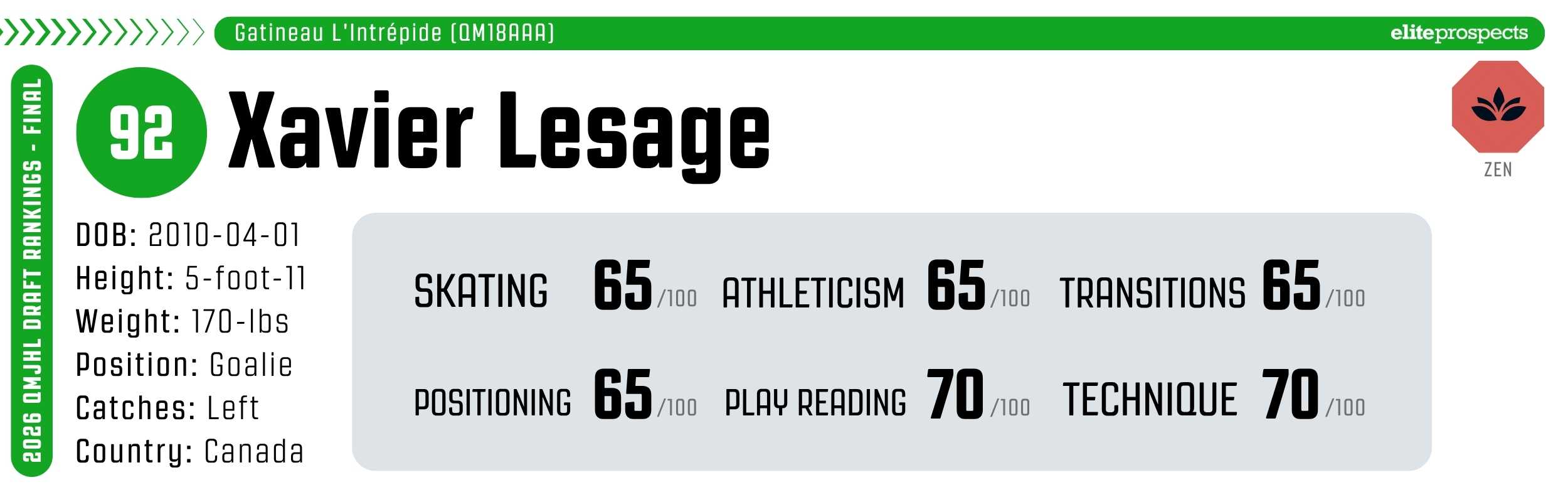
Playing for one of the worst U18 teams in Québec, it's pretty obvious to see that Xavier Lesage is not one of the contributing factors to that. Lesage is a jack of all trades, master of none archetype who lacks a true weakness. He has solid edgework, decently quick feet, some sneaky flexibility, and power at times. Though his best qualities would come in his composure and anticipation. He stays extra calm under intense chaos with exceptional body control. He is also constantly scanning the play and seemingly is predicting it as he is always quick to pucks with early eyes and rapid reactions. He may lack the dynamic raw talent that would give him the high-quality upside that the others have above him, but his reliability and all-around skillset give him a good chance at being a tandem.
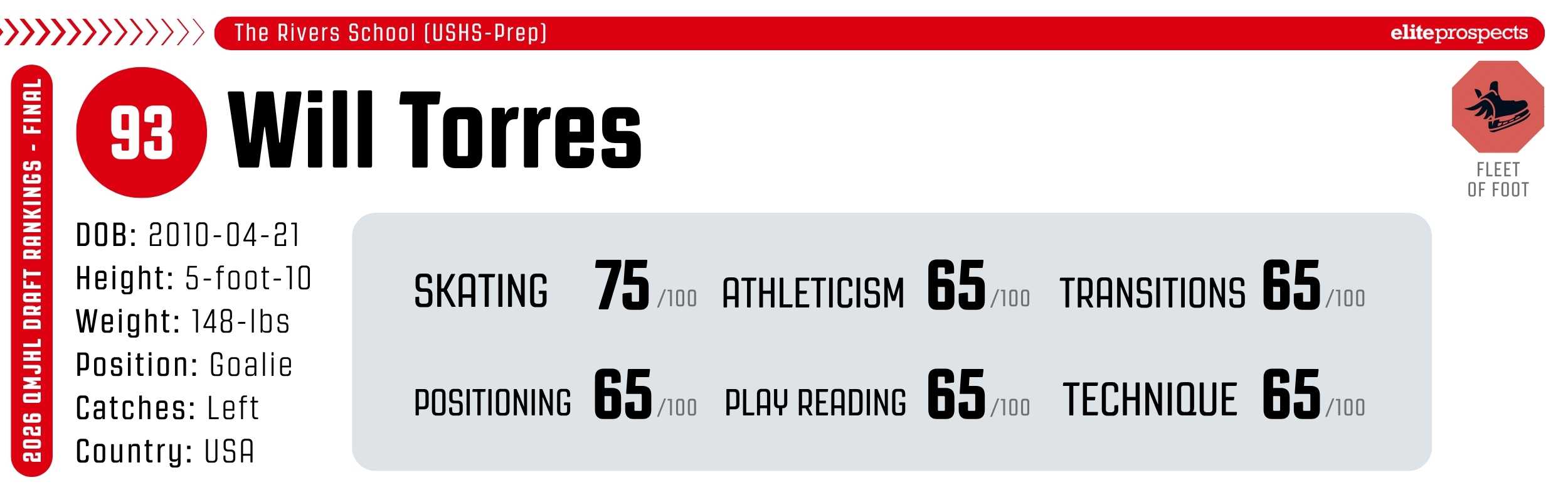
Whether with the Minuteman Flames or The Rivers School, Will Torres has been stringing together impressive performances. Leveraging his skating chops and great positional awareness, Torres challenges and cuts off the shooting angle much better than most of his size. His positional smarts extend to his route selection, cutting down on the time it takes to get back in position. Another ability that teams will surely latch onto is his stamina, with a 46-save performance against Little Caesars in October and a 59-save game against Bishop Kearney at US 15U Nationals. What will be integral to getting Torres to the level of a starting goaltender is improving his reads by leveraging his scans more, and perhaps scanning as two-on-ones break into the zone, allowing him to better anticipate passing options rather than challenging shooters every time. Torres looks like a possible tandem-calibre goaltender.
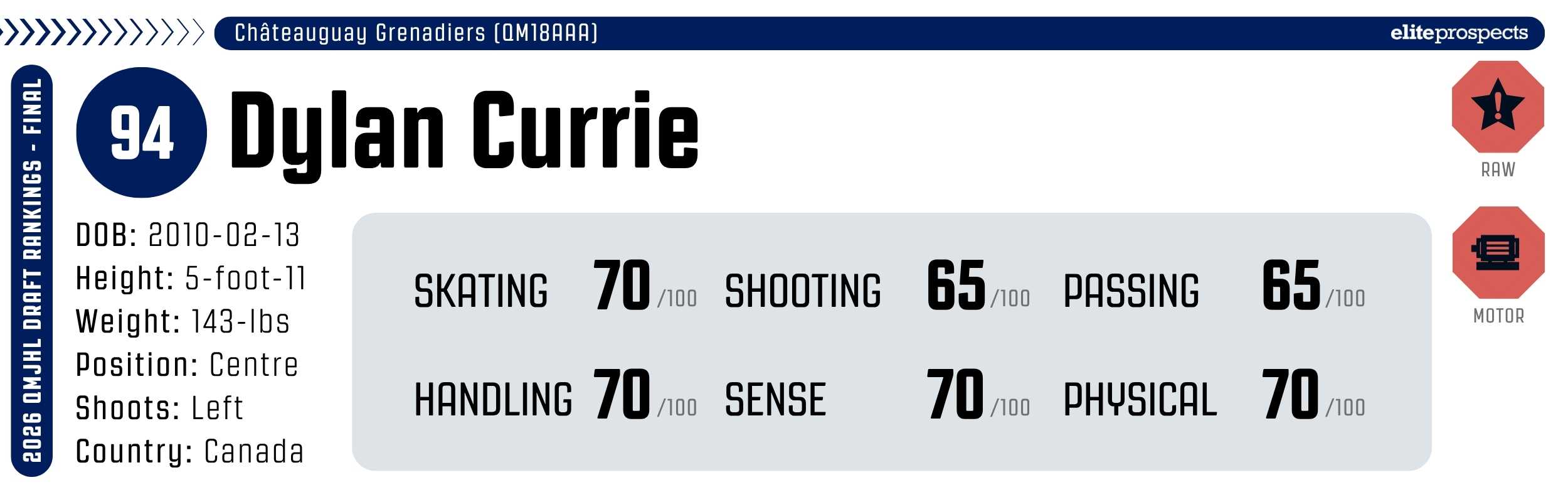
A positionally sound centre with mature habits, Dylan Currie is always looking for advantages to exploit. When opposing defencemen activate, he stays primed for quick counter-attacks and bursts out as soon as he gets an opening. His skill as a positional scorer shone at the QMJHL Cup, where he often exploited gaps in coverage to sneak down the weak side or into the slot for high-danger shots off of seam passes. While he shows glimpses of offensive scalability, such as crossover attacks in transition and quick cycle passing, Currie will need to add muscle and diversify his offence to create better looks at the QMJHL level. For now, he projects as a smart and reliable two-way forward with third-line upside.
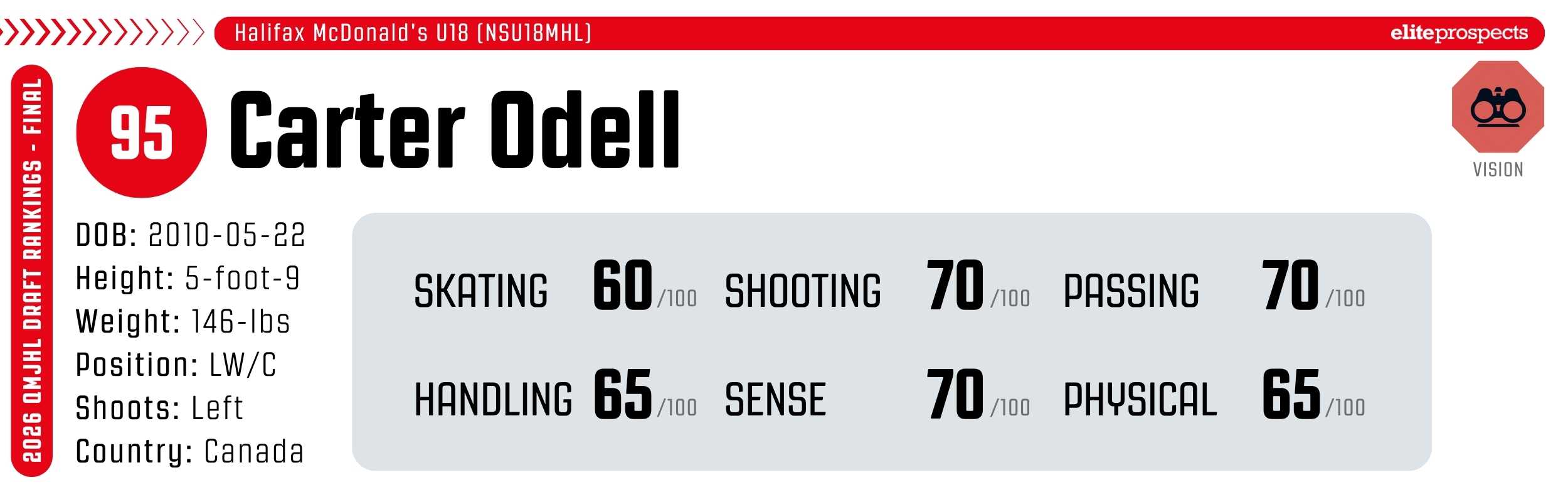
All season, Carter Odell has been the best pure-pace player in this East Coast class. A dominant bantam scorer – our team’s first impression was a six-goal game – he had that same scoring touch against his peers at the QMJHL Cup Atlantic, but it’s the evolution of his details to become an effective support player on a stacked Halifax U18 team that has impressed. He’s always down for a puck battle, regardless of size mismatch, and he has some hard-nosed skill to create from down low. Odell’s habits fit the key demographic of undersized forwards who win trust and opportunities with their all-around willingness and two-way upside. In the right environment, he could be a draft steal in the making.
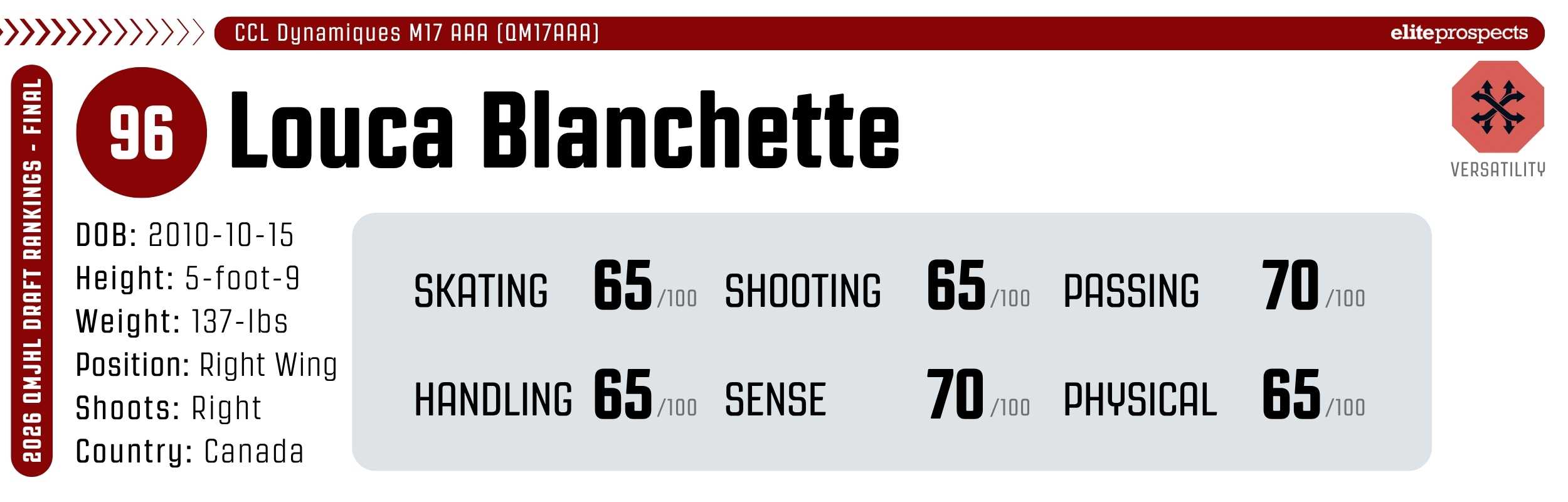
An energetic and physical winger, Louca Blanchette does most of his damage with his motor. He attacks in straight lines, forces defencemen to back off the line in transition, and crashes the net with intent. To support that north-south game, Blanchette brings clever flashes of inside playmaking, using stop-ups and cutbacks to slip pucks into pockets for teammates to pick up in stride. He handles the boards well, offering good counterweight and seal-off skill when dealing with aggressive defenders, and punishing passive ones with instant connective passing off the wall. While his skill and poise need to take a step to keep him effective as a cycle creator, his identity as a connector and facilitator with crash-and-bang value offers a clear QMJHL path as a bottom-six forward.
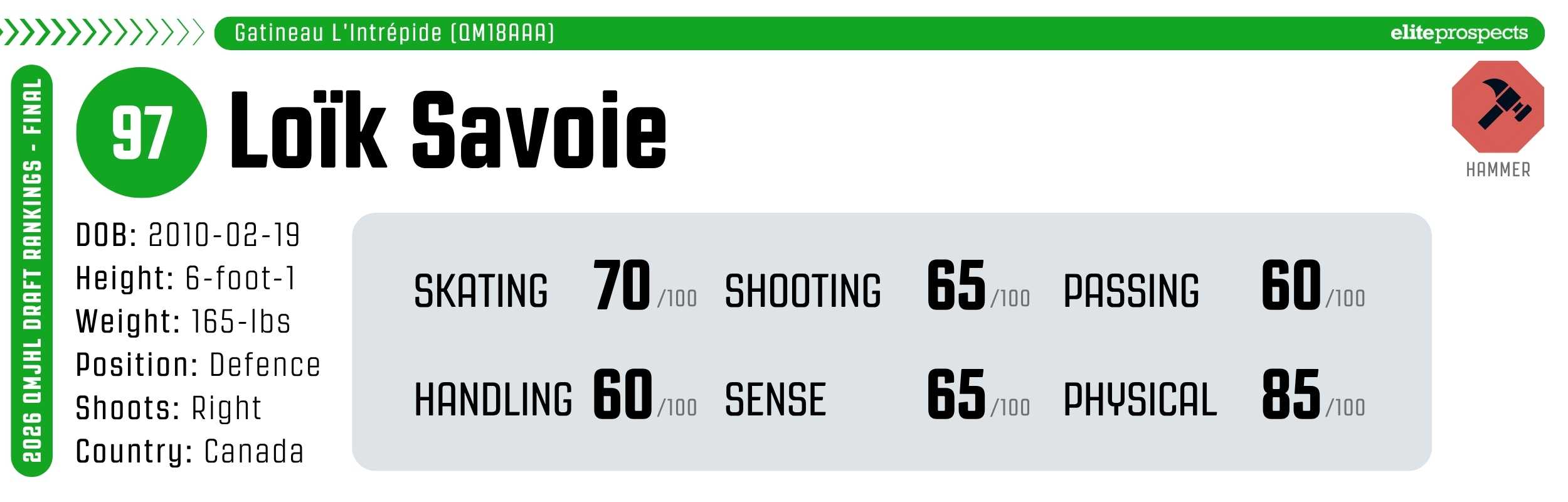
Loïk Savoie wakes up every day and chooses violence. A punishing blue-liner with the frame to back it up, Savoie crushes and hacks through opposing wingers as they protect the puck down low, and makes the net front an absolute nightmare. His rush defending is just as aggressive, as he steps up on carriers with his range fully extended, guides them across the ice to the wall, and squares them up for massive hits along the wall. With the puck, he keeps things simple, underhandling pucks and chipping them up the wall for teammates to pick up. While his mobility could use a step, he has straight-line speed through powerful strides that help him manage gaps relatively well. He won’t score a ton, but he’ll be a crusher in a depth capacity with value as an insulator.
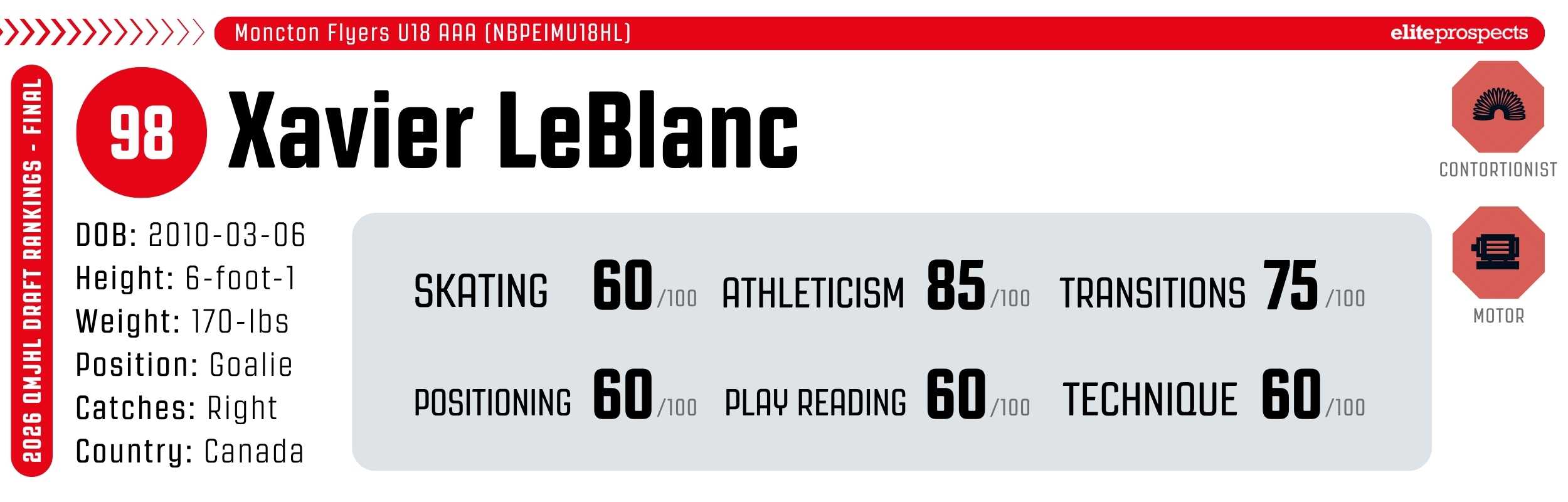
After a disappointing performance at the Atlantic leg of the QMJHL Cup, Xavier LeBlanc was nearly completely written off. But LeBlanc put his head down and improved more than any other goalie in this class. He has one of the best physical profiles, being extremely flexible and explosive, and stands as one of the biggest goalies in the class. But the really important aspects of him are that he has significantly overhauled his tracking, cleaned up his stance, gained more calmness and structure, and improved on his edges to pair with very quick feet. While he still can slip back into old habits in high-pressure situations, the goalie that he is now is night and day different from the one in October. It gives us optimism that he can continue this trend and use his great motor to take his development even further, potentially becoming a tandem in the QMJHL.
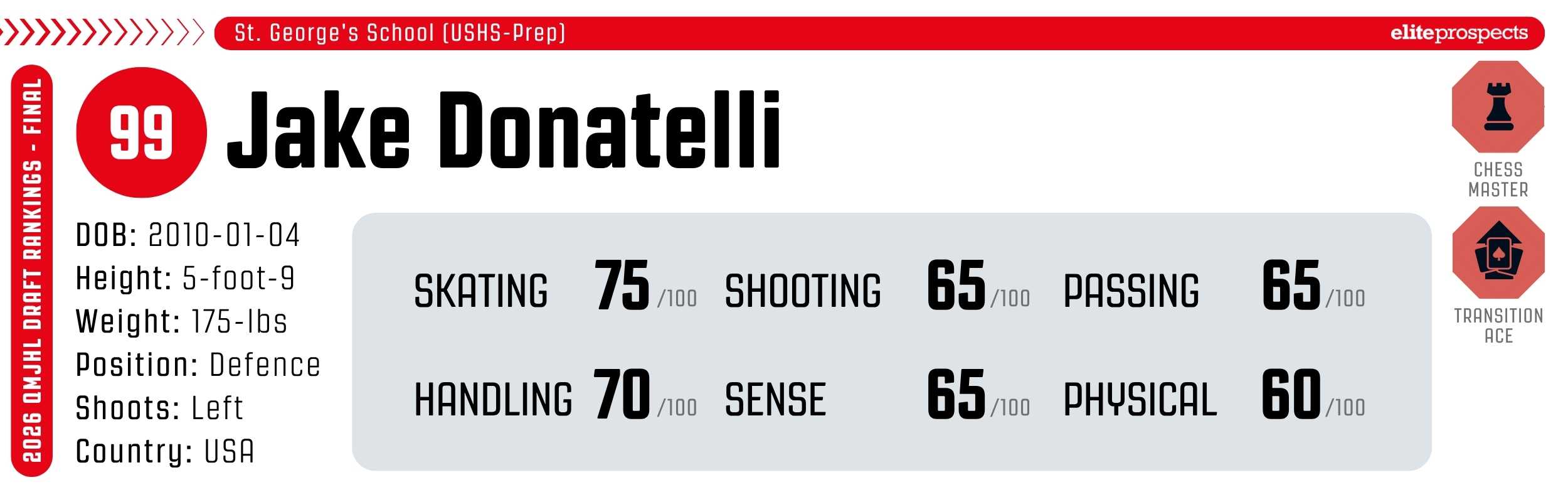
Towards the end of the year, Jake Donatelli began flashing far more manipulation skills off the rush, and it elevated both his stock and projection to the QMJHL. His puck-moving is the draw – he sells defenders forehand-to-backhand, distributes cleanly under pressure, and runs slick cross-ice and one-touch setups from the point that get his team going in the offensive zone. His skating supports it all, with easy crossovers to gain speed, and he doesn’t shy away from any battles despite his smaller frame. The defensive side is a work in progress; staying connected to the play and cycle, and tightening his positioning and gap will decide how he can become an every-game, puck-moving defenceman in the QMJHL. He could definitely become a fun, active middle-pairing defender if all goes right.
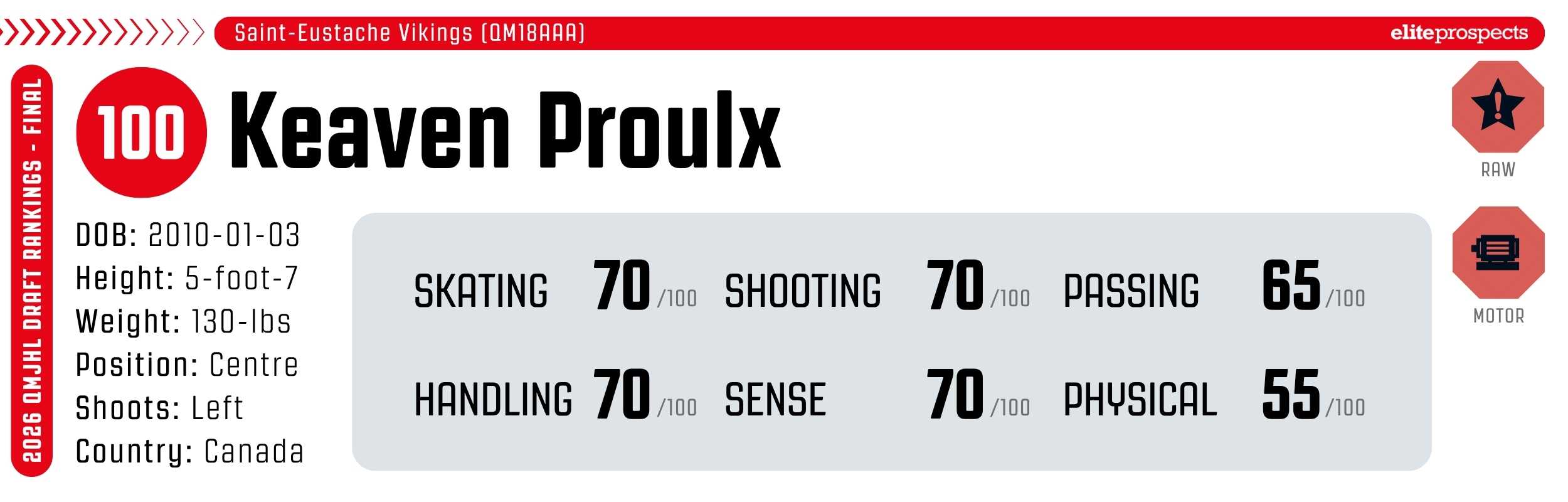
Keaven Proulx’s high-octane offensive game comes with tons of pace and flashes of playmaking skill. He drives at defensive formations with relentless effort, crashing his way through stick check attempts and threatening the middle both as a shooter and a passer. He never shies away from high-danger areas and the boards, even if his size often puts him at a disadvantage in those scenarios. He’ll need to refine his mechanics as both a skater and a handler, along with some physical development to help him become a checker, but his fearless mindset and constant engagement layer well with his offensive processing speed. He’ll need time, but he’s an investment that could pay off massively in two years in a top-nine capacity.
Honourable Mentions
Tomas Gagnon, C, Magog Cantonniers
Carter Heise, G, NV River Rats 15U AAA
Édouard Salvas, G, Saint-Hyacinthe Gaulois
Mikael Perreault, D, Collège Esther-Blondin Phénix
Zachary Renaud, G, Saint-Eustache Vikings
Aidan Graham, C, Pinnacle Growlers U18 AAA
Daniele Di Marzo, C, Laval-Montréal Rousseau Royal
Justin Cardillo, LW, Lac St-Louis Lions
Eric Hanley, RW, Valley Wildcats U18
Benjamin Art, G, Albany Academy
Brendan Martin, D, St. Sebastian's School
Jameson Needham, C, St. Sebastian's School
Owen Frick, RW, Cushing Academy
Nathan Barrett, D, Windy City Storm 15U AAA
Joseph St. Laurent, C, North Jersey Avalanche 15U AAA
Our Team
Hadi Kalakeche, QMJHL Draft Lead
Simon Desjardins, Quebec Crossover Scout
Madison Delaval, Atlantic Regional Scout
Robert Chalmers, New England Regional Scout
Liam Crouse, Goalie Scout